flat tire LEXUS RCF 2022 Owners Manual
[x] Cancel search | Manufacturer: LEXUS, Model Year: 2022, Model line: RCF, Model: LEXUS RCF 2022Pages: 412, PDF Size: 26.28 MB
Page 3 of 412

RCF_U
1
2
3
4
5
6
7
8
9
Pictorial indexSearch by illustration
For safety
and securityMake sure to read through them
(Main topics: Child seat, theft deterrent system)
Vehicle status
information and
indicatorsReading driving-related information
(Main topics: Meters, multi-information display)
Before drivingOpening and closing the doors and windows,
adjustment before driving
(Main topics: Keys, doors, seats)
DrivingOperations and advice which are necessary for driving
(Main topics: Starting engine, refueling)
Interior featuresUsage of the interior features
(Main topics: Air conditioner, storage features)
Maintenance
and careCaring for your vehicle and maintenance procedures
(Main topics: Interior and exterior, light bulbs)
When trouble
arisesWhat to do in case of malfunction and emergency
(Main topics: Battery discharge, flat tire)
Vehicle
specificationsVehicle specifications, customizable features
(Main topics: Fuel, oil, tire inflation pressure)
For ownersReporting safety defects for U.S. owners, and seat belt,
SRS airbag and headlight aim instructions for Canadian
owners
IndexSearch by symptom
Search alphabetically
Page 6 of 412
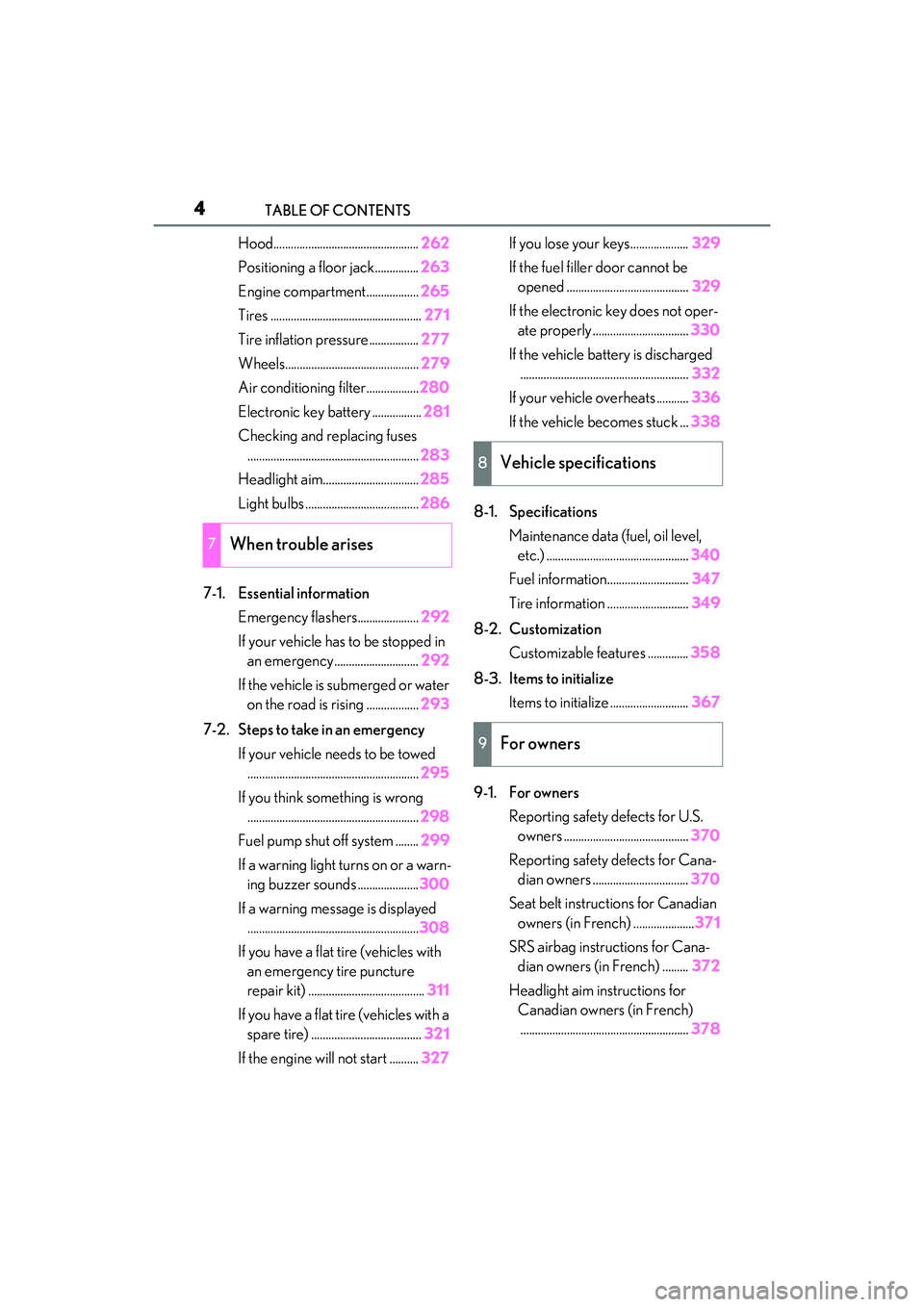
4TABLE OF CONTENTS
RC F Owner's Manual
Hood..................................................262
Positioning a floor jack............... 263
Engine compartment.................. 265
Tires .................................................... 271
Tire inflation pressure................. 277
Wheels.............................................. 279
Air conditioning filter..................280
Electronic key battery ................. 281
Checking and replacing fuses ........................................................... 283
Headlight aim................................. 285
Light bulbs ....................................... 286
7-1. Essential information Emergency flashers..................... 292
If your vehicle has to be stopped in an emergency ............................. 292
If the vehicle is submerged or water on the road is rising .................. 293
7-2. Steps to take in an emergency If your vehicle needs to be towed........................................................... 295
If you think something is wrong ........................................................... 298
Fuel pump shut off system ........ 299
If a warning light turns on or a warn- ing buzzer sounds ..................... 300
If a warning message is displayed ........................................................... 308
If you have a flat tire (vehicles with an emergency tire puncture
repair kit) ........................................ 311
If you have a flat tire (vehicles with a spare tire) ...................................... 321
If the engine wi ll not start .......... 327If you lose your keys....................
329
If the fuel filler door cannot be opened .......................................... 329
If the electronic key does not oper- ate properly ................................. 330
If the vehicle battery is discharged .......................................................... 332
If your vehicle overheats ........... 336
If the vehicle becomes stuck ... 338
8-1. Specifications Maintenance data (fuel, oil level, etc.) ................................................. 340
Fuel information............................ 347
Tire information ............................ 349
8-2. Customization Customizable features .............. 358
8-3. Items to initialize Items to initialize ........................... 367
9-1. For owners Reporting safety defects for U.S. owners ........................................... 370
Reporting safety defects for Cana- dian owners ................................. 370
Seat belt instructions for Canadian owners (in French) ..................... 371
SRS airbag instructions for Cana- dian owners (in French) ......... 372
Headlight aim instructions for Canadian owners (in French).......................................................... 378
7When trouble arises
8Vehicle specifications
9For owners
Page 15 of 412

13Pictorial index
RC F Owner's Manual
Windshield wipers .................................................................................................. P.143
Precautions for winter season .....................................................................................P.203
To prevent freezing (windshield wiper de-icer)
*.................................................. P.215
Precautions against car wash ...................................................................................... P.240
Fuel filler door ..........................................................................................................P.150
Refueling method .............................................................................................................. P .150
Fuel type/fuel tank capacity .......................................................................................... P.341
Tires.......................................................................................................................... ... P.271
Tire size/inflation pressure ............................ ............................................................... P.345
Winter tires................................................................................................................... .......P.203
Checking/rotation/tire pressure warning system................................................ P.271
Coping with flat tires................................................................................................. P.311, 3 21
Hood ..........................................................................................................................P .262
Opening ........................................................................................................................ ....... P.262
Engine oil ..................................................................................................................... .......... P.341
Coping with overheating ............................................................................................... P.336
Warning messages ......................................................................................................... P.308
Active rear wing
*.................................................................................................... P.195
Headlights .................................................................................................................P.13 8
Parking lights/daytime running lights................ ...............................................P.138
Turn signal lights ...................................................................................................... P.136
Side marker lights ...................................................................................................P.138
Tail lights .................................................................................................................... P.138
Stop lights
License plate lights .................................................................................................P.138
Back up lights
Shifting the shift lever to R .............................................................................................. P.13 3
*:If equipped
Light bulbs of the exterior lights for driving(Replacing method: P.286, Watts: P.346)
D
E
F
G
H
I
J
K
L
M
N
O
Page 57 of 412

551-3. LEXUS Enform
RC F Owner's Manual
1
For safety and security
Connect service not active
■Automatic Collision Notification
In case of either airbag deployment or
severe rear-end collision, the system is
designed to automatically call the
response center. The responding agent
receives the vehicle’s location and
attempts to speak with the vehicle
occupants to assess the level of emer-
gency. If the occupants are unable to
communicate, the ag ent automatically
treats the call as an emergency, con-
tacts the nearest emergency services
provider to describe the situation, and
requests that assistance be sent to the
location.
■Stolen Vehicle Location
If your vehicle is stolen, Safety Connect
can work with local authorities to assist
them in locating and recovering the
vehicle. After filing a police report, call
the Safety Connect response center at
1-800-25-LEXUS
(1-800-255-3987) in the United
States, 1-877-539-8777 in Puerto
Rico or 1-800-265- 3987 in Canada,
and follow the prompts for Safety Con-
nect to initiate this service.
In addition to assisting law enforce-
ment with recovery of a stolen vehicle,
Safety-Connect-equipped vehicle
location data may, under certain cir-
cumstances, be shared with third par-
ties to locate your vehicle. Further
information is available at Lexus.com.
■Emergency Assistance Button
(“SOS”)
In the event of an emergency on the
road, push the “SOS” button to reach
the Safety Connect response center.
The answering agent will determine
your vehicle’s location, assess the
emergency, and dispatch the neces-
sary assistance required.
If you accidentally press the “SOS” button,
tell the response-center agent that you are
not experiencing an emergency.
■Enhanced Roadside Assistance
Enhanced Roadside Assistance adds
GPS data to the already included war-
ranty-based Lexus roadside service.
Subscribers can press the “SOS” but-
ton to reach a Safety Connect
response-center agent, who can help
with a wide range of needs, such as:
towing, flat tire, fuel delivery, etc. For a
description of the Roadside Assistance
services and their limitations, please
see the Safety Connect Terms and
Conditions, which are available at
Lexus.com.
Important! Read this information about
exposure to radio frequency signals
before using Safety Connect;
The Safety Connect system installed in
your vehicle is a low-power radio trans-
mitter and receiver. It receives and also
sends out radio frequency (RF) signals.
In August 1996, the Federal Commu-
Safety Connect services
Safety information for Safety
Connect
Page 79 of 412

772-1. Instrument cluster
RC F Owner's Manual
2
Vehicle status information and indicators
■Tire pressure
●It may take a few minutes to display the
tire inflation pressure after the engine
switch is turned to IGNITION ON mode.
It may also take a few minutes to display
the tire inflation pressure after inflation
pressure has been adjusted.
●“---” may be displayed if the tire position
information cannot be determined due to
unfavorable radio wave conditions.
●Tire inflation pressure changes with tem-
perature. The displayed values may also
be different from the values measured
using a tire pressure gauge.
■Lap timer
Measures and displays current lap time
and previous lap times
Reading the display
Measured lap times since the timer was
last reset are displayed as follows:
• Content display area
Total lap time
Past lap times
Fastest lap (marked with a star)
• Sub-content display area
Current lap time
Most recent lap time
Operating the meter control
switches
Press: Start/stop lap timer
Press and hold: Reset : Mark off one lap: Change displayed content
While a lap time is being measured, the
display can be changed to show the follow-
ing content:
• Torque distribution (if equipped)
•G-force
• Tire pressure
• Rear wing position
Resetting/saving measured lap
times
After stopping the lap timer, press and hold
.
When a confirmation sc reen is displayed,
“F” content
A
B
C
A
B
A
B
Page 125 of 412

1234-1. Before driving
RC F Owner's Manual
4
Driving
NOTICE
●Do not use the accelerator pedal or
depress the accelerator and brake
pedals at the same time to hold the
vehicle on a hill.
■When parking the vehicle
●Always set the parking brake and shift
the shift lever to P. Failure to do so may
cause the vehicle to move or the vehi-
cle may accelerate suddenly if the
accelerator pedal is accidentally
depressed.
●Vehicles with titanium mufflers: Be
careful when parking in a parking spot
with anything protruding from the sur-
face, such as a multi-level parking sys-
tem, as the protruding area may
contact and damage the muffler.
■Avoiding damage to vehicle parts
●Do not turn the steering wheel fully in
either direction and ho ld it there for an
extended period of time. Doing so may
damage the power steering motor.
●When driving over bumps in the road,
drive as slowly as possible to avoid
damaging the wheels, underside of the
vehicle, etc.
●Vehicles with titanium mufflers: As the
vehicle’s ground clearance is low,
when driving over bumps or areas
where the road height changes, drive
as slowly as possible to avoid damag-
ing the muffler.
■If you get a flat tire while driving
A flat or damaged tire may cause the fol-
lowing situations. Hold the steering
wheel firmly and gradually depress the
brake pedal to slow down the vehicle.
●It may be difficult to control your vehi-
cle.
●The vehicle will make abnormal
sounds or vibrations.
●The vehicle will lean abnormally.
Information on what to do in case of a flat
tire (
P.321, 311)
■When encountering flooded roads
Do not drive on a road that has flooded
after heavy rain etc. Doing so may cause
the following serious damage to the vehi-
cle:
●Engine stalling
●Short in electrical components
●Engine damage caused by water
immersion
In the event that you drive on a flooded
road and the vehicle is flooded, be sure
to have your Lexus dealer check the fol-
lowing:
●Brake function
●Changes in quantity and quality of oil
and fluid used for the engine, transmis-
sion, differential, etc.
●Lubricant condition for the propeller
shaft, bearings and suspension joints
(where possible), and the function of
all joints, bearings, etc.
■Precaution for CCB (Carbon
Ceramic Brake) discs (if equipped)
Be careful not to subject the CCB discs
to any kind of strong impact.
Even if there is no obvious damage, in the
following situations, have the vehicle
inspected by your Lexus dealer:
Page 143 of 412

1414-3. Operating the lights and wipers
RC F Owner's Manual
4
Driving
out its headlights turned on is detected.
●House lights, street lights, traffic signals,
and illuminated billboards or signs and
other reflective objects may cause the
high beams to change to the low beams,
or the low beams to remain on.
●The following factors may affect the
amount of time taken for the high beams
to turn on or off:
• The brightness of the headlights, fog
lights, and tail lights of vehicles ahead
• The movement and direction of vehicles ahead
• When a vehicle ahead only has opera- tional lights on one side
• When a vehicle ahead is a two-wheeled
vehicle
• The condition of the road (gradient, curve, condition of th e road surface, etc.)
• The number of passengers and amount of luggage in the vehicle
●The high beams may turn on or off unex-
pectedly.
●Bicycles or similar vehicles may not be
detected.
●In the following situations the system may
not be able to correctly detect the sur-
rounding brightness level. This may cause
the low beams to remain on or the high
beams to flash or dazzle pedestrians or
vehicles ahead. In such a case, it is neces-
sary to manually switch between the high
and low beams.
• When driving in inclement weather
(heavy rain, snow, fo g, sandstorms, etc.)
• When the windshield is obscured by fog, mist, ice, dirt, etc.
• When the windshield is cracked or dam- aged
• When the camera sensor is deformed or
dirty
• When the temperature of the camera sensor is extremely high
• When the surrounding brightness level is equal to that of head lights, tail lights or
fog lights
• When headlights or tail lights of vehicles
ahead are turned off, dirty, changing
color, or not aimed properly
• When the vehicle is hit by water, snow,
dust, etc. from a preceding vehicle
• When driving through an area of inter- mittently changing brightness and dark-
ness
• When frequently and repeatedly driving
ascending/descending roads, or roads
with rough, bumpy or uneven surfaces
(such as stone-paved roads, gravel roads,
etc.)
• When frequently and repeatedly taking curves or driving on a winding road
• When there is a highly reflective object ahead of the vehicle, such as a sign or
mirror
• When the back of a preceding vehicle is highly reflective, such as a container on a
truck
• When the vehicle’s headlights are dam- aged or dirty, or are not aimed properly
• When the vehicle is listing or titling due to
a flat tire, a trailer being towed, etc.
• When the headlights are changed between the high beams and low beams
repeatedly in an abnormal manner
• When the driver believes that the high beams may be flashing or dazzling
pedestrians or other drivers
■Temporarily lowering sensor sensitivity
The sensitivity of the sensor can be tempo-
rarily lowered.
1 Turn the engine switch off while the fol-
lowing conditions are met.
●The headlight switch is in or .
●The headlight switch lever is in the origi-
nal position.
●Automatic High Beam switch is on.
2 Turn the engine switch to IGNITION
ON mode.
3 Within 30 seconds after 2, repeat
pushing the headlight switch lever to the
high beam position then pulling it to the
original position quickly 10 times, then
leave the lever in original position.
4 If the sensitivity is changed, the Auto-
matic High Beam indicator is turn on
and off 3 times.
Page 161 of 412

1594-5. Using the driving support systems
RC F Owner's Manual
4
Driving
■Enabling/disabling the pre-colli-
sion system
The pre-collision system can be
enabled/disabled on ( P.73) of
the multi-information display.
The system is automatically enabled each
time the engine switch is turned to IGNI-
TION ON mode.
If the system is disabled, the PCS warn-
ing light will turn on and a message will
be displayed on the multi-information
display.
■Changing the pre-collision warn-
ing timing
The pre-collision warning timing can
be changed on ( P.73) of the
multi-information display.
The operation timing setting is retained
when the engine switch is turned off.
1 Far
The warning will begin to operate earlier
than with the default timing.
2Middle
This is the default setting.
3Near
The warning will begin to operate later
than with the default timing.
■Operational conditions
The pre-collision system is enabled and the
WARNING
●If the vehicle cannot be driven in a sta-
ble manner, such as when the vehicle
has been in an accident or is malfunc-
tioning
●When the vehicle is driven in a sporty
manner or off-road
●When the tires are not properly
inflated
●When the tires are very worn
●When tires of a size other than speci-
fied are installed
●When tire chains are installed
●When a compact spare tire or an
emergency tire puncture repair kit is
used
●If equipment (snow plow, etc.) that may
obstruct the radar sensor or front cam-
era is temporarily installed to the vehi-
cle
Changing settings of the pre-col-
lision system
Page 165 of 412

1634-5. Using the driving support systems
RC F Owner's Manual
4
Driving
• The vehicle is wobbling.
• The vehicle is being driven at extremely high speeds.
• When driving on a hill
• If the radar sensor or front camera is mis- aligned
●In some situations such as the following,
sufficient braking force may not be
obtained, preventing the system from
performing properly:
• If the braking functions cannot operate to
their full extent, such as when the brake
parts are extremely cold, extremely hot,
or wet
• If the vehicle is not properly maintained (brakes or tires are excessively worn,
improper tire inflation pressure, etc.)
• When the vehicle is being driven on a gravel road or other slippery surface
●Some pedestrians such as the following
may not be detected by the radar sensor
and front camera, preventing the system
from operating properly:
• Pedestrians shorter than approximately 3.2 ft. (1 m) or tall er than approximately
6.5 ft. (2 m)
• Pedestrians wearing oversized clothing (a rain coat, long skir t, etc.), making their
silhouette obscure
• Pedestrians who are carrying large bag- gage, holding an umbrella, etc., hiding
part of their body
• Pedestrians who are bending forward or squatting
• Pedestrians who are pushing a stroller, wheelchair, bicycle or other vehicle
• Groups of pedestrians which are close
together
• Pedestrians who are wearing white and look extremely bright
• Pedestrians in the dark, such as at night or while in a tunnel
• Pedestrians whose clothing appears to
be nearly the same co lor or brightness as
their surroundings
• Pedestrians near walls , fences, guardrails,
or large objects
• Pedestrians who are on a metal object (manhole cover, steel plate, etc.) on the
road
• Pedestrians who are walking fast
• Pedestrians who are changing speed abruptly • Pedestrians running out from behind a
vehicle or a large object
• Pedestrians who are extremely close to
the side of the vehicle (outside rear view
mirror, etc.)
■If VSC is disabled
●If VSC is disabled ( P.199), the pre-col-
lision brake assist and pre-collision brak-
ing functions are also disabled.
●The PCS warning light will turn on and
“VSC Turned Off Pre-Collision Brake
System Unavailable” will be displayed on
the multi-information display.
Page 167 of 412

1654-5. Using the driving support systems
RC F Owner's Manual
4
Driving■Vehicle sway warning function
When the vehicle is swaying or
appears as if it may depart from its lane
multiple times, the warning buzzer
sounds and a message is displayed on
the multi-information display to alert
the driver.
WARNING
■Before using LDA system
Do not rely solely upon the LDA system.
The LDA system does not automatically
drive the vehicle or reduce the amount of
attention that must be paid to the area in
front of the vehicle. The driver must
always assume full responsibility for driv-
ing safely by paying careful attention to
the surrounding conditions and operat-
ing the steering wheel to correct the path
of the vehicle. Also, the driver must take
adequate breaks when fatigued, such as
from driving for a long period of time.
Failure to perform appropriate driving
operations and pay careful attention may
lead to an accident, resulting in death or
serious injury.
■To avoid operating LDA system by
mistake
When not using the LDA system, use the
LDA switch to turn the system off.
■Situations unsuitable for LDA system
Do not use the LDA system in the follow-
ing situations.
The system may not operate properly
and lead to an accident, resulting in
death or serious injury.
●A spare tire, tire chains, etc. are
equipped.
●When the tires have been excessively
worn, or when the tire inflation pres-
sure is low.
●Tires which differ by structure, manu-
facturer, brand or tread pattern are
used.
●Objects or patterns that could be mis-
taken for white (yellow) lines are pres-
ent on the side of the road (guardrails,
curbs, reflective poles, etc.).
●Vehicle is driven on a snow-covered
road.
●White (yellow) lines are difficult to see
due to rain, snow, fog, dust, etc.