inflation pressure LEXUS RCF 2022 Owners Manual
[x] Cancel search | Manufacturer: LEXUS, Model Year: 2022, Model line: RCF, Model: LEXUS RCF 2022Pages: 412, PDF Size: 26.28 MB
Page 3 of 412

RCF_U
1
2
3
4
5
6
7
8
9
Pictorial indexSearch by illustration
For safety
and securityMake sure to read through them
(Main topics: Child seat, theft deterrent system)
Vehicle status
information and
indicatorsReading driving-related information
(Main topics: Meters, multi-information display)
Before drivingOpening and closing the doors and windows,
adjustment before driving
(Main topics: Keys, doors, seats)
DrivingOperations and advice which are necessary for driving
(Main topics: Starting engine, refueling)
Interior featuresUsage of the interior features
(Main topics: Air conditioner, storage features)
Maintenance
and careCaring for your vehicle and maintenance procedures
(Main topics: Interior and exterior, light bulbs)
When trouble
arisesWhat to do in case of malfunction and emergency
(Main topics: Battery discharge, flat tire)
Vehicle
specificationsVehicle specifications, customizable features
(Main topics: Fuel, oil, tire inflation pressure)
For ownersReporting safety defects for U.S. owners, and seat belt,
SRS airbag and headlight aim instructions for Canadian
owners
IndexSearch by symptom
Search alphabetically
Page 6 of 412
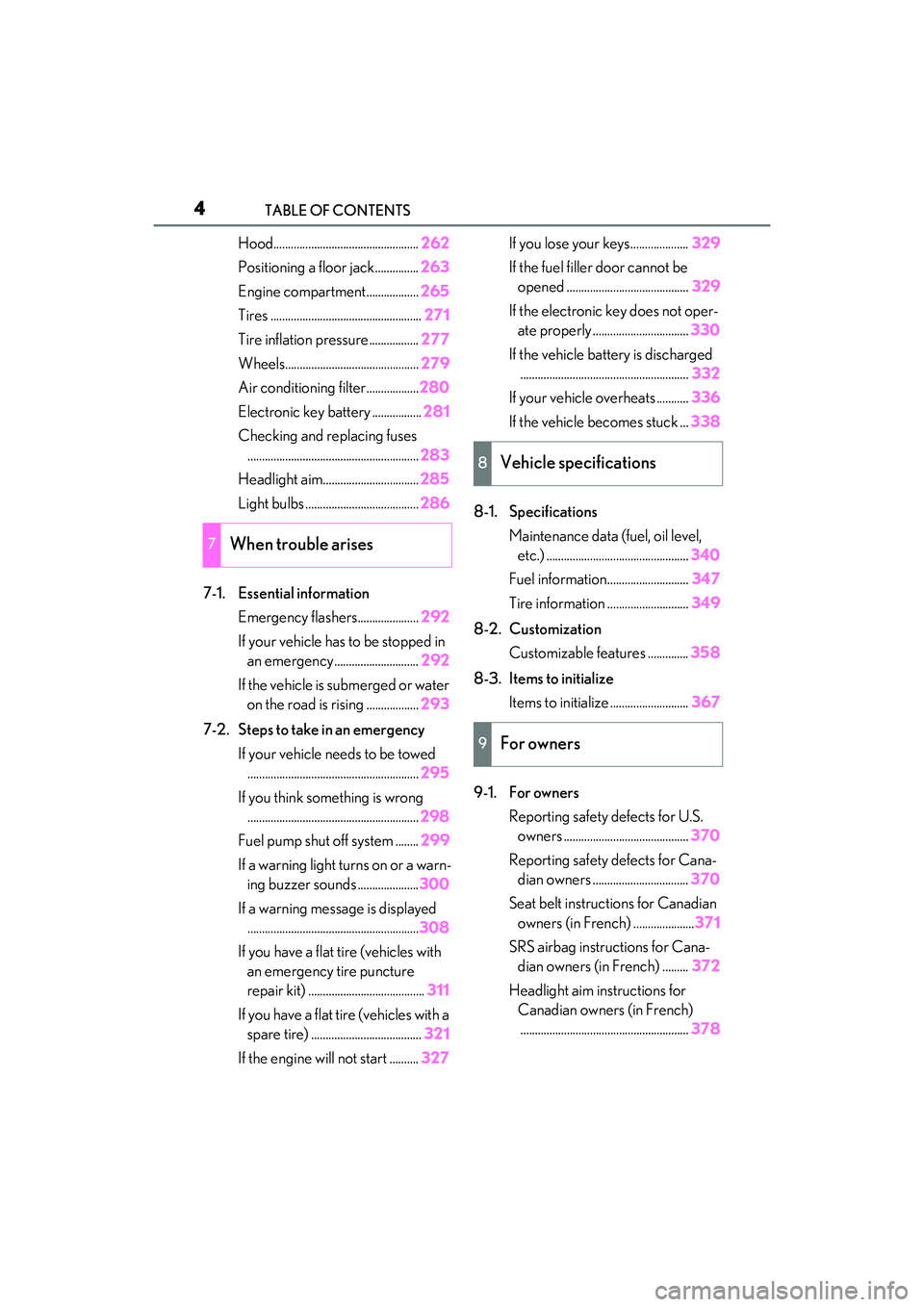
4TABLE OF CONTENTS
RC F Owner's Manual
Hood..................................................262
Positioning a floor jack............... 263
Engine compartment.................. 265
Tires .................................................... 271
Tire inflation pressure................. 277
Wheels.............................................. 279
Air conditioning filter..................280
Electronic key battery ................. 281
Checking and replacing fuses ........................................................... 283
Headlight aim................................. 285
Light bulbs ....................................... 286
7-1. Essential information Emergency flashers..................... 292
If your vehicle has to be stopped in an emergency ............................. 292
If the vehicle is submerged or water on the road is rising .................. 293
7-2. Steps to take in an emergency If your vehicle needs to be towed........................................................... 295
If you think something is wrong ........................................................... 298
Fuel pump shut off system ........ 299
If a warning light turns on or a warn- ing buzzer sounds ..................... 300
If a warning message is displayed ........................................................... 308
If you have a flat tire (vehicles with an emergency tire puncture
repair kit) ........................................ 311
If you have a flat tire (vehicles with a spare tire) ...................................... 321
If the engine wi ll not start .......... 327If you lose your keys....................
329
If the fuel filler door cannot be opened .......................................... 329
If the electronic key does not oper- ate properly ................................. 330
If the vehicle battery is discharged .......................................................... 332
If your vehicle overheats ........... 336
If the vehicle becomes stuck ... 338
8-1. Specifications Maintenance data (fuel, oil level, etc.) ................................................. 340
Fuel information............................ 347
Tire information ............................ 349
8-2. Customization Customizable features .............. 358
8-3. Items to initialize Items to initialize ........................... 367
9-1. For owners Reporting safety defects for U.S. owners ........................................... 370
Reporting safety defects for Cana- dian owners ................................. 370
Seat belt instructions for Canadian owners (in French) ..................... 371
SRS airbag instructions for Cana- dian owners (in French) ......... 372
Headlight aim instructions for Canadian owners (in French).......................................................... 378
7When trouble arises
8Vehicle specifications
9For owners
Page 15 of 412

13Pictorial index
RC F Owner's Manual
Windshield wipers .................................................................................................. P.143
Precautions for winter season .....................................................................................P.203
To prevent freezing (windshield wiper de-icer)
*.................................................. P.215
Precautions against car wash ...................................................................................... P.240
Fuel filler door ..........................................................................................................P.150
Refueling method .............................................................................................................. P .150
Fuel type/fuel tank capacity .......................................................................................... P.341
Tires.......................................................................................................................... ... P.271
Tire size/inflation pressure ............................ ............................................................... P.345
Winter tires................................................................................................................... .......P.203
Checking/rotation/tire pressure warning system................................................ P.271
Coping with flat tires................................................................................................. P.311, 3 21
Hood ..........................................................................................................................P .262
Opening ........................................................................................................................ ....... P.262
Engine oil ..................................................................................................................... .......... P.341
Coping with overheating ............................................................................................... P.336
Warning messages ......................................................................................................... P.308
Active rear wing
*.................................................................................................... P.195
Headlights .................................................................................................................P.13 8
Parking lights/daytime running lights................ ...............................................P.138
Turn signal lights ...................................................................................................... P.136
Side marker lights ...................................................................................................P.138
Tail lights .................................................................................................................... P.138
Stop lights
License plate lights .................................................................................................P.138
Back up lights
Shifting the shift lever to R .............................................................................................. P.13 3
*:If equipped
Light bulbs of the exterior lights for driving(Replacing method: P.286, Watts: P.346)
D
E
F
G
H
I
J
K
L
M
N
O
Page 79 of 412

772-1. Instrument cluster
RC F Owner's Manual
2
Vehicle status information and indicators
■Tire pressure
●It may take a few minutes to display the
tire inflation pressure after the engine
switch is turned to IGNITION ON mode.
It may also take a few minutes to display
the tire inflation pressure after inflation
pressure has been adjusted.
●“---” may be displayed if the tire position
information cannot be determined due to
unfavorable radio wave conditions.
●Tire inflation pressure changes with tem-
perature. The displayed values may also
be different from the values measured
using a tire pressure gauge.
■Lap timer
Measures and displays current lap time
and previous lap times
Reading the display
Measured lap times since the timer was
last reset are displayed as follows:
• Content display area
Total lap time
Past lap times
Fastest lap (marked with a star)
• Sub-content display area
Current lap time
Most recent lap time
Operating the meter control
switches
Press: Start/stop lap timer
Press and hold: Reset : Mark off one lap: Change displayed content
While a lap time is being measured, the
display can be changed to show the follow-
ing content:
• Torque distribution (if equipped)
•G-force
• Tire pressure
• Rear wing position
Resetting/saving measured lap
times
After stopping the lap timer, press and hold
.
When a confirmation sc reen is displayed,
“F” content
A
B
C
A
B
A
B
Page 165 of 412

1634-5. Using the driving support systems
RC F Owner's Manual
4
Driving
• The vehicle is wobbling.
• The vehicle is being driven at extremely high speeds.
• When driving on a hill
• If the radar sensor or front camera is mis- aligned
●In some situations such as the following,
sufficient braking force may not be
obtained, preventing the system from
performing properly:
• If the braking functions cannot operate to
their full extent, such as when the brake
parts are extremely cold, extremely hot,
or wet
• If the vehicle is not properly maintained (brakes or tires are excessively worn,
improper tire inflation pressure, etc.)
• When the vehicle is being driven on a gravel road or other slippery surface
●Some pedestrians such as the following
may not be detected by the radar sensor
and front camera, preventing the system
from operating properly:
• Pedestrians shorter than approximately 3.2 ft. (1 m) or tall er than approximately
6.5 ft. (2 m)
• Pedestrians wearing oversized clothing (a rain coat, long skir t, etc.), making their
silhouette obscure
• Pedestrians who are carrying large bag- gage, holding an umbrella, etc., hiding
part of their body
• Pedestrians who are bending forward or squatting
• Pedestrians who are pushing a stroller, wheelchair, bicycle or other vehicle
• Groups of pedestrians which are close
together
• Pedestrians who are wearing white and look extremely bright
• Pedestrians in the dark, such as at night or while in a tunnel
• Pedestrians whose clothing appears to
be nearly the same co lor or brightness as
their surroundings
• Pedestrians near walls , fences, guardrails,
or large objects
• Pedestrians who are on a metal object (manhole cover, steel plate, etc.) on the
road
• Pedestrians who are walking fast
• Pedestrians who are changing speed abruptly • Pedestrians running out from behind a
vehicle or a large object
• Pedestrians who are extremely close to
the side of the vehicle (outside rear view
mirror, etc.)
■If VSC is disabled
●If VSC is disabled ( P.199), the pre-col-
lision brake assist and pre-collision brak-
ing functions are also disabled.
●The PCS warning light will turn on and
“VSC Turned Off Pre-Collision Brake
System Unavailable” will be displayed on
the multi-information display.
Page 239 of 412

237
RC F Owner's Manual
6
6
Maintenance and care
Maintenance and care
.6-1. Maintenance and careCleaning and protecting the vehi-cle exterior ................................ 238
Cleaning and protecting the vehi- cle interior ................................. 243
6-2. Matte paint care guide (if equipped)
Basic knowledge about matte clear coat ................................... 247
Washing your vehicle .............. 251
Frequently Asked Questions ........................................................ 252
6-3. Maintenance Maintenance requirements .. 255
General maintenance ............. 256
Emission inspection and mainte- nance (I/M) programs ......... 259
6-4. Do-it-yourself maintenance Do-it-yourself service precautions........................................................ 260
Hood............................................... 262
Positioning a floor jack............ 263
Engine compartment............... 265
Tires ................................................. 271
Tire inflation pressure.............. 277
Wheels........................................... 279
Air conditioning filter...............280
Electronic key battery .............. 281
Checking and replacing fuses ........................................................ 283
Headlight aim.............................. 285Light bulbs....................................
286
Page 260 of 412

2586-3. Maintenance
RC F Owner's Manual
Seats• Do the seat controls operate properly?
Steering wheel
• Does the steering wheel rotate
smoothly?
• Does the steering wheel have the cor-
rect amount of free
play?
•There should not be any strange sounds
coming from the
steering wheel.
Vehicle exterior
ItemsCheck points
Doors/trunk• Do the doors/trunk operate smoothly?
Engine hood
•Does the engine hood lock system
work properly?
Fluid leaks
•There should not be any signs of fluid
leakage after the
vehicle has been
parked.
ItemsCheck points
Tires
• Is the tire inflation pressure correct?
• The tires should not be damaged or
excessively worn.
• Have the tires been rotated according to
the maintenance
schedule?
•The wheel nuts should not be loose.
Windshield wip-
ers
• The wiper blades should not show any
signs of cracking,
splitting, wear, con-
tamination or defor-
mation.
• The wiper blades should clear the
windshield without
streaking or skip-
ping.
ItemsCheck points
Page 263 of 412

2616-4. Do-it-yourself maintenance
RC F Owner's Manual
6
Maintenance and care
Light bulbs
(P.286)
•Bulb with same num-
ber and wattage rat-
ing as original
• Phillips-head screw- driver
•Flathead screw- driver
•Wrench
Radiator and con-
denser ( P.268)
Tire inflation pres-
sure ( P.277)• Tire pressure gauge
•Compressed air
source
Washer fluid
(P.270)
• Water or washer
fluid containing anti-
freeze (for winter
use)
• Funnel (used only for adding water or
washer fluid)
WARNING
The engine compartment contains many
mechanisms and fluids that may move
suddenly, become hot, or become elec-
trically energized. To avoid death or seri-
ous injury, observe the following
precautions.
■When working on the engine com-
partment
●Keep hands, clothi ng and tools away
from the moving fans and engine drive
belt.
●Be careful not to touch the engine,
radiator, exhaust manifold, etc. right
after driving as they may be hot. Oil
and other fluids may also be hot.
●Do not leave anything that may burn
easily, such as paper and rags, in the
engine compartment.
ItemsParts and tools●Do not smoke, cause sparks or expose
an open flame to fuel or the battery.
Fuel and battery fumes are flammable.
●Be extremely cautious when working
on the battery. It contains poisonous
and corrosive sulfuric acid.
■When working near the electric cool-
ing fans or radiator grille
Be sure the engine switch is off.
With the engine switch in IGNITION
ON mode, the electric cooling fans may
automatically start to run if the air condi-
tioning is on and/or the coolant tempera-
ture is high. ( P.268)
■Safety glasses
Wear safety glasses to prevent flying or
falling material, fluid spray, etc. from get-
ting in your eyes.
NOTICE
■If you remove the air cleaner filter
Driving with the air cleaner filter
removed may cause excessive engine
wear due to dirt in the air.
Page 274 of 412

2726-4. Do-it-yourself maintenance
RC F Owner's Manual
■When to replace your vehicle’s tires
Tires should be replaced if:
●The treadwear indicators are showing on
a tire.
●You have tire damage such as cuts, splits,
cracks deep enough to expose the fabric,
and bulges indicating internal damage
●A tire goes flat repeatedly or cannot be
properly repaired due to the size or loca-
tion of a cut or other damage
If you are not sure, consult your Lexus
dealer.
■Tire life
Any tire over 6 years old must be checked
by a qualified technician even if it has sel-
dom or never been used or damage is not
obvious.
■Low profile tires
Compared to normal tires, the grip perfor-
mance of these tires will be lower on snow
covered or icy roads. Be sure to use snow
tires when driving on snowy and/or icy
roads and drive carefully at a speed appro-
priate for the road conditions.
■Maximum load of tire
Check that the maximum load of the
replacement tire is greater than 1/2 of the
Gross Axle Weight Ratings (GAWR) of
either the front axle or the rear axle, which-
ever is greater.
For the GAWR, see the Certification Label.
For the maximum load of the tire, see the
load limit at maximum cold tire inflation
pressure mentioned on the sidewall of the
tire. ( P.349)
■Tire types
●Summer tires
Summer tires are high-speed performance tires best suited to
highway driving under
dry conditions. Since summer tires do not
have the same traction performance as
snow tires, summer ti res are inadequate for
driving on snow-covered or icy roads. For
driving on snow-cov ered roads or icy
roads, the use of snow tires is recom-
mended. When installing snow tires, be
sure to replace all four tires.
●All season tires
All season tires are designed to provide
better traction in snow and to be adequate
for driving in most winter conditions as well
as for use year-round. All season tires,
however, do not have adequate traction
performance compared with snow tires in
heavy or loose snow. Also, all season tires
fall short in accelerati on and handling per-
formance compared with summer tires in
highway driving.
●Snow tires
For driving on snow-covered roads or icy
roads, we recommend us ing snow tires. If
you need snow tires, select tires of the
same size, construction and load capacity
as the originally installed tires. Since your
vehicle has radial tires as original equip-
ment, make sure your snow tires also have
radial construction. Do not install studded
tires without first checking local regula-
tions for possible restrictions. Snow tires
should be installe d on all wheels.
( P.203)
■If the tread on snow tires wears down
below 0.16 in. (4 mm)
The effectiveness of the tires as snow tires is
lost.
Page 275 of 412

2736-4. Do-it-yourself maintenance
RC F Owner's Manual
6
Maintenance and care
Tires cannot be rotated.
Your vehicle is equipped with a tire
pressure warning system that uses tire
pressure warning valves and transmit-
ters to detect low tire inflation pressure
before serious problems arise.
The tire pressure detected by the
tire pressure warning system can be
displayed on the multi-information
display. ( P.73)
The illustration used is intended as an
example, and may differ from the image
that is actually displayed on the multi-infor-
mation display.
WARNING
■When inspecting or replacing tires
Observe the following precautions to
prevent accidents.
Failure to do so may cause damage to
parts of the drivetrain as well as danger-
ous handling characteristics, which may
lead to an accident resulting in death or
serious injury.
●Do not mix tires of different makes,
models or tread patterns.
Also, do not mix tires of remarkably
different treadwear.
●Do not use tire sizes other than those
recommended by Lexus.
●Do not mix differently constructed
tires (radial, bias-b elted or bias-ply
tires).
●Do not mix summer, all season and
snow tires.
●Do not use tires that have been used
on another vehicle.
Do not use tires if you do not know
how they were used previously.
●Vehicles with a spare tire: Do not tow if
your vehicle has a spare tire installed.
●Vehicles with an emergency tire punc-
ture repair kit: Do not tow anything if a
tire that has been repaired using the
emergency tire puncture repair kit is
installed. The load on the tire may
cause unexpected damage to the tire.
NOTICE
■Low profile tires
Low profile tires may cause greater dam-
age than usual to the tire wheel when
sustaining impact from the road surface.
Therefore, pay attention to the following:
●Be sure to use proper tire inflation
pressure. If tires are under-inflated,
they may be damaged more severely.
●Avoid potholes, uneven pavement,
curbs and other road hazards. Failure
to do so may lead to severe tire and
wheel damage.
■If tire inflation pressure of each tire
becomes low while driving
Do not continue driving, or your tires
and/or wheels may be ruined.
■Driving on rough roads
Take particular care when driving on
roads with loose surfaces or potholes.
These conditions may cause losses in tire
inflation pressure, reducing the cushion-
ing ability of the tires. In addition, driving
on rough roads may cause damage to
the tires themselves, as well as the vehi-
cle’s wheels and body.
Tire rotation
Tire pressure warning system