brakes LEXUS RX200T 2017 Owner's Manual
[x] Cancel search | Manufacturer: LEXUS, Model Year: 2017, Model line: RX200T, Model: LEXUS RX200T 2017Pages: 776, PDF Size: 44.51 MB
Page 423 of 776
4234-5. Using the driving support systems
4
Driving
RX350/RX200t_EE_OM48F32E
◆EPS (Electric Power Steering)
Employs an electric motor to reduce the amount of effort needed to turn the
steering wheel
◆Dynamic Torque Control AWD system (AWD models)
Automatically switches from front-wheel drive to all-wheel drive (AWD)
according to the driving conditions, helping to ensure reliable handling and
stability. Examples of conditions where the system will switch to AWD are
when cornering, going uphill, starting off or accelerating, and when the road
surface is slippery due to snow, rain, etc.
◆Adaptive Variable Suspension System (if equipped)
Controls the damping force of the shock absorber of each wheel according to
the road and driving conditions, helping achieve a comfortable ride, excellent
driveability and a high level of stability.
If SPORT S+ mode is selected using the driving mode select switch, the
damping force will become more suitable for sporty driving. ( P. 418)
◆VDIM (Vehicle Dynamics Integrated Management) (if equipped)
Provides integrated control of the ABS, brake assist, TRC, VSC, hill-start
assist control and EPS systems
Helps to maintain vehicle stability when swerving on slippery road surfaces by
controlling the brakes and engine output
◆Emergency brake signal
When the brakes are applie d suddenly, the stop lights automatically flash to
alert the vehicle behind.
Page 428 of 776
4284-5. Using the driving support systems
RX350/RX200t_EE_OM48F32E
WARNING
■Handling of tires and the suspension
Using tires with any kind of problem or modif ying the suspension will affect the driving assist systems, and may cause a system to malfunction.
■Trailer Sway Control precaution
The Trailer Sway Control system is not able to reduce trailer sway in all situations. Depending on many factors such as the conditions of the vehicle, trailer, road surface,
and driving environment, the Trailer Sway Control system may not be effective. Refer to your trailer owner’s manual for informatio n on how to tow your trailer properly.
■If trailer sway occurs
Observe the following precautions. Failing to do so may cause death or serious injury.
●Firmly grip the steering wheel. Steer straight ahead.
Do not try to control trailer swaying by turning the steering wheel.
●Begin releasing the accelerator pedal immediately but very gradually to reduce speed.
Do not increase speed. Do not apply vehicle brakes.
If you make no extreme correction with the steering or brakes, your vehicle and trailer
should stabilize. ( P. 238)
Page 429 of 776
429
4
Driving
RX350/RX200t_EE_OM48F32E
4-6. Driving tips
●Use fluids that are appropriate to the prevailing outside temperatures.
•Engine oil
• Engine coolant
• Washer fluid
●Have a service technician inspect the condition of the battery.
●Have the vehicle fitted with four snow tires or purchase a set of tire chains for
the front tires.
Ensure that all tires are of the specified size and the same brand, and that chains match the size of the tires.
Perform the following according to the driving conditions:
●Do not try to forcibly open a window or move a wiper that is frozen. Pour
warm water over the frozen area to melt the ice. Wipe away the water imme-
diately to prevent it from freezing.
●To ensure proper operation of the climate control system fan, remove any
snow that has accumulated on the air inlet vents in front of the windshield.
●Check for and remove any excess ice or snow that may have accumulated on
the exterior lights, vehicle’s roof, chassi s, around the tires or on the brakes.
●Remove any snow or mud from the bottom of your shoes before getting in the
vehicle.
Winter driving tips
Carry out the necessary preparations and inspections before driving the vehi-
cle in winter. Always drive the vehicle in a manner appropriate to the prevail-
ing weather conditions.
Pre-winter preparations
Before driving the vehicle
Page 434 of 776
4344-6. Driving tips
RX350/RX200t_EE_OM48F32E
Your vehicle is not designed to be driven off-road. However, in the event that off-
road driving cannot be avoided, please observe the following precautions to help
avoid the areas prohibited to vehicles.
●Drive your vehicle only in areas where off-road vehicles are permitted to
travel.
●Respect private property. Get owner’s permission before entering private
property.
●Do not enter areas that are closed. Honor gates, barriers and signs that
restrict travel.
●Stay on established roads. When co nditions are wet, driving techniques
should be changed or travel delayed to prevent damage to roads.
Off-road driving
WARNING
■Off-road driving precautions
Always observe the following precautions to minimize the risk of death, serious injury
or damage to your vehicle:
●Drive carefully when off the road. Do not ta ke unnecessary risks by driving in danger- ous places.
●Do not grip the steering wheel spokes when driving off-road. A bad bump could jerkthe wheel and injure your hands. Keep both hands and especially your thumbs on the outside of the rim.
●Always check your brakes for effectivene ss immediately after driving in sand, mud, water or snow.
●After driving through tall grass, mud, rock, sand, rivers, etc., check that there is no
grass, bush, paper, rags, stone, sand, etc. adhering or trapped on the underbody. Clear off any such matter from the underbody. If the vehicle is used with these materi- als trapped or adhering to the underb ody, a breakdown or fire could occur.
●When driving off-road or in rugged terrain, do not drive at excessive speeds, jump, make sharp turns, strike objects, etc. This may cause loss of control or vehicle rollover causing death or serious injury. You are also risking expensive damage to your vehi-
cle’s suspension and chassis.
Page 657 of 776
6578-1. Essential information
8
When trouble arises
RX350/RX200t_EE_OM48F32E
Steadily step on the brake pedal with both feet and firmly depress it.
Do not pump the brake pedal repeatedly as this will increase the effort required to slow the vehicle.
Shift the shift lever to N.
If the shift lever is shifted to N
After slowing down, stop the vehicle in a safe place by the road.
Stop the engine.
If the shift lever cannot be shifted to N
Keep depressing the brake pedal with both feet to reduce vehicle speed as
much as possible.
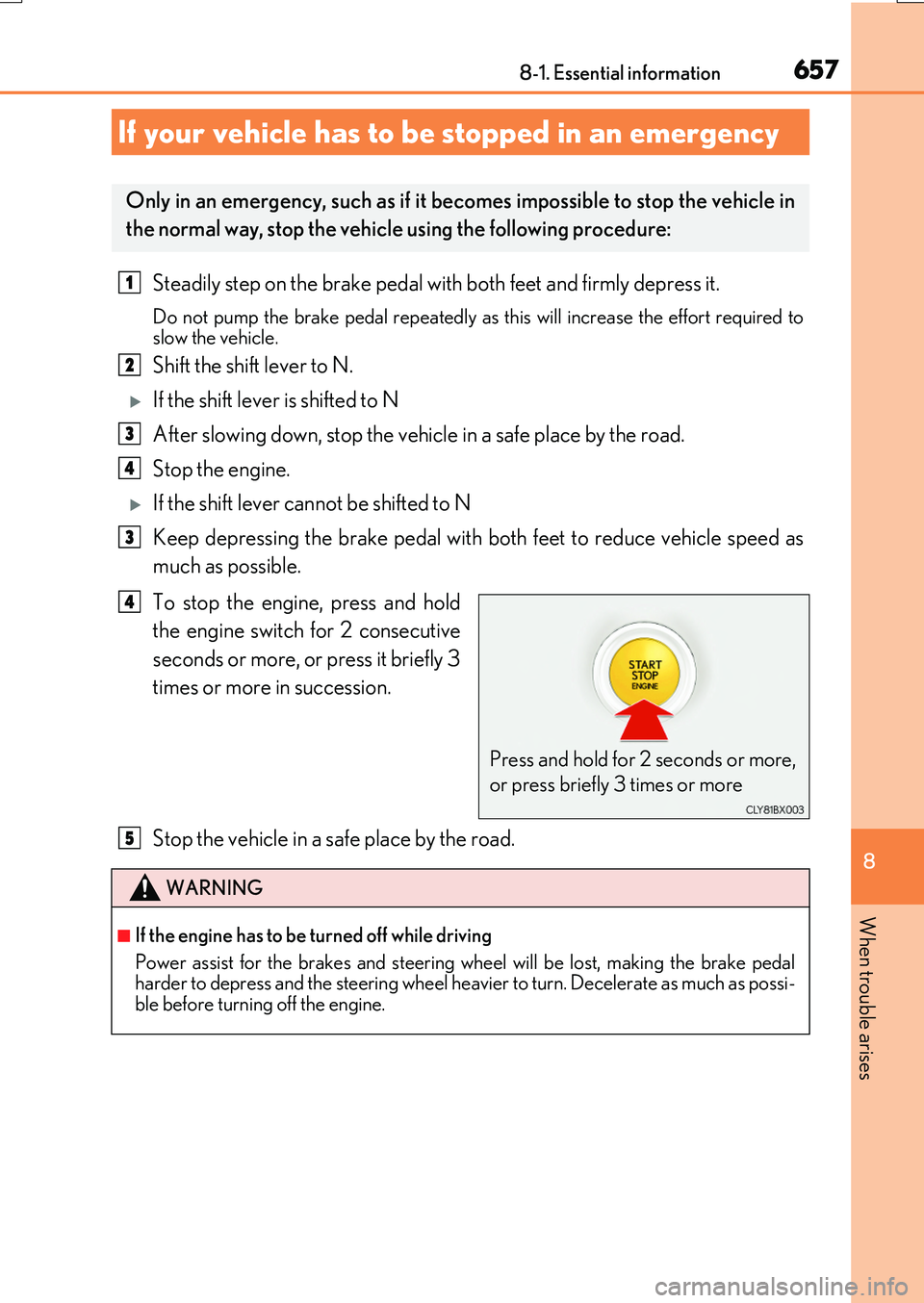
To stop the engine, press and hold
the engine switch for 2 consecutive
seconds or more, or press it briefly 3
times or more in succession.
Stop the vehicle in a safe place by the road.
If your vehicle has to be stopped in an emergency
Only in an emergency, such as if it becomes impossible to stop the vehicle in
the normal way, stop the vehicle using the following procedure:
1
2
3
4
3
Press and hold for 2 seconds or more,
or press briefly 3 times or more
4
WARNING
■If the engine has to be turned off while driving
Power assist for the brakes and steering wheel will be lost, making the brake pedal harder to depress and the steering wheel heavier to turn. Decelerate as much as possi-
ble before turning off the engine.
5
Page 660 of 776
6608-2. Steps to take in an emergency
RX350/RX200t_EE_OM48F32E
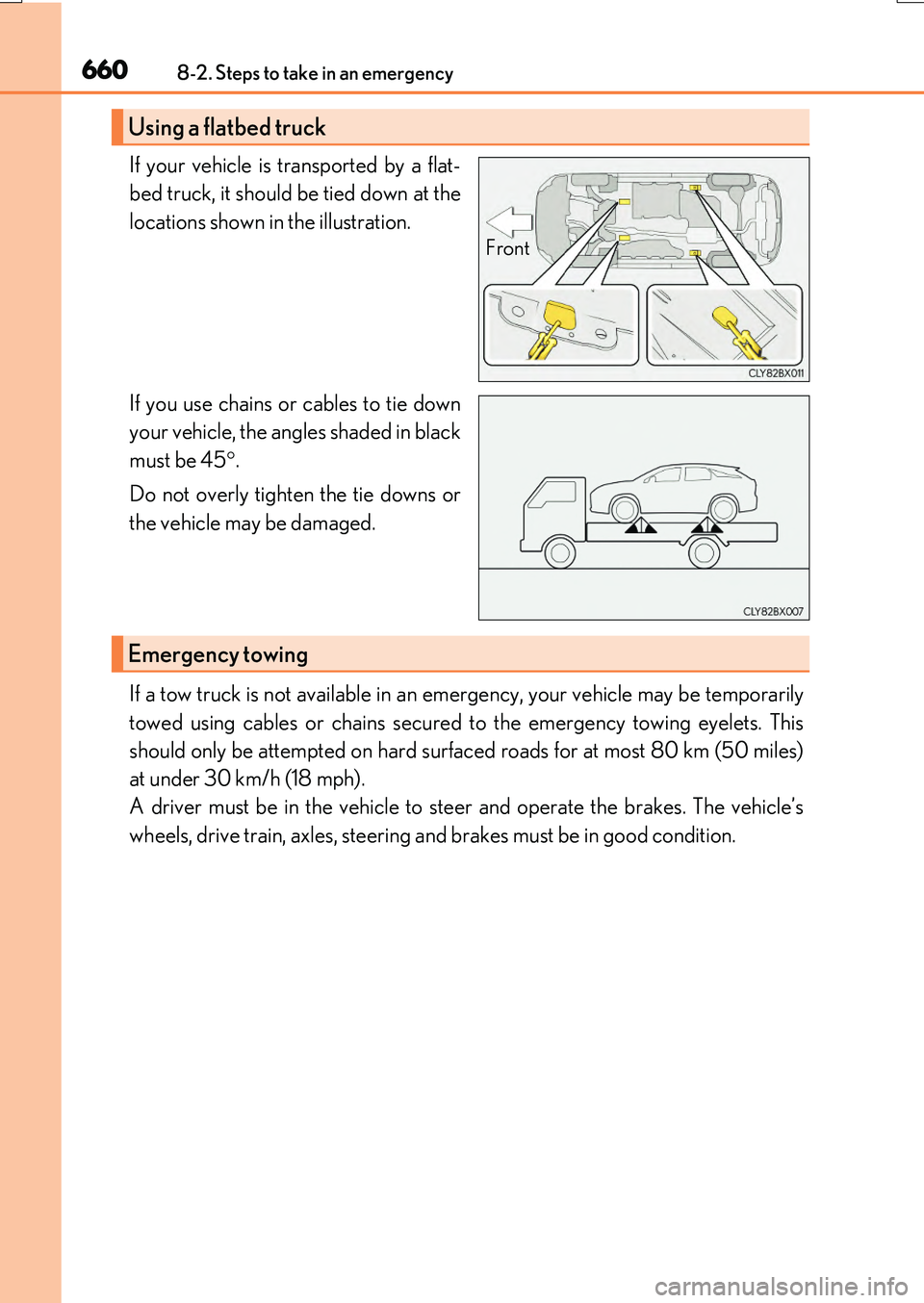
If your vehicle is transported by a flat-
bed truck, it should be tied down at the
locations shown in the illustration.
If you use chains or cables to tie down
your vehicle, the angles shaded in black
must be 45 .
Do not overly tighten the tie downs or
the vehicle may be damaged.
If a tow truck is not available in an emergency, your vehicle may be temporarily
towed using cables or chains secured to the emergency towing eyelets. This
should only be attempted on hard surfac ed roads for at most 80 km (50 miles)
at under 30 km/h (18 mph).
A driver must be in the vehicle to steer and operate the brakes. The vehicle’s
wheels, drive train, axles, steering and brakes must be in good condition.
Using a flatbed truck
Front
Emergency towing
Page 662 of 776
6628-2. Steps to take in an emergency
RX350/RX200t_EE_OM48F32E
■While towing
If the engine is not running, the power assist for the brakes and steering will not function, making steering and braking more difficult.
■Wheel nut wrench
Wheel nut wrench is installe d in luggage compartment. (P. 680, 695)
WARNING
Observe the following precautions. Failure to do so may result in death or serious injury.
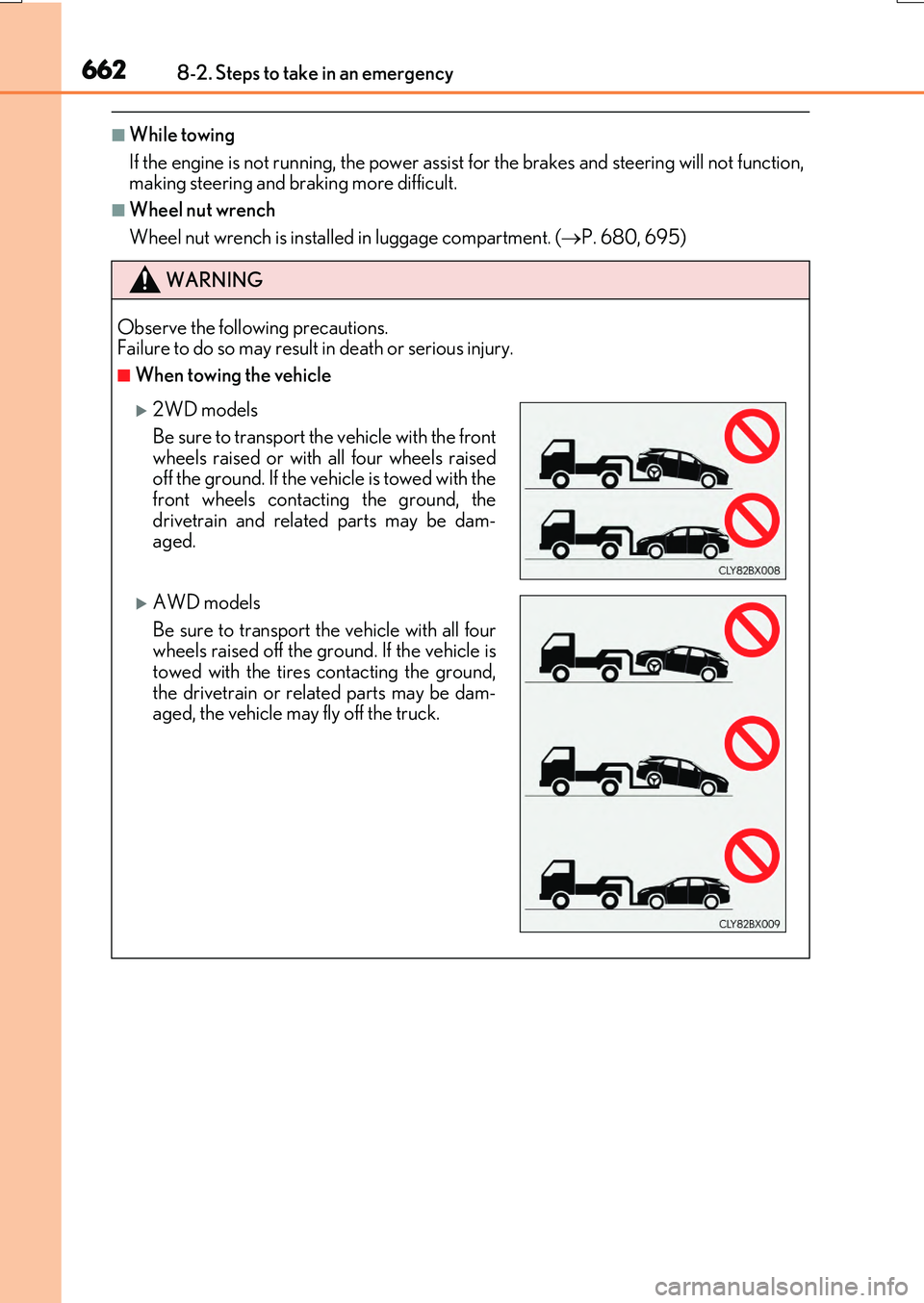
■When towing the vehicle
2WD models
Be sure to transport the vehicle with the front
wheels raised or with all four wheels raised off the ground. If the vehicle is towed with thefront wheels contacting the ground, the
drivetrain and related parts may be dam- aged.
AWD models
Be sure to transport the vehicle with all four wheels raised off the ground. If the vehicle istowed with the tires contacting the ground,
the drivetrain or related parts may be dam- aged, the vehicle may fly off the truck.
Page 672 of 776
6728-2. Steps to take in an emergency
RX350/RX200t_EE_OM48F32E
WARNING
■If the tire pressure warning light comes on
Be sure to observe the following precautions. Failure to do so could cause a loss of vehicle control and result in death or serious injury.
●Stop your vehicle in a safe place as soon as possible. Adjust the tire inflation pressureimmediately.
●Vehicles with a spare tire: If the tire pressure warning light comes on even after tire
inflation pressure adjustment, it is probable that you have a flat tire. Check the tires. If a tire is flat, change it with the spare tire and have the flat tire repaired by the nearest any authorized Lexus dealer or repairer, or another duly qualified and equipped pro-
fessional.
●Vehicles with an emergency tire puncture repair kit: If the tire pressure warning light comes on even after tire inflation pressure adjustment, it is probable that you have a
flat tire. Check the tires. If a tire is flat, re pair the flat tire by using emergency tire punc- ture repair kit.
●Avoid abrupt maneuvering and braking. If th e vehicle tires deteriorate, you could lose
control of the steering wheel or the brakes.
■If a blowout or sudden air leakage should occur
The tire pressure warning system may not activate immediately.
NOTICE
■To ensure the tire pressure warning system operates properly
Do not install tires with different specifications or makers, as the tire pressure warning system may not operate properly.
Page 687 of 776
6878-2. Steps to take in an emergency
8
When trouble arises
RX350/RX200t_EE_OM48F32E
WARNING
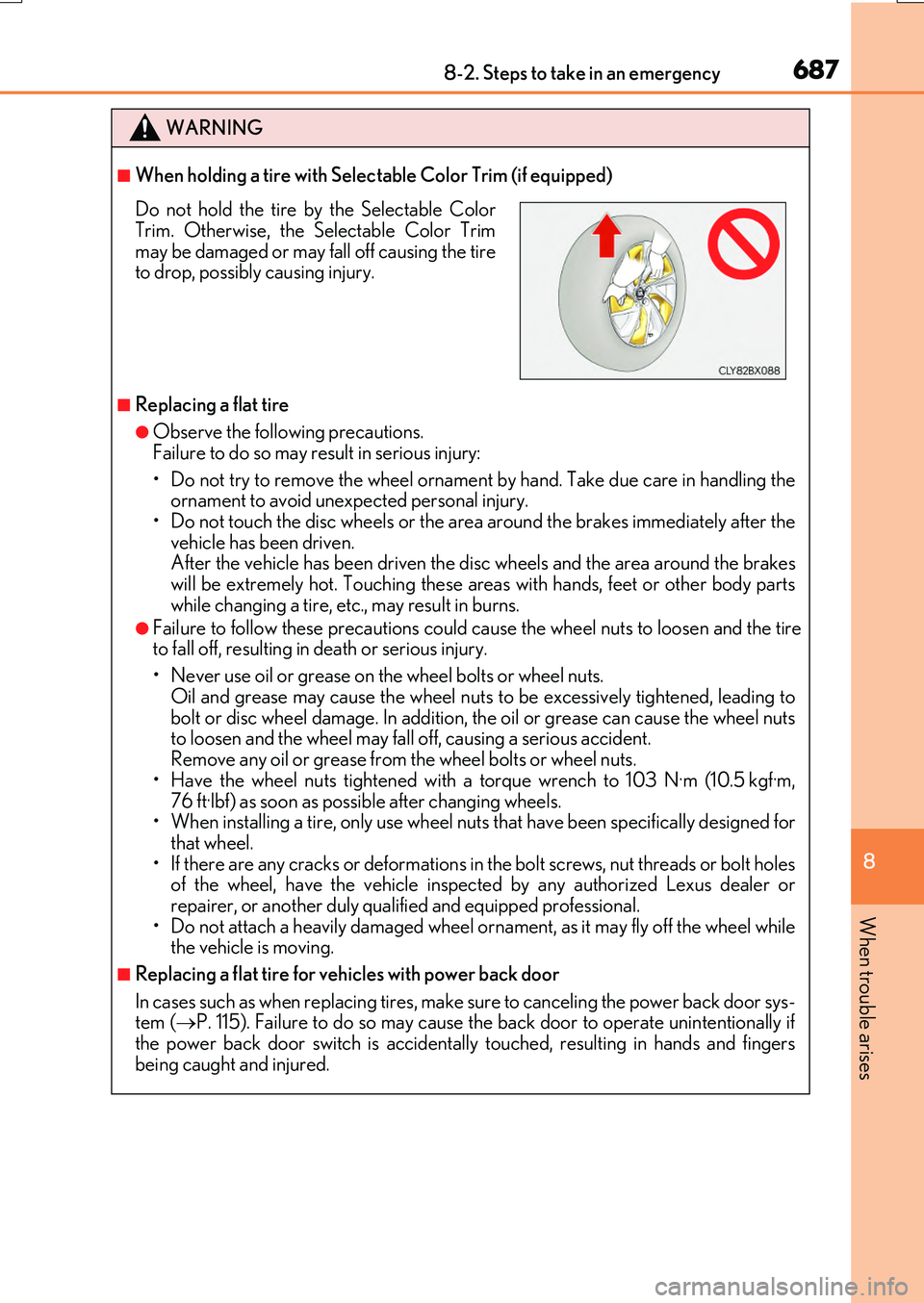
■When holding a tire with Selectable Color Trim (if equipped)
■Replacing a flat tire
●Observe the following precautions.
Failure to do so may result in serious injury:
• Do not try to remove the wheel ornament by hand. Take due care in handling the ornament to avoid unexpected personal injury.
• Do not touch the disc wheels or the area around the brakes immediately after the vehicle has been driven.After the vehicle has been driven the disc wheels and the area around the brakes
will be extremely hot. Touching these area s with hands, feet or other body parts while changing a tire, etc., may result in burns.
●Failure to follow these precautions could cause the wheel nuts to loosen and the tireto fall off, resulting in death or serious injury.
• Never use oil or grease on the wheel bolts or wheel nuts.
Oil and grease may cause the wheel nuts to be excessively tightened, leading to bolt or disc wheel damage. In addition, the oil or grease can cause the wheel nuts to loosen and the wheel may fall off, causing a serious accident.
Remove any oil or grease from the wheel bolts or wheel nuts. • Have the wheel nuts tightened with a torque wrench to 103 N·m (10.5 kgf·m,
76 ft·lbf) as soon as possible after changing wheels. • When installing a tire, only use wheel nuts that have been specifically designed for that wheel.
• If there are any cracks or deformations in the bolt screws, nut threads or bolt holes of the wheel, have the vehicle inspected by any authorized Lexus dealer orrepairer, or another duly qualif ied and equipped professional.
• Do not attach a heavily damaged wheel or nament, as it may fly off the wheel while the vehicle is moving.
■Replacing a flat tire for vehicles with power back door
In cases such as when replacing tires, make sure to canceling the power back door sys- tem ( P. 115). Failure to do so may cause the back door to operate unintentionally if the power back door switch is accidentally touched, resulting in hands and fingers
being caught and injured.
Do not hold the tire by the Selectable Color
Trim. Otherwise, the Selectable Color Trim may be damaged or may fall off causing the tireto drop, possibly causing injury.
Page 706 of 776
7068-2. Steps to take in an emergency
RX350/RX200t_EE_OM48F32E
WARNING
■When fixing the flat tire
●Stop your vehicle in a safe and flat area.
●Do not touch the wheels or the area around the brakes immediately after the vehicle
has been driven. After the vehicle has been driven, the wheels and the area around the brakes may beextremely hot. Touching these areas with hands, feet or other body parts may result in
burns.
●Connect the valve and hose securely with the tire installed on the vehicle.
●If the hose is not properly connected to the valve, air leakage may occur or sealant
may be sprayed out.
●If the hose comes off the valve while inflating the tire, there is a risk that the hose will move abruptly due to air pressure.
●After inflation of the tire has completed, the sealant may splatter when the hose is dis-connected or some air is let out of the tire.
●Follow the operation procedure to repair the tire. If the procedure is not followed, the
sealant may spray out.
●Keep back from the tire while it is being repaired, as there is a chance of it bursting while the repair operation is being performe d. If you notice any cracks or deforma-
tion of the tire, turn off the compressor sw itch and stop the repair operation immedi- ately.
●The kit may overheat if operated for a long period of time. Do not operate the com-
pressor continuously for more than 40 minutes.
●Parts of the kit become hot during operatio n. Be careful handling the kit during and after operation. Do not touch the metal part around the connecting area between the
bottle and compressor. It will be extremely hot.
●Do not attach the vehicle speed warning sticker to an area other than the one indi- cated. If the sticker is attached to an area where an SRS airbag is located, such as the
pad of the steering wheel, it may prevent the SRS air bag from operating properly.
■Driving to spread the liquid sealant evenly
●Drive the vehicle carefully at a low speed. Be especially careful when turning and cor-
nering.
●If the vehicle does not drive straight or you feel a pull through the steering wheel, stop the vehicle and check the following:
• Tire condition. The tire may have separated from the wheel. • Tire inflation pressure. If tire inflation pressure is 130 kPa (1.3 kgf/cm2 or b ar, 1 9 p si)or below, this may indica te severe tire damage.