towing LEXUS RX200T 2017 Owner's Manual
[x] Cancel search | Manufacturer: LEXUS, Model Year: 2017, Model line: RX200T, Model: LEXUS RX200T 2017Pages: 776, PDF Size: 44.51 MB
Page 368 of 776
3684-5. Using the driving support systems
RX350/RX200t_EE_OM48F32E
■Conditions under which the RCTA function will not detect a vehicle
The RCTA function is not designed to dete ct the following types of vehicles and/or objects:
●Vehicles approaching from directly behind
●Vehicles backing up in a parking space next to your vehicle
●Guardrails, walls, signs, parked vehi cles and similar stationary objects*
●Small motorcycles, bicycles, pedestrians, etc.*
●Vehicles moving away from your vehicle
●Vehicles approaching from the parking spaces next to your vehicle*
*: Depending on the conditions, detection of a vehicle and/or object may occur.
■Conditions under which the RCTA function may not function correctly
●The RCTA function may not detect vehicles correctly in the following situations:
• When the sensor is misaligned due to a strong impact to the sensor or its surround-
ing area • When mud, snow, ice, a sticker, etc. is covering the sensor or surrounding area onthe rear bumper
• When driving on a road surface that is wet with standing water during bad weather, such as heavy rain, snow, or fog• When multiple vehicles are approaching wi th only a small gap between each vehicle
• When a vehicle is approaching at high speed • When towing a trailer (vehicles with towing package)
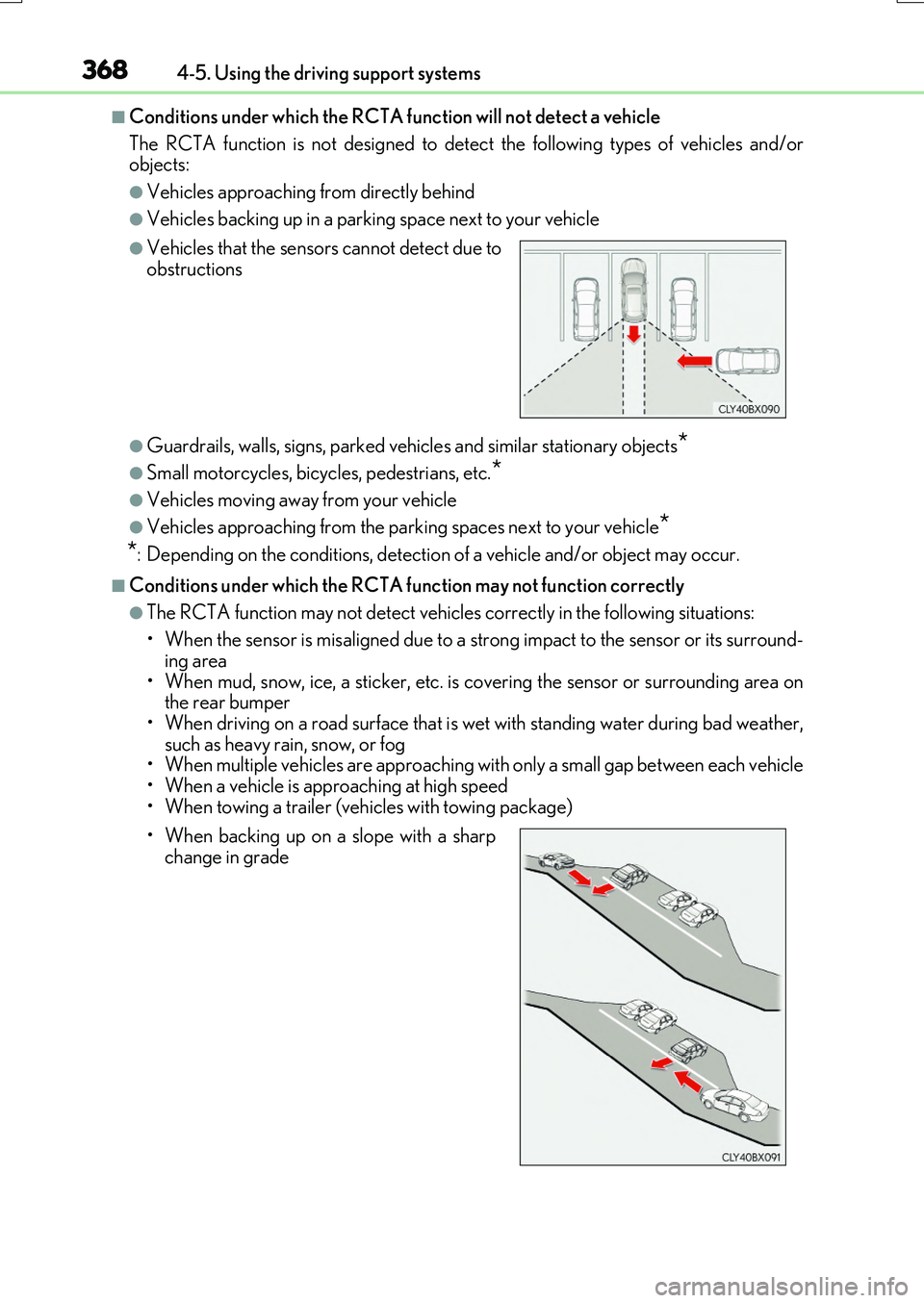
●Vehicles that the sensors cannot detect due toobstructions
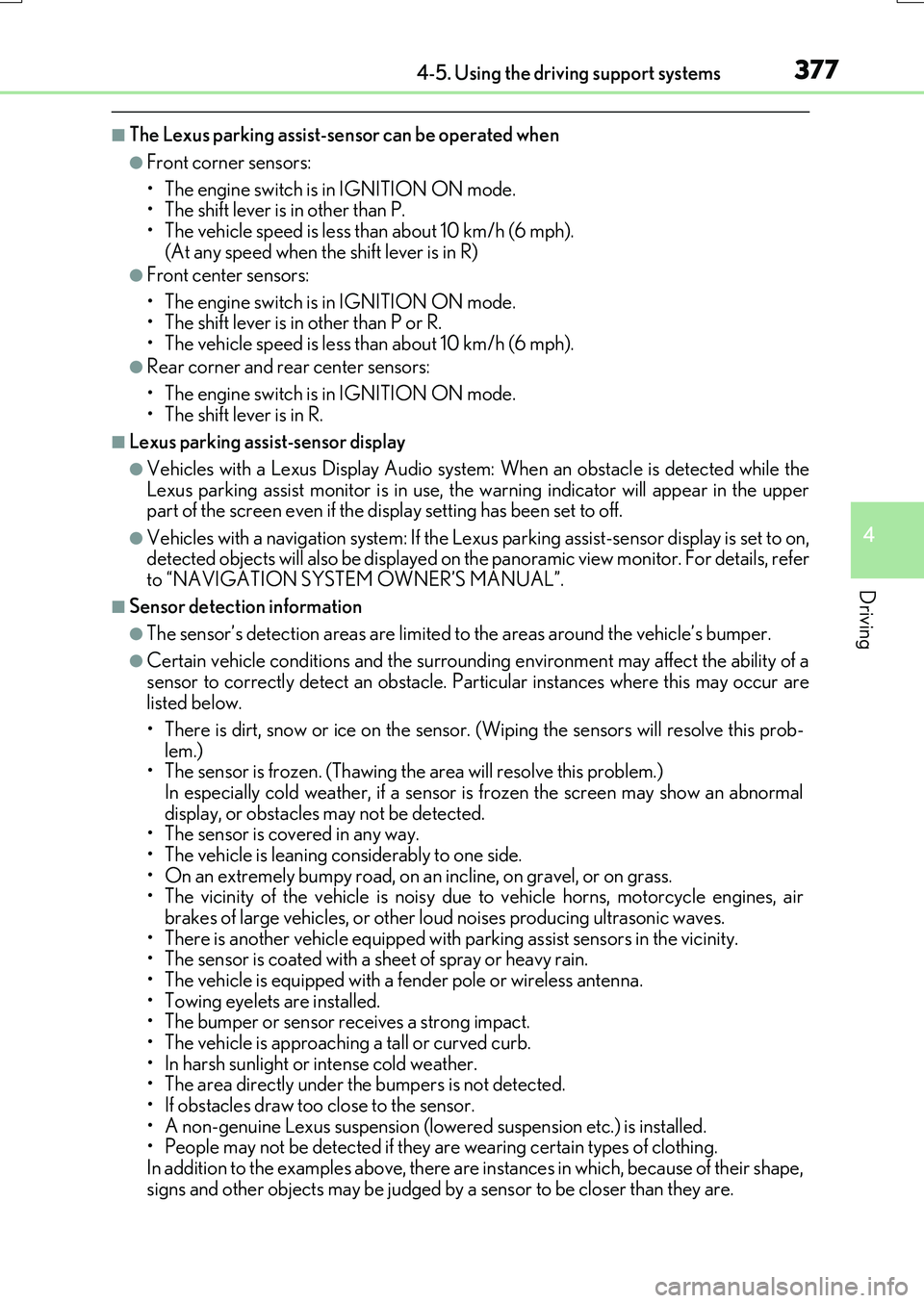
• When backing up on a slope with a sharp change in grade
Page 377 of 776
3774-5. Using the driving support systems
4
Driving
RX350/RX200t_EE_OM48F32E
■The Lexus parking assist-sensor can be operated when
●Front corner sensors:
• The engine switch is in IGNITION ON mode. • The shift lever is in other than P.
• The vehicle speed is less than about 10 km/h (6 mph). (At any speed when the shift lever is in R)
●Front center sensors:
• The engine switch is in IGNITION ON mode. • The shift lever is in other than P or R.
• The vehicle speed is less than about 10 km/h (6 mph).
●Rear corner and rear center sensors:
• The engine switch is in IGNITION ON mode. • The shift lever is in R.
■Lexus parking assist-sensor display
●Vehicles with a Lexus Display Audio system : When an obstacle is detected while the Lexus parking assist monitor is in use, the warning indicator will appear in the upperpart of the screen even if the display setting has been set to off.
●Vehicles with a navigation system: If the Lexu s parking assist-sensor display is set to on, detected objects will also be displayed on the panoramic view monitor. For details, refer to “NAVIGATION SYSTEM OWNER’S MANUAL”.
■Sensor detection information
●The sensor’s detection areas are limited to the areas around the vehicle’s bumper.
●Certain vehicle conditions and the surrounding environment may affect the ability of a
sensor to correctly detect an obstacle. Particular instances where this may occur are listed below.
• There is dirt, snow or ice on the sensor . (Wiping the sensors will resolve this prob-
lem.) • The sensor is frozen. (Thawing the area will resolve this problem.) In especially cold weather, if a sensor is frozen the screen may show an abnormal
display, or obstacles may not be detected. • The sensor is covered in any way.• The vehicle is leaning considerably to one side.
• On an extremely bumpy road, on an incline, on gravel, or on grass. • The vicinity of the vehicle is noisy due to vehicle horns, motorcycle engines, airbrakes of large vehicles, or other loud noises producing ultrasonic waves.
• There is another vehicle equipped with parking assist sensors in the vicinity. • The sensor is coated with a sheet of spray or heavy rain. • The vehicle is equipped with a fender pole or wireless antenna.
• Towing eyelets are installed. • The bumper or sensor receives a strong impact.
• The vehicle is approaching a tall or curved curb. • In harsh sunlight or intense cold weather.• The area directly under the bumpers is not detected.
• If obstacles draw too close to the sensor. • A non-genuine Lexus suspension (low ered suspension etc.) is installed. • People may not be detected if they are wearing certain types of clothing.
In addition to the examples above, there are instances in which, because of their shape, signs and other objects may be judged by a sensor to be closer than they are.
Page 393 of 776
3934-5. Using the driving support systems
4
Driving
RX350/RX200t_EE_OM48F32E
NOTICE
■To prevent the system from malfunctioning
●If the area around a sensor is subjected to an impact, the system may not operate properly due to the sensor being misali gned. Have the vehicle inspected by any
authorized Lexus dealer or repairer, or an other duly qualified and equipped profes- sional.
●When using a high pressure washer to wash the vehicle, do not spray the sensors
directly, as doing so may cause a sensor to malfunction.
●When using steam to clean the vehicle, do not direct steam too close to the sensors as doing so may cause a sensor to malfunction.
■To prevent a radar sensor from malfunctioning
●If the area around a radar sensor is subjec ted to an impact, the system may not oper- ate properly due to a sensor malfunction. Have the vehicle inspected by any autho-
rized Lexus dealer or repairer, or anothe r duly qualified and equipped professional.
●Observe the radar sensor handling precautions. (P. 360)
■To prevent unnecessary operation of the Intelligent Clearance Sonar system
In the following situations, disable the Inte lligent Clearance Sonar system as the system may operate even though there is no possibility of a collision.
●When inspecting the vehicle using a chassis roller, chassis dynamo or free roller
●When loading the vehicle onto a boat, truck or other transport vessel
●If the suspension has been modified or tires of a size other than specified are installed
●If the front of the vehicle is raised or lowered due to the carried load
●If towing eyelets are installed
Page 399 of 776
3994-5. Using the driving support systems
4
Driving
RX350/RX200t_EE_OM48F32E
■Situations in which the Rear Crossing Traffic Auto Brake function may not operate properly
In some situations such as the following , this function may not operate properly.
●Objects and vehicles which the radar sensors are not designed to detect
• Stationary objects • Vehicles which are moving away from your vehicle
• Pedestrians, motorcycles, bicycles, etc.*• Objects which are extremely close to a radar sensor • Vehicles which are approaching from the right or left at the rear of the vehicle at a
traveling speed of less than approximately 8 km/h (5 mph) • Vehicles which are approaching from the right or left at the rear of the vehicle at a traveling speed of more than a pproximately 24 km/h (15 mph)
*: Depending on conditions, detection of a vehicle and/or object may occur.
●Situations in which the radar sensors may not be able to detect an object
• When a sensor or the area around a sensor is extremely hot or cold • If the rear bumper is covered with ice, snow, dirt, etc.
• If heavy rain or water strikes the vehicle • When the detection area of a radar sensor is obstructed by an adjacent vehicle• If the vehicle is significantly tilted
• If towing eyelets are installed • If the suspension has been modified or ti res of a size other than specified are installed
• If the front of the vehicle is raised or lowered due to the carried load • If a sticker or an electronic component, such as a backlit license plate (especially flu-orescent type), fog lights, a fender pole or wireless antenna is installed near a radar
sensor • If the orientation of a radar sensor has been changed due to a collision or other
impact or removal and installation • When multiple vehicles are approaching wi th only a small gap between each vehicle • When a vehicle is approaching at high speed
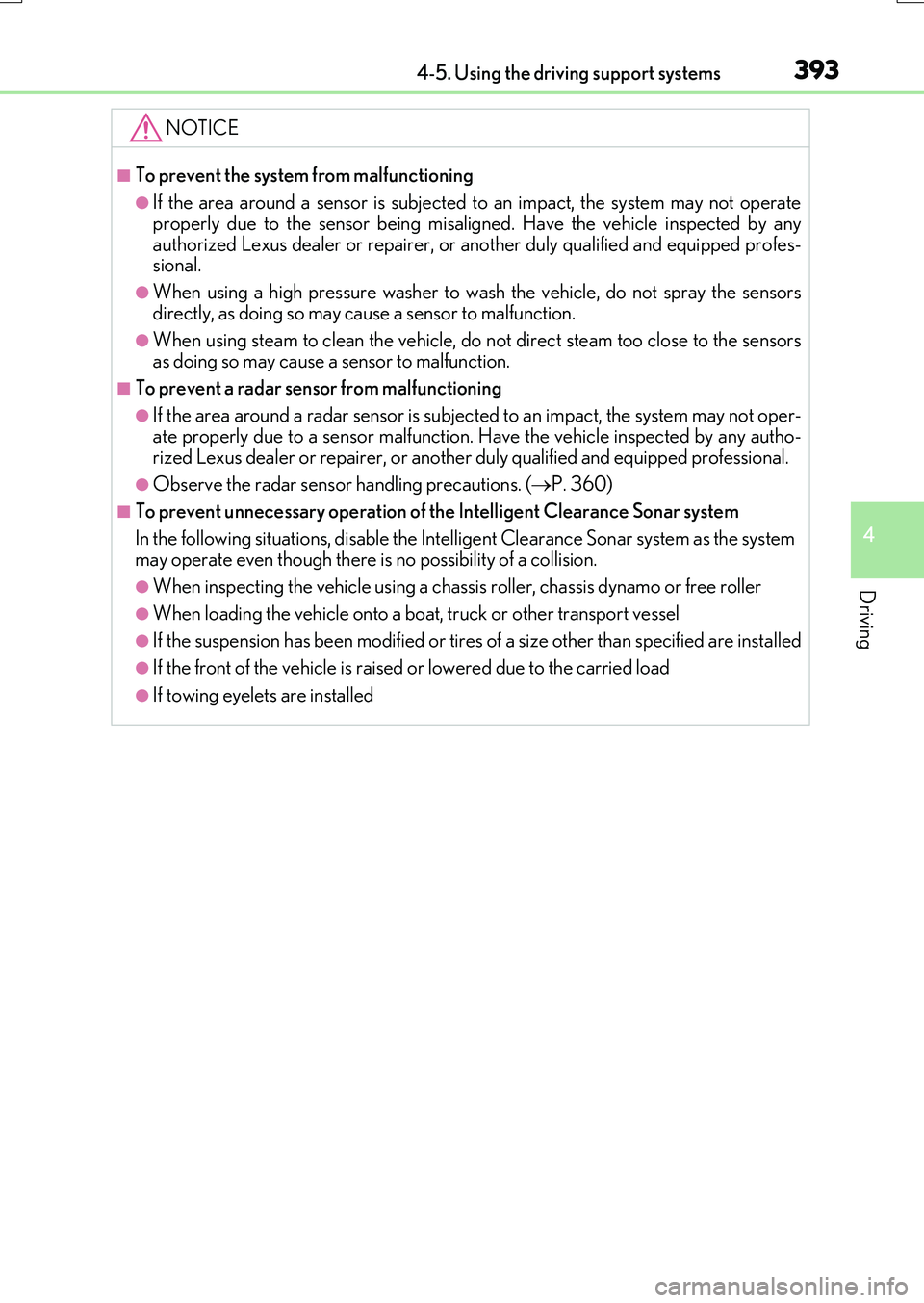
●Situations in which the radar sensor may not detect a vehicle
• When a vehicle approaches from the right or left at the rear of the vehicle while youare turning while backing up
• When turning while backing up
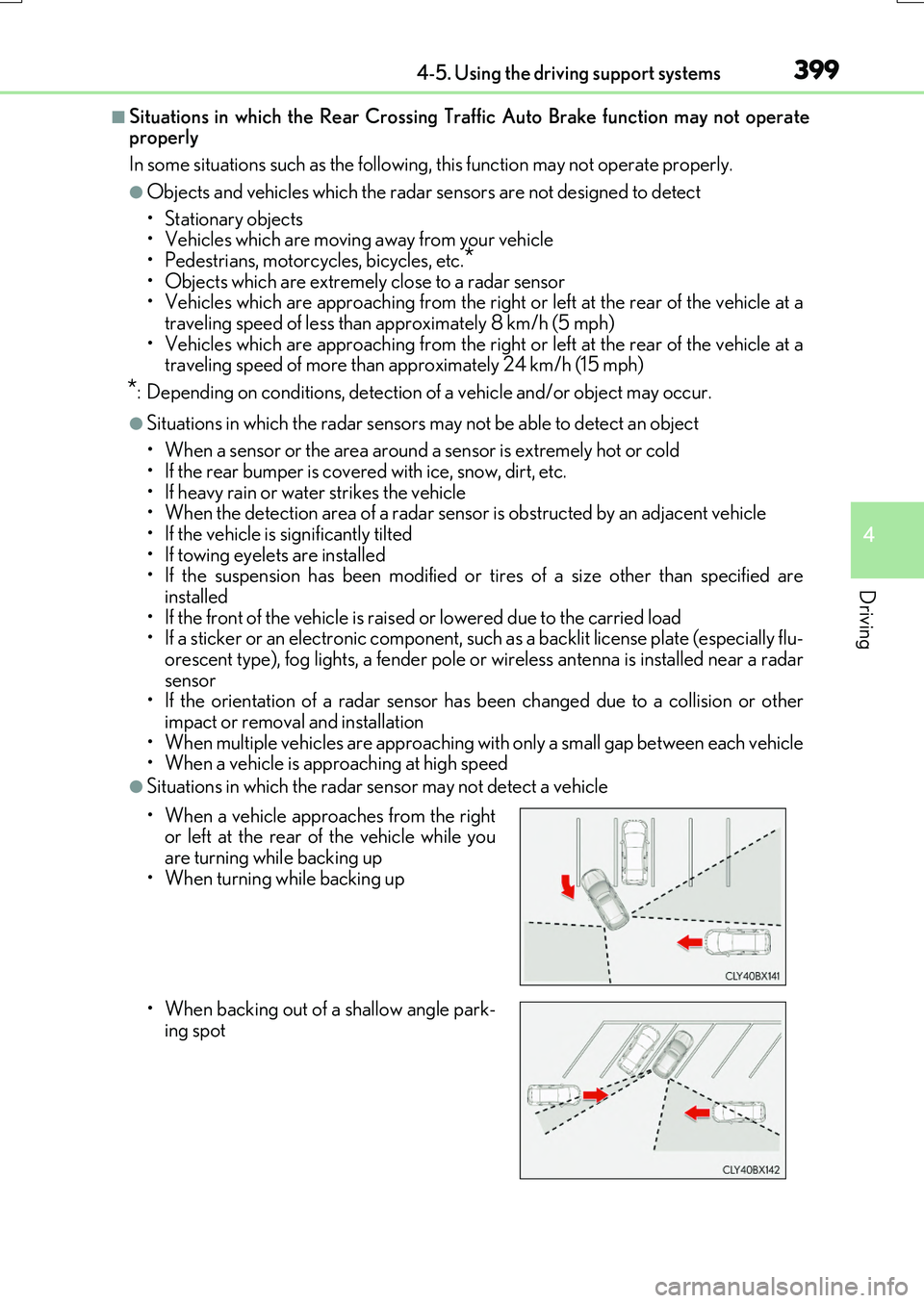
• When backing out of a shallow angle park-
ing spot
Page 559 of 776
5596-4. Using the storage features
6
Interior features
RX350/RX200t_EE_OM48F32E
NOTICE
To prevent damage to the rear cup holder, stow the cup holder before stowing the arm- rest.
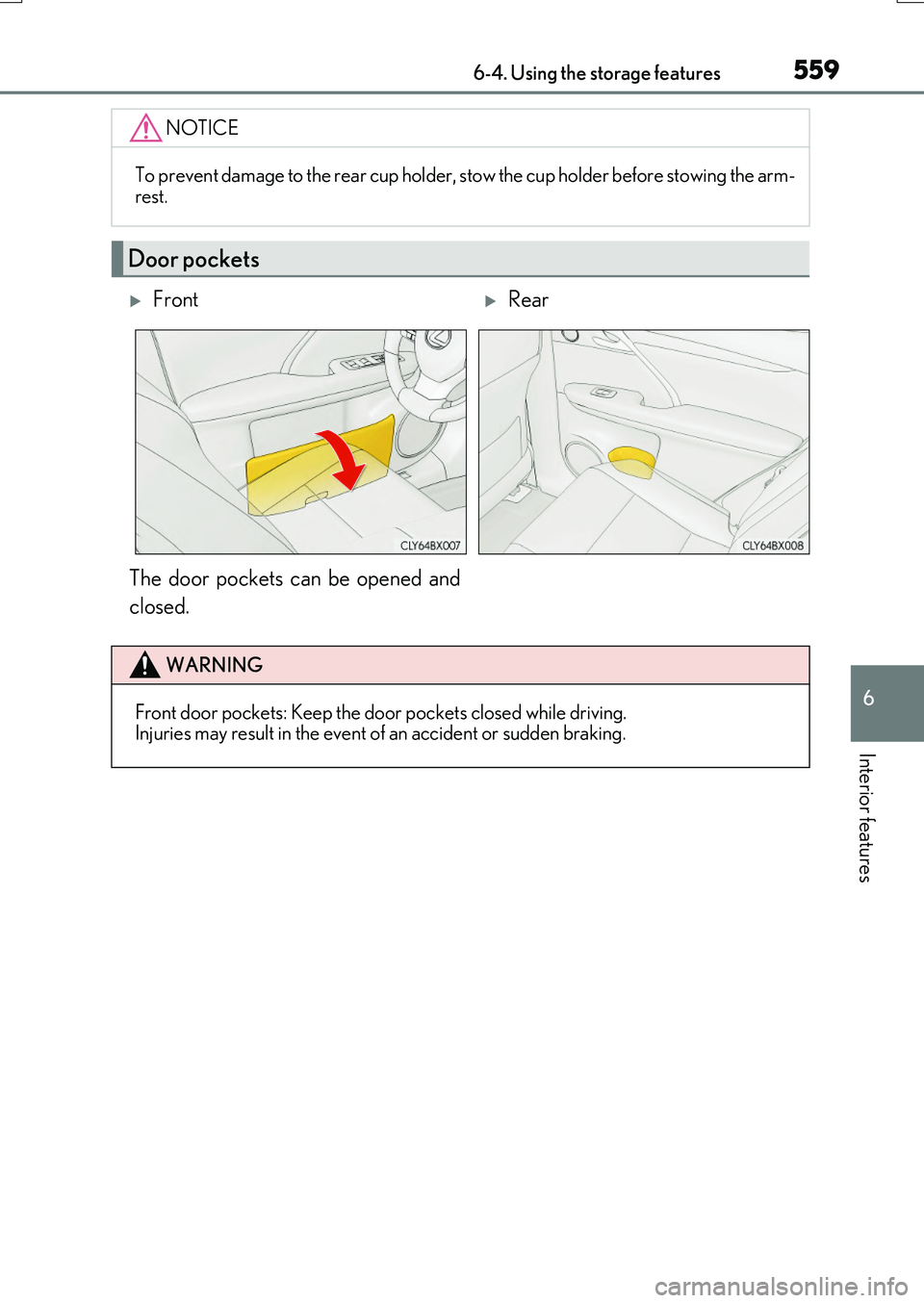
Door pockets
FrontRear
The door pockets can be opened and
closed.
WARNING
Front door pockets: Keep the door pockets closed while driving. Injuries may result in the event of an accident or sudden braking.
Page 603 of 776
6037-3. Do-it-yourself maintenance
7
Maintenance and care
RX350/RX200t_EE_OM48F32E
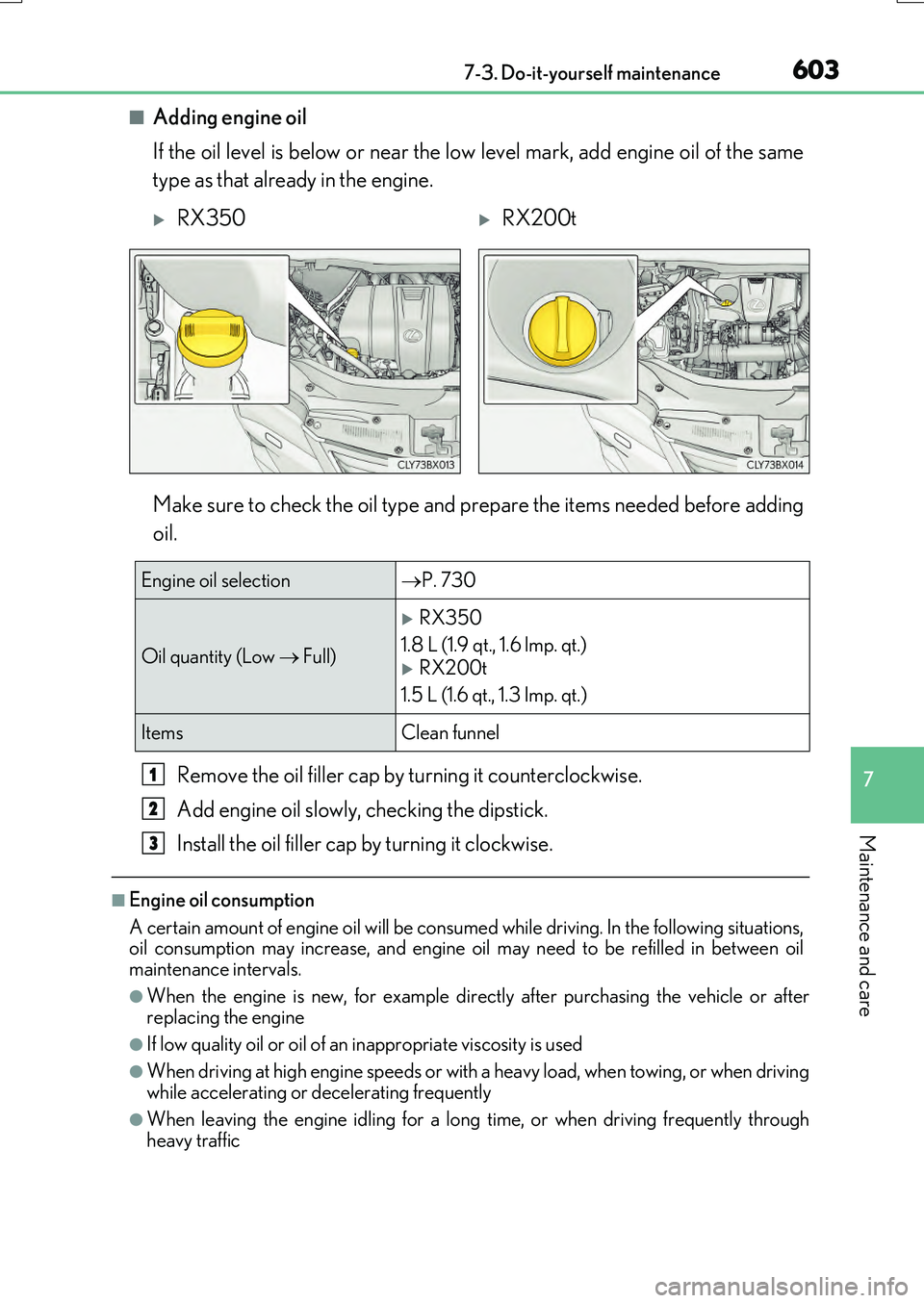
■Adding engine oil
If the oil level is below or near the low level mark, add engine oil of the same
type as that already in the engine.
Make sure to check the oil type and prepare the items needed before adding
oil.
Remove the oil filler cap by turning it counterclockwise.
Add engine oil slowly, checking the dipstick.
Install the oil filler cap by turning it clockwise.
■Engine oil consumption
A certain amount of engine oil will be consum ed while driving. In the following situations, oil consumption may increase, and engine o il may need to be refilled in between oil maintenance intervals.
●When the engine is new, for example directly after purchasing the vehicle or afterreplacing the engine
●If low quality oil or oil of an inappropriate viscosity is used
●When driving at high engine speeds or with a heavy load, when towing, or when driving while accelerating or decelerating frequently
●When leaving the engine idling for a long time, or when driving frequently through
heavy traffic
RX350RX200t
Engine oil selection P. 730
Oil quantity (Low Full)
RX350
1.8 L (1.9 qt., 1.6 lmp. qt.)
RX200t
1.5 L (1.6 qt., 1.3 Imp. qt.)
ItemsClean funnel
1
2
3
Page 658 of 776
658
RX350/RX200t_EE_OM48F32E
8-2. Steps to take in an emergency
The following may indicate a problem with your transmission. Contact any
authorized Lexus dealer or repairer, or another duly qualified and equipped pro-
fessional or commercial towing service before towing.
●The engine is running but the vehicle does not move.
●The vehicle makes an abnormal sound.
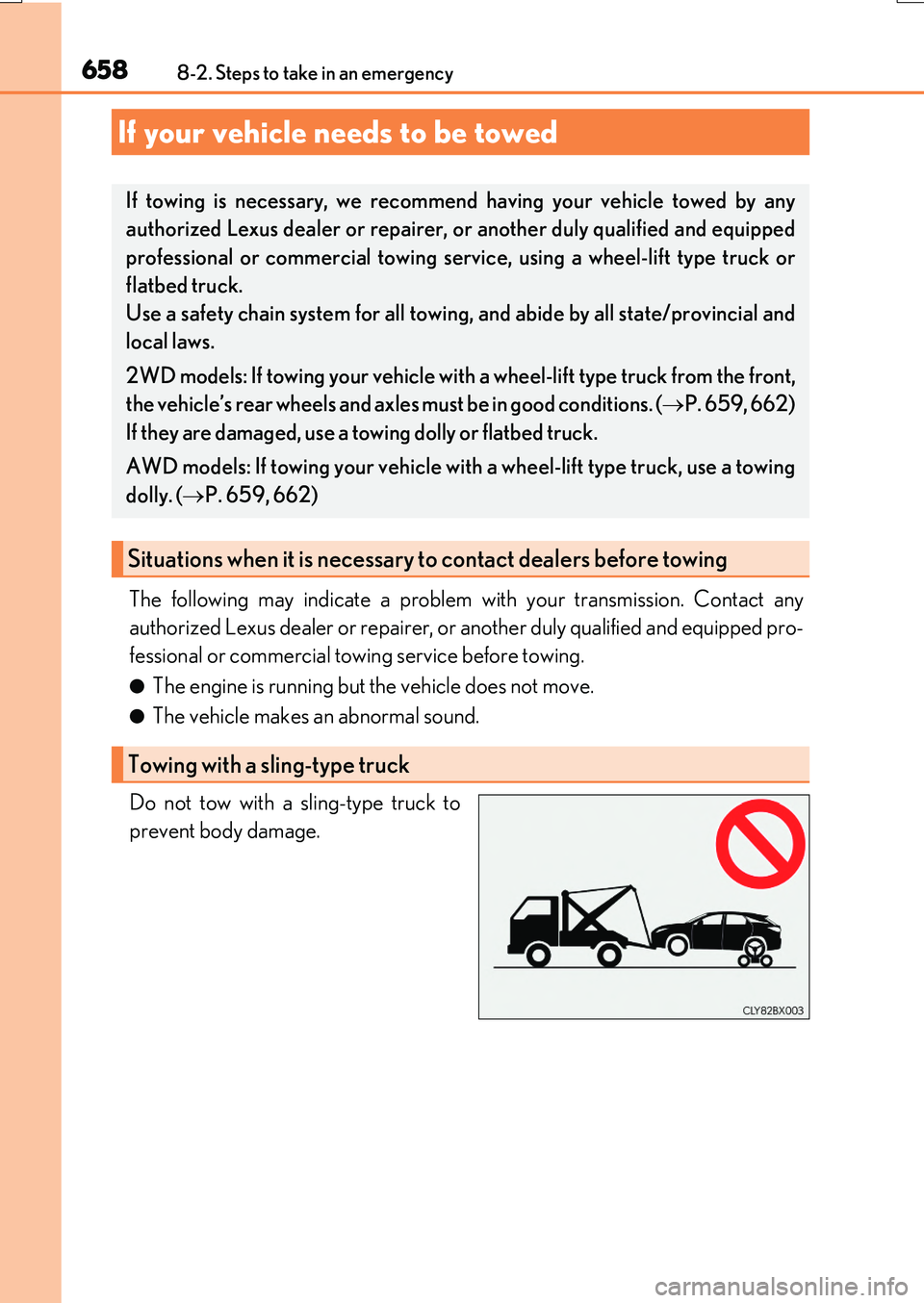
Do not tow with a sling-type truck to
prevent body damage.
If your vehicle needs to be towed
If towing is necessary, we recommend having your vehicle towed by any
authorized Lexus dealer or repairer , or another duly qualified and equipped
professional or commercial towing se rvice, using a wheel-lift type truck or
flatbed truck.
Use a safety chain system for all towing , and abide by all state/provincial and
local laws.
2WD models: If towing your vehicle with a wheel-lift type truck from the front,
the vehicle’s rear wheels and axles must be in good conditions. (P. 659, 662)
If they are damaged, use a towing dolly or flatbed truck.
AWD models: If towing your vehicle with a wheel-lift type truck, use a towing
dolly. ( P. 659, 662)
Situations when it is necessary to contact dealers before towing
Towing with a sling-type truck
Page 659 of 776
6598-2. Steps to take in an emergency
8
When trouble arises
RX350/RX200t_EE_OM48F32E
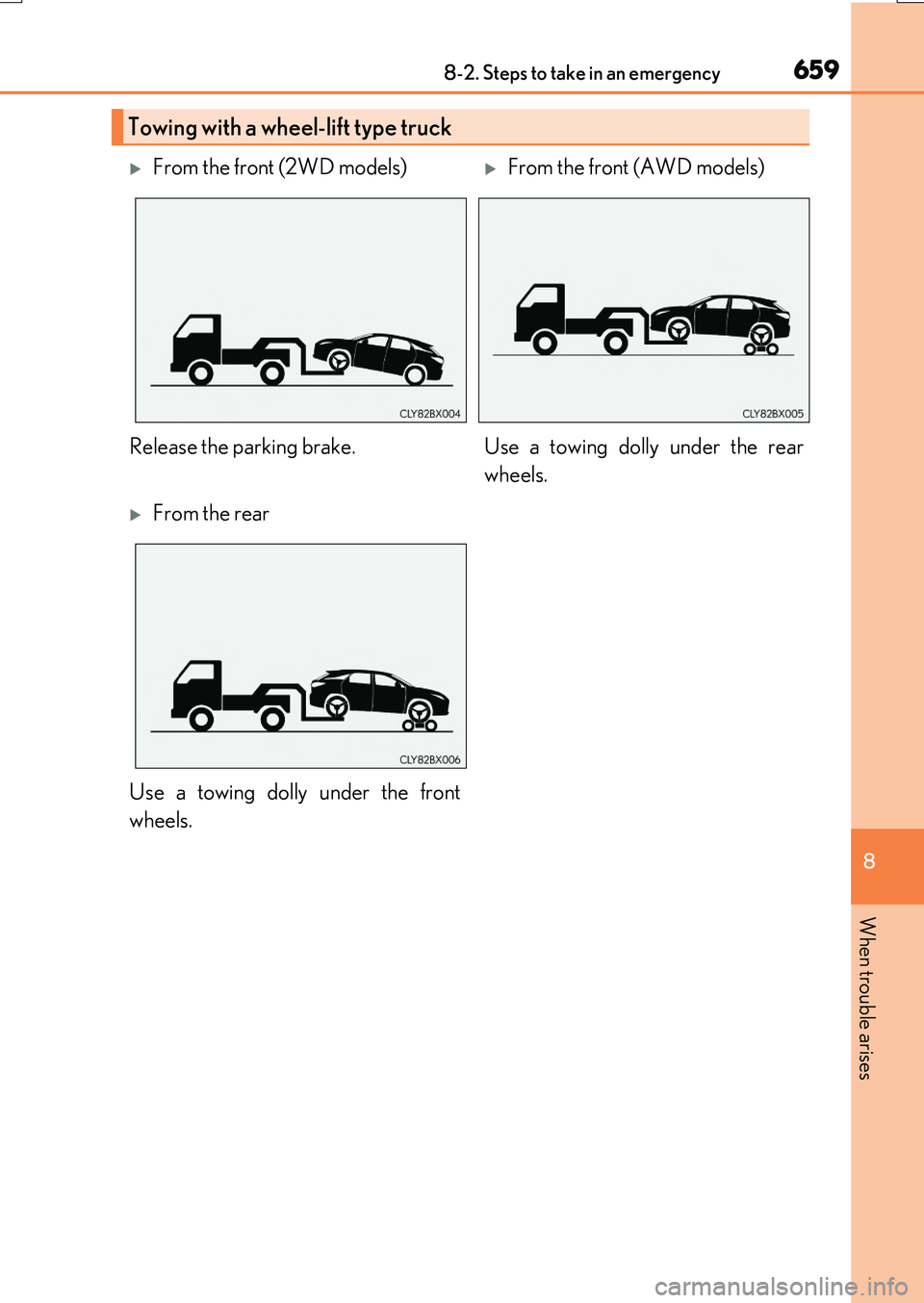
Towing with a wheel-lift type truck
From the front (2WD models)From the front (AWD models)
Release the parking brake. Use a towing dolly under the rear
wheels.
From the rear
Use a towing dolly under the front
wheels.
Page 660 of 776
6608-2. Steps to take in an emergency
RX350/RX200t_EE_OM48F32E
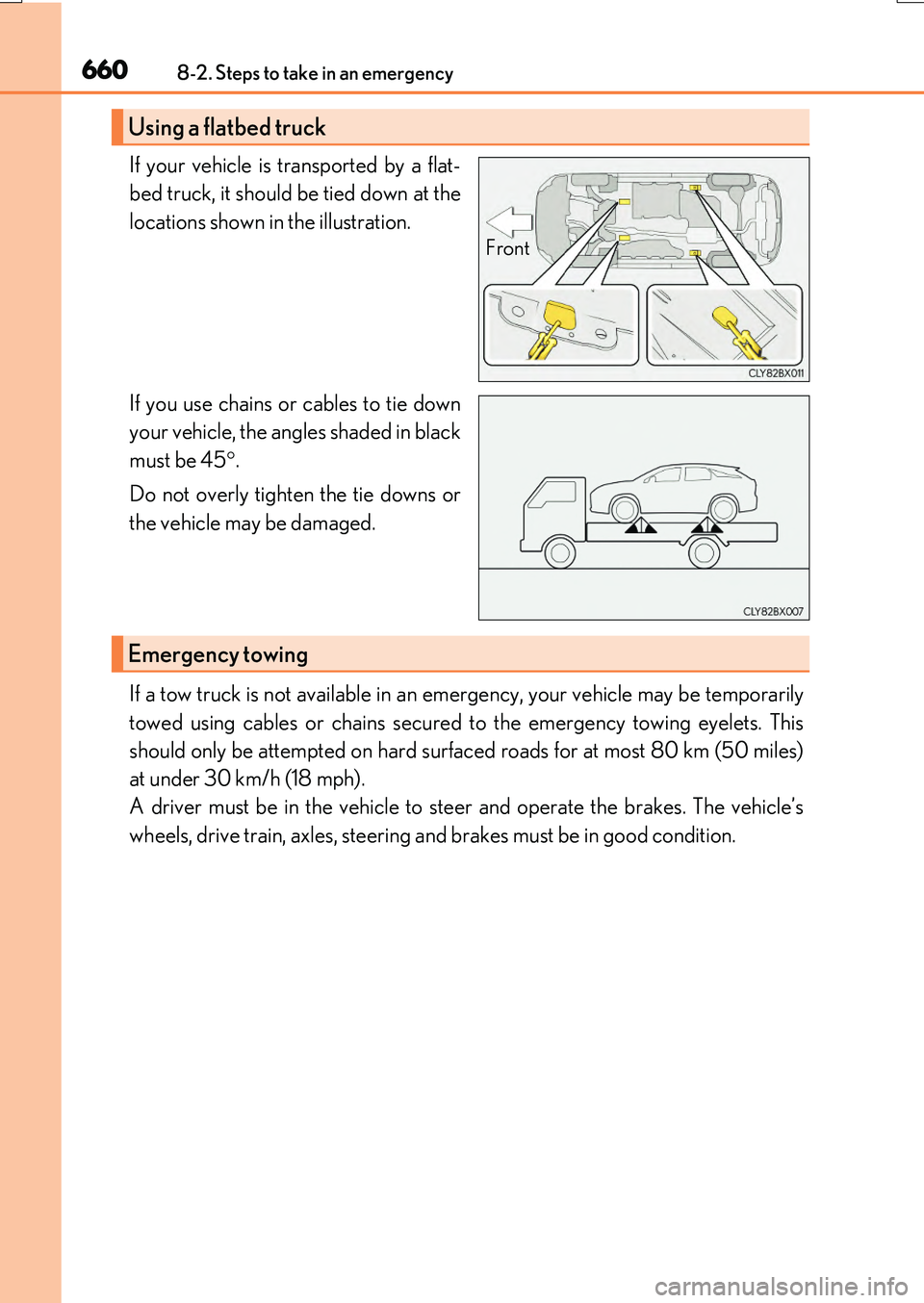
If your vehicle is transported by a flat-
bed truck, it should be tied down at the
locations shown in the illustration.
If you use chains or cables to tie down
your vehicle, the angles shaded in black
must be 45 .
Do not overly tighten the tie downs or
the vehicle may be damaged.
If a tow truck is not available in an emergency, your vehicle may be temporarily
towed using cables or chains secured to the emergency towing eyelets. This
should only be attempted on hard surfac ed roads for at most 80 km (50 miles)
at under 30 km/h (18 mph).
A driver must be in the vehicle to steer and operate the brakes. The vehicle’s
wheels, drive train, axles, steering and brakes must be in good condition.
Using a flatbed truck
Front
Emergency towing
Page 661 of 776
6618-2. Steps to take in an emergency
8
When trouble arises
RX350/RX200t_EE_OM48F32E
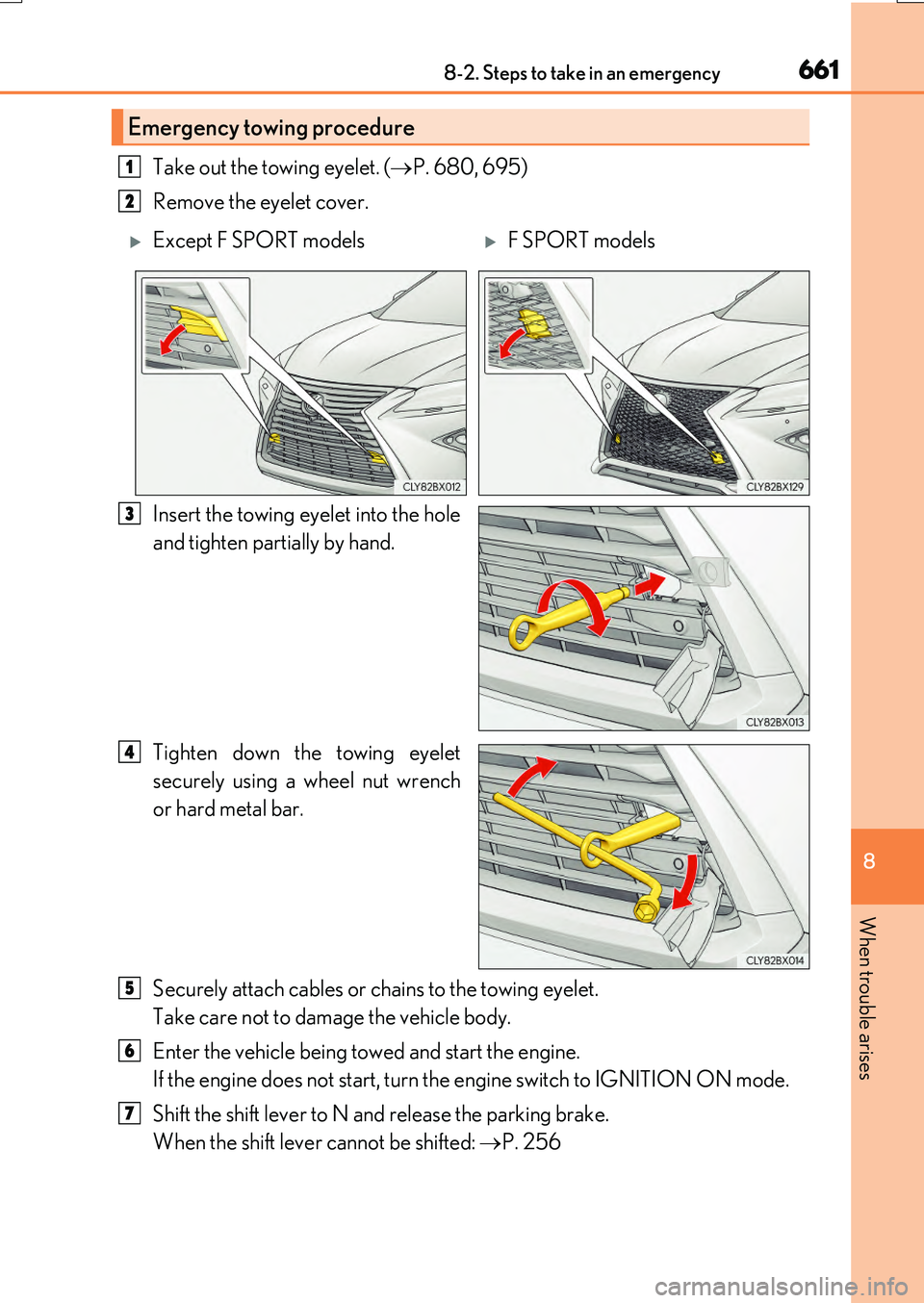
Take out the towing eyelet. (P. 680, 695)
Remove the eyelet cover.
Insert the towing eyelet into the hole
and tighten partially by hand.
Tighten down the towing eyelet
securely using a wheel nut wrench
or hard metal bar.
Securely attach cables or chains to the towing eyelet.
Take care not to damage the vehicle body.
Enter the vehicle being towed and start the engine.
If the engine does not start, turn the engine switch to IGNITION ON mode.
Shift the shift lever to N and release the parking brake.
When the shift lever cannot be shifted: P. 256
Emergency towing procedure
1
2
Except F SPORT modelsF SPORT models
3
4
5
6
7