ECU LEXUS RX200T 2017 Manual PDF
[x] Cancel search | Manufacturer: LEXUS, Model Year: 2017, Model line: RX200T, Model: LEXUS RX200T 2017Pages: 776, PDF Size: 44.51 MB
Page 663 of 776
6638-2. Steps to take in an emergency
8
When trouble arises
RX350/RX200t_EE_OM48F32E
WARNING
■While towing
●When towing using cables or chains, avoid sudden starts, etc. which place excessive stress on the towing eyelets, cables or ch ains. The towing eyelets, cables or chains
may become damaged, broken debris ma y hit people, and cause serious damage.
●Do not turn the engine switch off. There is a possibility that the steering wheel is locked and cannot be operated.
■Installing towing eyelets to the vehicle
Make sure that towing eyelets is installed securely. If not securely installed, towing ey elets may come loose during towing.
NOTICE
■To prevent damage to the vehicle when towing using a wheel-lift type truck
●Do not tow the vehicle from the rear when the engine switch is off. The steering lock mechanism is not strong enough to hold the front wheels straight.
●When raising the vehicle, ensure adequate ground clearance for towing at the oppo-
site end of the raised vehicle. Without adequate clearance, the vehicle could be dam- aged while being towed.
■To prevent body damage to the vehi cle towing with a sling-type truck
Do not tow with a sling-type truck, either from the front or rear.
■To prevent damage to the vehicle during emergency towing
Do not secure cables or chains to the suspension components.
■When towing a vehicle equipped with the Stop & Start system (RX200t)
When it is necessary to tow the vehicle with all 4 wheels contacting the ground, per- form the following procedure before towing the vehicle to protect the system.
Turn the engine switch off once, and then start the engine. If the engine does not start, turn the engine switch to IGNITION ON mode.
Page 683 of 776
6838-2. Steps to take in an emergency
8
When trouble arises
RX350/RX200t_EE_OM48F32E
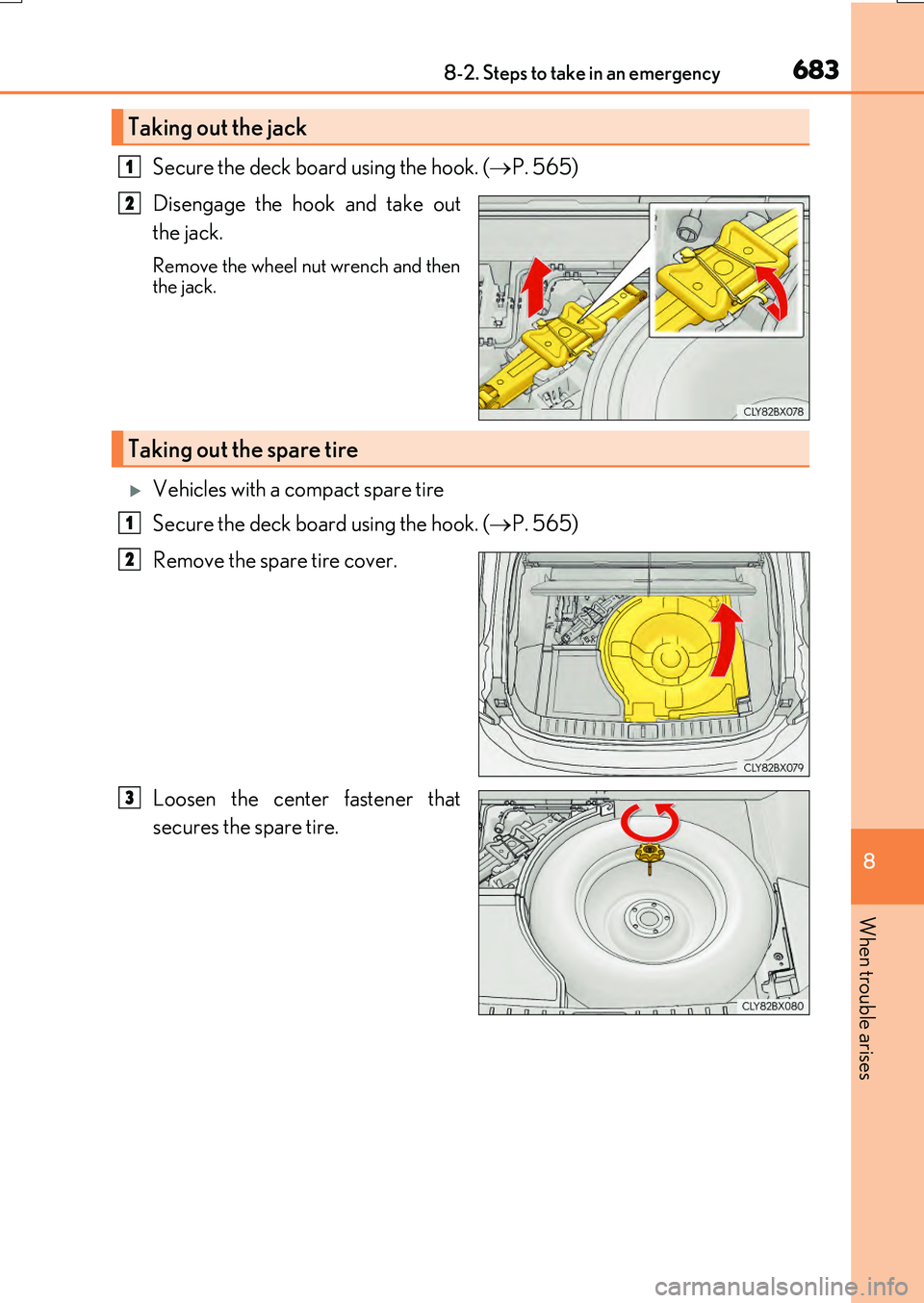
Secure the deck board using the hook. (P. 565)
Disengage the hook and take out
the jack.
Remove the wheel nut wrench and then the jack.
Vehicles with a compact spare tire
Secure the deck board using the hook. ( P. 565)
Remove the spare tire cover.
Loosen the center fastener that
secures the spare tire.
Taking out the jack
1
2
Taking out the spare tire
1
2
3
Page 684 of 776
6848-2. Steps to take in an emergency
RX350/RX200t_EE_OM48F32E
Vehicles with a full-size spare tire
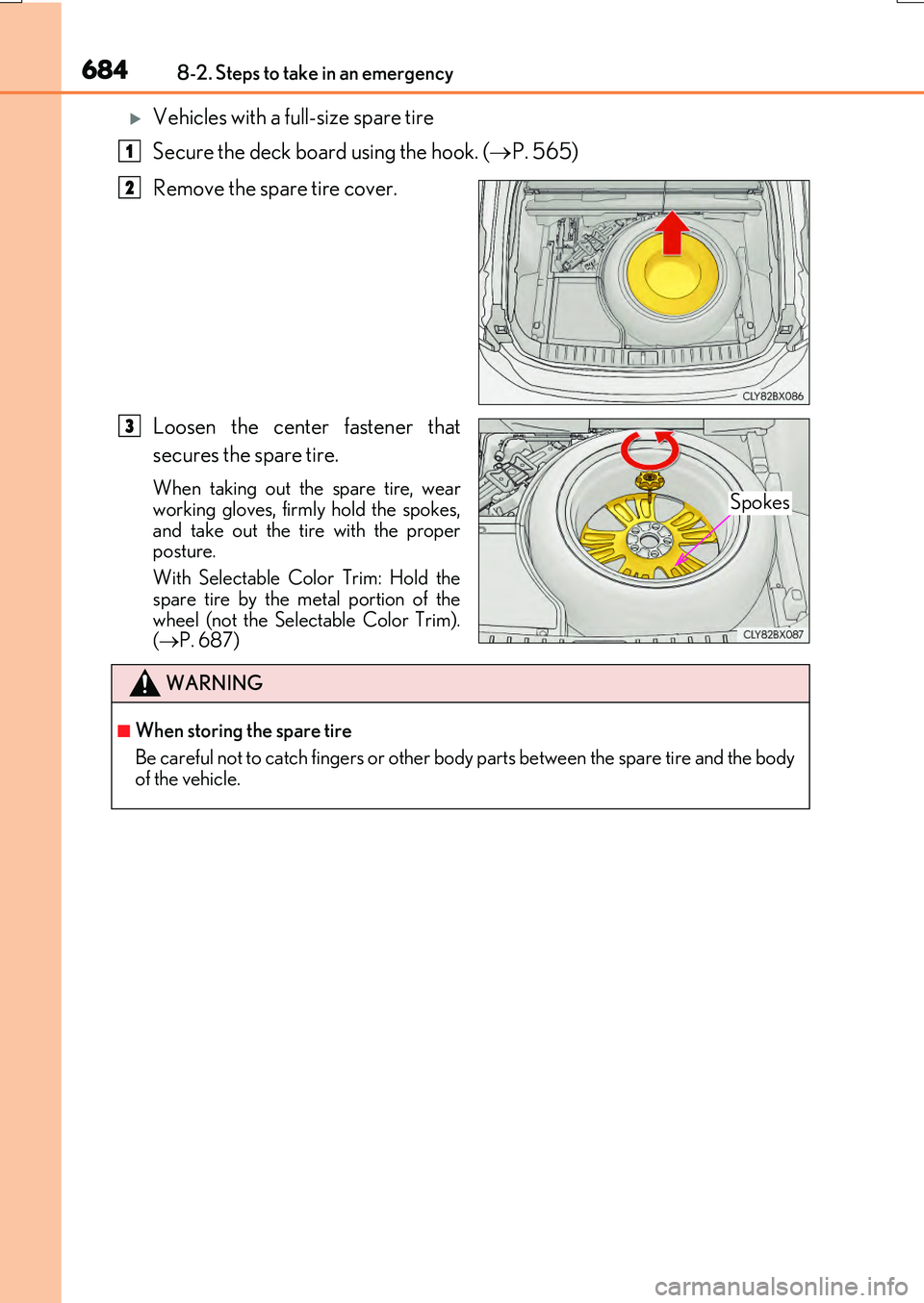
Secure the deck board using the hook. ( P. 565)
Remove the spare tire cover.
Loosen the center fastener that
secures the spare tire.
When taking out the spare tire, wear working gloves, firmly hold the spokes,
and take out the tire with the proper posture.
With Selectable Color Trim: Hold the
spare tire by the metal portion of the wheel (not the Selectable Color Trim).( P. 687)
1
2
Spokes
3
WARNING
■When storing the spare tire
Be careful not to catch fingers or other body parts between the spare tire and the body
of the vehicle.
Page 691 of 776
6918-2. Steps to take in an emergency
8
When trouble arises
RX350/RX200t_EE_OM48F32E
WARNING
■When using the compact spare tire (vehicles with a compact spare tire)
●Remember that the compact spare tire provided is specifically designed for use with your vehicle. Do not use your compact spare tire on another vehicle.
●Do not use more than one compact spare tire simultaneously.
●Replace the compact spare tire with a standard tire as soon as possible.
●Avoid sudden acceleration, abrupt steerin g, sudden braking and shifting operations
that cause sudden engine braking.
■When the compact spare tire is attached (vehicles with a compact spare tire)
The vehicle speed may not be correctly detected, and the following systems may not
operate correctly:
Also, not only can the following system not be utilized fully, but it may even negatively affect the drive-train components:
• AWD system (AWD models)
■Speed limit when using the compact spare tire (vehicles with a compact spare tire)
Do not drive at speeds in excess of 80 km /h (50 mph) when a compact spare tire is installed on the vehicle.
The compact spare tire is not designed for driving at high speeds. Failure to observe this precaution may lead to an accid ent causing death or serious injury.
■After using the tools and jack
Before driving, make sure all the tools and jack are securely in place in their storage location to reduce the possibility of personal injury during a collision or sudden brak- ing.
• ABS & Brake assist
•VSC •TRC• Trailer Sway Control
•EPS • VDIM (if equipped)• Adaptive Variable Suspension System
(if equipped) • Cruise control (if equipped)• Dynamic radar cruise control with full-
speed range (if equipped) • PCS (Pre-Crash Safety system) (ifequipped)
• LKA (Lane-Keeping Assist) (if
equipped) • RSA (Road Sign Assist) (if equipped)• Automatic High Beam (if equipped)
• AHS (Adaptive High-beam System) (if equipped)• Tire pressure warning system
• Lexus parking assist-sensor (if equipped)• Intelligent Clearance Sonar (ICS) (if
equipped) • Lexus parking assist monitor (ifequipped)
• Panoramic view monitor (if equipped) • BSM (Blind Spot Monitor) (ifequipped)
• Navigation system (if equipped)
Page 697 of 776
6978-2. Steps to take in an emergency
8
When trouble arises
RX350/RX200t_EE_OM48F32E
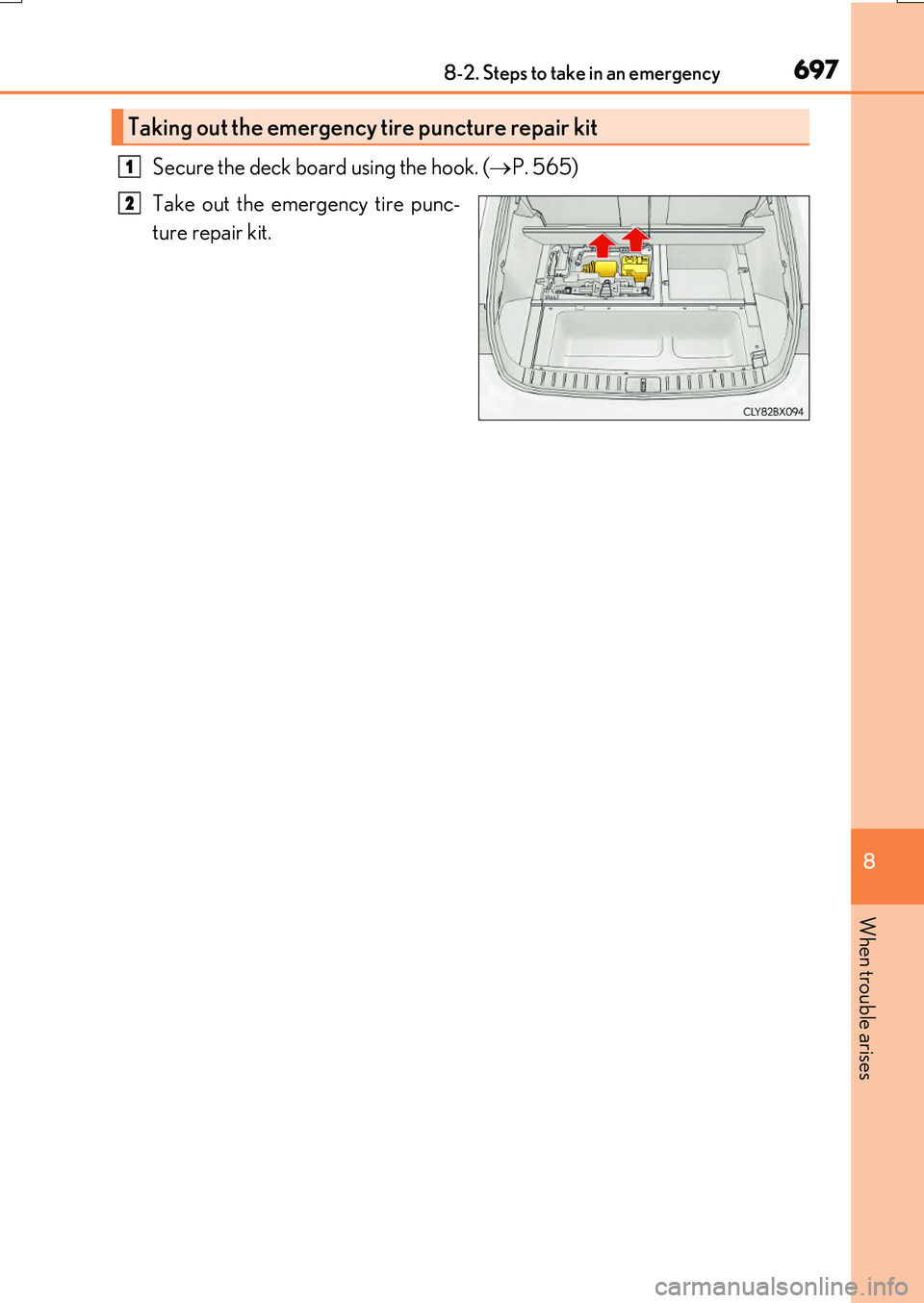
Secure the deck board using the hook. (P. 565)
Take out the emergency tire punc-
ture repair kit.
Taking out the emergency tire puncture repair kit
1
2
Page 699 of 776
6998-2. Steps to take in an emergency
8
When trouble arises
RX350/RX200t_EE_OM48F32E
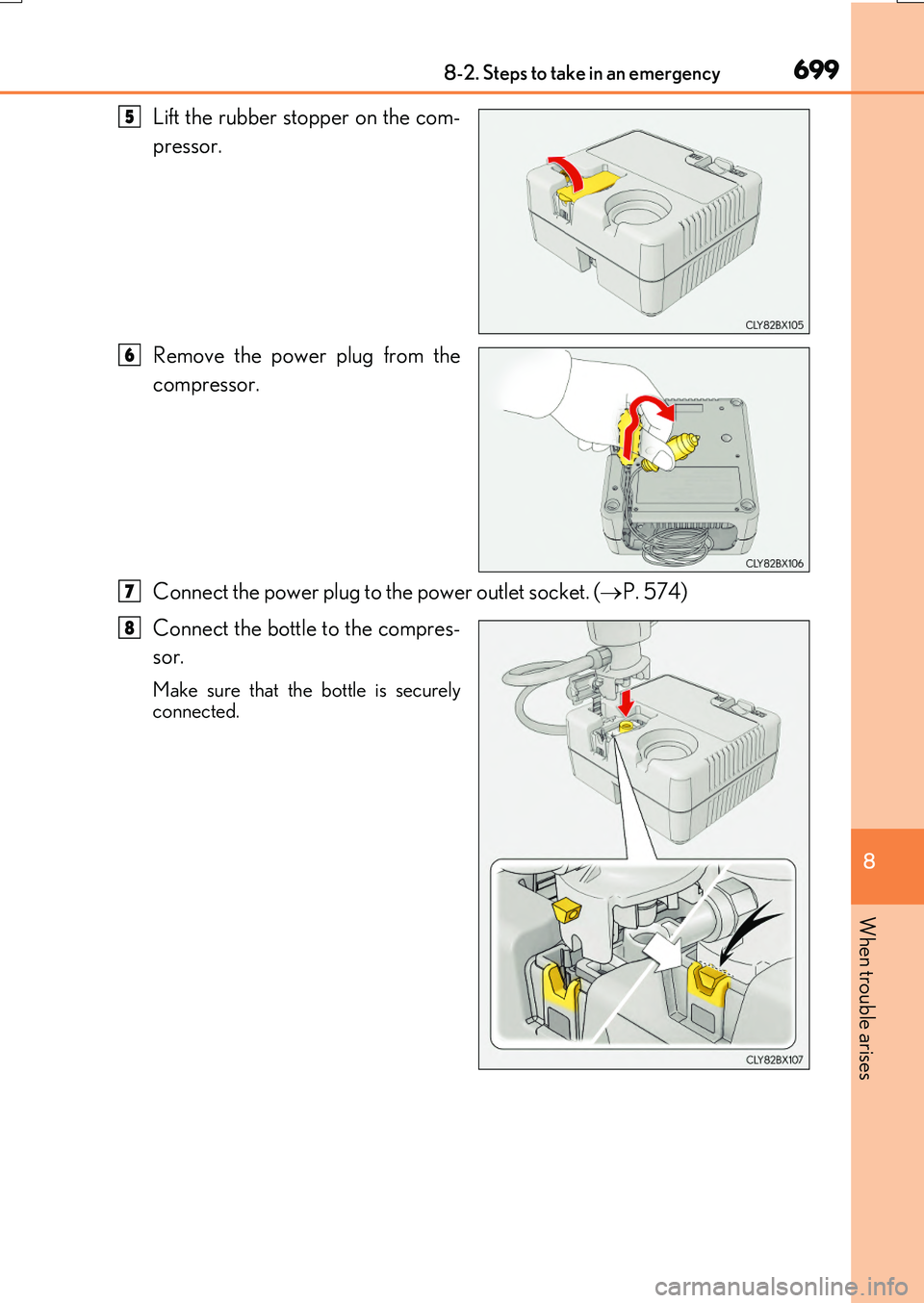
Lift the rubber stopper on the com-
pressor.
Remove the power plug from the
compressor.
Connect the power plug to the power outlet socket. ( P. 574)
Connect the bottle to the compres-
sor.
Make sure that the bottle is securely connected.
5
6
7
8
Page 706 of 776
7068-2. Steps to take in an emergency
RX350/RX200t_EE_OM48F32E
WARNING
■When fixing the flat tire
●Stop your vehicle in a safe and flat area.
●Do not touch the wheels or the area around the brakes immediately after the vehicle
has been driven. After the vehicle has been driven, the wheels and the area around the brakes may beextremely hot. Touching these areas with hands, feet or other body parts may result in
burns.
●Connect the valve and hose securely with the tire installed on the vehicle.
●If the hose is not properly connected to the valve, air leakage may occur or sealant
may be sprayed out.
●If the hose comes off the valve while inflating the tire, there is a risk that the hose will move abruptly due to air pressure.
●After inflation of the tire has completed, the sealant may splatter when the hose is dis-connected or some air is let out of the tire.
●Follow the operation procedure to repair the tire. If the procedure is not followed, the
sealant may spray out.
●Keep back from the tire while it is being repaired, as there is a chance of it bursting while the repair operation is being performe d. If you notice any cracks or deforma-
tion of the tire, turn off the compressor sw itch and stop the repair operation immedi- ately.
●The kit may overheat if operated for a long period of time. Do not operate the com-
pressor continuously for more than 40 minutes.
●Parts of the kit become hot during operatio n. Be careful handling the kit during and after operation. Do not touch the metal part around the connecting area between the
bottle and compressor. It will be extremely hot.
●Do not attach the vehicle speed warning sticker to an area other than the one indi- cated. If the sticker is attached to an area where an SRS airbag is located, such as the
pad of the steering wheel, it may prevent the SRS air bag from operating properly.
■Driving to spread the liquid sealant evenly
●Drive the vehicle carefully at a low speed. Be especially careful when turning and cor-
nering.
●If the vehicle does not drive straight or you feel a pull through the steering wheel, stop the vehicle and check the following:
• Tire condition. The tire may have separated from the wheel. • Tire inflation pressure. If tire inflation pressure is 130 kPa (1.3 kgf/cm2 or b ar, 1 9 p si)or below, this may indica te severe tire damage.