belt LEXUS RX350 2015 Owner's Manual
[x] Cancel search | Manufacturer: LEXUS, Model Year: 2015, Model line: RX350, Model: LEXUS RX350 2015Pages: 886, PDF Size: 11 MB
Page 88 of 886

881-3. Adjustable components (s eats, mirrors, steering wheel)
CAUTION■
Seat belt pretensioners ●
Do not place anything, such as a cushion, on the front passenger's seat. Doing so
will disperse the passenger's weight, wh ich prevents the sensor from detecting
the passenger's weight properly. As a resu lt, the seat belt pretensioner for the
front passenger's seat may not activate in the event of a collision.●
If the pretensioner has activated, the SRS warning light will come on. In that case,
the seat belt cannot be used again and must be replaced at your Lexus dealer.■
Adjustable shoulder anchor
Always make sure the shoulder belt is positioned across the center of your shoul-
der. The belt should be kept away from yo ur neck, but not falling off your shoulder.
Failure to do so could reduce the amount of protection in an accident and cause
death or serious injuries in the event of a sudden stop, sudden swerve or accident.
( P. 8 4 )■
Seat belt damage and wear ●
Do not damage the seat belts by allowing the belt, plate, or buckle to be jammed
in the door.●
Inspect the seat belt system periodically. Check for cuts, fraying, and loose parts.
Do not use a damaged seat belt until it is replaced. Damaged seat belts cannot
protect an occupant from death or serious injury.●
Ensure that the belt and tab are lo cked and the belt is not twisted.
If the seat belt does not function co rrectly, immediately contact your Lexus
dealer.●
Replace the seat assembly, including the belt s, if your vehicle has been involved in
a serious accident, even if there is no obvious damage.●
Do not attempt to install, remove, modify, disassemble or dispose of the seat belts.
Have any necessary repairs carried out by your Lexus dealer. Inappropriate han-
dling of the pretensioner may prevent it from operating properly, resulting in
death or serious injury.
Page 89 of 886
891-3. Adjustable components (seats, mirrors, steering wheel)
1
Before driving CAUTION■
Using a seat belt extender ●
Do not wear the seat belt extender if you can fasten the seat belt without the
extender.●
Do not use the seat belt extender when installing a child restraint system because
the belt will not securely hold the child restraint system, increasing the risk of
death or serious injury in the event of an accident.●
The personalized extender may not be safe on another vehicle, when used by
another person, or at a different seatin g position other than the one originally
intended.
NOTICE■
When using a seat belt extender
When releasing the seat belt, press on the buckle release button on the extender,
not on the seat belt.
This helps prevent damage to the vehi cle interior and the extender itself.
Page 91 of 886
911-3. Adjustable components (seats, mirrors, steering wheel)
1
Before driving ■
The steering wheel can be adjusted when
The “ENGINE START STOP” switch is in ACCESSORY or IGNITION ON
mode*.
*: Vehicles with driving position memory: If the driver's seat belt is fastened, the
steering wheel can be adjusted regard less of “ENGINE START STOP” switch
mode.■
Automatic adjustment of the steering position (vehicles with driving position
memory)
A desired steering position can be ente red to memory and recalled automatically
by the driving position memory. ( P. 76 )■
Notes for the auto tilt away function (vehicles with driving position memory)
The auto tilt away function can only operate when the “ENGINE START STOP”
switch has been turned off, the driver seat belt has been unfastened and the driver’s
seat movement ( P. 834) is in a setting other than off.
When the driver fastens the seat belt again, the steering wheel will return to the
original position. ( P. 7 8 )
CAUTION■
Caution while driving
Do not adjust the steering wheel while driving.
Doing so may cause the driver to mishandle the vehicle and cause an accident,
resulting in death or serious injury.
Page 117 of 886
1171
Before driving 1-7. Safety information
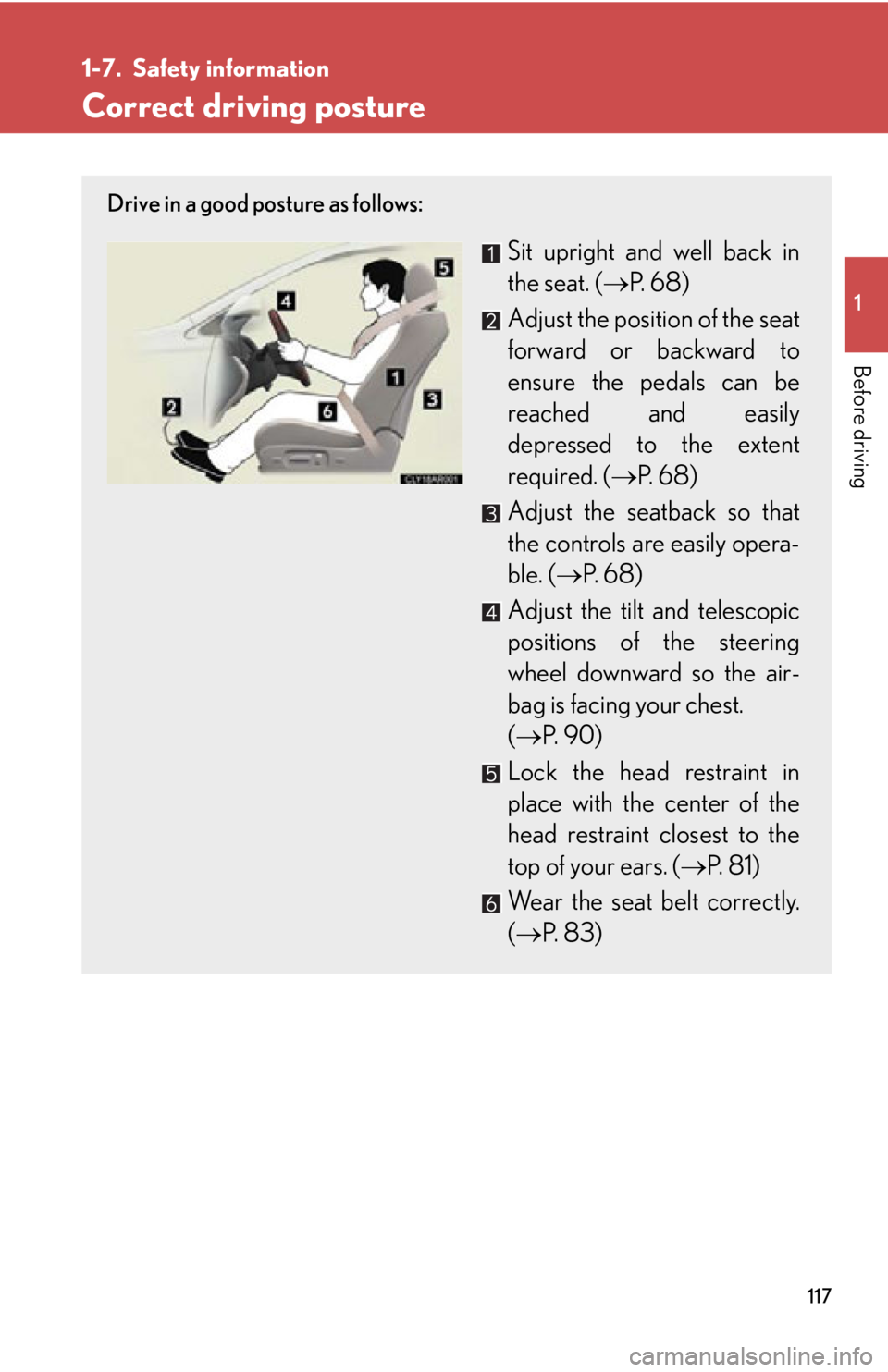
Correct driving posture Drive in a good posture as follows:
Sit upright and well back in
the seat. ( P. 6 8 )
Adjust the position of the seat
forward or backward to
ensure the pedals can be
reached and easily
depressed to the extent
required. ( P. 6 8 )
Adjust the seatback so that
the controls are easily opera-
ble. ( P. 6 8 )
Adjust the tilt and telescopic
positions of the steering
wheel downward so the air-
bag is facing your chest.
( P. 9 0 )
Lock the head restraint in
place with the center of the
head restraint closest to the
top of your ears. ( P. 8 1 )
Wear the seat belt correctly.
( P. 8 3 )
Page 118 of 886
1181-7. Safety information
CAUTION■
While driving ●
Do not adjust the position of the driver’s seat.
Doing so could cause the driver to lose control of the vehicle.●
Do not place a cushion between the driver or passenger and the seatback.
A cushion may prevent correct posture from being achieved, and reduce the
effectiveness of the seat belt and head re straint, increasing the risk of death or
serious injury to the driver or passenger.●
Do not place anything under the front seats.
Objects placed under the front seats may become jammed in the seat tracks and
stop the seat from locking in place. This may lead to an accident, resulting in
death or serious injury. The adjustment mechanism may also be damaged.■
Adjusting the seat position ●
Take care when adjusting the seat position to ensure that other passengers are
not injured by the moving seat.●
Do not put your hands under the seat or near the moving parts to avoid injury.
Fingers or hands may become jammed in the seat mechanism.
Page 119 of 886
11911-7. Safety information
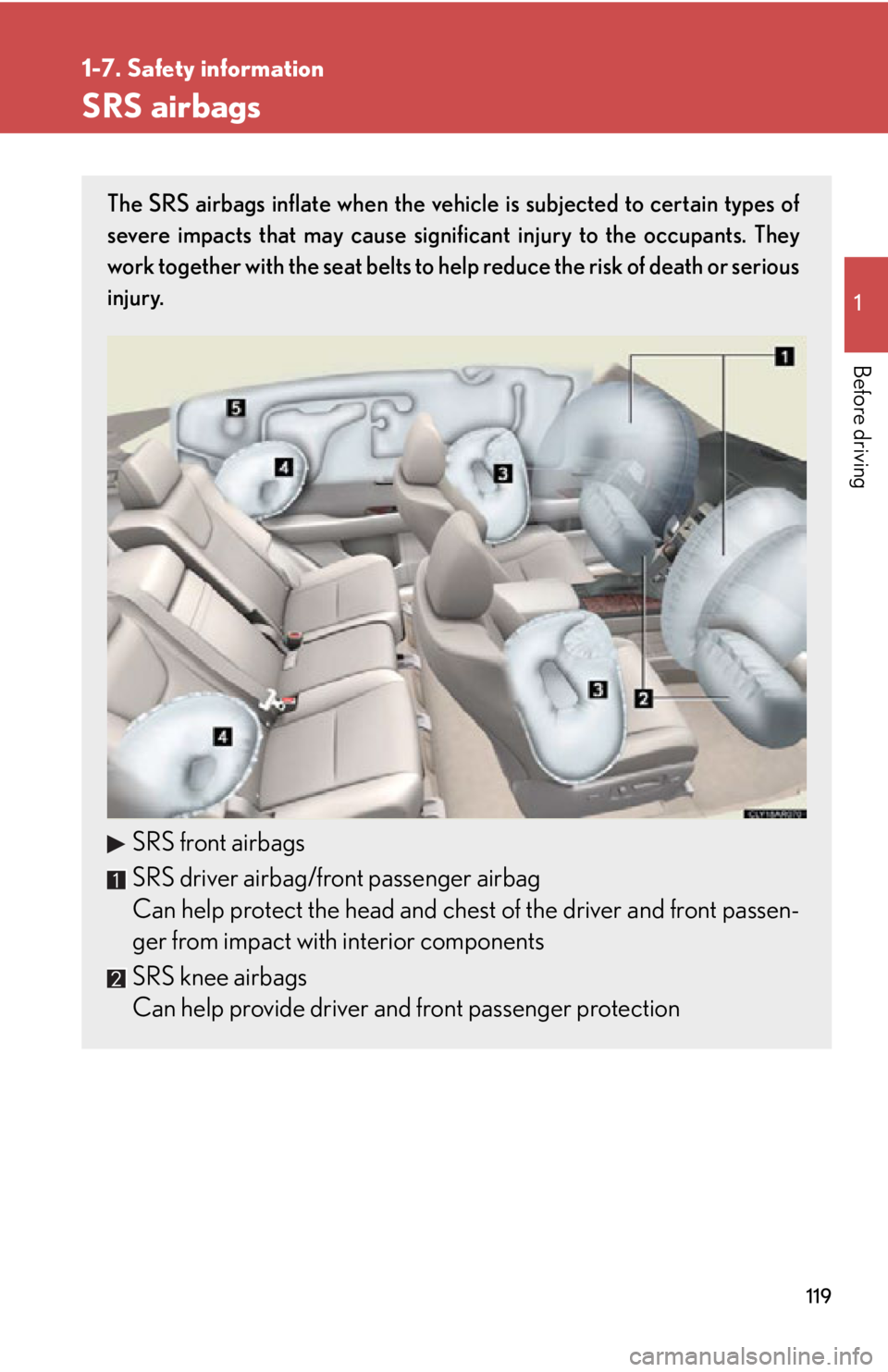
Before driving SRS airbags The SRS airbags inflate when the vehi cle is subjected to certain types of
severe impacts that may cause significant injury to the occupants. They
work together with the seat belts to he lp reduce the risk of death or serious
injury.
SRS front airbags
SRS driver airbag/front passenger airbag
Can help protect the head and ches t of the driver and front passen-
ger from impact with interior components
SRS knee airbags
Can help provide driver and front passenger protection
Page 121 of 886

1211-7. Safety information
1
Before driving SRS airbag system components
Knee airbags
Front passenger airbag
Curtain shield airbags
Front side airbags
Front passenger occupant
classification system
(ECU and sensors)
“AIR BAG ON” and “AIR BAG
OFF” indicator lights
Rear side airbags
SRS warning light
Driver airbag Curtain shield and rear side
airbag sensors
Driver's seat belt buckle
switch
Driver's seat position sensor
Airbag sensor assembly
Front airbag sensors
Front passenger’s seat belt
buckle switch
Door sensors
Seat belt pretensioners and
force limiters
Page 123 of 886
1231-7. Safety information
1
Before driving ●
Depending on the type of collision, it is possible that only the seat belt preten-
sioners will activate.●
The SRS front airbags for the front passenger will not activate if there is no pas-
senger sitting in the front passenger seat . However, the SRS front airbags for the
front passenger may deploy if luggage is put in the seat, even if the seat is unoc-
cupied. ( P. 1 3 2 )■
SRS airbag deployment conditions (SRS side airbags and curtain shield airbags)
The SRS side airbags and SRS curtain shield airbags will deploy in the event of an
impact that exceeds the set threshold level (the level of force corresponding to the
impact force produced by an approximately 3300 lb. [1500 kg] vehicle colliding
with the vehicle cabin from a direction perp endicular to the vehicle orientation at an
approximate speed of 12 - 18 mph [20 - 30 km/h]).
The SRS curtain shield airbags will deploy in the event of vehicle rollover.■
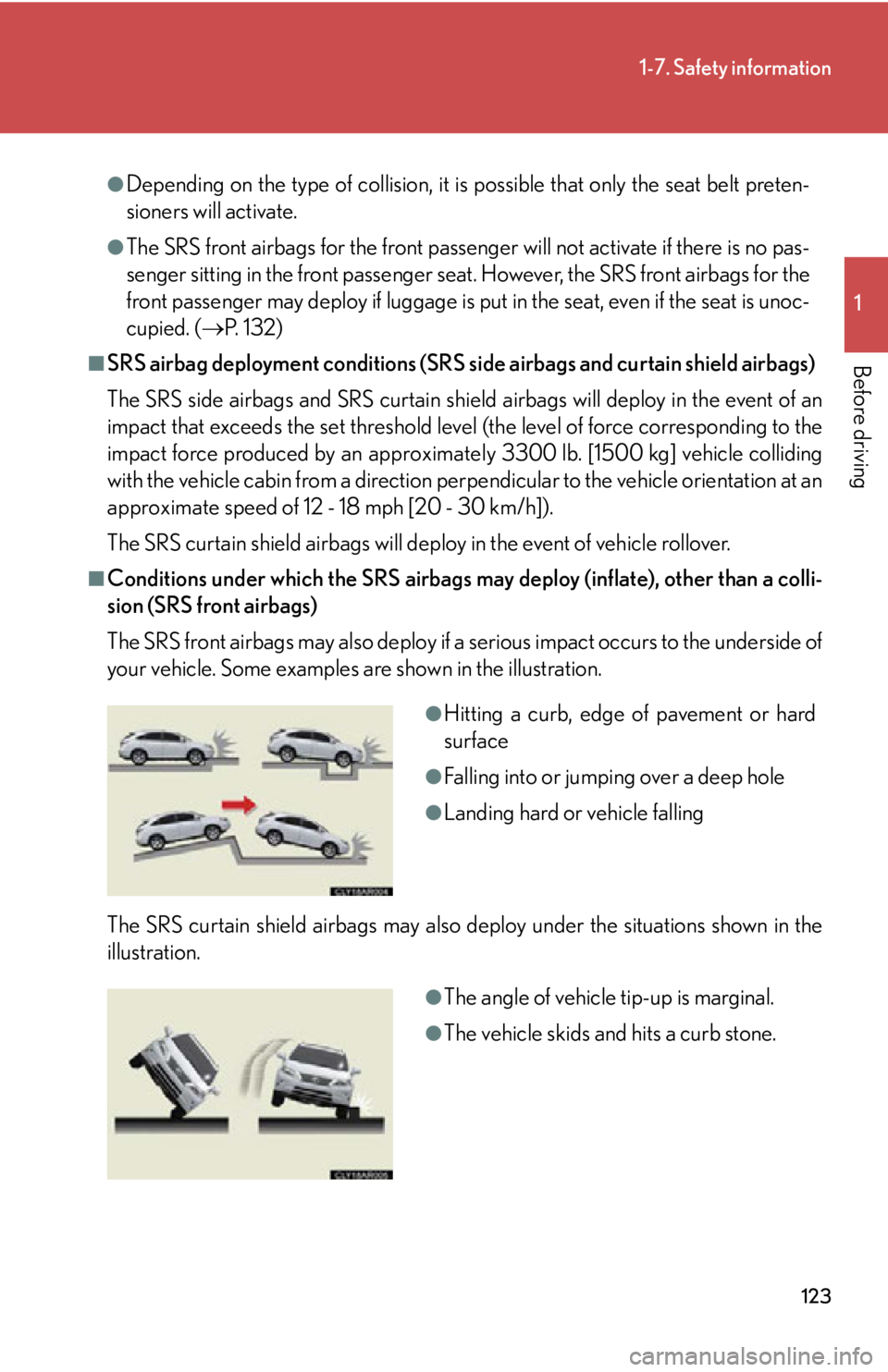
Conditions under which the SRS airbags may deploy (inflate), other than a colli-
sion (SRS front airbags)
The SRS front airbags may also deploy if a serious impact occurs to the underside of
your vehicle. Some examples are shown in the illustration.
The SRS curtain shield airbags may also deploy under the situations shown in the
illustration. ●
Hitting a curb, edge of pavement or hard
surface ●
Falling into or jumping over a deep hole ●
Landing hard or vehicle falling
●
The angle of vehicle tip-up is marginal.
●
The vehicle skids and hits a curb stone.
Page 127 of 886

1271-7. Safety information
1
Before driving CAUTION■
SRS airbag precautions
Observe the following precautions regarding the SRS airbags.
Failure to do so may cause death or serious injury. ●
The driver and all passengers in the vehi cle must wear their seat belts properly.
The SRS airbags are supplemental devices to be used with the seat belts.●
The SRS driver airbag deploys with considerable force, and can cause death or
serious injury especially if the driver is very close to the airbag. The National
Highway Traffic Safety Administration (“NHTSA”) advises:
Since the risk zone for driver’s airbag is the first 2 - 3 in. (50 - 75 mm) of inflation,
placing yourself 10 in. (250 mm) from your driver airbag provides you with a
clear margin of safety. This distance is measured from the center of the steering
wheel to your breastbone. If you sit less than 10 in. (250 mm) away now, you can
change your driving position in several ways:
• Move your seat to the rear as far as you can while still reaching the pedals
comfortably.
• Slightly recline the back of the seat.
Although vehicle designs vary, many dr ivers can achieve the 10 in. (250 mm)
distance, even with the driver seat all the way forward, simply by reclining the
back of the seat somewhat. If reclining the back of your seat makes it hard to
see the road, raise yourself by using a firm, non-slippery cushion, or raise the
seat if your vehicle has that feature.
• If your steering wheel is adjustable, ti lt it downward. This points the airbag
toward your chest instead of your head and neck.
The seat should be adjusted as recommended by NHTSA above, while still main-
taining control of the foot pedals, steering wheel, and your view of the instrument
panel controls.
Page 128 of 886
1281-7. Safety information
CAUTION■
SRS airbag precautions
●
The SRS front passenger airbag also depl oys with considerable force, and can
cause death or serious injury especially if the front passenger is very close to the
airbag. The front passenger seat should be as far from the airbag as possible with
the seatback adjusted, so the front passenger sits upright.●
Improperly seated and/or restrained infants and children can be killed or seri-
ously injured by a deploying airbag. An infant or child who is too small to use a
seat belt should be properly secured us ing a child restraint system. Lexus strongly
recommends that all infants and children be placed in the rear seats of the vehicle
and properly restrained. The rear seats ar e safer for infants and children than the
front passenger seat. ( P. 1 3 7 ) ●
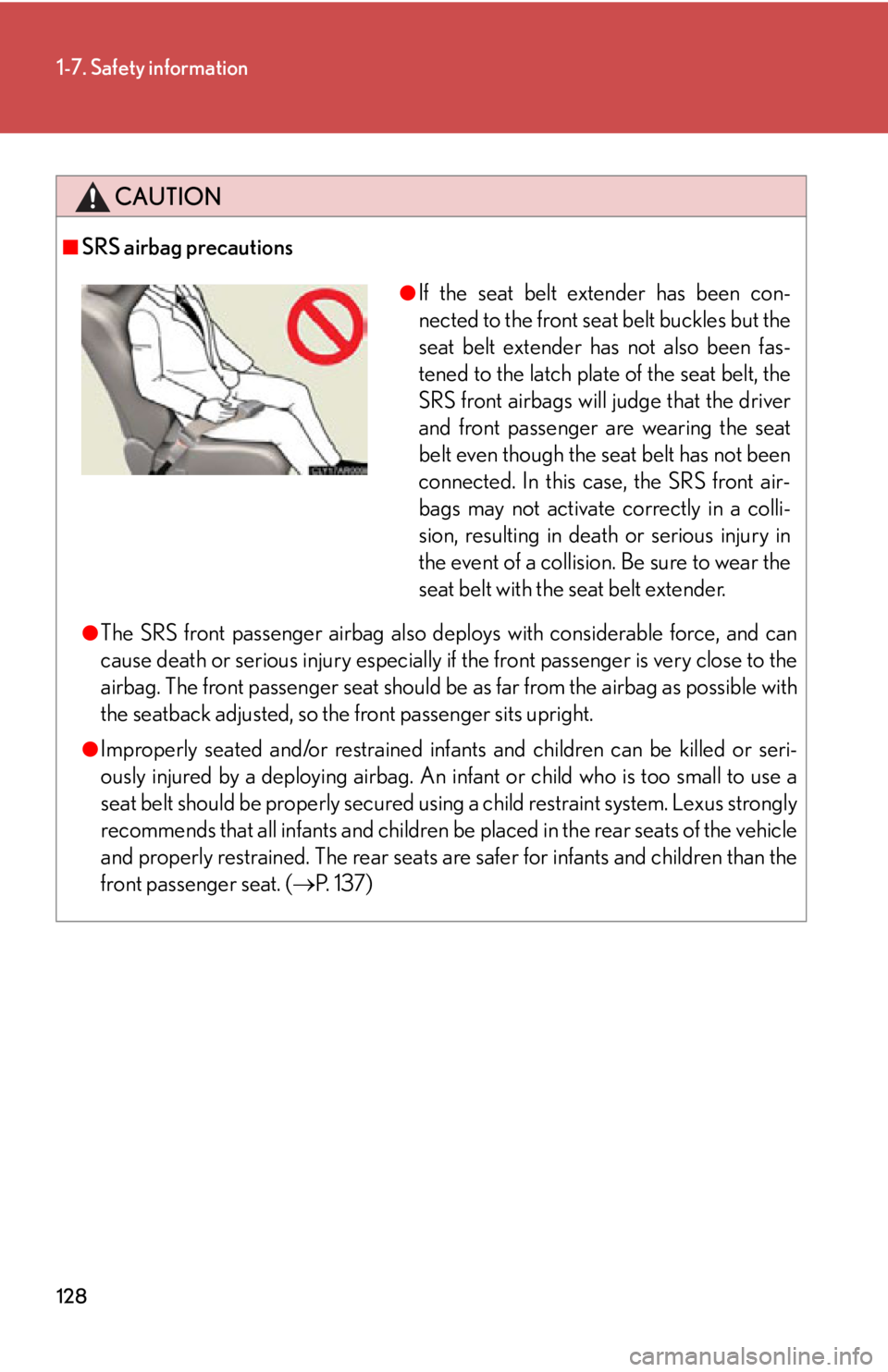
If the seat belt extender has been con-
nected to the front seat belt buckles but the
seat belt extender has not also been fas-
tened to the latch plate of the seat belt, the
SRS front airbags will judge that the driver
and front passenger are wearing the seat
belt even though the seat belt has not been
connected. In this case, the SRS front air-
bags may not activate correctly in a colli-
sion, resulting in death or serious injury in
the event of a collision. Be sure to wear the
seat belt with the seat belt extender.