tow LEXUS RX350 2015 Owner's Manual
[x] Cancel search | Manufacturer: LEXUS, Model Year: 2015, Model line: RX350, Model: LEXUS RX350 2015Pages: 886, PDF Size: 11 MB
Page 243 of 886
2432-4. Using other driving systems
2
When driving CAUTION■
Situations unsuitable for dynamic radar cruise control
Do not use dynamic radar cruise contro l in any of the following situations.
Doing so may result in inappropriate sp eed control and could cause an accident
resulting in death or serious injury. ●
In heavy traffic●
On roads with sharp bends●
On winding roads●
On slippery roads, such as thos e covered with rain, ice or snow●
On steep downhills, or where there are sudden changes between sharp up and
down gradients
Vehicle speed may exceed the set speed when driving down a steep hill.●
At entrances to expressways●
When weather conditions are bad enough that they may prevent the sensors
from functioning correctly (fog, sn ow, sandstorm, heavy rain, etc.)●
When an approach warning buzzer is heard often●
When your vehicle is towing a trailer or during emergency towing■
When the sensor may not be correctly detecting the vehicle ahead
Apply the brakes as necessary when any of the following types of vehicles are in
front of you.
As the sensor may not be able to correctly detect these types of vehicles, the
approach warning ( P. 237) will not be activated, and a fatal or serious accident
may result. ●
Vehicles that cut in suddenly●
Vehicles traveling at low speeds●
Vehicles that are not moving
●
Vehicles with small rear ends (tra ilers with no load on board etc.)
●
Motorcycles traveling in the same lane
Page 253 of 886

2532-4. Using other driving systems
2
When driving ■
Sensor detection information ●
Certain vehicle conditions and the su rrounding environment may affect the
ability of a sensor to correctly detect an obstacle. Particular instances where this
may occur are listed below.
• There is dirt, snow or ice on a sensor.
• A sensor is frozen.
• A sensor is covered in any way.
• The vehicle is leaning considerably to one side.
• On an extremely bumpy road, on an incline, on gravel, or on grass
• The vicinity of the vehicle is noisy due to vehicle horns, motorcycle engines,
air brakes of large vehicles, or other loud noises producing ultrasonic waves.
• There is another vehicle equipped with parking assist sensor s in the vicinity.
• A sensor is coated with a sheet of spray or heavy rain.
• The vehicle is equipped with a fender pole or radio antenna.
• Towing eyelets are installed.
• A bumper or sensor receives a strong impact.
• The vehicle is approaching a tall or right-angled curb.
• In harsh sunlight or intense cold weather.
• A non-genuine Lexus suspension (low ered suspension, etc.) is installed.
In addition to the examples above, there are instances in which, because of their
shapes, signs and other objects may be judg ed by a sensor to be closer than they
are. ●
The shape of the obstacle may prevent a sensor from detecting it. Pay particular
attention to the following obstacles:
• Wires, fences, ropes, etc.
• Cotton, snow and other materi als that absorb sound waves
• Sharply-angled objects
•Low obstacles
• Tall obstacles with upper sections projec ting outwards in the direction of your
vehicle
■
If a message is displayed
P. 7 5 4
Page 289 of 886

2892-4. Using other driving systems
2
When driving ■
Conditions under which the Blind Spot Monitor may not function correctly ●
The Blind Spot Monitor may not detect ve hicles correctly in the following condi-
tions:
• During bad weather such as heavy rain, fog, snow etc.
• When ice, mud etc. is attached to the rear bumper
• When driving on a road surface that is wet due to rain, standing water etc.
• When there is a significant difference in speed between your vehicle and the
vehicle that enters the detection area
• When a vehicle is in the detection area from a stop and remains in the detec-
tion area as your vehicle accelerates
• When driving up or down consecutive stee p inclines, such as hills, a dip in the
road etc.
• When multiple vehicles approach with only a small gap between each vehicle
• When vehicle lanes are wide, and the vehicle in the next lane is too far away
from your vehicle
• When the vehicle that enters the detect ion area is traveling at about the same
speed as your vehicle
• When there is a significant difference in height between your vehicle and the
vehicle that enters the detection area.
• Directly after the BSM switch is set to on.
• When towing a trailer
• When items such as a bicycle carrier are installed on the rear of the vehicle●
Instances of the Blind Sp ot Monitor unnecessarily detecting a vehicle and/or
object may increase under the following conditions:
• When there is only a short distance between your vehicle and a guardrail, wall
etc.
• When there is only a short distance between your vehicle and a following
vehicle.
• When vehicle lanes are narrow and a vehicle driving 2 lanes across from your
vehicle enters the detection area
Page 296 of 886
2962-5. Driving information
Cargo and luggage
Capacity and distribution
Cargo capacity depends on the to tal weight of the occupants.
(Cargo capacity) = (Total load capa city) — (Total weight of occupants)
Steps for Determining Correct Load Limit
(1) Locate the statement “The combined weight of occupants and cargo
should never exceed XXX kg or XXX lbs.” on your vehicle’s placard.
(2) Determine the combined weight of th e driver and passengers that will
be riding in your vehicle.
(3)Subtract the combined weight of the driver and passengers from
XXX kg or XXX lbs.
(4)The resulting figure equals the av ailable amount of cargo and luggage
load capacity.
For example, if the “XXX” amount equals 1400 lbs. and there will be
five 150 lb passengers in your ve hicle, the amount of available cargo
and luggage load capacity is 650 lbs. (1400 750 (5 150) = 650
lbs.)
(5)Determine the combined weight of luggage and cargo being loaded
on the vehicle. That weight may no t safely exceed the available cargo
and luggage load capacity calculated in Step 4. Take notice of the following information about storage precautions, cargo
capacity and load.
● Stow cargo and luggage in the luggage compartment whenever
possible.
● Be sure all items are secured in place.
● Be careful to keep the vehicle level. Placing the weight as far for-
ward as possible helps maintain vehicle balance.
● For better fuel economy, do not carry unnecessary weight.
Page 297 of 886
2972-5. Driving information
2
When driving (6)If your vehicle will be towing a trailer, load from your trailer will be
transferred to your vehicle. Consul t this manual to determine how this
reduces the available cargo and luggage load capacity of your vehi-
cle.
( P. 8 0 6 )
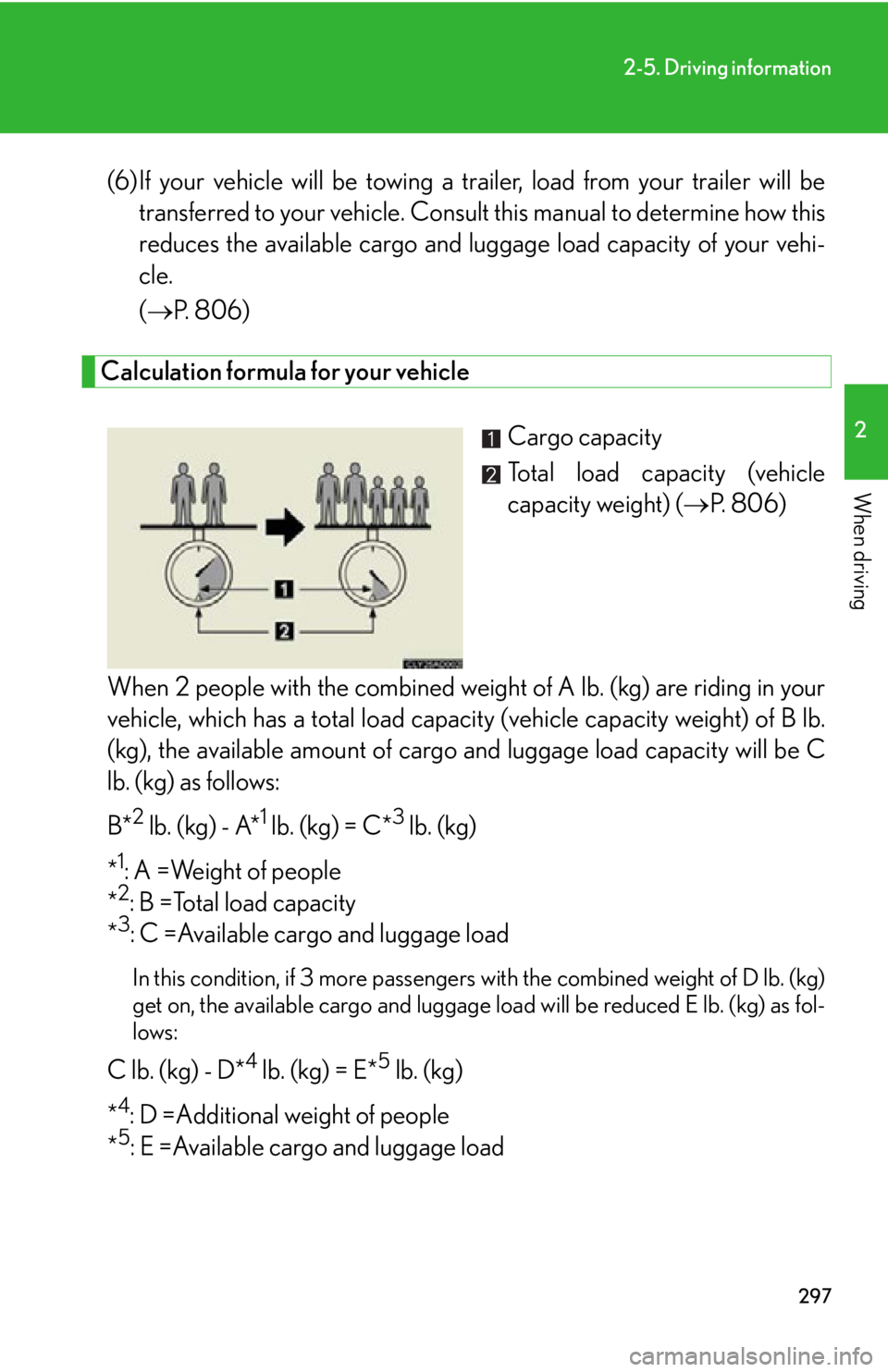
Calculation formula for your vehicle
Cargo capacity
Total load capacity (vehicle
capacity weight) ( P. 8 0 6 )
When 2 people with the combined weight of A lb. (kg) are riding in your
vehicle, which has a total load capacity (vehicle ca pacity weight) of B lb.
(kg), the available amount of cargo an d luggage load capacity will be C
lb. (kg) as follows:
B* 2
lb. (kg) - A* 1
lb. (kg) = C* 3
lb. (kg)
* 1
: A =Weight of people
* 2
: B =Total load capacity
* 3
: C =Available cargo and luggage load
In this condition, if 3 more passengers with the combined weight of D lb. (kg)
get on, the available cargo and luggage lo ad will be reduced E lb. (kg) as fol-
lows:
C lb. (kg) - D* 4
lb. (kg) = E* 5
lb. (kg)
* 4
: D =Additional weight of people
* 5
: E =Available cargo and luggage load
Page 298 of 886
2982-5. Driving information
As shown in the example above, if the number of occupants increases,
the cargo and luggage load will be re duced by an amount that equals the
increased weight due to the addition al occupants. In other words, if an
increase in the number of occupants ca uses an excess of the total load
capacity (combined weight of occupants plus cargo and luggage load),
you must reduce the cargo and luggage on your vehicle. CAUTION■
Things that must not be carri ed in the luggage compartment
The following things may cause a fire if loaded in the luggage compartment: ●
Receptacles containing gasoline●
Aerosol cans■
Storage precautions
Observe the following precautions.
Failure to do so may result in death or serious injury. ●
Stow cargo and luggage in the lugga ge compartment whenever possible.●
Do not stack cargo and luggage in the luggage compartment higher than the
seatbacks.
Such items may be thrown about and possib ly injure people in the vehicle in the
event of sudden braking or in an accident.●
Do not place cargo or luggage in or on the following locations as the items may
get under the brake or accelerator pedal and prevent the pedals from being
depressed properly, block the driver’s vision, or hit the driver or passengers,
causing an accident:
• At the feet of the driver
• On the front passenger or rear seats (when stacking items)
• On the luggage cover
• On the instrument panel
•On the dashboard
●
Secure all items in the occupant compartment, as they may shift and injure some-
one in the event of sudden braking, sudden swerving or an accident.
Page 301 of 886
3012-5. Driving information
2
When driving Vehicle load limits
■
Total load capacity and seating capacity
These details are also described on th e tire and loading information label.
( P. 6 9 3 )
CAUTION■
Overloading the vehicle
Do not overload the vehicle.
It may not only cause damage to the tire s, but also degrade steering and braking
ability, resulting in an accident. Vehicle load limits include total load capacity, seating capacity, TWR
(Trailer Weight Rating) and cargo capacity.
■ Total load capacity (vehicle capacity weight): ( P. 806)Total load capacity means the combined weight of occupants, cargo and
luggage.
■ Seating capacity: 5 occupants (Front 2, Rear 3) Seating capacity means the maximum number of occupants whose esti-
mated average weight is 150 lb. (68 kg) per person.
■ TWR (Trailer weight rating): ( P. 310, 806)TWR means the maximum gross trailer weight (trailer weight plus its
cargo weight) that your vehicle is able to tow.
■ Cargo capacity Cargo capacity may increase or decrease depending on the weight and
the number of occupants.
Page 306 of 886
3062-5. Driving information
Trailer towing
Towing related terms
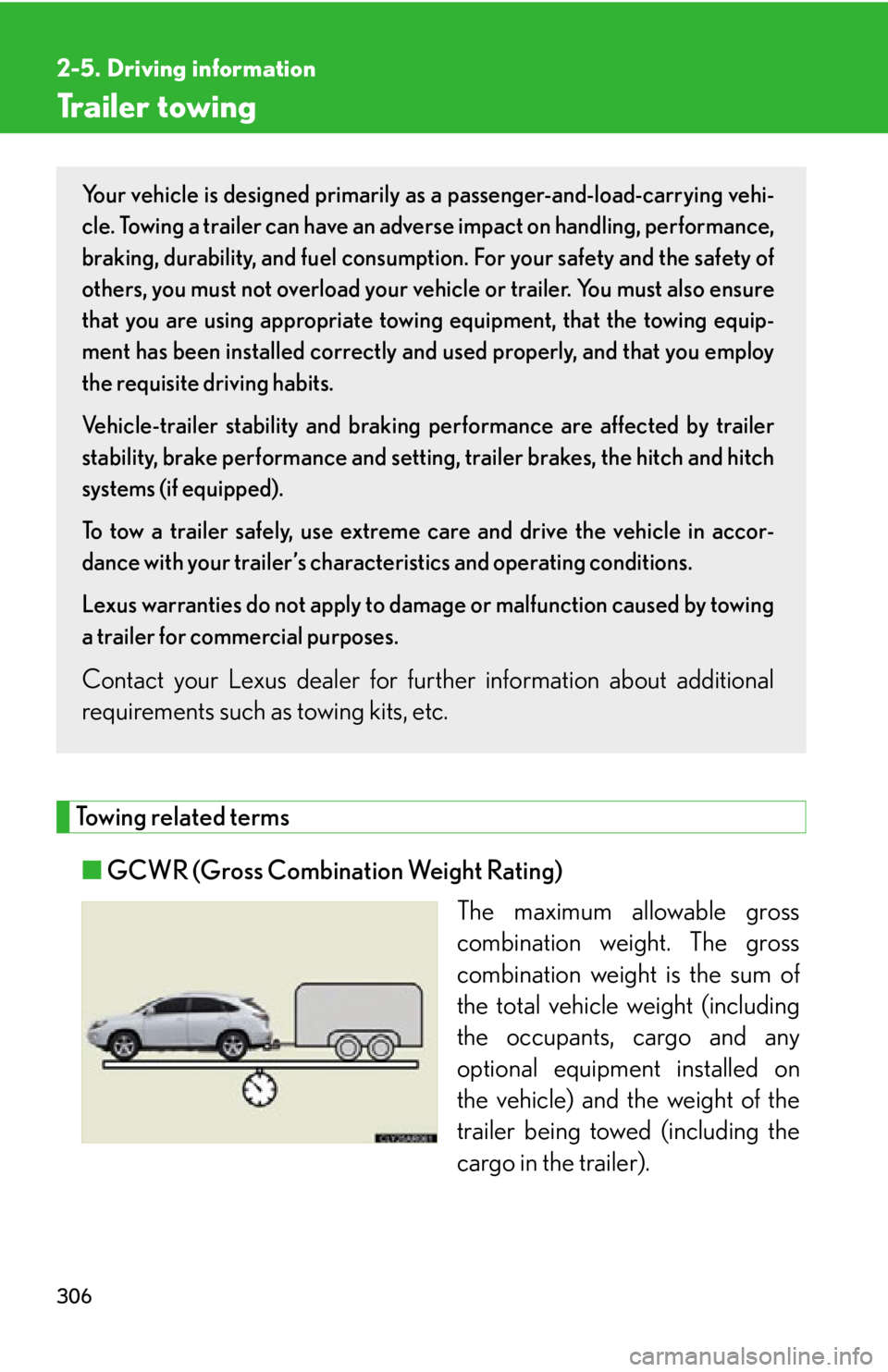
■ GCWR (Gross Combination Weight Rating)
The maximum allowable gross
combination weight. The gross
combination weight is the sum of
the total vehicle weight (including
the occupants, cargo and any
optional equipment installed on
the vehicle) and the weight of the
trailer being towed (including the
cargo in the trailer).Your vehicle is designed primarily as a passenger-and-load-carrying vehi-
cle. Towing a trailer can have an adverse impact on handling, performance,
braking, durability, and fuel consumpt ion. For your safety and the safety of
others, you must not overload your vehicle or trailer. You must also ensure
that you are using appropriate towing equipment, that the towing equip-
ment has been installed correctly and used properly, and that you employ
the requisite driving habits.
Vehicle-trailer stability and braking performance are affected by trailer
stability, brake performance and settin g, trailer brakes, the hitch and hitch
systems (if equipped).
To tow a trailer safely, use extreme care and drive the vehicle in accor-
dance with your trailer’s characteristics and operating conditions.
Lexus warranties do not apply to damage or malfunction caused by towing
a trailer for commercial purposes.
Contact your Lexus dealer for furt her information about additional
requirements such as towing kits, etc.
Page 307 of 886
3072-5. Driving information
2
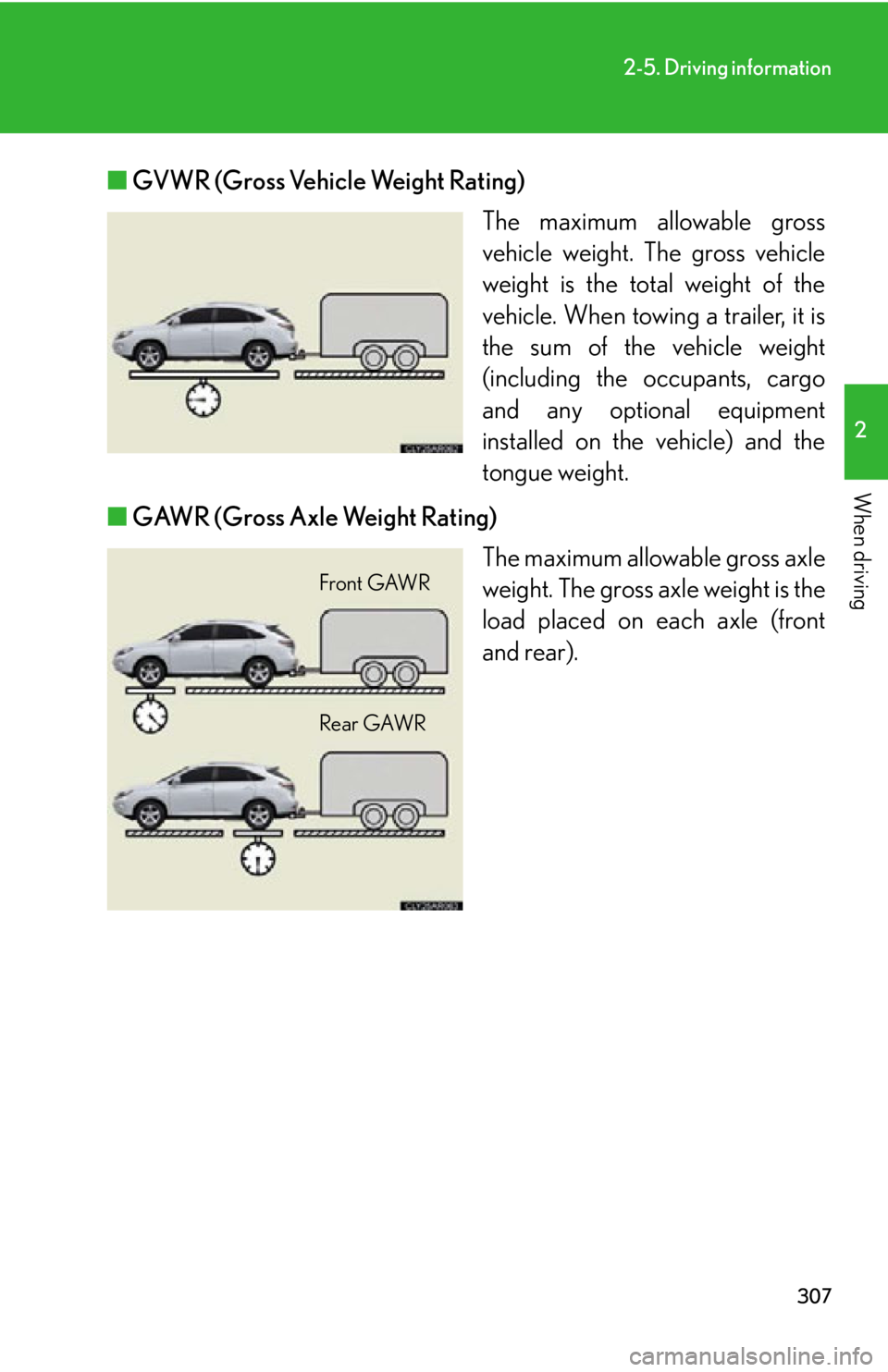
When driving ■ GVWR (Gross Vehicle Weight Rating)
The maximum allowable gross
vehicle weight. The gross vehicle
weight is the total weight of the
vehicle. When towing a trailer, it is
the sum of the vehicle weight
(including the occupants, cargo
and any optional equipment
installed on the vehicle) and the
tongue weight.
■ GAWR (Gross Axle Weight Rating)
The maximum allowable gross axle
weight. The gross axle weight is the
load placed on each axle (front
and rear).Front GAWR
Rear GAWR
Page 308 of 886
3082-5. Driving information
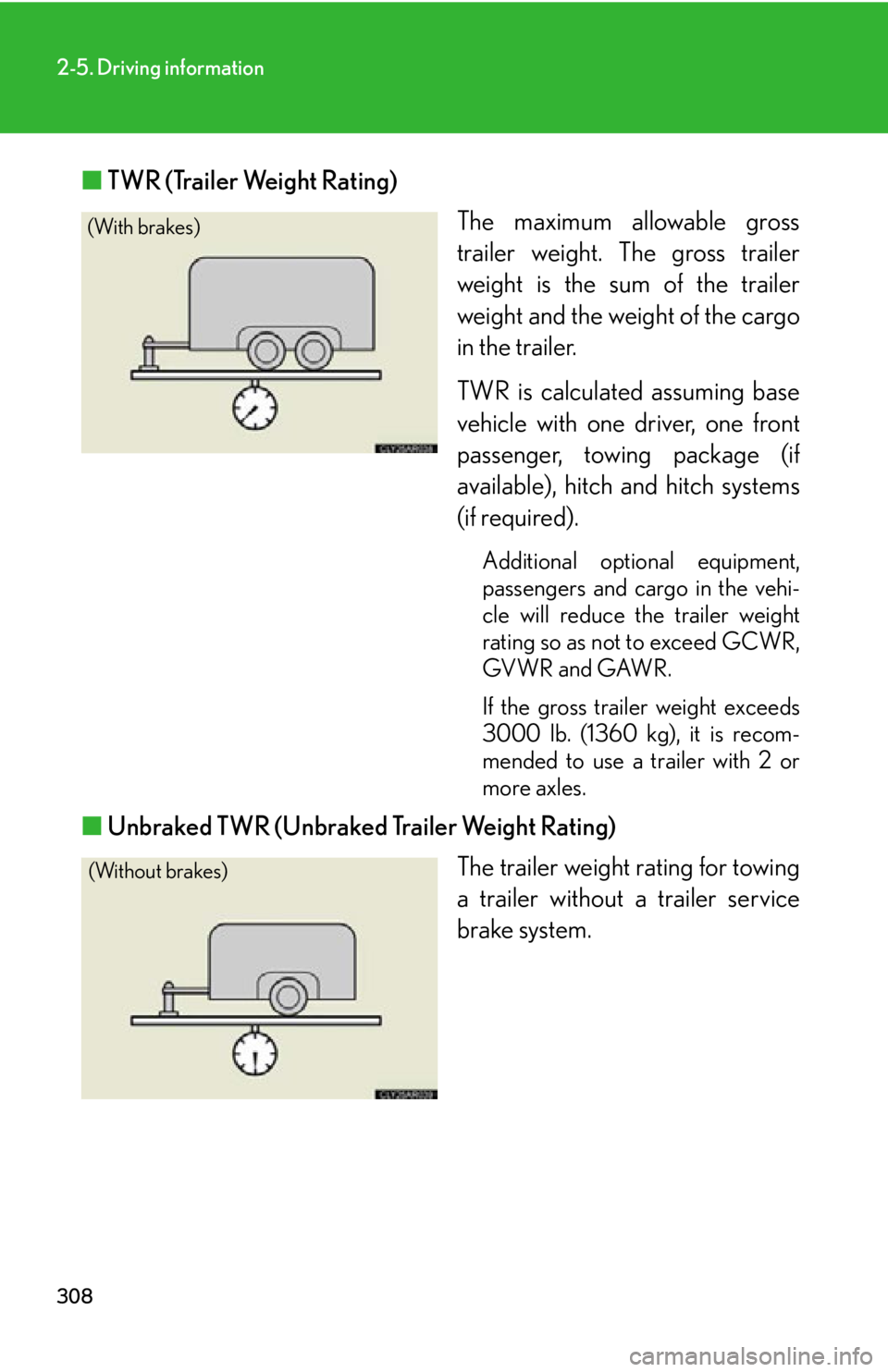
■ TWR (Trailer Weight Rating)
The maximum allowable gross
trailer weight. The gross trailer
weight is the sum of the trailer
weight and the weight of the cargo
in the trailer.
TWR is calculated assuming base
vehicle with one driver, one front
passenger, towing package (if
available), hitch and hitch systems
(if required). Additional optional equipment,
passengers and cargo in the vehi-
cle will reduce the trailer weight
rating so as not to exceed GCWR,
GVWR and GAWR.
If the gross trailer weight exceeds
3000 lb. (1360 kg), it is recom-
mended to use a trailer with 2 or
more axles.
■ Unbraked TWR (Unbraked Trailer Weight Rating)
The trailer weight rating for towing
a trailer without a trailer service
brake system.(With brakes)
(Without brakes)