parking brake LEXUS RX350 2015 Owners Manual
[x] Cancel search | Manufacturer: LEXUS, Model Year: 2015, Model line: RX350, Model: LEXUS RX350 2015Pages: 886, PDF Size: 11 MB
Page 3 of 886

1
2
3
4
5
6
7
32-1. Driving procedures
Driving the vehicle ........................ 154
Engine (ignition) switch .............. 165
Automatic transmission
(6-speed models) ........................ 171
Automatic transmission
(8-speed models) ...................... 178
Turn signal lever ............................ 187
Parking brake ................................. 189
Horn.................................................... 190
2-2. Instrument cluster
Gauges and meters ....................... 191
Indicators and warning
lights................................................. 194
Multi-information display......... 200
Head-up display ........................... 206
2-3. Operating the lights and
windshield wipers
Headlight switch .............................. 211
Fog light switch .............................. 215
Windshield wipers and
washer.............................................. 217
Rear window wiper and
washer............................................ 224
Headlight cleaner switch .......... 226 2-4. Using other driving systems
Cruise control ............................... 227
Dynamic radar cruise
control............................................ 232
Intuitive parking assist ................ 245
Rear view monitor system
(rear view mirror-attached
type) ................................................ 255
Rear view monitor system
(vehicles with the Lexus
Display Audio system) ............ 264
Driving assist systems................. 269
All-wheel drive lock switch ...... 275
Hill-start assist control ............... 276
Pre-Collision System.................. 278
BSM (Blind Spot Monitor) ....... 286
2-5. Driving information
Utility vehicle pre cautions ........ 292
Cargo and luggage ..................... 296
Vehicle load limits ......................... 301
Winter driving tips ....................... 302
Trailer towing ................................ 306
Dinghy towing ............................... 3232
When driving
Page 14 of 886
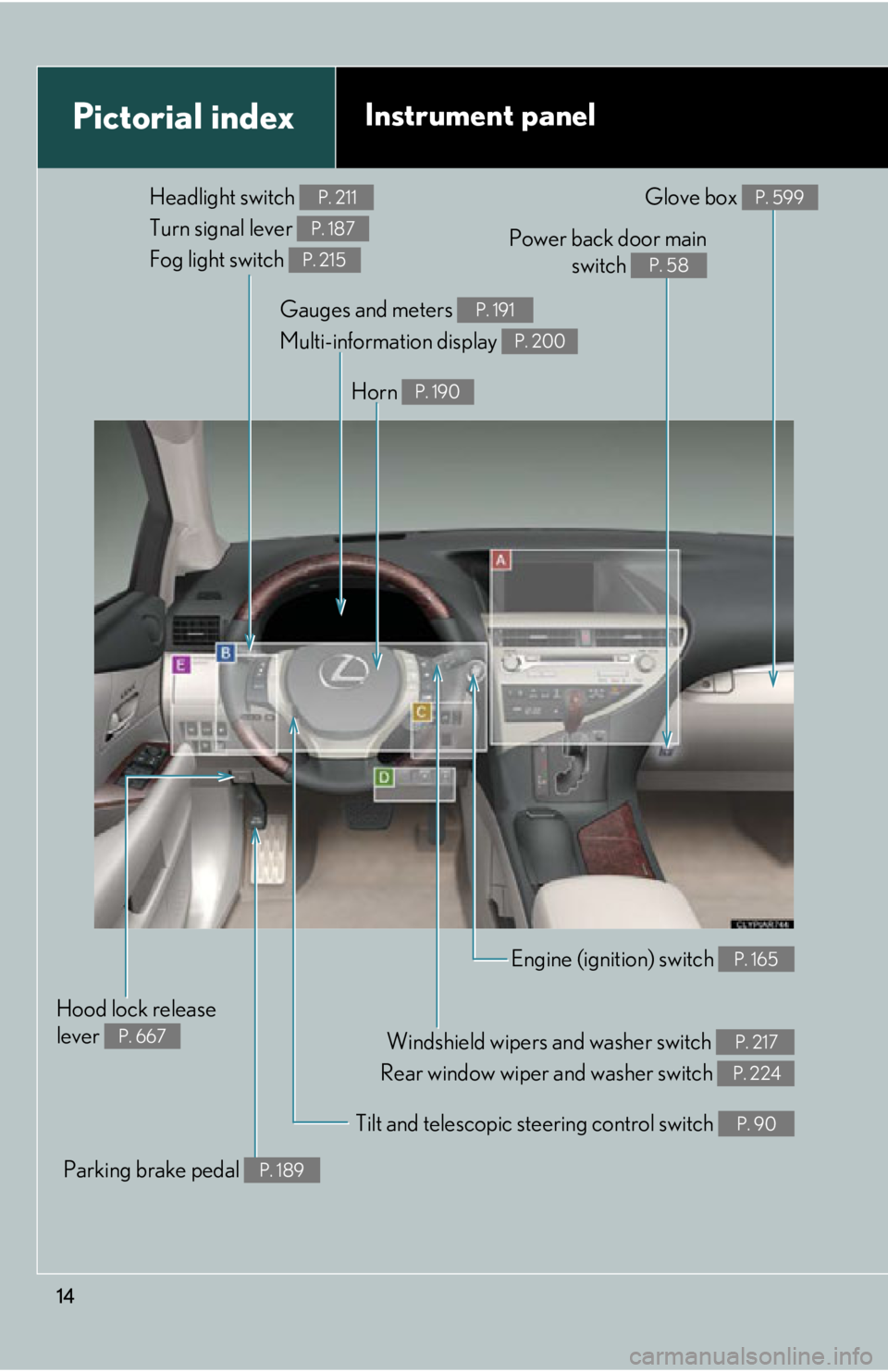
14Pictorial index Instrument panelHeadlight switch
Turn signal lever
Fog light switch P. 211
P. 187
P. 215
Windshield wipers and washer switch
Rear window wiper and washer switch P. 217
P. 224Power back door main
switch P. 58
Tilt and telescopic steering control switch P. 90Engine (ignition) switch P. 165
Hood lock release
lever P. 667 Gauges and meters
Multi-information display P. 191
P. 200
Glove box P. 599
Horn P. 190
Parking brake pedal P. 189
Page 74 of 886
741-3. Adjustable components (s eats, mirrors, steering wheel)
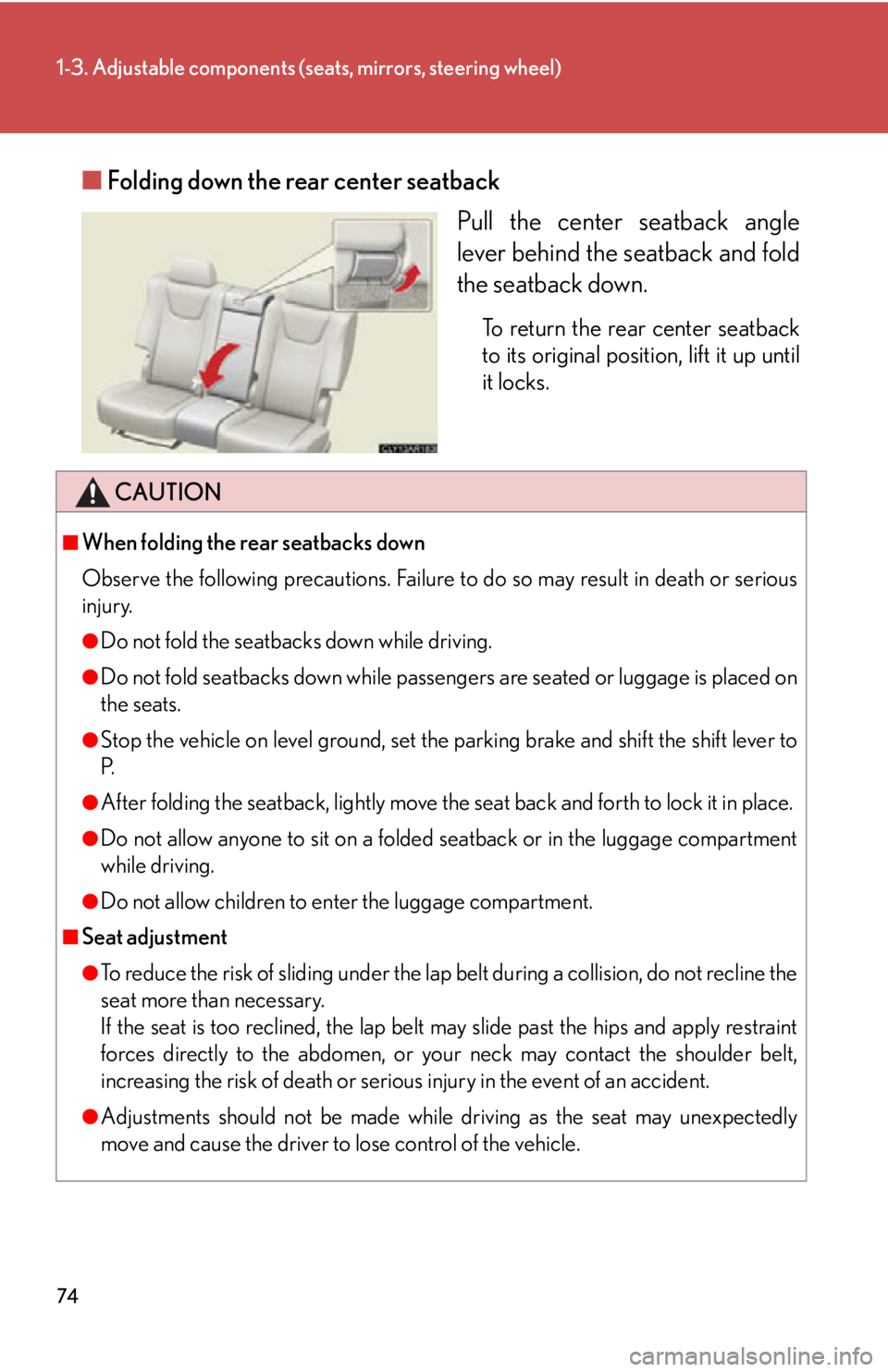
■ Folding down the rear center seatback
Pull the center seatback angle
lever behind the seatback and fold
the seatback down. To return the rear center seatback
to its original position, lift it up until
it locks.
CAUTION■
When folding the rear seatbacks down
Observe the following precautions. Failure to do so may result in death or serious
injury. ●
Do not fold the seatbacks down while driving.●
Do not fold seatbacks down while passenge rs are seated or luggage is placed on
the seats.●
Stop the vehicle on level ground, set the parking brake and shift the shift lever to
P.●
After folding the seatback, lightly move the seat back and forth to lock it in place.●
Do not allow anyone to sit on a folded seatback or in the luggage compartment
while driving.●
Do not allow children to en ter the luggage compartment.■
Seat adjustment ●
To reduce the risk of sliding under the lap belt during a collision, do not recline the
seat more than necessary.
If the seat is too reclined, the lap belt may slide past the hips and apply restraint
forces directly to the abdomen, or yo ur neck may contact the shoulder belt,
increasing the risk of death or seriou s injury in the event of an accident.
●
Adjustments should not be made while driving as the seat may unexpectedly
move and cause the driver to lose control of the vehicle.
Page 153 of 886
When driving
2
1532-1. Driving procedures
Driving the vehicle.................. 154
Engine (ignition) switch ......... 165
Automatic transmission
(6-speed models) .................. 171
Automatic transmission
(8-speed models) ................. 178
Turn signal lever ....................... 187
Parking brake ........................... 189
Horn ............................................ 190
2-2. Instrument cluster
Gauges and meters ................. 191
Indicators and warning
lights ......................................... 194
Multi-information
display .................................... 200
Head-up display ..................... 206
2-3. Operating the lights and
windshield wipers
Headlight switch....................... 211
Fog light switch ........................ 215
Windshield wipers and
washer ..................................... 217
Rear window wiper and
washer .................................... 224
Headlight cleaner switch..... 226 2-4. Using other driving
systems
Cruise control......................... 227
Dynamic radar cruise
control .................................... 232
Intuitive parking assist .......... 245
Rear view monitor system
(rear view mirror-attached
type) ........................................ 255
Rear view monitor system
(vehicles with the Lexus
Display Audio system) ....... 264
Driving assist systems ........... 269
All-wheel drive lock
switch ....................................... 275
Hill-start assist control .......... 276
Pre-Collision System ............ 278
BSM
(Blind Spot Monitor) .......... 286
2-5. Driving information
Utility vehicle
precautions ........................... 292
Cargo and luggage ............... 296
Vehicle load limits ................... 301
Winter driving tips ................. 302
Trailer towing .......................... 306
Dinghy towing ......................... 323
Page 154 of 886
1542-1. Driving procedures
Driving the vehicle
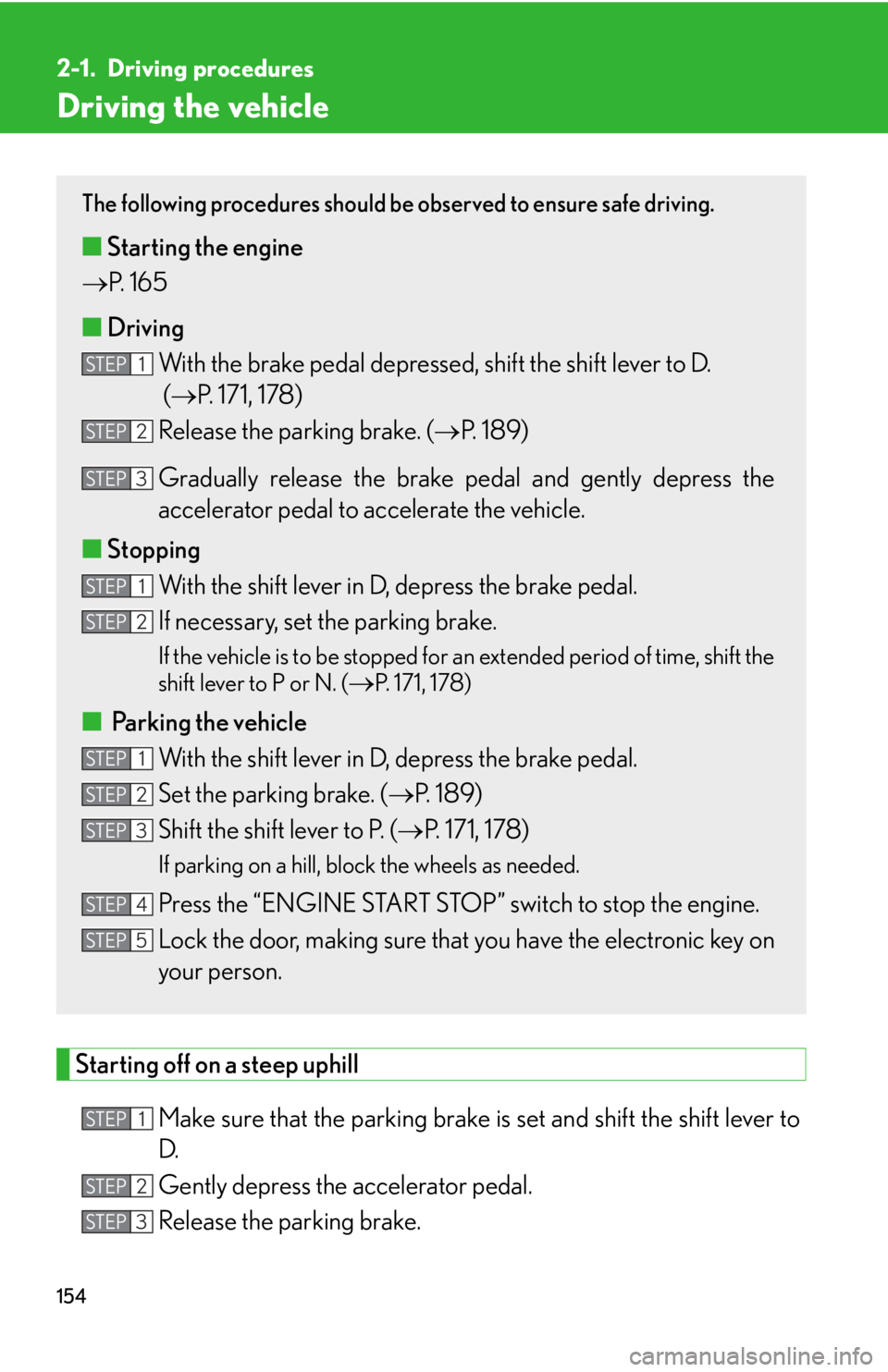
Starting off on a steep uphill
Make sure that the pa rking brake is set and shift the shift lever to
D.
Gently depress the accelerator pedal.
Release the parking brake. The following procedures should be observed to ensure safe driving.
■ Starting the engine
P. 1 6 5
■ Driving
With the brake pedal depressed, shift the shift lever to D.
( P. 171, 178)
Release the parking brake. ( P. 1 8 9 )
Gradually release the brake pedal and gently depress the
accelerator pedal to accelerate the vehicle.
■ Stopping
With the shift lever in D, depress the brake pedal.
If necessary, set the parking brake. If the vehicle is to be stopped for an extended period of time, shift the
shift lever to P or N. (
P. 171, 178)
■
Parking the vehicle
With the shift lever in D, depress the brake pedal.
Set the parking brake. ( P. 1 8 9 )
Shift the shift lever to P. ( P. 171, 178)If parking on a hill, block the wheels as needed.
Press the “ENGINE START STOP” switch to stop the engine.
Lock the door, making sure that you have the electronic key on
your person.STEP 1
STEP 2
STEP 3
STEP 1
STEP 2
STEP 1
STEP 2
STEP 3
STEP 4
STEP 5
STEP 1
STEP 2
STEP 3
Page 156 of 886
1562-1. Driving procedures
■
Drum-in-disc type parking brake system
Your vehicle has a drum-in-disc type parking brake system. This type of brake sys-
tem needs bedding-down of the brake shoe s periodically or whenever the parking
brake shoes and/or drum are replaced. Have your Lexus dealer perform the bed-
ding down operation.■
Operating your vehicle in a foreign country
Comply with the relevant vehicle registration laws and confirm the availability of the
correct fuel. ( P. 808)■
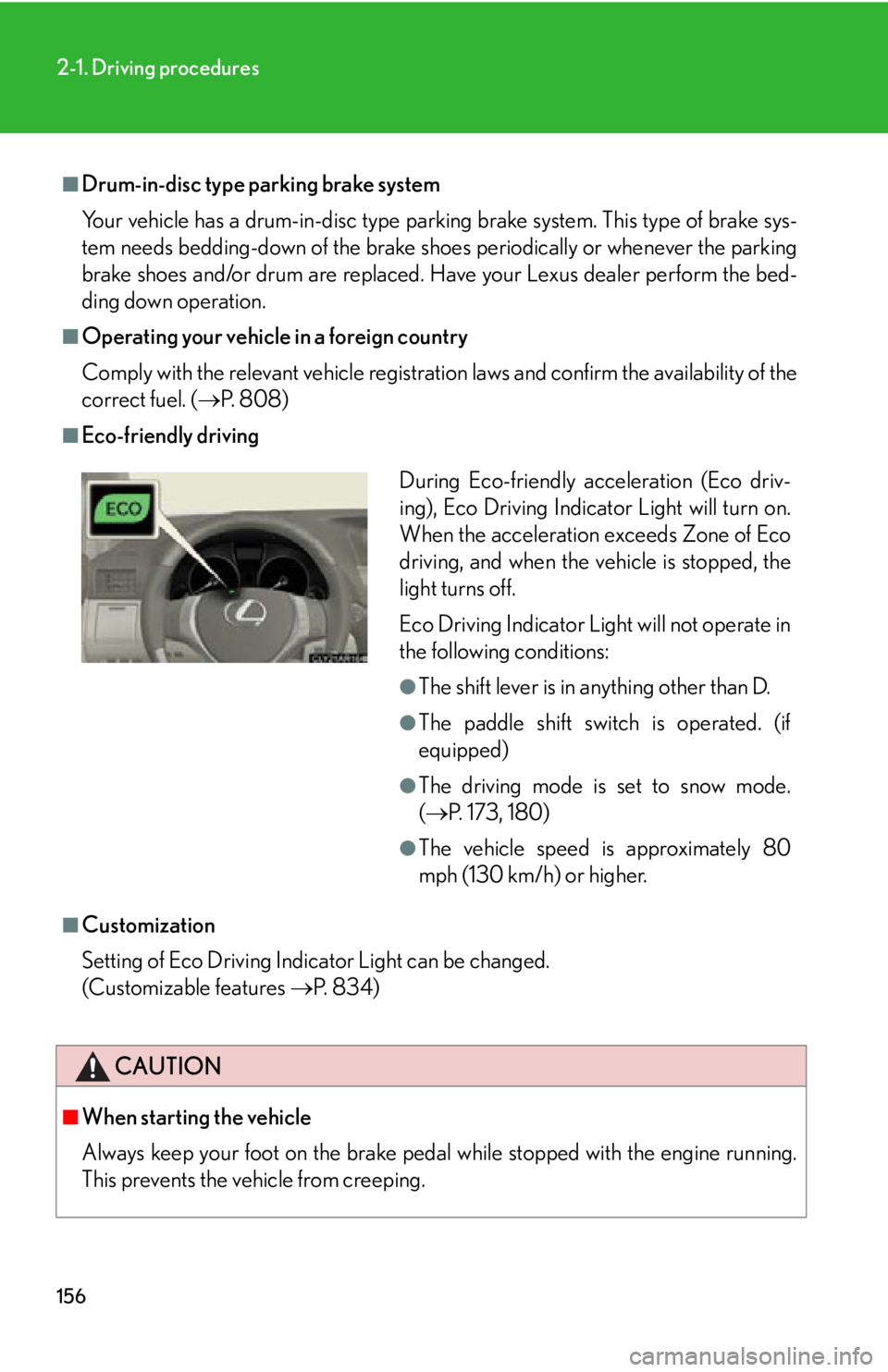
Eco-friendly driving
■
Customization
Setting of Eco Driving Indica tor Light can be changed.
(Customizable features P. 8 3 4 )
CAUTION
■
When starting the vehicle
Always keep your foot on the brake pedal while stopped with the engine running.
This prevents the vehicle from creeping. During Eco-friendly acceleration (Eco driv-
ing), Eco Driving Indicator Light will turn on.
When the acceleration exceeds Zone of Eco
driving, and when the ve hicle is stopped, the
light turns off.
Eco Driving Indicator Light will not operate in
the following conditions: ●
The shift lever is in anything other than D. ●
The paddle shift switch is operated. (if
equipped) ●
The driving mode is set to snow mode.
( P. 173, 180)●
The vehicle speed is approximately 80
mph (130 km/h) or higher.
Page 158 of 886

1582-1. Driving procedures
CAUTION●
Do not shift the shift lever to R while the vehicle is moving forward.
Doing so can damage the transmission and may result in a loss of vehicle control.●
Do not shift the shift lever to D while the vehicle is moving backward.
Doing so can damage the transmission and may result in a loss of vehicle control.●
Moving the shift lever to N while the vehicle is moving will disengage the engine
from the transmission. Engine braking is not available when N is selected.●
During normal driving, do not turn off the engine. Turning the engine off while
driving will not cause loss of steering or braking control, but the power assist to
these systems will be lost. This will make it more difficult to steer and brake, so you
should pull over and stop the vehicle as soon as it is safe to do so.
However, in the event of an emergency, such as if it becomes impossible to stop
the vehicle in the normal way: P. 8 0 4●
Use engine braking (downshift) to maintain a safe speed when driving down a
steep hill.
Using the brakes continuously may cause the brakes to overheat and lose effec-
tiveness. ( P. 171, 178)●
When stopped on an incline, use the brake pedal and parking brake to prevent
the vehicle from rolling backward or forward, causing an accident. ●
Do not adjust the position of the steering wheel, the seat, or the inside or outside
rear view mirrors while driving.
Doing so may result in a loss of vehicle control that can cause accidents, resulting
in death or serious injury.●
Always check that all passengers' arms, heads or other parts of their body are not
outside the vehicle, as this may result in death or serious injury.●
Do not drive in excess of the speed limit. Even if the legal speed limit permits it, do
not drive over 85 mph (140 km/h) unless your vehicle has high-speed capability
tires. Driving over 85 mph (140 km/h) may result in tire failure, loss of control and
possible injury. Be sure to consult a tire dealer to determine whether the tires on
your vehicle are high-speed capability tires or not before driving at such speeds.
Page 160 of 886

1602-1. Driving procedures
CAUTION■
When the vehicle is stopped ●
Do not race the engine.
If the vehicle is in any gear other than P or N, the vehicle may accelerate suddenly
and unexpectedly, causing an accident.●
Do not leave the vehicle with the engine running for a long time.
If such a situation cannot be avoided, park the vehicle in an open space and
check that exhaust fumes do no t enter the vehicle interior.●
In order to prevent accidents due to the vehicle rolling away, always keep
depressing the brake pedal while the en gine is running, and apply the parking
brake as necessary.●
If the vehicle is stopped on an incline, in order to prevent accidents caused by the
vehicle rolling forward or backward, always depress the brake pedal and securely
apply the parking brake as needed.●
Avoid revving or racing the engine.
Running the engine at high speed while the vehicle is stopped may cause the
exhaust system to overheat, which could result in a fire if combustible material is
nearby.
Page 161 of 886

1612-1. Driving procedures
2
When driving CAUTION■
When the vehicle is parked ●
Do not leave glasses, cigarett e lighters, spray cans, or soft drink cans in the vehi-
cle when it is in the sun.
Doing so may result in the following:
• Gas may leak from a cigarette lighter or spray can, and may lead to a fire.
• The temperature inside the vehicle may cause the plastic lenses and plastic
material of glasses to deform or crack.
• Soft drink cans may fracture, causing the contents to spray over the interior of
the vehicle, and may also cause a short circuit in the vehicle's electrical com-
ponents.●
Do not leave cigarette lighters in the vehicle. If a cigarette lighter is in a place such
as the glove box or on the floor, it may be lit accidentally when luggage is loaded
or the seat is adjusted, causing a fire.●
Do not attach adhesive discs to the wind shield or windows. Do not place contain-
ers such as air fresheners on the instru ment panel or dashboard. Adhesive discs
or containers may act as lenses, causing a fire in the vehicle.●
Do not leave a door or window open if the curved glass is coated with a metal-
lized film such as a silver-colored one. Reflected sunlight may cause the glass to
act as a lens, causing a fire.●
Always apply the parking brake, shift the shift lever to P, stop the engine and lock
the vehicle.
Do not leave the vehicle unattend ed while the engine is running.●
Do not touch the exhaust pipes while the engine is running or immediately after
turning the engine off.
Doing so may cause burns.●
Do not leave the engine running in an area with snow build-up, or where it is
snowing. If snowbanks build up around the vehicle while the engine is running,
exhaust gases may collect and enter the vehi cle. This may lead to death or a seri-
ous health hazard.
Page 162 of 886

1622-1. Driving procedures
CAUTION■
Exhaust gases
Exhaust gases include harmfu l carbon monoxide (CO) th at is colorless and odor-
less. Inhaling exhaust gases may lead to death or a serious health hazard. ●
If the vehicle is in a poorly ventilated ar ea, stop the engine. In a closed area, such
as a garage, exhaust gases may collect and enter the vehicle. This may lead to
death or a serious health hazard.●
The exhaust system should be checked occasionally. If there is a hole or crack
caused by corrosion, damage to a joint or abnormal exhaust noise, be sure to
have the vehicle inspected and repaired by your Lexus dealer . Failure to do so
may allow exhaust gases to enter the vehicl e, resulting in death or a serious health
hazard.■
When taking a nap in the vehicle
Always turn the engine off. Otherwise, if you accidentally move the shift lever or
depress the accelerator pedal, this could cause an accident or fire due to engine
overheating. Additionally, if the vehicle is parked in a poorly ventilated area, exhaust
gases may collect and enter th e vehicle, leading to death or a serious health hazard.■
When braking the vehicle ●
When the brakes are wet, drive more cautiously.
Braking distance increases when the brakes are wet, and this may cause one side
of the vehicle to brake differently than the other side. Also, the parking brake may
not securely hold the vehicle.●
If the power brake assist function does not operate, do not follow other vehicles
closely and avoid hills or sharp turns that require braking.
In this case, braking is still possible, but the brake pedal should be depressed
more firmly than usual. Also, the braking distance will increase. Have your brakes
fixed immediately.●
Do not pump the brake pedal if the engine stalls.
Each push on the brake pedal uses up the reserve for the power-assisted brakes.
●
The brake system consists of 2 individual hydraulic systems; if one of the systems
fails, the other will still operate. In this case, the brake pedal should be depressed
more firmly than usual and the braking distance will increase.
Have your brakes fixed immediately.