weight LEXUS RX350 2016 User Guide
[x] Cancel search | Manufacturer: LEXUS, Model Year: 2016, Model line: RX350, Model: LEXUS RX350 2016Pages: 748, PDF Size: 12.36 MB
Page 208 of 748
208 4-1. Before driving
RX350_U_OM48E90U ●
The gross trailer weight must never exceed 3500 lb. (1588 kg). ●
The gross combination weight must never exceed the following:
2WD models: 9165 lb. (4157 kg)
AWD models: 9360 lb. (4246 kg) ●
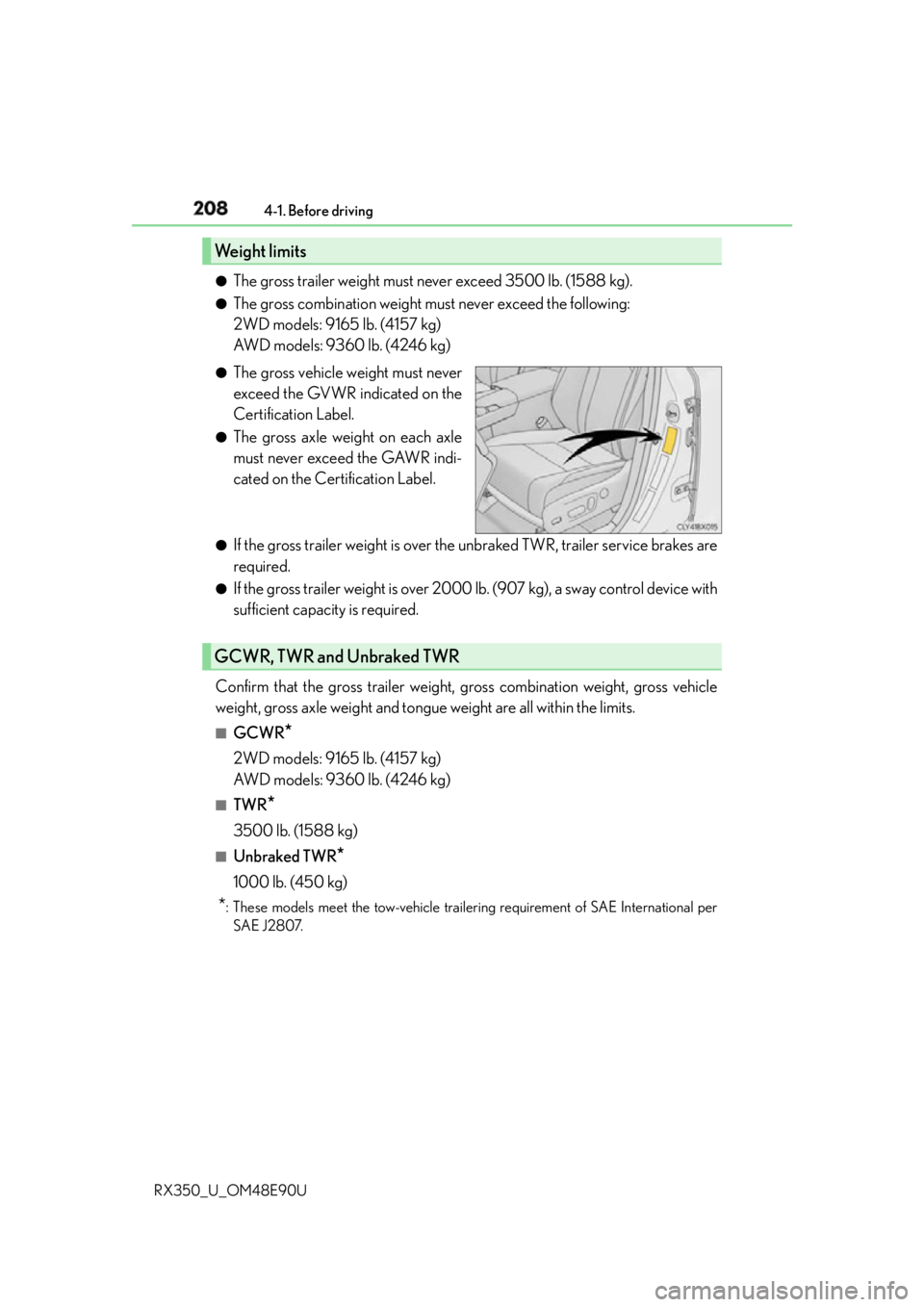
The gross vehicle weight must never
exceed the GVWR indicated on the
Certification Label. ●
The gross axle weight on each axle
must never exceed the GAWR indi-
cated on the Certification Label. ●
If the gross trailer weight is over the unbraked TWR, trailer service brakes are
required. ●
If the gross trailer weight is over 2000 lb. (907 kg), a sway control device with
sufficient capacity is required.
Confirm that the gross trailer weight, gross combination weight, gross vehicle
weight, gross axle weight and tongue weight are all within the limits.■
GCWR
*2WD models: 9165 lb. (4157 kg)
AWD models: 9360 lb. (4246 kg) ■
TWR
* 3500 lb. (1588 kg) ■
Unbraked TWR
*1000 lb. (450 kg)
* : These models meet the tow-vehicle traile ring requirement of SAE International per
SAE J2807.Weight limits
GCWR, TWR and Unbraked TWR
Page 209 of 748
2094-1. Before driving
4
Driving
RX350_U_OM48E90U ●
A recommended tongue weight varies in accordance with the types of trailers
or towing as described below. ●
To ensure the recommended values shown below, the trailer must be loaded
by referring to the following instructions.
•Tongue Weight
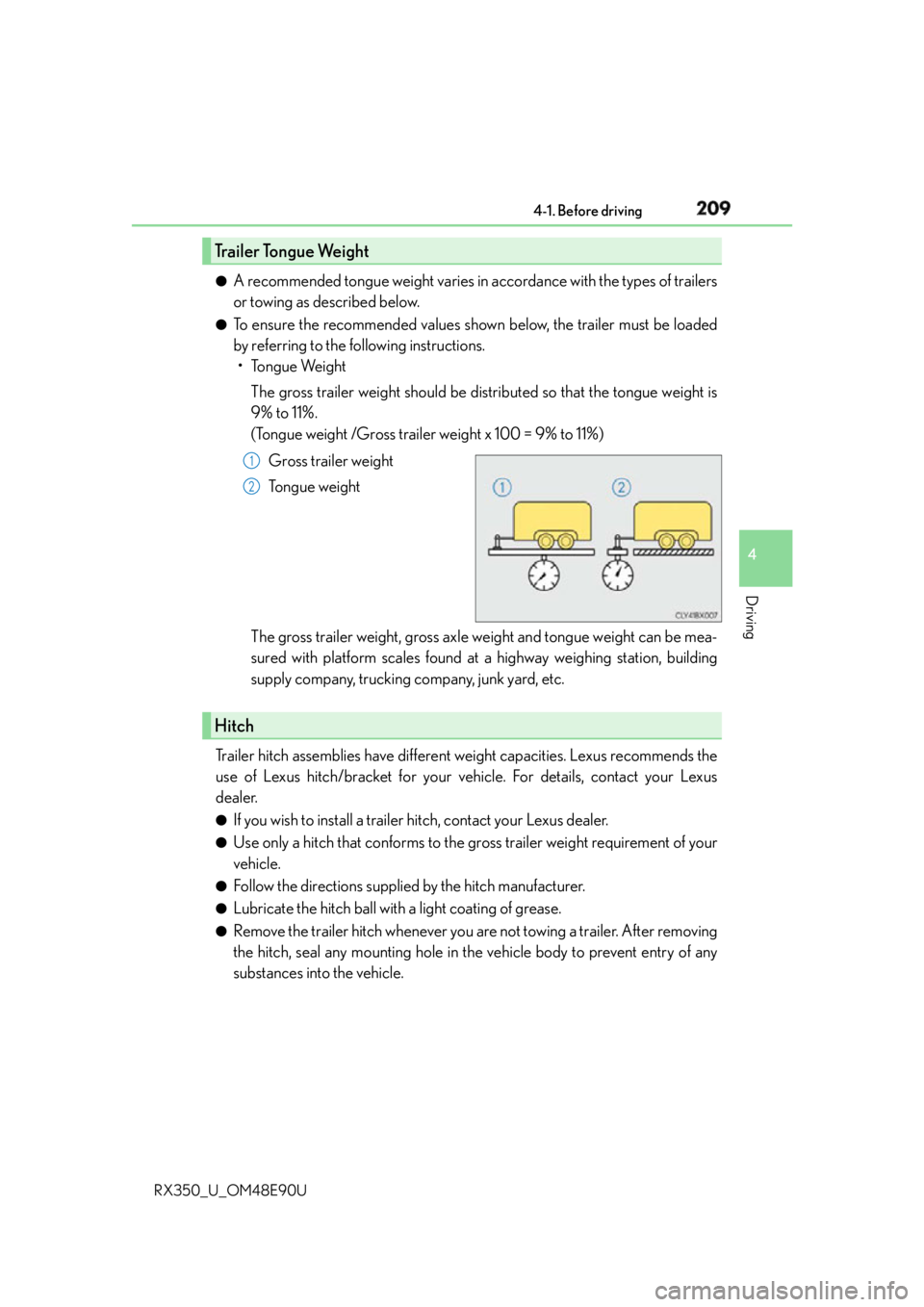
The gross trailer weight should be dist ributed so that the tongue weight is
9% to 11%.
(Tongue weight /Gross trailer weight x 100 = 9% to 11%)
Gross trailer weight
Tongue weight
The gross trailer weight, gross axle we ight and tongue we ight can be mea-
sured with platform scales found at a highway weighing station, building
supply company, trucking company, junk yard, etc.
Trailer hitch assemblies have different weight capacities. Lexus recommends the
use of Lexus hitch/bracket for your vehicle. For details, contact your Lexus
dealer. ●
If you wish to install a trailer hitch, contact your Lexus dealer. ●
Use only a hitch that conforms to the gross trailer weight requirement of your
vehicle. ●
Follow the directions supplied by the hitch manufacturer. ●
Lubricate the hitch ball with a light coating of grease. ●
Remove the trailer hitch whenever you are not towing a trailer. After removing
the hitch, seal any mounting hole in the vehicle body to prevent entry of any
substances into the vehicle.Trailer Tongue Weight 1
2
Hitch
Page 210 of 748
210 4-1. Before driving
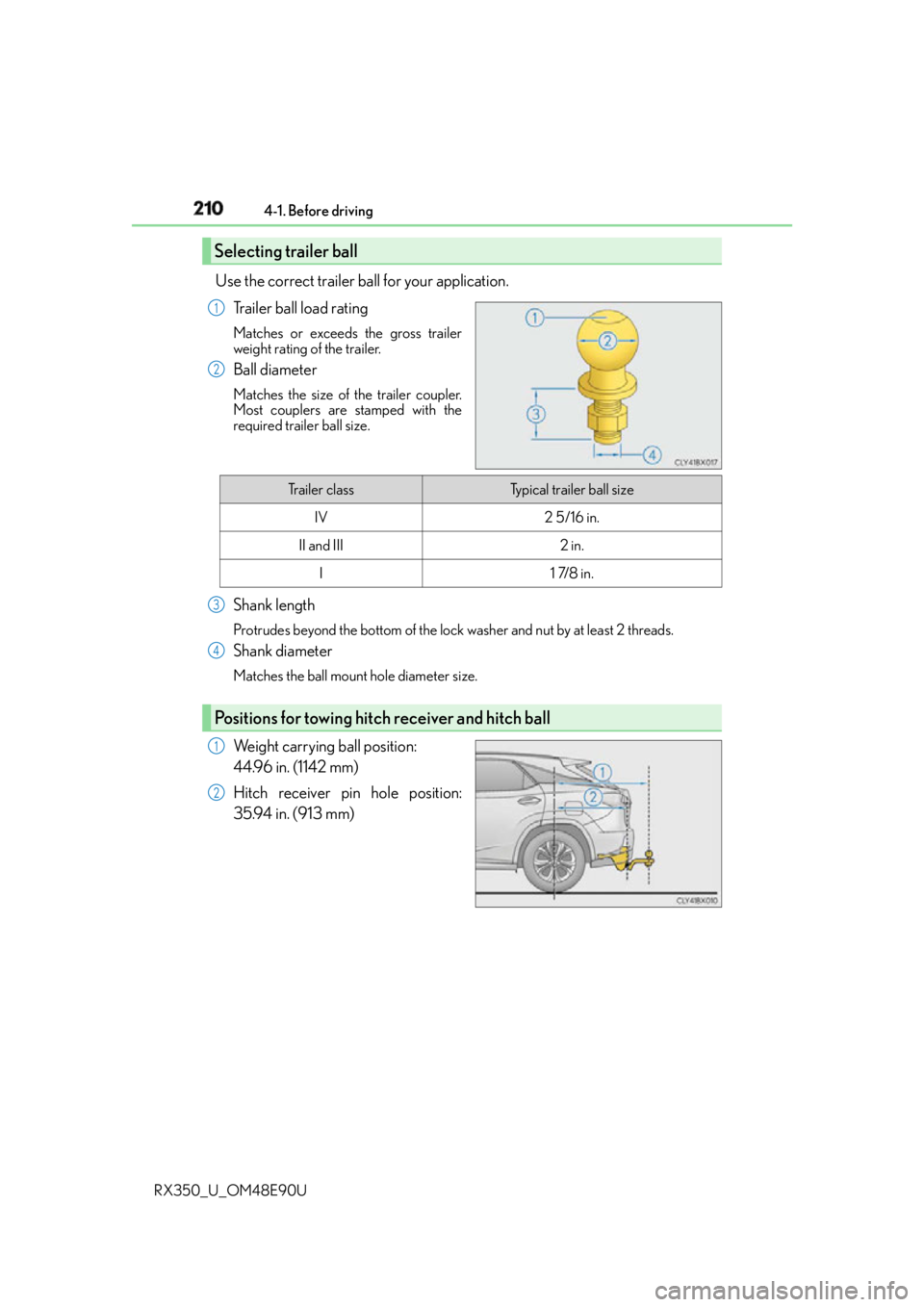
RX350_U_OM48E90U Use the correct trailer ball for your application.
Trailer ball load rating Matches or exceeds the gross trailer
weight rating of the trailer.
Ball diameter Matches the size of the trailer coupler.
Most couplers are stamped with the
required trailer ball size.
Shank length Protrudes beyond the bottom of the lock washer and nut by at least 2 threads.
Shank diameter Matches the ball mount hole diameter size.
Weight carrying ball position:
44.96 in. (1142 mm)
Hitch receiver pin hole position:
35.94 in. (913 mm)Selecting trailer ball 1
2
Trailer class Typical trailer ball size
IV 2 5/16 in.
II and III 2 in.
I 1 7/8 in.
Positions for towing hitch receiver and hitch ball 3
4
1
2
Page 214 of 748
214 4-1. Before driving
RX350_U_OM48E90U ■
Matching trailer ball height to trailer coupler height
■
Before towing
Check that the followin g conditions are met:●
Ensure that your vehicle’s tires are properly inflated. ( P. 6 8 0 )●
Trailer tires are inflated according to the trailer manufacturer’s recommendation. ●
All trailer lights work as required by law. ●
All lights work each time you connect them. ●
The trailer ball is set at the proper height for the coupler on the trailer.●
The trailer is level when it is hitched.
Do not drive if the trailer is not level, an d check for improper to ngue weight, overload-
ing, worn suspension, or other possible causes. ●
The trailer cargo is securely loaded. ●
The rear view mirrors conform to all applicable federal, state/provincial or local regula-
tions. If they do not, install rear view mirrors appropriate for towing purposes. ■
AVS (adaptive variable suspension system) (if equipped)
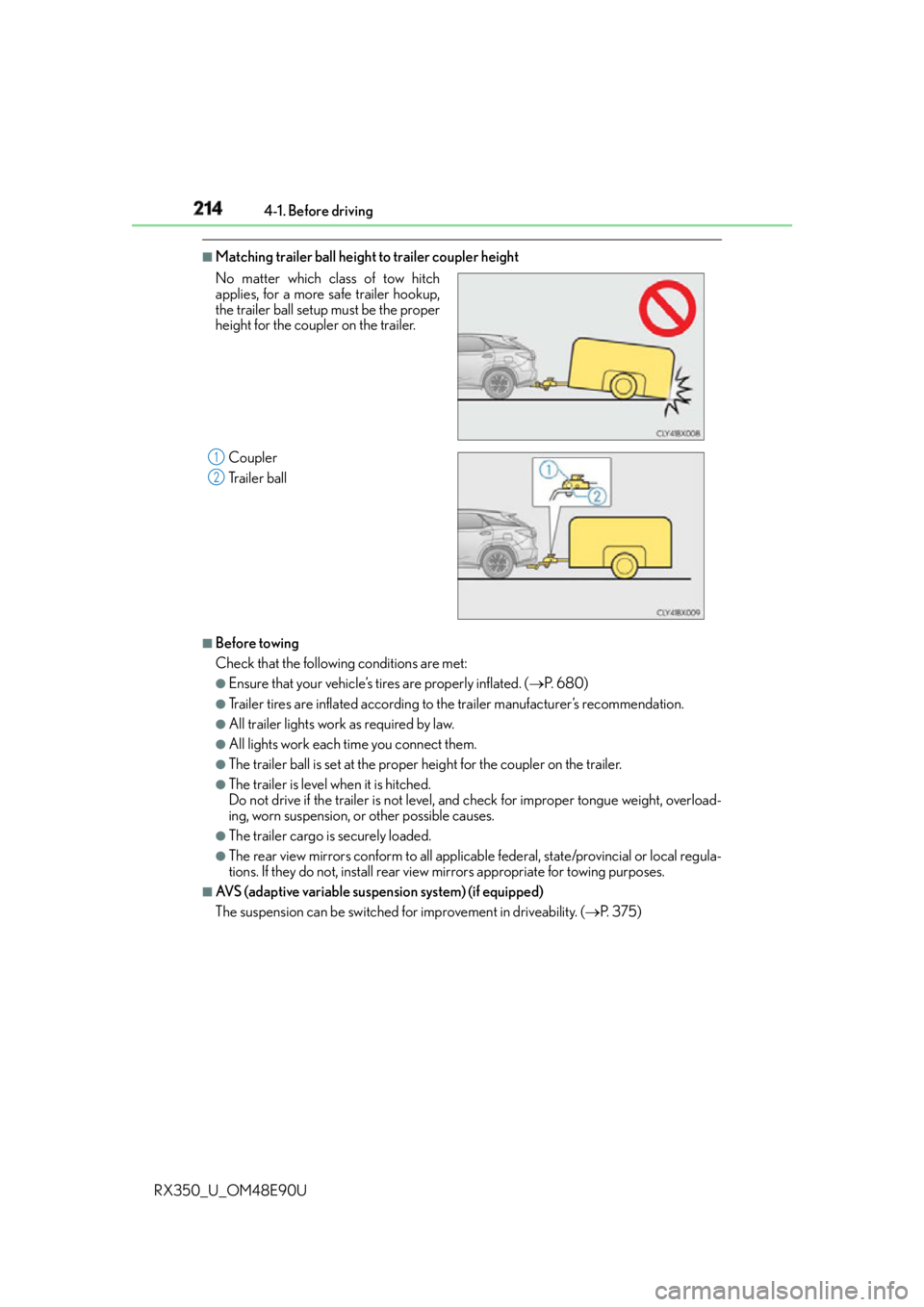
The suspension can be switched fo r improvement in driveability. ( P. 3 7 5 )No matter which class of tow hitch
applies, for a more safe trailer hookup,
the trailer ball setup must be the proper
height for the coupler on the trailer.
Coupler
Trailer ball 1
2
Page 215 of 748

2154-1. Before driving
4
Driving
RX350_U_OM48E90U ■
Break-in schedule
If your vehicle is new or equipped with any new power train components (such as an
engine, transaxle, transfer (AWD models), rear differential (AWD models) or wheel
bearing), Lexus recommends that you do not tow a trailer until the vehicle has been
driven for over 500 miles (800 km).
After the vehicle has been driven for over 500 miles (800 km), you can start towing.
However, for the next 500 miles (800 km), drive the vehicle at a speed of less than
50 mph (80 km/h) when towing a trailer, and avoid full throttle acceleration.■
Maintenance ●
If you tow a trailer, your vehicle will requir e more frequent maintenance due to the addi-
tional load. (See “Warranty and Services Guide”, “Owner’s Manual Supplement” or
“Scheduled Maintenance”.) ●
Retighten the fixing bolts of the towing ba ll and bracket after approximately 600 miles
(1000 km) of trailer towing. ■
If trailer sway occurs
One or more factors (crosswinds, passing vehicles, rough roads, etc.) can adversely
affect handling of your vehicle and trailer, causing instability.●
If trailer swaying occurs:
• Firmly grip the steering wheel. Steer straight ahead.
Do not try to control trailer sway ing by turning the steering wheel.
• Begin releasing the accelerator pedal i mmediately but very gradually to reduce
speed.
Do not increase speed. Do not apply vehicle brakes.
If you make no extreme correction with the steering or brakes, your vehicle and trailer
should stabilize. (if enabled, Trailer Sway Cont rol can also help to stabilize the vehicle and
trailer.) ●
After the trailer sw aying has stopped:
• Stop in a safe place. Get all occupants out of the vehicle.
• Check the tires of the vehicle and the trailer.
• Check the load in the trailer.
Make sure the load has not shifted.
Make sure the tongue weight is appropriate, if possible.
• Check the load in the vehicle.
Make sure the vehicle is not overloaded after occupants get in.
If you cannot find any problems, the speed at which trailer swaying occurred is beyond
the limit of your particular vehicle-trailer combination.
Drive at a lower speed to prevent instability. Remember that swaying of the towing vehi-
cle-trailer increases as speed increases.
Page 216 of 748

216 4-1. Before driving
RX350_U_OM48E90U WA R N I N G ■
Trailer towing precautions
To tow a trailer safely, use extreme care and drive the vehicle in accordance with the
trailer’s characteristics and op erating conditions. Failure to do so could cause an acci-
dent resulting in death or serious injury. Vehicle stability and braking performance are
affected by trailer stability, brake setting and performance, and the hitch. Your vehicle
will handle differently when towing a trailer. ■
To avoid accident or injury ●
Do not exceed the TWR, unbrak ed TWR, GCWR, GVWR or GAWR.●
If the gross trailer weight is over 2000 lb. (907 kg), a sway control device with suffi-
cient capacity is required. ●
Adjust the tongue weight within the approp riate range. Place heavier loads as close
to the trailer axle as possible. ●
Do not exceed 65 mph (104 km/h), the posted towing speed limit or the speed limit
for your trailer as set forth in your trailer owner’s manual, whichever is lowest. Slow
down sufficiently before making a turn, in cr oss winds, on wet or slippery surface, etc.
to help avoid an accident. If you experience a vehicle-trailer instability from reducing
a certain speed, slow down and make sure you keep your vehicle speed under the
speed of which you expe rience the instability.●
Do not make jerky, abrupt or sharp turns. ●
Do not apply the brakes suddenly as you ma y skid, resulting in ja ckknifing and loss of
vehicle control. This is especially true on wet or slippery surfaces. ●
Do not exceed the trailer hitch assembly weight, gross vehicle weight, gross axle
weight and trailer tongue weight capacities. ●
Do not use the following systems when trailer towing.
•Cruise control
*• Dynamic radar cruise control
*• Dynamic radar cruise cont rol with full-speed range
*• LDA (Lane-Departure Alert with steering control)
*• LKA (Lane-Keeping Assist)
*• PCS (Pre-Crash Safety system)
*• BSM (Blind Spot Monitor)
*
* : If equipped ●
Slow down and downshift before descending steep or long downhill grades. Do not
make sudden downshifts while descen ding steep or long downhill grades.●
Vehicle-trailer instability is more likely on steep long downhills. Before descending
steep or long downhill grades, slow down and downshift. Do not make sudden down-
shifts when descending stee p or long downhill grades. Avoid holding the brake pedal
down too long or applying the brakes too frequently. This could cause the brakes to
overheat and result in reduced braking efficiency. ●
Do not tow a trailer when the compact spare tire is installed on your vehicle.
Page 217 of 748

2174-1. Before driving
4
Driving
RX350_U_OM48E90U WA R N I N G ■
Hitch
Trailer hitch assemblies have different weight capacities established by the hitch manu-
facturer. Even though the vehicle may be physically capable of towing a higher weight,
the operator must determine the maximum weig ht rating of the particular hitch assem-
bly and never exceed the maximum weight rating specified for the trailer-hitch.
Exceeding the maximum weight rating set by the trailer-hitch manufacturer can cause
an accident resulting in death or serious personal injuries.■
When towing a trailer
Lexus recommends trailers with brakes that conform to any applicable federal and
state/provincial regulations. ●
If the gross trailer weight exceeds unbraked TWR, trailer brakes are required. Lexus
recommends trailers with brakes that conform to all applicable federal and state/pro-
vincial regulations. ●
Never tap into your vehicle’s hydraulic system, as this will lower the vehicle’s braking
effectiveness. ●
Never tow a trailer without using a safety ch ain securely attached to both the trailer
and the vehicle. If damage occurs to the coupling unit or hitch ball, there is danger of
the trailer wandering into another lane.
NOTICE ■
When installing a trailer hitch
Use only the position recommended by your Lexus dealer. Do not install the trailer
hitch on the bumper; this may cause body damage.■
Do not directly splice trailer lights
Do not directly splice trailer lights. Dire ctly splicing trailer lights may damage your
vehicle’s electrical system and cause a malfunction.
Page 587 of 748
5877-3. Do-it-yourself maintenance
7
Maintenance and care
RX350_U_OM48E90U ■
When to replace your vehicle’s tires
Tires should be replaced if: ●
The treadwear indicators are showing on a tire. ●
You have tire damage such as cuts, splits, cracks deep enough to expose the fabric, and
bulges indicating internal damage. ●
A tire goes flat repeatedly or cannot be prop erly repaired due to the size or location of
a cut or other damage.
If you are not sure, consult with your Lexus dealer. ■
Replacing tires and wheels
If the ID code of the tire pressure warning valve and transmitter is not registered, the tire
pressure warning system will not work proper ly. After driving for about 20 minutes, the
tire pressure warning light blinks for 1 minute and stays on to indicate a system malfunc-
tion. ■
Tire life
Any tire over 6 years old must be checked by a qualified technician even if it has seldom
or never been used or damage is not obvious. ■
Routine tire inflation pressure checks
The tire pressure warning system does not replace routine tire inflation pressure checks.
Make sure to check tire inflation pressure as part of your routine of daily vehicle checks.■
Maximum load of tire
Check that the maximum load of the replacem ent tire is greater than 1 /2 of the Gross
Axle Weight Ratings (GAWR) of either the front axle or the rear axle, whichever is
greater.
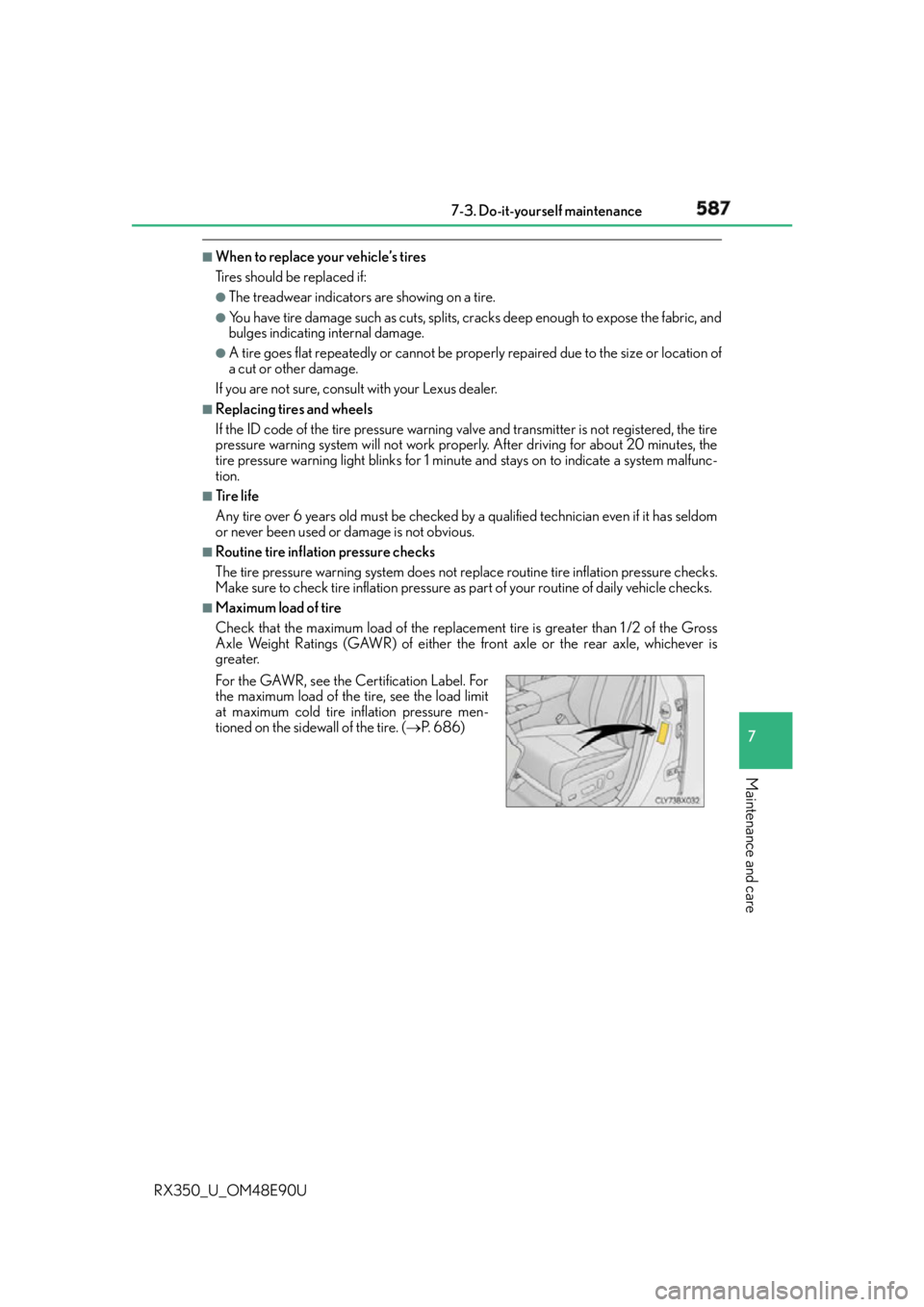
For the GAWR, see the Certification Label. For
the maximum load of the tire, see the load limit
at maximum cold tire inflation pressure men-
tioned on the sidewall of the tire. ( P. 686)
Page 595 of 748
5957-3. Do-it-yourself maintenance
7
Maintenance and care
RX350_U_OM48E90U ■
Instructions for checking tire inflation pressure
When checking tire inflation pressure, observe the following: ●
Check only when the tires are cold.
If your vehicle has been parked for at least 3 hours or has not been driven for more than
1 mile or 1.5 km, you will get an accurate cold tire inflation pressure reading. ●
Always use a tire pressure gauge.
It is difficult to judge if a tire is prop erly inflated based only on its appearance.●
It is normal for the tire inflation pressure to be higher after driving as heat is generated
in the tire. Do not reduce tire inflation pressure after driving. ●
Never exceed the vehicle capacity weight.
Passengers and luggage weight should be placed so that the vehicle is balanced.
WA R N I N G ■
Proper inflation is critical to save tire performance
Keep your tires properly inflated.
If the tires are not properly inflated, the following conditions may occur which could
lead to an accident resulting in death or serious injury: ●
Excessive wear ●
Uneven wear ●
Poor handling ●
Possibility of blowouts result ing from overheated tires●
Air leaking from between tire and wheel ●
Wheel deformation and/or tire damage ●
Greater possibility of tire damage while driving (due to road hazards, expansion
joints, sharp edges in the road, etc.)
NOTICE ■
When inspecting and adjust ing tire inflation pressure
Be sure to put the tire valve caps back on.
If a valve cap is not installed, dirt or moisture may get into the valve and cause an air
leak, resulting in decreased tire inflation pressure.
Page 596 of 748
596 7-3. Do-it-yourself maintenance
RX350_U_OM48E90U When replacing wheels, care should be taken to ensure that they are equivalent
to those removed in load capacity , diameter, rim width and inset
* .
Replacement wheels are available at your Lexus dealer.
* : Conventionally referred to as “offset”.
Lexus does not recommend using the following: ●
Wheels of different sizes or types ●
Used wheels ●
Bent wheels that have been straightened ●
Use only Lexus wheel nuts and wrenches designed for use with your alumi-
num wheels. ●
When rotating, repairing or changing your tires, check that the wheel nuts are
still tight after driving 1000 miles (1600 km). ●
Be careful not to damage the aluminum wheels when using tire chains. ●
Use only Lexus genuine balance weights or equivalent and a plastic or rubber
hammer when balancing your wheels. ■
When replacing wheels
The wheels of your vehicle are equipped with tire pressure warning valves and transmit-
ters that allow the tire pressure warning system to provide advance warning in the event
of a loss in tire inflation pressure. Whenever wheels are replaced, tire pressure warning
valves and transmitters must be installed. ( P. 5 8 5 )Wheels If a wheel is bent, cracked or heavily corroded, it should be replaced. Other-
wise, the tire may separate from the whee l or cause a loss of handling control.
Wheel selection
Aluminum wheel precautions