tow LEXUS RX350 2016 Repair Manual
[x] Cancel search | Manufacturer: LEXUS, Model Year: 2016, Model line: RX350, Model: LEXUS RX350 2016Pages: 748, PDF Size: 12.36 MB
Page 570 of 748
570
RX350_U_OM48E90U 7-3. Do-it-yourself maintenance
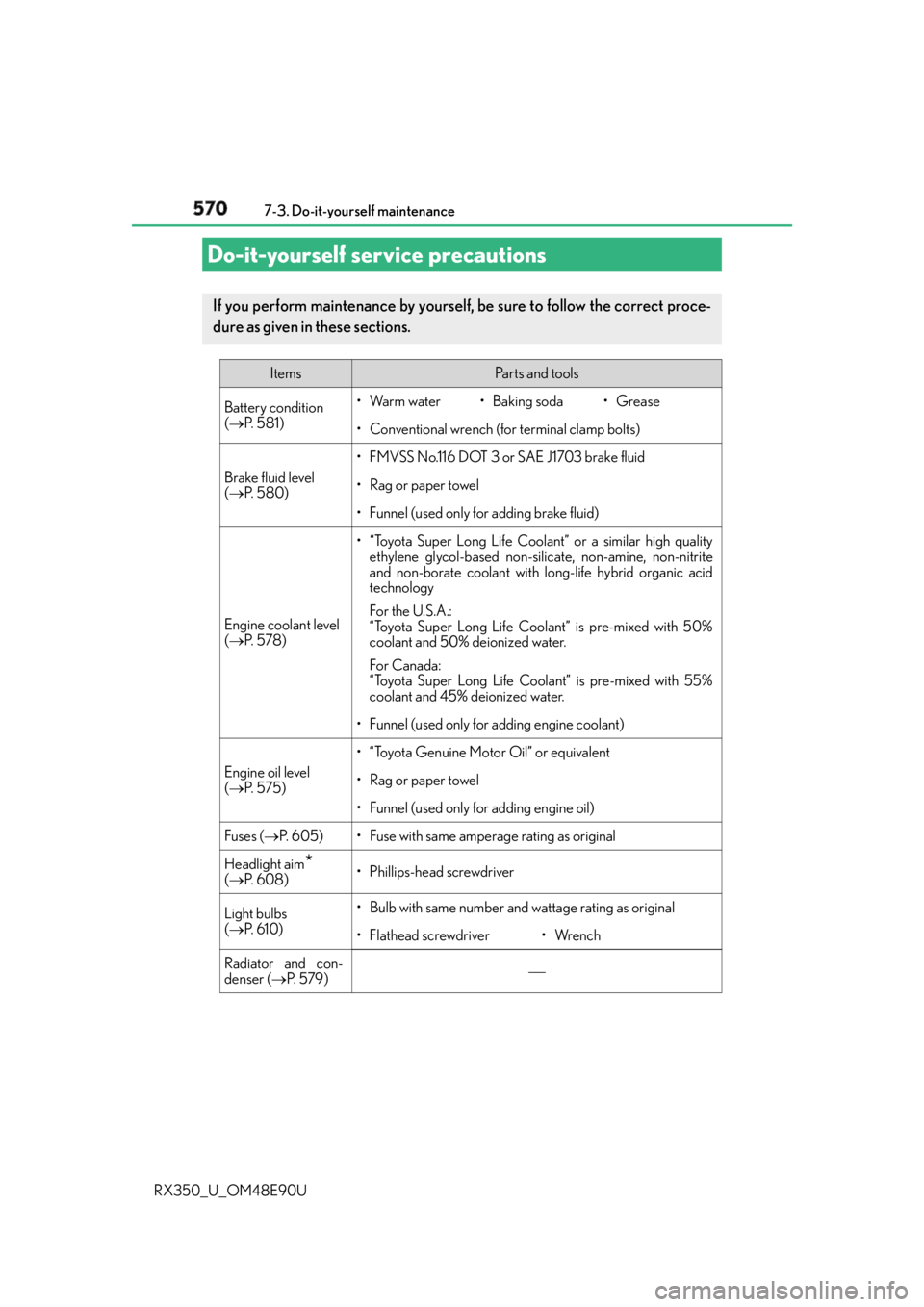
Do-it-yourself service precautions If you perform maintenance by yourself, be sure to follow the correct proce-
dure as given in these sections. Items Pa r t s a n d t o o l s
Battery condition
( P. 5 8 1 ) •Warm water • Baking soda •Grease
• Conventional wrench (for terminal clamp bolts)
Brake fluid level
( P. 5 8 0 ) • FMVSS No.116 DOT 3 or SAE J1703 brake fluid
• Rag or paper towel
• Funnel (used only for adding brake fluid)
Engine coolant level
( P. 5 7 8 ) • “Toyota Super Long Life Coolant” or a similar high quality
ethylene glycol-based non-silicate, non-amine, non-nitrite
and non-borate coolant with long-life hybrid organic acid
technology
For the U.S.A.:
“Toyota Super Long Life Coolant” is pre-mixed with 50%
coolant and 50% deionized water.
For Canada:
“Toyota Super Long Life Coolant” is pre-mixed with 55%
coolant and 45% deionized water.
• Funnel (used only for adding engine coolant)
Engine oil level
( P. 5 7 5 ) • “Toyota Genuine Motor Oil” or equivalent
• Rag or paper towel
• Funnel (used only for adding engine oil)
Fuses ( P. 6 0 5 ) • Fuse with same amperage rating as original
Headlight aim
*( P. 6 0 8 ) • Phillips-head screwdriver
Light bulbs
( P. 6 1 0 ) • Bulb with same number and wattage rating as original
•Flathead screwdriver •Wrench
Radiator and con-
denser ( P. 5 7 9 )
Page 576 of 748
576 7-3. Do-it-yourself maintenance
RX350_U_OM48E90U ■
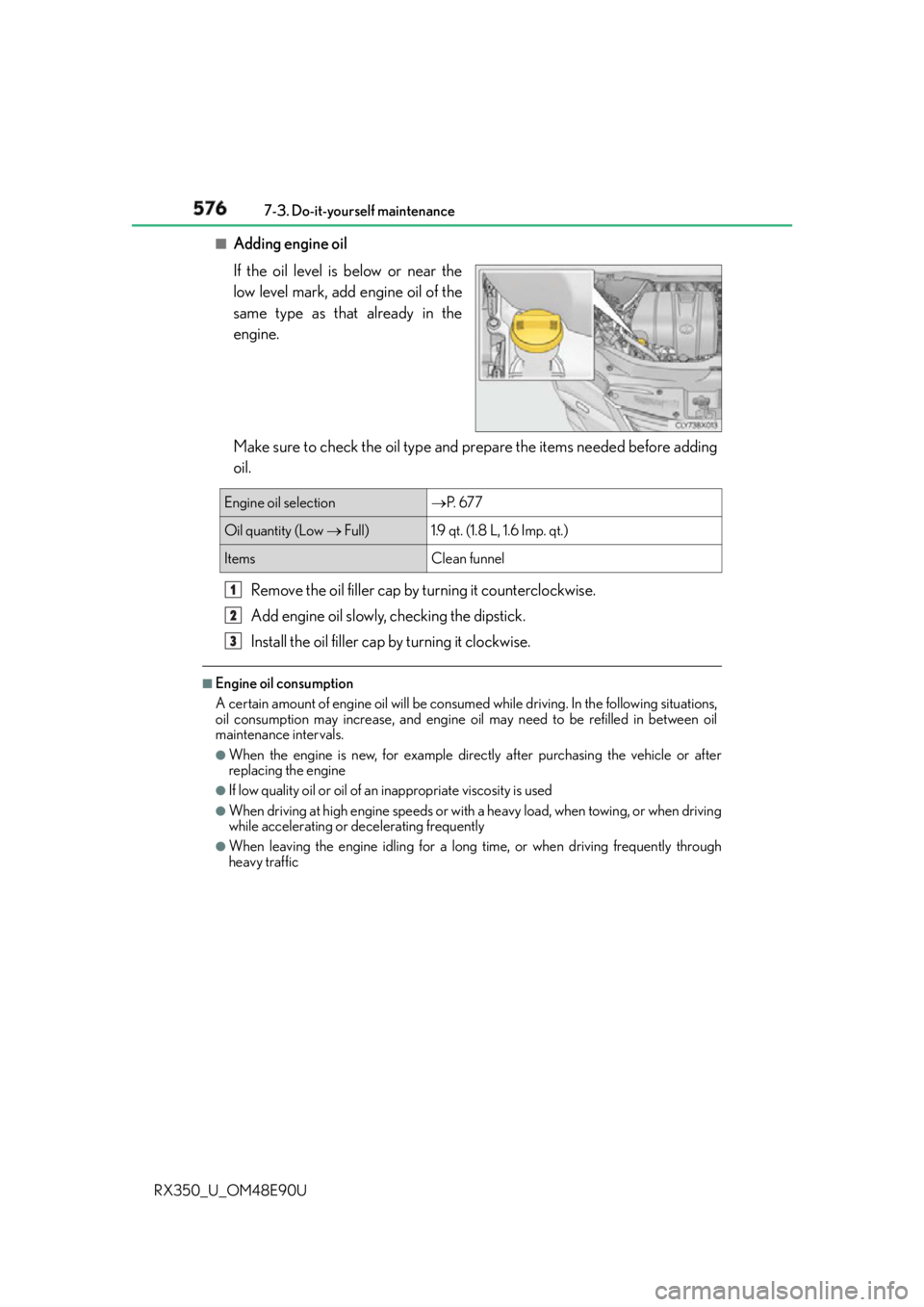
Adding engine oil
If the oil level is below or near the
low level mark, add engine oil of the
same type as that already in the
engine.
Make sure to check the oil type and prepare the items needed before adding
oil.
Remove the oil filler cap by turning it coun terclockwise.
Add engine oil slowly, checking the dipstick.
Install the oil filler cap by turning it clockwise. ■
Engine oil consumption
A certain amount of engine oil will be consum ed while driving. In th e following situations,
oil consumption may increase, and engine o il may need to be refilled in between oil
maintenance intervals. ●
When the engine is new, for example directly after purchasing the vehicle or after
replacing the engine ●
If low quality oil or oil of an inappropriate viscosity is used●
When driving at high engine speeds or with a heavy load, when towing, or when driving
while accelerating or de celerating frequently●
When leaving the engi ne idling for a long time, or when driving frequently through
heavy trafficEngine oil selection P. 6 7 7
Oil quantity (Low Full) 1.9 qt. (1.8 L, 1.6 Imp. qt.)
Items Clean funnel1
2
3
Page 589 of 748

5897-3. Do-it-yourself maintenance
7
Maintenance and care
RX350_U_OM48E90U ■
Situations in which the tire pressure warning system may not operate properly ●
In the following cases, the tire pressure warning system may not operate properly.
• If non-genuine Lexus wheels are used.
• A tire has been replaced with a tire that is not an OE (Original Equipment) tire.
• A tire has been replaced with a tire that is not of the specified size.
• Tire chains etc. are equipped.
• If a window tint that affects the radio wave signals is installed.
• If there is a lot of snow or ice on the vehicle, particularly around the wheels or wheel
housings.
• If the tire inflation pressure is extremely higher than the specified level.
• If wheel without the tire pressure warning valve and transmitter is used.
• If the ID code on the tire pressure warning valves and transmitters is not registered
in the tire pressure warning computer. ●
Performance may be affected in the following situations.
• Near a TV tower, electric power plant, gas station, radio station, large display, air-
port or other facility th at generates strong radio waves or electrical noise.
• When carrying a portable radio, cellular phone, cordless ph one or other wireless
communication device.
If tire position information is not correctl y displayed due to the radio wave conditions,
the display may be corrected by driving and changing the radio wave conditions. ●
When the vehicle is parked, the time taken for the warning to start or go off could be
extended. ●
When tire inflation pressure declines rapidly for example when a tire has burst, the
warning may not function. ■
The initialization operation ●
Make sure to carry out initialization af ter adjusting the tire inflation pressure.
Also, make sure the tires are cold before carry ing out initialization or tire inflation pres-
sure adjustment. ●
If you have accidentally turned the engine swit ch off during initialization, it is not neces-
sary to press the reset switch again as init ialization will restart automatically when the
engine switch has been turned to IG NITION ON mode for the next time.●
If you accidentally press the reset switch when initialization is not necessary, adjust the
tire inflation pressure to the specified leve l when the tires are co ld, and conduct initial-
ization again. ●
While the position of each tire is being de termined and the inflation pressures are not
being displayed on the mu lti-information display, if the in flation pressure of a tire drops,
the tire pressure warning light will come on.
Page 592 of 748
592 7-3. Do-it-yourself maintenance
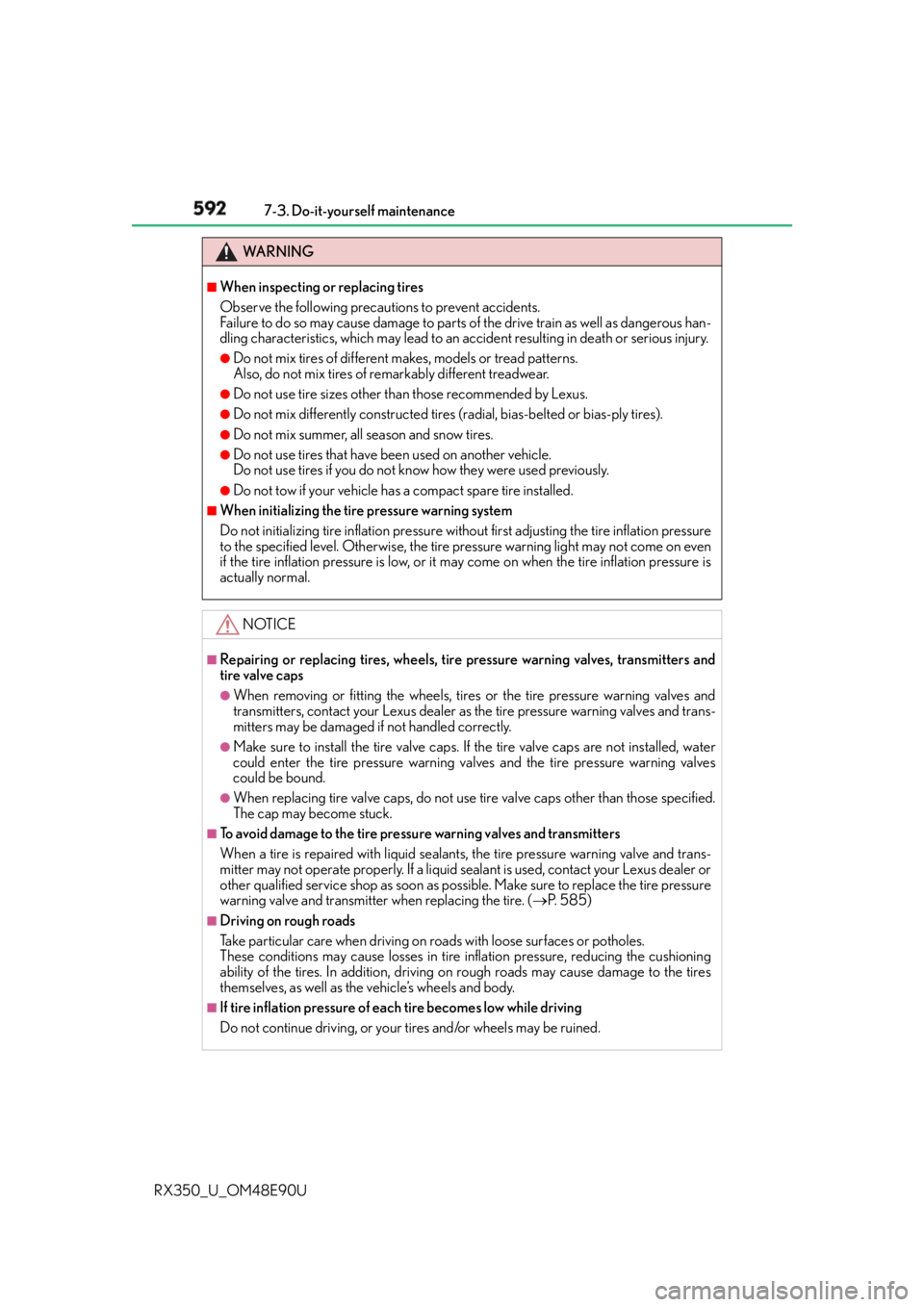
RX350_U_OM48E90U WA R N I N G ■
When inspecting or replacing tires
Observe the following precautions to prevent accidents.
Failure to do so may cause damage to parts of the drive train as well as dangerous han-
dling characteristics, which may lead to an accident resultin g in death or serious injury.●
Do not mix tires of different makes, models or tread patterns.
Also, do not mix tires of remarkably different treadwear. ●
Do not use tire sizes other than those recommended by Lexus. ●
Do not mix differently constructed tires (radial, bias-belted or bias-ply tires). ●
Do not mix summer, all season and snow tires. ●
Do not use tires that have been used on another vehicle.
Do not use tires if you do not know how they were used previously. ●
Do not tow if your vehicle has a compact spare tire installed. ■
When initializing the tire pressure warning system
Do not initializing tire inflation pressure wi thout first adjusting the tire inflation pressure
to the specified level. Otherwise, the tire pressure warning light may not come on even
if the tire inflation pressure is low, or it may come on when the tire inflation pressure is
actually normal.
NOTICE ■
Repairing or replacing tires, wheels, tire pressure warning valves, transmitters and
tire valve caps ●
When removing or fitting the wheels, tires or the tire pressure warning valves and
transmitters, contact your Lexus dealer as the tire pressure warning valves and trans-
mitters may be damaged if not handled correctly.●
Make sure to install the tire valve caps. If the tire valve caps ar e not installed, water
could enter the tire pressure warning valves and the tire pressure warning valves
could be bound. ●
When replacing tire valve caps, do not use tire valve caps other than those specified.
The cap may become stuck. ■
To avoid damage to the tire pressu re warning valves and transmitters
When a tire is repaired with liquid sealants, the tire pressure warning valve and trans-
mitter may not operate properly. If a liquid se alant is used, contact your Lexus dealer or
other qualified service shop as soon as possible. Make sure to replace the tire pressure
warning valve and transmitter when replacing the tire. ( P. 585)■
Driving on rough roads
Take particular care when driving on roads with loose surfaces or potholes.
These conditions may cause losses in tire inflation pressure, reducing the cushioning
ability of the tires. In addition, driving on rough roads may cause damage to the tires
themselves, as well as the vehicle’s wheels and body. ■
If tire inflation pressure of ea ch tire becomes low while driving
Do not continue driving, or your tires and/or wheels may be ruined.
Page 618 of 748
618 7-3. Do-it-yourself maintenance
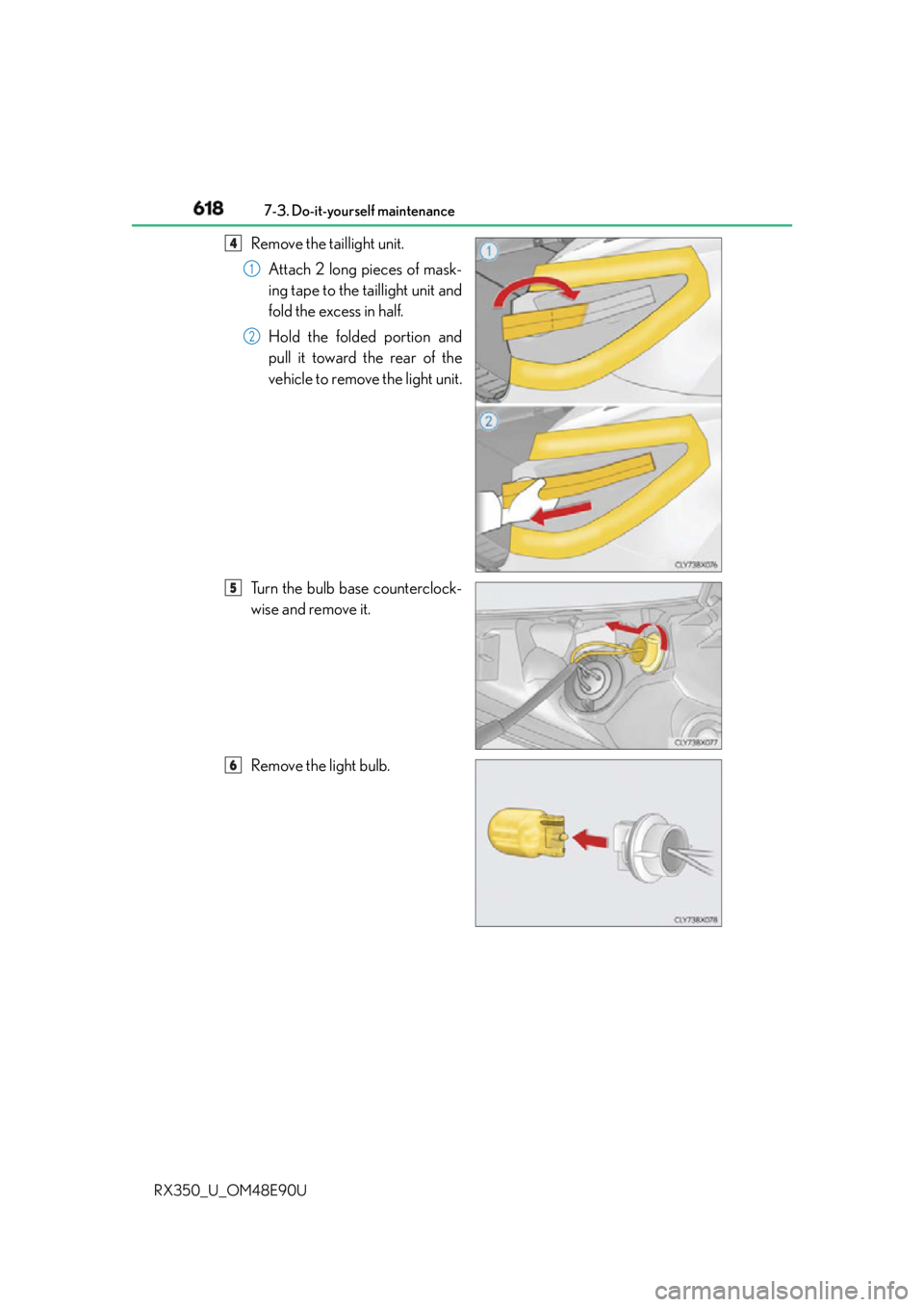
RX350_U_OM48E90U Remove the taillight unit.
Attach 2 long pieces of mask-
ing tape to the taillight unit and
fold the excess in half.
Hold the folded portion and
pull it toward the rear of the
vehicle to remove the light unit.
Turn the bulb base counterclock-
wise and remove it.
Remove the light bulb. 4
1
2
5
6
Page 619 of 748
6197-3. Do-it-yourself maintenance
7
Maintenance and care
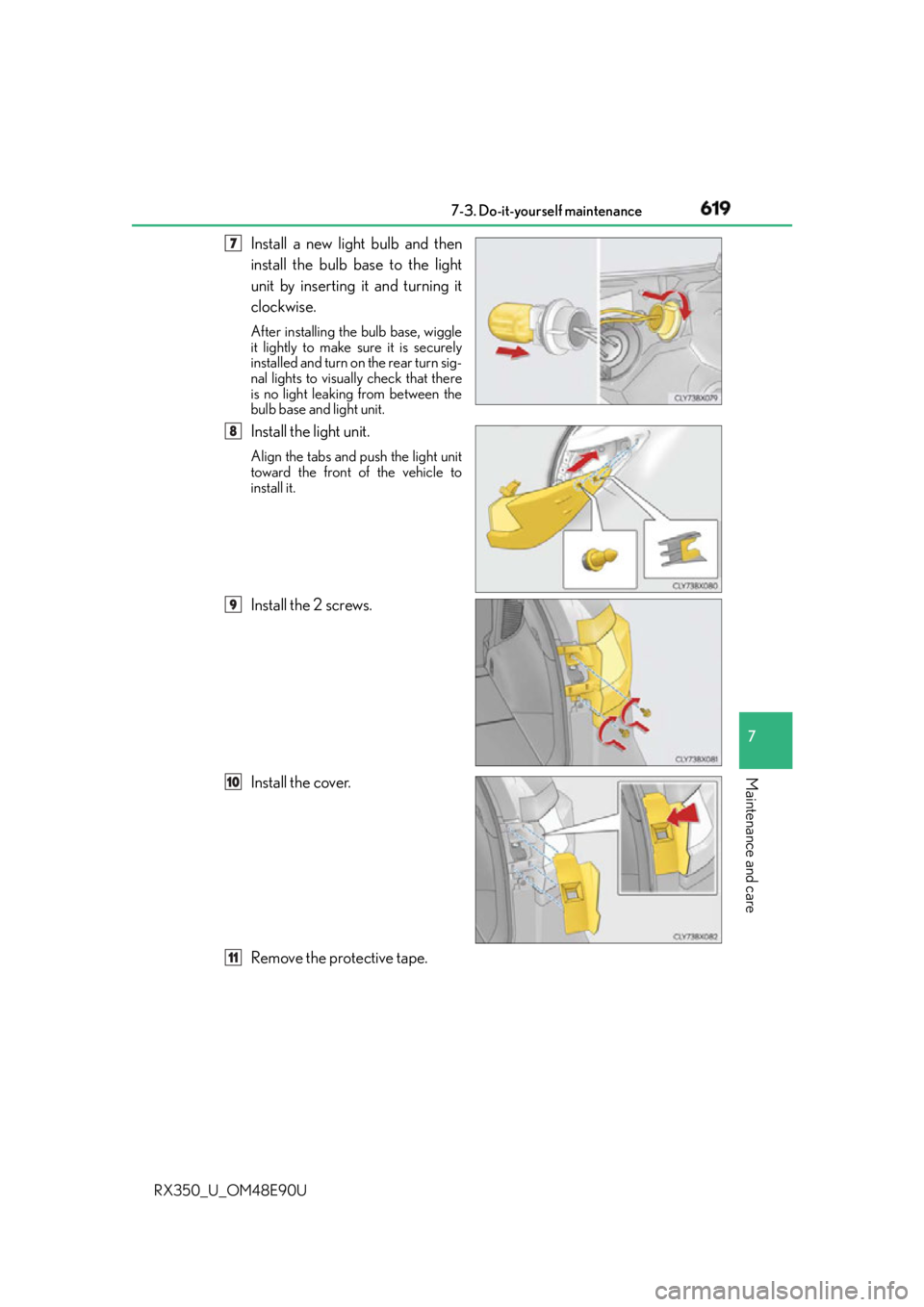
RX350_U_OM48E90U Install a new light bulb and then
install the bulb base to the light
unit by inserting it and turning it
clockwise. After installing the bulb base, wiggle
it lightly to make sure it is securely
installed and turn on the rear turn sig-
nal lights to visually check that there
is no light leaking from between the
bulb base and light unit.
Install the light unit. Align the tabs and push the light unit
toward the front of the vehicle to
install it.
Install the 2 screws.
Install the cover.
Remove the protective tape. 47
8
9
10
11
Page 623 of 748
623
8When trouble arises
RX350_U_OM48E90U 8-1. Essential information
Emergency flashers .................. 624
If your vehicle has to be
stopped in an
emergency................................. 625
8-2. Steps to take in an
emergency
If your vehicle needs to be
towed ........................................... 626
If you think something is
wrong ........................................... 632
Fuel pump shut off
system .......................................... 633
If a warning light turns
on or a warning buzzer
sounds.......................................... 634
If a warning message is
displayed.......................................641
If you have a flat tire................... 646
If the engine will not start ........658
If the shift lever cannot be
shifted from P............................660
If the electronic key does
not operate properly ...............661
If the vehicle battery is
discharged ................................. 665
If your vehicle overheats .........668
If the vehicle becomes
stuck ............................................... 671
Page 626 of 748
626
RX350_U_OM48E90U 8-2. Steps to take in an emergency
The following may indicate a problem with your transmission. Contact your
Lexus dealer or commercial towing service before towing. ( P. 6 3 0 )●
The engine is running but the vehicle dose not move. ●
The vehicle makes an abnormal sound.
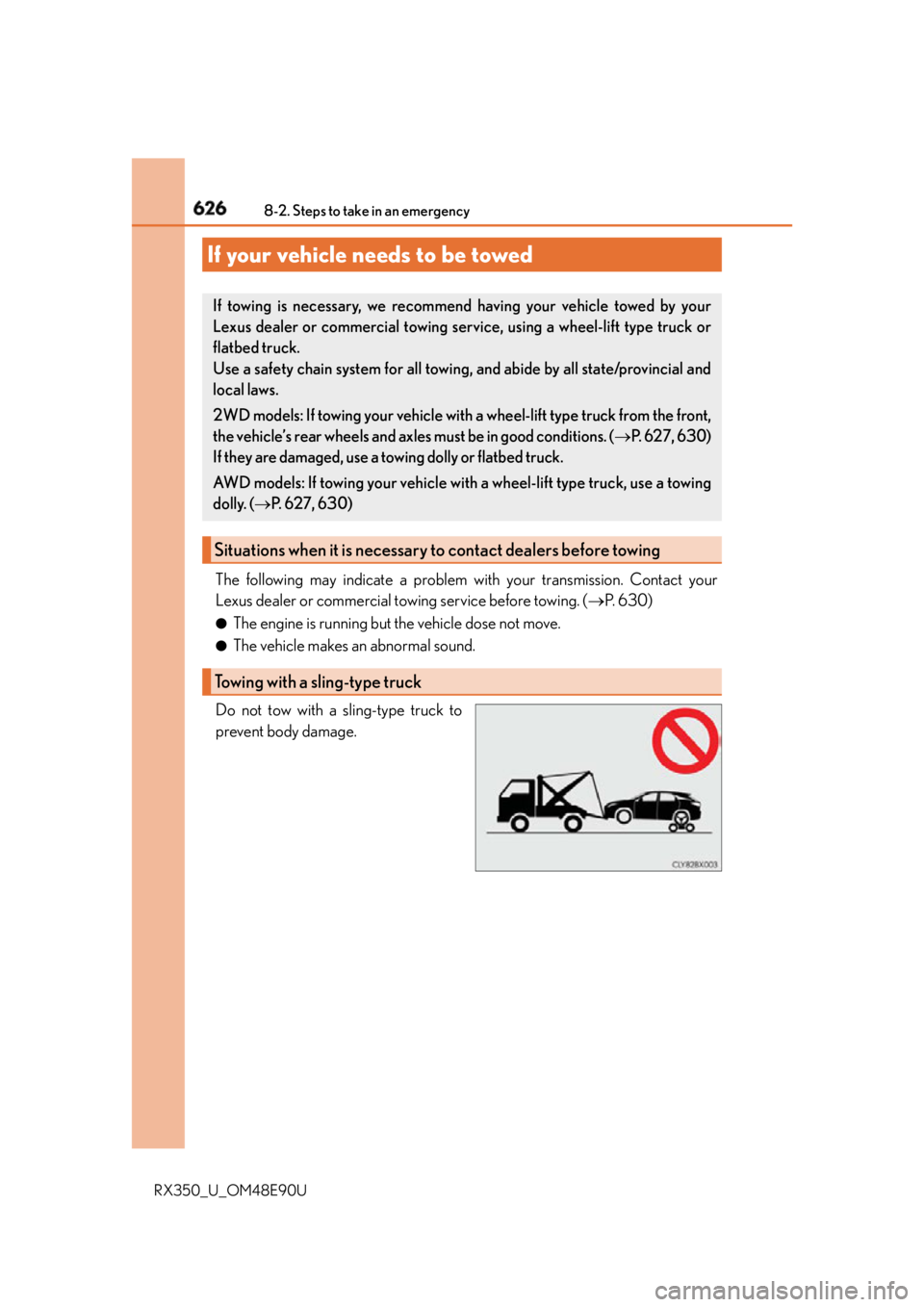
Do not tow with a sling-type truck to
prevent body damage.If your vehicle needs to be towed If towing is necessary, we recommend having your vehicle towed by your
Lexus dealer or commercial towing se rvice, using a wheel-lift type truck or
flatbed truck.
Use a safety chain system for all towing, and abide by all state/provincial and
local laws.
2WD models: If towing your vehicle with a wheel-lift type truck from the front,
the vehicle’s rear wheels and axles must be in good conditions. ( P. 6 2 7 , 6 3 0 )
If they are damaged, use a towing dolly or flatbed truck.
AWD models: If towing your vehicle with a wheel-lift type truck, use a towing
dolly. ( P. 6 2 7 , 6 3 0 )
Situations when it is necessary to contact dealers before towing
Towing with a sling-type truck
Page 627 of 748
6278-2. Steps to take in an emergency
8
When trouble arises
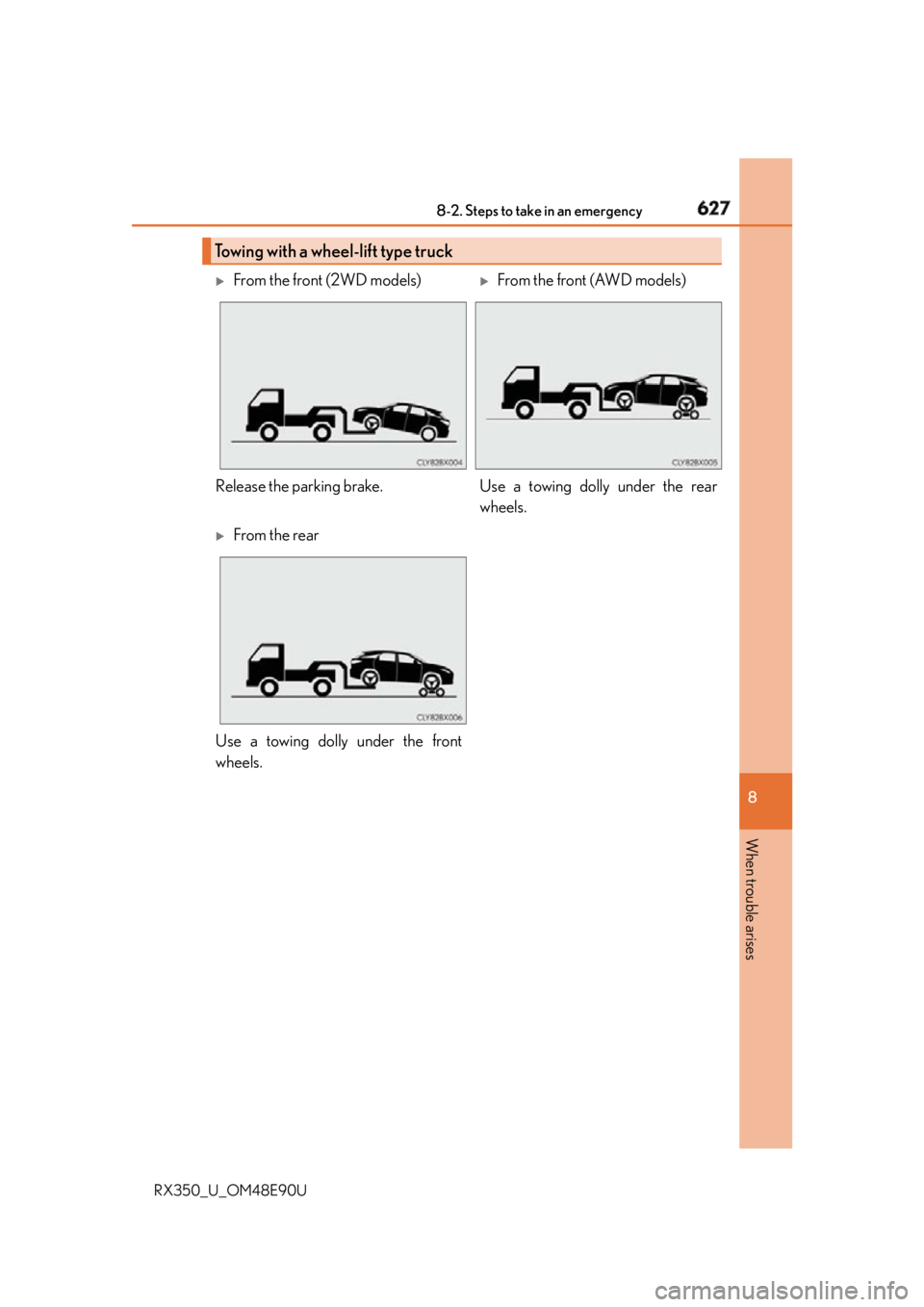
RX350_U_OM48E90U Towing with a wheel-lift type truck
From the front (2WD models)
From the front (AWD models)
Release the parking brake. Use a towing dolly under the rear
wheels.
From the rear
Use a towing dolly under the front
wheels.
Page 628 of 748
628 8-2. Steps to take in an emergency
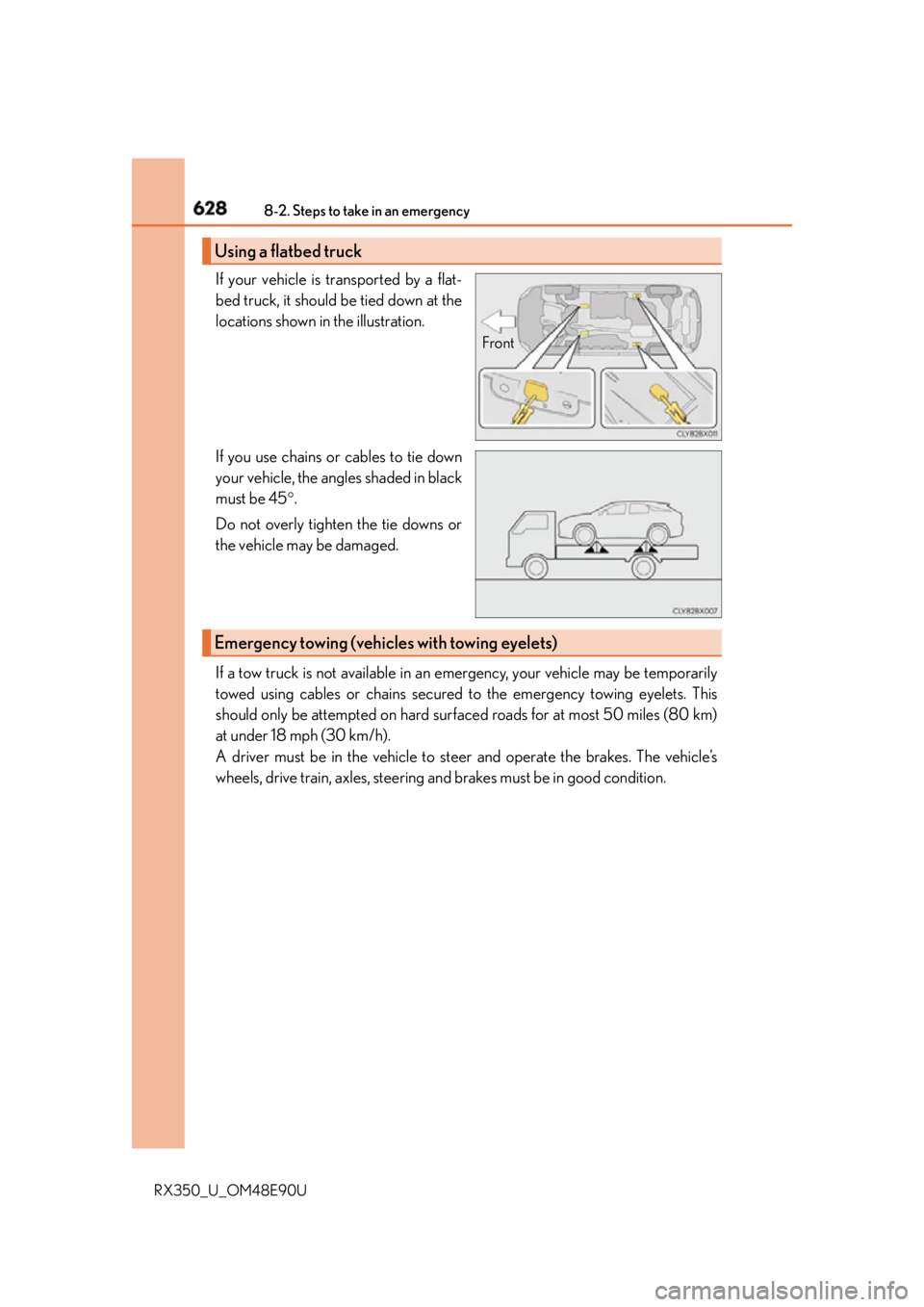
RX350_U_OM48E90U If your vehicle is transported by a flat-
bed truck, it should be tied down at the
locations shown in the illustration.
If you use chains or cables to tie down
your vehicle, the angles shaded in black
must be 45 .
Do not overly tighten the tie downs or
the vehicle may be damaged.
If a tow truck is not available in an emergency, your vehicle may be temporarily
towed using cables or chains secured to the emergency towing eyelets. This
should only be attempted on hard surf aced roads for at most 50 miles (80 km)
at under 18 mph (30 km/h).
A driver must be in the vehicle to steer and operate the brakes. The vehicle’s
wheels, drive train, axles, steering an d brakes must be in good condition.Using a flatbed truck Front
Emergency towing (vehicles with towing eyelets)