ECU LEXUS RX350 2022 Manual PDF
[x] Cancel search | Manufacturer: LEXUS, Model Year: 2022, Model line: RX350, Model: LEXUS RX350 2022Pages: 508, PDF Size: 26.2 MB
Page 391 of 508
3897-2. Steps to take in an emergency
7
When trouble arises
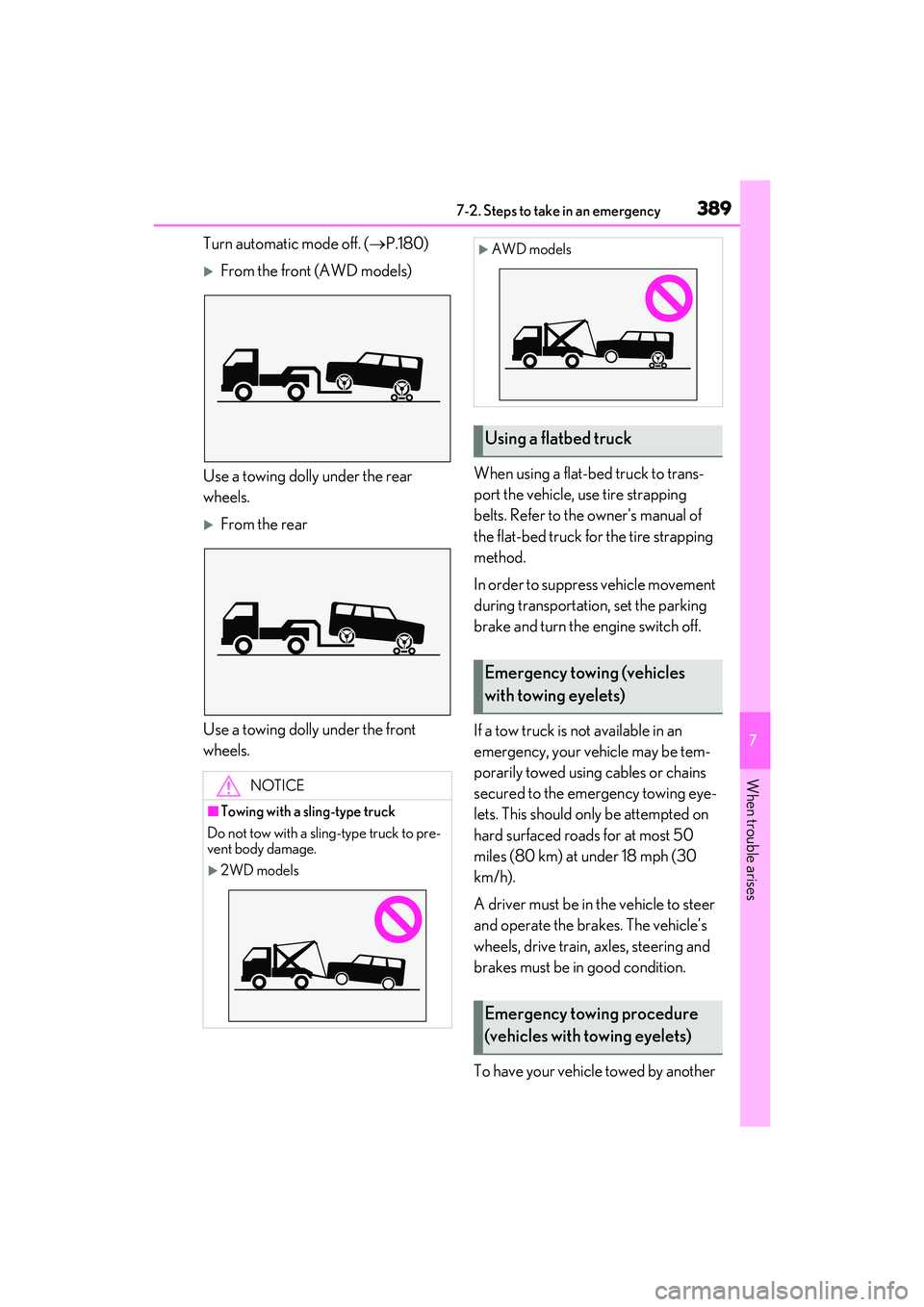
Turn automatic mode off. (P.180)
From the front (AWD models)
Use a towing dolly under the rear
wheels.
From the rear
Use a towing dolly under the front
wheels. When using a flat-bed truck to trans-
port the vehicle, use tire strapping
belts. Refer to the owner's manual of
the flat-bed truck for the tire strapping
method.
In order to suppress vehicle movement
during transportation, set the parking
brake and turn the engine switch off.
If a tow truck is not available in an
emergency, your vehicle may be tem-
porarily towed using cables or chains
secured to the emergency towing eye-
lets. This should only be attempted on
hard surfaced roads for at most 50
miles (80 km) at under 18 mph (30
km/h).
A driver must be in the vehicle to steer
and operate the brakes. The vehicle’s
wheels, drive train, axles, steering and
brakes must be in good condition.
To have your vehicle towed by another
NOTICE
■Towing with a sling-type truck
Do not tow with a sling-type truck to pre-
vent body damage.
2WD models
AWD models
Using a flatbed truck
Emergency towing (vehicles
with towing eyelets)
Emergency towing procedure
(vehicles with towing eyelets)
Page 392 of 508
3907-2. Steps to take in an emergency
vehicle, the towing eyelet must be
installed to your vehicle. Install the tow-
ing eyelet using the following proce-
dure.
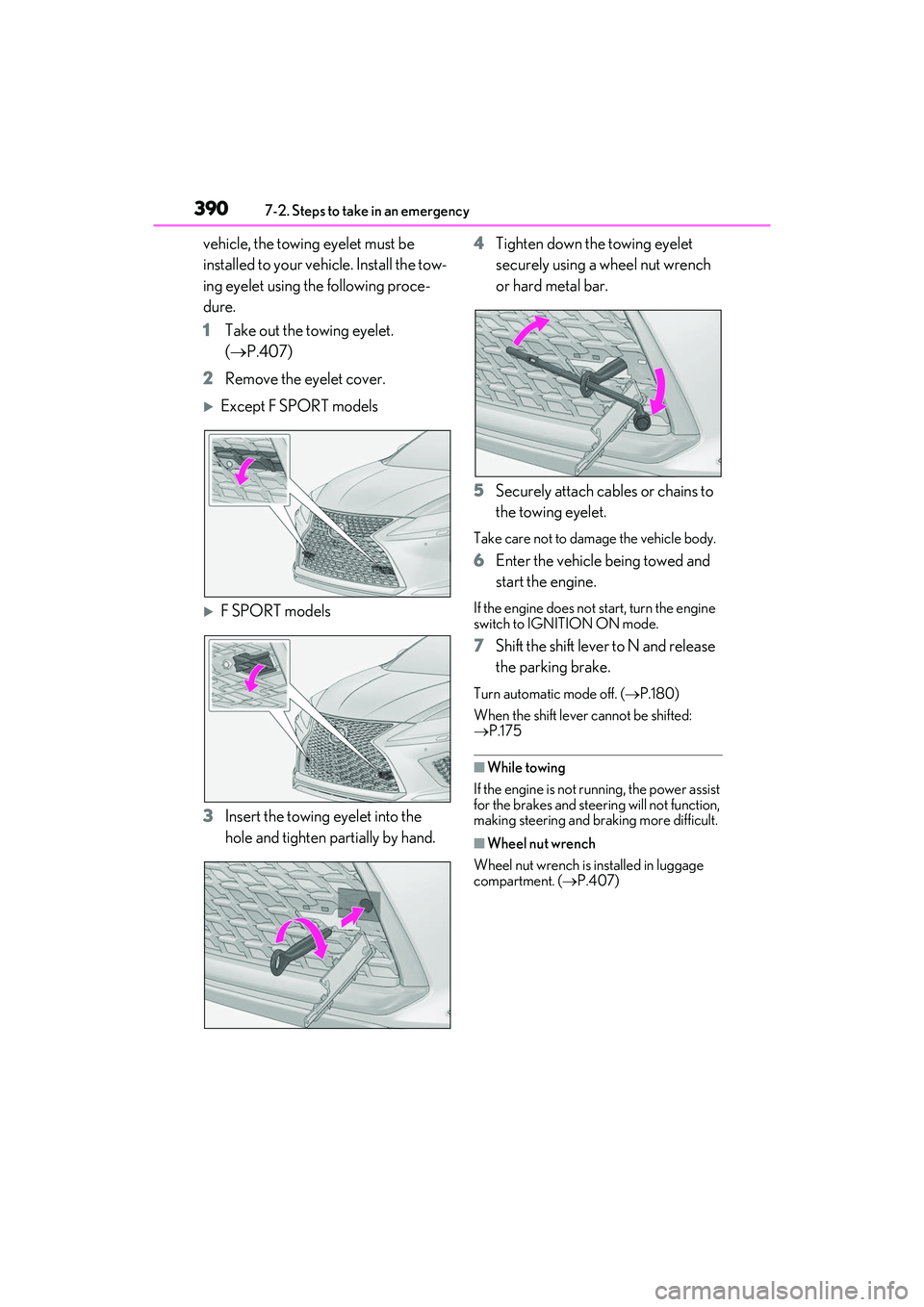
1 Take out the towing eyelet.
( P.407)
2 Remove the eyelet cover.
Except F SPORT models
F SPORT models
3 Insert the towing eyelet into the
hole and tighten partially by hand. 4
Tighten down the towing eyelet
securely using a wheel nut wrench
or hard metal bar.
5 Securely attach cables or chains to
the towing eyelet.
Take care not to damage the vehicle body.
6Enter the vehicle being towed and
start the engine.
If the engine does not start, turn the engine
switch to IGNITION ON mode.
7Shift the shift lever to N and release
the parking brake.
Turn automatic mode off. (P.180)
When the shift lever cannot be shifted:
P.175
■While towing
If the engine is not running, the power assist
for the brakes and steer ing will not function,
making steering and braking more difficult.
■Wheel nut wrench
Wheel nut wrench is installed in luggage
compartment. ( P.407)
Page 401 of 508
3997-2. Steps to take in an emergency
7
When trouble arises
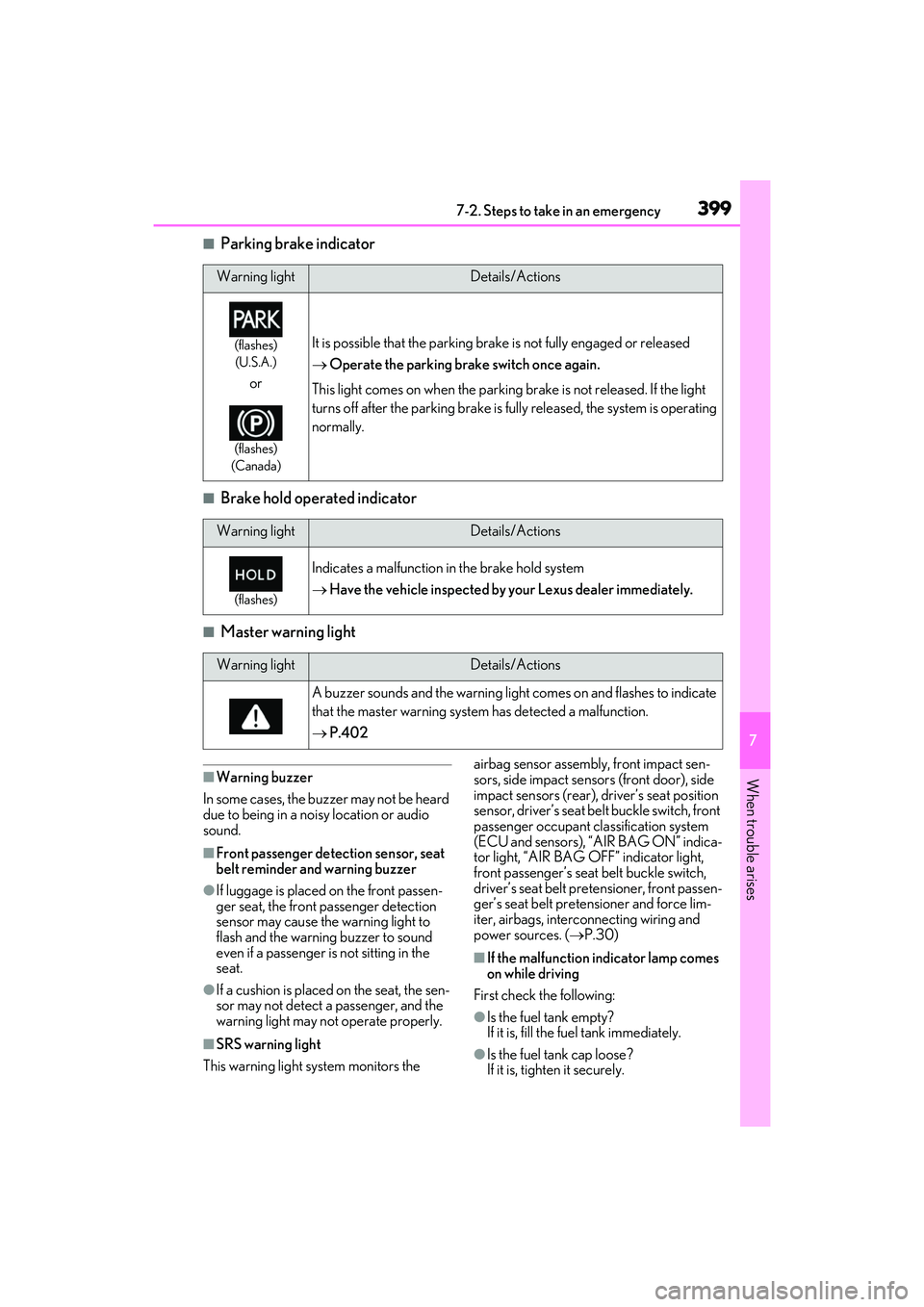
■Parking brake indicator
■Brake hold operated indicator
■Master warning light
■Warning buzzer
In some cases, the bu zzer may not be heard
due to being in a noisy location or audio
sound.
■Front passenger detection sensor, seat
belt reminder and warning buzzer
●If luggage is placed on the front passen-
ger seat, the front passenger detection
sensor may cause the warning light to
flash and the warning buzzer to sound
even if a passenger is not sitting in the
seat.
●If a cushion is placed on the seat, the sen-
sor may not detect a passenger, and the
warning light may not operate properly.
■SRS warning light
This warning light sy stem monitors the airbag sensor assembly, front impact sen-
sors, side impact sensor
s (front door), side
impact sensors (rear), driver’s seat position
sensor, driver’s seat belt buckle switch, front
passenger occupant classification system
(ECU and sensors), “AIR BAG ON” indica-
tor light, “AIR BAG OFF” indicator light,
front passenger’s seat belt buckle switch,
driver’s seat belt pr etensioner, front passen-
ger’s seat belt pretensioner and force lim-
iter, airbags, interconnecting wiring and
power sources. ( P.30)
■If the malfunction in dicator lamp comes
on while driving
First check the following:
●Is the fuel tank empty?
If it is, fill the fuel tank immediately.
●Is the fuel tank cap loose?
If it is, tighten it securely.
Warning lightDetails/Actions
(flashes) (U.S.A.)
or
(flashes)
(Canada)
It is possible that the parking brake is not fully engaged or released
Operate the parking brake switch once again.
This light comes on when the parking brake is not released. If the light
turns off after the parking brake is fu lly released, the system is operating
normally.
Warning lightDetails/Actions
(flashes)
Indicates a malfunction in the brake hold system
Have the vehicle inspected by your Lexus dealer immediately.
Warning lightDetails/Actions
A buzzer sounds and the warning light comes on and flashes to indicate
that the master warning system has detected a malfunction.
P.402
Page 411 of 508

4097-2. Steps to take in an emergency
7
When trouble arises
When replacing tires on a vehicle with
wheel lock nuts, use the following pro-
cedures to remove and install the
wheel lock nuts. The wheel lock key is
stored in the tray inside the luggage
compartment. Always return the wheel
lock key to its original position after
use, so that it does not get lost.
■Removal
For ease of removal, the wheel lock nut
should always be the first one loos-
ened.
1 Place the wheel lock key on top of
the wheel lock nut, turning until the
wheel lock key and wheel lock nut
patterns engage.
2 Place the wheel nut wrench on the
wheel lock key, and while applying
pressure on the wheel lock key,
loosen the wheel lock nut.
■Installation
For ease of installation, the wheel lock nut should always be the last one tight-
ened.
1
By hand, install a wheel lock nut on
each wheel.
2 Place the wheel lock key on top of
the wheel lock nut, turning until the
wheel lock key and wheel lock nut
patterns engage.
3 Place the wheel nut wrench on the
wheel lock key, and while applying
pressure on the wheel lock key,
tighten the wheel lock nut to the
recommended torque.
1 Secure the deck board using the
hook. ( P.311)
2 Disengage the hook and take out
the jack.
RX350: Remove the wheel nut wrench
and then the jack.
RX350L: Remove the jack handle and
then the jack.
WARNING
●Do not raise the vehicle while some-
one is inside.
●When raising the vehicle, do not put an
object on or under the jack.
●Do not raise the vehicle to a height
greater than that required to replace
the tire.
●Use a jack stand if it is necessary to get
under the vehicle.
●When lowering the vehicle, make sure
that there is no-one near the vehicle. If
there are people nearby, warn them
vocally before lowering.
Wheel lock nut (if equipped)
NOTICE
■When using a wheel lock key
Do not use an impact wrench. Using an
impact wrench may cause permanent
damage to wheel lock nut and wheel lock
key. If in doubt about wheel lock applica-
tion, contact your Lexus dealer.
Taking out the jack
Page 412 of 508
4107-2. Steps to take in an emergency
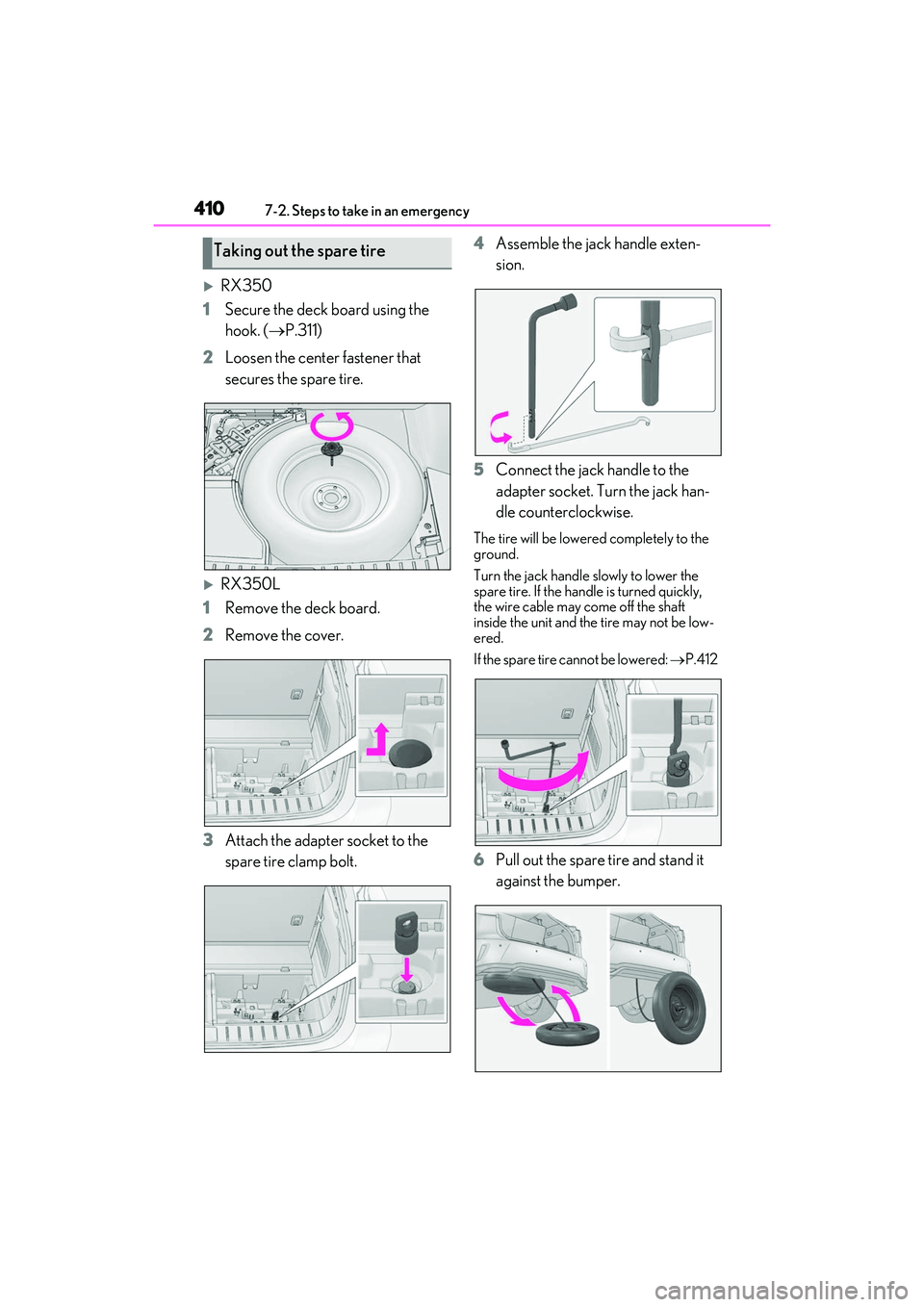
RX350
1 Secure the deck board using the
hook. ( P.311)
2 Loosen the center fastener that
secures the spare tire.
RX350L
1 Remove the deck board.
2 Remove the cover.
3 Attach the adapter socket to the
spare tire clamp bolt. 4
Assemble the jack handle exten-
sion.
5 Connect the jack handle to the
adapter socket. Turn the jack han-
dle counterclockwise.
The tire will be lowered completely to the
ground.
Turn the jack handle slowly to lower the
spare tire. If the handle is turned quickly,
the wire cable may come off the shaft
inside the unit and the tire may not be low-
ered.
If the spare tire cannot be lowered: P.412
6 Pull out the spare tire and stand it
against the bumper.
Taking out the spare tire
Page 419 of 508
4177-2. Steps to take in an emergency
7
When trouble arises
WARNING
Also, not only can the following system
not be utilized fully, but it may even nega-
tively affect the drive-train components:
• AWD system (AWD models)
■Speed limit when using the compact
spare tire
Do not drive at speeds in excess of 50
mph (80 km/h) when a compact spare
tire is installed on the vehicle.
The compact spare tire is not designed
for driving at high speeds. Failure to
observe this precaution may lead to an
accident causing deat h or serious injury.
■After using the tools and jack
Before driving, make sure all the tools
and jack are securely in place in their
storage location to reduce the possibility
of personal injury during a collision or
sudden braking.
NOTICE
■Be careful when driving over bumps
with the compact spare tire installed
on the vehicle
The vehicle becomes lower when driving
with the compact spare tire compared to
when driving with standard tires. Be
careful when driving over uneven road
surfaces.
■Driving with tire chains and the com-
pact spare tire
Do not fit tire chains to the compact
spare tire. Tire chai ns may damage the
vehicle body and adversely affect driving
performance.
■When replacing the tires
When removing or fitting the wheels,
tires or the tire pressure warning valve
and transmitter, contact your Lexus
dealer as the tire pr essure warning valve
and transmitter may be damaged if not
handled correctly.
■When stowing the flat tire (RX350L)
●Ensure that there is no object caught
between the tire and the vehicle
underbody.
●Securely tighten the spare tire clamp
bolt to hold the spare wheel carrier by
the hook.
●Stow the flat tire in the spare tire loca-
tion. Failure to do so may cause dam-
age to the spare tire carrier. Proper
storage reduces the possibility of injury
in a collision or during sudden braking.
●Have the flat tire repaired and the
spare tire replaced wi th it as soon as
possible.
■Proper storage of the spare tire
(RX350L)
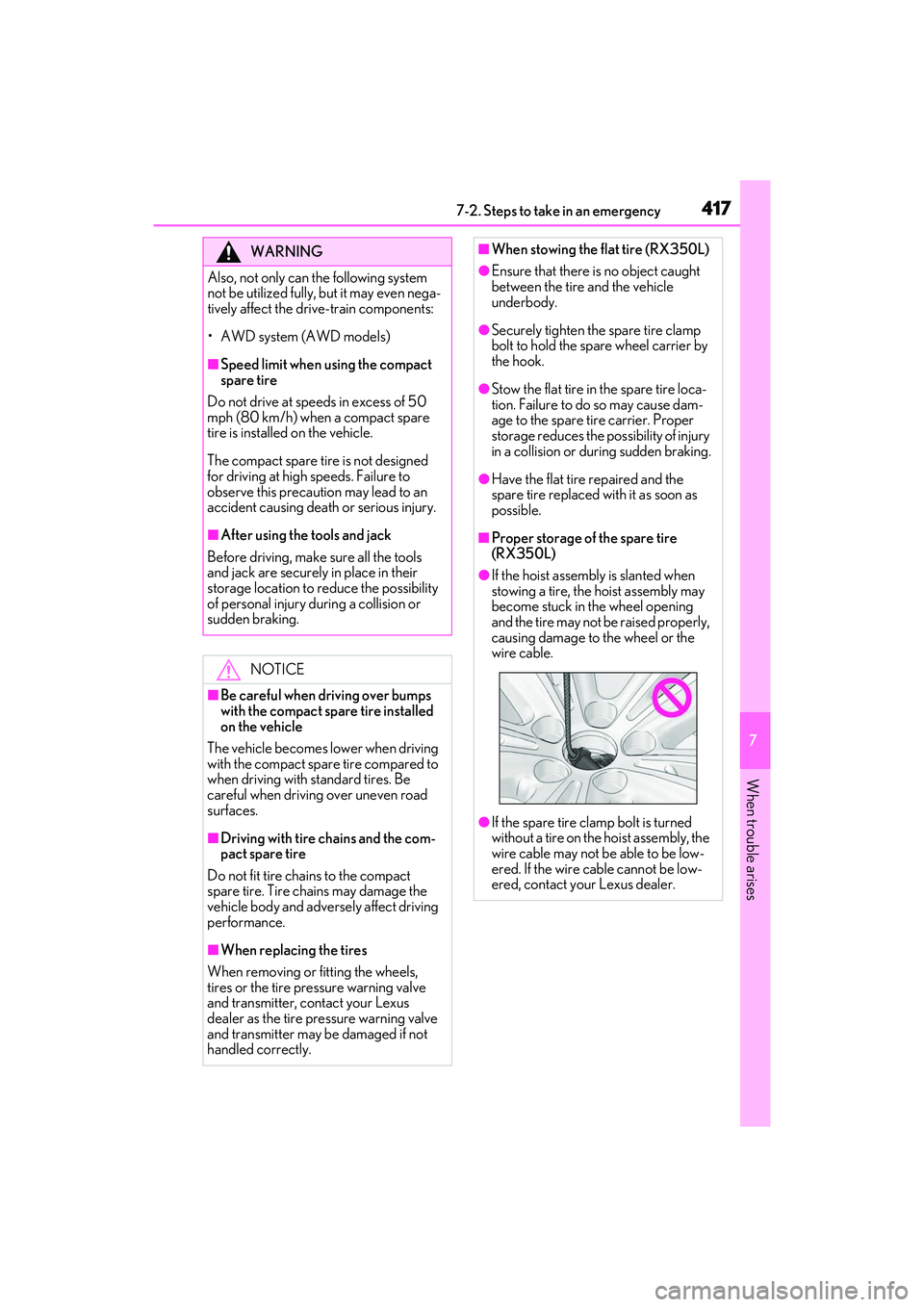
●If the hoist assembly is slanted when
stowing a tire, the hoist assembly may
become stuck in the wheel opening
and the tire may not be raised properly,
causing damage to the wheel or the
wire cable.
●If the spare tire clamp bolt is turned
without a tire on the hoist assembly, the
wire cable may not be able to be low-
ered. If the wire cable cannot be low-
ered, contact your Lexus dealer.
Page 426 of 508
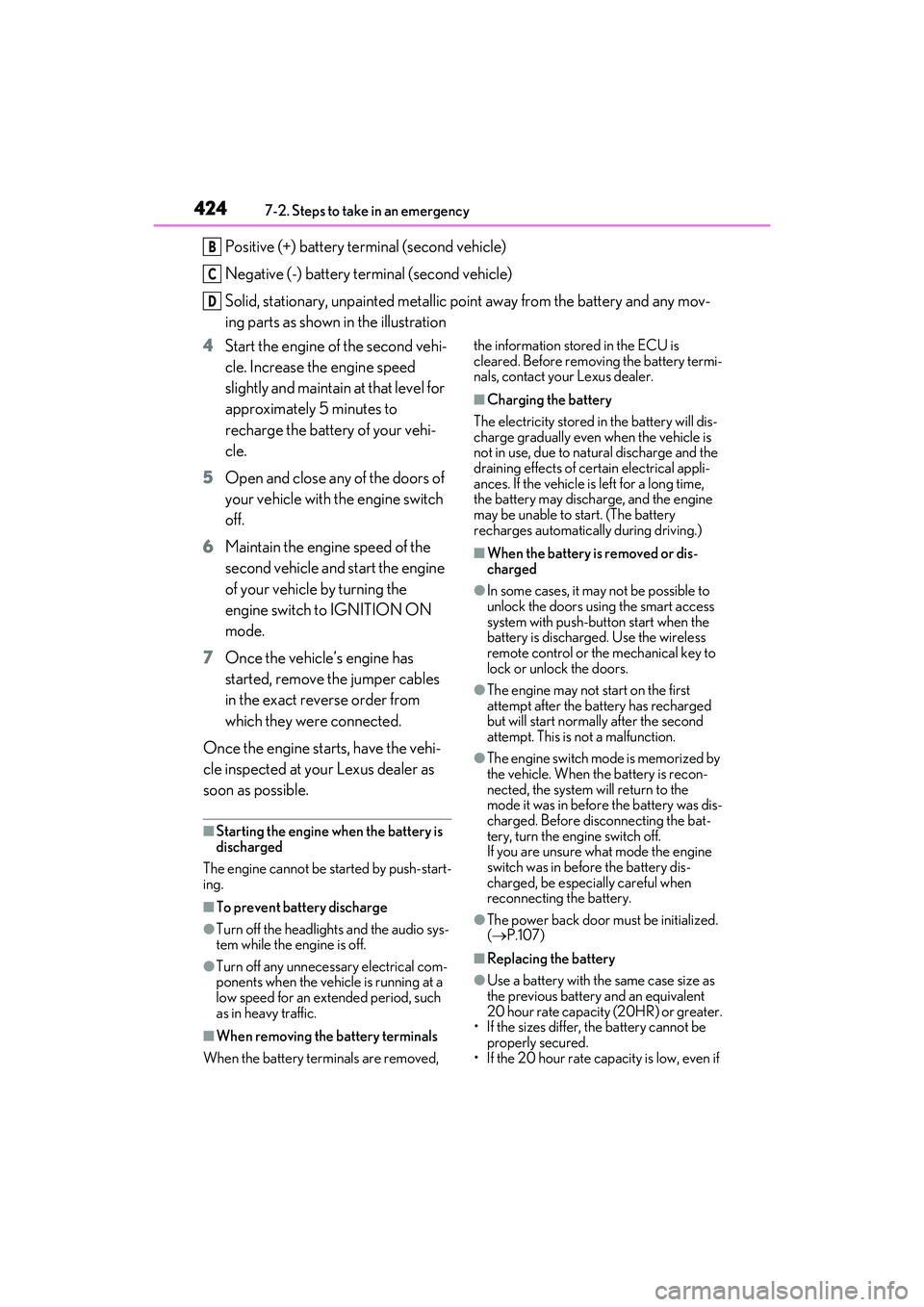
4247-2. Steps to take in an emergency
Positive (+) battery terminal (second vehicle)
Negative (-) battery terminal (second vehicle)
Solid, stationary, unpainted metallic point away from the battery and any mov-
ing parts as shown in the illustration
4 Start the engine of the second vehi-
cle. Increase the engine speed
slightly and maintain at that level for
approximately 5 minutes to
recharge the battery of your vehi-
cle.
5 Open and close any of the doors of
your vehicle with the engine switch
off.
6 Maintain the engine speed of the
second vehicle and start the engine
of your vehicle by turning the
engine switch to IGNITION ON
mode.
7 Once the vehicle’s engine has
started, remove the jumper cables
in the exact reverse order from
which they were connected.
Once the engine starts, have the vehi-
cle inspected at your Lexus dealer as
soon as possible.
■Starting the engine when the battery is
discharged
The engine cannot be started by push-start-
ing.
■To prevent battery discharge
●Turn off the headlights and the audio sys-
tem while the engine is off.
●Turn off any unnecessary electrical com-
ponents when the vehicle is running at a
low speed for an extended period, such
as in heavy traffic.
■When removing the battery terminals
When the battery terminals are removed, the information stored in the ECU is
cleared. Before removi
ng the battery termi-
nals, contact your Lexus dealer.
■Charging the battery
The electricity stored in the battery will dis-
charge gradually even when the vehicle is
not in use, due to natural discharge and the
draining effects of certain electrical appli-
ances. If the vehicle is left for a long time,
the battery may discharge, and the engine
may be unable to start. (The battery
recharges automatically during driving.)
■When the battery is removed or dis-
charged
●In some cases, it may not be possible to
unlock the doors using the smart access
system with push-button start when the
battery is discharged. Use the wireless
remote control or the mechanical key to
lock or unlock the doors.
●The engine may not start on the first
attempt after the battery has recharged
but will start normally after the second
attempt. This is not a malfunction.
●The engine switch mode is memorized by
the vehicle. When the battery is recon-
nected, the system will return to the
mode it was in before the battery was dis-
charged. Before disconnecting the bat-
tery, turn the engine switch off.
If you are unsure wh at mode the engine
switch was in before the battery dis-
charged, be especially careful when
reconnecting the battery.
●The power back door must be initialized.
( P.107)
■Replacing the battery
●Use a battery with the same case size as
the previous battery and an equivalent
20 hour rate capacity (20HR) or greater.
• If the sizes differ, the battery cannot be
properly secured.
• If the 20 hour rate capacity is low, even if
B
C
D
Page 450 of 508
4488-1. Specifications
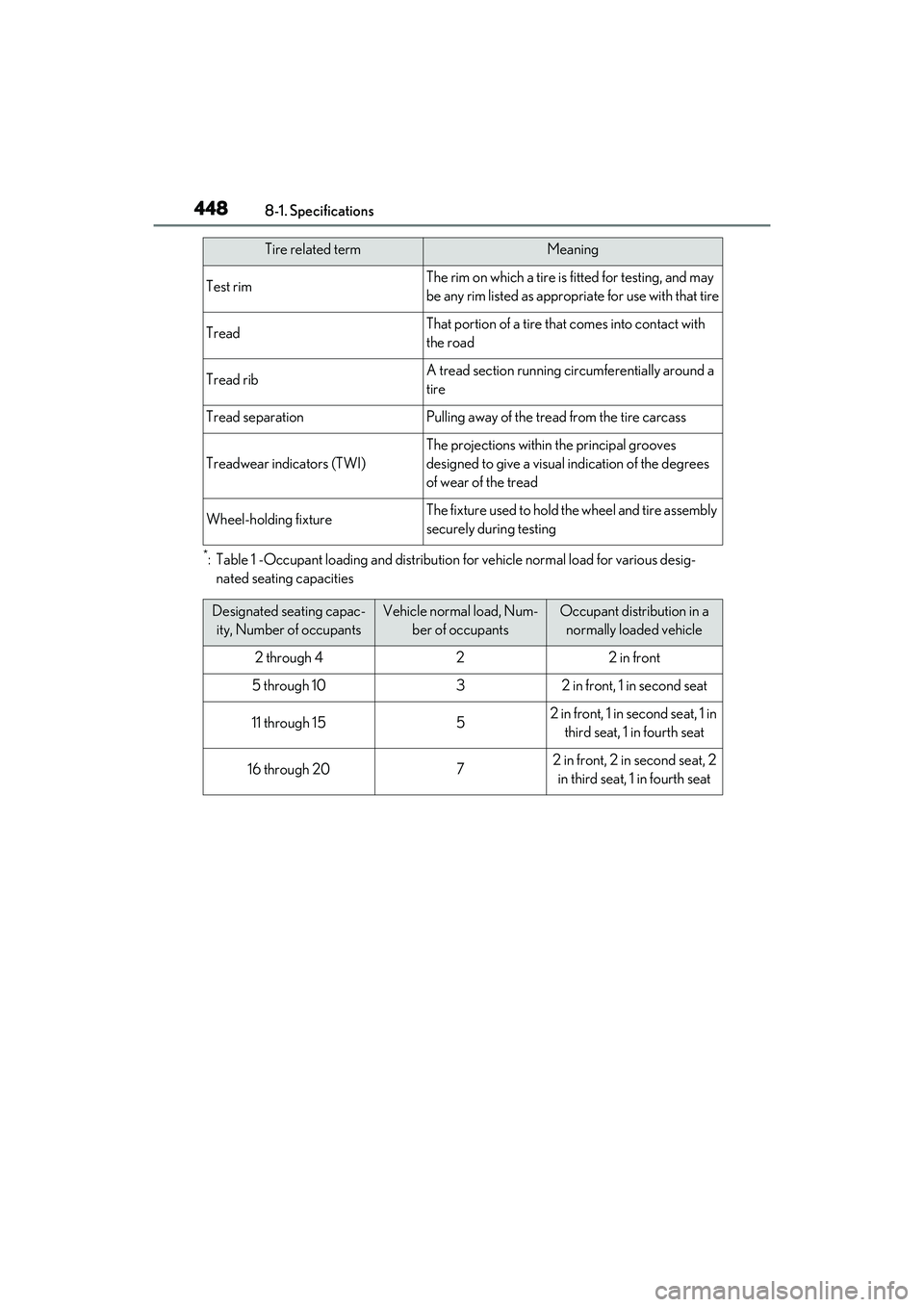
*: Table 1 -Occupant loading and distribution for vehicle normal load for various desig-
nated seating capacities
Test rimThe rim on which a tire is fitted for testing, and may
be any rim listed as appropriate for use with that tire
TreadThat portion of a tire that comes into contact with
the road
Tread ribA tread section running ci rcumferentially around a
tire
Tread separationPulling away of the tread from the tire carcass
Treadwear indicators (TWI)
The projections within the principal grooves
designed to give a visual indication of the degrees
of wear of the tread
Wheel-holding fixtureThe fixture used to hold the wheel and tire assembly
securely during testing
Tire related termMeaning
Designated seating capac- ity, Number of occupantsVehicle normal load, Num- ber of occupantsOccupant distribution in a normally loaded vehicle
2 through 422 in front
5 through 1032 in front, 1 in second seat
11 through 1552 in front, 1 in second seat, 1 in third seat, 1 in fourth seat
16 through 2072 in front, 2 in second seat, 2 in third seat, 1 in fourth seat
Page 455 of 508
4538-2. Customization
8
Vehicle specifications
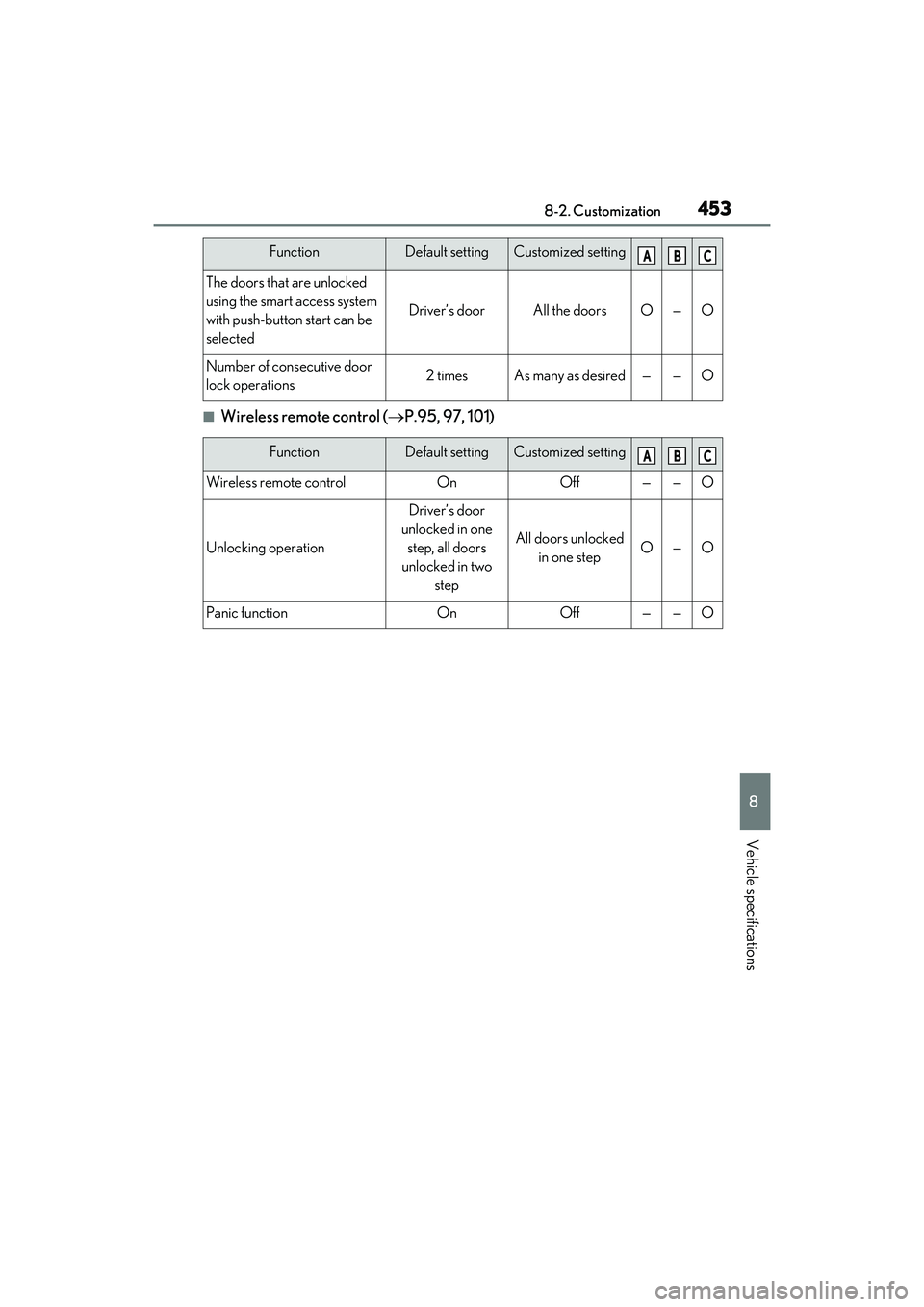
■Wireless remote control (P.95, 97, 101)
The doors that are unlocked
using the smart access system
with push-button start can be
selected
Driver’s doorAll the doorsO—O
Number of consecutive door
lock operations2 timesAs many as desired——O
FunctionDefault settingCustomized setting
Wireless remote controlOnOff——O
Unlocking operation
Driver’s door
unlocked in one step, all doors
unlocked in two step
All doors unlocked in one stepO—O
Panic functionOnOff——O
FunctionDefault settingCustomized settingABC
ABC
Page 467 of 508
4659-1. For owners
9
For owners
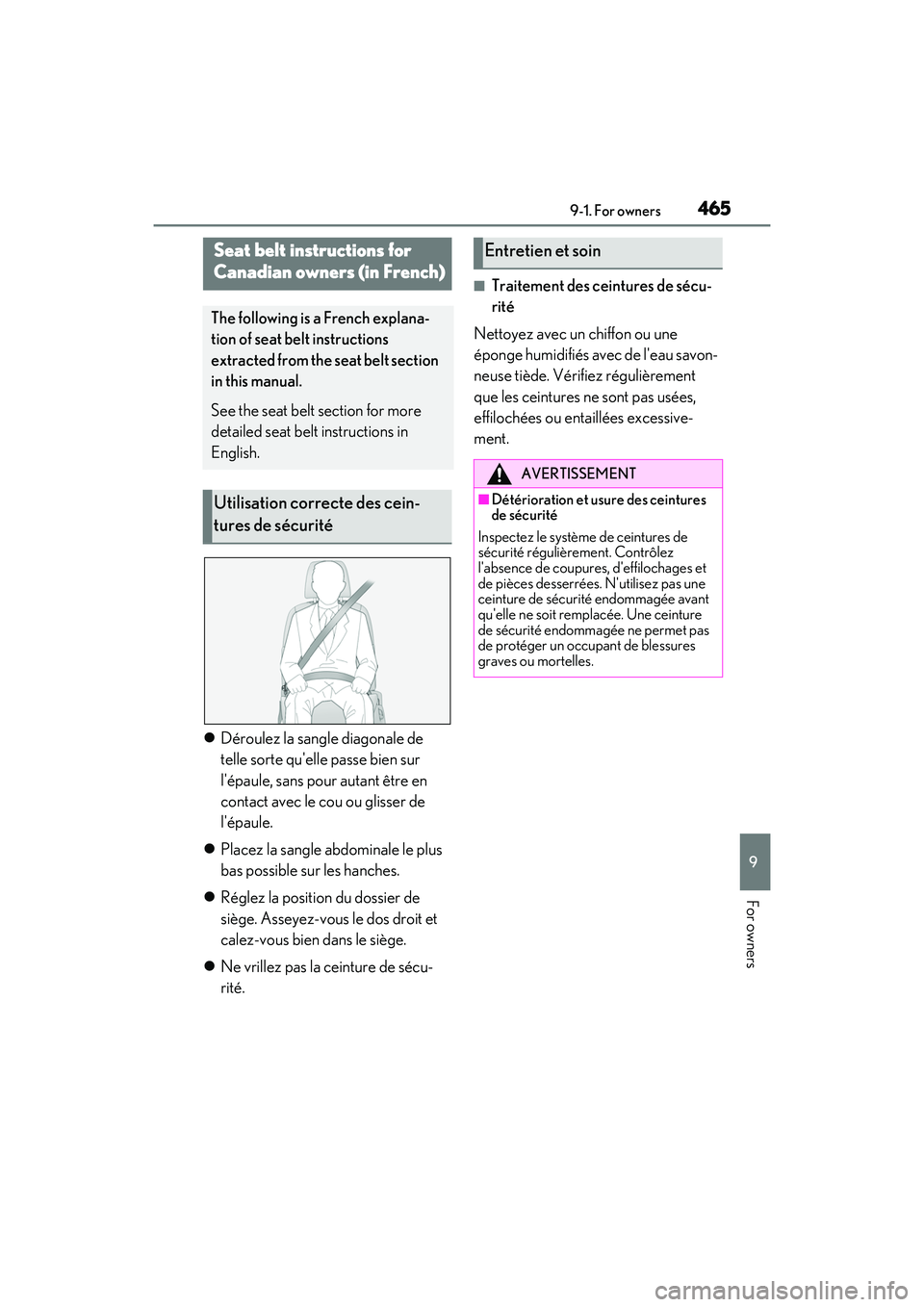
Déroulez la sangle diagonale de
telle sorte qu'elle passe bien sur
l'épaule, sans pour autant être en
contact avec le cou ou glisser de
l'épaule.
Placez la sangle abdominale le plus
bas possible sur les hanches.
Réglez la position du dossier de
siège. Asseyez-vous le dos droit et
calez-vous bien dans le siège.
Ne vrillez pas la ceinture de sécu-
rité.
■Traitement des ceintures de sécu-
rité
Nettoyez avec un chiffon ou une
éponge humidifiés avec de l'eau savon-
neuse tiède. Vérifiez régulièrement
que les ceintures ne sont pas usées,
effilochées ou entaillées excessive-
ment.
Seat belt instructions for
Canadian owners (in French)
The following is a French explana-
tion of seat belt instructions
extracted from the seat belt section
in this manual.
See the seat belt section for more
detailed seat belt instructions in
English.
Utilisation correcte des cein-
tures de sécurité
Entretien et soin
AVERTISSEMENT
■Détérioration et usure des ceintures
de sécurité
Inspectez le système de ceintures de
sécurité régulièrement. Contrôlez
l'absence de coupures, d'effilochages et
de pièces desserrées. N'utilisez pas une
ceinture de sécurité endommagée avant
qu'elle ne soit remplacée. Une ceinture
de sécurité endommagée ne permet pas
de protéger un occupant de blessures
graves ou mortelles.