flat LEXUS RX450H 2016 Repair Manual
[x] Cancel search | Manufacturer: LEXUS, Model Year: 2016, Model line: RX450H, Model: LEXUS RX450H 2016Pages: 660, PDF Size: 14.85 MB
Page 556 of 660
5567-2. Steps to take in an emergency
RX450h_U_OM0E013U
WARNING
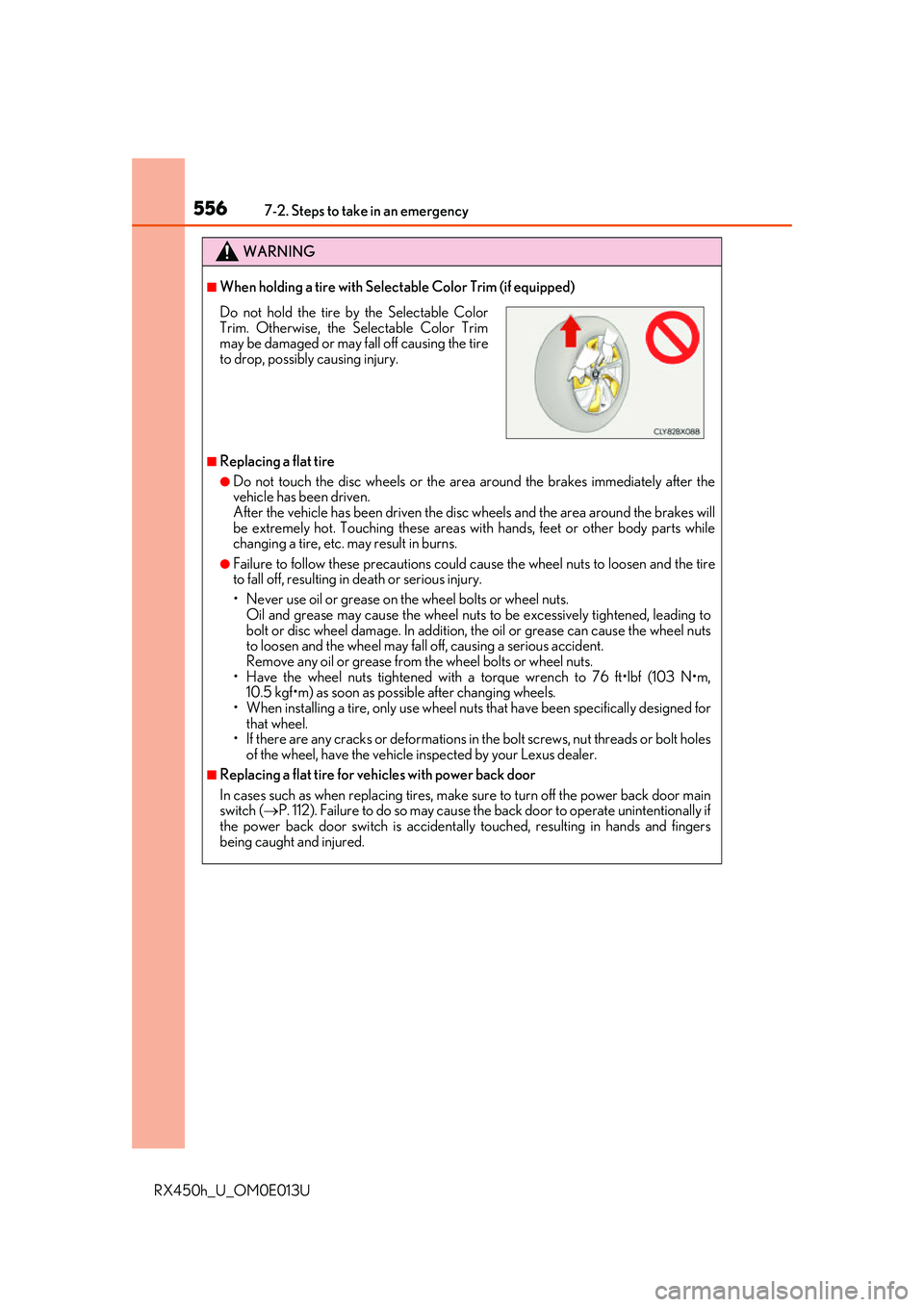
■When holding a tire with Selectable Color Trim (if equipped)
■Replacing a flat tire
●Do not touch the disc wheels or the area around the brakes immediately after the
vehicle has been driven.
After the vehicle has been driven the disc wheels and the area around the brakes will
be extremely hot. Touching these areas with hands, feet or other body parts while
changing a tire, etc. may result in burns.
●Failure to follow these precautions could cause the wheel nuts to loosen and the tire
to fall off, resulting in death or serious injury.
• Never use oil or grease on the wheel bolts or wheel nuts. Oil and grease may cause the wheel nuts to be excessively tightened, leading to
bolt or disc wheel damage. In addition, the oil or grease can cause the wheel nuts
to loosen and the wheel may fall off, causing a serious accident.
Remove any oil or grease from the wheel bolts or wheel nuts.
• Have the wheel nuts tightened with a torque wrench to 76 ft•lbf (103 N•m, 10.5 kgf•m) as soon as possible after changing wheels.
• When installing a tire, only use wheel nuts that have been specifically designed for
that wheel.
• If there are any cracks or deformations in the bolt screws, nut threads or bolt holes
of the wheel, have the vehicle inspected by your Lexus dealer.
■Replacing a flat tire for vehicles with power back door
In cases such as when replacing tires, make sure to turn off the power back door main
switch (P. 112). Failure to do so may cause the back door to operate unintentionally if
the power back door switch is accidentally touched, re sulting in hands and fingers
being caught and injured.
Do not hold the tire by the Selectable Color
Trim. Otherwise, the Selectable Color Trim
may be damaged or may fall off causing the tire
to drop, possibly causing injury.
Page 557 of 660
5577-2. Steps to take in an emergency
7
When trouble arises
RX450h_U_OM0E013U
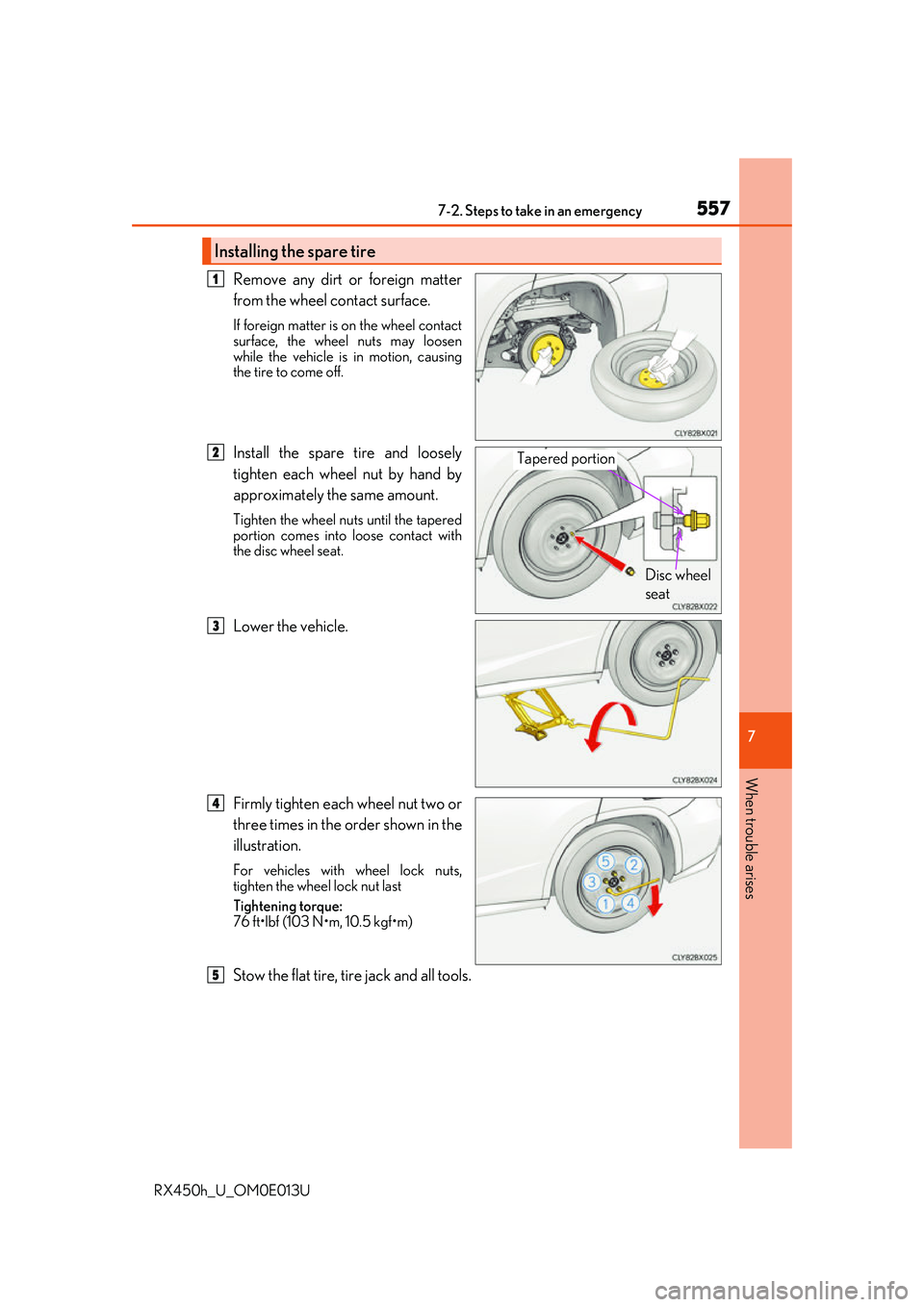
Remove any dirt or foreign matter
from the wheel contact surface.
If foreign matter is on the wheel contact
surface, the wheel nuts may loosen
while the vehicle is in motion, causing
the tire to come off.
Install the spare tire and loosely
tighten each wheel nut by hand by
approximately the same amount.
Tighten the wheel nuts until the tapered
portion comes into loose contact with
the disc wheel seat.
Lower the vehicle.
Firmly tighten each wheel nut two or
three times in the order shown in the
illustration.
For vehicles with wheel lock nuts,
tighten the wheel lock nut last
Tightening torque:
76 ft•lbf (103 N•m, 10.5 kgf•m)
Stow the flat tire, tire jack and all tools.
Installing the spare tire
1
Disc wheel
seat
Tapered portion2
3
4
5
Page 558 of 660
5587-2. Steps to take in an emergency
RX450h_U_OM0E013U
■The compact spare tire
●The compact spare tire is identified by the label “TEMPORARY USE ONLY” on the
tire sidewall.
Use the compact spare tire temporarily, and only in an emergency.
●Make sure to check the tire inflation pressure of the compact spare tire. (P. 589)
■When using the compact spare tire
As the compact spare tire is not equipped wi th a tire pressure warning valve and trans-
mitter, low inflation pressure of the spare tire will not be indicated by the tire pressure
warning system. Also, if you replace the compact spare tire after the tire pressure warn-
ing light comes on, the light remains on.
■When the compact spare tire is equipped
When driving with the compact spare tire inst alled, the vehicle height will be different
than when driving with standard tires.
■If you have a flat front tire on a road covered with snow or ice
Install the compact spare tire on one of the rear wheels of the vehicle. Perform the follow-
ing steps and fit tire chains to the front tires: Replace a rear tire with the compact spare tire.
Replace the flat front tire with the tire removed from the rear of the vehicle.
Fit tire chains to the front tires.
1
2
3
Page 563 of 660
5637-2. Steps to take in an emergency
7
When trouble arises
RX450h_U_OM0E013U
Turn the power switch to ON mode and check that the parking brake is set.
( P. 233, 245)
Turn the power switch to ACCESSORY mode.
Depress the brake pedal.
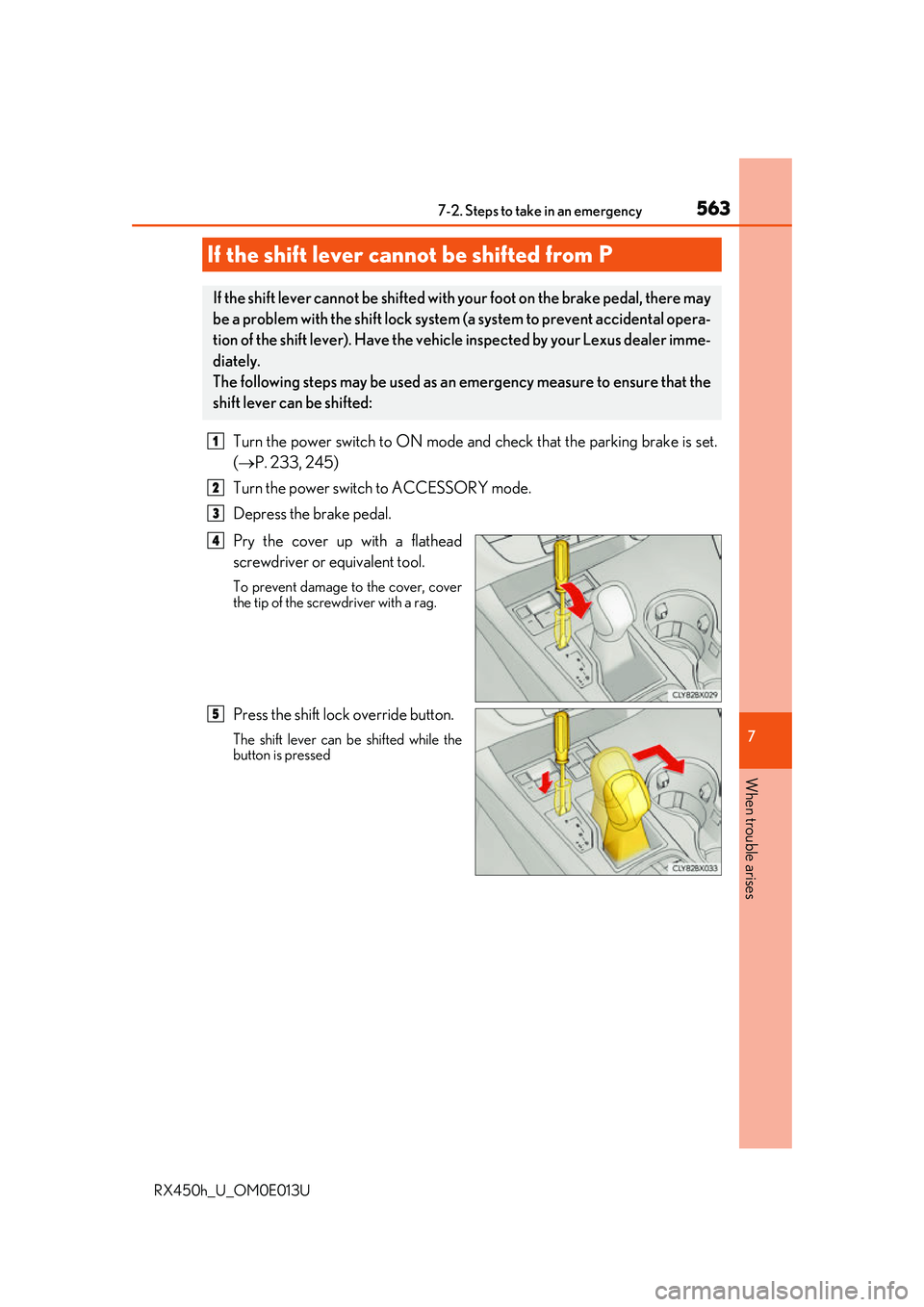
Pry the cover up with a flathead
screwdriver or equivalent tool.
To prevent damage to the cover, cover
the tip of the scre wdriver with a rag.
Press the shift lock override button.
The shift lever can be shifted while the
button is pressed
If the shift lever cannot be shifted from P
If the shift lever cannot be shifted with your foot on the brake pedal, there may
be a problem with the shift lock system (a system to prevent accidental opera-
tion of the shift le ver). Have the vehicle inspecte d by your Lexus dealer imme-
diately.
The following steps may be used as an emergency measure to ensure that the
shift lever can be shifted:
1
2
3
4
5
Page 589 of 660
5898-1. Specifications
8
Vehicle specifications
RX450h_U_OM0E013U
Type A
Type B
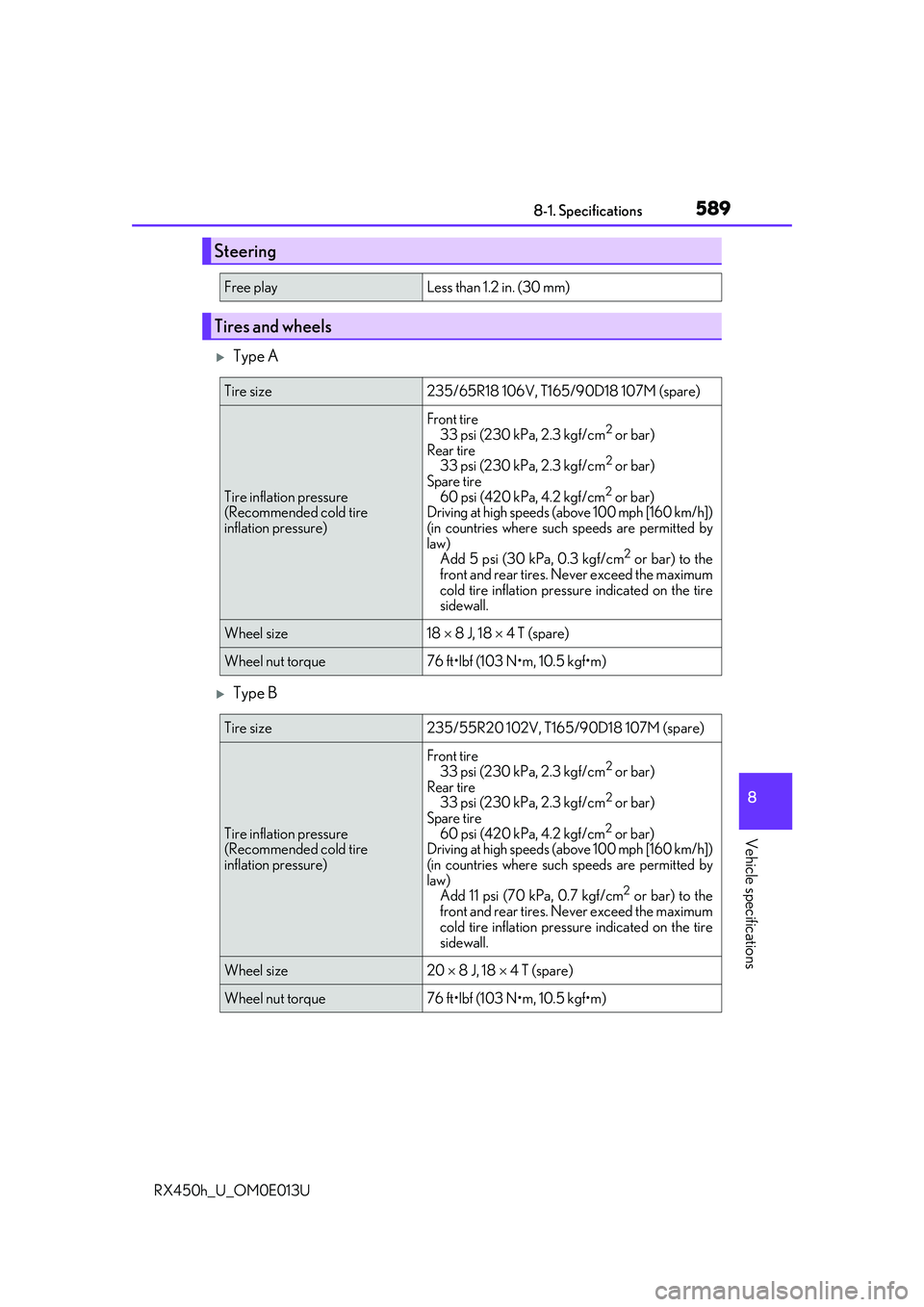
Steering
Free playLess than 1.2 in. (30 mm)
Tires and wheels
Tire size235/65R18 106V, T165/90D18 107M (spare)
Tire inflation pressure
(Recommended cold tire
inflation pressure)
Front tire33 psi (230 kPa, 2.3 kgf/cm2 or bar)
Rear tire
33 psi (230 kPa, 2.3 kgf/cm2 or bar)Spare tire
60 psi (420 kPa, 4.2 kgf/cm2 or bar)
Driving at high speeds (above 100 mph [160 km/h])
(in countries where such speeds are permitted by
law)
Add 5 psi (30 kPa, 0.3 kgf/cm2 or bar) to the
front and rear tires. Never exceed the maximum
cold tire inflation pressu re indicated on the tire
sidewall.
Wheel size18 8 J, 18 4 T (spare)
Wheel nut torque76 ft•lbf (103 N•m, 10.5 kgf•m)
Tire size235/55R20 102V, T165/90D18 107M (spare)
Tire inflation pressure
(Recommended cold tire
inflation pressure)
Front tire
33 psi (230 kPa, 2.3 kgf/cm2 or bar)
Rear tire33 psi (230 kPa, 2.3 kgf/cm2 or bar)
Spare tire
60 psi (420 kPa, 4.2 kgf/cm2 or bar)Driving at high speeds (above 100 mph [160 km/h])
(in countries where such speeds are permitted by
law)
Add 11 psi (70 kPa, 0.7 kgf/cm2 or bar) to the
front and rear tires. Never exceed the maximum
cold tire inflation pressu re indicated on the tire
sidewall.
Wheel size20 8 J, 18 4 T (spare)
Wheel nut torque76 ft•lbf (103 N•m, 10.5 kgf•m)
Page 595 of 660
5958-1. Specifications
8
Vehicle specifications
RX450h_U_OM0E013U
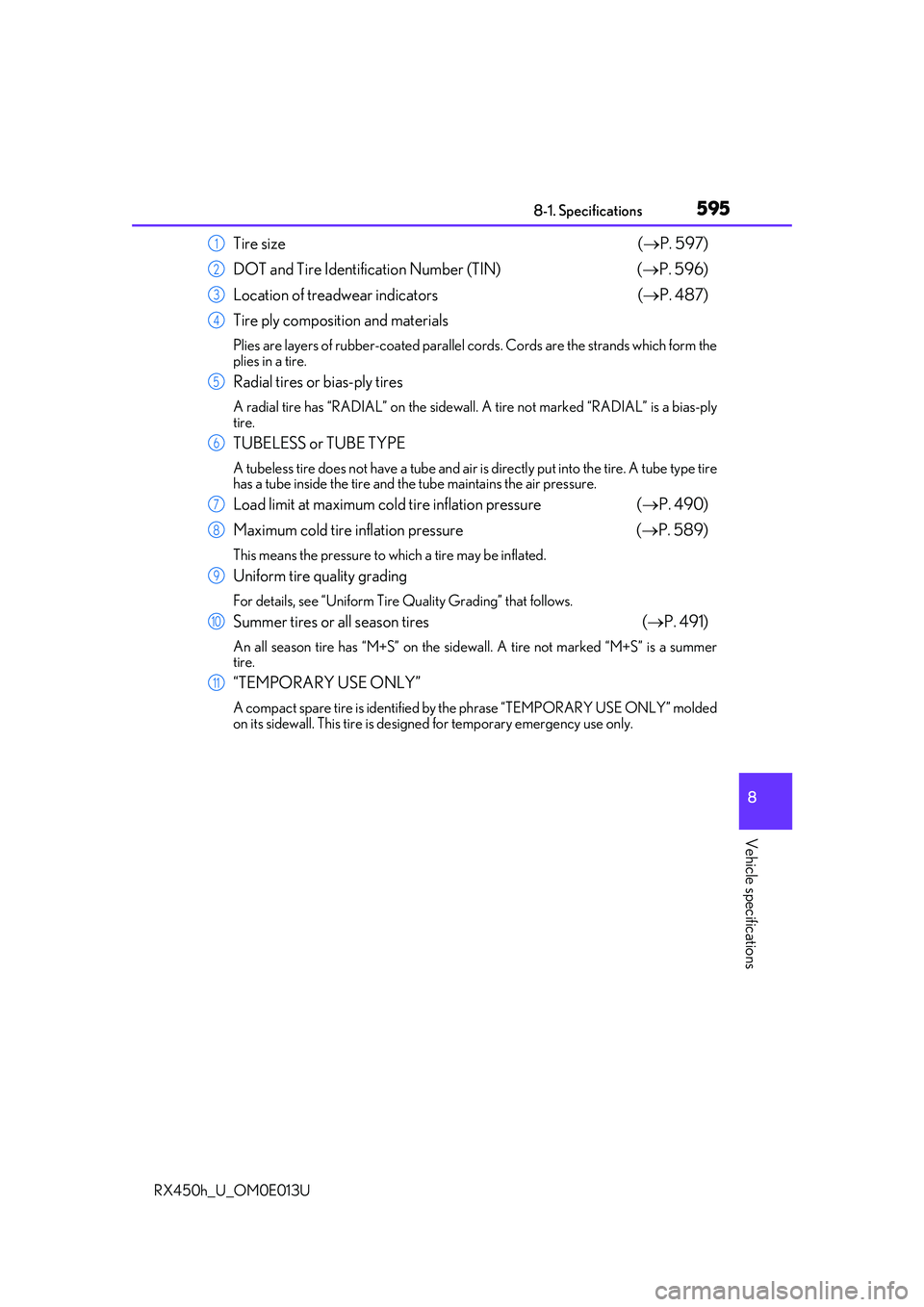
Tire size( P. 597)
DOT and Tire Identification Number (TIN) ( P. 596)
Location of treadwear indicators (P. 487)
Tire ply composition and materials
Plies are layers of rubber-c oated parallel cords. Cords are the strands which form the
plies in a tire.
Radial tires or bias-ply tires
A radial tire has “RADIAL” on the sidewall. A tire not marked “RADIAL” is a bias-ply
tire.
TUBELESS or TUBE TYPE
A tubeless tire does not have a tube and air is directly put into the tire. A tube type tire
has a tube inside the tire and the tube maintains the air pressure.
Load limit at maximum cold tire inflation pressure ( P. 490)
Maximum cold tire inflation pressure ( P. 589)
This means the pressure to which a tire may be inflated.
Uniform tire quality grading
For details, see “Uniform Tire Quality Grading” that follows.
Summer tires or all season tires ( P. 491)
An all season tire has “M+S” on the side wall. A tire not marked “M+S” is a summer
tire.
“TEMPORARY USE ONLY”
A compact spare tire is identified by the phrase “TEMPORARY USE ONLY” molded
on its sidewall. This tire is designed for temporary emergency use only.
1
2
3
4
5
6
7
8
9
10
11
Page 600 of 660
6008-1. Specifications
RX450h_U_OM0E013U
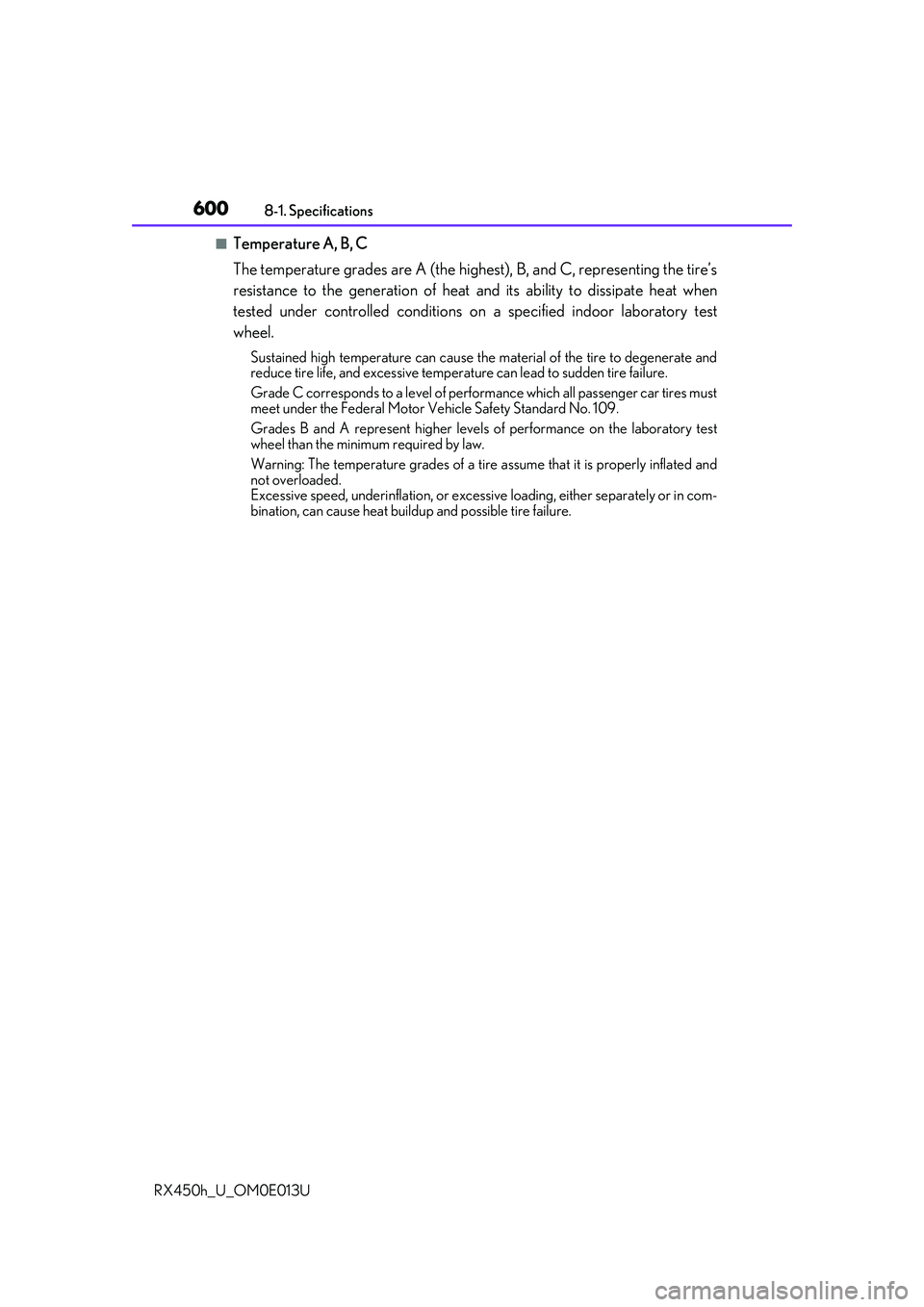
■Temperature A, B, C
The temperature grades are A (the highes t), B, and C, representing the tire’s
resistance to the generation of heat and its ability to dissipate heat when
tested under controlled conditions on a specified indoor laboratory test
wheel.
Sustained high temperature can cause the ma terial of the tire to degenerate and
reduce tire life, and excessive temperature can lead to sudden tire failure.
Grade C corresponds to a level of perfor mance which all passenger car tires must
meet under the Federal Motor Vehicle Safety Standard No. 109.
Grades B and A represent higher levels of performance on the laboratory test
wheel than the minimum required by law.
Warning: The temperature grades of a tire assume that it is properly inflated and
not overloaded.
Excessive speed, underi nflation, or excessive loading, either separately or in com-
bination, can cause heat buildup and possible tire failure.
Page 601 of 660
6018-1. Specifications
8
Vehicle specifications
RX450h_U_OM0E013U
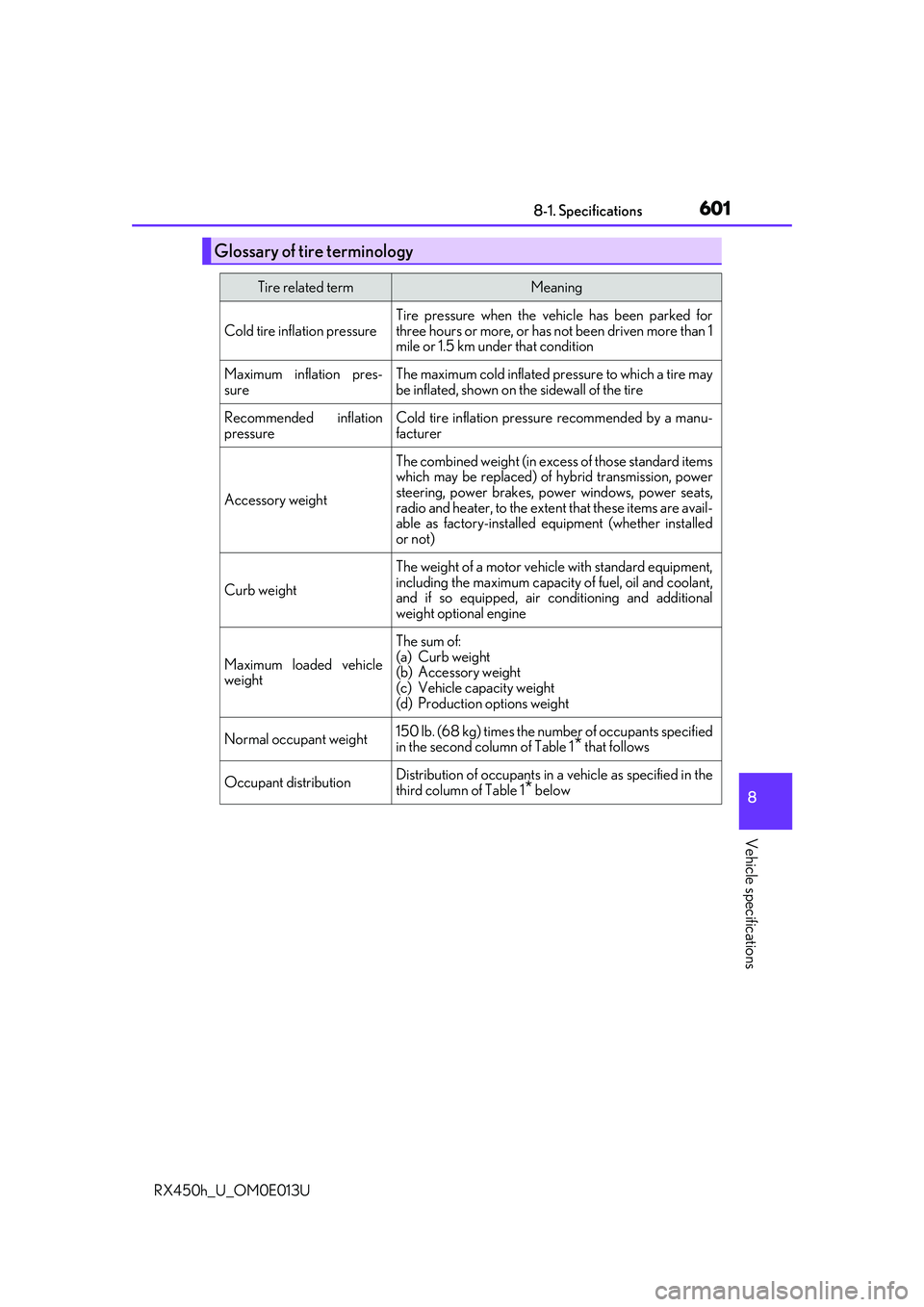
Glossary of tire terminology
Tire related termMeaning
Cold tire inflation pressure
Tire pressure when the vehicle has been parked for
three hours or more, or has not been driven more than 1
mile or 1.5 km un der that condition
Maximum inflation pres-
sureThe maximum cold inflated pr essure to which a tire may
be inflated, shown on the sidewall of the tire
Recommended inflation
pressureCold tire inflation pressure recommended by a manu-
facturer
Accessory weight
The combined weight (in exce ss of those standard items
which may be replaced) of hybrid transmission, power
steering, power brakes, power windows, power seats,
radio and heater, to the extent that these items are avail-
able as factory-installed eq uipment (whether installed
or not)
Curb weight
The weight of a motor vehicle with standard equipment,
including the maximum capacity of fuel, oil and coolant,
and if so equipped, air co nditioning and additional
weight optional engine
Maximum loaded vehicle
weight
The sum of:
(a) Curb weight
(b) Accessory weight
(c) Vehicle capacity weight
(d) Production options weight
Normal occupant weight150 lb. (68 kg) times the numb er of occupants specified
in the second column of Table 1* that follows
Occupant distributionDistribution of occupants in a vehicle as specified in the
third column of Table 1
* below
Page 602 of 660
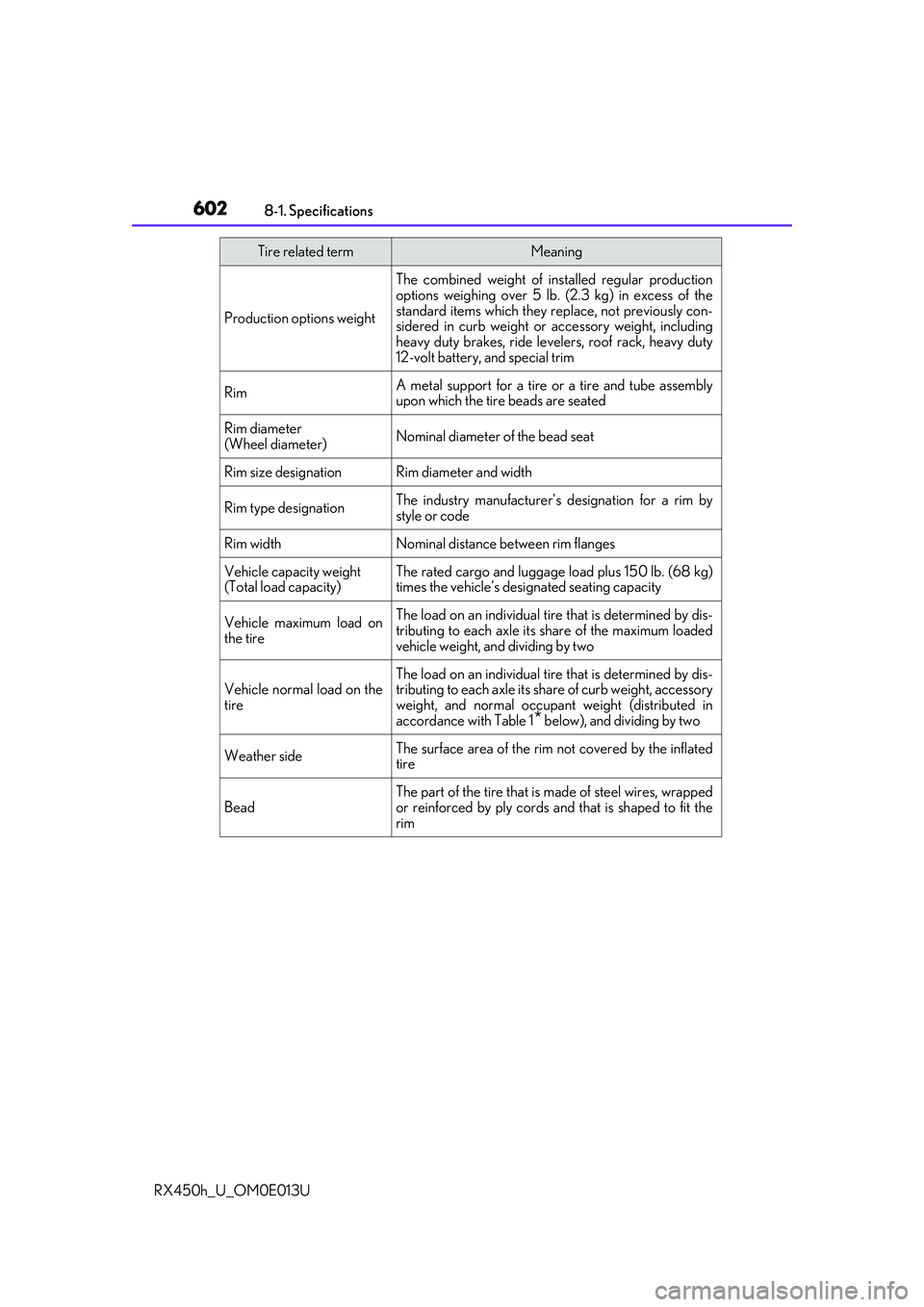
6028-1. Specifications
RX450h_U_OM0E013U
Production options weight
The combined weight of in stalled regular production
options weighing over 5 lb. (2.3 kg) in excess of the
standard items which they re place, not previously con-
sidered in curb weight or accessory weight, including
heavy duty brakes, ride levelers, roof rack, heavy duty
12-volt battery, and special trim
RimA metal support for a tire or a tire and tube assembly
upon which the tire beads are seated
Rim diameter
(Wheel diameter)Nominal diameter of the bead seat
Rim size designationRim diameter and width
Rim type designationThe industry manufacturer’s designation for a rim by
style or code
Rim widthNominal distance between rim flanges
Vehicle capacity weight
(Total load capacity)The rated cargo and luggage load plus 150 lb. (68 kg)
times the vehicle’s desi gnated seating capacity
Vehicle maximum load on
the tireThe load on an individual tire that is determined by dis-
tributing to each axle its share of the maximum loaded
vehicle weight, and dividing by two
Vehicle normal load on the
tire
The load on an individual tire that is determined by dis-
tributing to each axle its sh are of curb weight, accessory
weight, and normal occupant weight (distributed in
accordance with Table 1
* below), and dividing by two
Weather sideThe surface area of the rim not covered by the inflated
tire
BeadThe part of the tire that is made of steel wires, wrapped
or reinforced by ply cords an d that is shaped to fit the
rim
Tire related termMeaning
Page 603 of 660
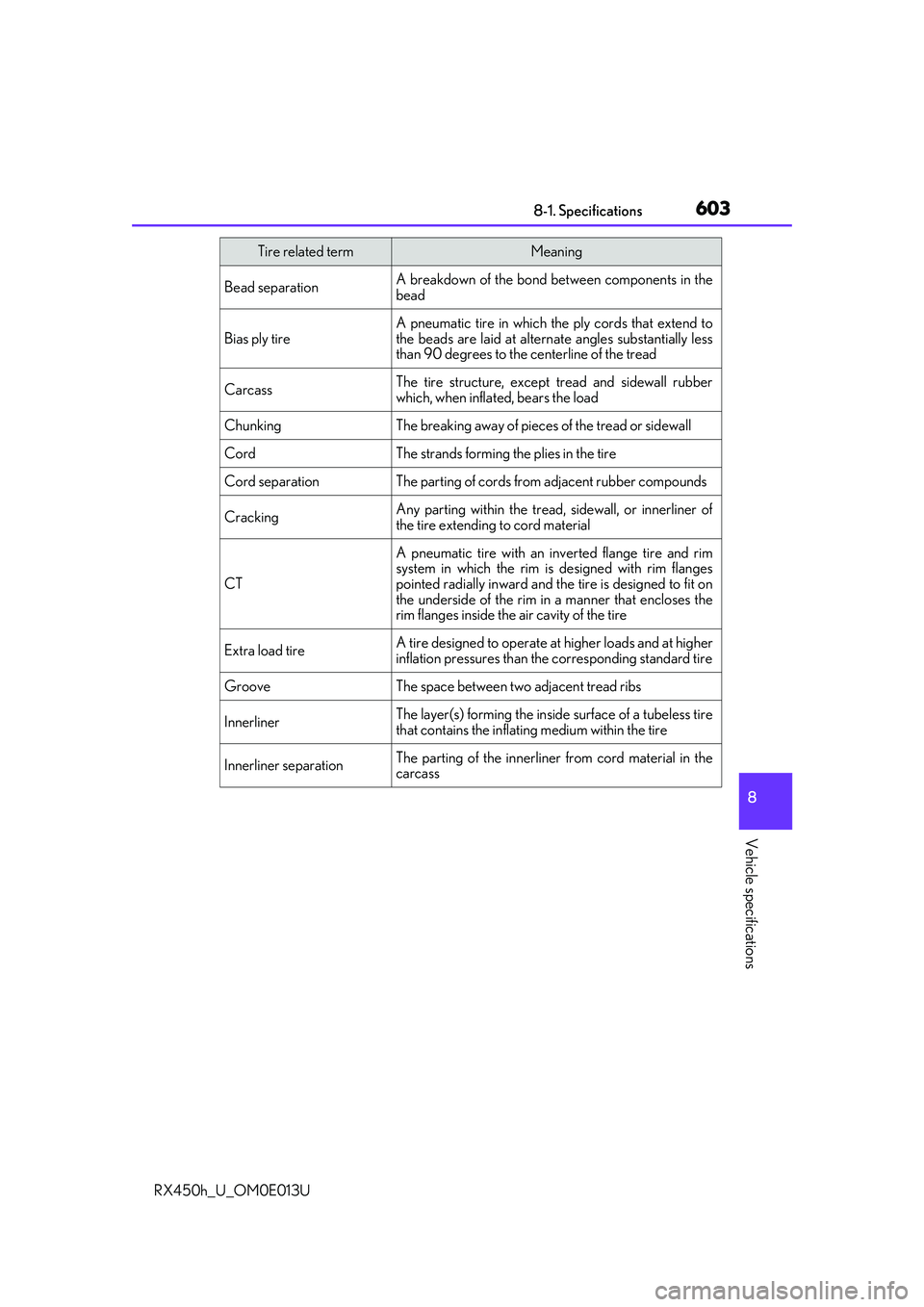
6038-1. Specifications
8
Vehicle specifications
RX450h_U_OM0E013U
Bead separationA breakdown of the bond between components in the
bead
Bias ply tire
A pneumatic tire in which the ply cords that extend to
the beads are laid at alternate angles substantially less
than 90 degrees to the centerline of the tread
CarcassThe tire structure, except tread and sidewall rubber
which, when inflated, bears the load
ChunkingThe breaking away of pieces of the tread or sidewall
CordThe strands forming th e plies in the tire
Cord separationThe parting of cords from adjacent rubber compounds
CrackingAny parting within the tread, sidewall, or innerliner of
the tire extending to cord material
CT
A pneumatic tire with an inverted flange tire and rim
system in which the rim is designed with rim flanges
pointed radially inward and the tire is designed to fit on
the underside of the rim in a manner that encloses the
rim flanges inside the air cavity of the tire
Extra load tireA tire designed to operate at higher loads and at higher
inflation pressures than the corresponding standard tire
GrooveThe space between two adjacent tread ribs
InnerlinerThe layer(s) forming the insi de surface of a tubeless tire
that contains the inflating medium within the tire
Innerliner separationThe parting of the innerliner from cord material in the
carcass
Tire related termMeaning