low LEXUS RX450H 2019 Owners Manual
[x] Cancel search | Manufacturer: LEXUS, Model Year: 2019, Model line: RX450H, Model: LEXUS RX450H 2019Pages: 792, PDF Size: 13.48 MB
Page 218 of 792

2184-1. Before driving
RX450h_RX450hL_U
WARNING
Observe the following precautions.
Failure to do so may result in death or serious injury.
■When taking a nap in the vehicle
Always turn the hybrid system off. Otherwise, if you accidentally move the shift lever or
depress the accelerator pedal, this could cause an accident or fire due to hybrid system
overheating. Additionally, if the vehicle is parked in a poorly ventilated area, exhaust
gases may collect and enter the vehicle, lead ing to death or a serious health hazard.
■When braking
●When the brakes are wet, drive more cautiously.
Braking distance increases when the brakes are wet, and this may cause one side of
the vehicle to brake differently than the other side. Also, the parking brake may not
securely hold the vehicle.
●If the electronically controlled brake function does not operate, do not follow other
vehicles closely and avoid hills or sharp turns that require braking.
In this case, braking is still possible, bu t the brake pedal should be depressed more
firmly than usual. Also, the braking distan ce will increase. Have your brakes fixed
immediately.
●The brake system consists of 2 or more indi vidual hydraulic systems; if one of the sys-
tems fails, the other(s) will still operate. In this case, the brake pedal should be
depressed more firmly than usual and the braking distance will increase. Have your
brakes fixed immediately.
■If the vehicle becomes stuck
Do not spin the wheels excessive ly when any of the tires is up in the air, or the vehicle is
stuck in sand, mud, etc. This may damage the driveline components or propel the vehi-
cle forward or backward, causing an accident.
Page 219 of 792
2194-1. Before driving
4
Driving
RX450h_RX450hL_U
NOTICE
■When driving the vehicle
●Do not depress the accelerator and brake pedals at the same time during driving, as
this may restrain driving torque.
●Do not use the accelerator pedal or depress the accelerator and brake pedals at the
same time to hold the vehicle on a hill.
■When parking the vehicle
Always set the parking brake and shift the shift lever to P. Failure to do so may cause the
vehicle to move or the vehicle may accelerate suddenly if the accelerator pedal is acci-
dentally depressed.
■Avoiding damage to vehicle parts
●Do not turn the steering wheel fully in either direction and hold it there for an
extended period of time.
Doing so may damage the power steering motor.
●When driving over bumps on the road, drive as slowly as possible to avoid damaging
the wheels, underside of the vehicle, etc.
■If you get a flat tire while driving
A flat or damaged tire may cause the following situations . Hold the steering wheel
firmly and gradually depress the brake pedal to slow down the vehicle.
●It may be difficult to control your vehicle.
●The vehicle will make abnormal sounds or vibrations.
●The vehicle will lean abnormally.
Information on what to do in case of a flat tire ( P. 673)
■When encountering flooded roads
Do not drive on a road that has flooded after heavy rain, etc. Doing so may cause the
following serious damage to the vehicle:
●Engine stalling
●Short in electrical components
●Engine damage caused by water immersion
In the event that you drive on a flooded road and the vehicle is flooded, be sure to have
your Lexus dealer check the following:
●Brake function
●Changes in quantity and quality of oil and fluid used for the engine, hybrid transmis-
sion, rear differential, etc.
●Lubricant condition for the bearings and su spension joints (where possible), and the
function of all joints, bearings, etc.
Page 220 of 792

2204-1. Before driving
RX450h_RX450hL_U
Cargo capacity depends on the total weight of the occupants.
(Cargo capacity) = (Total load capac ity) — (Total weight of occupants)
Steps for Determining Correct Load Limit —
(1) Locate the statement “The combined weight of occupants and cargo should
never exceed XXX kg or XXX lbs. ” on your vehicle’s placard.
(2) Determine the combined weight of th e driver and passengers that will be rid-
ing in your vehicle.
(3) Subtract the combined weight of th e driver and passengers from XXX kg or
XXX lbs.
(4) The resulting figure equals the ava ilable amount of cargo and luggage load
capacity.
For example, if the “XXX” amount equals 1400 lbs. and there will be five 150
lb passengers in your vehicle, the amou nt of available cargo and luggage load
capacity is 650 lbs. (1400 750 (5 150) = 650 lbs.)
(5) Determine the combined weight of luggage and cargo being loaded on the
vehicle. That weight may not safely exceed the available cargo and luggage
load capacity calculated in Step 4.
(6) If your vehicle will be towing a trailer, load from your trailer will be transferred
to your vehicle. Consult this manual to determine how this reduces the avail-
able cargo and luggage load capacity of your vehicle.
( P. 223)
Vehicles without towing package: Lexus does not recommend towing a trailer with
your vehicle. Your vehicle is not designed for trailer towing.
Cargo and luggage
Take notice of the following informat ion about storage precautions, cargo
capacity and load.
Capacity and distribution
Page 221 of 792
2214-1. Before driving
4
Driving
RX450h_RX450hL_U
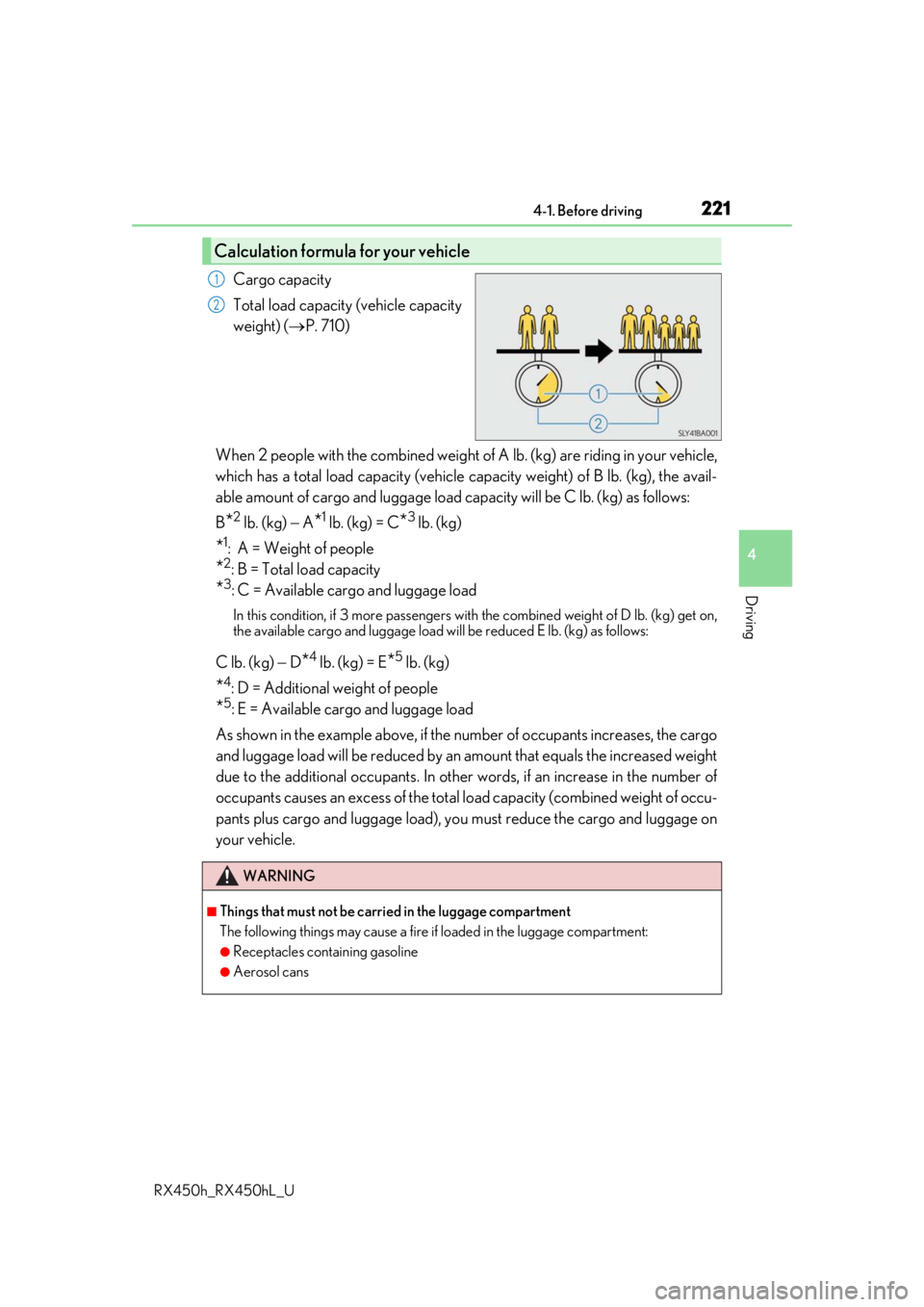
Cargo capacity
Total load capacity (vehicle capacity
weight) (P. 710)
When 2 people with the combined weight of A lb. (kg) are riding in your vehicle,
which has a total load capacity (vehicle capacity weight) of B lb. (kg), the avail-
able amount of cargo and luggage load capacity will be C lb. (kg) as follows:
B
*2 lb. (kg) A*1 lb. (kg) = C*3 lb. (kg)
*1: A = Weight of people
*2: B = Total load capacity
*3: C = Available cargo and luggage load
In this condition, if 3 more passengers with the combined weight of D lb. (kg) get on,
the available cargo and luggage load w ill be reduced E lb. (kg) as follows:
C lb. (kg) D*4 lb. (kg) = E*5 lb. (kg)
*4: D = Additional weight of people
*5: E = Available cargo and luggage load
As shown in the example above, if the nu mber of occupants increases, the cargo
and luggage load will be reduced by an amount that equals the increased weight
due to the additional occupants. In other words, if an increase in the number of
occupants causes an excess of the total load capacity (combined weight of occu-
pants plus cargo and luggage load), yo u must reduce the cargo and luggage on
your vehicle.
Calculation formula for your vehicle
1
2
WARNING
■Things that must not be carri ed in the luggage compartment
The following things may cause a fire if loaded in the luggage compartment:
●Receptacles containing gasoline
●Aerosol cans
Page 222 of 792
2224-1. Before driving
RX450h_RX450hL_U
WARNING
■Storage precautions
Observe the following precautions.
Failure to do so may prevent the pedals from being depressed properly, may block the
driver’s vision, or may result in items hittin g the driver or passengers, possibly causing
an accident.
●Stow cargo and luggage in the luggage compartment whenever possible.
●Do not stack cargo and luggage in the luggage compartment higher than the seat-
backs.
●When you fold down the rear seats, long items should not be placed directly behind
the front seats.
●Never allow anyone to ride in the luggage compartment. It is not designed for pas-
sengers. They should ride in their seats with their seat belts properly fastened.
●Do not place cargo or luggage in or on the following locations.
• At the feet of the driver
• On the front passenger or re ar seats (when stacking items)
•On the luggage cover
• On the instrument panel
•On the dashboard
●Secure all items in the occupant compartment.
■Capacity and distribution
●Do not exceed the maximum axle weight rating or the total vehicle weight rating.
●Even if the total load of occupant’s weight and the cargo load is less than the total load
capacity, do not apply the load unevenly. Improper loading may cause deterioration
of steering or braking control whic h may cause death or serious injury.
■Roof luggage carrier precautions
Observe the following precautions:
●Place the cargo so that its weight is distributed evenly between the front and rear
axles.
●If loading long or wide cargo, never exceed the vehicle overall length or width.
( P. 710)
●Before driving, make sure the cargo is secu rely fastened on the roof luggage carrier.
●Loading cargo on the roof luggage carrier will make the center of gravity of the vehi-
cle higher. Avoid high speeds, sudden star ts, sharp turns, sudden braking or abrupt
maneuvers, otherwise it may re sult in loss of control or vehicle rollover due to failure
to operate this vehicle correctly and result in death or serious injury.
●If driving for a long distance, on rough road s, or at high speeds, stop the vehicle now
and then during the trip to make sure the cargo remains in its place.
●Do not exceed 165 lb. (75 kg) cargo weight on the roof luggage carrier.
NOTICE
■When loading cargo (vehicles with a moon roof or panoramic moon roof)
Be careful not to scratch the surface of the moon roof or panoramic moon roof.
Page 225 of 792
2254-1. Before driving
4
Driving
RX450h_RX450hL_U
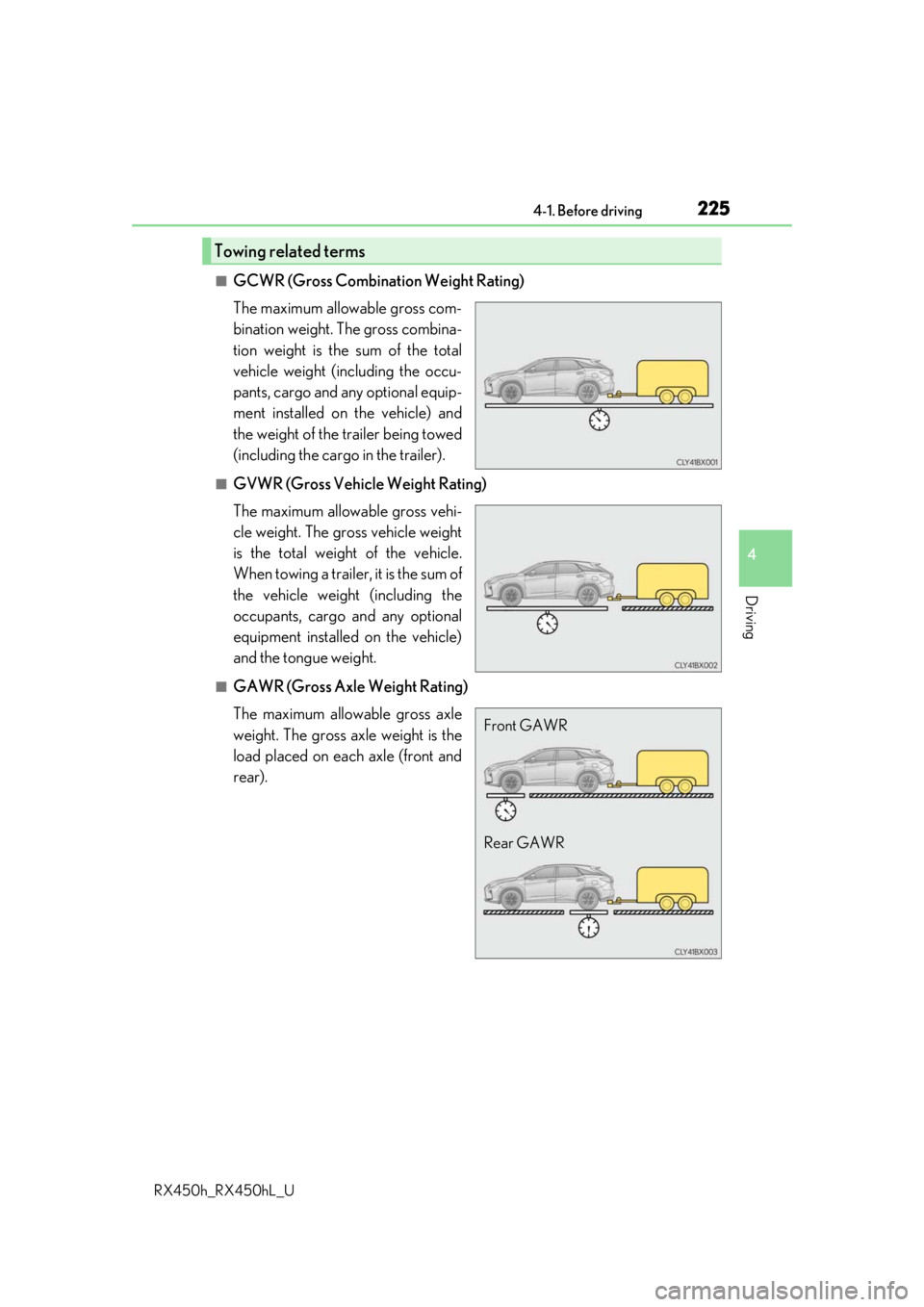
■GCWR (Gross Combination Weight Rating)
The maximum allowable gross com-
bination weight. The gross combina-
tion weight is the sum of the total
vehicle weight (including the occu-
pants, cargo and any optional equip-
ment installed on the vehicle) and
the weight of the trailer being towed
(including the cargo in the trailer).
■GVWR (Gross Vehicle Weight Rating)
The maximum allowable gross vehi-
cle weight. The gross vehicle weight
is the total weight of the vehicle.
When towing a trailer, it is the sum of
the vehicle weight (including the
occupants, cargo and any optional
equipment installed on the vehicle)
and the tongue weight.
■GAWR (Gross Axle Weight Rating)
The maximum allowable gross axle
weight. The gross axle weight is the
load placed on each axle (front and
rear).
Towing related terms
Front GAWR
Rear GAWR
Page 226 of 792
2264-1. Before driving
RX450h_RX450hL_U
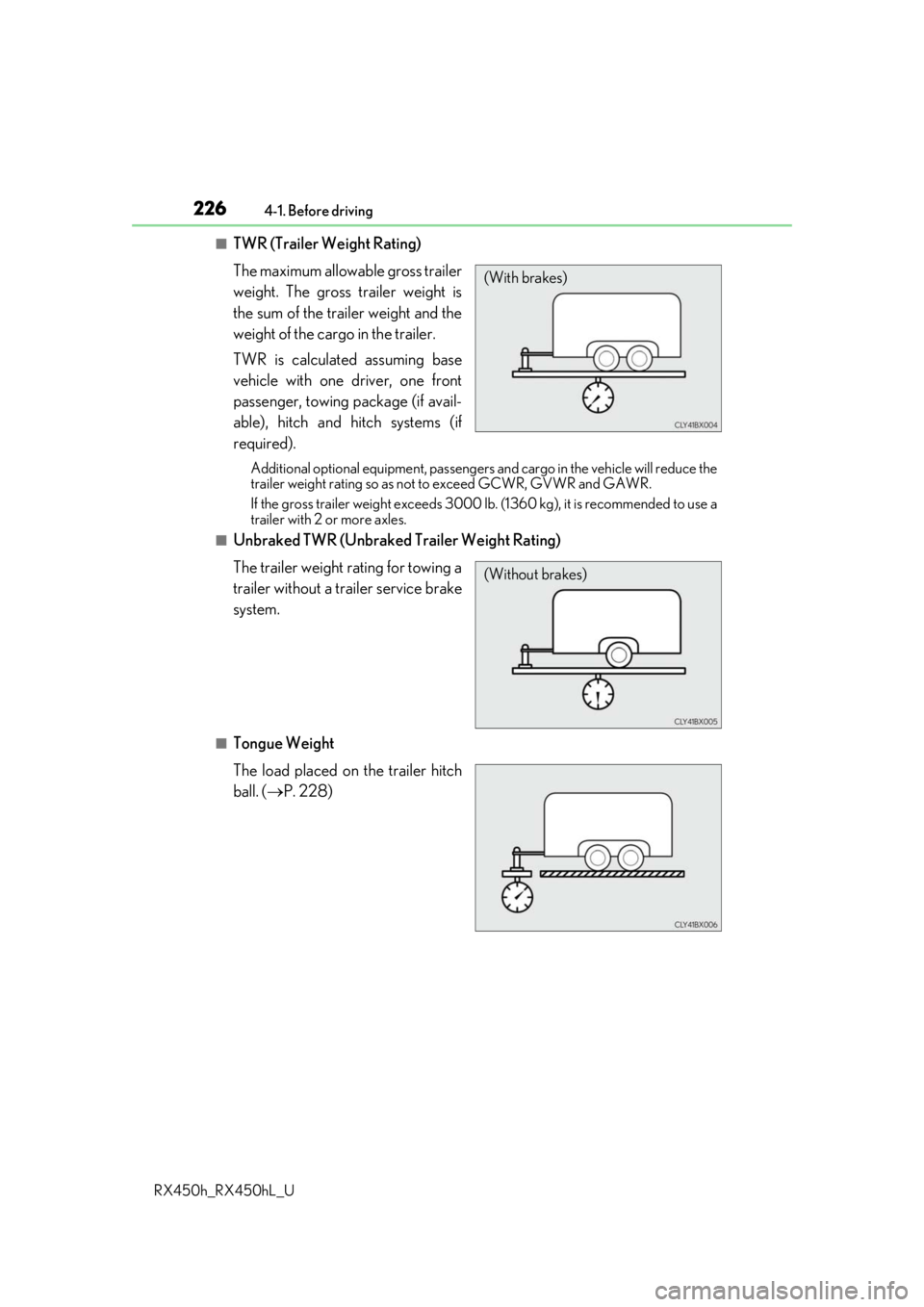
■TWR (Trailer Weight Rating)
The maximum allowable gross trailer
weight. The gross trailer weight is
the sum of the trailer weight and the
weight of the cargo in the trailer.
TWR is calculated assuming base
vehicle with one driver, one front
passenger, towing package (if avail-
able), hitch and hitch systems (if
required).
Additional optional equipment, passengers and cargo in the vehicle will reduce the
trailer weight rating so as not to exceed GCWR, GVWR and GAWR.
If the gross trailer weight exceeds 3000 lb. (1360 kg), it is recommended to use a
trailer with 2 or more axles.
■Unbraked TWR (Unbraked Trailer Weight Rating)
The trailer weight rating for towing a
trailer without a trailer service brake
system.
■Tongue Weight
The load placed on the trailer hitch
ball. ( P. 228)
(With brakes)
(Without brakes)
Page 228 of 792
2284-1. Before driving
RX450h_RX450hL_U
●A recommended tongue weight varies in accordance with the types of trailers
or towing as described below.
●To ensure the recommended values show n below, the trailer must be loaded
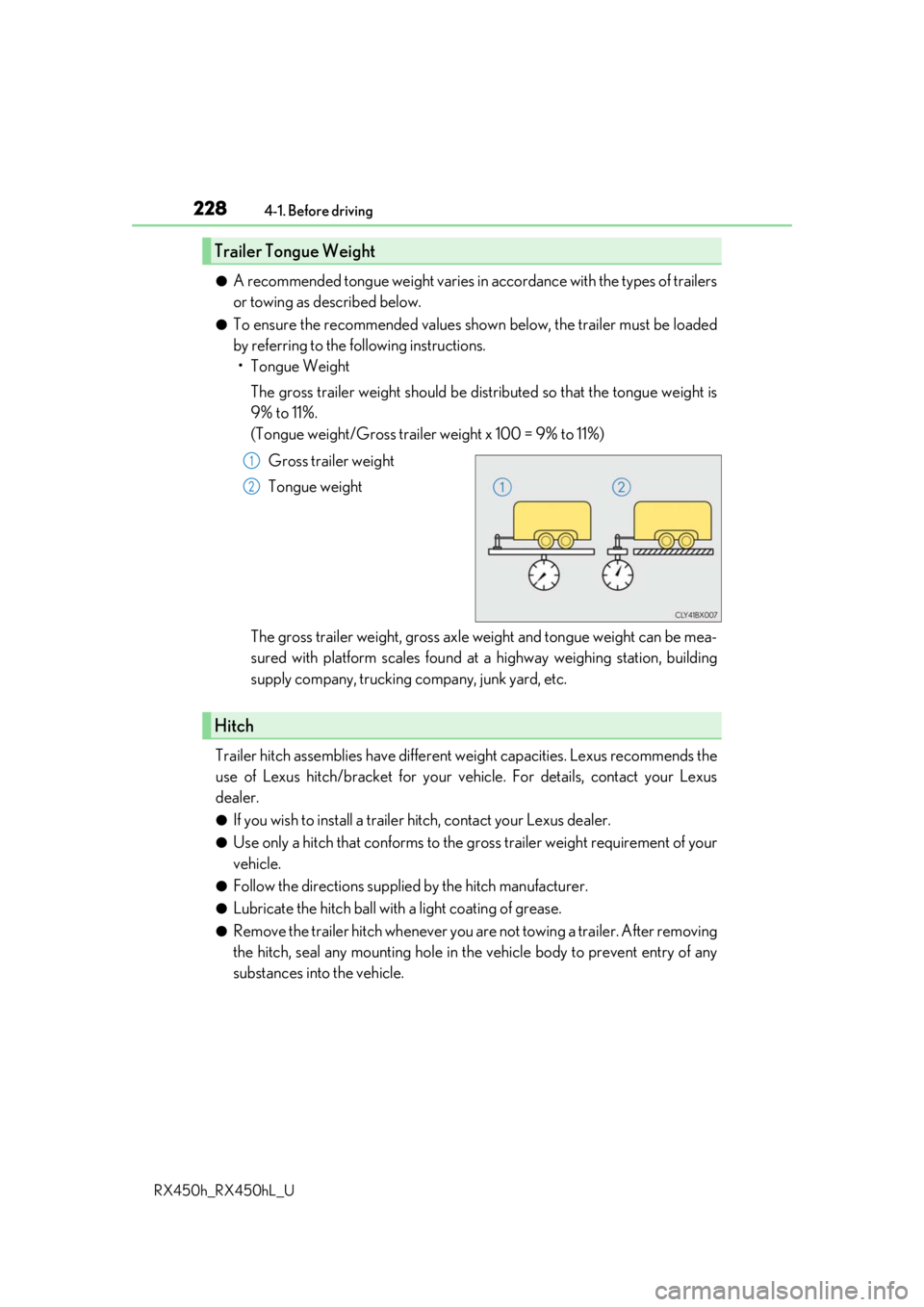
by referring to the following instructions. • Tongue Weight
The gross trailer weight should be dist ributed so that the tongue weight is
9% to 11%.
(Tongue weight/Gross trailer weight x 100 = 9% to 11%)
Gross trailer weight
Tongue weight
The gross trailer weight, gross axle weight and tongue weight can be mea-
sured with platform scales found at a highway weighing station, building
supply company, trucking company, junk yard, etc.
Trailer hitch assemblies have different weight capacities. Lexus recommends the
use of Lexus hitch/bracket for your ve hicle. For details, contact your Lexus
dealer.
●If you wish to install a trailer hitch, contact your Lexus dealer.
●Use only a hitch that conforms to the gross trailer weight requirement of your
vehicle.
●Follow the directions supplied by the hitch manufacturer.
●Lubricate the hitch ball with a light coating of grease.
●Remove the trailer hitch whenever you ar e not towing a trailer. After removing
the hitch, seal any mounting hole in the vehicle body to prevent entry of any
substances into the vehicle.
Trailer Tongue Weight
1
2
Hitch
Page 230 of 792
2304-1. Before driving
RX450h_RX450hL_U
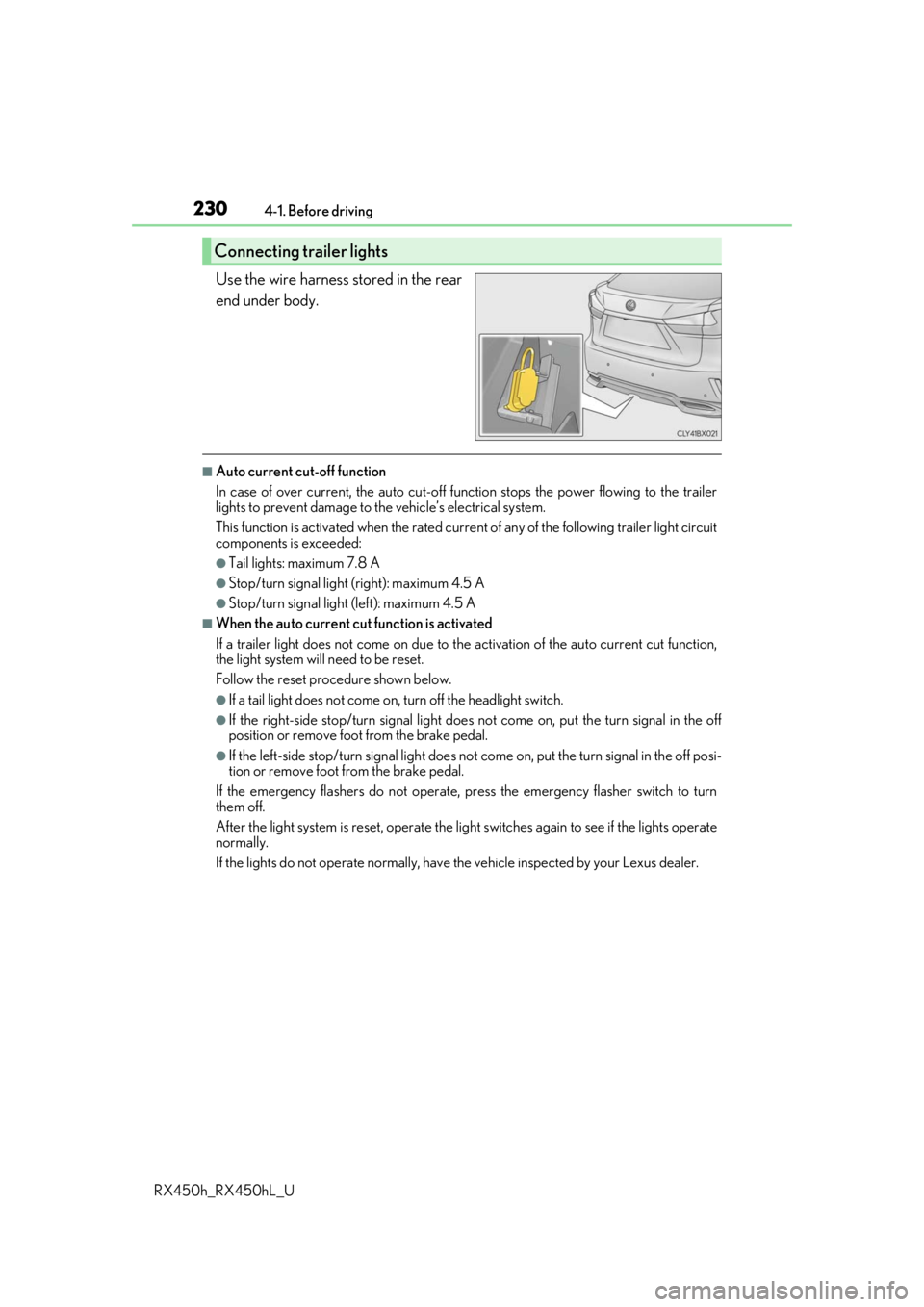
Use the wire harness stored in the rear
end under body.
■Auto current cut-off function
In case of over current, the auto cut-off function stops the power flowing to the trailer
lights to prevent damage to the vehicle’s electrical system.
This function is activated when the rated current of any of the following trailer light circuit
components is exceeded:
●Tail lights: maximum 7.8 A
●Stop/turn signal light (right): maximum 4.5 A
●Stop/turn signal light (left): maximum 4.5 A
■When the auto current cu t function is activated
If a trailer light does not come on due to th e activation of the auto current cut function,
the light system will need to be reset.
Follow the reset procedure shown below.
●If a tail light does not come on, turn off the headlight switch.
●If the right-side stop/turn signal light does not come on, put the turn signal in the off
position or remove foot from the brake pedal.
●If the left-side stop/turn signal light does not come on, put the turn signal in the off posi-
tion or remove foot from the brake pedal.
If the emergency flashers do not operate, press the emergency flasher switch to turn
them off.
After the light system is reset, operate the lig ht switches again to see if the lights operate
normally.
If the lights do not operate normally, have the vehicle inspected by your Lexus dealer.
Connecting trailer lights
Page 231 of 792

2314-1. Before driving
4
Driving
RX450h_RX450hL_U
Your vehicle will handle differently when towing a trailer. Help to avoid an acci-
dent, death or serious injury, keep the following in mind when towing:
●Speed limits for towing a trailer vary by state or province. Do not exceed the
posted towing speed limit.
●Lexus recommends that the vehicle-traile r speed limit is 65 mph (104 km/h)
on a flat, straight, dry road. Do not exce ed this limit, the posted towing speed
limit or the speed limit for your trailer as set forth in your trailer owner’s man-
ual, whichever is lowest. Instability of the towing vehicle-trailer combination
(trailer sway) increases as speed increases. Exceeding speed limits may cause
loss of control.
●Before starting out, check the trailer lights, tires and the vehicle-trailer con-
nections. Recheck after driving a short distance.
●Practice turning, stopping and reversing with the trailer attached in an area
away from traffic until you become acc ustomed to the feel of the vehicle-
trailer combination.
●Reversing with a trailer attached is di fficult and requires practice. Grip the
bottom of the steering wheel and move your hand to the left to move the
trailer to the left. Move your hand to the right to move the trailer to right. (This
is generally opposite to reversing with out a trailer attached.) Avoid sharp or
prolonged turning. Have someone guid e you when reversing to reduce the
risk of an accident.
●As stopping distance is increased when towing a trailer, vehicle-to vehicle dis-
tance should be increased. For each 10 mph (16 km/h) of speed, allow at least
one vehicle and trailer length.
●Avoid sudden braking as you may skid, resulting in the trailer jackknifing and a
loss of vehicle control. This is especi ally true on wet or slippery surfaces.
●Avoid jerky starts or sudden acceleration.
●Avoid jerky steering and sharp turns, an d slow down before making a turn.
●Note that when making a turn, the trailer wheels will be closer than the vehicle
wheels to the inside of the turn. Compensate by making a wider than normal
turning radius.
●Slow down before making a turn, in cross winds, on wet or slippery surfaces,
etc.
Increasing vehicle speed can destabilize the trailer.
●Take care when passing other vehicles . Passing requires considerable dis-
tance. After passing a vehicle, do not fo rget the length of your trailer, and be
sure you have plenty of room before changing lanes.
Trailer towing tips