ignition LEXUS SC300 1991 Service Repair Manual
[x] Cancel search | Manufacturer: LEXUS, Model Year: 1991, Model line: SC300, Model: LEXUS SC300 1991Pages: 4087, PDF Size: 75.75 MB
Page 2027 of 4087
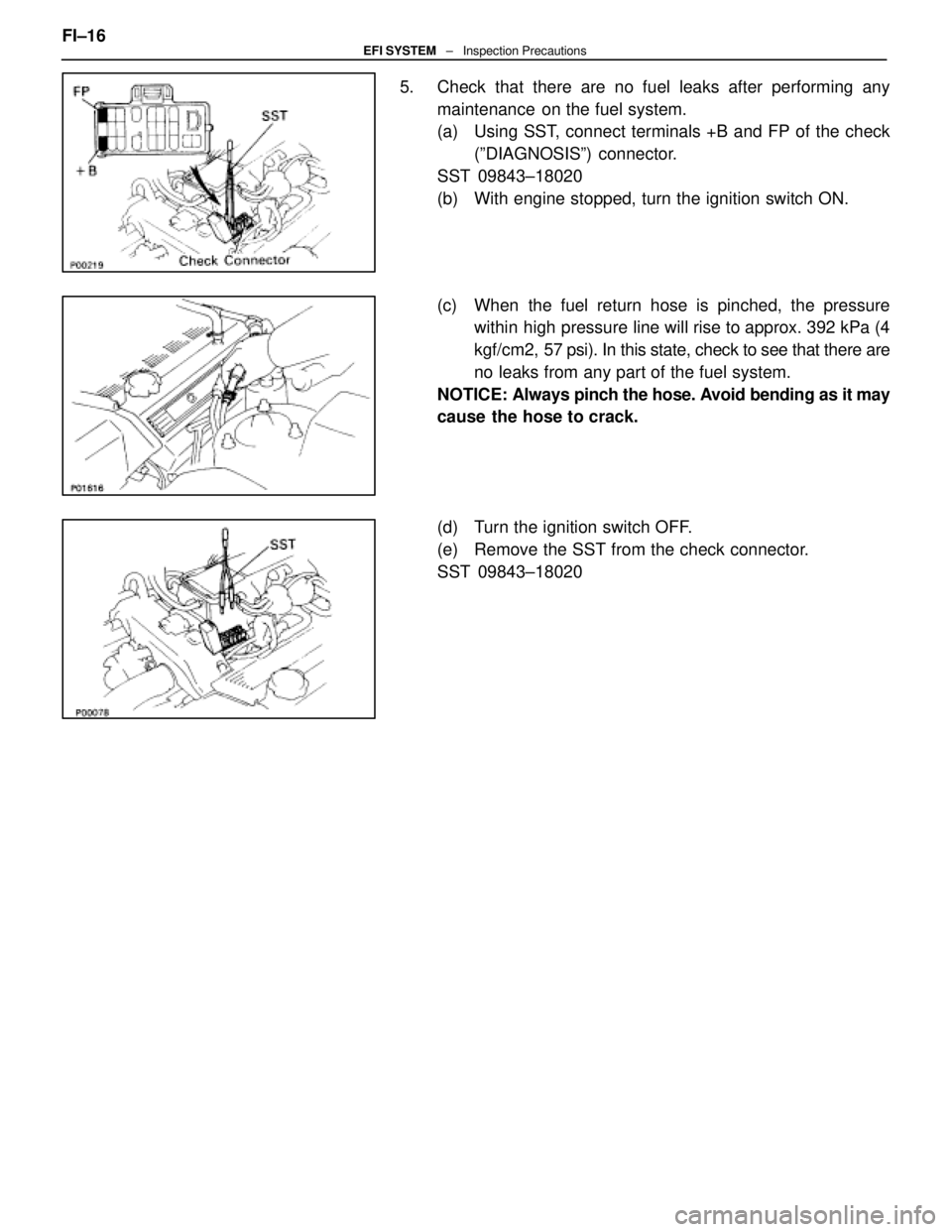
5. Check that there are no fuel leaks after performing anymaintenance on the fuel system.
(a) Using SST, connect terminals +B and FP of the check(ºDIAGNOSISº) connector.
SST 09843±18020
(b) With engine stopped, turn the ignition switch ON.
(c) When the fuel return hose is pinched, the pressure within high pressure line will rise to approx. 392 kPa (4
kgf/cm2, 57 psi). In this state, check to see that there are
no leaks from any part of the fuel system.
NOTICE: Always pinch the hose. Avoid bending as it may
cause the hose to crack.
(d) Turn the ignition switch OFF.
(e) Remove the SST from the check connector.
SST 09843±18020
FI±16
EFI SYSTEM
± Inspection Precautions
WhereEverybodyKnowsYourName
Page 2028 of 4087
FUEL SYSTEM
Fuel Pump
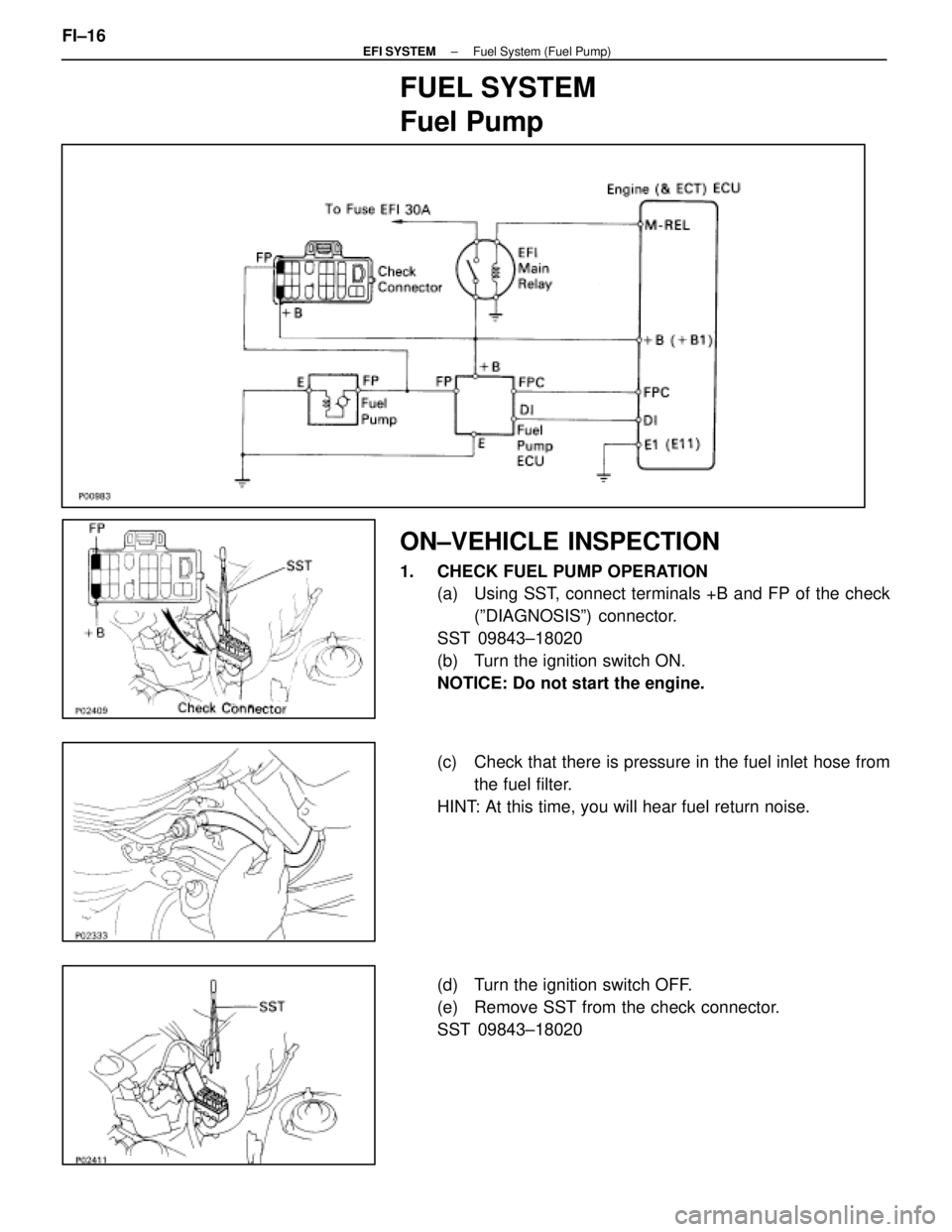
ON±VEHICLE INSPECTION
1. CHECK FUEL PUMP OPERATION(a) Using SST, connect terminals +B and FP of the check
(ºDIAGNOSISº) connector.
SST 09843±18020
(b) Turn the ignition switch ON.
NOTICE: Do not start the engine.
(c) Check that there is pressure in the fuel inlet hose from the fuel filter.
HINT: At this time, you will hear fuel return noise.
(d) Turn the ignition switch OFF.
(e) Remove SST from the check connector.
SST 09843±18020
FI±16
±
EFI SYSTEM Fuel System (Fuel Pump)
WhereEverybodyKnowsYourName
Page 2029 of 4087
If there is no pressure, check the following parts:
wFuses
w EFI main relay
w Fuel pump ECU
w Fuel pump
w Engine (& ECT) ECU
w Wiring connections
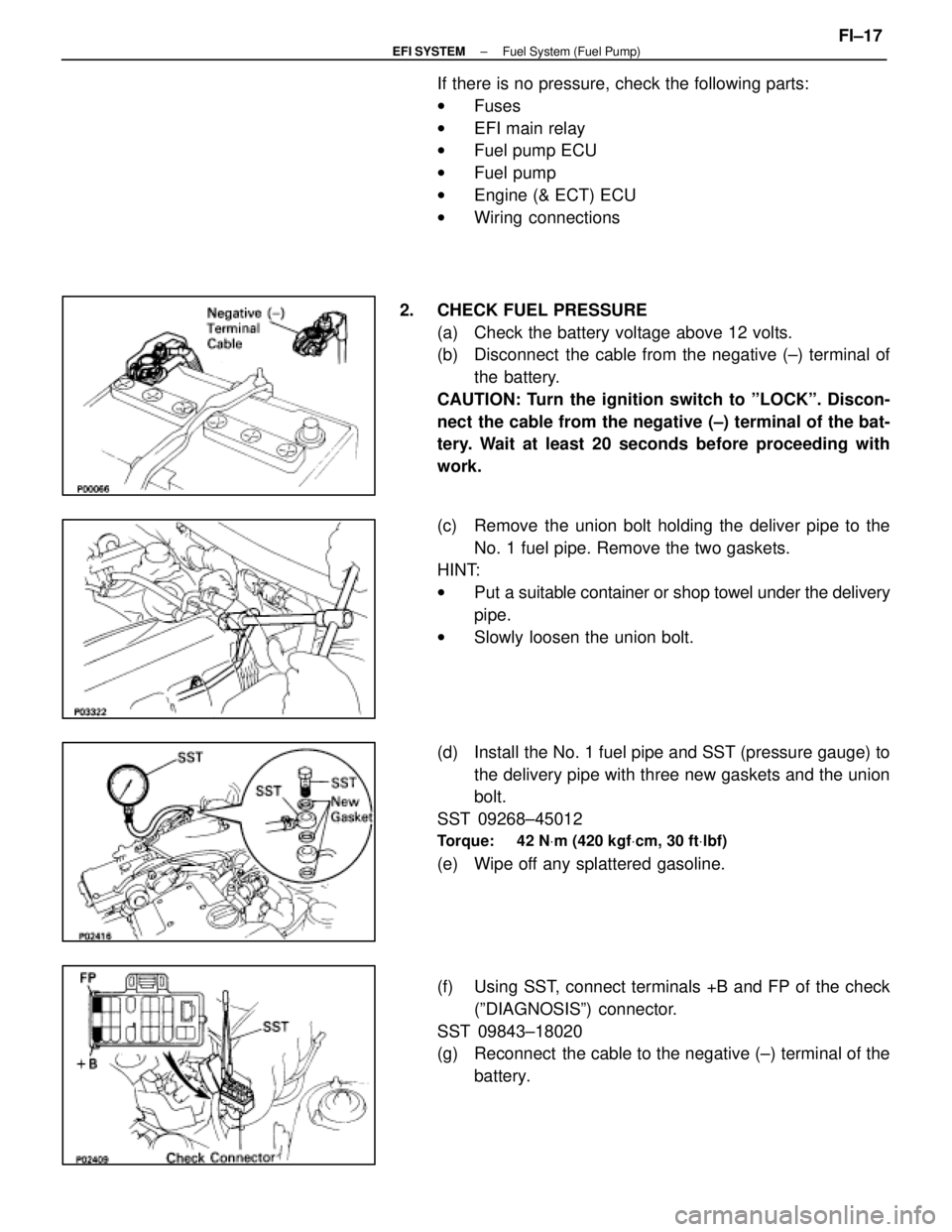
2. CHECK FUEL PRESSURE (a) Check the battery voltage above 12 volts.
(b) Disconnect the cable from the negative (±) terminal ofthe battery.
CAUTION: Turn the ignition switch to ºLOCKº. Discon-
nect the cable from the negative (±) terminal of the bat-
tery. Wait at least 20 seconds before proceeding with
work.
(c) Remove the union bolt holding the deliver pipe to the No. 1 fuel pipe. Remove the two gaskets.
HINT:
w Put a suitable container or shop towel under the delivery
pipe.
w Slowly loosen the union bolt.
(d) Install the No. 1 fuel pipe and SST (pressure gauge) to the delivery pipe with three new gaskets and the union
bolt.
SST 09268±45012
Torque: 42 N Vm (420 kgf Vcm, 30 ft Vlbf)
(e) Wipe off any splattered gasoline.
(f) Using SST, connect terminals +B and FP of the check
(ºDIAGNOSISº) connector.
SST 09843±18020
(g) Reconnect the cable to the negative (±) terminal of the battery.
±
EFI SYSTEM Fuel System (Fuel Pump)FI±17
WhereEverybodyKnowsYourName
Page 2030 of 4087
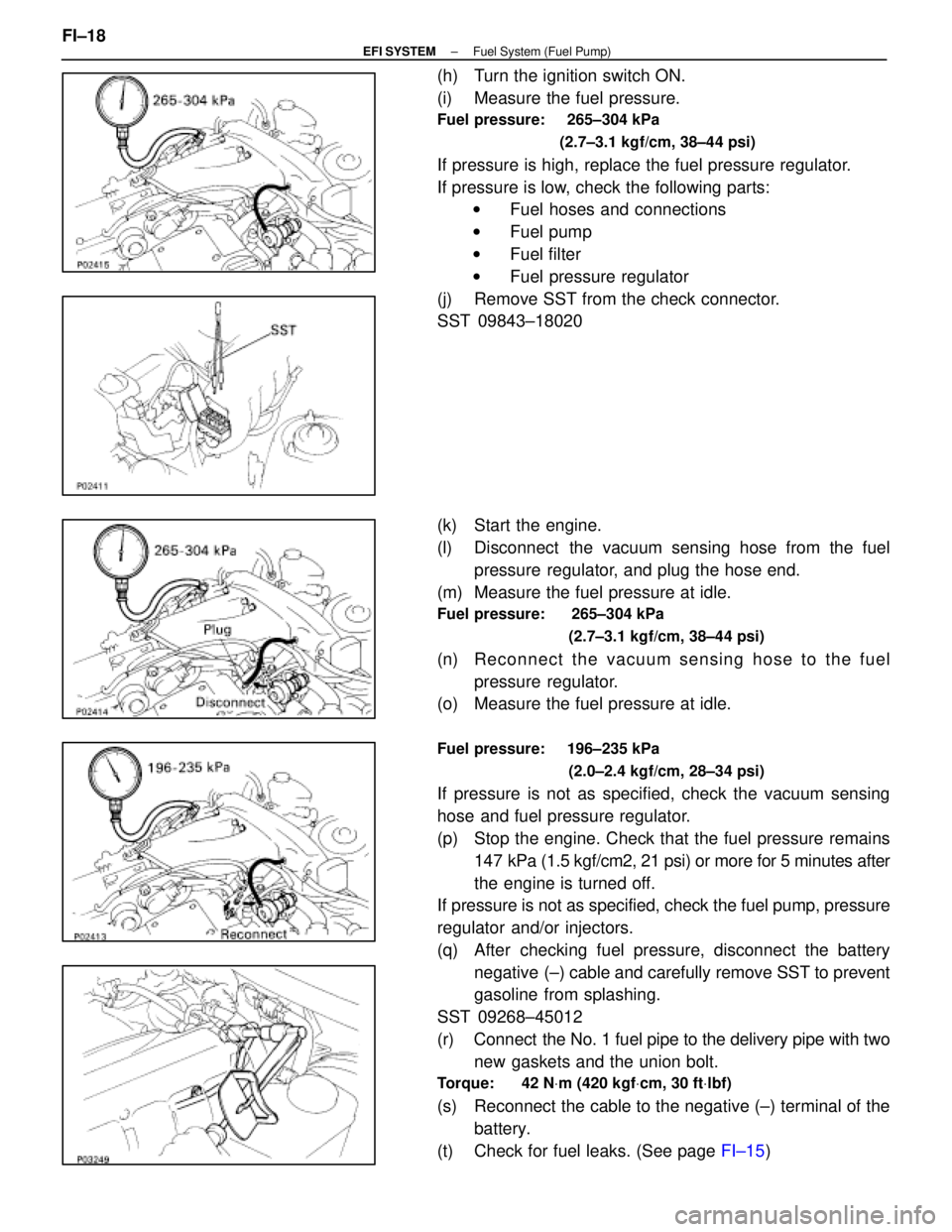
(h) Turn the ignition switch ON.
(i) Measure the fuel pressure.
Fuel pressure: 265±304 kPa (2.7±3.1 kgf/cm, 38±44 psi)
If pressure is high, replace the fuel pressure regulator.
If pressure is low, check the following parts:w Fuel hoses and connections
w Fuel pump
w Fuel filter
w Fuel pressure regulator
(j) Remove SST from the check connector.
SST 09843±18020
(k) Start the engine.
(l) Disconnect the vacuum sensing hose from the fuel pressure regulator, and plug the hose end.
(m) Measure the fuel pressure at idle.
Fuel pressure: 265±304 kPa
(2.7±3.1 kgf/cm, 38±44 psi)
(n) Re c onnect the vacuum sensing hose to the fuel
pressure regulator.
(o) Measure the fuel pressure at idle.
Fuel pressure: 196±235 kPa
(2.0±2.4 kgf/cm, 28±34 psi)
If pressure is not as specified, check the vacuum sensing
hose and fuel pressure regulator.
(p) Stop the engine. Check that the fuel pressure remains147 kPa (1.5 kgf/cm2, 21 psi) or more for 5 minutes after
the engine is turned off.
If pressure is not as specified, check the fuel pump, pressure
regulator and/or injectors.
(q) After checking fuel pressure, disconnect the battery
negative (±) cable and carefully remove SST to prevent
gasoline from splashing.
SST 09268±45012
(r) Connect the No. 1 fuel pipe to the delivery pipe with two new gaskets and the union bolt.
Torque: 42 N Vm (420 kgf Vcm, 30 ft Vlbf)
(s) Reconnect the cable to the negative (±) terminal of the
battery.
(t) Check for fuel leaks. (See page FI±15)
FI±18
±
EFI SYSTEM Fuel System (Fuel Pump)
WhereEverybodyKnowsYourName
Page 2032 of 4087
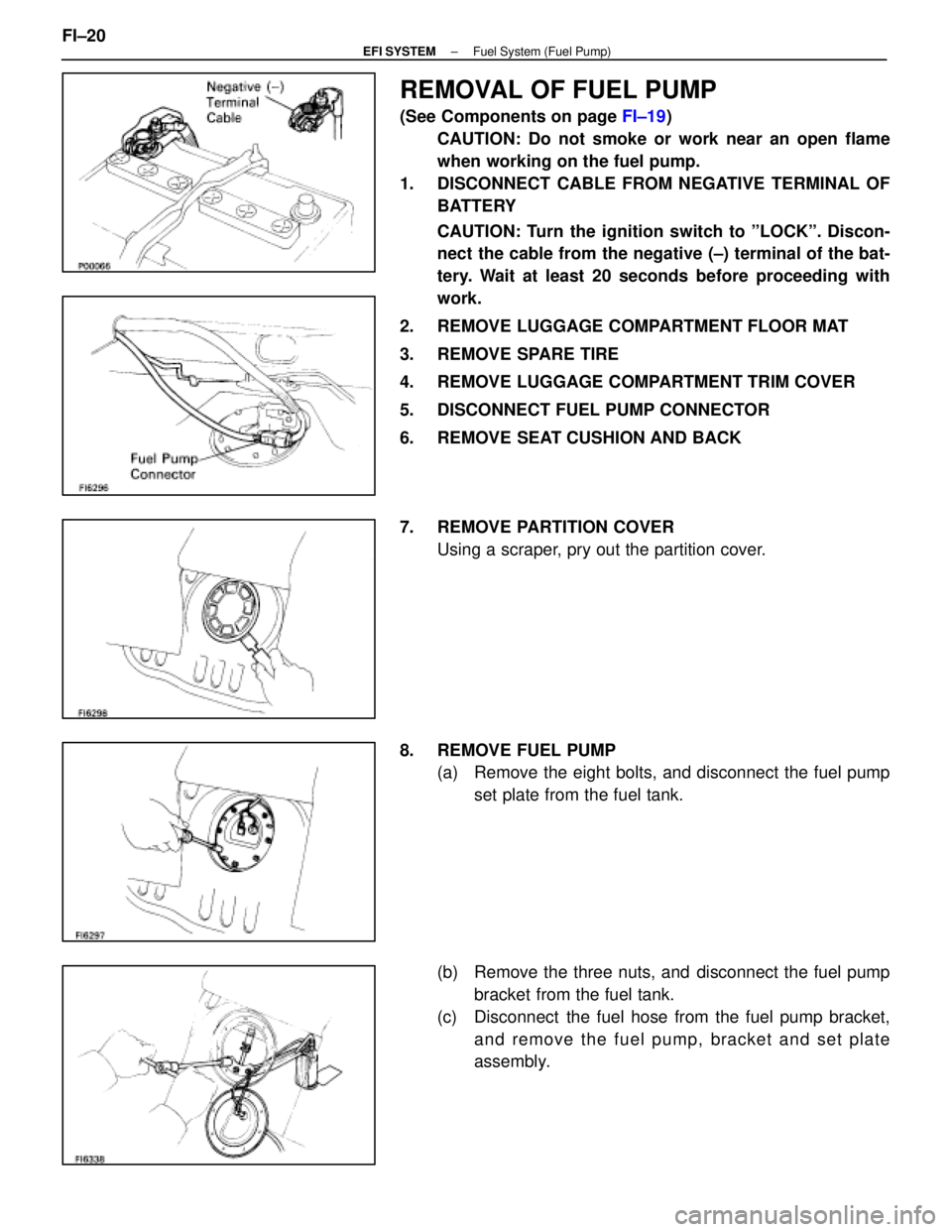
REMOVAL OF FUEL PUMP
(See Components on page FI±19)
CAUTION: Do not smoke or work near an open flame
when working on the fuel pump.
1. DISCONNECT CABLE FROM NEGATIVE TERMINAL OF BATTERY
CAUTION: Turn the ignition switch to ºLOCKº. Discon-
nect the cable from the negative (±) terminal of the bat-
tery. Wait at least 20 seconds before proceeding with
work.
2. REMOVE LUGGAGE COMPARTMENT FLOOR MAT
3. REMOVE SPARE TIRE
4. REMOVE LUGGAGE COMPARTMENT TRIM COVER
5. DISCONNECT FUEL PUMP CONNECTOR
6. REMOVE SEAT CUSHION AND BACK
7. REMOVE PARTITION COVER Using a scraper, pry out the partition cover.
8. REMOVE FUEL PUMP (a) Remove the eight bolts, and disconnect the fuel pump
set plate from the fuel tank.
(b) Remove the three nuts, and disconnect the fuel pump bracket from the fuel tank.
(c) Disconnect the fuel hose from the fuel pump bracket, and remove the fuel pump, bracket and set plate
assembly.
FI±20
±
EFI SYSTEM Fuel System (Fuel Pump)
WhereEverybodyKnowsYourName
Page 2036 of 4087
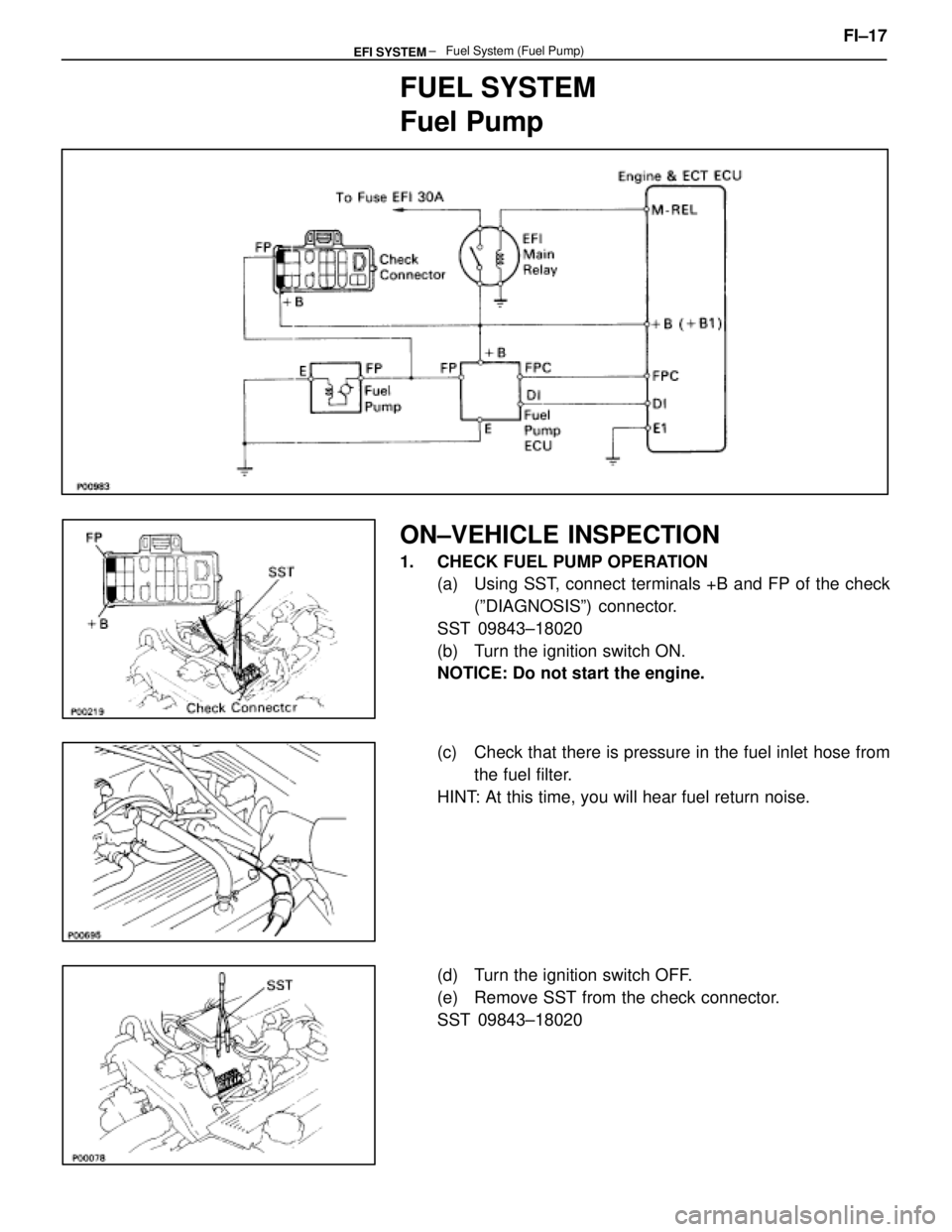
FUEL SYSTEM
Fuel Pump
ON±VEHICLE INSPECTION
1. CHECK FUEL PUMP OPERATION(a) Using SST, connect terminals +B and FP of the check
(ºDIAGNOSISº) connector.
SST 09843±18020
(b) Turn the ignition switch ON.
NOTICE: Do not start the engine.
(c) Check that there is pressure in the fuel inlet hose from the fuel filter.
HINT: At this time, you will hear fuel return noise.
(d) Turn the ignition switch OFF.
(e) Remove SST from the check connector.
SST 09843±18020 FI±17
± Fuel System (Fuel Pump)EFI SYSTEM
WhereEverybodyKnowsYourName
Page 2037 of 4087
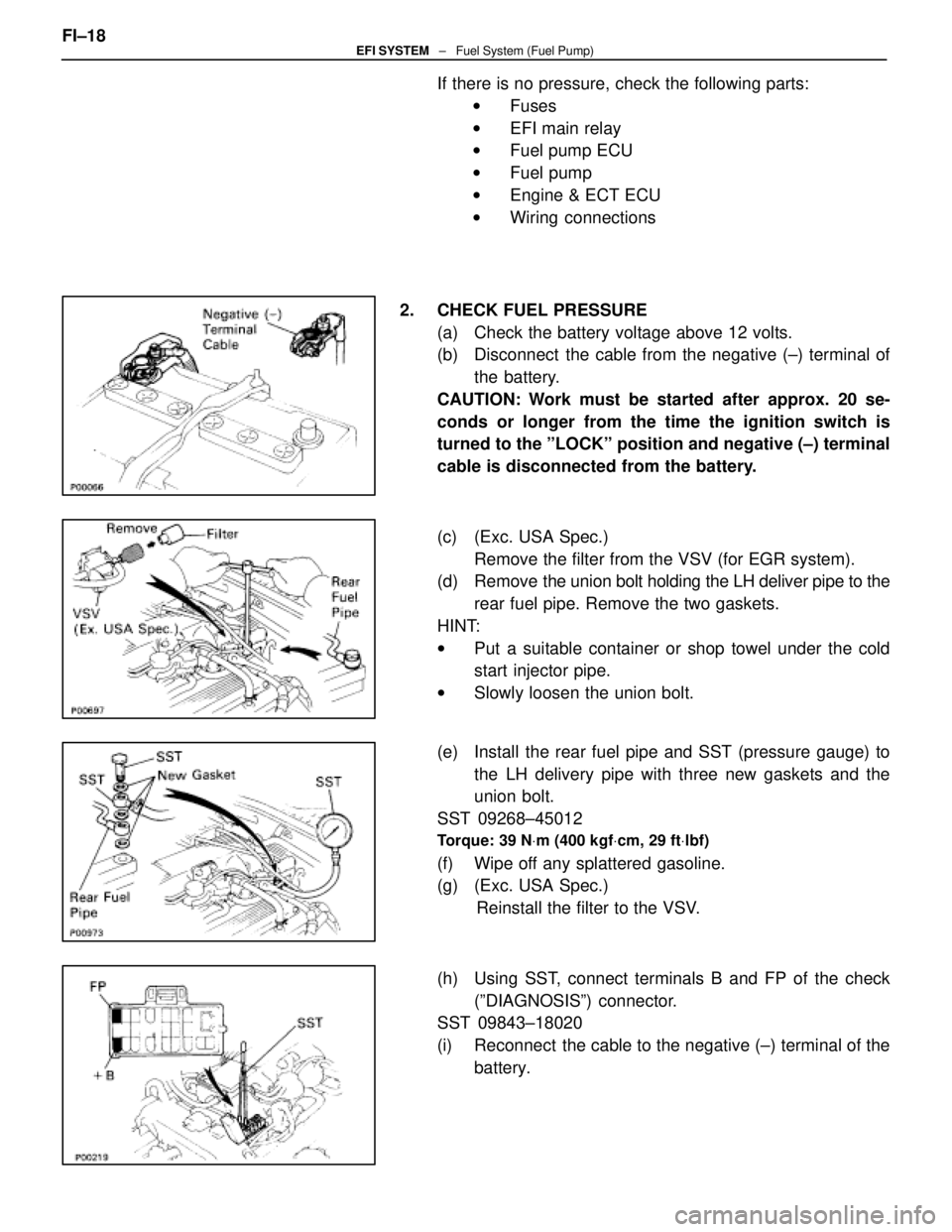
If there is no pressure, check the following parts:w Fuses
w EFI main relay
w Fuel pump ECU
w Fuel pump
w Engine & ECT ECU
w Wiring connections
2. CHECK FUEL PRESSURE (a) Check the battery voltage above 12 volts.
(b) Disconnect the cable from the negative (±) terminal ofthe battery.
CAUTION: Work must be started after approx. 20 se-
conds or longer from the time the ignition switch is
turned to the ºLOCKº position and negative (±) terminal
cable is disconnected from the battery.
(c) (Exc. USA Spec.) Remove the filter from the VSV (for EGR system).
(d) Remove the union bolt holding the LH deliver pipe to the
rear fuel pipe. Remove the two gaskets.
HINT:
w Put a suitable container or shop towel under the cold
start injector pipe.
w Slowly loosen the union bolt.
(e) Install the rear fuel pipe and SST (pressure gauge) to the LH delivery pipe with three new gaskets and the
union bolt.
SST 09268±45012
Torque: 39 N Vm (400 kgf Vcm, 29 ft Vlbf)
(f) Wipe off any splattered gasoline.
(g) (Exc. USA Spec.)
Reinstall the filter to the VSV.
(h) Using SST, connect terminals B and FP of the check (ºDIAGNOSISº) connector.
SST 09843±18020
(i) Reconnect the cable to the negative (±) terminal of the
battery.
FI±18
EFI SYSTEM
± Fuel System (Fuel Pump)
WhereEverybodyKnowsYourName
Page 2038 of 4087
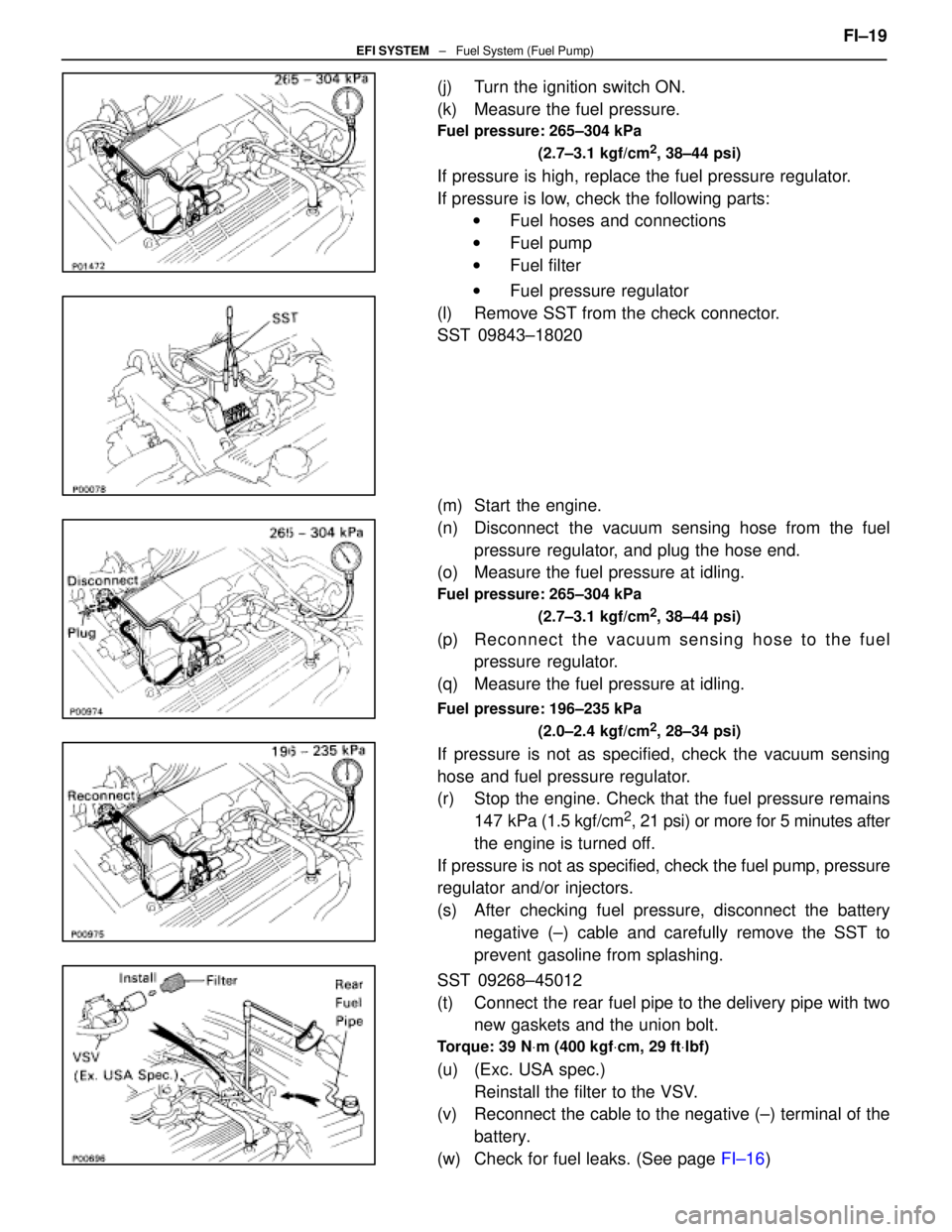
(j) Turn the ignition switch ON.
(k) Measure the fuel pressure.
Fuel pressure: 265±304 kPa(2.7±3.1 kgf/cm
2, 38±44 psi)
If pressure is high, replace the fuel pressure regulator.
If pressure is low, check the following parts:w Fuel hoses and connections
w Fuel pump
w Fuel filter
w Fuel pressure regulator
(l) Remove SST from the check connector.
SST 09843±18020
(m) Start the engine.
(n) Disconnect the vacuum sensing hose from the fuel pressure regulator, and plug the hose end.
(o) Measure the fuel pressure at idling.
Fuel pressure: 265±304 kPa
(2.7±3.1 kgf/cm
2, 38±44 psi)
(p) Re connect the vacuum sensing hose to the fuel
pressure regulator.
(q) Measure the fuel pressure at idling.
Fuel pressure: 196±235 kPa
(2.0±2.4 kgf/cm
2, 28±34 psi)
If pressure is not as specified, check the vacuum sensing
hose and fuel pressure regulator.
(r) Stop the engine. Check that the fuel pressure remains147 kPa (1.5 kgf/cm
2, 21 psi) or more for 5 minutes after
the engine is turned off.
If pressure is not as specified, check the fuel pump, pressure
regulator and/or injectors.
(s) After checking fuel pressure, disconnect the battery negative (±) cable and carefully remove the SST to
prevent gasoline from splashing.
SST 09268±45012
(t) Connect the rear fuel pipe to the delivery pipe with two new gaskets and the union bolt.
Torque: 39 N Vm (400 kgf Vcm, 29 ft Vlbf)
(u) (Exc. USA spec.)
Reinstall the filter to the VSV.
(v) Reconnect the cable to the negative (±) terminal of the
battery.
(w) Check for fuel leaks. (See page FI±16) FI±19
EFI SYSTEM
± Fuel System (Fuel Pump)
WhereEverybodyKnowsYourName
Page 2040 of 4087
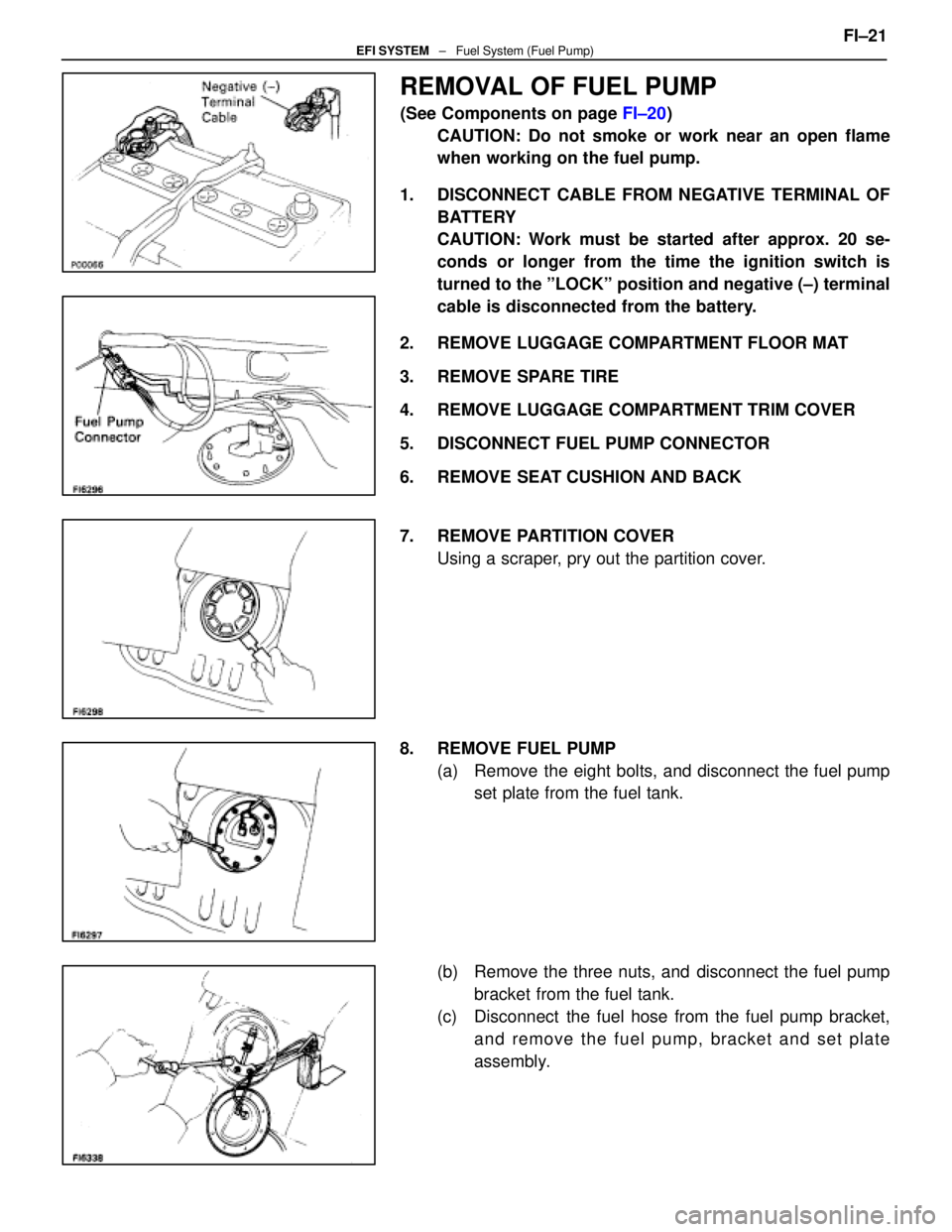
REMOVAL OF FUEL PUMP
(See Components on page FI±20)
CAUTION: Do not smoke or work near an open flame
when working on the fuel pump.
1. DISCONNECT CABLE FROM NEGATIVE TERMINAL OF BATTERY
CAUTION: Work must be started after approx. 20 se-
conds or longer from the time the ignition switch is
turned to the ºLOCKº position and negative (±) terminal
cable is disconnected from the battery.
2. REMOVE LUGGAGE COMPARTMENT FLOOR MAT
3. REMOVE SPARE TIRE
4. REMOVE LUGGAGE COMPARTMENT TRIM COVER
5. DISCONNECT FUEL PUMP CONNECTOR
6. REMOVE SEAT CUSHION AND BACK
7. REMOVE PARTITION COVER Using a scraper, pry out the partition cover.
8. REMOVE FUEL PUMP (a) Remove the eight bolts, and disconnect the fuel pumpset plate from the fuel tank.
(b) Remove the three nuts, and disconnect the fuel pump bracket from the fuel tank.
(c) Disconnect the fuel hose from the fuel pump bracket, and remove the fuel pump, bracket and set plate
assembly. FI±21
EFI SYSTEM
± Fuel System (Fuel Pump)
WhereEverybodyKnowsYourName
Page 2048 of 4087
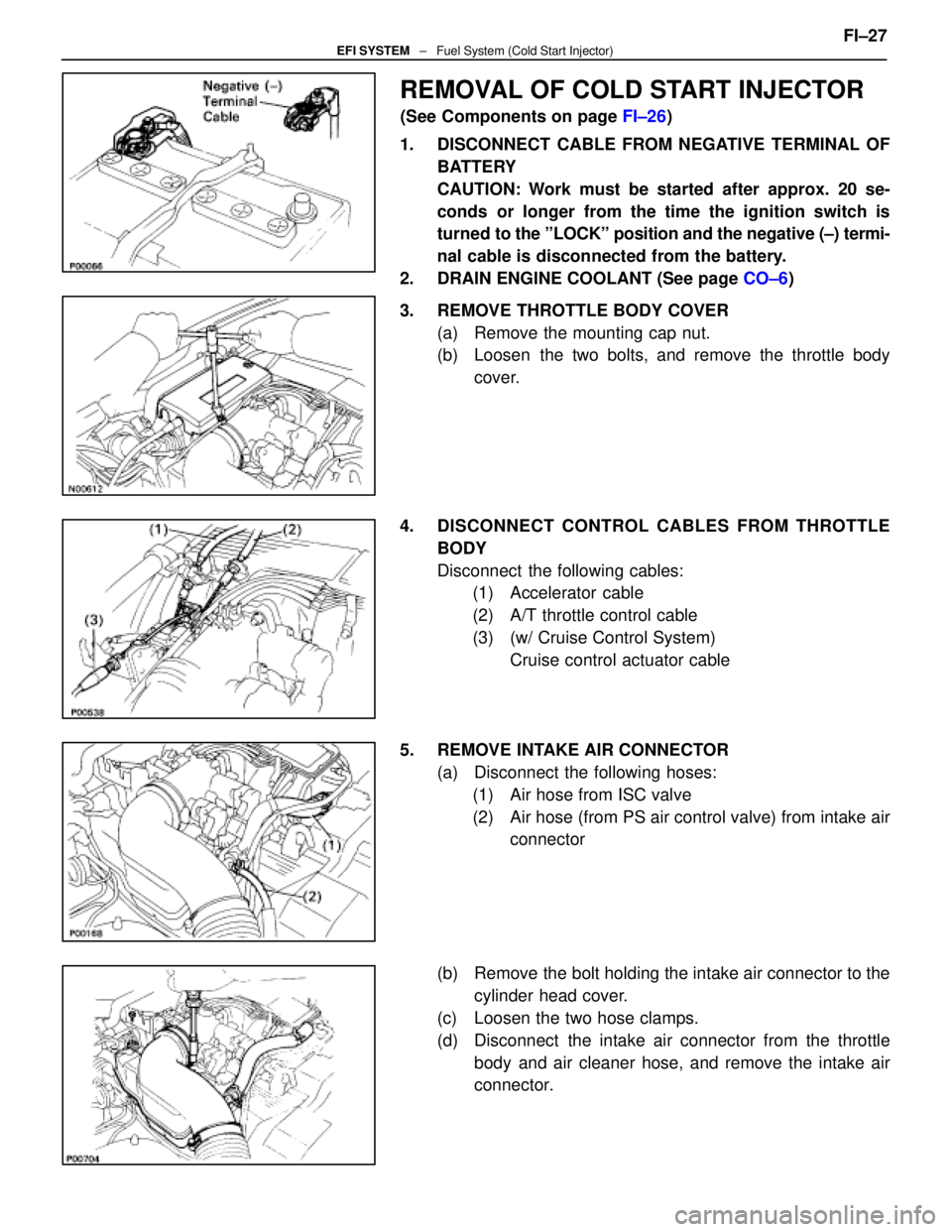
REMOVAL OF COLD START INJECTOR
(See Components on page FI±26)
1. DISCONNECT CABLE FROM NEGATIVE TERMINAL OF BATTERY
CAUTION: Work must be started after approx. 20 se-
conds or longer from the time the ignition switch is
turned to the ºLOCKº position and the negative (±) termi-
nal cable is disconnected from the battery.
2. DRAIN ENGINE COOLANT (See page CO±6)
3. REMOVE THROTTLE BODY COVER (a) Remove the mounting cap nut.
(b) Loosen the two bolts, and remove the throttle bodycover.
4. DISCONNECT CONTROL CABLES FROM THROTTLE BODY
Disconnect the following cables:(1) Accelerator cable
(2) A/T throttle control cable
(3) (w/ Cruise Control System)
Cruise control actuator cable
5. REMOVE INTAKE AIR CONNECTOR (a) Disconnect the following hoses:(1) Air hose from ISC valve
(2) Air hose (from PS air control valve) from intake air connector
(b) Remove the bolt holding the intake air connector to the cylinder head cover.
(c) Loosen the two hose clamps.
(d) Disconnect the intake air connector from the throttle body and air cleaner hose, and remove the intake air
connector. FI±27
EFI SYSTEM
± Fuel System (Cold Start Injector)
WhereEverybodyKnowsYourName