code 32 LEXUS SC300 1991 Service Repair Manual
[x] Cancel search | Manufacturer: LEXUS, Model Year: 1991, Model line: SC300, Model: LEXUS SC300 1991Pages: 4087, PDF Size: 75.75 MB
Page 3546 of 4087
OKNG
OKNG
INSPECTION PROCEDURE
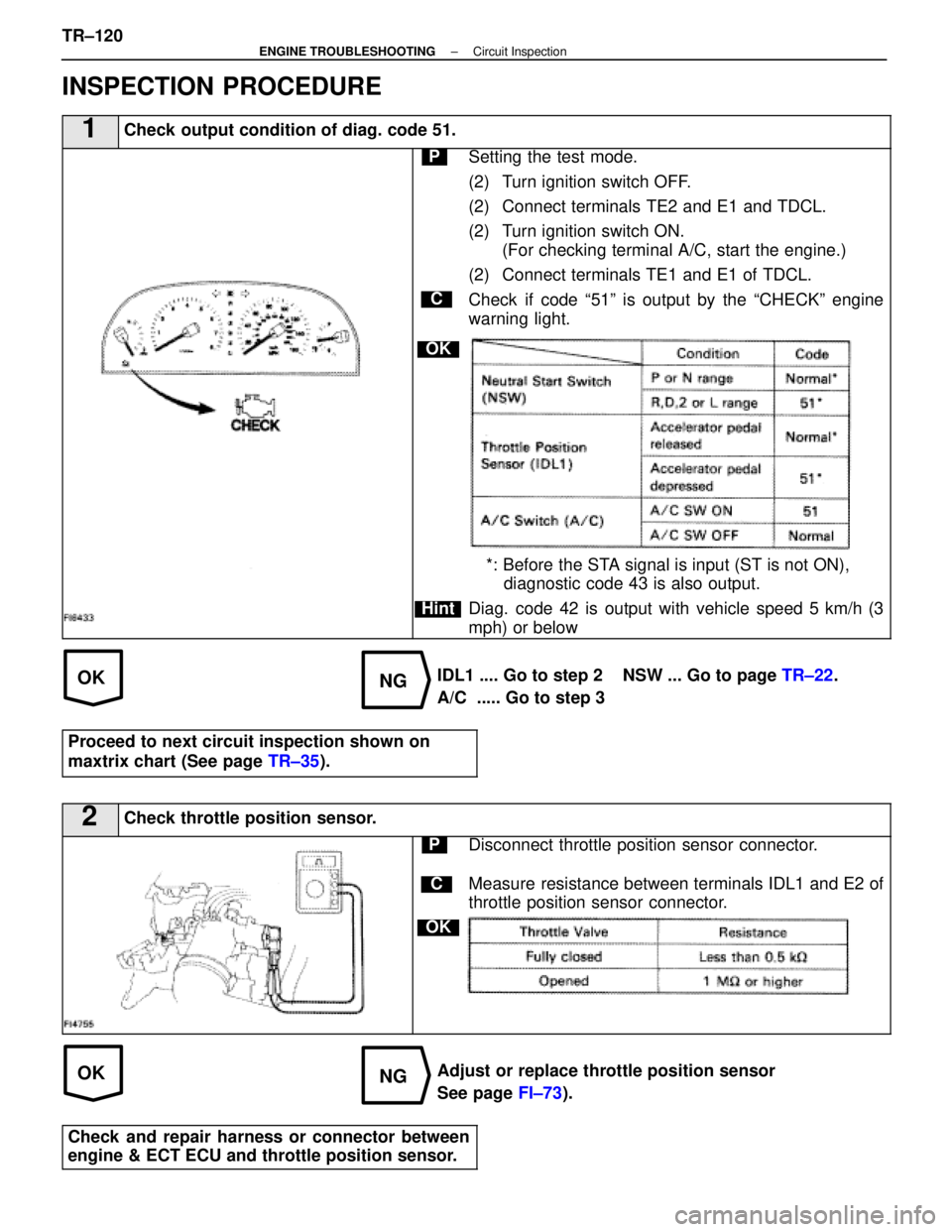
1Check output condition of diag. code 51.
C
OK
Hint
PSetting the test mode.
(2) Turn ignition switch OFF.
(2) Connect terminals TE2 and E1 and TDCL.
(2) Turn ignition switch ON.(For checking terminal A/C, start the engine.)
(2) Connect terminals TE1 and E1 of TDCL.
Check if code ª51º is output by the ªCHECKº engine
warning light.
*: Before the STA signal is input (ST is not ON), diagnostic code 43 is also output.
Diag. code 42 is output with vehicle speed 5 km/h (3
mph) or below
IDL1 .... Go to step 2 NSW ... Go to page TR±22.
A/C ..... Go to step 3
Proceed to next circuit inspection shown on
maxtrix chart (See page TR±35).
2Check throttle position sensor.
C
OK
PDisconnect throttle position sensor connector.
Measure resistance between terminals IDL1 and E2 of
throttle position sensor connector.
Adjust or replace throttle position sensor
See page FI±73).
Check and repair harness or connector between
engine & ECT ECU and throttle position sensor.
TR±120±
ENGINE TROUBLESHOOTING Circuit Inspection
WhereEverybodyKnowsYourName
Page 3554 of 4087

Neutral Start Switch Circuit
CIRCUIT DESCRIPTION
The neutral start switch goes on when the shift lever is in the N or P shif\
t position. When it goes on the terminal
NSW of the ECU is grounded to body ground via the starter relay and theft deterrent ECU\
, thus the terminal
NSW voltage becomes 0V. When the shift lever is in the D, 2, L or R position, the neutral start\
switch goes off,
so the voltage of ECU terminal NSW becomes battery voltage, the voltage of the ECU internal power source.
If the shift lever is moved from the N range to the D range, this signal\
is used for air±fuel ratio correction and
for idle speed control (estimated control), etc.
When the neutral start switch is off, code º51º is output in the test mode diagnosis. (This is not a\
bnormal.)
DIAGNOSTIC CHARTDIAGNOSTIC CHART
HINT: This diagnosis chart is based on premise that the engine is cranked norm\
ally. If the engine is notcranked, proceed to the matrix chart of problem symptoms on page TR±35.
Check output condition of diag. code 51.
Proceed to next circuit inspection shown
on matrix chart (See page TR±35).
Check for open in harness and connector
between neutral start switch and ECU.
Repair or replace harness or connector.
Check and replace ECU.
Check and replace ECU.
Replace neutral start switch.Check neutral start switch (See page
AT±100 ).
TR±122
±
ENGINE TROUBLESHOOTING Circuit Inspection
WhereEverybodyKnowsYourName
Page 3555 of 4087
OK
NG
Type I
NG
Type II
NG
OK
OKNG
INSPECTION PROCEDURE
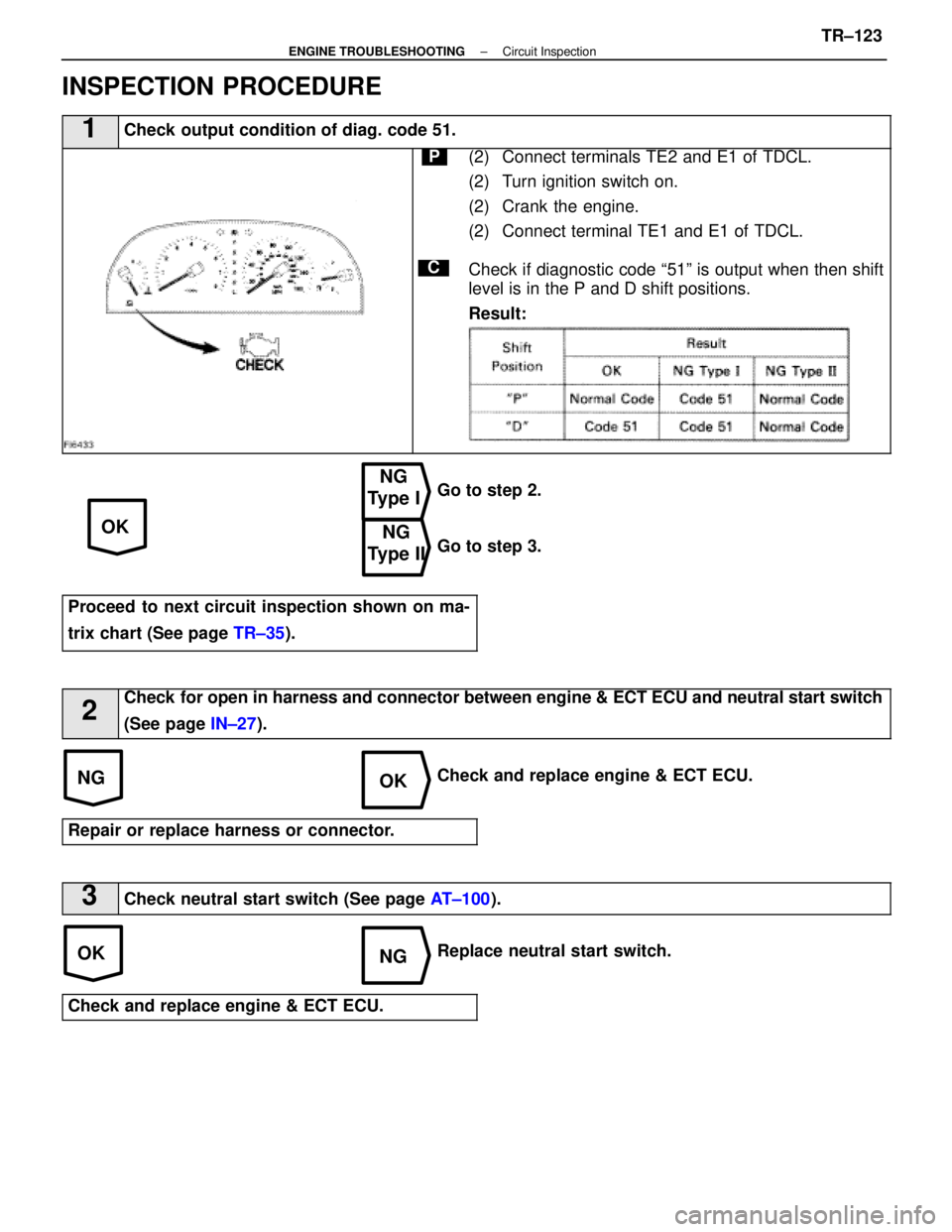
1Check output condition of diag. code 51.
C
P(2) Connect terminals TE2 and E1 of TDCL.
(2) Turn ignition switch on.
(2) Crank the engine.
(2) Connect terminal TE1 and E1 of TDCL.
Check if diagnostic code ª51º is output when then shift
level is in the P and D shift positions.
Result:
Go to step 2.
Go to step 3.
Proceed to next circuit inspection shown on ma-
trix chart (See page TR±35).
2
Check for open in harness and connector between engine & ECT ECU and neutral \
start switch
(See page IN±27).
Check and replace engine & ECT ECU.
Repair or replace harness or connector.
3Check neutral start switch (See page AT±100).
Replace neutral start switch.
Check and replace engine & ECT ECU.
±
ENGINE TROUBLESHOOTING Circuit InspectionTR±123
WhereEverybodyKnowsYourName
Page 3562 of 4087
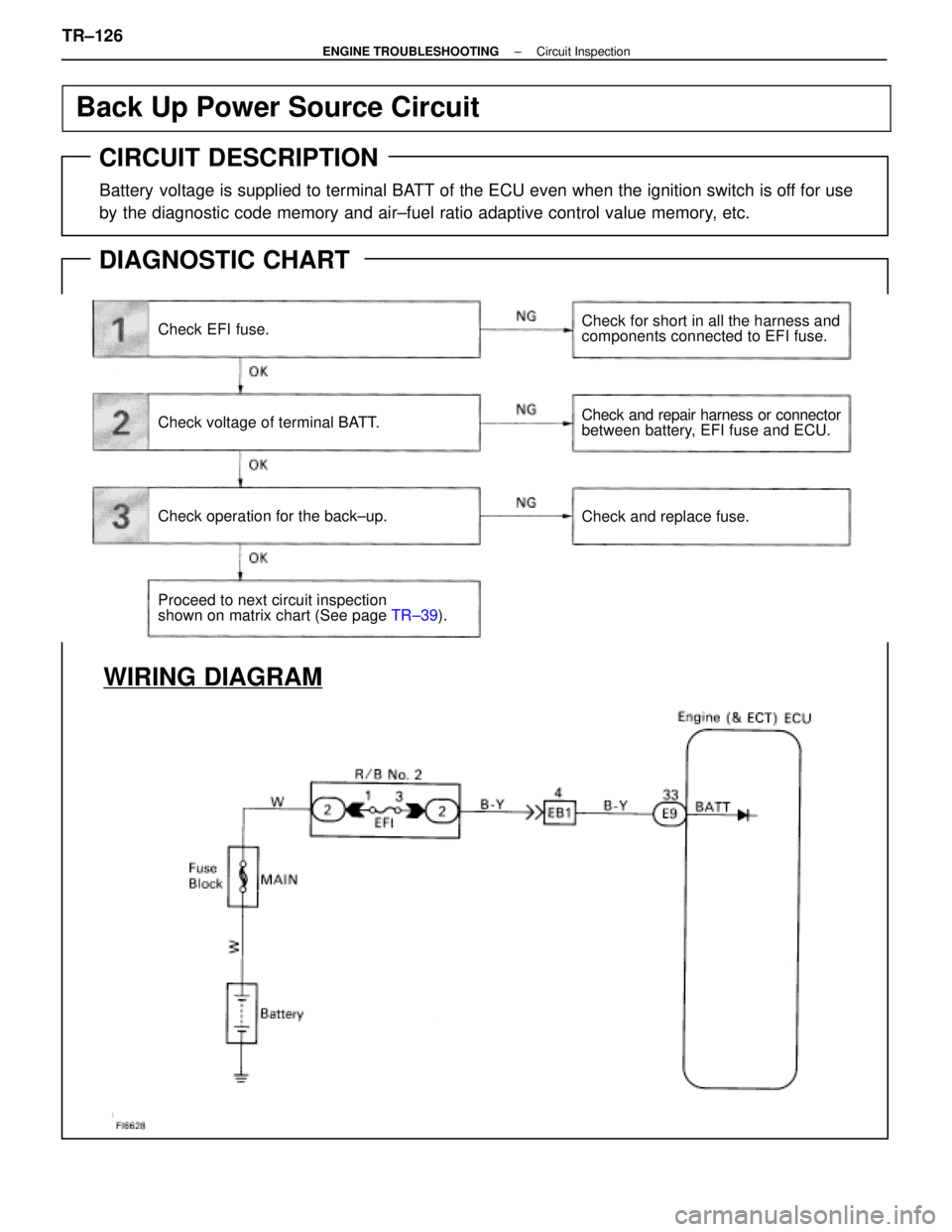
Check EFI fuse.
Check voltage of terminal BATT.
Check operation for the back±up.
Proceed to next circuit inspection
shown on matrix chart (See page TR±39).
Check for short in all the harness and
components connected to EFI fuse.
Check and repair harness or connector
between battery, EFI fuse and ECU.
Check and replace fuse.
WIRING DIAGRAM
Back Up Power Source Circuit
CIRCUIT DESCRIPTION
Battery voltage is supplied to terminal BATT of the ECU even when the ignition switch is off for use
by the diagnostic code memory and air±fuel ratio adaptive control val\
ue memory, etc.
DIAGNOSTIC CHART
TR±126±
ENGINE TROUBLESHOOTING Circuit Inspection
WhereEverybodyKnowsYourName
Page 3563 of 4087
OKNG
OKNG
YESNO
INSPECTION PROCEDURE
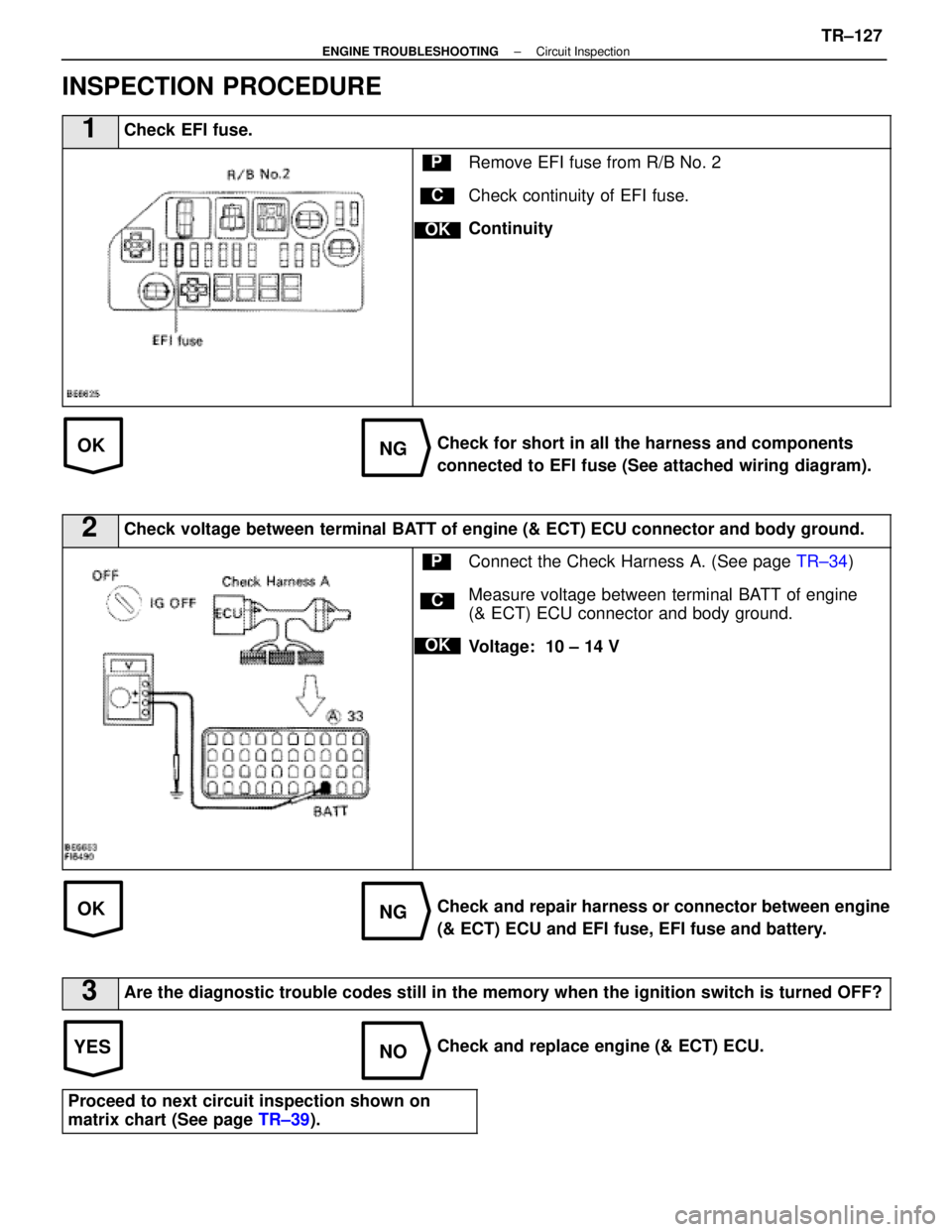
1Check EFI fuse.
C
OK
PRemove EFI fuse from R/B No. 2
Check continuity of EFI fuse.
Continuity
Check for short in all the harness and components
connected to EFI fuse (See attached wiring diagram).
2Check voltage between terminal BATT of engine (& ECT) ECU connector and body ground.
C
OK
PConnect the Check Harness A. (See page TR±34)
Measure voltage between terminal BATT of engine
(& ECT) ECU connector and body ground.
Voltage: 10 ± 14 V
Check and repair harness or connector between engine
(& ECT) ECU and EFI fuse, EFI fuse and battery.
3Are the diagnostic trouble codes still in the memory when the ignition s\
witch is turned OFF?
Check and replace engine (& ECT) ECU.
Proceed to next circuit inspection shown on
matrix chart (See page TR±39).
±
ENGINE TROUBLESHOOTING Circuit InspectionTR±127
WhereEverybodyKnowsYourName
Page 3568 of 4087
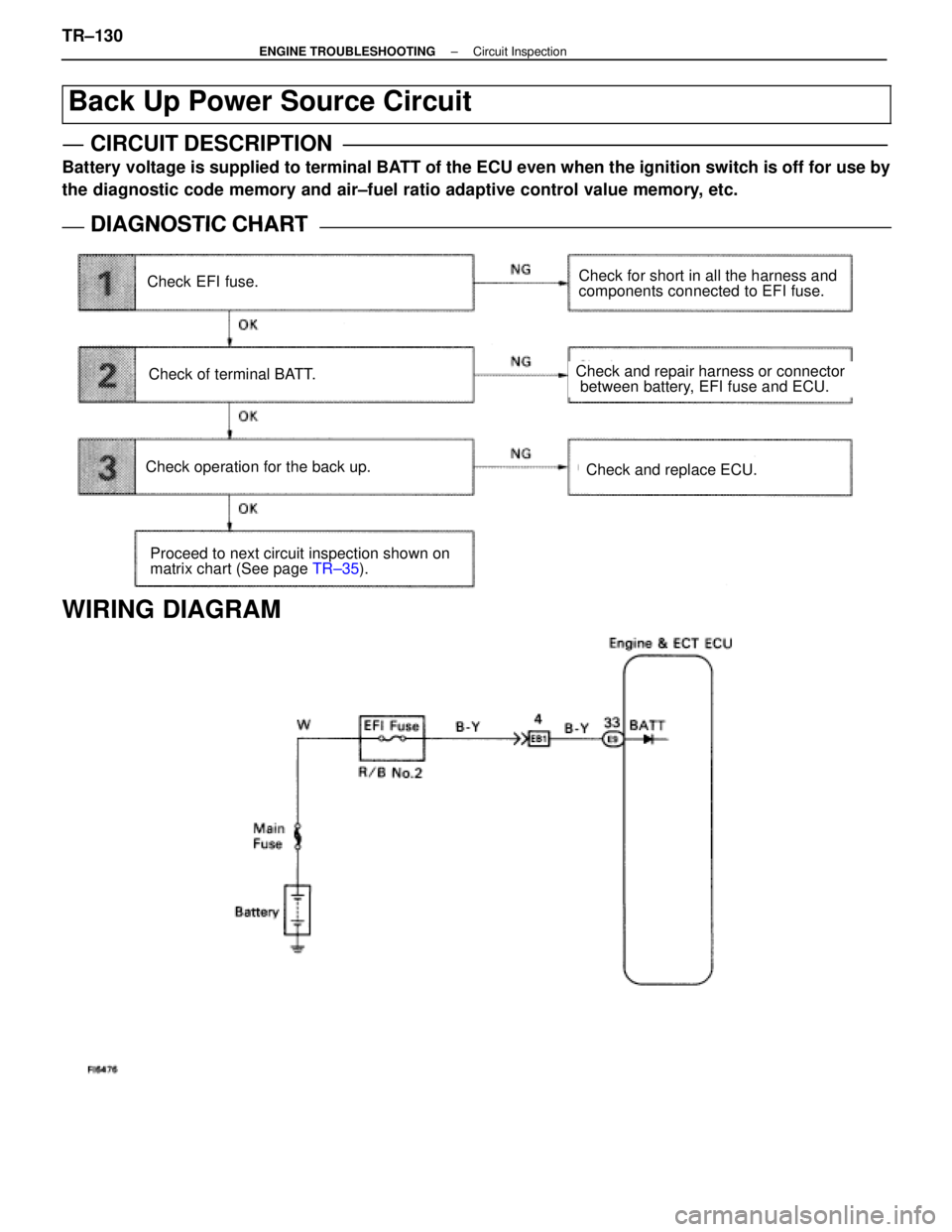
Back Up Power Source Circuit
CIRCUIT DESCRIPTION
Battery voltage is supplied to terminal BATT of the ECU even when the ignition switch is off for use by
the diagnostic code memory and air±fuel ratio adaptive control value mem\
ory, etc.
DIAGNOSTIC CHARTDIAGNOSTIC CHART
Check for short in all the harness and
components connected to EFI fuse.Check EFI fuse.
Check of terminal BATT.
Proceed to next circuit inspection shown on
matrix chart (See page TR±35).
Check operation for the back up.Check and replace ECU.
Check and repair harness or connector
between battery, EFI fuse and ECU.
WIRING DIAGRAM
TR±130±
ENGINE TROUBLESHOOTING Circuit Inspection
WhereEverybodyKnowsYourName
Page 3569 of 4087
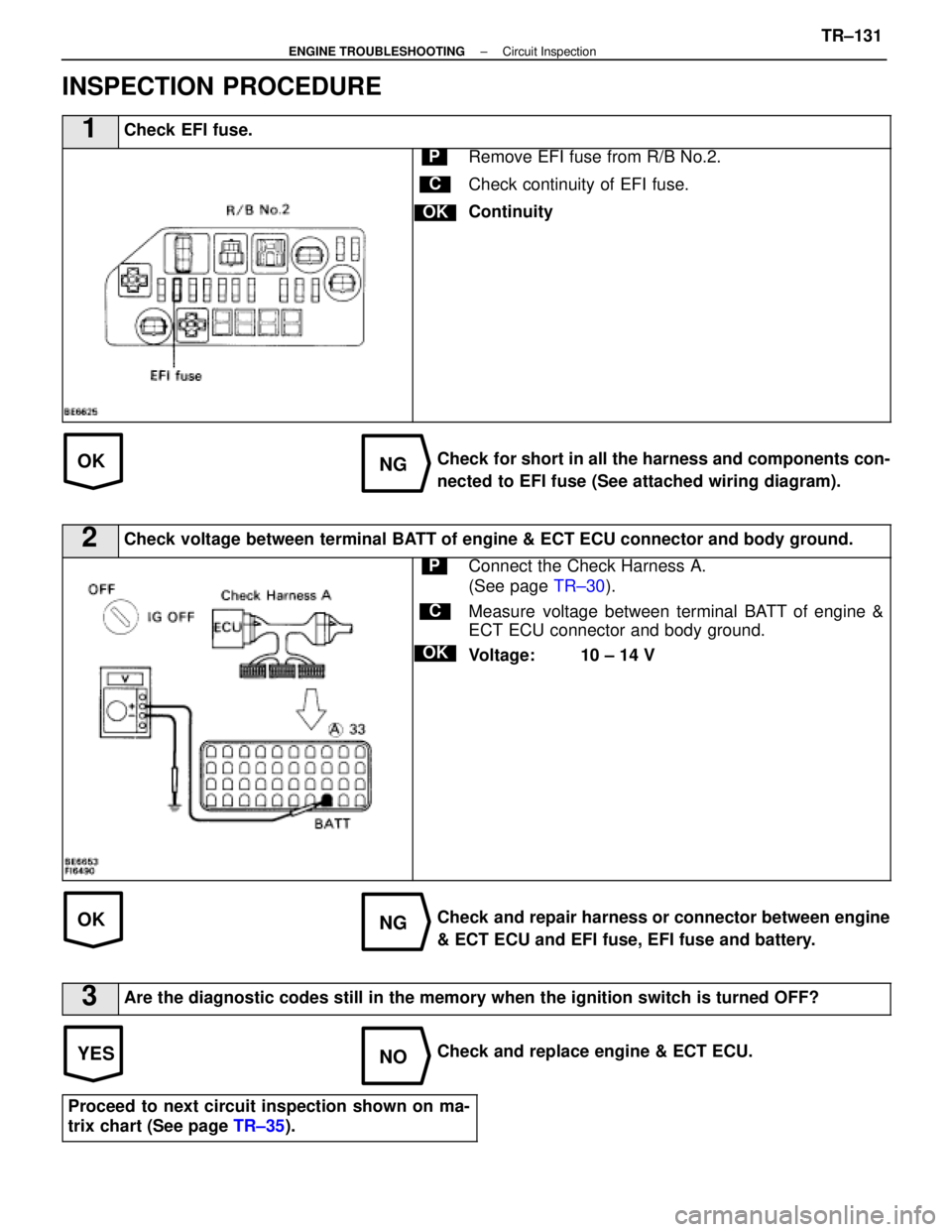
OKNG
OKNG
YESNO
INSPECTION PROCEDURE
1Check EFI fuse.
C
OK
PRemove EFI fuse from R/B No.2.
Check continuity of EFI fuse.
Continuity
Check for short in all the harness and components con-
nected to EFI fuse (See attached wiring diagram).
2Check voltage between terminal BATT of engine & ECT ECU connector and body ground.
C
OK
PConnect the Check Harness A.
(See page TR±30).
Measure voltage between terminal BATT of engine &
ECT ECU connector and body ground.
Voltage: 10 ± 14 V
Check and repair harness or connector between engine
& ECT ECU and EFI fuse, EFI fuse and battery.
3Are the diagnostic codes still in the memory when the ignition switch is\
turned OFF?
Check and replace engine & ECT ECU.
Proceed to next circuit inspection shown on ma-
trix chart (See page TR±35).
±
ENGINE TROUBLESHOOTING Circuit InspectionTR±131
WhereEverybodyKnowsYourName
Page 3584 of 4087

TE1, TE2 Terminal Circuit
CIRCUIT DESCRIPTION
Terminal TE1 is located in the check connector in the engine compartment and terminals T\
E1 and TE2 are lo-
cated in the TDCL in the cabin. When these terminals are connected with \
the E1 terminal, diagnostic codes in
normal mode or test mode can be read from the ºCHECKº engine warning lig\
ht on the combination meter.
DIAGNOSTIC CHARTDIAGNOSTIC CHART
HINT: If terminals TE1 and TE2 are connected with terminal E1, diagnostic code is not output or test mode isnot activated.
Even though terminal TE1 is not connected with terminal E1, the ºCHEC\
Kº engine warning light blinks.
For the above phenomenon, the likely cause is an open or short in the wire \
harness, or malfunction inside
the ECU.
Check continuity between terminal E1 and
body ground.
Repair or replace harness or
connector.Check for open and short in harness and
connector between check connector TDCL
and ECU.
Check voltage of terminals TE1, TE2.
Check and replace ECU.
Repair or replace harness or
connector.
Check and replace ECU.
WIRING DIAGRAM
TR±146±
ENGINE TROUBLESHOOTING
WhereEverybodyKnowsYourName
Page 3587 of 4087

HOW TO PROCEED WITH TROUBLESHOOTING
The Engine Control System broadly consists of the sensors, ECU and actuator\
s. The ECU receives signals from
various sensors, judges the operating conditions and determines the opti\
mum injection duration, timing, ignition
timing and idle speed.
In general, the Engine Control System is considered to be a very intricate\
system to troubleshoot. But, the fact
is that if you proceed to inspect the circuit one by one following the p\
rocedures directed in this manual, trouble-
shooting of this system is not complex.
This section explains the most ideal method of troubleshooting and tells how\
to carry out the necessary repairs.
[1] CUSTOMER PROBLEM ANALYSISUsing the customer problem analysis check sheet for reference, ask the c\
ustomer in as much details as
possible about the problem.
[2] CHECK AND CLEAR DIAGNOSTIC CODE (PRECHECK) Before confirming the problem symptom, first check the diagnostic code and mak\
e a note of any malfunc-
tion code which is output, then clear the code.
HINT: Output of the malfunction code indicates that there is a malfunction in\
the circuit indicated. However,
it does not indicate whether the malfunction is still occurring or occur\
red in the past and returned to normal.
In order to determine this, the problem symptoms should be confirmed in 4 \
first and the diagnostic code
be rechecked in [6].
Accordingly, if troubleshooting is begun based on the malfunction code only in diag\
nostic code check in
[2] , it could result in a misdiagnosis, leading to troubleshooting of circuits which are normal \
and making
it more difficult to locate the cause of the problem.
[3] SETTING THE TEST MODE DIAGNOSIS, [4] PROBLEM SYMPTOM CONFIRMATION, [5] SYMPTOM SIMULATION
In order to find out the trouble more quickly, set the diagnosis check in test mode and with higher sensing
ability of the ECU, confirm the problem symptoms. If the trouble does not reappear, use the symptom simu-
lation method to make sure the trouble is reproduced.
[6] DIAGNOSTIC CODE CHECK IN TEST MODE Check the diagnostic code in test mode. If the malfunction code is output, pr\
oceed to ºstep [8] Diagnostic
Code Chartº. If the normal code is output, proceed to ºstep [7] Basic Inspectionº.
[7] BASIC INSPECTION Carry out basic inspection such as the spark check and fuel pressure che\
ck, etc.
[8] DIAGNOSTIC CODE CHART If the malfunction code is displayed, proceed to inspect the circuit ind\
icated by the chart for each code.
[9] MATRIX CHART OF PROBLEM SYMPTOMS If the normal code is displayed in the diagnosis in test mode, perform tro\
ubleshooting according to the in-
spection order in the Matrix Chart of Problem Symptoms.
[10] PARTS INSPECTION When the Matrix Chart of Problem Symptoms instructs to check the parts, proc\
eed to parts inspection sec-
tion included in this manual.
[11] CIRCUIT INSPECTION Determine if the malfunction is the sensor, actuator, wire harness, connector or the ECU.
TR±2
±
ENGINE TROUBLESHOOTING How to Proceed with Troubleshooting
WhereEverybodyKnowsYourName
Page 3591 of 4087
![LEXUS SC300 1991 Service Repair Manual
How to Proceed with Troubleshooting Using Volt/Ohm Meter
and TCCS Checker
For the explanation of steps [1] ~ [6], [8] and [10] ~ [16], see the explan\
ation of steps with the same title on page
TR±2](/img/36/57052/w960_57052-3590.png "LEXUS SC300 1991 Service Repair Manual
How to Proceed with Troubleshooting Using Volt/Ohm Meter
and TCCS Checker
For the explanation of steps [1] ~ [6], [8] and [10] ~ [16], see the explan\
ation of steps with the same title on page
TR±2")
How to Proceed with Troubleshooting Using Volt/Ohm Meter
and TCCS Checker
For the explanation of steps [1] ~ [6], [8] and [10] ~ [16], see the explan\
ation of steps with the same title on page
TR±2.
[7] [9] CIRCUIT INSPECTION BY CHECKER If the Normal code is displayed in the diagnostic code check, connect the \
checker to the vehicle and check
all the circuits which can be inspected using the checker.
If a malfunctioning circuit is then detected, proceed to ºCircuit Ins\
pection by Volt/Ohm Meterº and check
the applicable circuit using a volt/ohm meter. Determine if the malfunction is in the sensor, actuator, wire
harness, connector or the ECU. If the malfunctioning circuit cannot be detected u\
sing the checker, proceed
to ºBasic Inspectionº and perform troubleshooting.
If a malfunction code is displayed in the diagnostic code check, use the c\
hecker to inspect the circuit indi-
cated by the diagnostic code chart for the displayed code.
For instructions on how to connect the checker to the vehicle and how to us\
e the checker, please refer to
the Instruction Manual for TCCS checker.
TR±6
±
ENGINE TROUBLESHOOTING How to Proceed with Troubleshooting
WhereEverybodyKnowsYourName