sensor LEXUS SC400 1991 Service Repair Manual
[x] Cancel search | Manufacturer: LEXUS, Model Year: 1991, Model line: SC400, Model: LEXUS SC400 1991Pages: 4087, PDF Size: 75.75 MB
Page 1598 of 4087
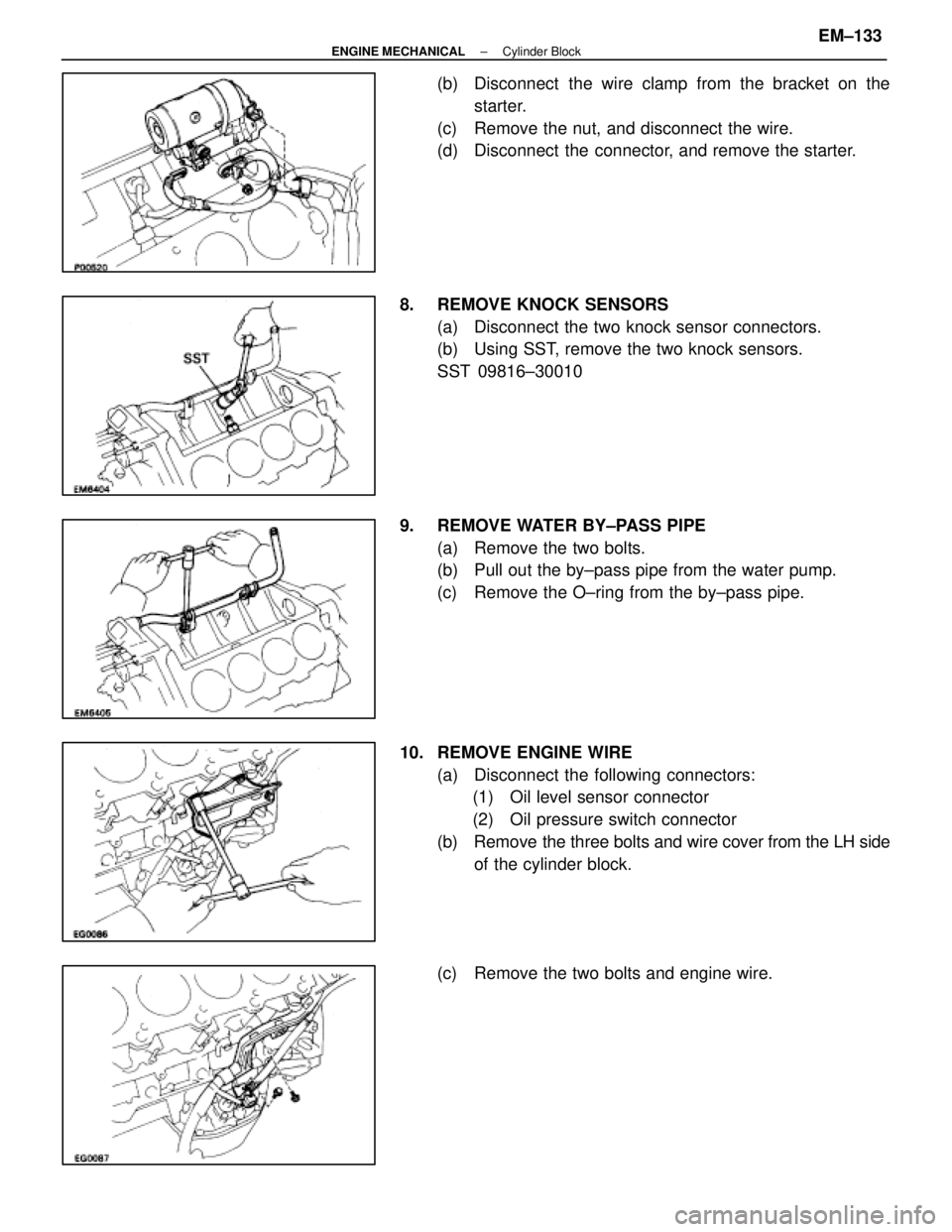
(b) Disconnect the wire clamp from the bracket on thestarter.
(c) Remove the nut, and disconnect the wire.
(d) Disconnect the connector, and remove the starter.
8. REMOVE KNOCK SENSORS (a) Disconnect the two knock sensor connectors.
(b) Using SST, remove the two knock sensors.
SST 09816±30010
9. REMOVE WATER BY±PASS PIPE (a) Remove the two bolts.
(b) Pull out the by±pass pipe from the water pump.
(c) Remove the O±ring from the by±pass pipe.
10. REMOVE ENGINE WIRE (a) Disconnect the following connectors:(1) Oil level sensor connector
(2) Oil pressure switch connector
(b) Remove the three bolts and wire cover from the LH side
of the cylinder block.
(c) Remove the two bolts and engine wire.
±
ENGINE MECHANICAL Cylinder BlockEM±133
WhereEverybodyKnowsYourName
Page 1628 of 4087
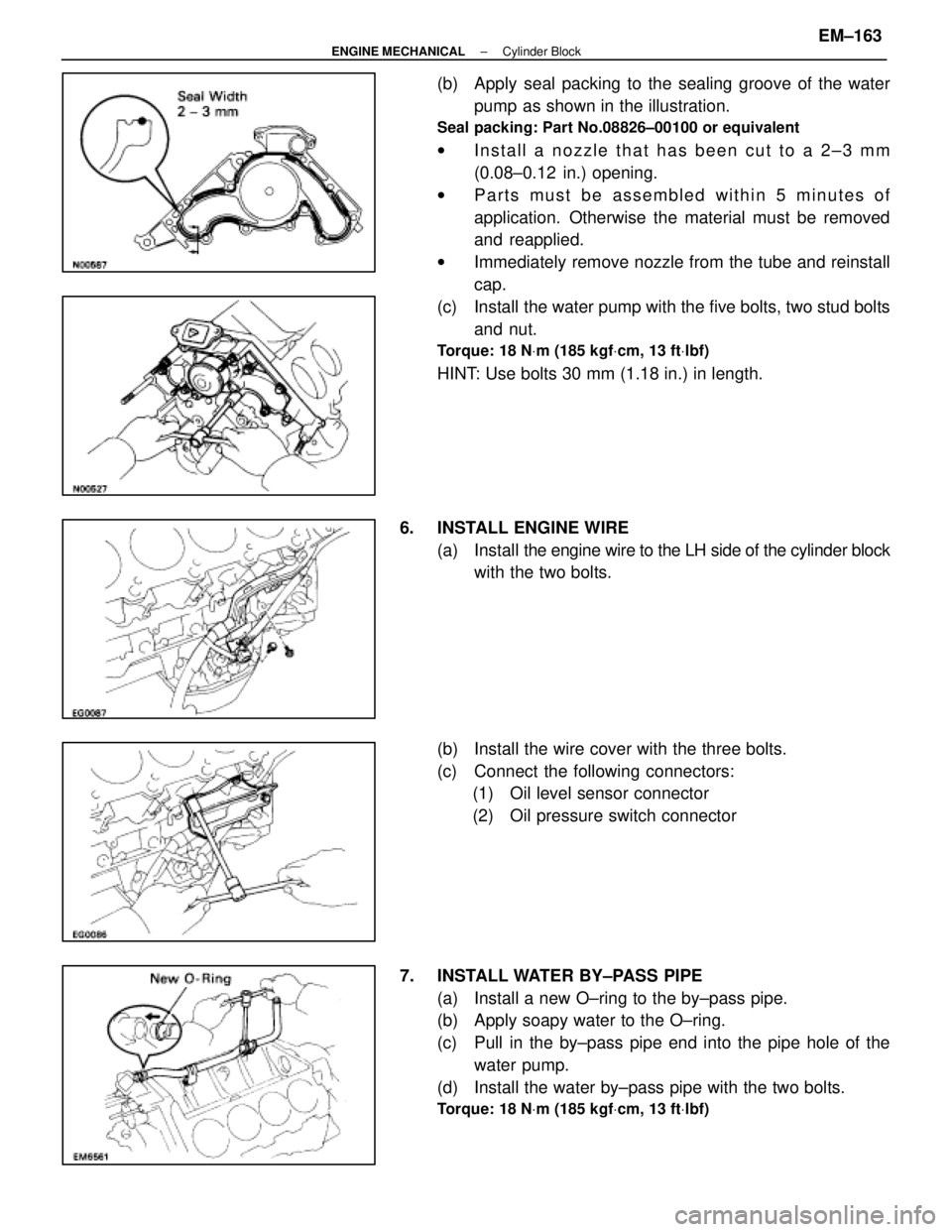
(b) Apply seal packing to the sealing groove of the waterpump as shown in the illustration.
Seal packing: Part No.08826±00100 or equivalent
wInstall a nozzle that has been cut to a 2±3 mm
(0.08±0.12 in.) opening.
w Parts must be assembled within 5 minutes of
application. Otherwise the material must be removed
and reapplied.
w Immediately remove nozzle from the tube and reinstall
cap.
(c) Install the water pump with the five bolts, two stud bolts and nut.
Torque: 18 N Vm (185 kgf Vcm, 13 ft Vlbf)
HINT: Use bolts 30 mm (1.18 in.) in length.
6. INSTALL ENGINE WIRE (a) Install the engine wire to the LH side of the cylinder block
with the two bolts.
(b) Install the wire cover with the three bolts.
(c) Connect the following connectors: (1) Oil level sensor connector
(2) Oil pressure switch connector
7. INSTALL WATER BY±PASS PIPE (a) Install a new O±ring to the by±pass pipe.
(b) Apply soapy water to the O±ring.
(c) Pull in the by±pass pipe end into the pipe hole of thewater pump.
(d) Install the water by±pass pipe with the two bolts.
Torque: 18 N Vm (185 kgf Vcm, 13 ft Vlbf)
±
ENGINE MECHANICAL Cylinder BlockEM±163
WhereEverybodyKnowsYourName
Page 1629 of 4087
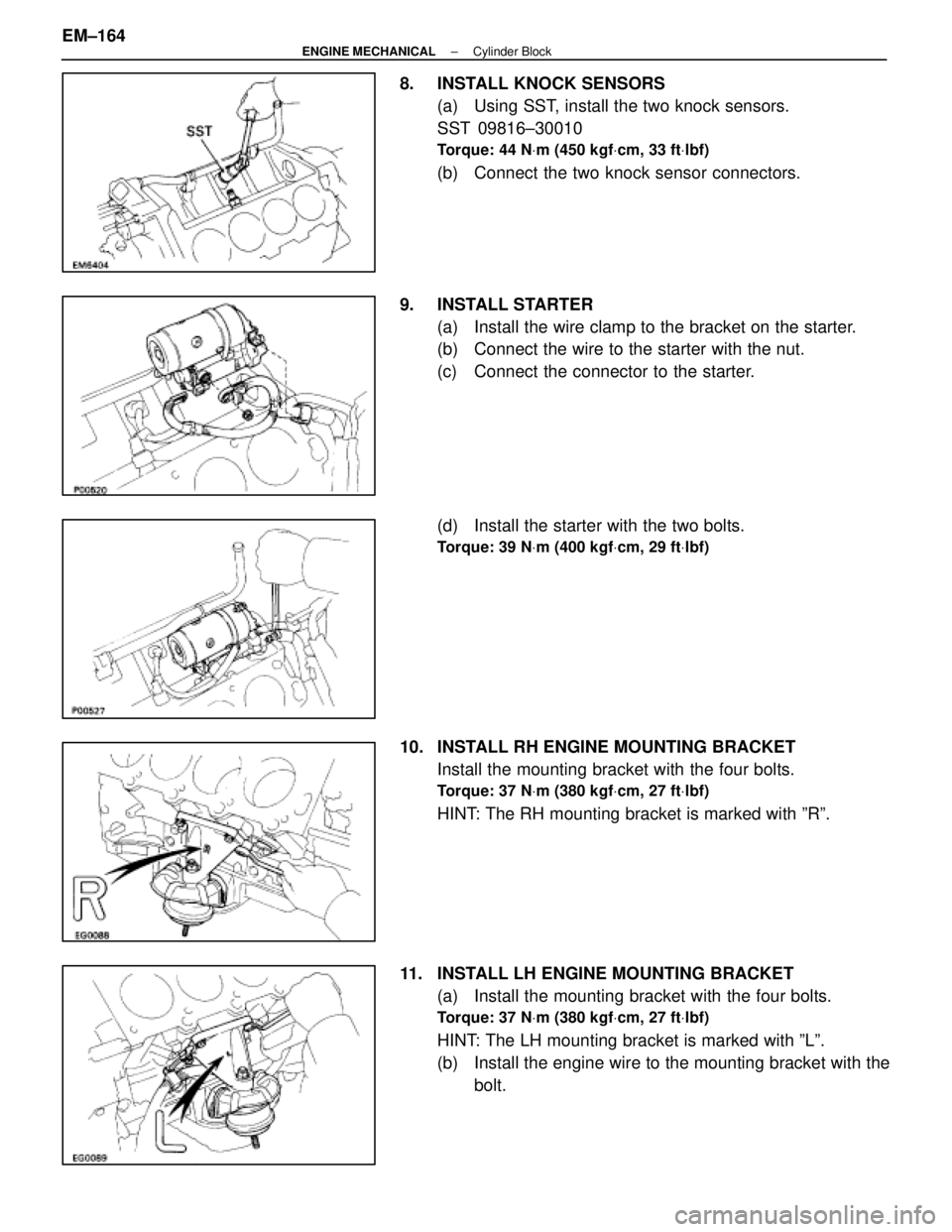
8. INSTALL KNOCK SENSORS(a) Using SST, install the two knock sensors.
SST 09816±30010
Torque: 44 N Vm (450 kgf Vcm, 33 ft Vlbf)
(b) Connect the two knock sensor connectors.
9. INSTALL STARTER (a) Install the wire clamp to the bracket on the starter.
(b) Connect the wire to the starter with the nut.
(c) Connect the connector to the starter.
(d) Install the starter with the two bolts.
Torque: 39 N Vm (400 kgf Vcm, 29 ft Vlbf)
10. INSTALL RH ENGINE MOUNTING BRACKET
Install the mounting bracket with the four bolts.
Torque: 37 N Vm (380 kgf Vcm, 27 ft Vlbf)
HINT: The RH mounting bracket is marked with ºRº.
11. INSTALL LH ENGINE MOUNTING BRACKET (a) Install the mounting bracket with the four bolts.
Torque: 37 N Vm (380 kgf Vcm, 27 ft Vlbf)
HINT: The LH mounting bracket is marked with ºLº.
(b) Install the engine wire to the mounting bracket with the
bolt.
EM±164
±
ENGINE MECHANICAL Cylinder Block
WhereEverybodyKnowsYourName
Page 1631 of 4087
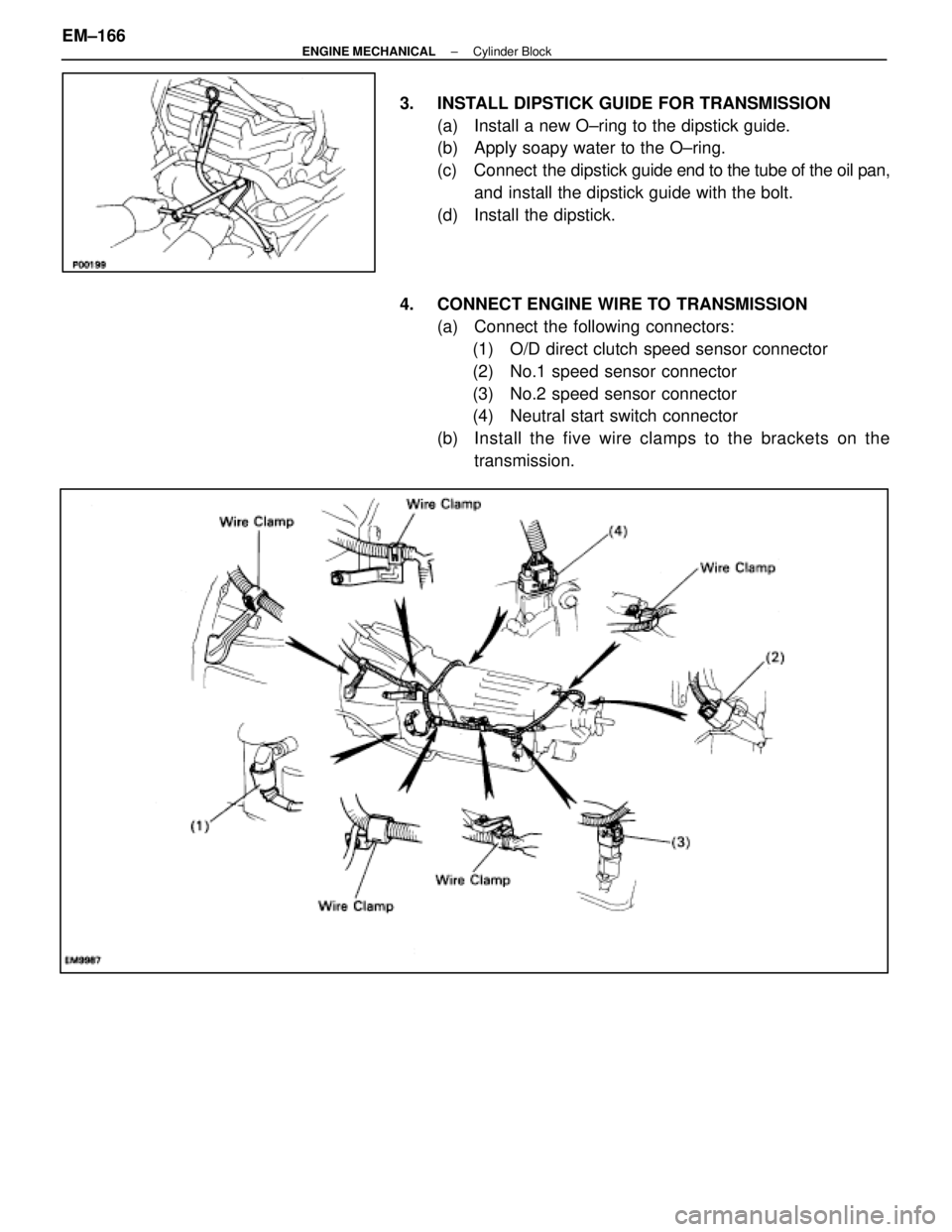
3. INSTALL DIPSTICK GUIDE FOR TRANSMISSION(a) Install a new O±ring to the dipstick guide.
(b) Apply soapy water to the O±ring.
(c) Connect the dipstick guide end to the tube of the oil pan,
and install the dipstick guide with the bolt.
(d) Install the dipstick.
4. CONNECT ENGINE WIRE TO TRANSMISSION (a) Connect the following connectors:(1) O/D direct clutch speed sensor connector
(2) No.1 speed sensor connector
(3) No.2 speed sensor connector
(4) Neutral start switch connector
(b) Install the five wire clamps to the brackets on the transmission.
EM±166±
ENGINE MECHANICAL Cylinder Block
WhereEverybodyKnowsYourName
Page 1634 of 4087
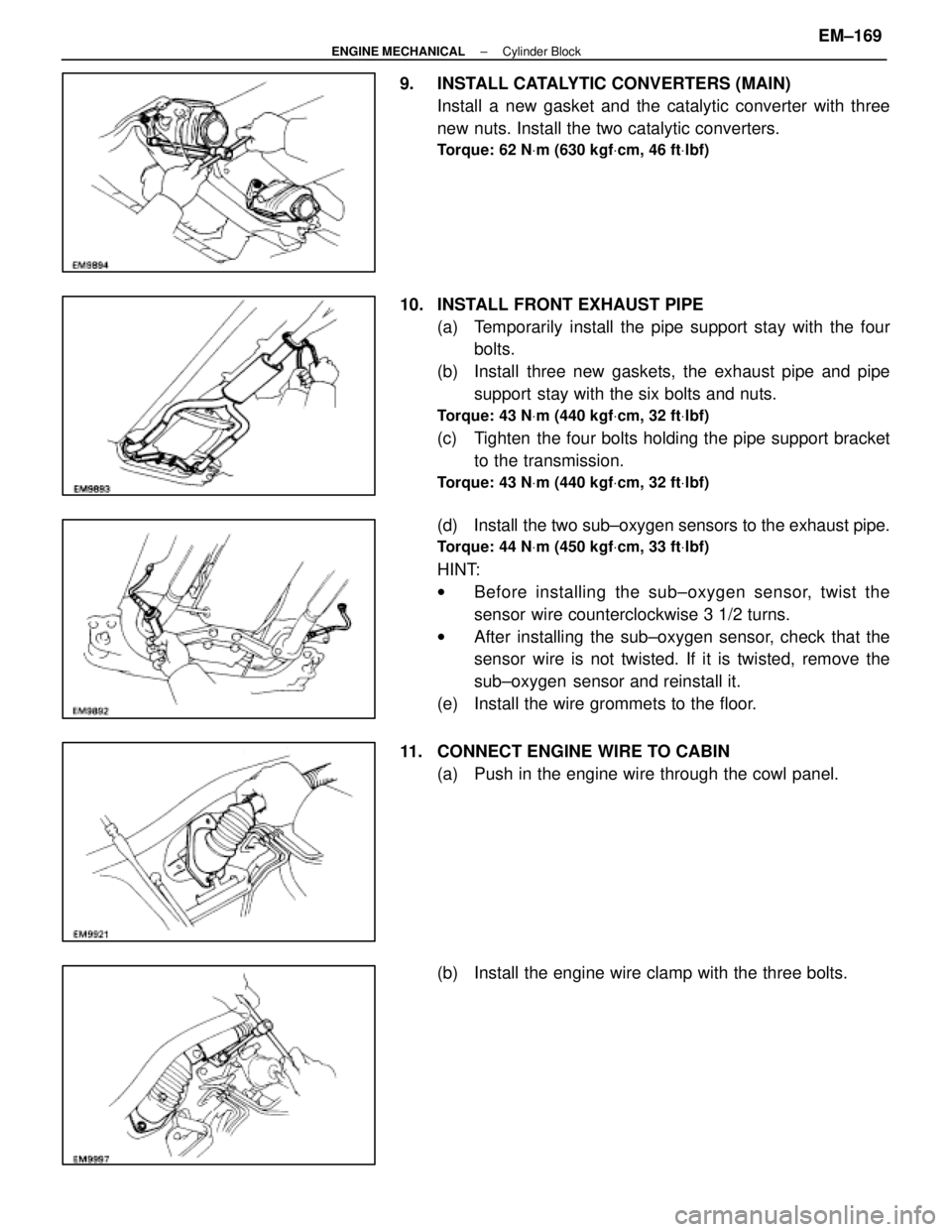
9. INSTALL CATALYTIC CONVERTERS (MAIN)Install a new gasket and the catalytic converter with three
new nuts. Install the two catalytic converters.
Torque: 62 N Vm (630 kgf Vcm, 46 ft Vlbf)
10. INSTALL FRONT EXHAUST PIPE
(a) Temporarily install the pipe support stay with the fourbolts.
(b) Install three new gaskets, the exhaust pipe and pipe support stay with the six bolts and nuts.
Torque: 43 N Vm (440 kgf Vcm, 32 ft Vlbf)
(c) Tighten the four bolts holding the pipe support bracket
to the transmission.
Torque: 43 N Vm (440 kgf Vcm, 32 ft Vlbf)
(d) Install the two sub±oxygen sensors to the exhaust pipe.
Torque: 44 N Vm (450 kgf Vcm, 33 ft Vlbf)
HINT:
w Before installing the s ub±oxygen sensor, twist the
sensor wire counterclockwise 3 1/2 turns.
w After installing the sub±oxygen sensor, check that the
sensor wire is not twisted. If it is twisted, remove the
sub±oxygen sensor and reinstall it.
(e) Install the wire grommets to the floor.
11. CONNECT ENGINE WIRE TO CABIN (a) Push in the engine wire through the cowl panel.
(b) Install the engine wire clamp with the three bolts.
±
ENGINE MECHANICAL Cylinder BlockEM±169
WhereEverybodyKnowsYourName
Page 1640 of 4087
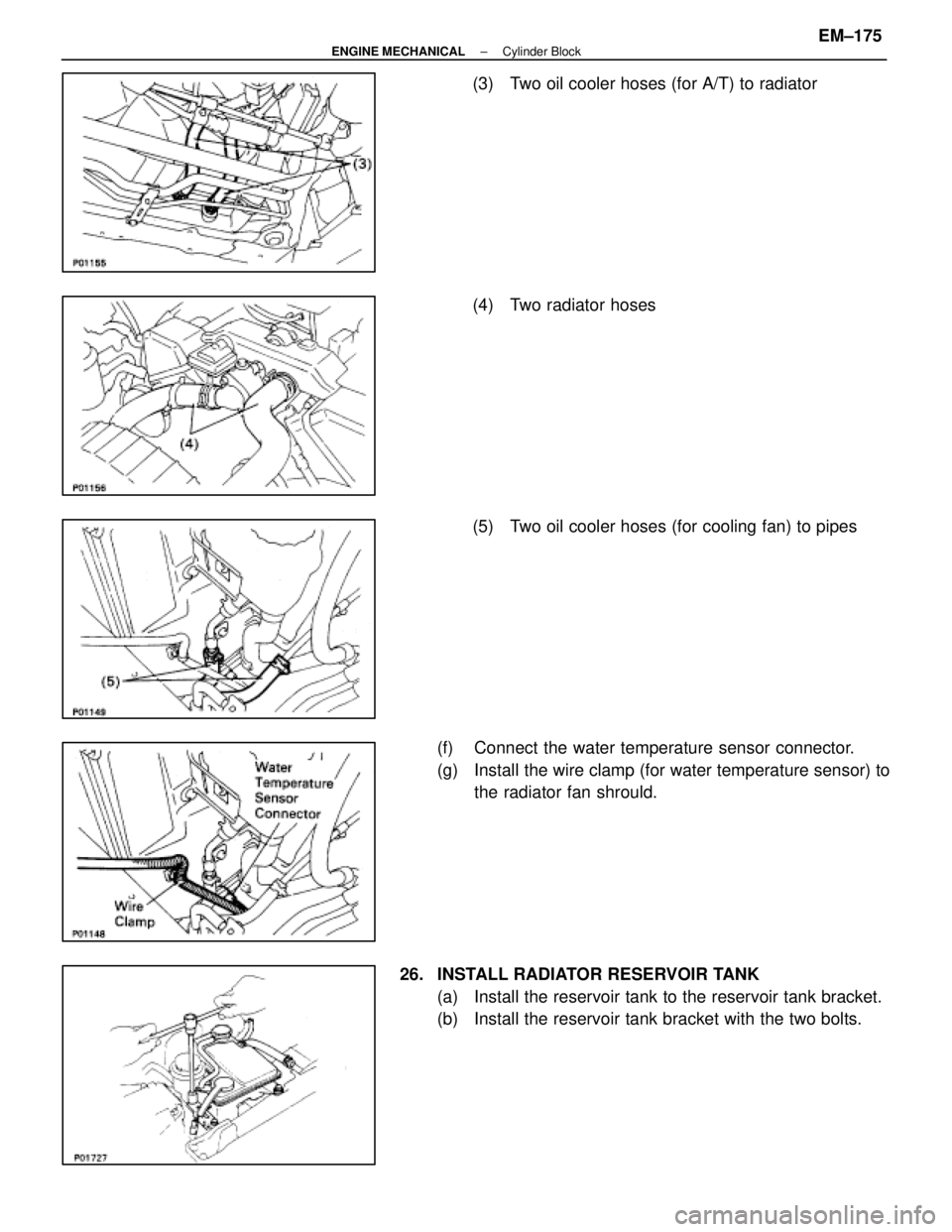
(3) Two oil cooler hoses (for A/T) to radiator
(4) Two radiator hoses
(5) Two oil cooler hoses (for cooling fan) to pipes
(f) Connect the water temperature sensor connector.
(g) Install the wire clamp (for water temperature sensor) to the radiator fan shrould.
26. INSTALL RADIATOR RESERVOIR TANK (a) Install the reservoir tank to the reservoir tank bracket.
(b) Install the reservoir tank bracket with the two bolts.
±
ENGINE MECHANICAL Cylinder BlockEM±175
WhereEverybodyKnowsYourName
Page 1641 of 4087
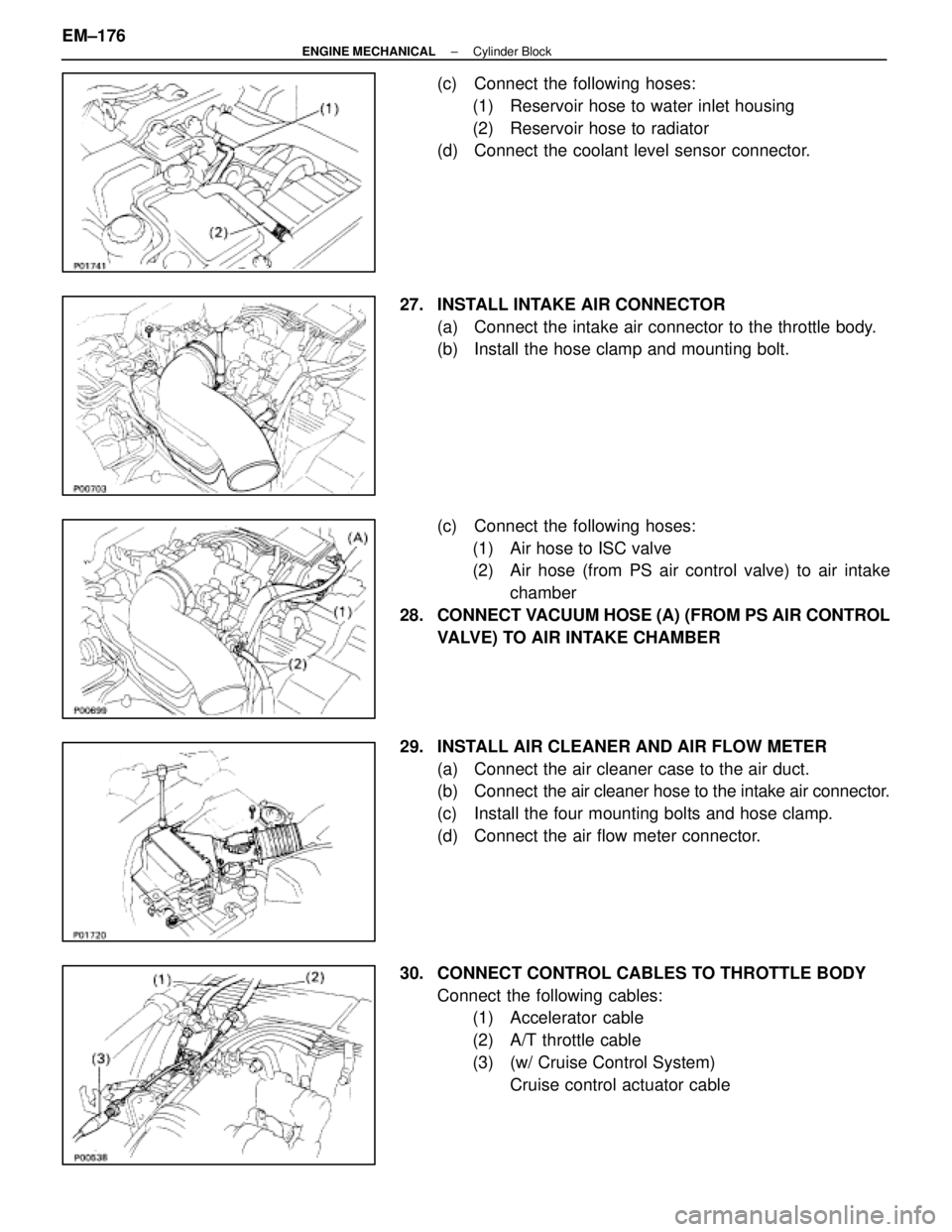
(c) Connect the following hoses:(1) Reservoir hose to water inlet housing
(2) Reservoir hose to radiator
(d) Connect the coolant level sensor connector.
27. INSTALL INTAKE AIR CONNECTOR (a) Connect the intake air connector to the throttle body.
(b) Install the hose clamp and mounting bolt.
(c) Connect the following hoses:(1) Air hose to ISC valve
(2) Air hose (from PS air control valve) to air intake chamber
28. CONNECT VACUUM HOSE (A) (FROM PS AIR CONTROL VALVE) TO AIR INTAKE CHAMBER
29. INSTALL AIR CLEANER AND AIR FLOW METER (a) Connect the air cleaner case to the air duct.
(b) Connect the air cleaner hose to the intake air connector.
(c) Install the four mounting bolts and hose clamp.
(d) Connect the air flow meter connector.
30. CONNECT CONTROL CABLES TO THROTTLE BODY Connect the following cables:(1) Accelerator cable
(2) A/T throttle cable
(3) (w/ Cruise Control System)
Cruise control actuator cable
EM±176
±
ENGINE MECHANICAL Cylinder Block
WhereEverybodyKnowsYourName
Page 1647 of 4087

The 1 UZ±FE engine has 8±cylinders in a V±arrangement at a bank an\
gle of 905. From the front of the RH
bank cylinders are numbered 2±4±6±8, and from the front of the LH b\
ank cylinders are numbered 1 ±3±5±7.
The crankshaft is supported by 5 bearings specified by the inside of the cr\
ankcase. These bearings are made
of a copper and lead alloy. The crankshaft is integrated with 8 weights which are cast along with it\
for balancing. Oil holes are built
into the center of the crankshaft for supplying oil to the connecting ro\
ds, pistons and other components. The ignition order is 1±8±4±3±6±5±7±2. The cylinder\
head is made of aluminum alloy, with a cross flow
type intake and exhaust layout and with pent±roof type combustion chambers. The spark plugs are loca\
ted in
the center of the combustion chambers.
At the front and rear of the intake manifold, a water passage has been p\
rovided which connects the RH
and LH cylinder heads. Exhaust and intake valves are equipped with irregular pitch springs made\
of special valve spring carbon
steel which are capable of following no matter what the engine speed.
The RH and LH intake camshafts are driven by a single timing belt, and a ge\
ar on the intake camshaft en-
gages with a gear on the exhaust camshaft to drive it. The camshaft jour\
nal is supported at 5 (intake) or 4 (ex-
haust) places between the valve lifters of each cylinder and on the front end of the cylinder \
head. Lubrication
of the cam journal gear is accomplished by oil being supplied through the \
oiler port in the center of the camshaft. Adjustment of the valve clearance is done by means of an outer shim type\
system, in which valve adjusting
shims are located above the valve lifters. This permits replacement of the sh\
ims without removal of the cam-
shafts. Pistons are made of high temperature±resistant aluminum alloy, and a depression is built into the piston
head to prevent interference with valves.
Piston pins are the full±floating type, with the pins fastened to neither the piston boss nor the connecting
rods. Instead, snap rings are fitted on both ends of the pins, preventing the\
pins from falling out. The No.1 compression ring is made of steel and the No.2 compression ring\
is made of cast iron. The oil
ring is m ade of a combination of steel and stainless steel. The outer diameter of\
each piston ring is slightly larger
than the diameter of the piston and the flexibility of the rings allows them\
to hug the cylinder walls when they
are mounted on the piston. Compression rings No.1 and No.2 work to prevent \
the leakage of gas from the cylin-
der and the oil ring works to scrape oil off the cylinder walls to prevent it from entering the combustion chamber. The cylinder block is made of aluminum alloy with a bank angle of 90 5. Cast iron cylinders are installed
inside the cylinder block. It has 8 cylinders which are approximately twice the length of th\
e piston stroke. The
top of each cylinder is closed off by the cylinder heads and the lower end of the cylinders becomes the crank-
case, in which the crankshaft is installed. In addition, the cylinder bl\
ock contains a water jacket, through which
coolant is pumped to cool the cylinders. The No.1 and No.2 oil pans are bolted onto the bottom of the cylinder block\
. The No.1 oil pan is made of
aluminum alloy. The No.2 oil pan is an oil reservoir made of pressed steel sheet. An o\
il level sensor is installed
in the No.1 oil pan (If the oil level drops below a set level, a warnin\
g light lights up.). A oil pan baffle plate keeps
sufficient oil in the bottom of the No.2 oil pan even when the vehicle is tilted. \
This dividing plate also prevents
the oil from making waves when the vehicle is stopped suddenly and the oil \
shifts away from the oil pump suction
pipe. Plastic region tightening bolts are used for the cylinder head, main bearing ca\
p and connecting rod.
EM±4
±
ENGINE MECHANICAL Operation
WhereEverybodyKnowsYourName
Page 1649 of 4087
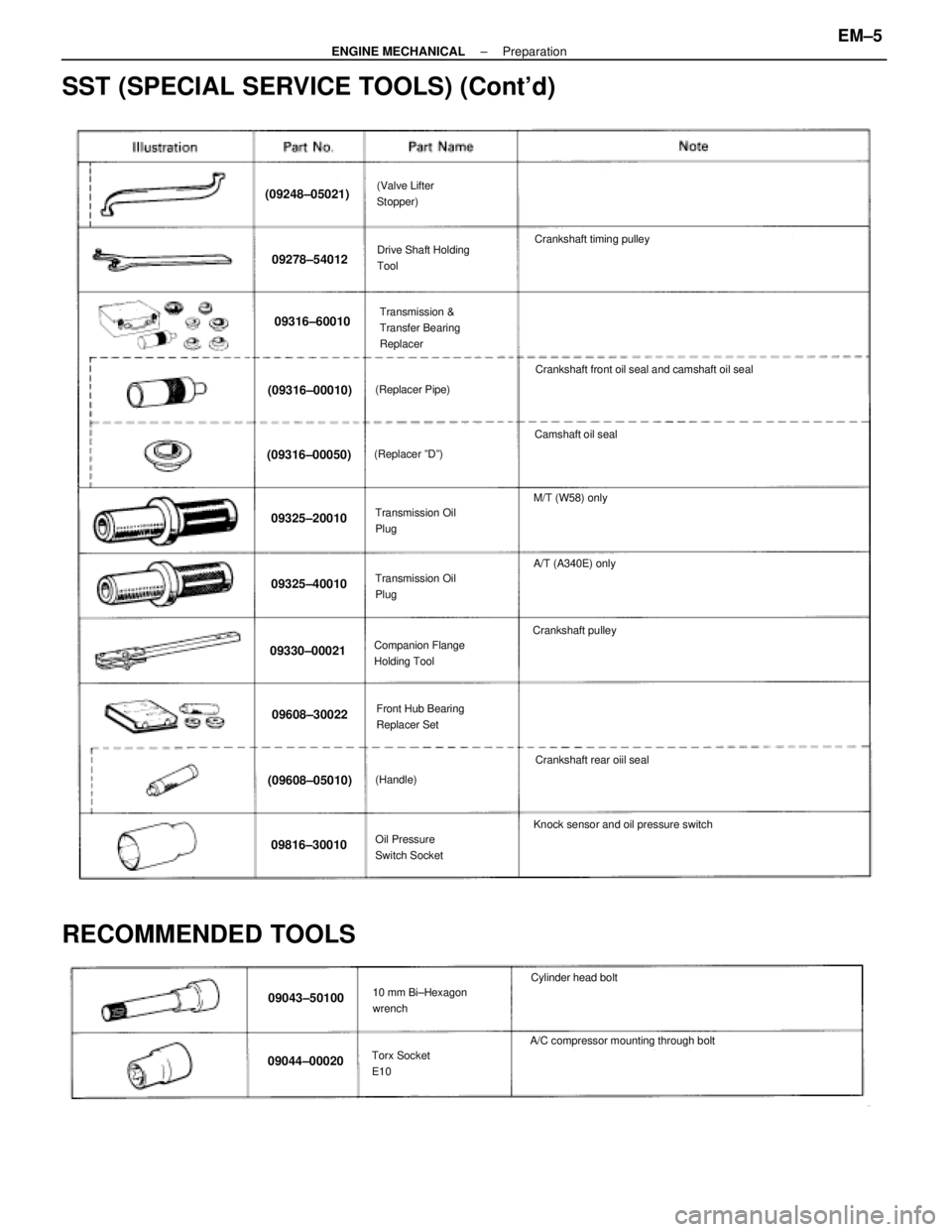
SST (SPECIAL SERVICE TOOLS) (Cont'd)
(09248±05021)(Valve Lifter
Stopper)
09316±60010Transmission &
Transfer Bearing
Replacer
Crankshaft timing pulley
09278±54012Drive Shaft Holding
Tool
M/T (W58) only
09325±20010Transmission Oil
Plug
(09316±00010)(Replacer Pipe)
Crankshaft front oil seal and camshaft oil seal
(09316±00050)(Replacer ºDº)
Camshaft oil seal
A/T (A340E) only
09325±40010Transmission Oil
Plug
Crankshaft pulley
09330±00021Companion Flange
Holding Tool
09608±30022Front Hub Bearing
Replacer Set
Knock sensor and oil pressure switch
09816±30010Oil Pressure
Switch Socket
(09608±05010)(Handle)
Crankshaft rear oiil seal
RECOMMENDED TOOLS
Cylinder head bolt
09043±5010010 mm Bi±Hexagon
wrench
A/C compressor mounting through bolt
09044±00020Torx Socket
E10
±
ENGINE MECHANICAL PreparationEM±5
WhereEverybodyKnowsYourName
Page 1658 of 4087

6. REMOVE THROTTLE BODY WITH INTAKE AIRCONNECTOR
(a) Disconnect the following hoses and connectors:(1) PCV hose
(2) Three vacuum hoses
(3) VSV (for EGR) connector
(4) Throttle position sensor connector
(5) IAC valve connector
(6) (w/ TRAC)
Sub±throttle position sensor connector
(7) (w/ TRAC) Sub±throttle actuator connector
(8) (USA spec. only)
EGR gas temperature sensor connector
(b) Remove the four bolts and two nuts holding the intake air connector to the intake chamber.
(c) Remove the VSV nut.
(d) Disc onnect the two water by±pass hoses from the
throttle body. Plug the hose ends.
(e) Remove the throttle body with the intake air connector and gasket.
7. REMOVE NO. 3 TIMING BELT COVER AND CYLINDER
HEAD REAR COVER
(a) Remove the oil filler cap.
(b) Using a 5 mm hexagon wrench, remove the ten bolts,No. 3 timing belt cover and cylinder head rear cover.
8. DISCONNECT HIGH±TENSION CORDS FROM SPARK PLUGS
(a) Remove the bolt holding the cord clamp from thecylinder head.
(b) Disconnect the two high±tension cord clamps from the No. 3 cylinder head cover.
(c) Disconnect the high±tension cords at the rubber boot. Do not pull on the cords.
NOTICE: Pulling on or bending the cords may damage
the conductor inside.
±
ENGINE MECHANICAL Engine Tune±UpEM±11
WhereEverybodyKnowsYourName