lock LEXUS SC400 1991 Service Repair Manual
[x] Cancel search | Manufacturer: LEXUS, Model Year: 1991, Model line: SC400, Model: LEXUS SC400 1991Pages: 4087, PDF Size: 75.75 MB
Page 2566 of 4087
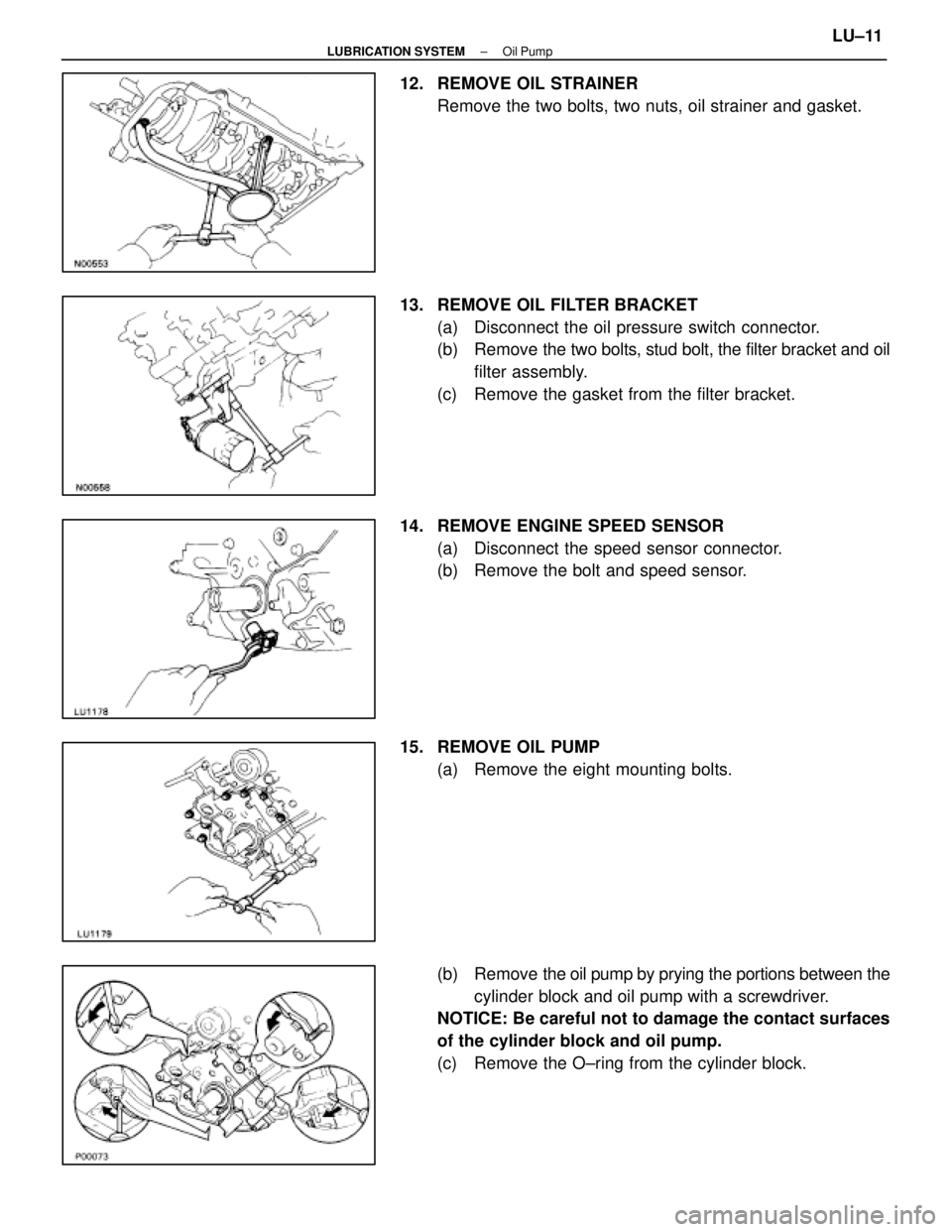
12. REMOVE OIL STRAINERRemove the two bolts, two nuts, oil strainer and gasket.
13. REMOVE OIL FILTER BRACKET (a) Disconnect the oil pressure switch connector.
(b) Remove the two bo lts, stud bolt, the filter bracket and oil
filter assembly.
(c) Remove the gasket from the filter bracket.
14. REMOVE ENGINE SPEED SENSOR (a) Disconnect the speed sensor connector.
(b) Remove the bolt and speed sensor.
15. REMOVE OIL PUMP (a) Remove the eight mounting bolts.
(b) Remove the oil pump by prying the portions between the
cylinder block and oil pump with a screwdriver.
NOTICE: Be careful not to damage the contact surfaces
of the cylinder block and oil pump.
(c) Remove the O±ring from the cylinder block.
±
LUBRICATION SYSTEM Oil PumpLU±11
WhereEverybodyKnowsYourName
Page 2570 of 4087
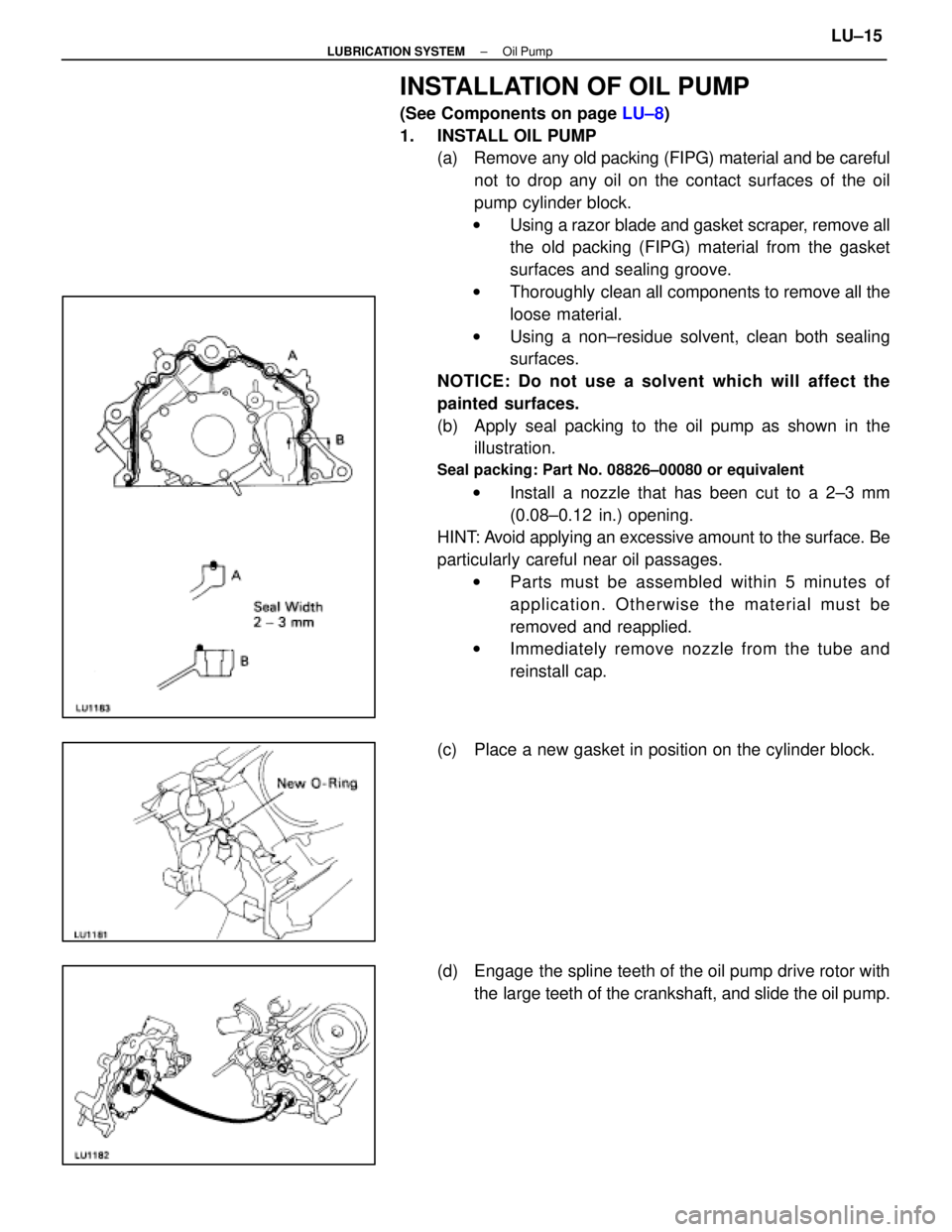
INSTALLATION OF OIL PUMP
(See Components on page LU±8)
1. INSTALL OIL PUMP (a) Remove any old packing (FIPG) material and be careful
not to drop any oil on the contact surfaces of the oil
pump cylinder block.
w Using a razor blade and gasket scraper, remove all
the old packing (FIPG) material from the gasket
surfaces and sealing groove.
w Thoroughly clean all components to remove all the
loose material.
w Using a non±residue solvent, clean both sealing
surfaces.
NOTICE: Do not use a solvent which will affect the
painted surfaces.
(b) Apply seal packing to the oil pump as shown in the illustration.
Seal packing: Part No. 08826±00080 or equivalent
w Install a nozzle that has been cut to a 2±3 mm
(0.08±0.12 in.) opening.
HINT: Avoid applying an excessive amount to the surface. Be
particularly careful near oil passages.
w Parts must be assembled within 5 minutes of
application. Otherwise the material must be
removed and reapplied.
w Immediately remove nozzle from the tube and
reinstall cap.
(c) Place a new gasket in position on the cylinder block.
(d) Engage the spline teeth of the oil pump drive rotor with the large teeth of the crankshaft, and slide the oil pump.
±
LUBRICATION SYSTEM Oil PumpLU±15
WhereEverybodyKnowsYourName
Page 2572 of 4087
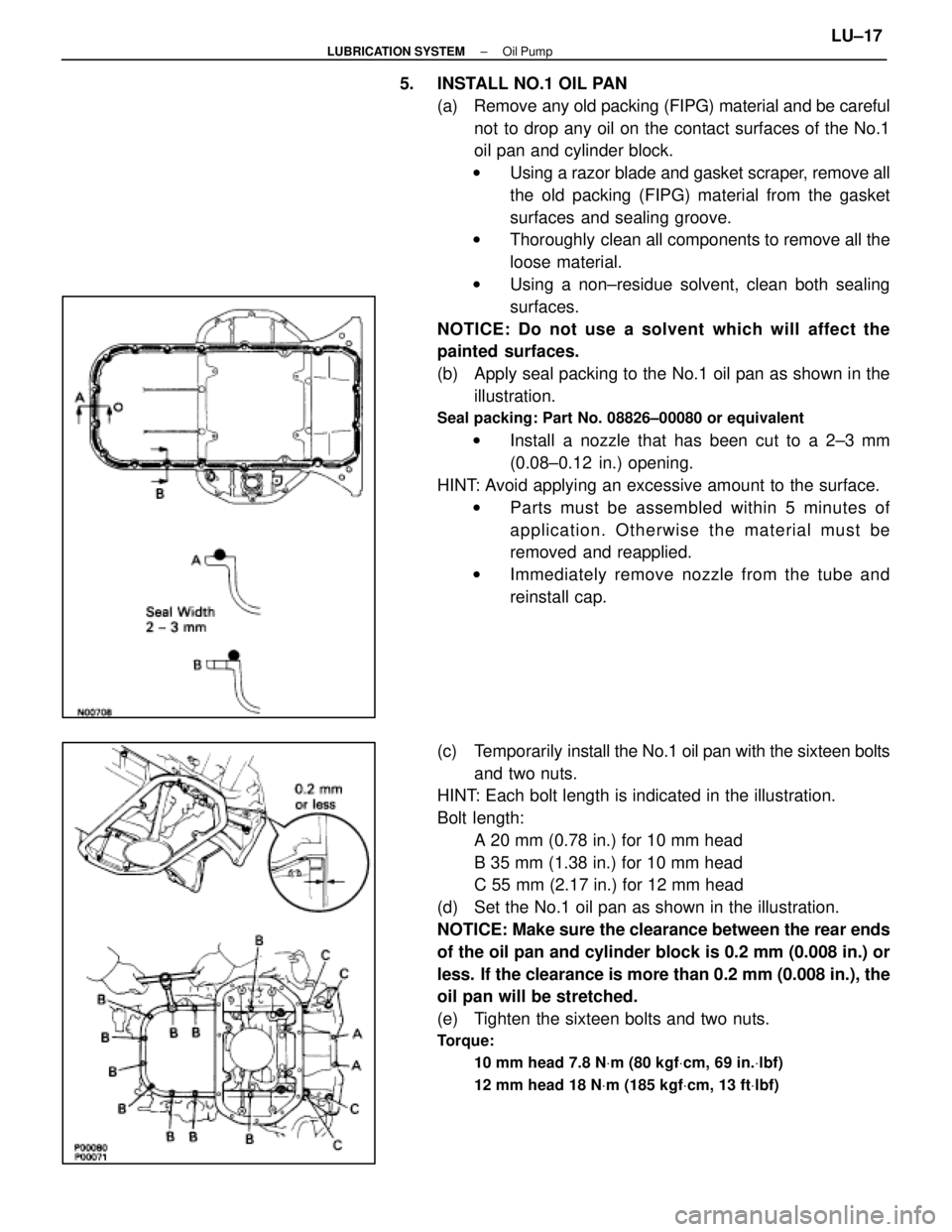
5. INSTALL NO.1 OIL PAN(a) Remove any old packing (FIPG) material and be carefulnot to drop any oil on the contact surfaces of the No.1
oil pan and cylinder block.
w Using a razor blade and gasket scraper, remove all
the old packing (FIPG) material from the gasket
surfaces and sealing groove.
w Thoroughly clean all components to remove all the
loose material.
w Using a non±residue solvent, clean both sealing
surfaces.
NOTICE: Do not use a solvent which will affect the
painted surfaces.
(b) Apply seal packing to the No.1 oil pan as shown in the illustration.
Seal packing: Part No. 08826±00080 or equivalent
w Install a nozzle that has been cut to a 2±3 mm
(0.08±0.12 in.) opening.
HINT: Avoid applying an excessive amount to the surface. w Parts must be assembled within 5 minutes of
application. Otherwise the material must be
removed and reapplied.
w Immediately remove nozzle from the tube and
reinstall cap.
(c) Temporarily install the No.1 oil pan with the sixteen bolts
and two nuts.
HINT: Each bolt length is indicated in the illustration.
Bolt length:
A 20 mm (0.78 in.) for 10 mm head
B 35 mm (1.38 in.) for 10 mm head
C 55 mm (2.17 in.) for 12 mm head
(d) Set the No.1 oil pan as shown in the illustration.
NOTICE: Make sure the clearance between the rear ends
of the oil pan and cylinder block is 0.2 mm (0.008 in.) or
less. If the clearance is more than 0.2 mm (0.008 in.), the
oil pan will be stretched.
(e) Tighten the sixteen bolts and two nuts.
Torque:
10 mm head 7.8 N Vm (80 kgf Vcm, 69 in. Vlbf)
12 mm head 18 N Vm (185 kgf Vcm, 13 ft Vlbf)
±
LUBRICATION SYSTEM Oil PumpLU±17
WhereEverybodyKnowsYourName
Page 2575 of 4087

SERVICE SPECIFICATIONS
SERVICE DATA
Oil pressureat idling29 kPa (0.3 kgf/cm2, 4.3 psi) or more
at 3,000 rpm 294±588 kPa
(3.0±6.0 kgf/cm2, 43±85 psi)
Oil pumpTip clearanceSTD0.110±0.240 mm0.0043±0.0094 in.
Limit 0.35 mm0.0138 in.
Side clearanceSTD 0.030±0.090 mm0.0012±0.0035 in.
Limit 0.15 mm0.0059 in.
Body clearanceSTD 0.100±0.175 mm0.0039±0.0069 in.
Limit0.30 mm0.0118 in.
TORQUE SPECIFICATIONS
Part tightenedNVmkgf Vcmft Vlbf
Oil oumo body cover X Oil pump body101058
Oil pump X Cylinder block12 mm head 16160 12
14 mm head 30310 22
Engine speed sensor X Oil pump6.465 56 in. Vlbf
Oil filter bracket X Oil pump18185 13
Oil strainer X Oil pump7.880 69 in. Vlbf
Oil strainer X Cylinder block7.880 69 in. Vlbf
No.2 oil pan X Cylinder block10 mm head 7.880 69 in. Vlbf
12 mm head 18185 13
Oil pan baffle plate X No.1 oil pan7.880 69 in. Vlbf
No.2 oil pan X No.1 oil pan7.880 69 in. Vlbf
No.2 oil pan X Cylinder block7.880 69 in. Vlbf
Oil level sensor X No.1 oil pan5.45548 in. Vlbf
LU±20±
LUBRICATION SYSTEM Service Specifications
WhereEverybodyKnowsYourName
Page 2577 of 4087

DESCRIPTION
The starter is a reduction type starter with a small, high±speed motor u\
sed to drive the pinion gear. It is
installed in the center of the V±bank of the cylinder block. ST±2
±
STARTING SYSTEM Description
WhereEverybodyKnowsYourName
Page 2581 of 4087
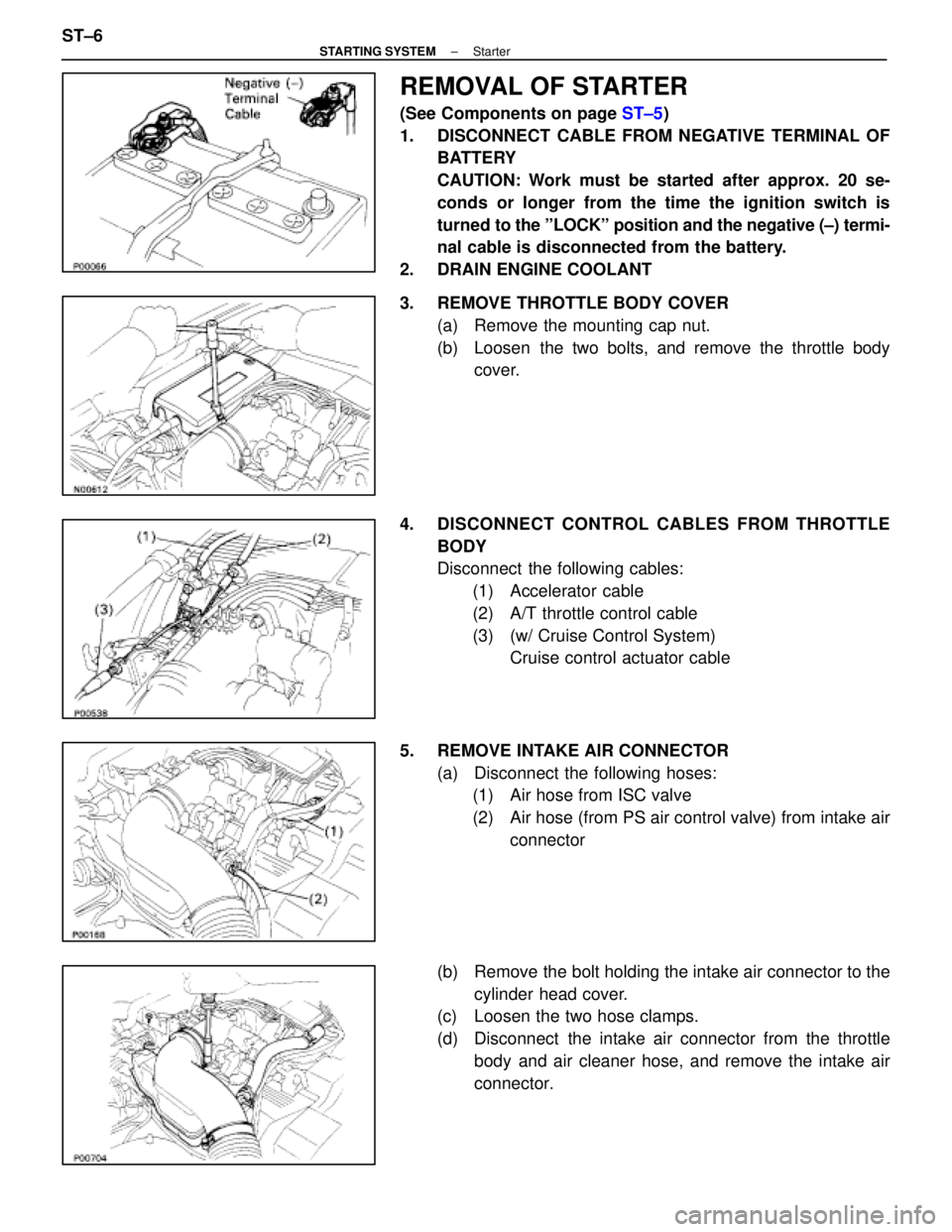
REMOVAL OF STARTER
(See Components on page ST±5)
1. DISCONNECT CABLE FROM NEGATIVE TERMINAL OF BATTERY
CAUTION: Work must be started after approx. 20 se-
conds or longer from the time the ignition switch is
turned to the ºLOCKº position and the negative (±) termi-
nal cable is disconnected from the battery.
2. DRAIN ENGINE COOLANT
3. REMOVE THROTTLE BODY COVER (a) Remove the mounting cap nut.
(b) Loosen the two bolts, and remove the throttle bodycover.
4. DISCONNECT CONTROL CABLES FROM THROTTLE BODY
Disconnect the following cables:(1) Accelerator cable
(2) A/T throttle control cable
(3) (w/ Cruise Control System) Cruise control actuator cable
5. REMOVE INTAKE AIR CONNECTOR (a) Disconnect the following hoses:(1) Air hose from ISC valve
(2) Air hose (from PS air control valve) from intake air
connector
(b) Remove the bolt holding the intake air connector to the cylinder head cover.
(c) Loosen the two hose clamps.
(d) Disconnect the intake air connector from the throttle
body and air cleaner hose, and remove the intake air
connector.
ST±6
±
STARTING SYSTEM Starter
WhereEverybodyKnowsYourName
Page 2589 of 4087
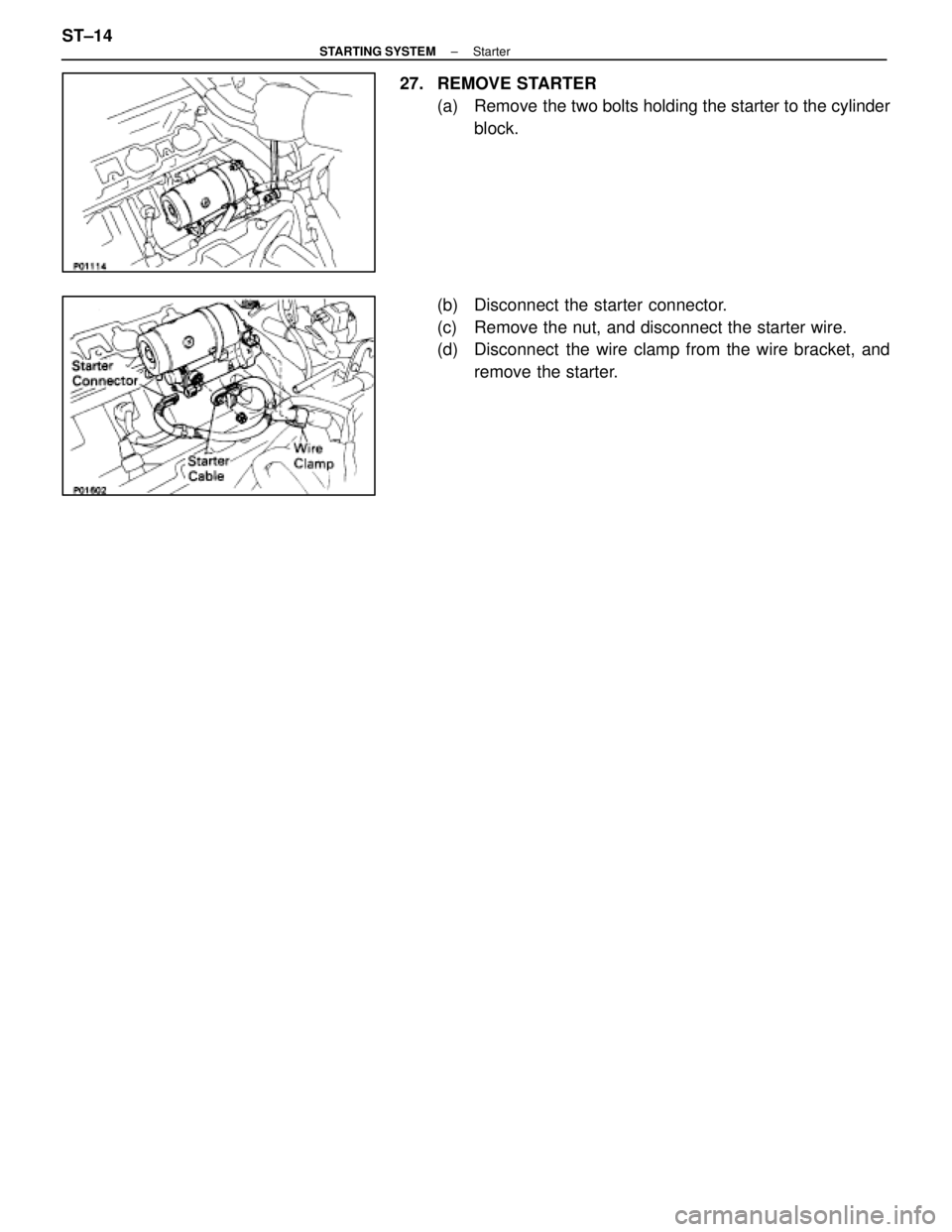
27. REMOVE STARTER(a) Remove the two bolts holding the starter to the cylinderblock.
(b) Disconnect the starter connector.
(c) Remove the nut, and disconnect the starter wire.
(d) Disconnect the wire clamp from the wire bracket, and remove the starter.
ST±14
±
STARTING SYSTEM Starter
WhereEverybodyKnowsYourName
Page 2592 of 4087
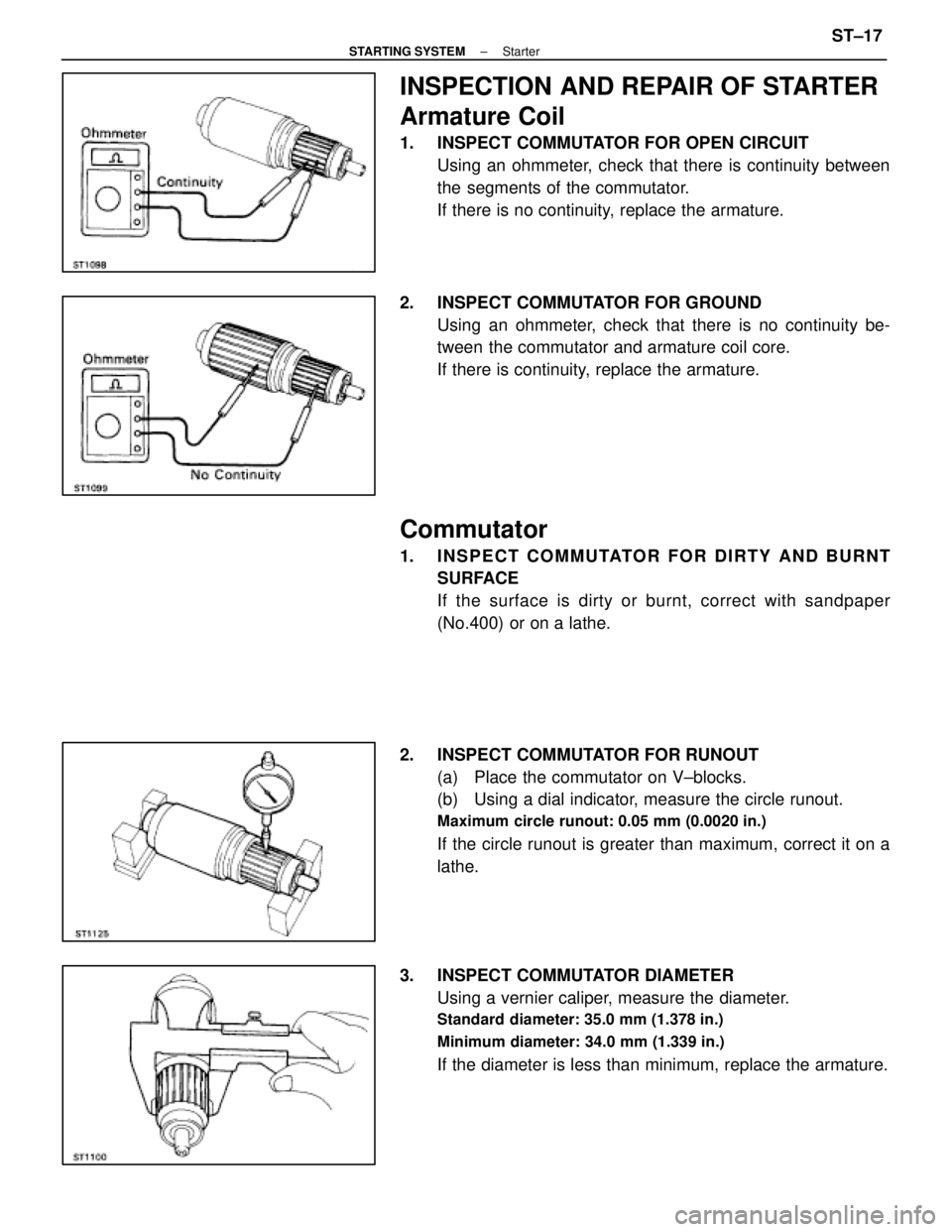
INSPECTION AND REPAIR OF STARTER
Armature Coil
1. INSPECT COMMUTATOR FOR OPEN CIRCUITUsing an ohmmeter, check that there is continuity between
the segments of the commutator.
If there is no continuity, replace the armature.
2. INSPECT COMMUTATOR FOR GROUND Using an ohmmeter, check that there is no continuity be-
tween the commutator and armature coil core.
If there is continuity, replace the armature.
Commutator
1. INSPECT COMMUTATOR FOR DIRTY AND BURNTSURFACE
If the surface is dirty or burnt, correct with sandpaper
(No.400) or on a lathe.
2. INSPECT COMMUTATOR FOR RUNOUT (a) Place the commutator on V±blocks.
(b) Using a dial indicator, measure the circle runout.
Maximum circle runout: 0.05 mm (0.0020 in.)
If the circle runout is greater than maximum, correct it on a
lathe.
3. INSPECT COMMUTATOR DIAMETER Using a vernier caliper, measure the diameter.
Standard diameter: 35.0 mm (1.378 in.)
Minimum diameter: 34.0 mm (1.339 in.)
If the diameter is less than minimum, replace the armature.
±
STARTING SYSTEM StarterST±17
WhereEverybodyKnowsYourName
Page 2594 of 4087
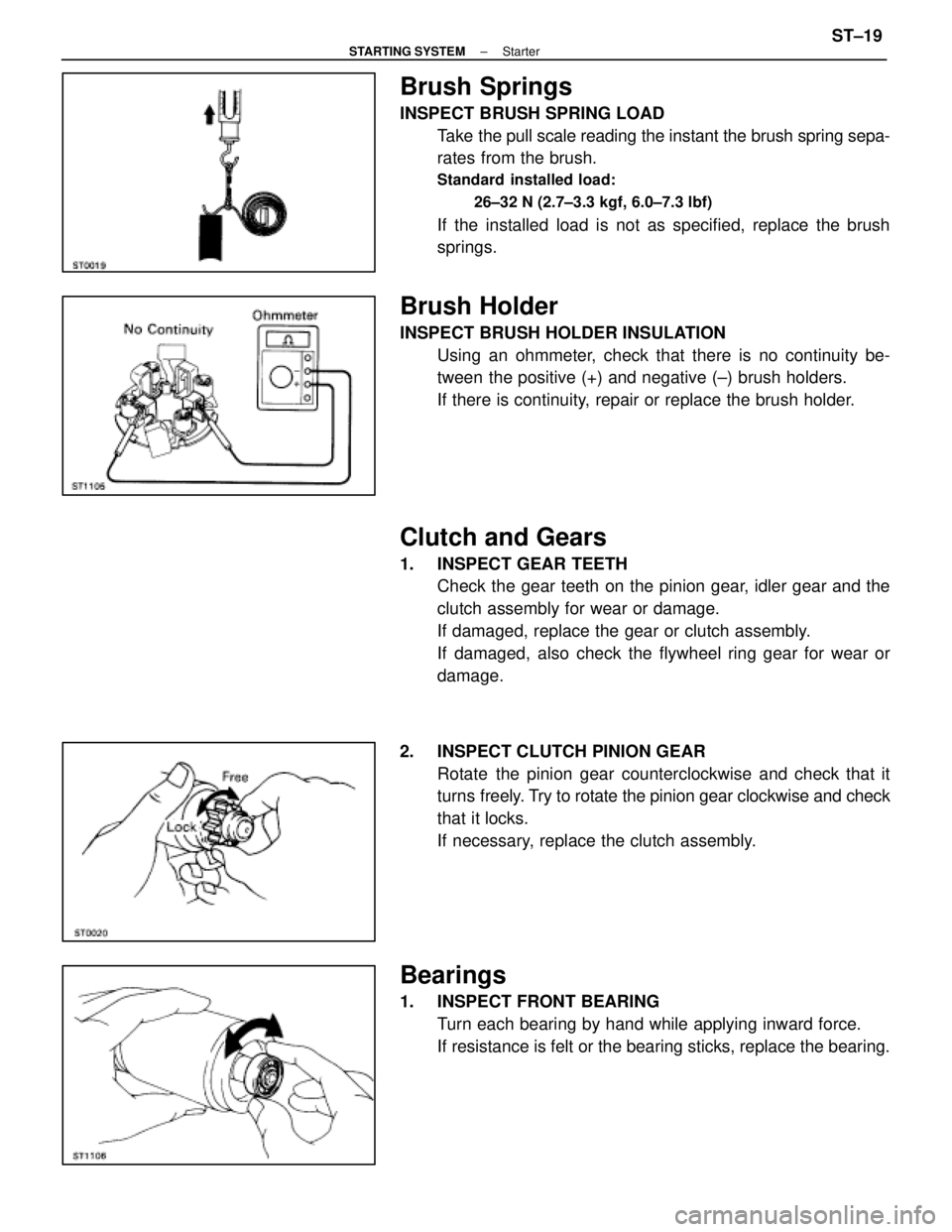
Brush Springs
INSPECT BRUSH SPRING LOADTake the pull scale reading the instant the brush spring sepa-
rates from the brush.
Standard installed load:
26±32 N (2.7±3.3 kgf, 6.0±7.3 lbf)
If the installed load is not as specified, replace the brush
springs.
Brush Holder
INSPECT BRUSH HOLDER INSULATIONUsing an ohmmeter, check that there is no continuity be-
tween the positive (+) and negative (±) brush holders.
If there is continuity, repair or replace the brush holder.
Clutch and Gears
1. INSPECT GEAR TEETHCheck the gear teeth on the pinion gear, idler gear and the
clutch assembly for wear or damage.
If damaged, replace the gear or clutch assembly.
If damaged, also check the flywheel ring gear for wear or
damage.
2. INSPECT CLUTCH PINION GEAR Rotate the pinion gear counterclockwise and check that it
turns freely. Try to rotate the pinion gear clockwise and check
that it locks.
If necessary, replace the clutch assembly.
Bearings
1. INSPECT FRONT BEARING Turn each bearing by hand while applying inward force.
If resistance is felt or the bearing sticks, replace the bearing.
±
STARTING SYSTEM StarterST±19
WhereEverybodyKnowsYourName
Page 2610 of 4087
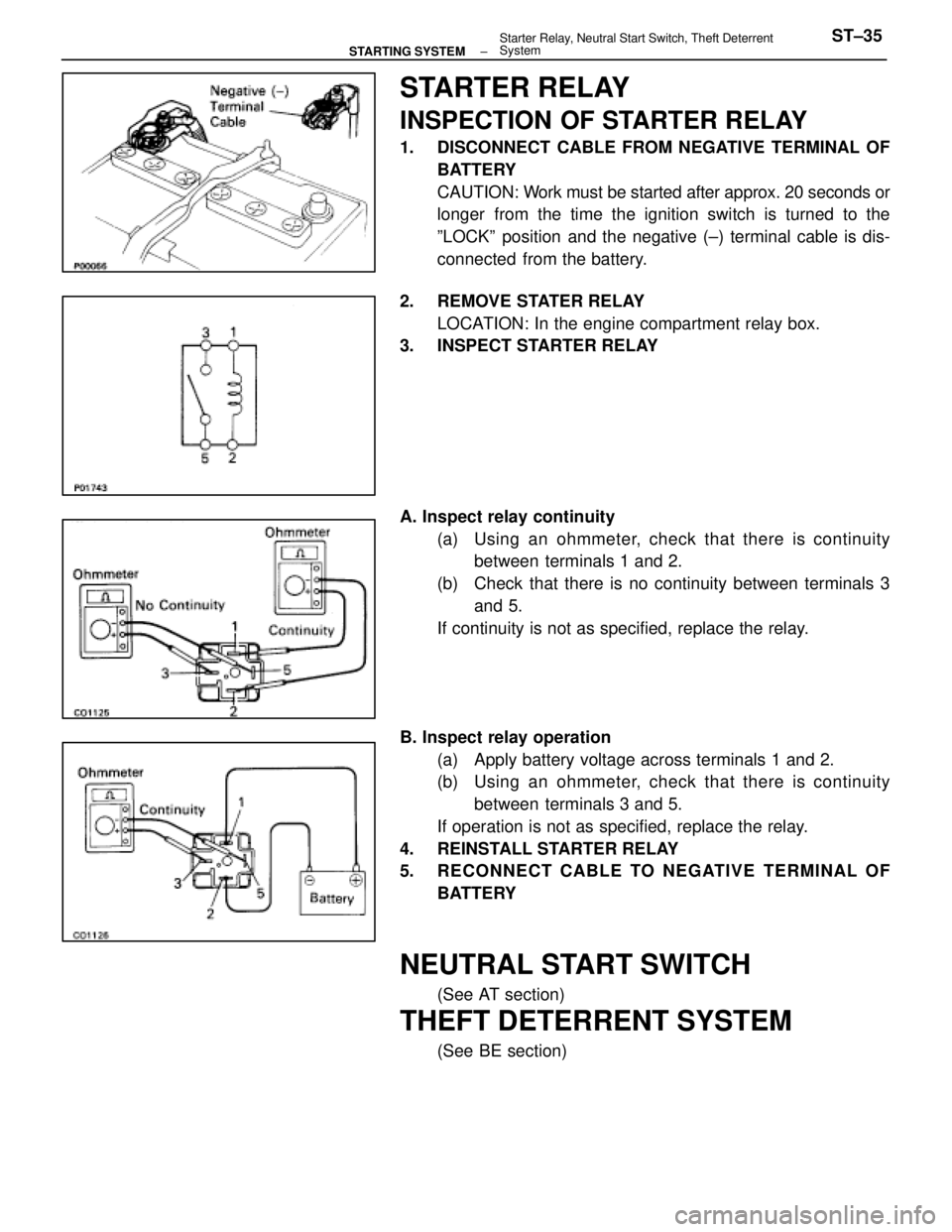
STARTER RELAY
INSPECTION OF STARTER RELAY
1. DISCONNECT CABLE FROM NEGATIVE TERMINAL OFBATTERY
CAUTION: Work must be started after approx. 20 seconds or
longer from the time the ignition switch is turned to the
ºLOCKº position and the negative (±) terminal cable is dis-
connected from the battery.
2. REMOVE STATER RELAY LOCATION: In the engine compartment relay box.
3. INSPECT STARTER RELAY
A. Inspect relay continuity
(a) Using an ohmmeter, check that there is continuitybetween terminals 1 and 2.
(b) Check that there is no continuity between terminals 3 and 5.
If continuity is not as specified, replace the relay.
B. Inspect relay operation (a) Apply battery voltage across terminals 1 and 2.
(b) Using an ohmmeter, check that there is continuitybetween terminals 3 and 5.
If operation is not as specified, replace the relay.
4. REINSTALL STARTER RELAY
5. RECONNECT CABLE TO NEGATIVE TERMINAL OF BATTERY
NEUTRAL START SWITCH
(See AT section)
THEFT DETERRENT SYSTEM
(See BE section)
±
STARTING SYSTEM Starter Relay, Neutral Start Switch, Theft Deterrent
SystemST±35
WhereEverybodyKnowsYourName