air LEXUS UX250H 2019 Owners Manual
[x] Cancel search | Manufacturer: LEXUS, Model Year: 2019, Model line: UX250H, Model: LEXUS UX250H 2019Pages: 476, PDF Size: 10.51 MB
Page 411 of 476
4117-2. Steps to take in an emergency
7
When trouble arises
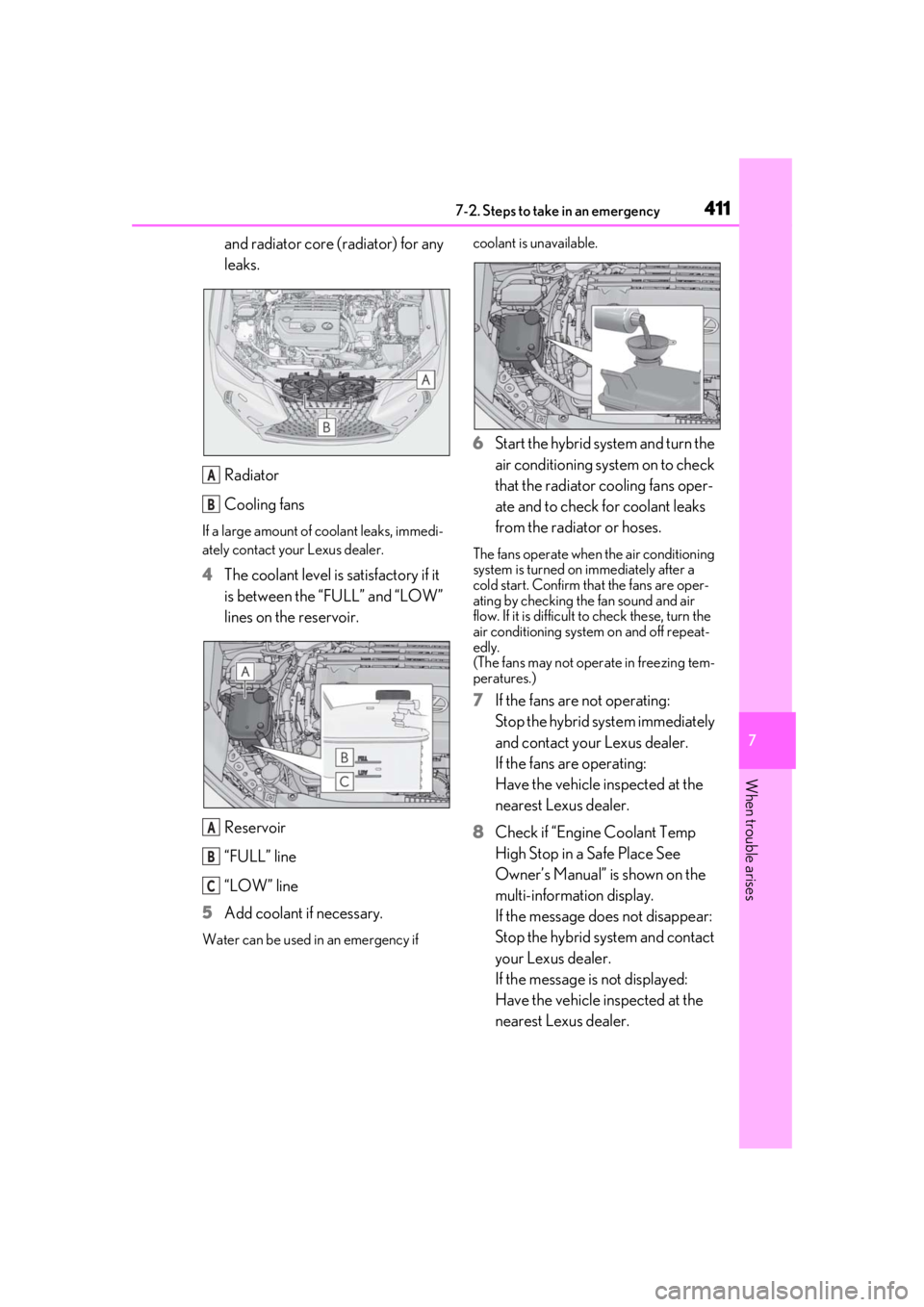
and radiator core (radiator) for any
leaks.
Radiator
Cooling fans
If a large amount of coolant leaks, immedi-
ately contact your Lexus dealer.
4The coolant level is satisfactory if it
is between the “FULL” and “LOW”
lines on the reservoir.
Reservoir
“FULL” line
“LOW” line
5 Add coolant if necessary.
Water can be used in an emergency if coolant is unavailable.
6
Start the hybrid system and turn the
air conditioning system on to check
that the radiator cooling fans oper-
ate and to check for coolant leaks
from the radiator or hoses.
The fans operate when the air conditioning
system is turned on immediately after a
cold start. Confirm that the fans are oper-
ating by checking the fan sound and air
flow. If it is difficult to check these, turn the
air conditioning system on and off repeat-
edly.
(The fans may not oper ate in freezing tem-
peratures.)
7 If the fans are not operating:
Stop the hybrid system immediately
and contact your Lexus dealer.
If the fans are operating:
Have the vehicle inspected at the
nearest Lexus dealer.
8 Check if “Engine Coolant Temp
High Stop in a Safe Place See
Owner’s Manual” is shown on the
multi-information display.
If the message does not disappear:
Stop the hybrid system and contact
your Lexus dealer.
If the message is not displayed:
Have the vehicle inspected at the
nearest Lexus dealer.
A
B
A
B
C
Page 425 of 476
4258-1. Specifications
8
Vehicle specifications
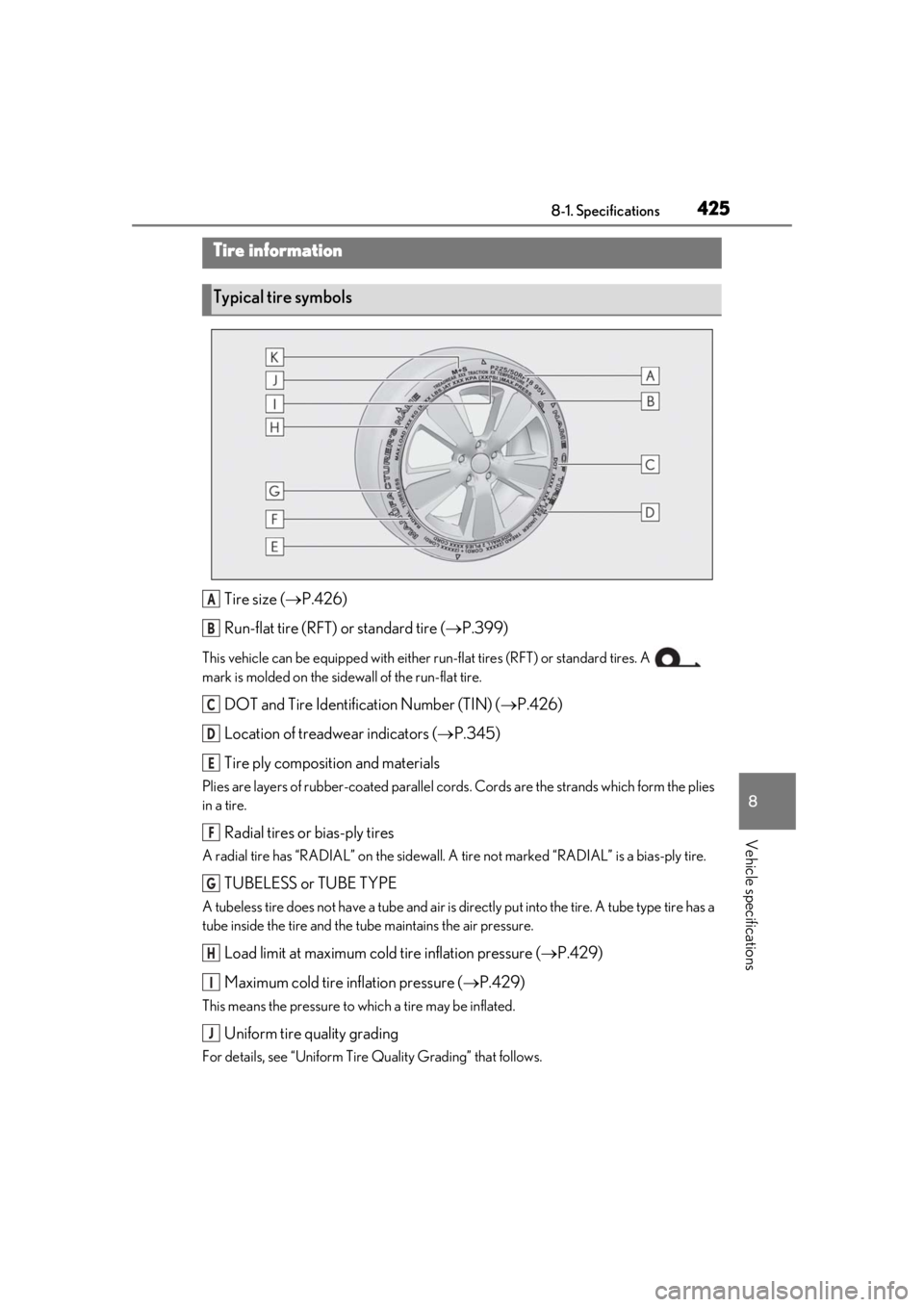
Tire size (P.426)
Run-flat tire (RFT) or standard tire ( P.399)
This vehicle can be equipped with either run-flat tires (RFT) or standard tires. A
mark is molded on the sidewall of the run-flat tire.
DOT and Tire Identification Number (TIN) ( P.426)
Location of treadwear indicators ( P.345)
Tire ply composition and materials
Plies are layers of rubber-coated parallel cords. Cords are the strands which form the plies
in a tire.
Radial tires or bias-ply tires
A radial tire has “RADIAL” on the sidewall. A tire not marked “RADIAL” is a bias-ply tire.
TUBELESS or TUBE TYPE
A tubeless tire does not have a tube and air is directly put into the tire. A tube type tire has a
tube inside the tire and the tube maintains the air pressure.
Load limit at maximum cold tire inflation pressure ( P.429)
Maximum cold tire inflation pressure ( P.429)
This means the pressure to which a tire may be inflated.
Uniform tire quality grading
For details, see “Uniform Tire Quality Grading” that follows.
Tire information
Typical tire symbols
A
B
C
D
E
F
G
H
I
J
Page 429 of 476
4298-1. Specifications
8
Vehicle specifications
Glossary of tire terminology
Tire related termMeaning
Cold tire inflation pressure
Tire pressure when the vehicle has been parked for three
hours or more, or has not been driven more than 1 mile or 1.5
km under that condition
Maximum inflation pressureThe maximum cold inflated pre ssure to which a tire may be
inflated, shown on th e sidewall of the tire
Recommended inflation
pressureCold tire inflation pressure recommended by a manufac-
turer
Accessory weight
The combined weight (in excess of those standard items
which may be replaced) of hybr id transmission, power steer-
ing, power brakes, power windows, power seats, radio and
heater, to the extent that these items are available as factory-
installed equipment (whether installed or not)
Curb weight
The weight of a motor vehicle with standard equipment,
including the maximum capacity of fuel, oil and coolant, and
if so equipped, air conditio ning and additional weight
optional engine
Maximum loaded vehicle
weight
The sum of:
(a) Curb weight
(b) Accessory weight
(c) Vehicle capacity weight
(d) Production options weight
Normal occupant weight150 lb. (68 kg) times the number of occupants specified in
the second column of Table 1
* that follows
Occupant distributionDistribution of occupants in a ve hicle as specified in the third
column of Table 1
* below
Production options weight
The combined weight of in stalled regular production
options weighing over 5 lb. (2.3 kg) in excess of the stan-
dard items which they replace, not previously considered in
curb weight or accessory we ight, including heavy duty
brakes, ride levelers, roof r ack, heavy duty 12-volt battery,
and special trim
RimA metal support for a tire or a tire and tube assembly upon
which the tire beads are seated
Rim diameter
(Wheel diameter)Nominal diameter of the bead seat
Page 430 of 476
4308-1. Specifications
Rim size designationRim diameter and width
Rim type designationThe industry manufacturer’s designation for a rim by style or
code
Rim widthNominal distance between rim flanges
Vehicle capacity weight
(Total load capacity)The rated cargo and luggage load plus 150 lb. (68 kg) times
the vehicle’s designated seating capacity
Vehicle maximum load on
the tireThe load on an individual tire that is determined by distribut-
ing to each axle its share of the maximum loaded vehicle
weight, and dividing by two
Vehicle normal load on the
tire
The load on an individual tire that is determined by distribut-
ing to each axle its share of curb weight, accessory weight,
and normal occupant weight (distributed in accordance with
Table 1
* below), and dividing by two
Weather sideThe surface area of the rim not covered by the inflated tire
BeadThe part of the tire that is ma de of steel wires, wrapped or
reinforced by ply cords and th at is shaped to fit the rim
Bead separationA breakdown of the bond between components in the bead
Bias ply tire
A pneumatic tire in which the ply cords that extend to the
beads are laid at alternate angles substantially less than 90
degrees to the centerline of the tread
CarcassThe tire structure, except tread and sidewall rubber which,
when inflated, bears the load
ChunkingThe breaking away of pieces of the tread or sidewall
CordThe strands forming the plies in the tire
Cord separationThe parting of cords from adjacent rubber compounds
CrackingAny parting within the tread, side wall, or innerliner of the tire
extending to cord material
CT
A pneumatic tire with an inverted flange tire and rim system
in which the rim is designed wi th rim flanges pointed radially
inward and the tire is designed to fit on the underside of the
rim in a manner that encloses the rim flanges inside the air
cavity of the tire
Extra load tireA tire designed to operate at higher loads and at higher
inflation pressures than the corresponding standard tire
Tire related termMeaning
Page 443 of 476
4438-2. Customization
8
Vehicle specifications
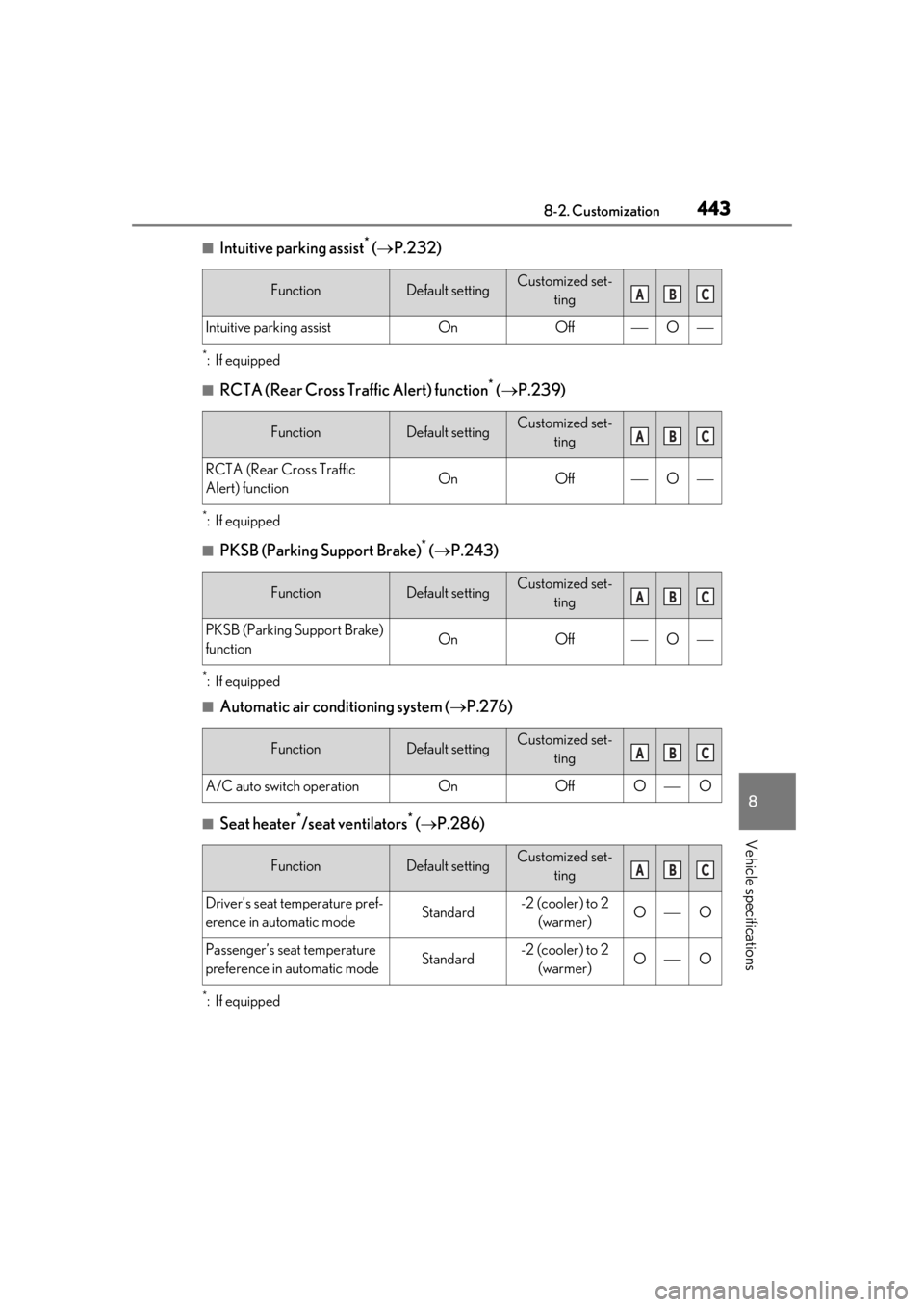
■Intuitive parking assist* ( P.232)
*:If equipped
■RCTA (Rear Cross Traffic Alert) function* ( P.239)
*:If equipped
■PKSB (Parking Support Brake)* ( P.243)
*:If equipped
■Automatic air conditioning system ( P.276)
■Seat heater*/seat ventilators* ( P.286)
*:If equipped
FunctionDefault settingCustomized set-
ting
Intuitive parking assistOnOffO
FunctionDefault settingCustomized set-ting
RCTA (Rear Cross Traffic
Alert) functionOnOffO
FunctionDefault settingCustomized set-ting
PKSB (Parking Support Brake)
functionOnOffO
FunctionDefault settingCustomized set-ting
A/C auto switch operationOnOffOO
FunctionDefault settingCustomized set-ting
Driver’s seat temperature pref-
erence in automatic modeStandard-2 (cooler) to 2 (warmer)OO
Passenger’s seat temperature
preference in automatic modeStandard-2 (cooler) to 2 (warmer)OO
ABC
ABC
ABC
ABC
ABC
Page 447 of 476
447
9
9
For owners
For owners
9-1. For ownersReporting safety defects for U.S. owners ........................................ 448
Seat belt instructions for Cana- dian owners (in French)....... 448
SRS airbag instructions for Cana- dian owners (in French)....... 450
Headlight aim instructions for Canadian owners (in French)
........................................................ 456
Page 450 of 476
4509-1. For owners
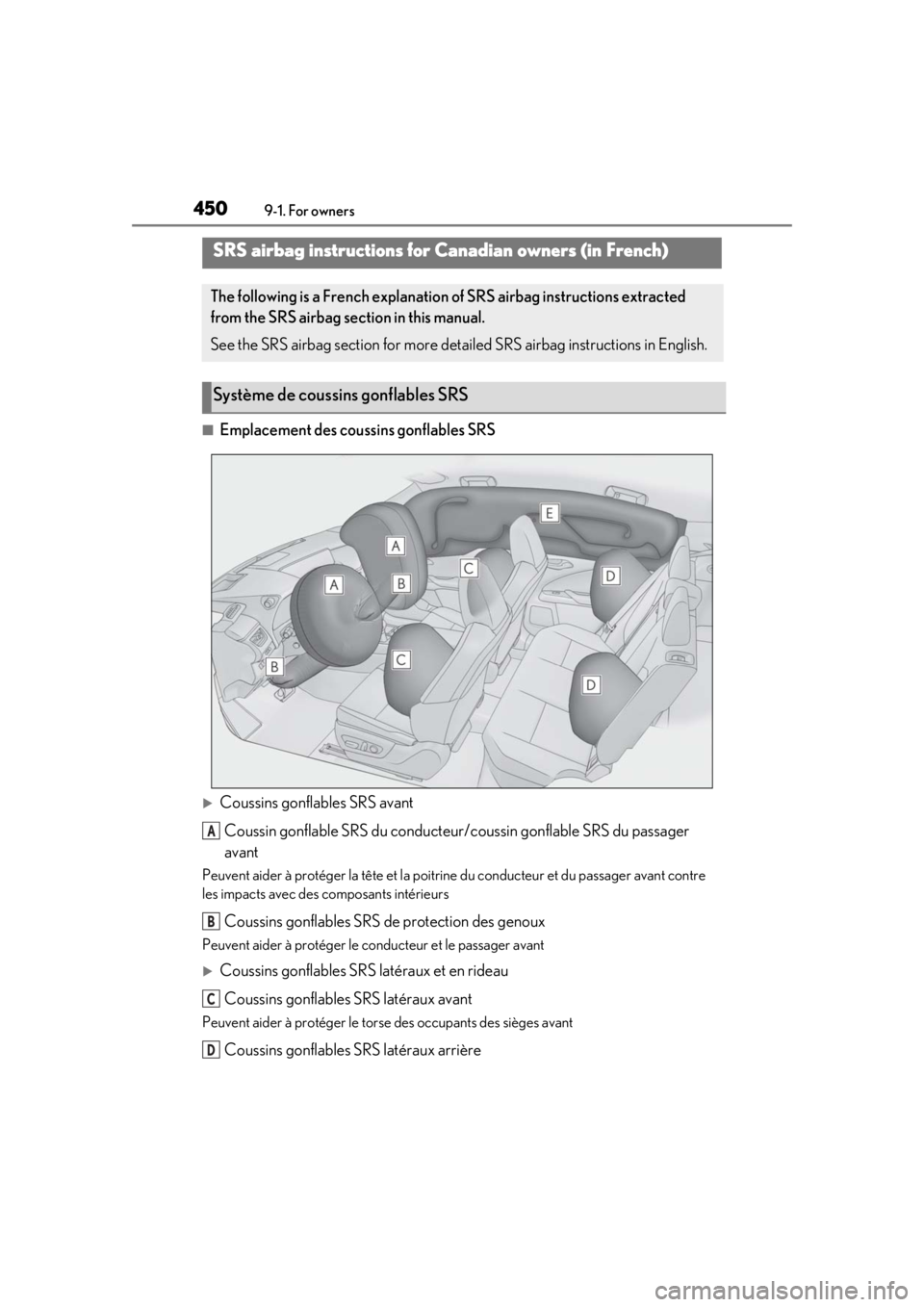
■Emplacement des coussins gonflables SRS
Coussins gonflables SRS avant
Coussin gonflable SRS du conducteur /coussin gonflable SRS du passager
avant
Peuvent aider à protéger la tête et la poitrine du conducteur et du passager avant contre
les impacts avec des composants intérieurs
Coussins gonflables SRS de protection des genoux
Peuvent aider à protéger le conducteur et le passager avant
Coussins gonflables SRS latéraux et en rideau
Coussins gonflables SRS latéraux avant
Peuvent aider à protéger le torse des occupants des sièges avant
Coussins gonflables SRS latéraux arrière
SRS airbag instructions for Canadian owners (in French)
The following is a French explanation of SRS airbag instructions extracted
from the SRS airbag section in this manual.
See the SRS airbag section for more deta iled SRS airbag instructions in English.
Système de coussins gonflables SRS
A
B
C
D
Page 451 of 476
4519-1. For owners
9
For owners
Peuvent aider à protéger le torse des occupants des sièges latéraux arrière
Coussins gonflables SRS en rideau
• Peuvent aider à protéger principalement la tête des occupants des sièges latéraux
• Peuvent aider à empêcher les occupants d’être éjectés du véhicule en cas de tonneaux
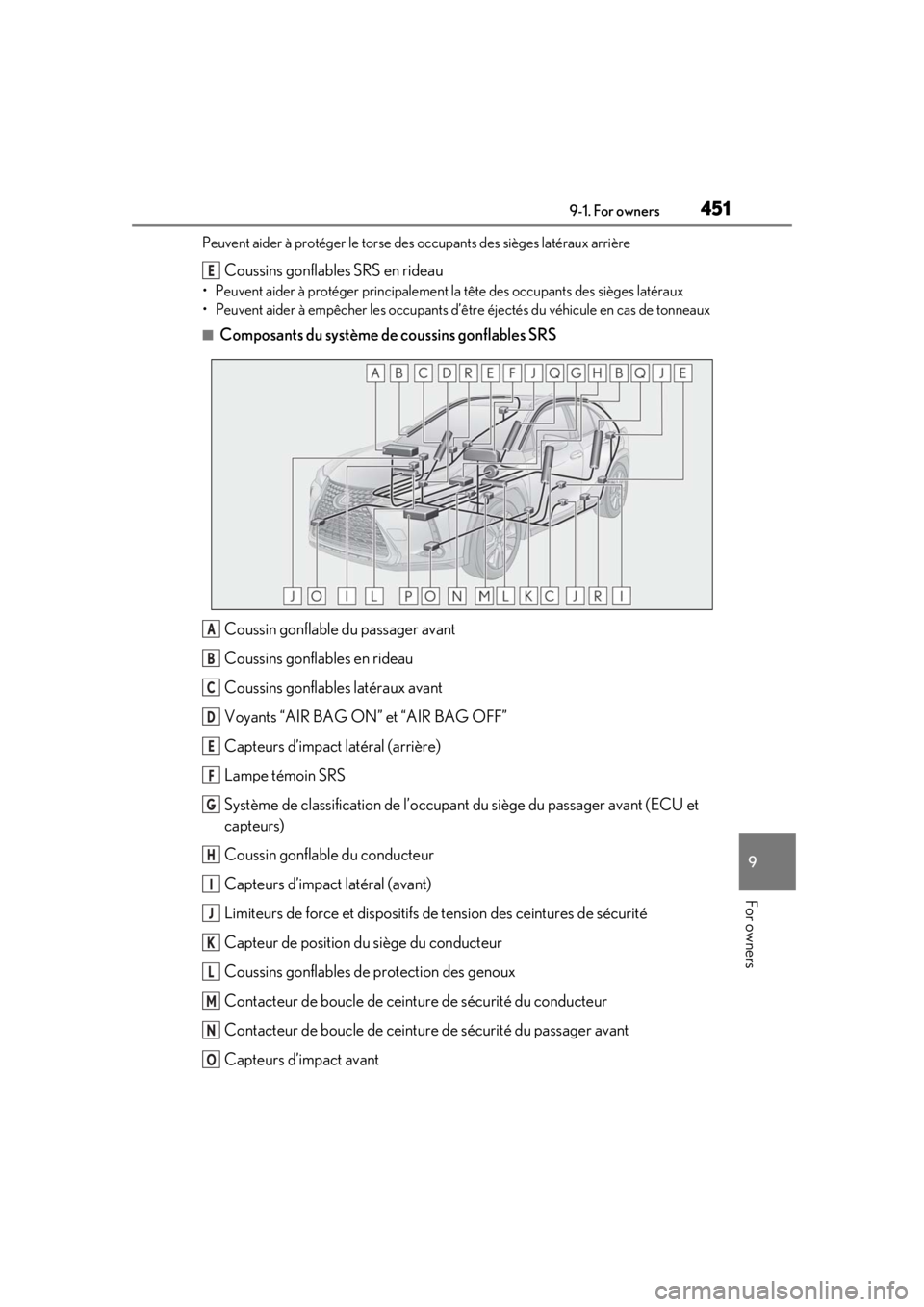
■Composants du système de coussins gonflables SRS
Coussin gonflable du passager avant
Coussins gonflables en rideau
Coussins gonflables latéraux avant
Voyants “AIR BAG ON” et “AIR BAG OFF”
Capteurs d’impact latéral (arrière)
Lampe témoin SRS
Système de classification de l’occupant du siège du passager avant (ECU et
capteurs)
Coussin gonflable du conducteur
Capteurs d’impact latéral (avant)
Limiteurs de force et dispositifs de tension des ceintures de sécurit\
é
Capteur de position du siège du conducteur
Coussins gonflables de protection des genoux
Contacteur de boucle de ceintu re de sécurité du conducteur
Contacteur de boucle de ceinture de sécurité du passager avant
Capteurs d’impact avant
E
A
B
C
D
E
F
G
H
I
J
K
L
M
N
O
Page 452 of 476

4529-1. For owners
Module de capteur de coussin gonflable
Coussins gonflables latéraux arrière
Capteurs d’impact latéral (portière avant)
Votre véhicule est doté de COUSSINS GONFLABLES ÉVOLUÉS dont la conception
s’appuie sur les normes de sécurité des véhicules à moteur américains (FMVSS208). Le
module de capteur de coussin gonflable (ECU) contrôle le déploiement des coussins gon-
flables en fonction des informations obtenues des capteurs et d’autres éléments affichés
dans le diagramme des composants du systèm e ci-dessus. Ces informations comprennent
des données relatives à la grav ité de l’accident et aux occupants. Au moment du déploie-
ment des coussins gonflables, une réaction chimique se produi t dans les gonfleurs de cous-
sin gonflable et les coussins gonflables se remplissent rapidement d’un gaz non toxique
pour aider à limiter le mouvement des occupants.
P
Q
R
AVERTISSEMENT
■Précautions relatives aux coussins
gonflables SRS
Observez les précautions suivantes en
ce qui concerne les coussins gonflables
SRS.
Négliger de le faire pourrait occasionner
des blessures graves, voire mortelles.
●Le conducteur et tous les passagers du
véhicule doivent porter leur ceinture
de sécurité de la manière appropriée.
Les coussins gonflables SRS sont des
dispositifs supplémentaires qui doivent
être utilisés avec les ceintures de sécu-
rité.
●Le coussin gonflable SRS du conduc-
teur se déploie avec une force con-
sidérable et peut occasionner des
blessures graves, voire mortelles,
notamment lorsque le conducteur se
trouve très près du coussin gonflable.
La National Highway Traffic Safety
Administration (NHTSA), aux États-
Unis, fait les recommandations
suivantes :
La zone à risque du coussin gonflable
du conducteur couvre 2 à 3 in.
(50 à 75 mm) de la zone de déploie-
ment du coussin gonflable. Pour
assurer une marge de sécurité suff-
isante, restez à 10 in. (250 mm) du
coussin gonflable. Cette distance est
mesurée depuis le centre du volant
jusqu’à votre sternum. Si maintenant
vous vous tenez assis à moins de 10 in.
(250 mm), vous pouvez changer votre
position de conduite de plusieurs
manières :
• Reculez votre siège à la position maxi- male vous permettant d’atteindre
encore aisément les pédales.
Page 454 of 476
4549-1. For owners
AVERTISSEMENT
●Le déploiement d’un coussin gonflable
risque d’infliger des blessures graves,
voire mortelles, aux bébés et aux
enfants mal assis et/ou mal attachés.
Un bébé ou un enfant trop petit pour
utiliser une ceinture de sécurité doit
être correctement retenu à l’aide d’un
dispositif de retenue pour enfants.
Lexus recommande vivement de
placer et d’attacher correctement tous
les bébés et tous les enfants sur les
sièges arrière du véhicule à l’aide de
dispositifs de retenue adaptés. Les
sièges arrière sont plus sécuritaires
pour les bébés et les enfants que le
siège du passager avant.
●N’installez jamais un dispositif de
retenue pour enfants de type dos à la
route sur le siège du passager avant,
même si le voyant “AIR BAG OFF” est
allumé. En cas d’accident, la force et la
vitesse de déploiement du coussin
gonflable du passager avant pour-
raient infliger à l’enfant des blessures
graves, voire mortelles, si le dispositif
de retenue pour enfants de type dos à
la route était installé sur le siège du
passager avant.
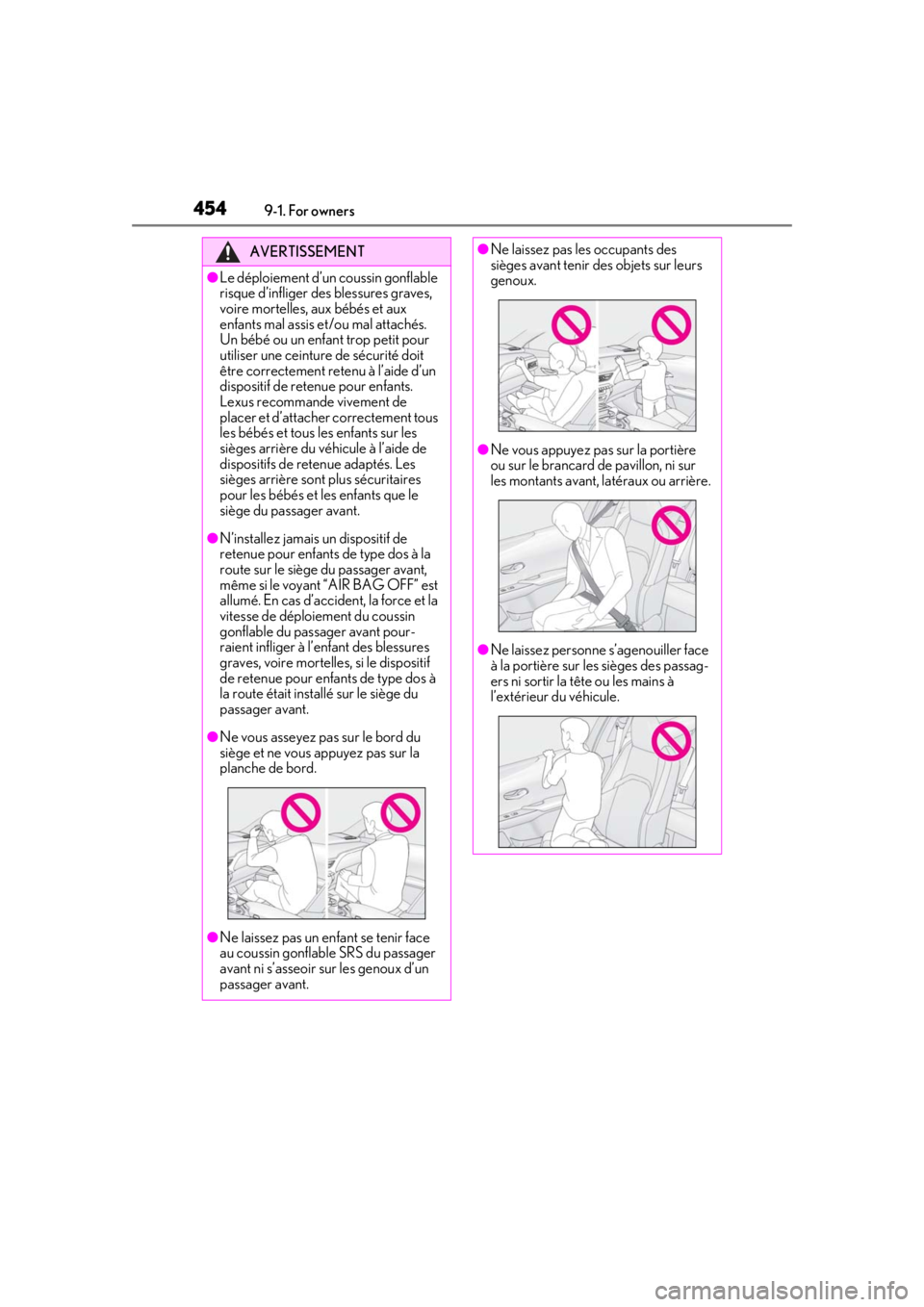
●Ne vous asseyez pas sur le bord du
siège et ne vous appuyez pas sur la
planche de bord.
●Ne laissez pas un enfant se tenir face
au coussin gonflable SRS du passager
avant ni s’asseoir sur les genoux d’un
passager avant.
●Ne laissez pas les occupants des
sièges avant tenir des objets sur leurs
genoux.
●Ne vous appuyez pas sur la portière
ou sur le brancard de pavillon, ni sur
les montants avant, latéraux ou arrière.
●Ne laissez personne s’agenouiller face
à la portière sur les sièges des passag-
ers ni sortir la tête ou les mains à
l’extérieur du véhicule.