door lock LEXUS UX250H 2019 Owners Manual
[x] Cancel search | Manufacturer: LEXUS, Model Year: 2019, Model line: UX250H, Model: LEXUS UX250H 2019Pages: 476, PDF Size: 10.51 MB
Page 2 of 476
2TABLE OF CONTENTS
For your information ......................................6
Reading this manual .................................... 10
How to search ................................................. 11
Pictorial index ................................................. 12
1-1. For safe use Before driving .................................... 24
For safe driving.................................. 25
Seat belts ............................................. 26
SRS airbags ......................................... 31
Front passenger occupant classifi- cation system ................................. 39
Exhaust gas precautions .............. 43
1-2. Child safety Riding with children........................ 44
Child restraint systems ................. 44
1-3. LEXUS Enform Lexus Enform Safety Connect .. 56
Lexus Enform Remote .................. 60
Lexus Enform Service Connect.. 61
1-4. Hybrid system Hybrid system features .................. 62
Hybrid system precautions ......... 65
1-5. Theft deterrent system Immobilizer sy stem ........................ 69
Alarm...................................................... 71
Theft prevention labels (for the U.S.A.)................................................ 72
2-1. Instrument cluster Warning lights and indicators ..... 74Gauges and meters (except F
SPORT models) ............................ 78
Gauges and meters (F SPORT models).............................................. 82
Multi-information display ............. 87
Head-up display ............................... 93
Energy monitor/consumption screen ................................................ 97
3-1. Key information Keys .................................................... 104
3-2. Opening, closing and locking the doors
Side doors ........................................ 108
Back door........................................... 112
Smart access system with push-but- ton start ........................................... 124
3-3. Adjusting the seats Front seats.......................................... 131
Rear seats.......................................... 132
Driving position memory ........... 133
Head restraints .............................. 136
3-4. Adjusting the steering wheel and mirrors
Steering wheel ............................... 139
Inside rear view mirror ............... 140
Outside rear view mirrors.......... 142
3-5. Opening, closing the windows and moon roof
Power windows ............................. 145
Moon roof ......................................... 147
1For safety and security
2Vehicle status information and
indicators
3Before driving
Page 12 of 476
12Pictorial index
Pictorial index
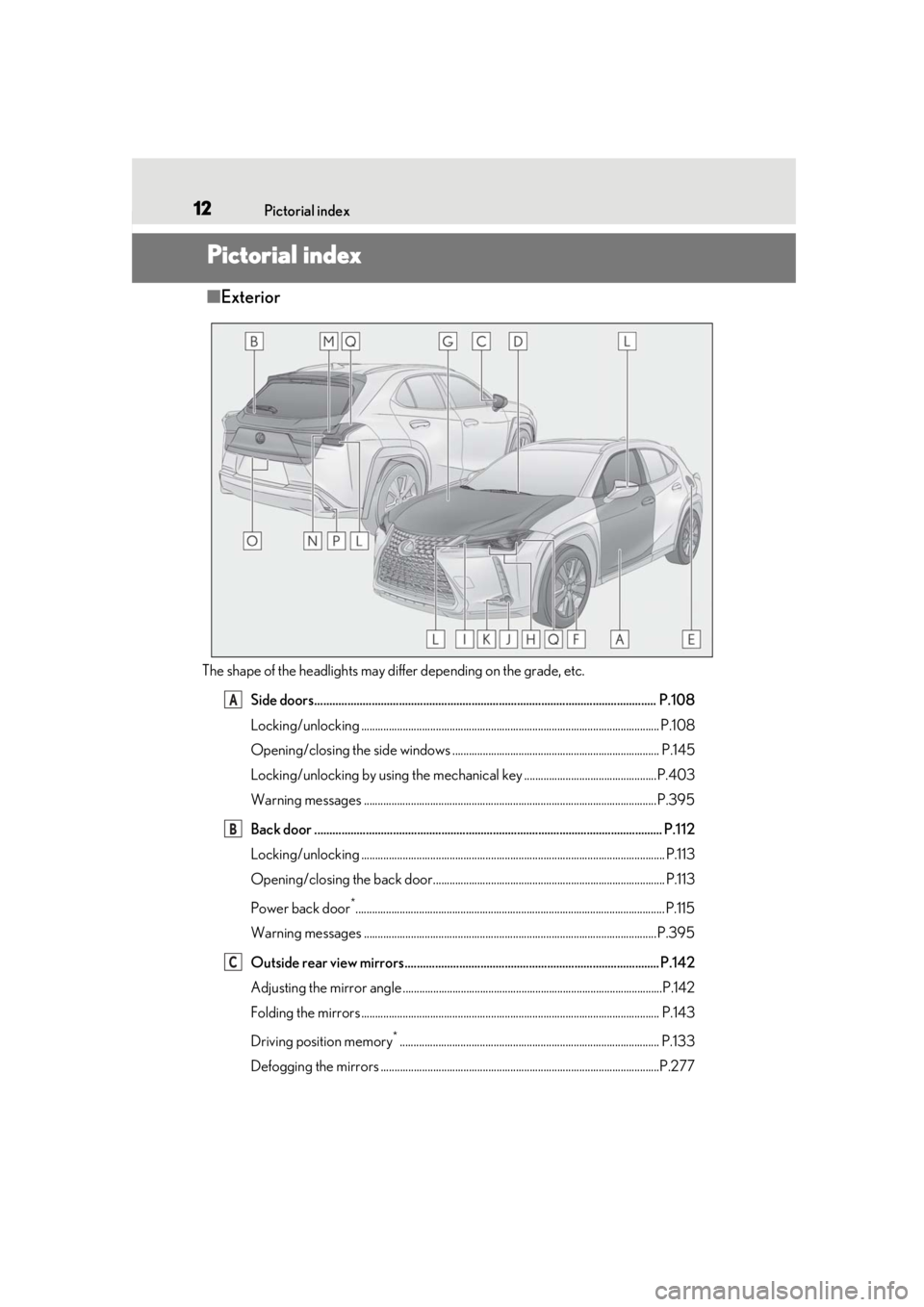
■Exterior
The shape of the headlights may differ depending on the grade, etc.
Side doors................................................................................................................. P.108
Locking/unlocking ............................................................................................................ P. 108
Opening/closing the side windows ........................................................................... P.145
Locking/unlocking by using th e mechanical key ................................................P.403
Warning messages ..........................................................................................................P.395
Back door ................................................................................................................... P.1 12
Locking/unlocking .............................................................................................................. P.113
Opening/closing the back door.................................................................................... P.113
Power back door
*................................................................................................................ P.115
Warning messages ..........................................................................................................P.395
Outside rear view mirrors.................................................................................... P.142
Adjusting the mirror angle ..............................................................................................P.142
Folding the mirrors ............................................................................................................ P.143
Driving position memory
*.............................................................................................. P.133
Defogging the mirrors .....................................................................................................P.277
A
B
C
Page 18 of 476
18Pictorial index
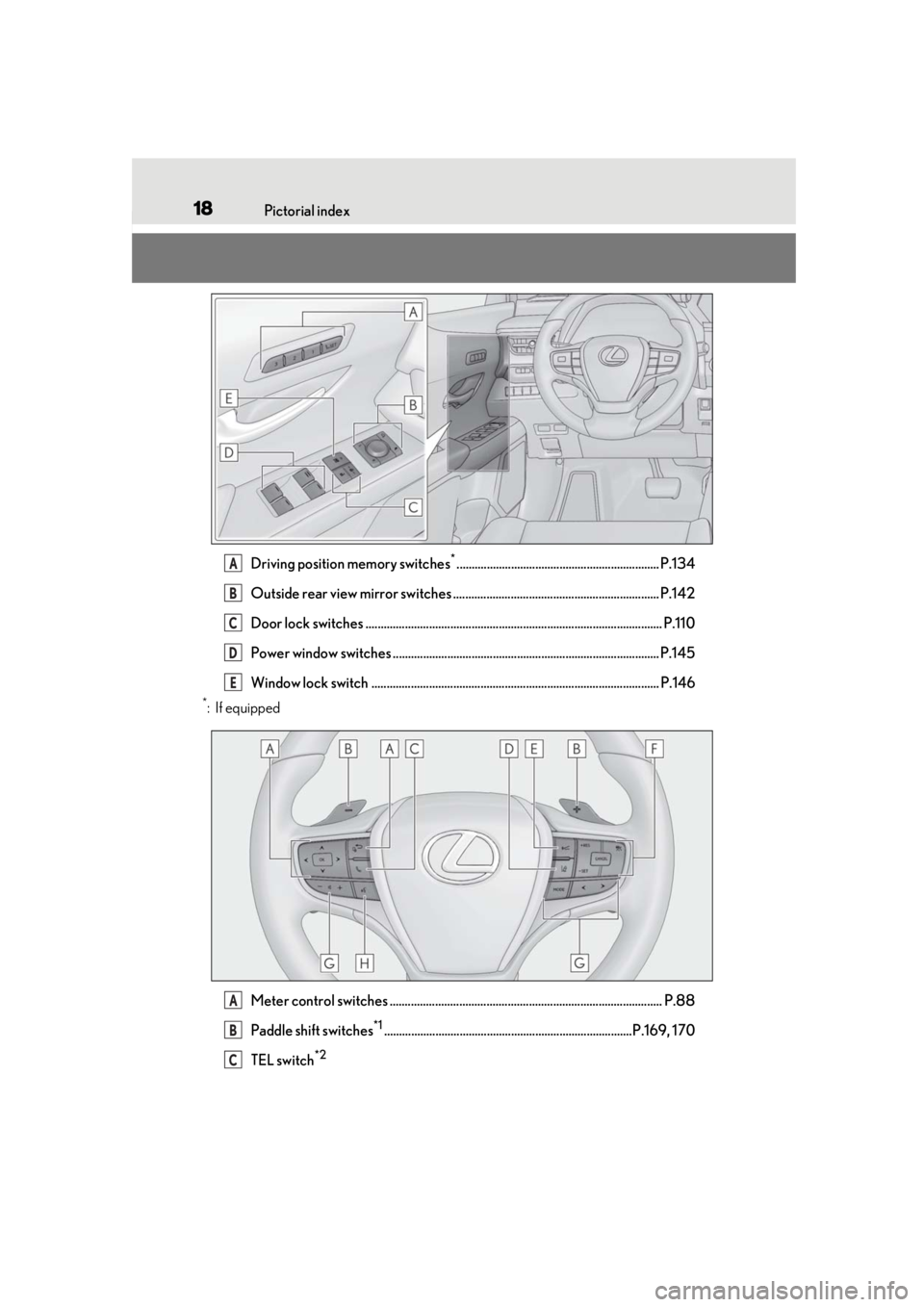
Driving position memory switches*................................................................... P.134
Outside rear view mirror switches .................................................................... P.142
Door lock switches .................................................................................................. P.110
Power window switches ........................................................................................ P.145
Window lock switch ............................................................................................... P.146
*:If equipped
Meter control switches .......................................................................................... P.88
Paddle shift switches
*1..................................................................................P.169, 170
TEL switch
*2
A
B
C
D
E
A
B
C
Page 27 of 476
271-1. For safe use
1
For safety and security
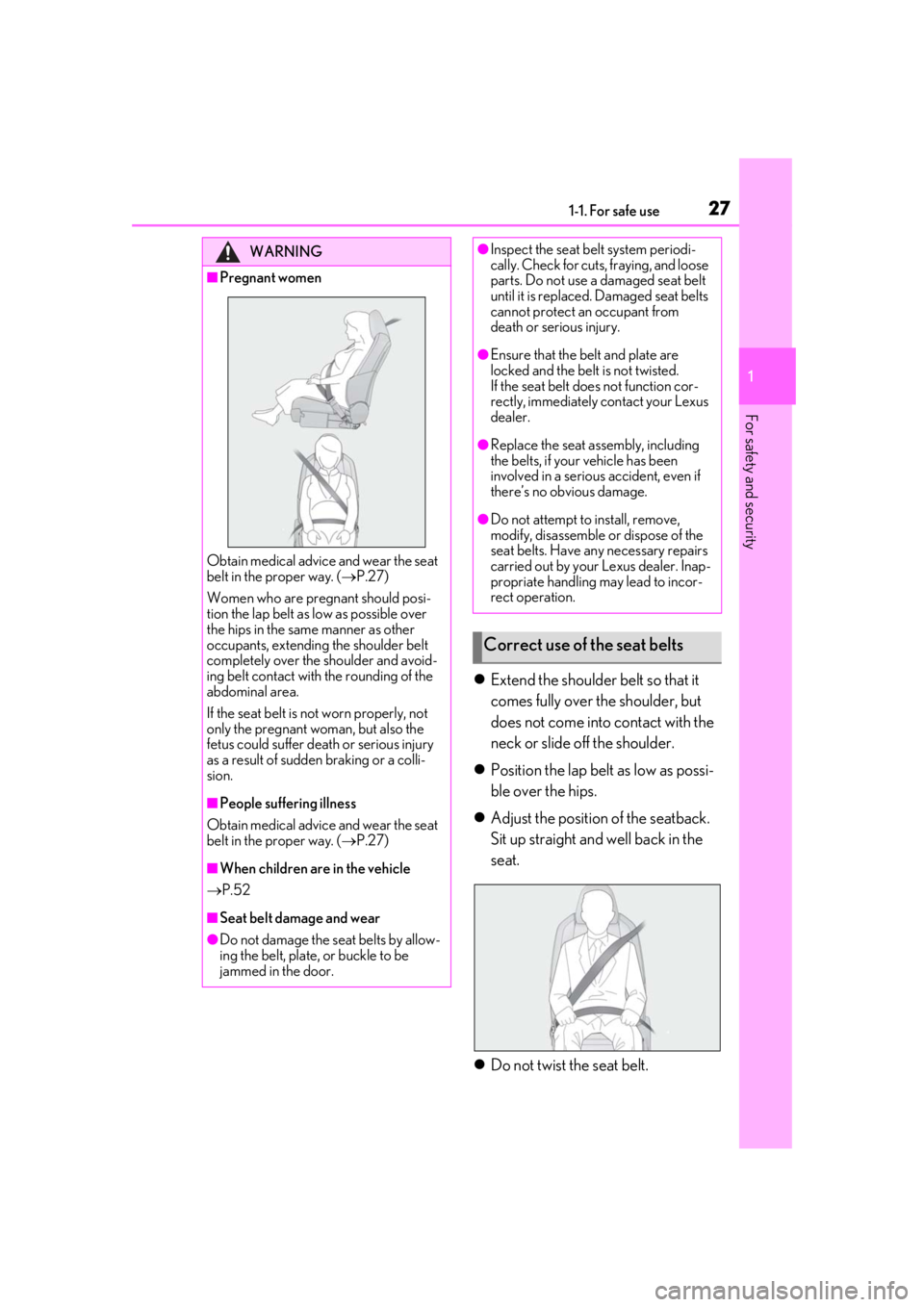
Extend the shoulder belt so that it
comes fully over the shoulder, but
does not come into contact with the
neck or slide off the shoulder.
Position the lap belt as low as possi-
ble over the hips.
Adjust the position of the seatback.
Sit up straight and well back in the
seat.
Do not twist the seat belt.
WARNING
■Pregnant women
Obtain medical advice and wear the seat
belt in the proper way. ( P.27)
Women who are pregnant should posi-
tion the lap belt as low as possible over
the hips in the same manner as other
occupants, extending the shoulder belt
completely over the shoulder and avoid-
ing belt contact with the rounding of the
abdominal area.
If the seat belt is not worn properly, not
only the pregnant woman, but also the
fetus could suffer death or serious injury
as a result of sudden braking or a colli-
sion.
■People suffering illness
Obtain medical advice and wear the seat
belt in the proper way. ( P.27)
■When children are in the vehicle
P.52
■Seat belt damage and wear
●Do not damage the seat belts by allow-
ing the belt, plate, or buckle to be
jammed in the door.
●Inspect the seat belt system periodi-
cally. Check for cuts, fraying, and loose
parts. Do not use a damaged seat belt
until it is replaced. Damaged seat belts
cannot protect an occupant from
death or serious injury.
●Ensure that the belt and plate are
locked and the belt is not twisted.
If the seat belt does not function cor-
rectly, immediately contact your Lexus
dealer.
●Replace the seat assembly, including
the belts, if your vehicle has been
involved in a serious accident, even if
there’s no obvious damage.
●Do not attempt to install, remove,
modify, disassemble or dispose of the
seat belts. Have any necessary repairs
carried out by your Lexus dealer. Inap-
propriate handling may lead to incor-
rect operation.
Correct use of the seat belts
Page 33 of 476
331-1. For safe use
1
For safety and security
Rear side airbags
Side impact sensors (front door)
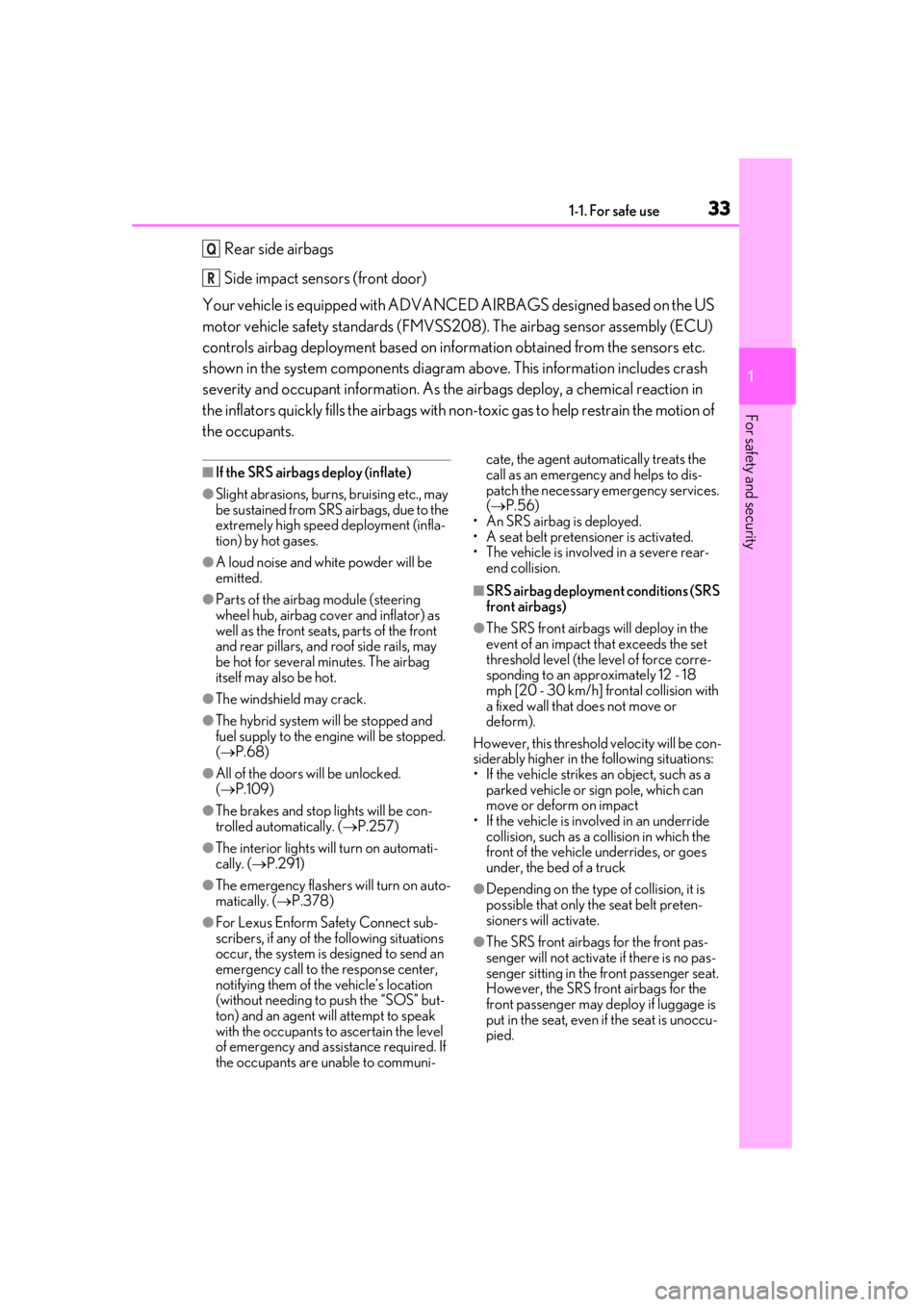
Your vehicle is equipped with ADVANCED AIRBAGS designed based on the US
motor vehicle safety standards (FMVSS208). The airbag sensor assembly (ECU)
controls airbag deployment based on information obtained from the sensors etc.
shown in the system components diagram above. This information includes crash
severity and occupant information. As the airbags deploy, a chemical reaction in
the inflators quickly fills the airbags with no n-toxic gas to help restrain the motion of
the occupants.
■If the SRS airbags deploy (inflate)
●Slight abrasions, burns, bruising etc., may
be sustained from SRS airbags, due to the
extremely high speed deployment (infla-
tion) by hot gases.
●A loud noise and white powder will be
emitted.
●Parts of the airbag module (steering
wheel hub, airbag cover and inflator) as
well as the front seat s, parts of the front
and rear pillars, and roof side rails, may
be hot for several minutes. The airbag
itself may also be hot.
●The windshield may crack.
●The hybrid system will be stopped and
fuel supply to the engine will be stopped.
( P.68)
●All of the doors will be unlocked.
( P.109)
●The brakes and stop lights will be con-
trolled automatically. ( P.257)
●The interior lights will turn on automati-
cally. ( P.291)
●The emergency flashers will turn on auto-
matically. ( P.378)
●For Lexus Enform Safety Connect sub-
scribers, if any of the following situations
occur, the system is designed to send an
emergency call to the response center,
notifying them of the vehicle’s location
(without needing to push the “SOS” but-
ton) and an agent will attempt to speak
with the occupants to ascertain the level
of emergency and assi stance required. If
the occupants are unable to communi- cate, the agent automatically treats the
call as an emergency and helps to dis-
patch the necessary emergency services.
(
P.56)
• An SRS airbag is deployed.
• A seat belt pretensioner is activated.
• The vehicle is involved in a severe rear- end collision.
■SRS airbag deployment conditions (SRS
front airbags)
●The SRS front airbags will deploy in the
event of an impact that exceeds the set
threshold level (the level of force corre-
sponding to an approximately 12 - 18
mph [20 - 30 km/h] frontal collision with
a fixed wall that does not move or
deform).
However, this threshold velocity will be con-
siderably higher in the following situations:
• If the vehicle strikes an object, such as a parked vehicle or sign pole, which can
move or deform on impact
• If the vehicle is involved in an underride collision, such as a collision in which the
front of the vehicle underrides, or goes
under, the bed of a truck
●Depending on the type of collision, it is
possible that only the seat belt preten-
sioners will activate.
●The SRS front airbags for the front pas-
senger will not activate if there is no pas-
senger sitting in the front passenger seat.
However, the SRS front airbags for the
front passenger may deploy if luggage is
put in the seat, even if the seat is unoccu-
pied.
Q
R
Page 44 of 476
441-2. Child safety
1-2.Child safety
Points to remember: P.44
Child restraint system: P.46
When using a child restraint system on
a passenger seat: P.47
When using a child restraint system on
a rear seat: P.48
Child restraint system installation
method
• Fixed with a seat belt: P.48
• Fixed with a child restraint LATCH anchor: P.52
• Using an anchor bracket (for top tether strap): P.54
The laws of all 50 states of the U.S.A.
as well as Canada now require the use
of child restraint systems.
Riding with children
Observe the following precautions
when children are in the vehicle.
Use a child restraint system appro-
priate for the child , until the child
becomes large enough to properly
wear the vehicle’s seat belt.
It is recommended that children
sit in the rear seats to avoid acci-
dental contact with the shift lever,
wiper switch, etc.
Use the rear door child-protector
lock or the window lock switch to
avoid children opening the door
while driving or operating the
power window accidentally.
( P.111, 146)
Do not let small children operate
equipment which may catch or
pinch body parts, such as the
power window, hood, back door,
seats etc.
WARNING
■When children are in the vehicle
Never leave children unattended in the
vehicle, and never allow children to have
or use the key.
Children may be able to start the vehicle
or shift the vehicle into neutral. There is
also a danger that children may injure
themselves by playing with the windows,
the moon roof (if eq uipped) or other fea-
tures of the vehicle. In addition, heat
build-up or extremely cold temperatures
inside the vehicle can be fatal to children.
Child restraint systems
Before installing a child restraint
system in the vehicle, there are pre-
cautions that need to be observed,
different types of child restraint sys-
tems, as well as installation meth-
ods, etc., written in this manual.
Use a child restraint system when
riding with a small child that cannot
properly use a seat belt. For the
child’s safety, install the child restraint
system to a rear seat. Be sure to fol-
low the installation method that is in
the operation manual enclosed with
the restraint system.
Table of contents
Points to remember
Page 48 of 476
481-2. Child safety
A child restraint system for a small
child or baby must itself be properly
restrained on the seat with the lap por-
tion of the lap/shoulder belt.
■Installing child restraint system
using a seat belt (child restraint
lock function belt)
Install the child restraint system in
accordance to the operation manual
enclosed with the child restraint sys-
tem.
■Rear-facing Infant seat/con-
vertible seat
1
Adjust the seatback
If there is a gap between the child seat and
the seatback, adjust the seatback until
good contact is achieved.
WARNING
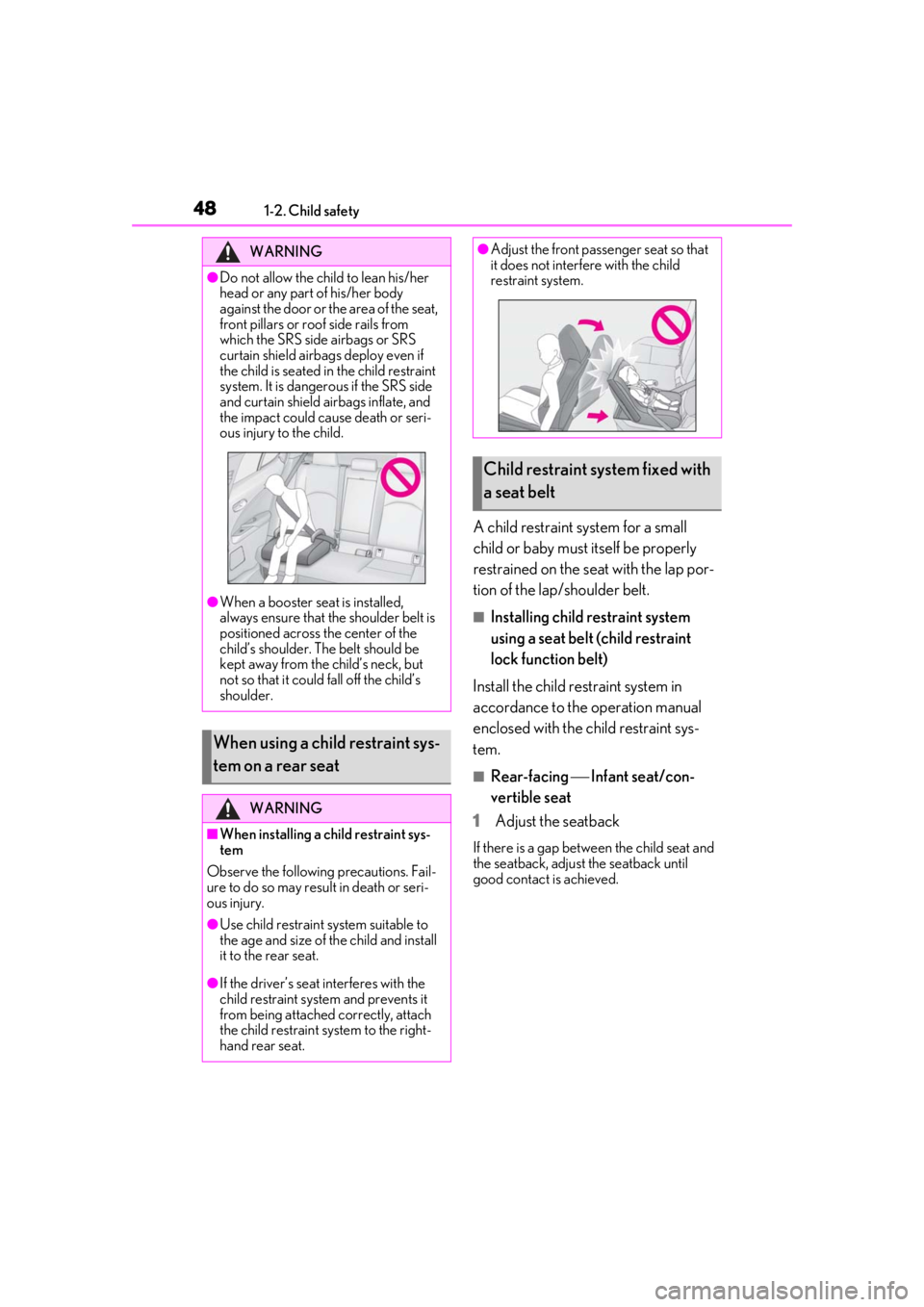
●Do not allow the child to lean his/her
head or any part of his/her body
against the door or the area of the seat,
front pillars or roof side rails from
which the SRS side airbags or SRS
curtain shield airbags deploy even if
the child is seated in the child restraint
system. It is dangerous if the SRS side
and curtain shield airbags inflate, and
the impact could cause death or seri-
ous injury to the child.
●When a booster seat is installed,
always ensure that th e shoulder belt is
positioned across the center of the
child’s shoulder. The belt should be
kept away from the child’s neck, but
not so that it could fall off the child’s
shoulder.
When using a child restraint sys-
tem on a rear seat
WARNING
■When installing a child restraint sys-
tem
Observe the following precautions. Fail-
ure to do so may result in death or seri-
ous injury.
●Use child restraint system suitable to
the age and size of the child and install
it to the rear seat.
●If the driver’s seat interferes with the
child restraint system and prevents it
from being attached correctly, attach
the child restraint system to the right-
hand rear seat.
●Adjust the front passe nger seat so that
it does not interfere with the child
restraint system.
Child restraint system fixed with
a seat belt
Page 71 of 476
711-5. Theft deterrent system
1
For safety and security
■Items to check before locking the
vehicle
To prevent unexpected triggering of
the alarm and vehicle theft, make sure
of the following:
Nobody is in the vehicle.
The windows and moon roof (if
equipped) are closed before the
alarm is set.
No valuables or other personal
items are left in the vehicle.
■Setting
Close the doors and hood, and lock all
the doors. The system will be set auto-
matically after 30 seconds.
The security indicator changes from being
on to flashing when the system is set.
■Canceling or stopping
Do one of the following to deactivate
or stop the alarms:
Unlock the doors.
Turn the power switch to ACC or
ON, or start the hybrid system. (The
alarm will be deactivated or stopped
after a few seconds.)
■System maintenance
The vehicle has a maintenance-free type
alarm system.
■Triggering of the alarm
The alarm may be triggered in the following
situations:
(Stopping the alarm deactivates the alarm
system.)
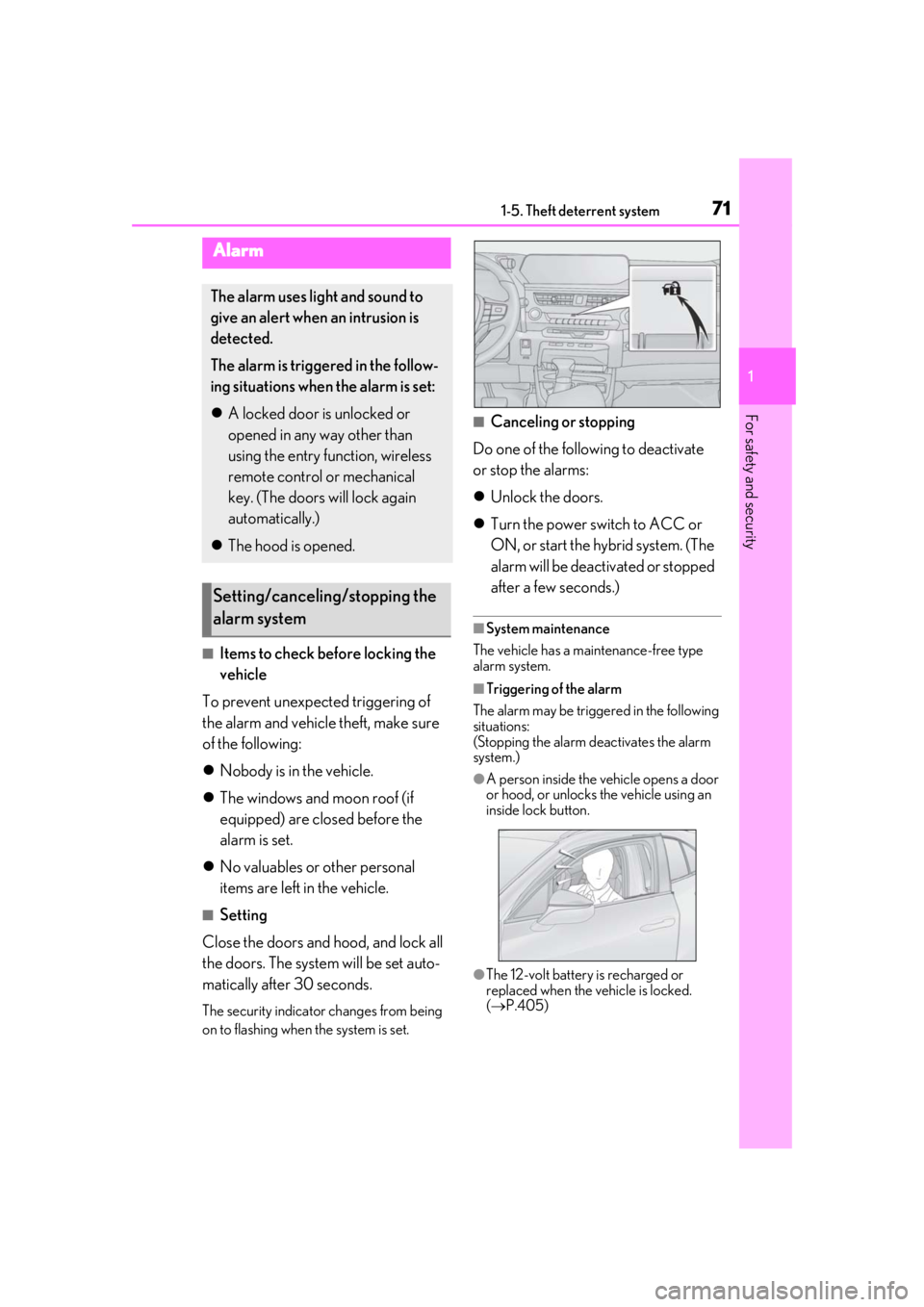
●A person inside the vehicle opens a door
or hood, or unlocks the vehicle using an
inside lock button.
●The 12-volt battery is recharged or
replaced when the vehicle is locked.
( P.405)
Alarm
The alarm uses light and sound to
give an alert when an intrusion is
detected.
The alarm is triggered in the follow-
ing situations when the alarm is set:
A locked door is unlocked or
opened in any way other than
using the entry function, wireless
remote control or mechanical
key. (The doors will lock again
automatically.)
The hood is opened.
Setting/canceling/stopping the
alarm system
Page 72 of 476
721-5. Theft deterrent system
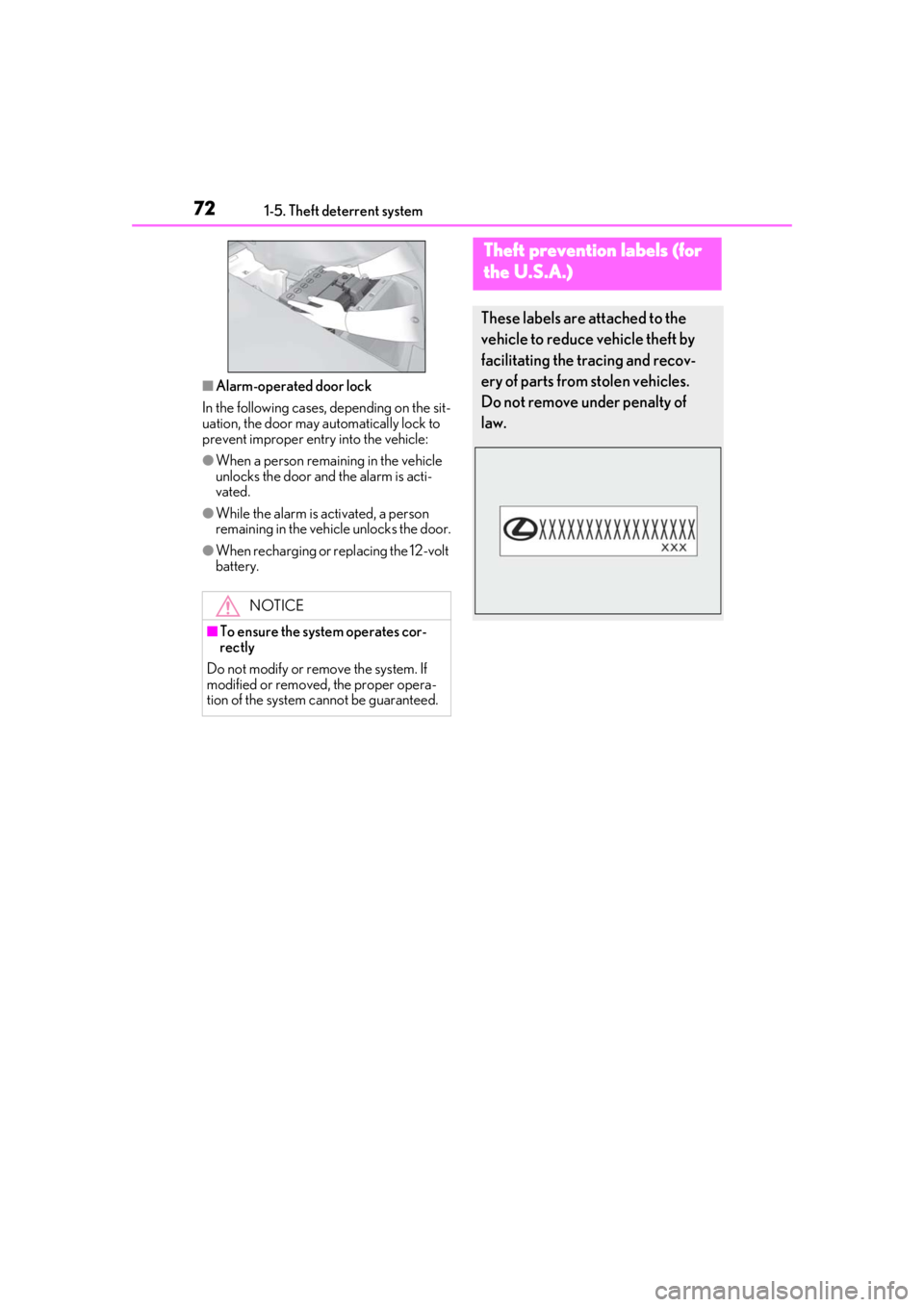
■Alarm-operated door lock
In the following cases, depending on the sit-
uation, the door may automatically lock to
prevent improper entry into the vehicle:
●When a person remaining in the vehicle
unlocks the door and the alarm is acti-
vated.
●While the alarm is activated, a person
remaining in the vehicle unlocks the door.
●When recharging or replacing the 12-volt
battery.
NOTICE
■To ensure the system operates cor-
rectly
Do not modify or remove the system. If
modified or removed, the proper opera-
tion of the system cannot be guaranteed.
Theft prevention labels (for
t
he U.S.A.)
These labels are attached to the
vehicle to reduce vehicle theft by
facilitating the tracing and recov-
ery of parts from stolen vehicles.
Do not remove under penalty of
law.
Page 103 of 476
103
3
3
Before driving
Before driving
3-1. Key informationKeys ................................................. 104
3-2. Opening, closing and locking the doors
Side doors ..................................... 108
Back door ....................................... 112
Smart access system with push- button start ................................. 124
3-3. Adjusting the seats Front seats ...................................... 131
Rear seats ...................................... 132
Driving position memory ........ 133
Head restraints............................ 136
3-4. Adjusting the steering wheel and mirrors
Steering wheel............................. 139
Inside rear view mirror............. 140
Outside rear view mirrors ...... 142
3-5. Opening, closing the windows and moon roof
Power windows........................... 145
Moon roof ..................................... 147