high LEXUS UX250H 2019 Owners Manual
[x] Cancel search | Manufacturer: LEXUS, Model Year: 2019, Model line: UX250H, Model: LEXUS UX250H 2019Pages: 476, PDF Size: 10.51 MB
Page 3 of 476
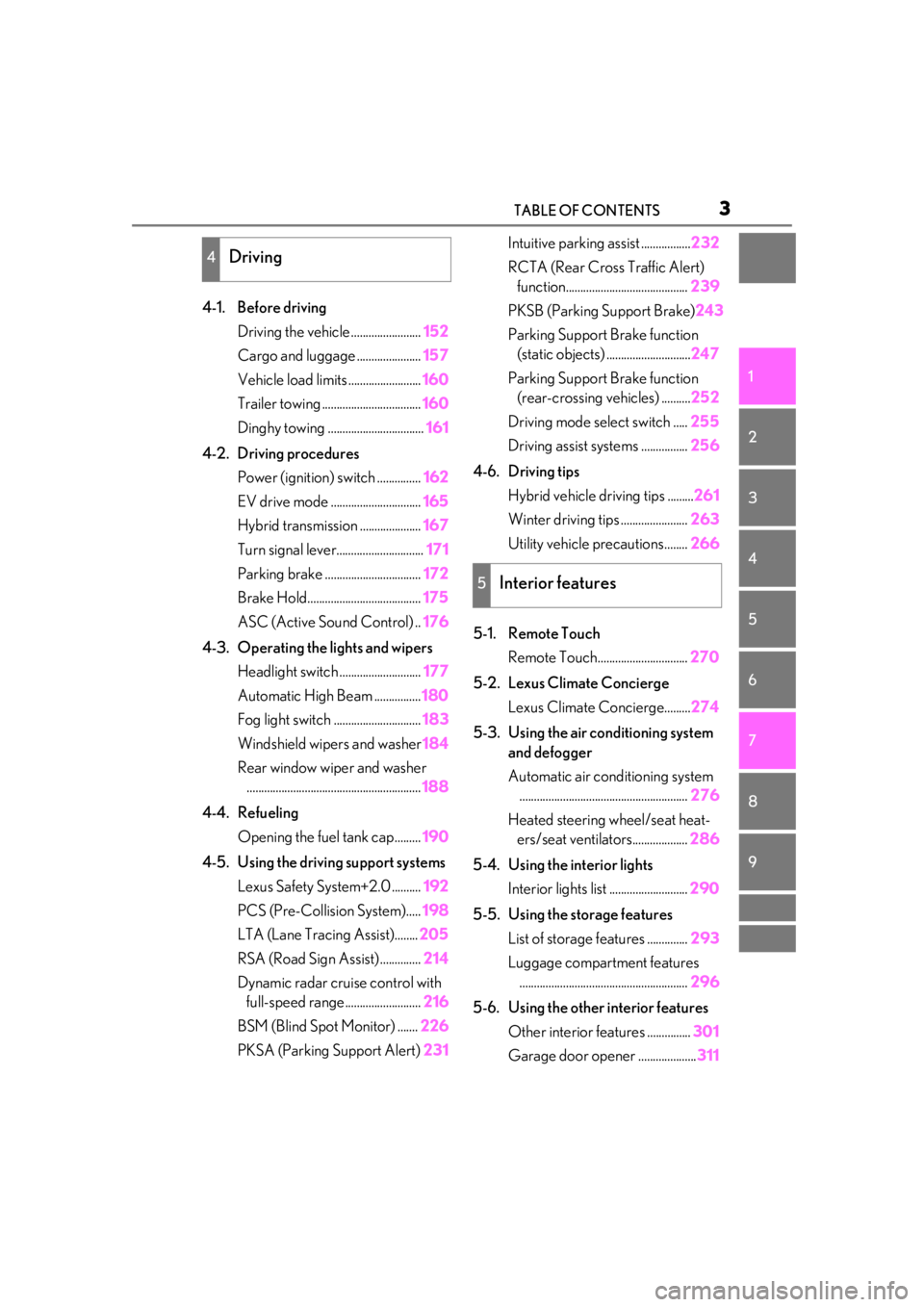
3TABLE OF CONTENTS
1
2
3
4
5
6
7
8
9
4-1. Before drivingDriving the vehicle ........................ 152
Cargo and luggage ...................... 157
Vehicle load limits ......................... 160
Trailer towing .................................. 160
Dinghy towing ................................. 161
4-2. Driving procedures Power (ignition) switch ............... 162
EV drive mode ............................... 165
Hybrid transmission ..................... 167
Turn signal lever.............................. 171
Parking brake ................................. 172
Brake Hold....................................... 175
ASC (Active Sound Control) .. 176
4-3. Operating the lights and wipers Headlight switch ............................ 177
Automatic High Beam ................ 180
Fog light switch .............................. 183
Windshield wipers and washer 184
Rear window wiper and washer ............................................................ 188
4-4. Refueling Opening the fuel tank cap......... 190
4-5. Using the driving support systems Lexus Safety System+2.0 .......... 192
PCS (Pre-Collision System)..... 198
LTA (Lane Tracing Assist)........ 205
RSA (Road Sign Assist) .............. 214
Dynamic radar crui se control with
full-speed range.......................... 216
BSM (Blind Spot Monitor) ....... 226
PKSA (Parking Support Alert) 231Intuitive parking assist .................
232
RCTA (Rear Cross Traffic Alert) function.......................................... 239
PKSB (Parking Support Brake) 243
Parking Support Brake function (static objects) ............................. 247
Parking Support Brake function (rear-crossing vehicles) .......... 252
Driving mode select switch ..... 255
Driving assist systems ................ 256
4-6. Driving tips Hybrid vehicle driving tips ......... 261
Winter driving tips ....................... 263
Utility vehicle precautions........ 266
5-1. Remote Touch Remote Touch............................... 270
5-2. Lexus Climate Concierge Lexus Climate Concierge......... 274
5-3. Using the air conditioning system and defogger
Automatic air conditioning system.......................................................... 276
Heated steering wheel/seat heat- ers/seat ventilators................... 286
5-4. Using the interior lights Interior lights list ........................... 290
5-5. Using the storage features List of storage features .............. 293
Luggage
compartment features
.......................................................... 296
5-6. Using the other interior features Other interior features ............... 301
Garage door opener .................... 311
4Driving
5Interior features
Page 7 of 476

7
late governmental regulations. In addi-
tion, damage or performance
problems resulting from the modifica-
tion may not be covered under war-
ranty.
The installation of a mobile two-way
radio system in your vehicle could
affect electronic systems such as:
Hybrid system
Multiport fuel injection sys-
tem/sequential multiport fuel injec-
tion system
Lexus Safety System+2.0
Anti-lock brake system
SRS airbag system
Seat belt pretensioner system
Be sure to check with your Lexus
dealer for precautionary measures or
special instructions regarding installa-
tion of a mobile two-way radio system.
High voltage parts and cables on the
hybrid vehicles emit approximately the
same amount of electromagnetic
waves as the conventional gasoline
powered vehicles or home electronic
appliances despite of their electro-
magnetic shielding.
Unwanted noise may occur in the
reception of the mobile two-way radio.
The vehicle is equipped with sophisti- cated computers that will record cer-
tain data, such as:
The recorded data varies according to
the vehicle grade level and options
with which it is equipped.
These computers do not record con-
versations or sounds, and only record
images outside of the vehicle in certain
situations.
• Engine speed/Elect
ric motor speed
(traction motor speed)
• Accelerator status
•Brake status
• Vehicle speed
• Operation status of the driving assist systems, such as the ABS and
pre-collision system
• Images from the front camera (avail- able only when certain safety sys-
tems are activated, which varies
depending on the vehicle specifica-
tions).
Data Transmission
Your vehicle may transmit the data
recorded in these computers to Lexus
without notification to you.
Data usage
Lexus may use the data recorded in this
computer to diagnose malfunctions, con-
duct research and development, and
improve quality.
Lexus will not disclose the recorded data to
a third party except:
• With the consent of the vehicle owner or
with the consent of the lessee if the vehi-
cle is leased
• In response to an official request by the police, a court of law or a government
agency
Installation of a mobile two-way
radio system
Vehicle data recording
Page 16 of 476

16Pictorial index
When the warning messages are displayed..........................................................P.395
Parking brake switch ............................................................................................. P.172
Applying/releasing ............................................................................................................ P.172
Precautions against winter season ................... ......................................................... P.264
Warning buzzer/message................................................................................ P.387, 395
Turn signal lever ....................................................................................................... P.171
Headlight switch...................................................................................................... P.177
Headlights/parking lights/tail lights/license plate lights/
daytime running lights ....................................................................................................... P. 177
Automatic High Beam ..................................................................................................... P.180
Fog lights
*1............................................................................................................................ P.1 83
Windshield wiper and washer switch ................................................................P.184
Rear window wiper and washer switch ........................................................... P.188
Usage.......................................................................................................................... ..P.184, 188
Adding washer fluid .......................................................................................................... P. 341
Headlight cleaners
*1......................................................................................................... P.184
Warning messages ..........................................................................................................P.395
Emergency flasher switch ...................................................................................P.378
Hood lock release lever ...................................................................................... P.335
Tilt and telescopic steering control switch
*1................................................... P.139
Adjustment ..................................................................................................................... ...... P.139
Driving position memory
*1............................................................................................. P.133
Tilt and telescopic steeri ng lock release lever
*1............................................ P.139
Adjustment ..................................................................................................................... ...... P.139
Air conditioning system ....................................................................................... P.276
Usage.......................................................................................................................... ........... P.276
Rear window defogger....................................................................................................P.277
Audio system
*2
*1
: If equipped
*2: Refer to “NAVIGATION AND MULTIMEDIA SYSTEM OWNER’S MANUAL”.
E
F
G
H
I
J
K
L
M
Page 24 of 476
241-1. For safe use
1-1.For safe use
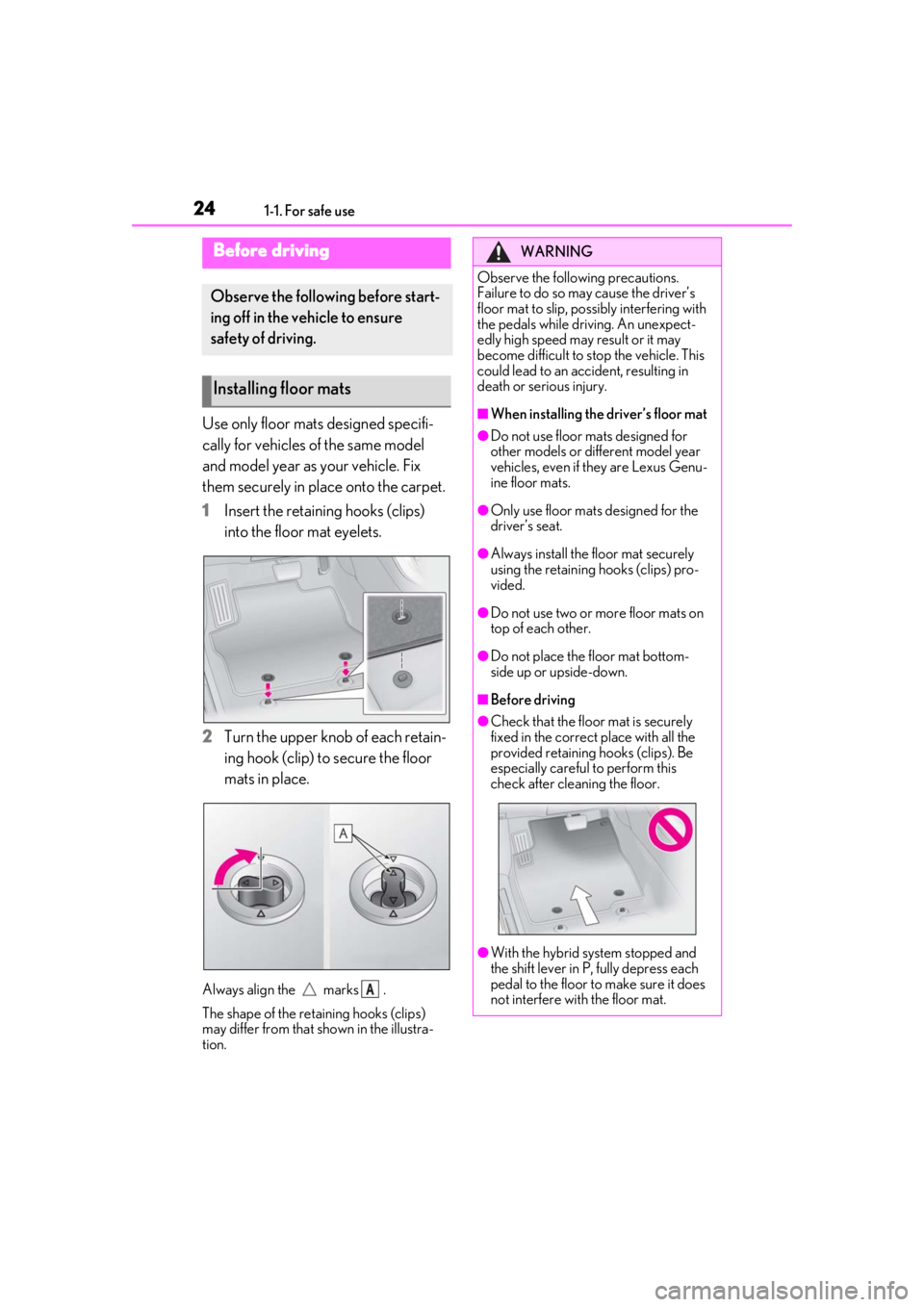
Use only floor mats designed specifi-
cally for vehicles of the same model
and model year as your vehicle. Fix
them securely in place onto the carpet.
1
Insert the retaining hooks (clips)
into the floor mat eyelets.
2
Turn the upper knob of each retain-
ing hook (clip) to secure the floor
mats in place.
Always align the marks .
The shape of the reta ining hooks (clips)
may differ from that shown in the illustra-
tion.
Before driving
Observe the following before start-
ing off in the vehicle to ensure
safety of driving.
Installing floor mats
A
WARNING
Observe the following precautions.
Failure to do so may cause the driver’s
floor mat to slip, poss ibly interfering with
the pedals while driving. An unexpect-
edly high speed may result or it may
become difficult to stop the vehicle. This
could lead to an accident, resulting in
death or serious injury.
■When installing the driver’s floor mat
●Do not use floor mats designed for
other models or different model year
vehicles, even if they are Lexus Genu-
ine floor mats.
●Only use floor mats designed for the
driver’s seat.
●Always install the floor mat securely
using the retaining hooks (clips) pro-
vided.
●Do not use two or more floor mats on
top of each other.
●Do not place the floor mat bottom-
side up or upside-down.
■Before driving
●Check that the floor mat is securely
fixed in the correct place with all the
provided retaining hooks (clips). Be
especially careful to perform this
check after cleaning the floor.
●With the hybrid system stopped and
the shift lever in P, fully depress each
pedal to the floor to make sure it does
not interfere with the floor mat.
Page 33 of 476

331-1. For safe use
1
For safety and security
Rear side airbags
Side impact sensors (front door)
Your vehicle is equipped with ADVANCED AIRBAGS designed based on the US
motor vehicle safety standards (FMVSS208). The airbag sensor assembly (ECU)
controls airbag deployment based on information obtained from the sensors etc.
shown in the system components diagram above. This information includes crash
severity and occupant information. As the airbags deploy, a chemical reaction in
the inflators quickly fills the airbags with no n-toxic gas to help restrain the motion of
the occupants.
■If the SRS airbags deploy (inflate)
●Slight abrasions, burns, bruising etc., may
be sustained from SRS airbags, due to the
extremely high speed deployment (infla-
tion) by hot gases.
●A loud noise and white powder will be
emitted.
●Parts of the airbag module (steering
wheel hub, airbag cover and inflator) as
well as the front seat s, parts of the front
and rear pillars, and roof side rails, may
be hot for several minutes. The airbag
itself may also be hot.
●The windshield may crack.
●The hybrid system will be stopped and
fuel supply to the engine will be stopped.
( P.68)
●All of the doors will be unlocked.
( P.109)
●The brakes and stop lights will be con-
trolled automatically. ( P.257)
●The interior lights will turn on automati-
cally. ( P.291)
●The emergency flashers will turn on auto-
matically. ( P.378)
●For Lexus Enform Safety Connect sub-
scribers, if any of the following situations
occur, the system is designed to send an
emergency call to the response center,
notifying them of the vehicle’s location
(without needing to push the “SOS” but-
ton) and an agent will attempt to speak
with the occupants to ascertain the level
of emergency and assi stance required. If
the occupants are unable to communi- cate, the agent automatically treats the
call as an emergency and helps to dis-
patch the necessary emergency services.
(
P.56)
• An SRS airbag is deployed.
• A seat belt pretensioner is activated.
• The vehicle is involved in a severe rear- end collision.
■SRS airbag deployment conditions (SRS
front airbags)
●The SRS front airbags will deploy in the
event of an impact that exceeds the set
threshold level (the level of force corre-
sponding to an approximately 12 - 18
mph [20 - 30 km/h] frontal collision with
a fixed wall that does not move or
deform).
However, this threshold velocity will be con-
siderably higher in the following situations:
• If the vehicle strikes an object, such as a parked vehicle or sign pole, which can
move or deform on impact
• If the vehicle is involved in an underride collision, such as a collision in which the
front of the vehicle underrides, or goes
under, the bed of a truck
●Depending on the type of collision, it is
possible that only the seat belt preten-
sioners will activate.
●The SRS front airbags for the front pas-
senger will not activate if there is no pas-
senger sitting in the front passenger seat.
However, the SRS front airbags for the
front passenger may deploy if luggage is
put in the seat, even if the seat is unoccu-
pied.
Q
R
Page 36 of 476
361-1. For safe use
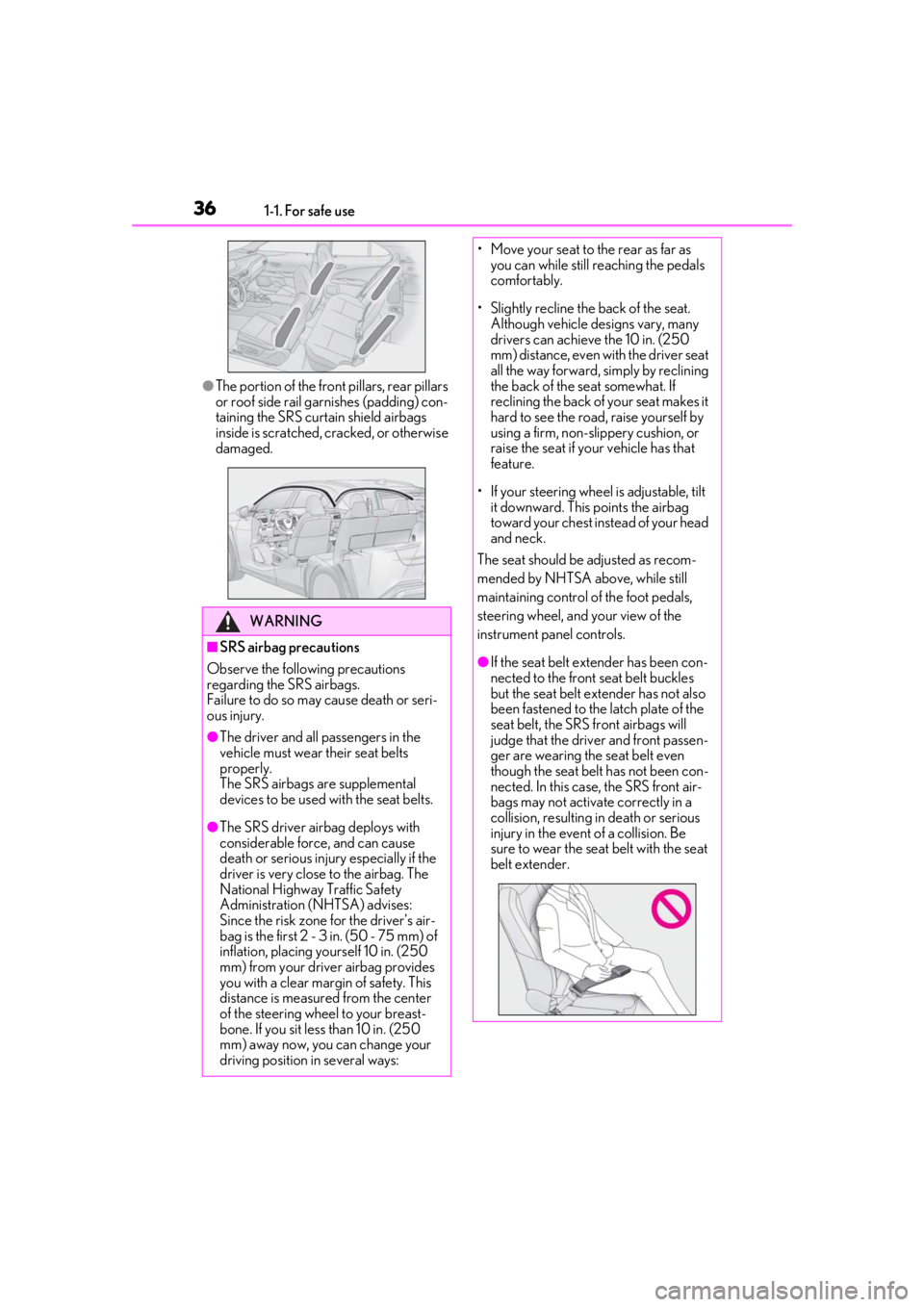
●The portion of the front pillars, rear pillars
or roof side rail garnishes (padding) con-
taining the SRS curtain shield airbags
inside is scratched, cracked, or otherwise
damaged.
WARNING
■SRS airbag precautions
Observe the following precautions
regarding the SRS airbags.
Failure to do so may cause death or seri-
ous injury.
●The driver and all passengers in the
vehicle must wear their seat belts
properly.
The SRS airbags are supplemental
devices to be used with the seat belts.
●The SRS driver airbag deploys with
considerable force, and can cause
death or serious injury especially if the
driver is very close to the airbag. The
National Highway Traffic Safety
Administration (NHTSA) advises:
Since the risk zone for the driver’s air-
bag is the first 2 - 3 in. (50 - 75 mm) of
inflation, placing yourself 10 in. (250
mm) from your driver airbag provides
you with a clear margin of safety. This
distance is measured from the center
of the steering wheel to your breast-
bone. If you sit less than 10 in. (250
mm) away now, you can change your
driving position in several ways:
• Move your seat to the rear as far as you can while still reaching the pedals
comfortably.
• Slightly recline the back of the seat. Although vehicle designs vary, many
drivers can achieve the 10 in. (250
mm) distance, even with the driver seat
all the way forward, simply by reclining
the back of the seat somewhat. If
reclining the back of your seat makes it
hard to see the road, raise yourself by
using a firm, non-slippery cushion, or
raise the seat if your vehicle has that
feature.
• If your steering wheel is adjustable, tilt it downward. This points the airbag
toward your chest instead of your head
and neck.
The seat should be adjusted as recom-
mended by NHTSA above, while still
maintaining control of the foot pedals,
steering wheel, and your view of the
instrument panel controls.
●If the seat belt extender has been con-
nected to the front seat belt buckles
but the seat belt extender has not also
been fastened to the latch plate of the
seat belt, the SRS front airbags will
judge that the driver and front passen-
ger are wearing the seat belt even
though the seat belt has not been con-
nected. In this case, the SRS front air-
bags may not activate correctly in a
collision, resulting in death or serious
injury in the event of a collision. Be
sure to wear the seat belt with the seat
belt extender.
Page 50 of 476
501-2. Child safety
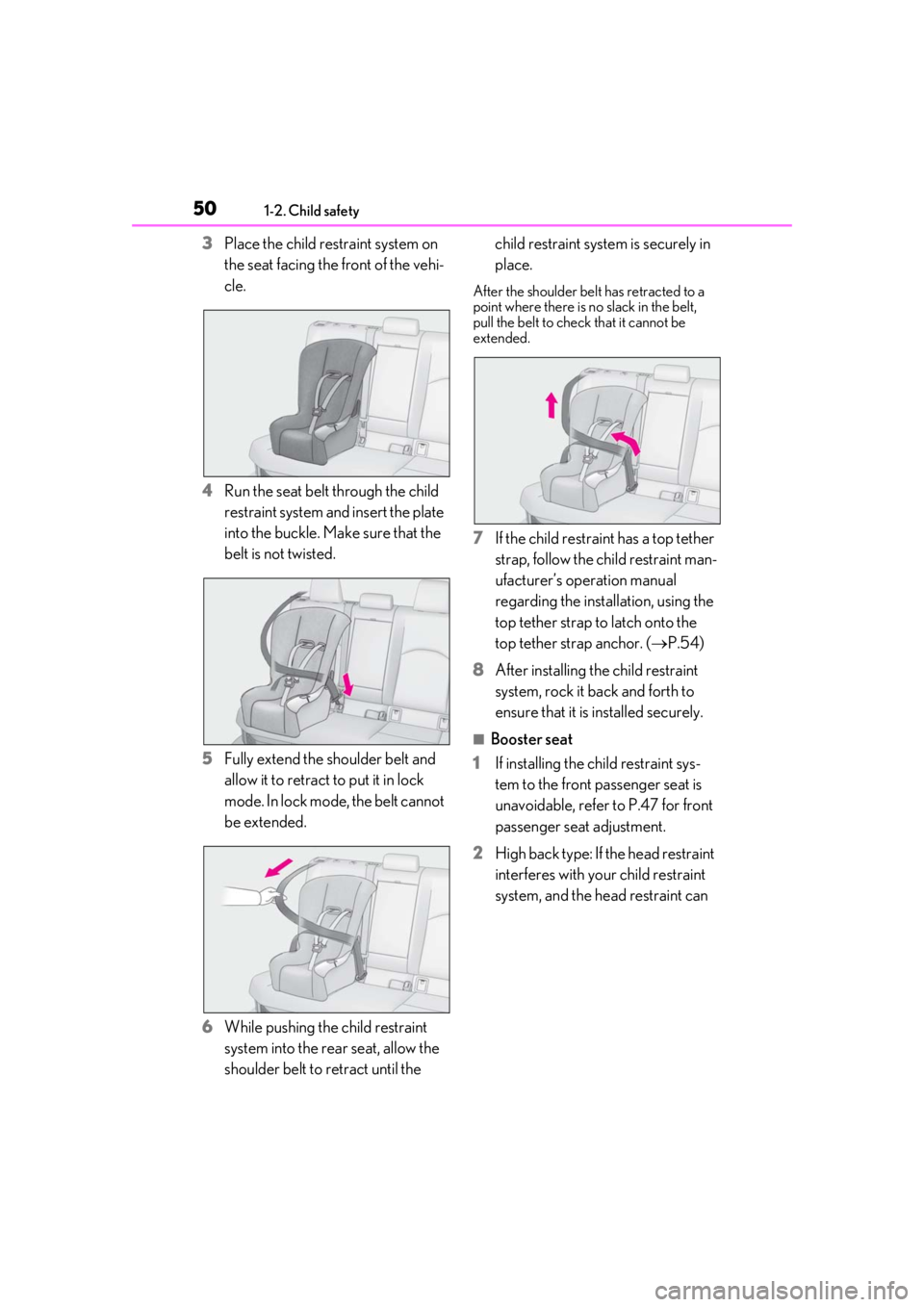
3Place the child restraint system on
the seat facing the front of the vehi-
cle.
4 Run the seat belt through the child
restraint system and insert the plate
into the buckle. Make sure that the
belt is not twisted.
5 Fully extend the shoulder belt and
allow it to retract to put it in lock
mode. In lock mode, the belt cannot
be extended.
6 While pushing the child restraint
system into the rear seat, allow the
shoulder belt to retract until the child restraint system is securely in
place.
After the shoulder belt has retracted to a
point where there is no slack in the belt,
pull the belt to check that it cannot be
extended.
7
If the child restraint has a top tether
strap, follow the child restraint man-
ufacturer’s operation manual
regarding the installation, using the
top tether strap to latch onto the
top tether strap anchor. ( P.54)
8 After installing the child restraint
system, rock it back and forth to
ensure that it is installed securely.
■Booster seat
1 If installing the child restraint sys-
tem to the front passenger seat is
unavoidable, refer to P.47 for front
passenger seat adjustment.
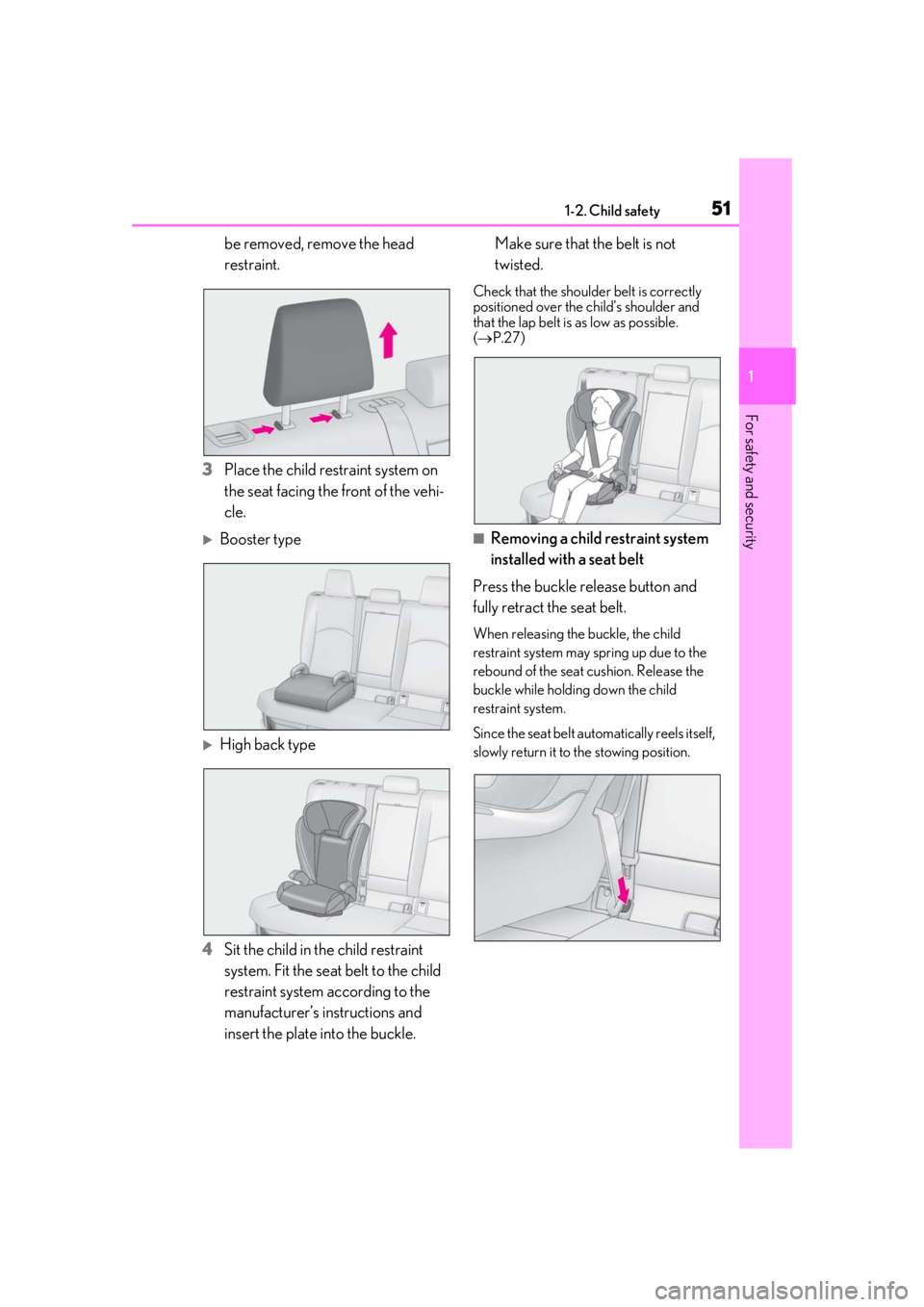
2 High back type: If the head restraint
interferes with your child restraint
system, and the head restraint can
Page 51 of 476
511-2. Child safety
1
For safety and security
be removed, remove the head
restraint.
3 Place the child restraint system on
the seat facing the front of the vehi-
cle.
Booster type
High back type
4 Sit the child in the child restraint
system. Fit the seat belt to the child
restraint system according to the
manufacturer’s in structions and
insert the plate into the buckle. Make sure that the belt is not
twisted.
Check that the shoulder
belt is correctly
positioned over the child’s shoulder and
that the lap belt is as low as possible.
( P.27)
■Removing a child restraint system
installed with a seat belt
Press the buckle release button and
fully retract the seat belt.
When releasing the buckle, the child
restraint system may sp ring up due to the
rebound of the seat cushion. Release the
buckle while holding down the child
restraint system.
Since the seat belt auto matically reels itself,
slowly return it to the stowing position.
Page 63 of 476
631-4. Hybrid system
1
For safety and security
charged.
*: When the hybrid battery (traction bat-tery) requires charging or the engine is
warming up, etc., the gasoline engine will
not automatically stop. ( P.63)
■During normal driving
The gasoline engine is predominantly
used. The electric motor (traction
motor) charges the hybrid battery
(traction battery) as necessary.
■When accelerating sharply
When the accelerator pedal is
depressed heavily, the power of the
hybrid battery (traction battery) is
added to that of the gasoline engine via
the electric motor (traction motor).
■When braking (regenerative brak-
ing)
The wheels operate the electric motor
(traction motor) as a power generator,
and the hybrid battery (traction bat-
tery) is charged.
■Regenerative braking
In the following situations, kinetic energy is
converted to electric energy and decelera-
tion force can be obta ined in conjunction
with the recharging of the hybrid battery
(traction battery).
●The accelerator pedal is released while
driving with the shift lever in D or S.
●The brake pedal is depressed while driv-
ing with the shift lever in D or S.
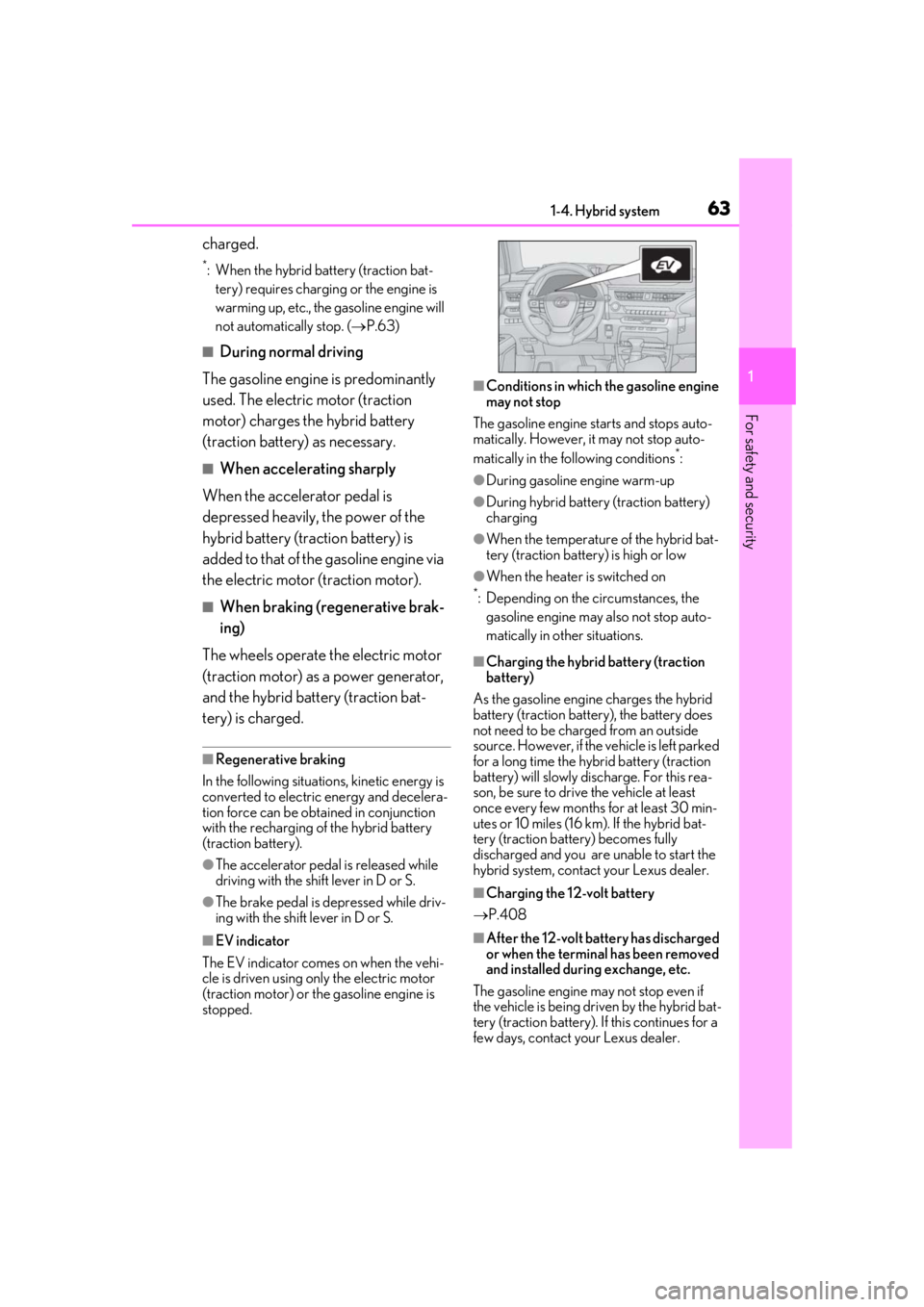
■EV indicator
The EV indicator comes on when the vehi-
cle is driven using only the electric motor
(traction motor) or th e gasoline engine is
stopped.
■Conditions in which the gasoline engine
may not stop
The gasoline engine starts and stops auto-
matically. However, it may not stop auto-
matically in the following conditions
*:
●During gasoline engine warm-up
●During hybrid battery (traction battery)
charging
●When the temperature of the hybrid bat-
tery (traction battery) is high or low
●When the heater is switched on
*: Depending on the circumstances, the gasoline engine may also not stop auto-
matically in other situations.
■Charging the hybrid battery (traction
battery)
As the gasoline engine charges the hybrid
battery (traction battery), the battery does
not need to be charged from an outside
source. However, if the vehicle is left parked
for a long time the hybrid battery (traction
battery) will slowly discharge. For this rea-
son, be sure to drive the vehicle at least
once every few months for at least 30 min-
utes or 10 miles (16 km ). If the hybrid bat-
tery (traction battery) becomes fully
discharged and you are unable to start the
hybrid system, contact your Lexus dealer.
■Charging the 12-volt battery
P.408
■After the 12-volt battery has discharged
or when the terminal has been removed
and installed during exchange, etc.
The gasoline engine may not stop even if
the vehicle is being driven by the hybrid bat-
tery (traction battery). If this continues for a
few days, contact your Lexus dealer.
Page 65 of 476
651-4. Hybrid system
1
For safety and security
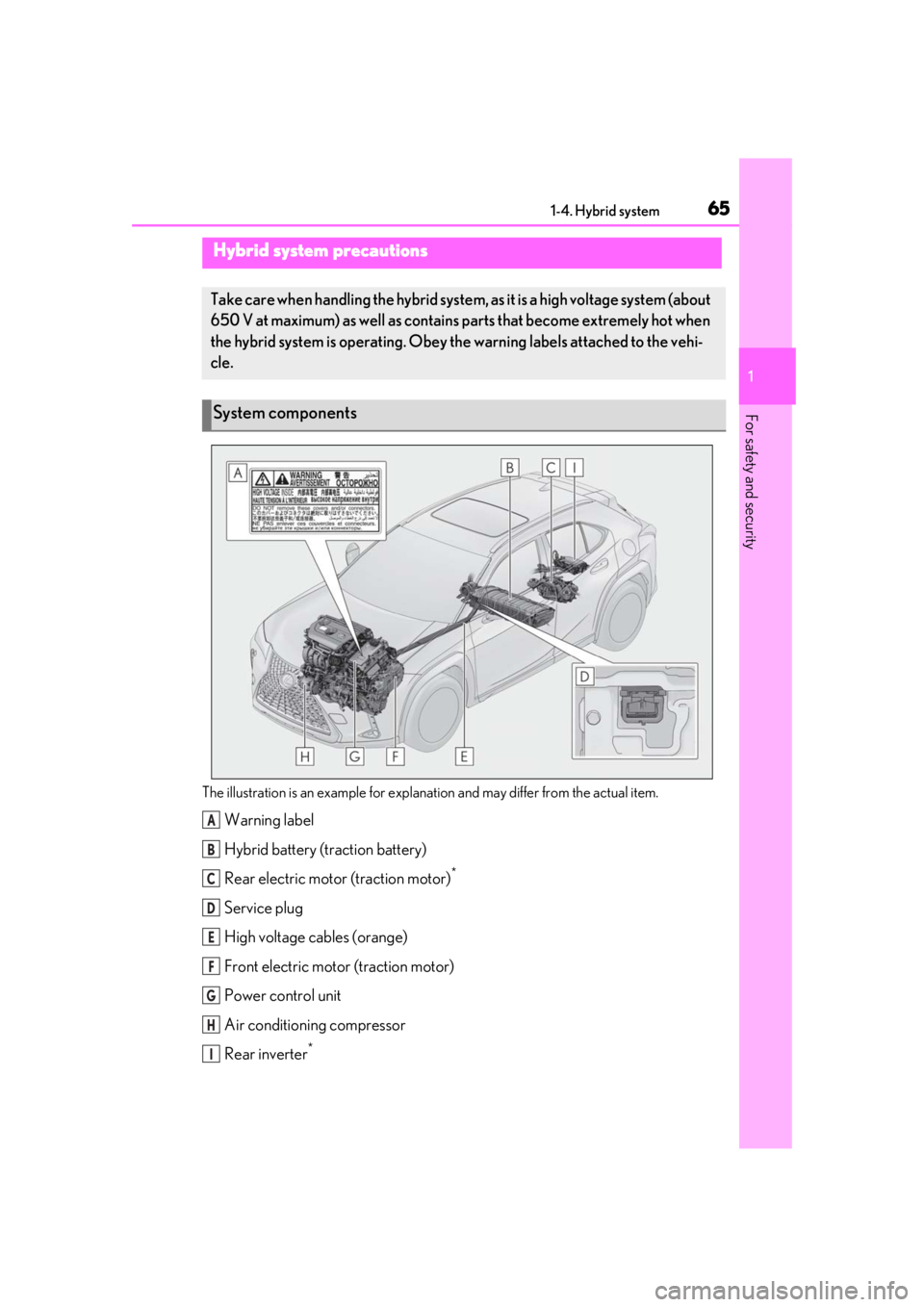
The illustration is an example for explanation and may differ from the actual item.
Warning label
Hybrid battery (traction battery)
Rear electric motor (traction motor)
*
Service plug
High voltage cables (orange)
Front electric motor (traction motor)
Power control unit
Air conditioning compressor
Rear inverter
*
Hybrid system precautions
Take care when handling the hybrid system, as it is a high voltage system (about
650 V at maximum) as well as contains parts that become extremely hot when
the hybrid system is operating. Obey th e warning labels attached to the vehi-
cle.
System components
A
B
C
D
E
F
G
H
I