windshield LEXUS UX250H 2019 Owners Manual
[x] Cancel search | Manufacturer: LEXUS, Model Year: 2019, Model line: UX250H, Model: LEXUS UX250H 2019Pages: 476, PDF Size: 10.51 MB
Page 3 of 476

3TABLE OF CONTENTS
1
2
3
4
5
6
7
8
9
4-1. Before drivingDriving the vehicle ........................ 152
Cargo and luggage ...................... 157
Vehicle load limits ......................... 160
Trailer towing .................................. 160
Dinghy towing ................................. 161
4-2. Driving procedures Power (ignition) switch ............... 162
EV drive mode ............................... 165
Hybrid transmission ..................... 167
Turn signal lever.............................. 171
Parking brake ................................. 172
Brake Hold....................................... 175
ASC (Active Sound Control) .. 176
4-3. Operating the lights and wipers Headlight switch ............................ 177
Automatic High Beam ................ 180
Fog light switch .............................. 183
Windshield wipers and washer 184
Rear window wiper and washer ............................................................ 188
4-4. Refueling Opening the fuel tank cap......... 190
4-5. Using the driving support systems Lexus Safety System+2.0 .......... 192
PCS (Pre-Collision System)..... 198
LTA (Lane Tracing Assist)........ 205
RSA (Road Sign Assist) .............. 214
Dynamic radar crui se control with
full-speed range.......................... 216
BSM (Blind Spot Monitor) ....... 226
PKSA (Parking Support Alert) 231Intuitive parking assist .................
232
RCTA (Rear Cross Traffic Alert) function.......................................... 239
PKSB (Parking Support Brake) 243
Parking Support Brake function (static objects) ............................. 247
Parking Support Brake function (rear-crossing vehicles) .......... 252
Driving mode select switch ..... 255
Driving assist systems ................ 256
4-6. Driving tips Hybrid vehicle driving tips ......... 261
Winter driving tips ....................... 263
Utility vehicle precautions........ 266
5-1. Remote Touch Remote Touch............................... 270
5-2. Lexus Climate Concierge Lexus Climate Concierge......... 274
5-3. Using the air conditioning system and defogger
Automatic air conditioning system.......................................................... 276
Heated steering wheel/seat heat- ers/seat ventilators................... 286
5-4. Using the interior lights Interior lights list ........................... 290
5-5. Using the storage features List of storage features .............. 293
Luggage
compartment features
.......................................................... 296
5-6. Using the other interior features Other interior features ............... 301
Garage door opener .................... 311
4Driving
5Interior features
Page 13 of 476
13Pictorial index
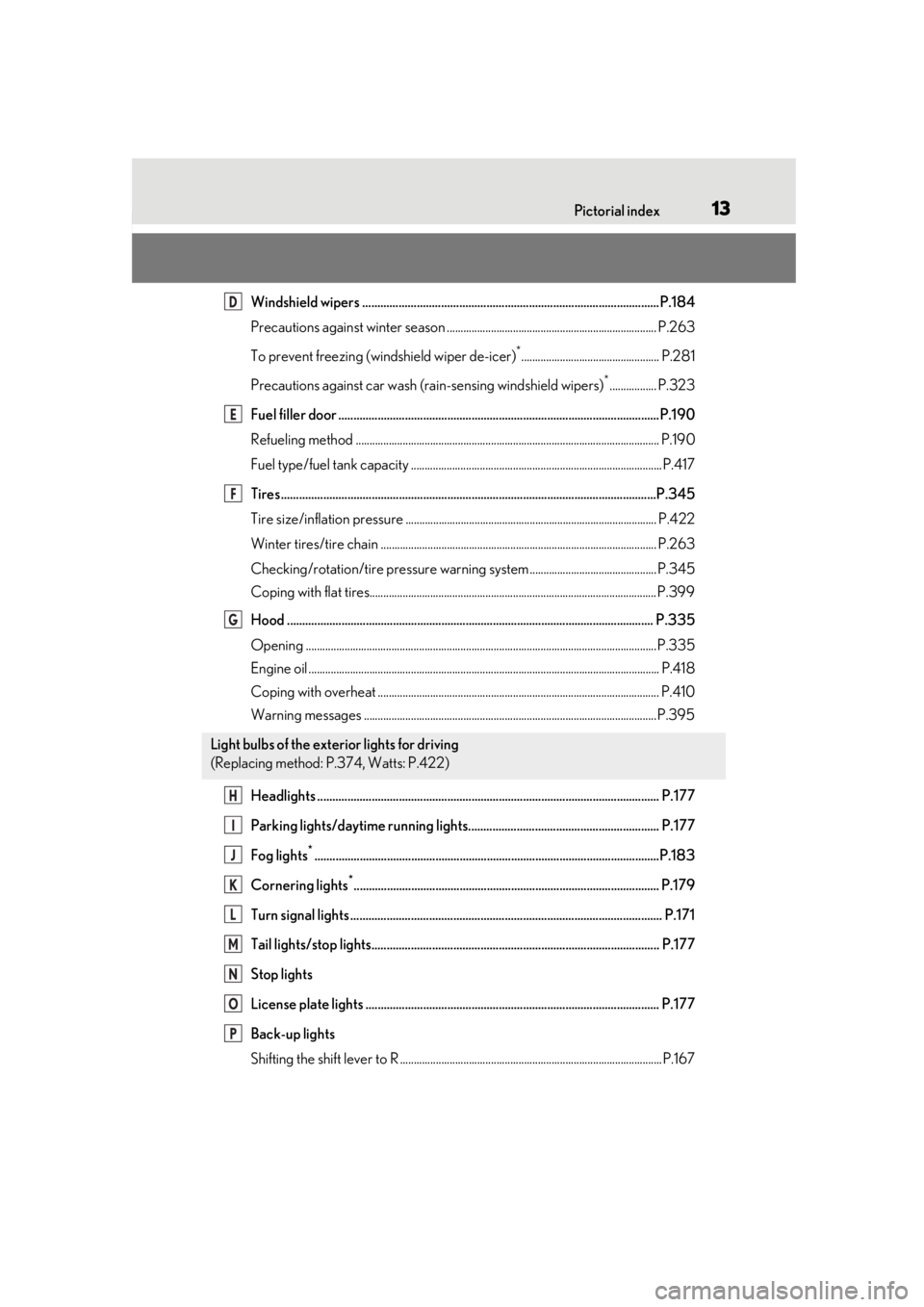
Windshield wipers ..................................................................................................P.184
Precautions against winter season ............................................................................ P.263
To prevent freezing (windshield wiper de-icer)
*.................................................. P.281
Precautions against car wash (r ain-sensing windshield wipers)
*................. P.323
Fuel filler door ..........................................................................................................P.190
Refueling method .............................................................................................................. P .190
Fuel type/fuel tank capacity ......... ..................................................................................P.417
Tires.......................................................................................................................... ..P.345
Tire size/inflation pressure ........................................................................................... P.422
Winter tires/tire chain .................................................................................................... P.26 3
Checking/rotation/tire pressure warning system.............................................. P.345
Coping with flat tires........................................................................................................ P .399
Hood ......................................................................................................................... P. 335
Opening ........................................................................................................................ .......P.335
Engine oil ..................................................................................................................... .......... P.418
Coping with overheat ...................................................................................................... P.410
Warning messages ..........................................................................................................P.395
Headlights ................................................................................................................. P.17 7
Parking lights/daytime running lights............................................................... P.177
Fog lights
*..................................................................................................................P.183
Cornering lights
*..................................................................................................... P.179
Turn signal lights ....................................................................................................... P.171
Tail lights/stop lights............................................................................................... P.177
Stop lights
License plate lights ................................................................................................. P.177
Back-up lights
Shifting the shift lever to R ...............................................................................................P.1 67
Light bulbs of the exterior lights for driving
(Replacing method: P.374, Watts: P.422)
D
E
F
G
H
I
J
K
L
M
N
O
P
Page 16 of 476

16Pictorial index
When the warning messages are displayed..........................................................P.395
Parking brake switch ............................................................................................. P.172
Applying/releasing ............................................................................................................ P.172
Precautions against winter season ................... ......................................................... P.264
Warning buzzer/message................................................................................ P.387, 395
Turn signal lever ....................................................................................................... P.171
Headlight switch...................................................................................................... P.177
Headlights/parking lights/tail lights/license plate lights/
daytime running lights ....................................................................................................... P. 177
Automatic High Beam ..................................................................................................... P.180
Fog lights
*1............................................................................................................................ P.1 83
Windshield wiper and washer switch ................................................................P.184
Rear window wiper and washer switch ........................................................... P.188
Usage.......................................................................................................................... ..P.184, 188
Adding washer fluid .......................................................................................................... P. 341
Headlight cleaners
*1......................................................................................................... P.184
Warning messages ..........................................................................................................P.395
Emergency flasher switch ...................................................................................P.378
Hood lock release lever ...................................................................................... P.335
Tilt and telescopic steering control switch
*1................................................... P.139
Adjustment ..................................................................................................................... ...... P.139
Driving position memory
*1............................................................................................. P.133
Tilt and telescopic steeri ng lock release lever
*1............................................ P.139
Adjustment ..................................................................................................................... ...... P.139
Air conditioning system ....................................................................................... P.276
Usage.......................................................................................................................... ........... P.276
Rear window defogger....................................................................................................P.277
Audio system
*2
*1
: If equipped
*2: Refer to “NAVIGATION AND MULTIMEDIA SYSTEM OWNER’S MANUAL”.
E
F
G
H
I
J
K
L
M
Page 33 of 476

331-1. For safe use
1
For safety and security
Rear side airbags
Side impact sensors (front door)
Your vehicle is equipped with ADVANCED AIRBAGS designed based on the US
motor vehicle safety standards (FMVSS208). The airbag sensor assembly (ECU)
controls airbag deployment based on information obtained from the sensors etc.
shown in the system components diagram above. This information includes crash
severity and occupant information. As the airbags deploy, a chemical reaction in
the inflators quickly fills the airbags with no n-toxic gas to help restrain the motion of
the occupants.
■If the SRS airbags deploy (inflate)
●Slight abrasions, burns, bruising etc., may
be sustained from SRS airbags, due to the
extremely high speed deployment (infla-
tion) by hot gases.
●A loud noise and white powder will be
emitted.
●Parts of the airbag module (steering
wheel hub, airbag cover and inflator) as
well as the front seat s, parts of the front
and rear pillars, and roof side rails, may
be hot for several minutes. The airbag
itself may also be hot.
●The windshield may crack.
●The hybrid system will be stopped and
fuel supply to the engine will be stopped.
( P.68)
●All of the doors will be unlocked.
( P.109)
●The brakes and stop lights will be con-
trolled automatically. ( P.257)
●The interior lights will turn on automati-
cally. ( P.291)
●The emergency flashers will turn on auto-
matically. ( P.378)
●For Lexus Enform Safety Connect sub-
scribers, if any of the following situations
occur, the system is designed to send an
emergency call to the response center,
notifying them of the vehicle’s location
(without needing to push the “SOS” but-
ton) and an agent will attempt to speak
with the occupants to ascertain the level
of emergency and assi stance required. If
the occupants are unable to communi- cate, the agent automatically treats the
call as an emergency and helps to dis-
patch the necessary emergency services.
(
P.56)
• An SRS airbag is deployed.
• A seat belt pretensioner is activated.
• The vehicle is involved in a severe rear- end collision.
■SRS airbag deployment conditions (SRS
front airbags)
●The SRS front airbags will deploy in the
event of an impact that exceeds the set
threshold level (the level of force corre-
sponding to an approximately 12 - 18
mph [20 - 30 km/h] frontal collision with
a fixed wall that does not move or
deform).
However, this threshold velocity will be con-
siderably higher in the following situations:
• If the vehicle strikes an object, such as a parked vehicle or sign pole, which can
move or deform on impact
• If the vehicle is involved in an underride collision, such as a collision in which the
front of the vehicle underrides, or goes
under, the bed of a truck
●Depending on the type of collision, it is
possible that only the seat belt preten-
sioners will activate.
●The SRS front airbags for the front pas-
senger will not activate if there is no pas-
senger sitting in the front passenger seat.
However, the SRS front airbags for the
front passenger may deploy if luggage is
put in the seat, even if the seat is unoccu-
pied.
Q
R
Page 38 of 476
381-1. For safe use
WARNING
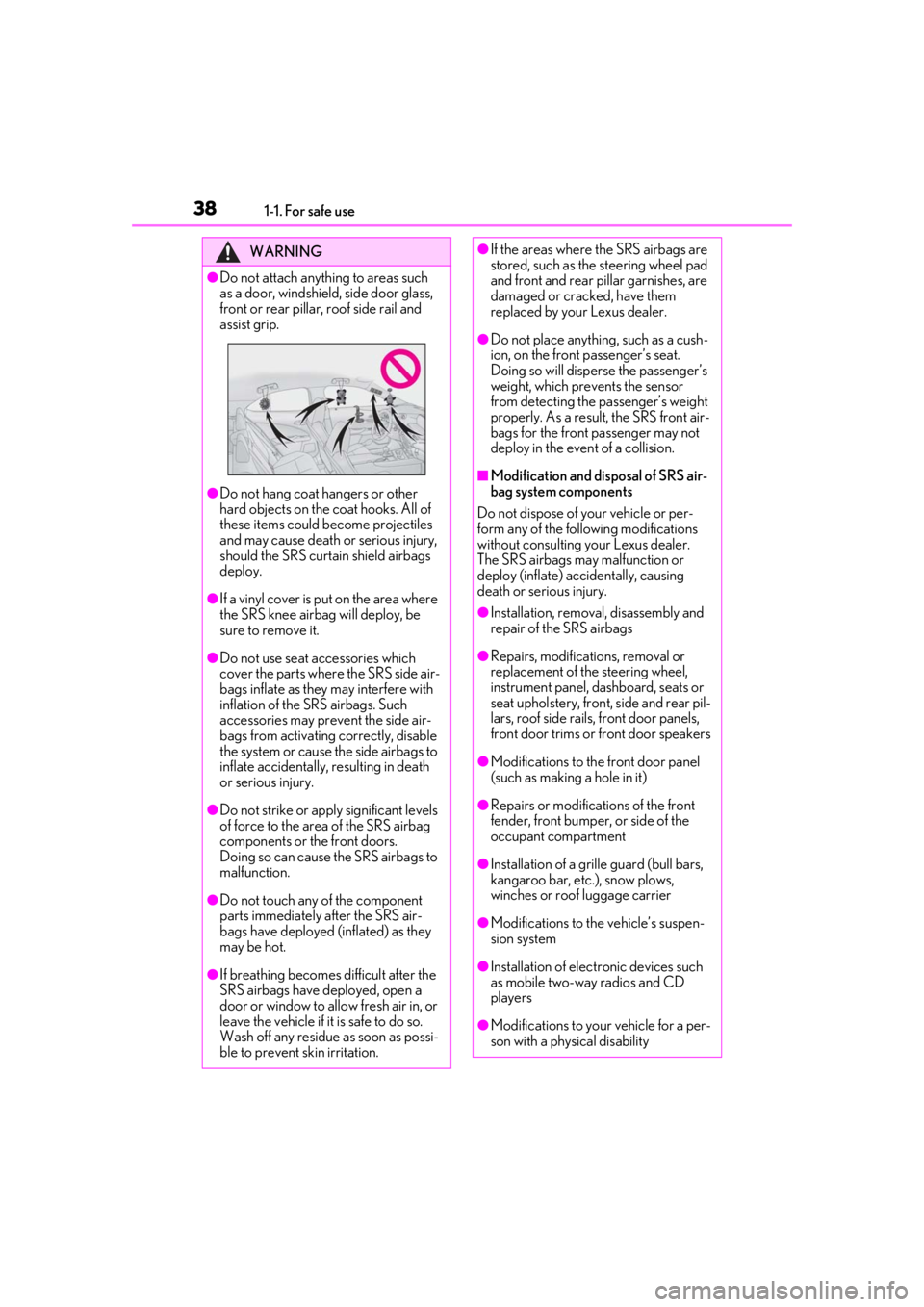
●Do not attach anything to areas such
as a door, windshield, side door glass,
front or rear pillar, roof side rail and
assist grip.
●Do not hang coat hangers or other
hard objects on the coat hooks. All of
these items could become projectiles
and may cause death or serious injury,
should the SRS curtain shield airbags
deploy.
●If a vinyl cover is put on the area where
the SRS knee airbag will deploy, be
sure to remove it.
●Do not use seat accessories which
cover the parts where the SRS side air-
bags inflate as they may interfere with
inflation of the SRS airbags. Such
accessories may prevent the side air-
bags from activating correctly, disable
the system or cause the side airbags to
inflate accidentally, resulting in death
or serious injury.
●Do not strike or apply significant levels
of force to the area of the SRS airbag
components or the front doors.
Doing so can cause the SRS airbags to
malfunction.
●Do not touch any of the component
parts immediately after the SRS air-
bags have deployed (inflated) as they
may be hot.
●If breathing becomes difficult after the
SRS airbags have deployed, open a
door or window to allow fresh air in, or
leave the vehicle if it is safe to do so.
Wash off any residue as soon as possi-
ble to prevent skin irritation.
●If the areas where the SRS airbags are
stored, such as the steering wheel pad
and front and rear pillar garnishes, are
damaged or cracked, have them
replaced by your Lexus dealer.
●Do not place anything, such as a cush-
ion, on the front passenger’s seat.
Doing so will disperse the passenger’s
weight, which prevents the sensor
from detecting the passenger’s weight
properly. As a result, the SRS front air-
bags for the front passenger may not
deploy in the event of a collision.
■Modification and disposal of SRS air-
bag system components
Do not dispose of your vehicle or per-
form any of the following modifications
without consulting your Lexus dealer.
The SRS airbags may malfunction or
deploy (inflate) accidentally, causing
death or serious injury.
●Installation, removal, disassembly and
repair of the SRS airbags
●Repairs, modifications, removal or
replacement of the steering wheel,
instrument panel, dashboard, seats or
seat upholstery, front, side and rear pil-
lars, roof side rails, front door panels,
front door trims or front door speakers
●Modifications to the front door panel
(such as making a hole in it)
●Repairs or modifications of the front
fender, front bumper, or side of the
occupant compartment
●Installation of a grille guard (bull bars,
kangaroo bar, etc.), snow plows,
winches or roof luggage carrier
●Modifications to the vehicle’s suspen-
sion system
●Installation of elec tronic devices such
as mobile two-way radios and CD
players
●Modifications to your vehicle for a per-
son with a physical disability
Page 151 of 476

151
4
4
Driving
Driving
4-1. Before drivingDriving the vehicle ..................... 152
Cargo and luggage ................... 157
Vehicle load limits ...................... 160
Trailer towing ............................... 160
Dinghy towing .............................. 161
4-2. Driving procedures Power (ignition) switch ............ 162
EV drive mode ............................ 165
Hybrid transmission .................. 167
Turn signal lever........................... 171
Parking brake .............................. 172
Brake Hold.................................... 175
ASC (Active Sound Control) 176
4-3. Operating the lights and wipers Headlight switch ......................... 177
Automatic High Beam ............. 180
Fog light switch ........................... 183
Windshield wipers and washer ......................................................... 184
Rear window wiper and washer ......................................................... 188
4-4. Refueling Opening the fuel tank cap...... 190
4-5. Using the driving support sys- tems
Lexus Safety System+2.0 ....... 192
PCS (Pre-Collision System).. 198
LTA (Lane Tracing Assist)..... 205
RSA (Road Sign Assist) ........... 214Dynamic radar cruise control with
full-speed range....................... 216
BSM (Blind Spot Monitor) .... 226
PKSA (Parking Support Alert) ........................................................ 231
Intuitive parking assist ............. 232
RCTA (Rear Cross Traffic Alert) function....................................... 239
PKSB (Parking Support Brake) ....................................................... 243
Parking Support Brake function (static objects) ......................... 247
Parking Support Brake function (rear-crossing vehicles) ...... 252
Driving mode select switch .. 255
Driving assist systems.............. 256
4-6. Driving tips Hybrid vehicle driving tips ..... 261
Winter driving tips .................... 263
Utility vehicle precautions..... 266
Page 155 of 476
1554-1. Before driving
4
Driving
WARNING
●Do not shift the shift lever to a driving
position while the vehicle is moving
backward.
Doing so can damage the hybrid trans-
mission and may result in a loss of vehi-
cle control.
●Shifting the shift lever to N while the
vehicle is moving will disengage the
hybrid system. Engine braking is not
available with the hybrid system disen-
gaged.
●Be careful not to shift the shift lever
with the accelerator pedal depressed.
Shifting the shift lever to any position
other than P or N may lead to unex-
pected rapid acceleration of the vehi-
cle that may cause an accident and
result in death or serious injury.
■If you hear a squealing or scraping
noise (brake pad wear limit indica-
tors)
Have the brake pads checked and
replaced by your Lexus dealer as soon as
possible. Rotor damage may result if the
pads are not replaced when needed.
It is dangerous to drive the vehicle when
the wear limits of the brake pads and/or
those of the brake discs are exceeded.
■When the vehicle is stopped
●Do not depress the accelerator pedal
unnecessarily.
If the shift lever is in any position other
than P or N, the vehicle may acceler-
ate suddenly and unexpectedly, caus-
ing an accident.
●In order to prevent accidents due to
the vehicle rolling away, always keep
depressing the brake pedal while
stopped with the “READY” indicator is
illuminated, and apply the parking
brake as necessary.
●If the vehicle is stopped on an incline,
in order to prevent accidents caused
by the vehicle rolling forward or back-
ward, always depress the brake pedal
and securely apply the parking brake
as needed.
●Avoid revving or racing the engine.
Running the engine at high speed
while the vehicle is stopped may cause
the exhaust system to overheat, which
could result in a fire if combustible
material is nearby.
■When the vehicle is parked
●Do not leave glasses, cigarette lighters,
spray cans, or soft drink cans in the
vehicle when it is in the sun.
Doing so may result in the following:
• Gas may leak from a cigarette lighter or spray can, and may lead to a fire.
• The temperature inside the vehicle may cause the plastic lenses and plas-
tic material of glasses to deform or
crack.
• Soft drink cans may fracture, causing the contents to spray over the interior
of the vehicle, and may also cause a
short circuit in the vehicle’s electrical
components.
●Do not leave cigarette lighters in the
vehicle. If a cigare tte lighter is in a
place such as the glove box or on the
floor, it may be lit accidentally when
luggage is loaded or the seat is
adjusted, causing a fire.
●Do not attach adhesive discs to the
windshield or windows. Do not place
containers such as air fresheners on
the instrument panel or dashboard.
Adhesive discs or containers may act
as lenses, causing a fire in the vehicle.
●Do not leave a door or window open if
the curved glass is coated with a met-
allized film such as a silver-colored
one. Reflected sunlight may cause the
glass to act as a lens, causing a fire.
Page 166 of 476

1664-2. Driving procedures
mation display.
●The temperature of the hybrid system is
high.
The vehicle has been left in the sun,
driven on a hill, driven at high speeds, etc.
●The temperature of the hybrid system is
low.
The vehicle has been left in temperatures
lower than about 32 °F (0 °C) for a long
period of time, etc.
●The gasoline engine is warming up.
●The hybrid battery (traction battery) is
low.
The remaining battery level indicated in
the “Energy Monitor” display is low.
( P.97)
●Vehicle speed is high.
●The accelerator pedal is depressed firmly
or the vehicle is on a hill, etc.
●The windshield defogger is in use.
■Switching to EV drive mode when the
gasoline engine is cold
If the hybrid system is started while the gas-
oline engine is cold, the gasoline engine will
start automatically after a short period of
time in order to warm up. In this case, you
will become unable to switch to EV drive
mode.
After the hybrid system has started and the
“READY” indicator has illuminated, press
the EV drive mode switch before the gaso-
line engine starts to switch to EV drive
mode.
■Automatic cancelation of EV drive
mode
When driving in EV drive mode, the gaso-
line engine may automatically restart in the
following situations. When EV drive mode
is canceled, a buzzer will sound, the EV
drive mode indicator w ill go off after flash-
ing, and a message is displayed on the
multi-information display.
●The hybrid battery (traction battery)
becomes low.
The remaining battery level indicated in
the “Energy Monitor” display is low.
( P.97)
●Vehicle speed is high.
●The accelerator pedal is depressed firmly
or the vehicle is on a hill, etc.
■Possible driving distan ce when driving in
EV drive mode
EV drive mode’s possible driving distance
ranges from a few hundred meters to
approximately 0.6 mile (1 km). However,
depending on vehicle conditions, there are
situations when EV drive mode cannot be
used. (The distance that is possible depends
on the hybrid battery [traction battery] level
and driving conditions.)
■Fuel economy
The hybrid system is designed to achieve
the best possible fuel economy during nor-
mal driving (using the gasoline engine and
electric motor [tractio n motor]). Driving in
EV drive mode more than necessary may
lower fuel economy.
■If “EV Mode Unavailable” is shown on
the multi-information display
The EV drive mode is not available. The rea-
son the EV drive mode is not available (the
vehicle is idling, batter y charge is low, vehi-
cle speed is higher than the EV drive mode
operating speed range or accelerator pedal
is depressed too much) may be displayed.
Use the EV drive mode when it becomes
available.
■If “EV Mode Deactivated” is shown on
the multi-information display
The EV drive mode has been automatically
canceled. The reason the EV drive mode is
not available (the batt ery charge is low,
vehicle speed is higher than the EV drive
mode operating speed range or accelera-
tor pedal is depressed too much) may be
displayed. Drive the vehicle for a while
before attempting to turn on the EV drive
mode again.
Page 178 of 476
1784-3. Operating the lights and wipers
■Automatic light off system
●When the headlights come on: The head-
lights and tail lights turn off 30 seconds
after a driver’s door is opened and closed
if the power switch is turned to ACC or
OFF. (The lights turn off immediately if on the key is pressed after all the
doors are locked.)
●When only the tail lights come on: The tail
lights turn off automatically if the power
switch is turned to ACC or OFF. and the
driver’s door is opened.
To turn the lights on again, turn the power
switch to ON, or turn the light switch off
once and then back to or .
■Automatic headlight leveling system (if
equipped)
The level of the headlights is automatically
adjusted according to the number of pas-
sengers and the loading condition of the
vehicle to ensure that the headlights do not
interfere with other road users.
■Windshield wiper linked headlight illu-
mination
When driving during daytime with the
headlight switch turned to position, if
the windshield wipers are used, the head-
lights will turn on auto matically after several
seconds to help enha nce the visibility of
your vehicle.
■12-volt battery-saving function
In order to prevent the 12-volt battery of the
vehicle from discharging, if the headlights
and/or tail lights are on when the power
switch is turned off the 12-volt battery sav-
ing function will operate and automatically
turn off all the lights after approximately 20 minutes. When the power switch is turned
to ON, the 12-volt battery-saving function
will be disabled.
When any of the following are performed,
the 12-volt battery-saving function is can-
celed once and then reactivated. All the
lights will turn off automatically 20 minutes
after the 12-volt battery-saving function has
been reactivated:
●When the headlight switch is operated
●When a door is opened or closed
■Welcome light illumination control
The parking and tail lights automatically
turn on at night when the doors are
unlocked using the entry function or wire-
less remote control if the light switch is in
the position.
■Customization
Settings (e.g. light sensor sensitivity) can be
changed. (Customizable features:
P.440)
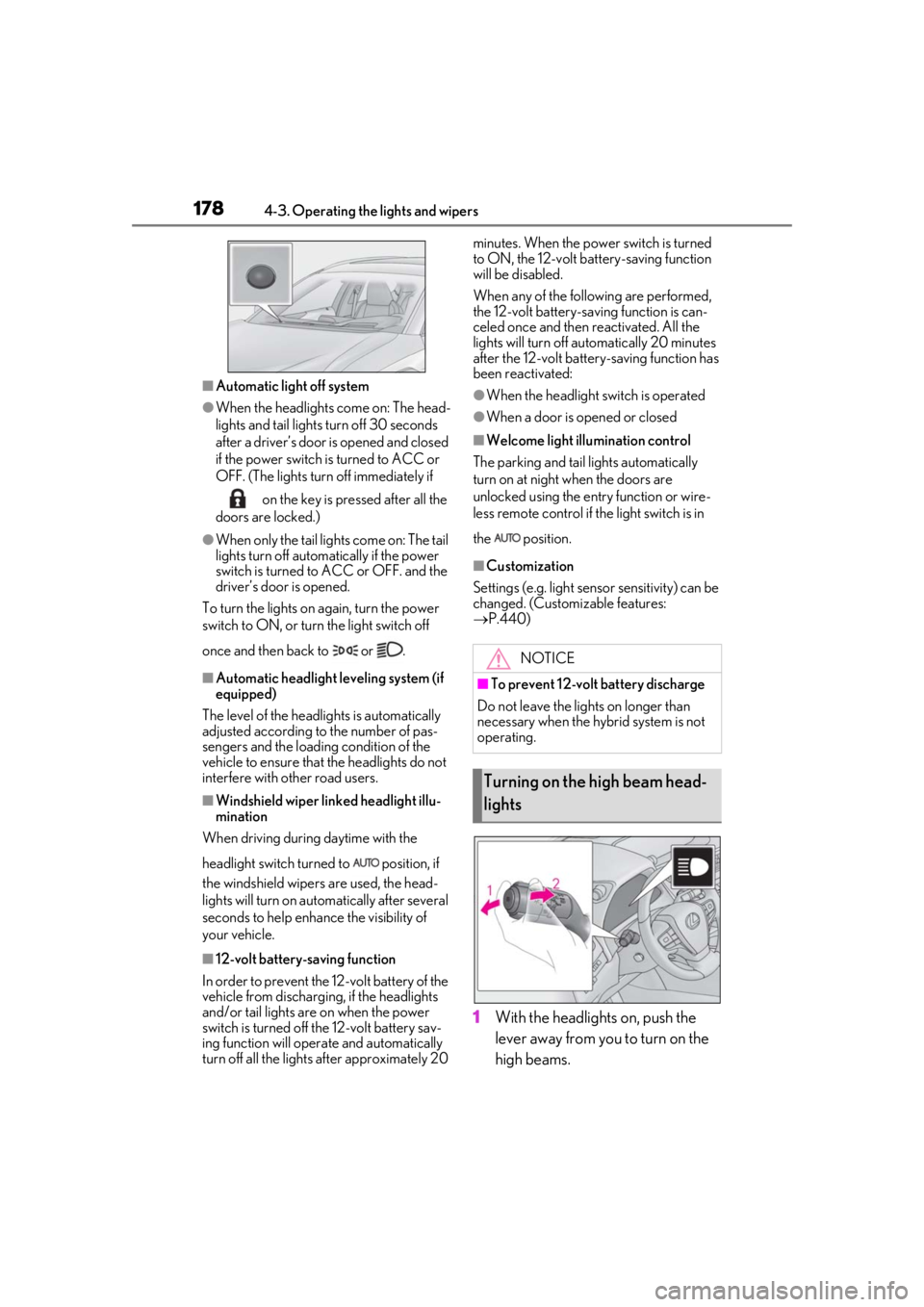
1With the headlights on, push the
lever away from you to turn on the
high beams.
NOTICE
■To prevent 12-volt battery discharge
Do not leave the lights on longer than
necessary when the hybrid system is not
operating.
Turning on the high beam head-
lights
Page 180 of 476
1804-3. Operating the lights and wipers
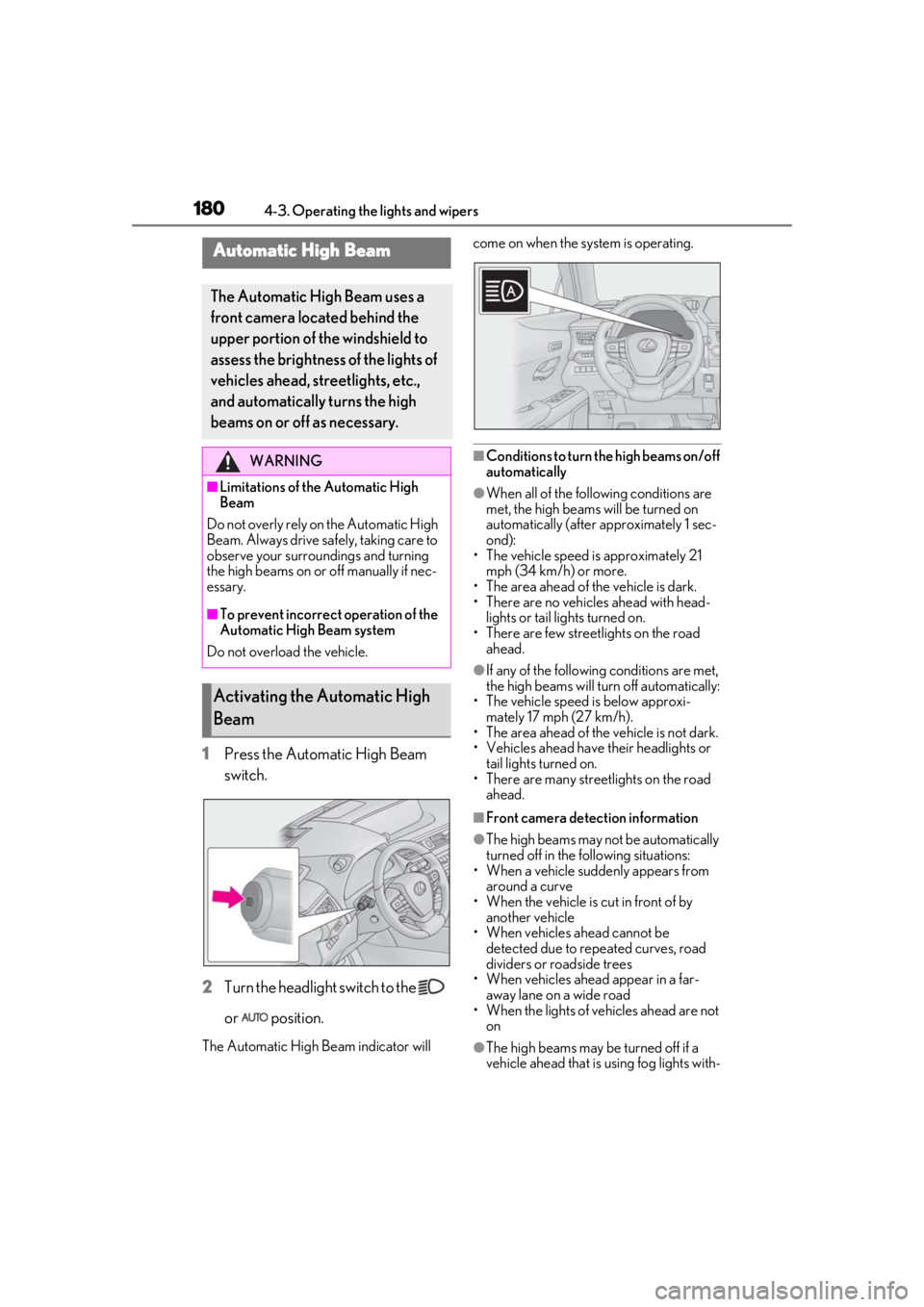
1Press the Automatic High Beam
switch.
2
Turn the headlight switch to the
or position.
The Automatic High Beam indicator will come on when the system is operating.
■Conditions to turn the high beams on/off
automatically
●When all of the follo
wing conditions are
met, the high beams will be turned on
automatically (after approximately 1 sec-
ond):
• The vehicle speed is approximately 21 mph (34 km/h) or more.
• The area ahead of the vehicle is dark.
• There are no vehicles ahead with head- lights or tail lights turned on.
• There are few streetlights on the road ahead.
●If any of the following conditions are met,
the high beams will turn off automatically:
• The vehicle speed is below approxi-
mately 17 mph (27 km/h).
• The area ahead of the vehicle is not dark.
• Vehicles ahead have their headlights or
tail lights turned on.
• There are many streetlights on the road ahead.
■Front camera detection information
●The high beams may not be automatically
turned off in the following situations:
• When a vehicle suddenly appears from around a curve
• When the vehicle is cut in front of by
another vehicle
• When vehicles ahead cannot be detected due to repeated curves, road
dividers or roadside trees
• When vehicles ahead appear in a far- away lane on a wide road
• When the lights of vehicles ahead are not
on
●The high beams may be turned off if a
vehicle ahead that is using fog lights with-
Automatic High Beam
The Automatic High Beam uses a
front camera located behind the
upper portion of the windshield to
assess the brightness of the lights of
vehicles ahead, streetlights, etc.,
and automatically turns the high
beams on or off as necessary.
WARNING
■Limitations of the Automatic High
Beam
Do not overly rely on the Automatic High
Beam. Always drive sa fely, taking care to
observe your surroundings and turning
the high beams on or off manually if nec-
essary.
■To prevent incorrect operation of the
Automatic High Beam system
Do not overload the vehicle.
Activating the Automatic High
Beam