belt LINCOLN AVIATOR 2004 Owner's Guide
[x] Cancel search | Manufacturer: LINCOLN, Model Year: 2004, Model line: AVIATOR, Model: LINCOLN AVIATOR 2004Pages: 336, PDF Size: 3.69 MB
Page 194 of 336
If you smell exhaust fumes inside your vehicle, have your dealer
inspect your vehicle immediately. Do not drive if you smell
exhaust fumes.
Important safety precautions
A computer system controls the engine's idle revolutions per minute
(RPM). When the engine starts, the idle RPM runs higher than normal in
order to warm the engine. If the engine idle speed does not slow down
automatically, have the vehicle checked.
Before starting the vehicle:
1. Make sure all vehicle occupants have buckled their safety belts. For
more information on safety belts and their proper usage, refer to the
Seating and Safety Restraintschapter.
2. Make sure vehicle accessories are off.
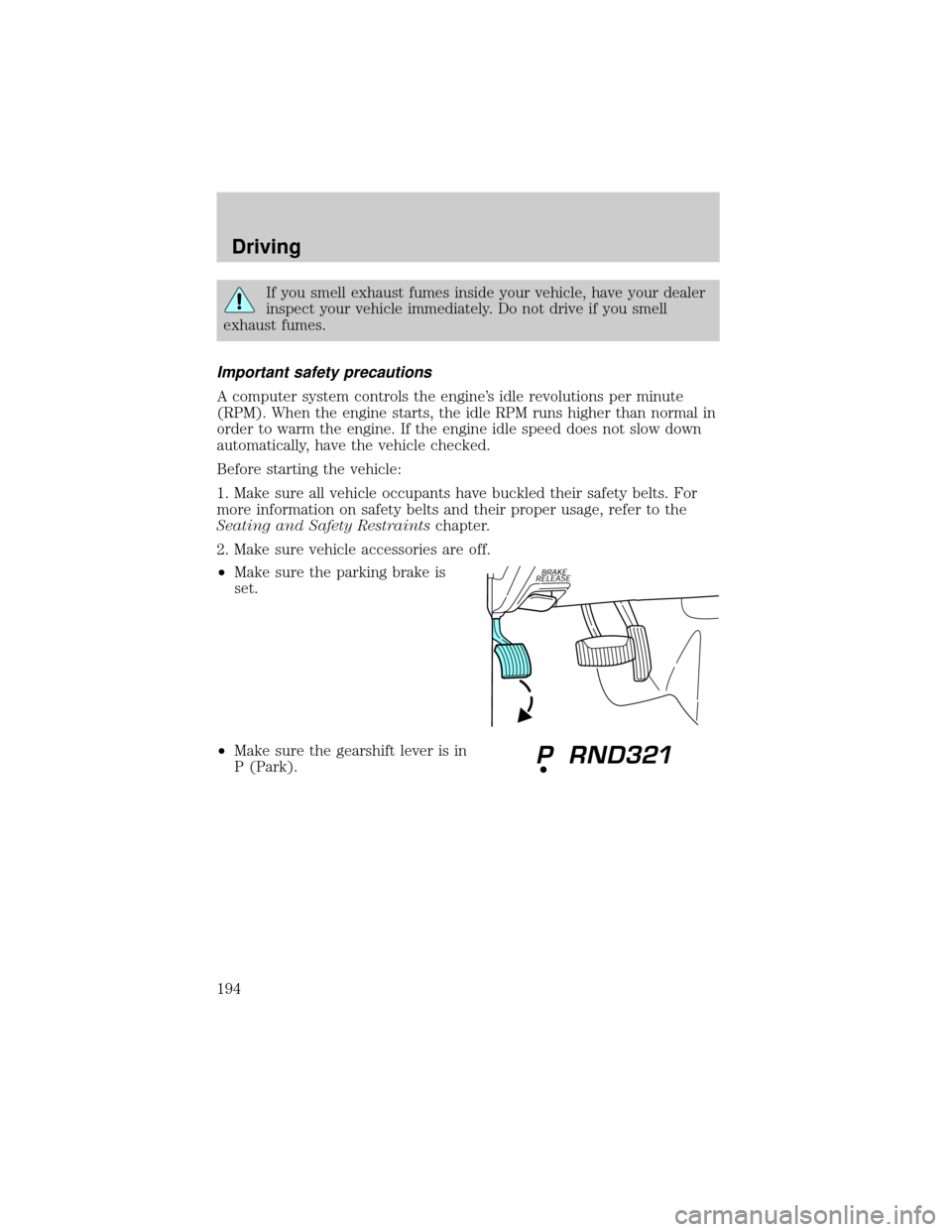
²Make sure the parking brake is
set.
²Make sure the gearshift lever is in
P (Park).
Driving
194
Page 195 of 336
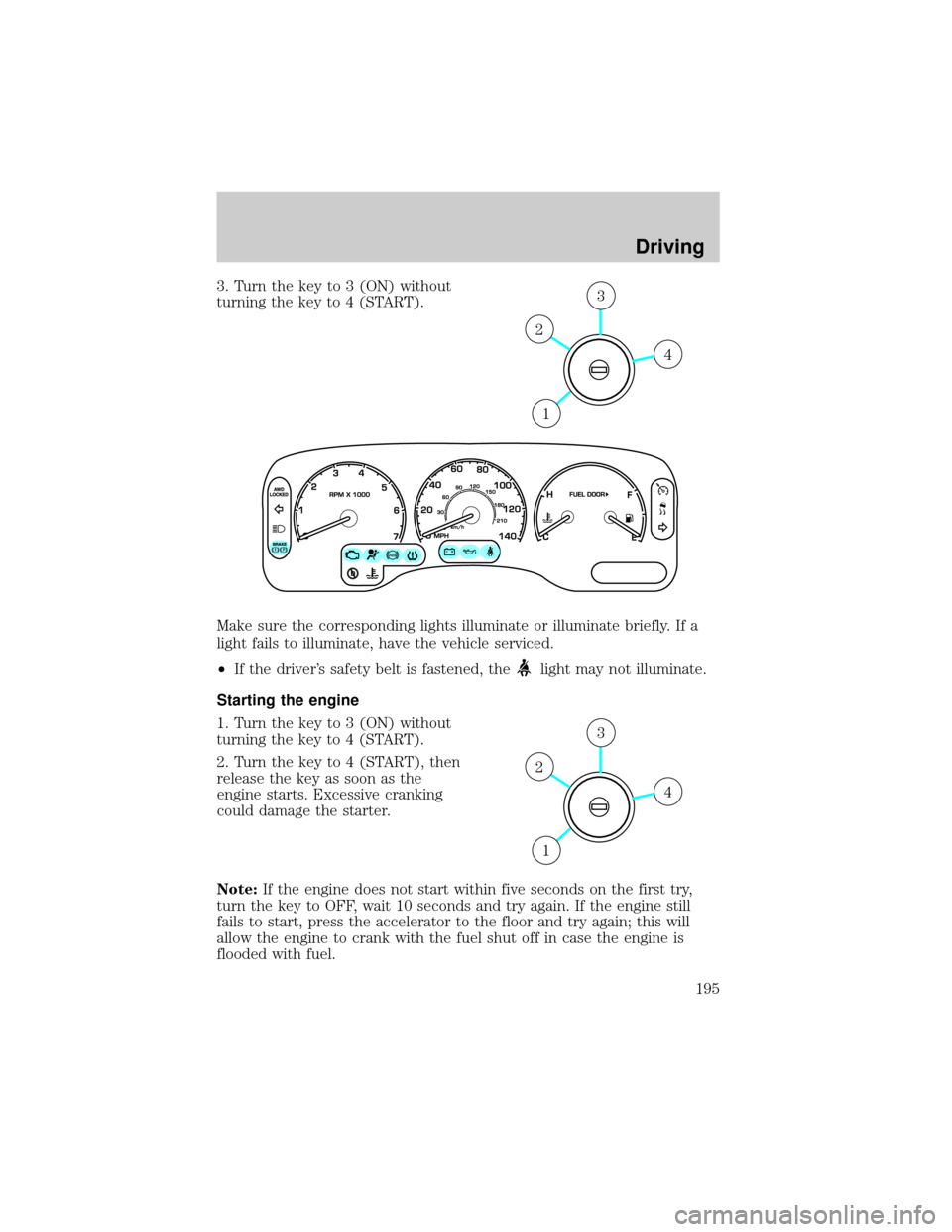
3. Turn the key to 3 (ON) without
turning the key to 4 (START).
Make sure the corresponding lights illuminate or illuminate briefly. If a
light fails to illuminate, have the vehicle serviced.
²If the driver's safety belt is fastened, the
light may not illuminate.
Starting the engine
1. Turn the key to 3 (ON) without
turning the key to 4 (START).
2. Turn the key to 4 (START), then
release the key as soon as the
engine starts. Excessive cranking
could damage the starter.
Note:If the engine does not start within five seconds on the first try,
turn the key to OFF, wait 10 seconds and try again. If the engine still
fails to start, press the accelerator to the floor and try again; this will
allow the engine to crank with the fuel shut off in case the engine is
flooded with fuel.
4
3
2
1
4
3
2
1
Driving
195
Page 203 of 336
²Some noise is normal during operation. If the noise is excessive, check
for low power steering pump fluid level before seeking service by your
dealer.
²Heavy or uneven steering efforts may be caused by low power steering
pump fluid level. Check for low power steering pump fluid level before
seeking service by your dealer.
²Do not fill the power steering pump reservoir above the MAX mark on
the reservoir, as this may result in leaks from the reservoir.
If the power steering system breaks down (or if the engine is turned
off), you can steer the vehicle manually, but it takes more effort.
If the steering wanders or pulls, check for:
²an improperly inflated tire
²uneven tire wear
²loose or worn suspension components
²loose or worn steering components
²improper steering alignment
Speed sensitive steering
Your vehicle is equipped with speed sensitive, variable assist power
steering (VAPS). At low speeds, steering assist will adjust to reduce
efforts and improve low speed maneuverability and at high speeds, the
assist will adjust to improve steering feel.
If the amount of effort required to steer your vehicle changes while
driving at a constant vehicle speed, have the power steering system
checked by your dealer or a qualified service technician.
PREPARING TO DRIVE YOUR VEHICLE
Utility vehicles have a significantly higher rollover rate than
other types of vehicles.
In a rollover crash, an unbelted person is significantly more likely
to die than a person wearing a seat belt.
Your vehicle has special design and equipment features to make it
capable of performing in a wide variety of circumstances. These special
design features, such as larger tires and increased ground clearance, give
the vehicle a higher center of gravity than a passenger car.
Driving
203
Page 253 of 336
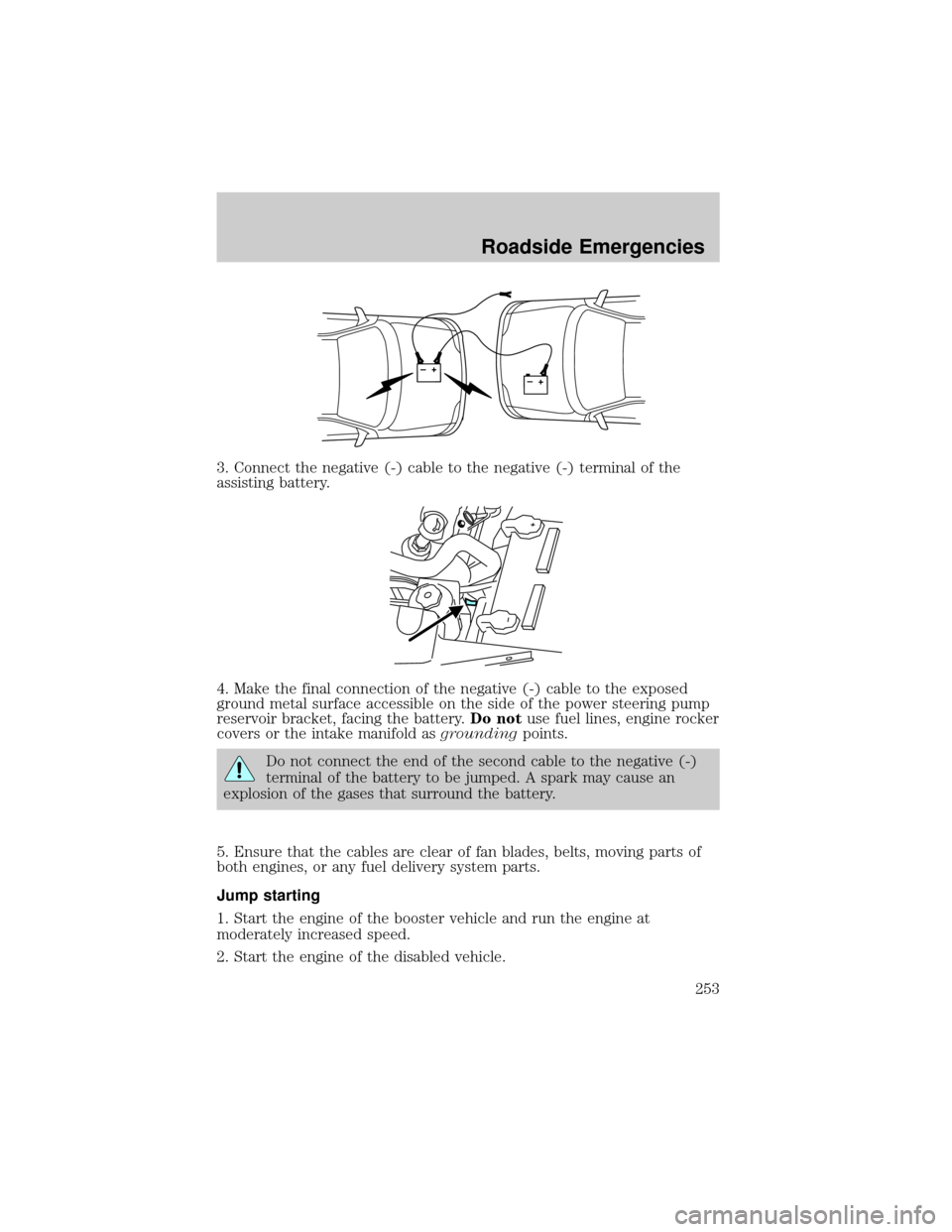
3. Connect the negative (-) cable to the negative (-) terminal of the
assisting battery.
4. Make the final connection of the negative (-) cable to the exposed
ground metal surface accessible on the side of the power steering pump
reservoir bracket, facing the battery.Do notuse fuel lines, engine rocker
covers or the intake manifold asgroundingpoints.
Do not connect the end of the second cable to the negative (-)
terminal of the battery to be jumped. A spark may cause an
explosion of the gases that surround the battery.
5. Ensure that the cables are clear of fan blades, belts, moving parts of
both engines, or any fuel delivery system parts.
Jump starting
1. Start the engine of the booster vehicle and run the engine at
moderately increased speed.
2. Start the engine of the disabled vehicle.
+–+–
Roadside Emergencies
253
Page 256 of 336
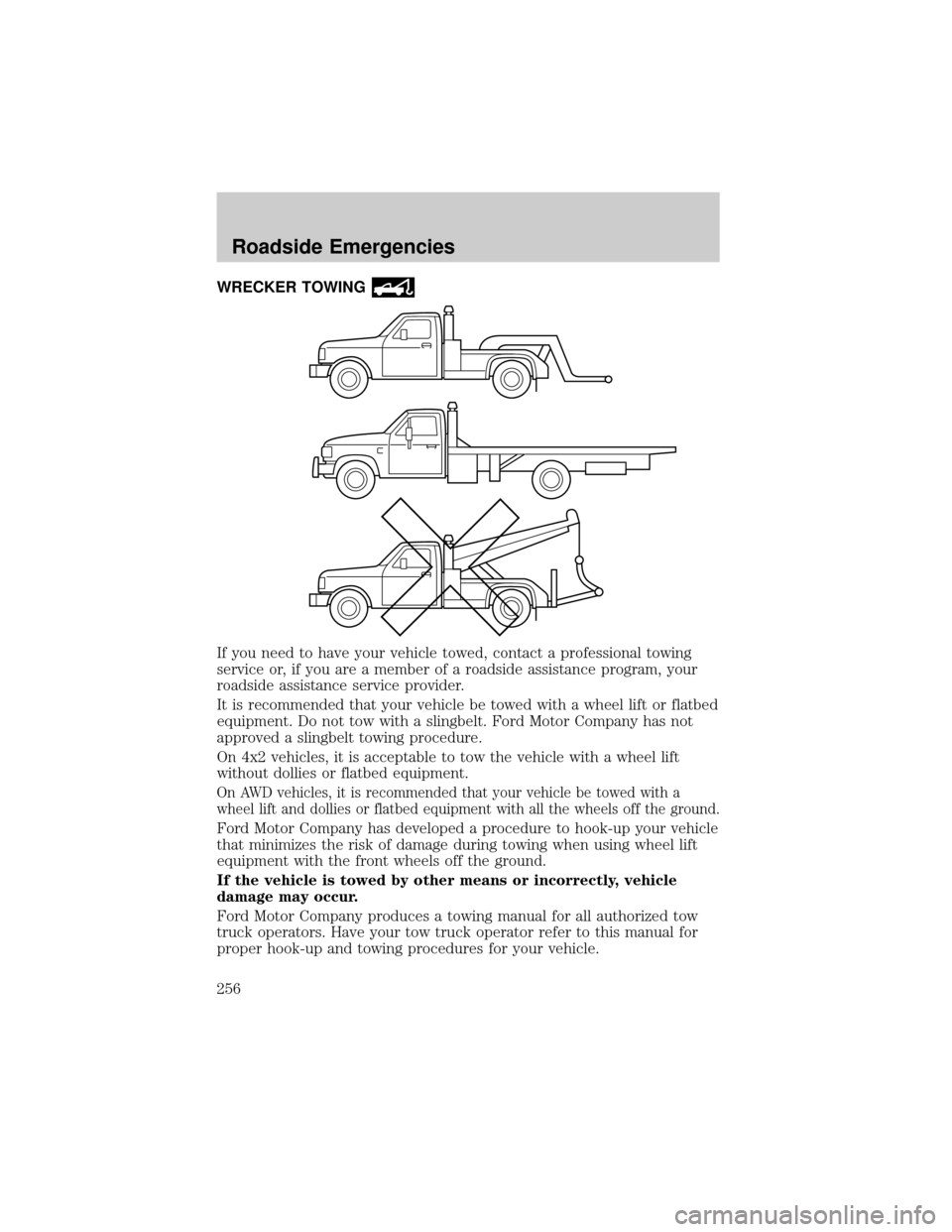
WRECKER TOWING
If you need to have your vehicle towed, contact a professional towing
service or, if you are a member of a roadside assistance program, your
roadside assistance service provider.
It is recommended that your vehicle be towed with a wheel lift or flatbed
equipment. Do not tow with a slingbelt. Ford Motor Company has not
approved a slingbelt towing procedure.
On 4x2 vehicles, it is acceptable to tow the vehicle with a wheel lift
without dollies or flatbed equipment.
On AWD vehicles, it is recommended that your vehicle be towed with a
wheel lift and dollies or flatbed equipment with all the wheels off the ground.
Ford Motor Company has developed a procedure to hook-up your vehicle
that minimizes the risk of damage during towing when using wheel lift
equipment with the front wheels off the ground.
If the vehicle is towed by other means or incorrectly, vehicle
damage may occur.
Ford Motor Company produces a towing manual for all authorized tow
truck operators. Have your tow truck operator refer to this manual for
proper hook-up and towing procedures for your vehicle.
Roadside Emergencies
256
Page 269 of 336
Do not use sharp objects, such as a razor blade, to clean the
inside of the rear window or to remove decals, as it may cause
damage to the rear window defroster's heated grid lines.
INSTRUMENT PANEL AND CLUSTER LENS
Clean the instrument panel with a damp cloth, then dry with a dry cloth.
²Avoid cleaners or polish that increase the gloss of the upper portion of
the instrument panel. The dull finish in this area helps protect the
driver from undesirable windshield reflection.
Do not use chemical solvents or strong detergents when cleaning
the steering wheel or instrument panel to avoid contamination of
the air bag system.
²Be certain to wash or wipe your hands clean if you have been in
contact with certain products such as insect repellent and suntan
lotion in order to avoid possible damage to the interior painted
surfaces.
INTERIOR
For fabric, carpets, cloth seats, safety belts and seats equipped with side
air bags:
²Remove dust and loose dirt with a vacuum cleaner.
²Remove light stains and soil with Motorcraft Extra Strength
Upholstery Cleaner (ZC-41).
²If grease or tar is present on the material, spot-clean the area first
with Motorcraft Spot and Stain Remover (ZC-14).
²Never saturate the seat covers with cleaning solution.
²Do not use household cleaning products or glass cleaners, which can
stain and discolor the fabric and affect the flame retardant abilities of
the seat materials.
Do not use cleaning solvents, bleach or dye on the vehicle's
safety belts, as these actions may weaken the belt webbing.
Do not use chemical solvents or strong detergents when cleaning
the seat-mounted side air bag. Such products could contaminate
the side air bag system and affect performance of the side air bag in a
collision.
Cleaning
269
Page 324 of 336

A
ABS (see Brakes) .....................197
Accessory delay ........................105
AdvanceTrac ..............................199
Air bag supplemental restraint
system ................................174, 178
and child safety seats ............176
description ......................174, 178
disposal ....................................181
driver air bag ..................176, 179
indicator light .........................180
operation .........................176, 179
passenger air bag ...........176, 179
side air bag ..............................178
Air cleaner filter .......................311
All Wheel Drive (AWD),
driving off road .........................211
Ambulance packages ....................7
Antifreeze
(see Engine coolant) ................281
Anti-lock brake system
(see Brakes) ......................197±198
Anti-theft system ......................149
arming the system ..................150
disarming a triggered
system .....................................151
Audio system (see Radio) ...16, 21
Automatic transmission
driving an automatic
overdrive .................................206
fluid, adding ............................296
fluid, checking ........................296
fluid, refill capacities ..............312
fluid, specification ..................316
Auxiliary power point ...............101
Axle
lubricant specifications ..314, 316refill capacities ........................312
B
Battery .......................................279
acid, treating emergencies .....279
jumping a disabled battery ....251
maintenance-free ....................279
replacement, specifications ...311
servicing ..................................279
BeltMinder .................................170
Brakes ........................................196
anti-lock ...........................197±198
anti-lock brake system (ABS)
warning light ...........................198
fluid, checking and adding ....296
fluid, refill capacities ..............312
fluid, specifications .........314, 316
lubricant specifications ..314, 316
parking ....................................198
shift interlock ..........................204
Bulbs ............................................88
C
Calculating load ........................224
Capacities for refilling fluids ....312
Cargo cover ...............................135
Cassette tape player ...................21
CD-single premium .....................16
Cell phone use ..........................131
Certification Label ....................318
Changing a tire .........................243
Child safety restraints ..............182
child safety belts ....................182
Child safety seats ......................184
attaching with tether straps ..188
in front seat ............................186
in rear seat ..............................186
Index
Index
324
Page 328 of 336

radio functions ..........................34
O
Octane rating ............................288
Oil (see Engine oil) ..................276
P
Panic alarm feature, remote
entry system ..............................139
Parking brake ............................198
Parts (see Motorcraft parts) ....311
Pedals (see Power adjustable
foot pedals) ...............................108
Power adjustable foot pedals ...108
Power distribution box
(see Fuses) ...............................238
Power door locks ......................136
Power mirrors ...........................106
Power point ...............................101
Power steering ..................202±203
fluid, checking and adding ....295
fluid, refill capacity ................312
fluid, specifications .........314, 316
Power Windows .........................102
Preparing to drive your
vehicle ........................................203
R
Radio ......................................16, 21
Rear Park Assist .......................209
Rear window defroster ...............81
Relays ................................233, 242
Remote entry system .......137, 139
illuminated entry ....................142locking/unlocking
doors ................................136, 138
opening the trunk ...................139
panic alarm .............................139
replacement/additional
transmitters .............................141
replacing the batteries ...........140
Roadside assistance ..................231
Roof rack ...................................134
S
Safety Belt Maintenance ..........173
Safety belts (see Safety
restraints) ..................165±167, 169
Safety Canopy ...........................179
Safety defects, reporting ..........265
Safety restraints ................165±169
belt minder .............................170
extension assembly ................173
for adults .........................166±167
for children .....................181±182
safety belt maintenance .........173
warning light and chime ........169
Safety seats for children ..........184
Seat belts
(see Safety restraints) .............165
Seats ..........................................153
child safety seats ....................184
climate control ........................157
easy access/easyout feature ..156
memory seat ...................139, 156
SecuriLock passive anti-theft
system ................................146±148
Servicing your vehicle ..............272
Snowplowing .................................7
Spark plugs,
specifications .....................311, 316
Index
328