fuel LINCOLN AVIATOR 2004 Service Manual
[x] Cancel search | Manufacturer: LINCOLN, Model Year: 2004, Model line: AVIATOR, Model: LINCOLN AVIATOR 2004Pages: 336, PDF Size: 3.69 MB
Page 292 of 336
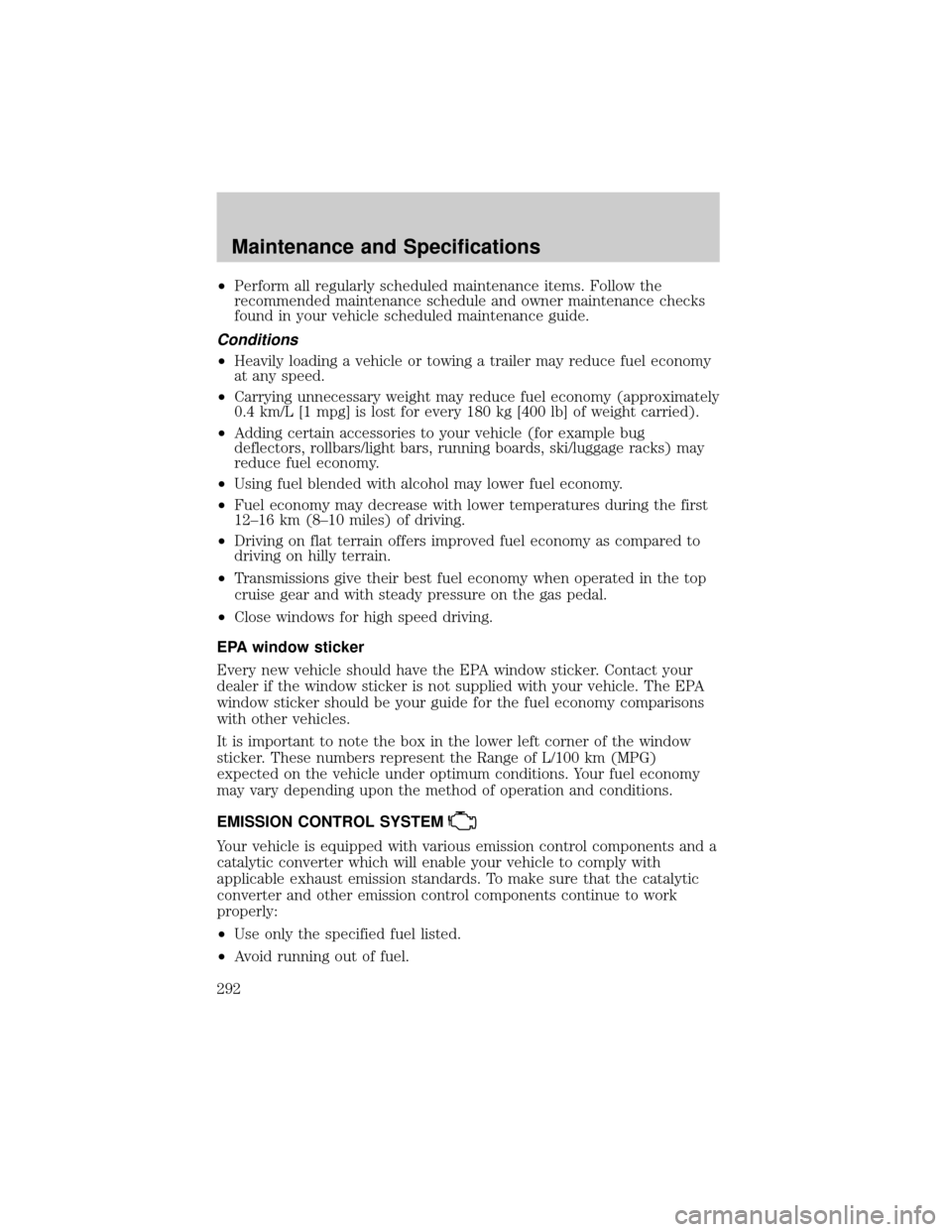
²Perform all regularly scheduled maintenance items. Follow the
recommended maintenance schedule and owner maintenance checks
found in your vehicle scheduled maintenance guide.
Conditions
²Heavily loading a vehicle or towing a trailer may reduce fuel economy
at any speed.
²Carrying unnecessary weight may reduce fuel economy (approximately
0.4 km/L [1 mpg] is lost for every 180 kg [400 lb] of weight carried).
²Adding certain accessories to your vehicle (for example bug
deflectors, rollbars/light bars, running boards, ski/luggage racks) may
reduce fuel economy.
²Using fuel blended with alcohol may lower fuel economy.
²Fuel economy may decrease with lower temperatures during the first
12±16 km (8±10 miles) of driving.
²Driving on flat terrain offers improved fuel economy as compared to
driving on hilly terrain.
²Transmissions give their best fuel economy when operated in the top
cruise gear and with steady pressure on the gas pedal.
²Close windows for high speed driving.
EPA window sticker
Every new vehicle should have the EPA window sticker. Contact your
dealer if the window sticker is not supplied with your vehicle. The EPA
window sticker should be your guide for the fuel economy comparisons
with other vehicles.
It is important to note the box in the lower left corner of the window
sticker. These numbers represent the Range of L/100 km (MPG)
expected on the vehicle under optimum conditions. Your fuel economy
may vary depending upon the method of operation and conditions.
EMISSION CONTROL SYSTEM
Your vehicle is equipped with various emission control components and a
catalytic converter which will enable your vehicle to comply with
applicable exhaust emission standards. To make sure that the catalytic
converter and other emission control components continue to work
properly:
²Use only the specified fuel listed.
²Avoid running out of fuel.
Maintenance and Specifications
292
Page 294 of 336

On board diagnostics (OBD-II)
Your vehicle is equipped with a computer that monitors the engine's
emission control system. This system is commonly known as the On
Board Diagnostics System (OBD-II). This OBD-II system protects the
environment by ensuring that your vehicle continues to meet
government emission standards. The OBD-II system also assists the
service technician in properly servicing your vehicle. When theCheck
Engine/Service Engine Soonlight illuminates, the OBD-II system has
detected a malfunction. Temporary malfunctions may cause yourCheck
Engine/Service Engine Soonlight to illuminate. Examples are:
1. The vehicle has run out of fuel. (The engine may misfire or run
poorly.)
2. Poor fuel quality or water in the fuel.
3. The fuel cap may not have been securely tightened.
These temporary malfunctions can be corrected by filling the fuel tank
with good quality fuel and/or properly tightening the fuel cap. After three
driving cycles without these or any other temporary malfunctions
present, theCheck Engine/Service Engine Soonlight should turn off.
(A driving cycle consists of a cold engine startup followed by mixed
city/highway driving.) No additional vehicle service is required.
If theCheck Engine/Service Engine Soonlight remains on, have your
vehicle serviced at the first available opportunity.
Readiness for Inspection/Maintenance (I/M) testing
In some localities, it may be a legal requirement to pass an I/M test of
the on-board diagnostics system. If your ªCheck Engine/Service Engine
Soonº light is on, refer to the description in theWarning lights and
chimessection of theInstrument clusterchapter. Your vehicle may not
pass the I/M test with the ªCheck Engine/Service Engine Soonº light on.
If the vehicle's powertrain system or its battery has just been serviced,
the on-board diagnostics system is reset to a ªnot ready for I/M testº
condition. To ready the on-board diagnostics system for I/M testing, a
minimum of 30 minutes of city and highway driving is necessary as
described below:
²First, at least 10 minutes of driving on an expressway or highway.
²Next, at least 20 minutes driving in stop-and-go, city-type traffic with
at least four idle periods.
Maintenance and Specifications
294
Page 299 of 336
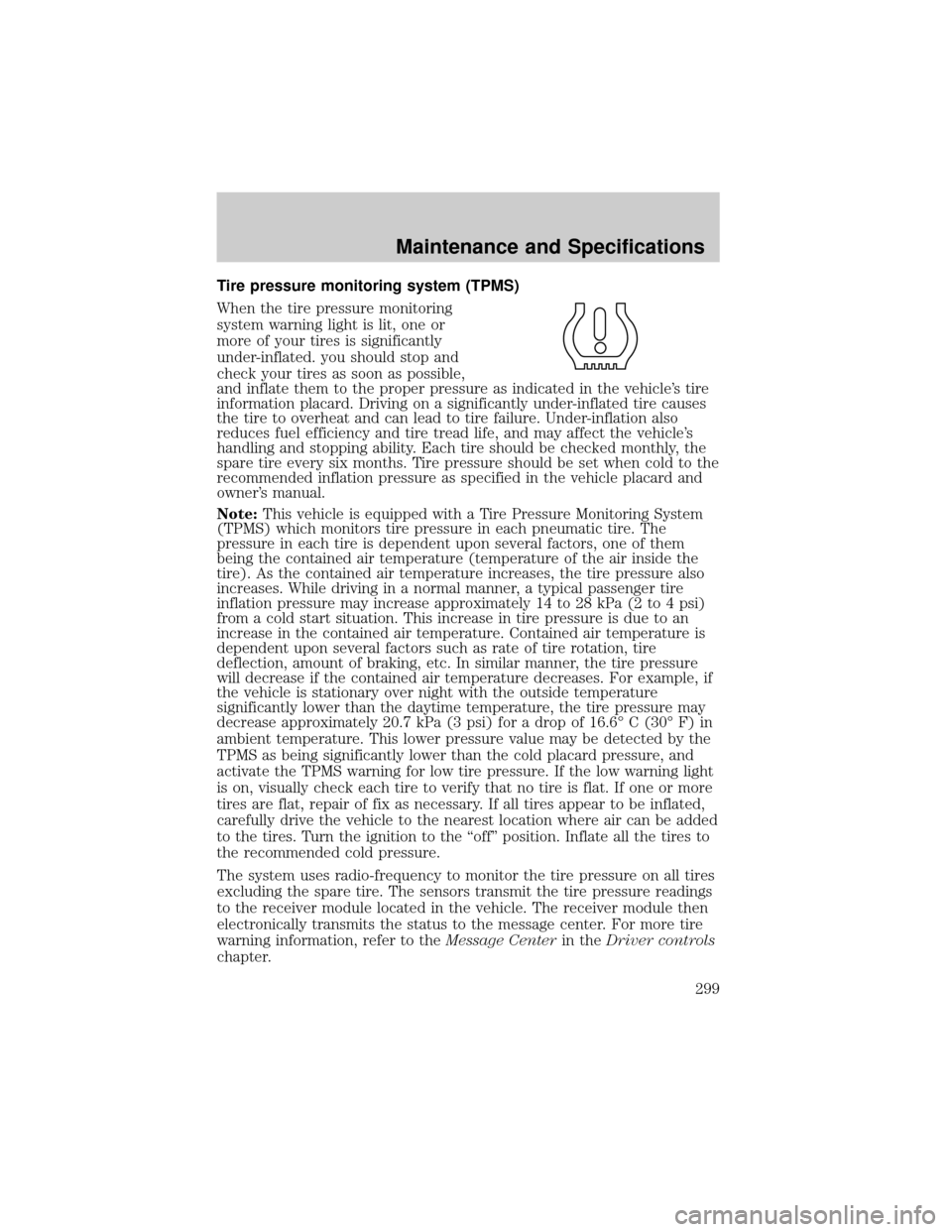
Tire pressure monitoring system (TPMS)
When the tire pressure monitoring
system warning light is lit, one or
more of your tires is significantly
under-inflated. you should stop and
check your tires as soon as possible,
and inflate them to the proper pressure as indicated in the vehicle's tire
information placard. Driving on a significantly under-inflated tire causes
the tire to overheat and can lead to tire failure. Under-inflation also
reduces fuel efficiency and tire tread life, and may affect the vehicle's
handling and stopping ability. Each tire should be checked monthly, the
spare tire every six months. Tire pressure should be set when cold to the
recommended inflation pressure as specified in the vehicle placard and
owner's manual.
Note:This vehicle is equipped with a Tire Pressure Monitoring System
(TPMS) which monitors tire pressure in each pneumatic tire. The
pressure in each tire is dependent upon several factors, one of them
being the contained air temperature (temperature of the air inside the
tire). As the contained air temperature increases, the tire pressure also
increases. While driving in a normal manner, a typical passenger tire
inflation pressure may increase approximately 14 to 28 kPa (2 to 4 psi)
from a cold start situation. This increase in tire pressure is due to an
increase in the contained air temperature. Contained air temperature is
dependent upon several factors such as rate of tire rotation, tire
deflection, amount of braking, etc. In similar manner, the tire pressure
will decrease if the contained air temperature decreases. For example, if
the vehicle is stationary over night with the outside temperature
significantly lower than the daytime temperature, the tire pressure may
decrease approximately 20.7 kPa (3 psi) for a drop of 16.6É C (30É F) in
ambient temperature. This lower pressure value may be detected by the
TPMS as being significantly lower than the cold placard pressure, and
activate the TPMS warning for low tire pressure. If the low warning light
is on, visually check each tire to verify that no tire is flat. If one or more
tires are flat, repair of fix as necessary. If all tires appear to be inflated,
carefully drive the vehicle to the nearest location where air can be added
to the tires. Turn the ignition to the ªoffº position. Inflate all the tires to
the recommended cold pressure.
The system uses radio-frequency to monitor the tire pressure on all tires
excluding the spare tire. The sensors transmit the tire pressure readings
to the receiver module located in the vehicle. The receiver module then
electronically transmits the status to the message center. For more tire
warning information, refer to theMessage Centerin theDriver controls
chapter.
Maintenance and Specifications
299
Page 311 of 336
Follow these guidelines when using snow tires and chains:
²Use only cable type chains or chains offered by Ford as an accessory
or equivalent. Other conventional link type chains may contact and
cause damage to the vehicle's wheel house and/or body.
²Do not install chains on the front wheels. Chains on the front wheels
may interfere with suspension components.
²Install chains securely, verifying that the chains do not touch any
wiring, brake lines or fuel lines.
²Drive cautiously. If you hear the chains rub or bang against your
vehicle, stop and re-tighten the chains. If this does not work, remove
the chains to prevent damage to your vehicle.
²If possible, avoid fully loading your vehicle.
²Remove the tire chains when they are no longer needed. Do not use
tire chains on dry roads.
²The suspension insulation and bumpers will help prevent vehicle
damage. Do not remove these components from your vehicle when
using snow tires and chains.
²Do not exceed 48 km/h (30 mph) with tire chains on your vehicle.
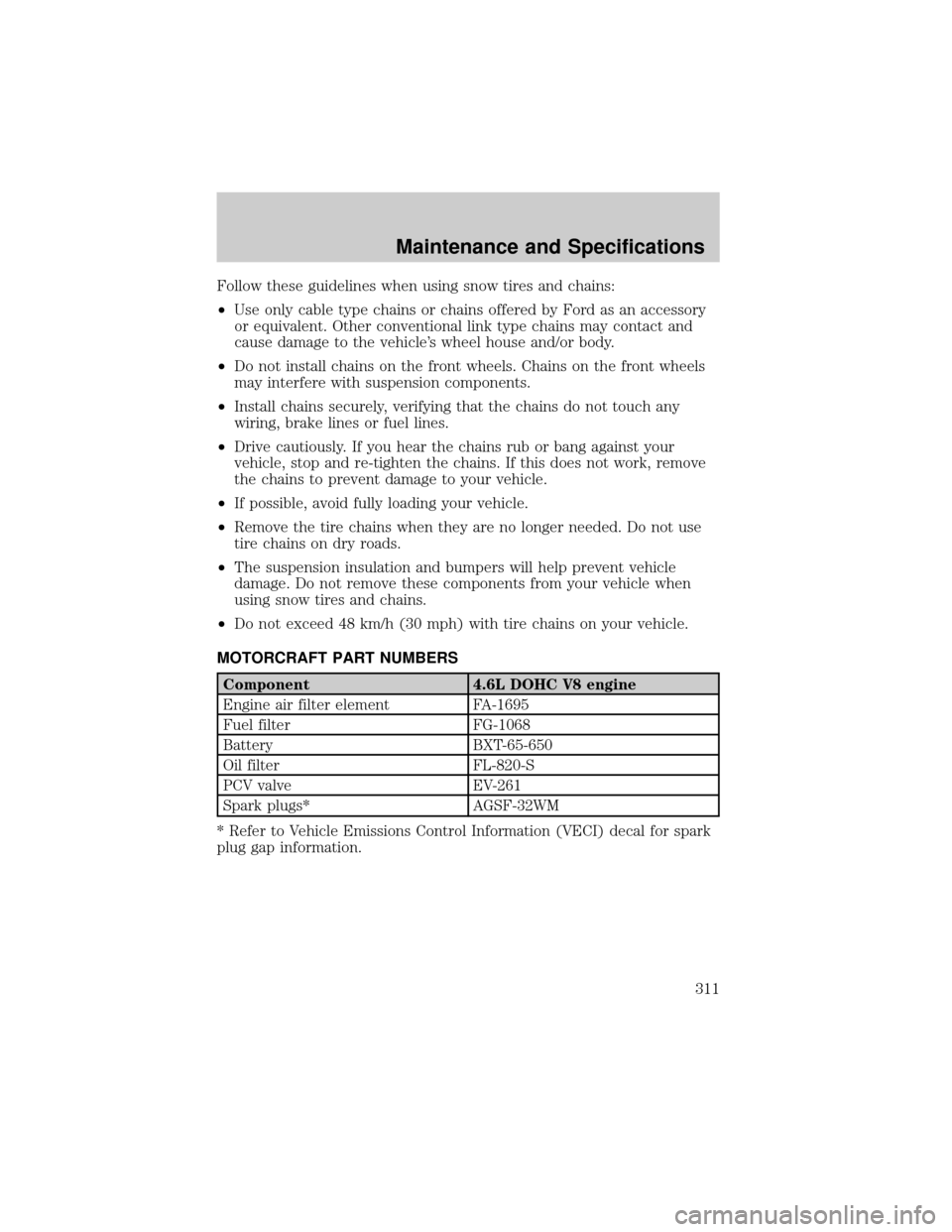
MOTORCRAFT PART NUMBERS
Component 4.6L DOHC V8 engine
Engine air filter element FA-1695
Fuel filter FG-1068
Battery BXT-65-650
Oil filter FL-820-S
PCV valve EV-261
Spark plugs* AGSF-32WM
* Refer to Vehicle Emissions Control Information (VECI) decal for spark
plug gap information.
Maintenance and Specifications
311
Page 312 of 336
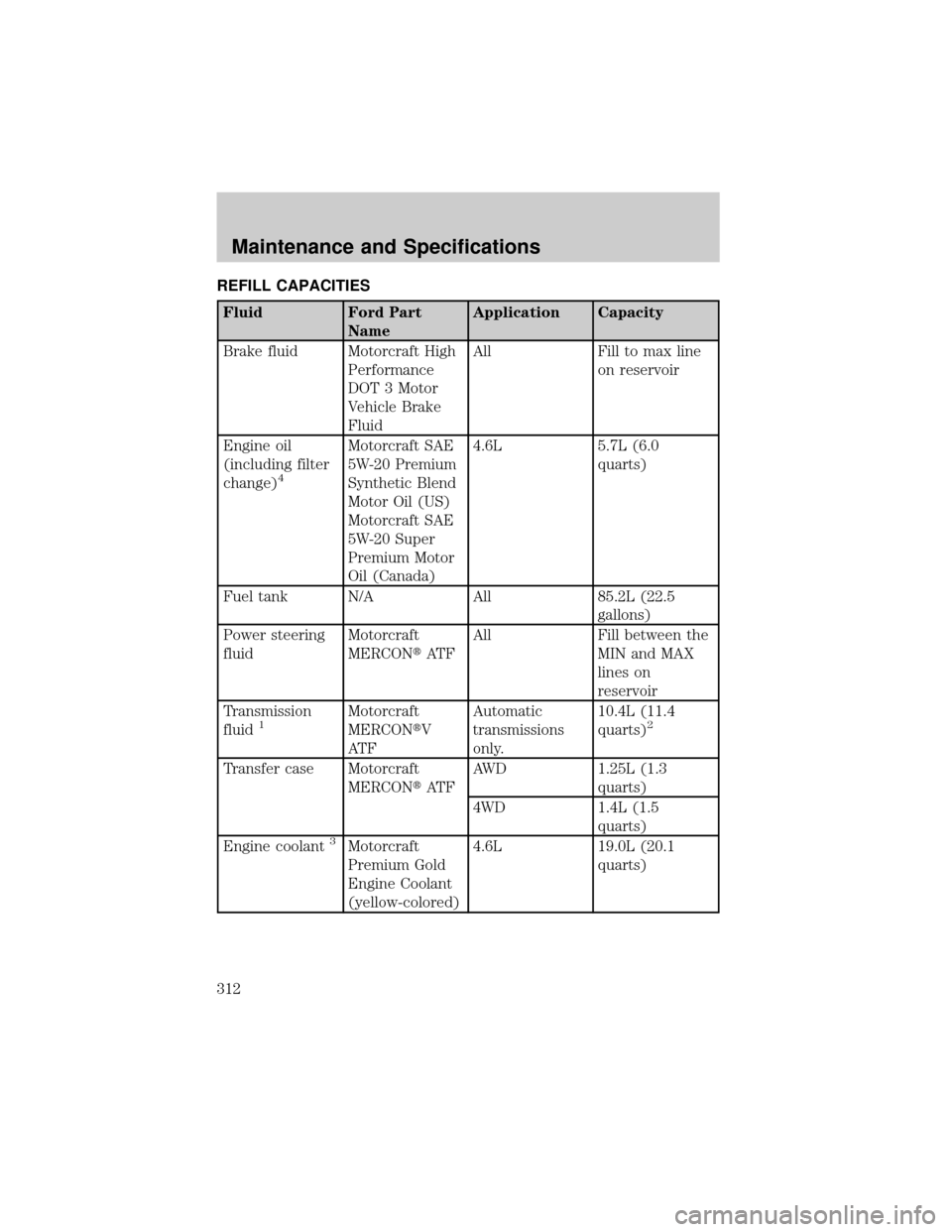
REFILL CAPACITIES
Fluid Ford Part
NameApplication Capacity
Brake fluid Motorcraft High
Performance
DOT 3 Motor
Vehicle Brake
FluidAll Fill to max line
on reservoir
Engine oil
(including filter
change)
4
Motorcraft SAE
5W-20 Premium
Synthetic Blend
Motor Oil (US)
Motorcraft SAE
5W-20 Super
Premium Motor
Oil (Canada)4.6L 5.7L (6.0
quarts)
Fuel tank N/A All 85.2L (22.5
gallons)
Power steering
fluidMotorcraft
MERCONtAT FAll Fill between the
MIN and MAX
lines on
reservoir
Transmission
fluid
1Motorcraft
MERCONtV
AT FAutomatic
transmissions
only.10.4L (11.4
quarts)2
Transfer case Motorcraft
MERCONtAT FAWD 1.25L (1.3
quarts)
4WD 1.4L (1.5
quarts)
Engine coolant
3Motorcraft
Premium Gold
Engine Coolant
(yellow-colored)4.6L 19.0L (20.1
quarts)
Maintenance and Specifications
312
Page 313 of 336
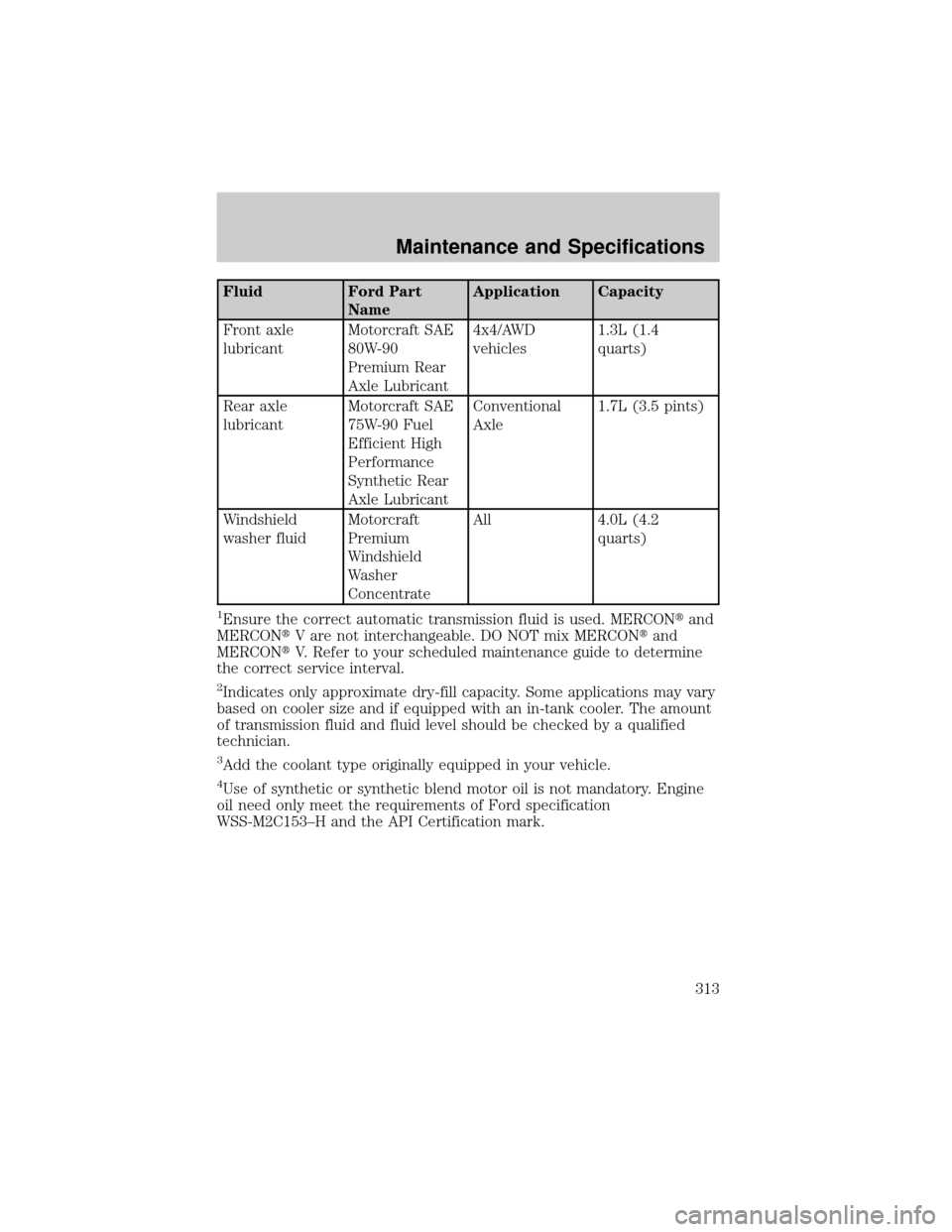
Fluid Ford Part
NameApplication Capacity
Front axle
lubricantMotorcraft SAE
80W-90
Premium Rear
Axle Lubricant4x4/AWD
vehicles1.3L (1.4
quarts)
Rear axle
lubricantMotorcraft SAE
75W-90 Fuel
Efficient High
Performance
Synthetic Rear
Axle LubricantConventional
Axle1.7L (3.5 pints)
Windshield
washer fluidMotorcraft
Premium
Windshield
Washer
ConcentrateAll 4.0L (4.2
quarts)
1Ensure the correct automatic transmission fluid is used. MERCONtand
MERCONtV are not interchangeable. DO NOT mix MERCONtand
MERCONtV. Refer to your scheduled maintenance guide to determine
the correct service interval.
2Indicates only approximate dry-fill capacity. Some applications may vary
based on cooler size and if equipped with an in-tank cooler. The amount
of transmission fluid and fluid level should be checked by a qualified
technician.
3Add the coolant type originally equipped in your vehicle.
4Use of synthetic or synthetic blend motor oil is not mandatory. Engine
oil need only meet the requirements of Ford specification
WSS-M2C153±H and the API Certification mark.
Maintenance and Specifications
313
Page 314 of 336
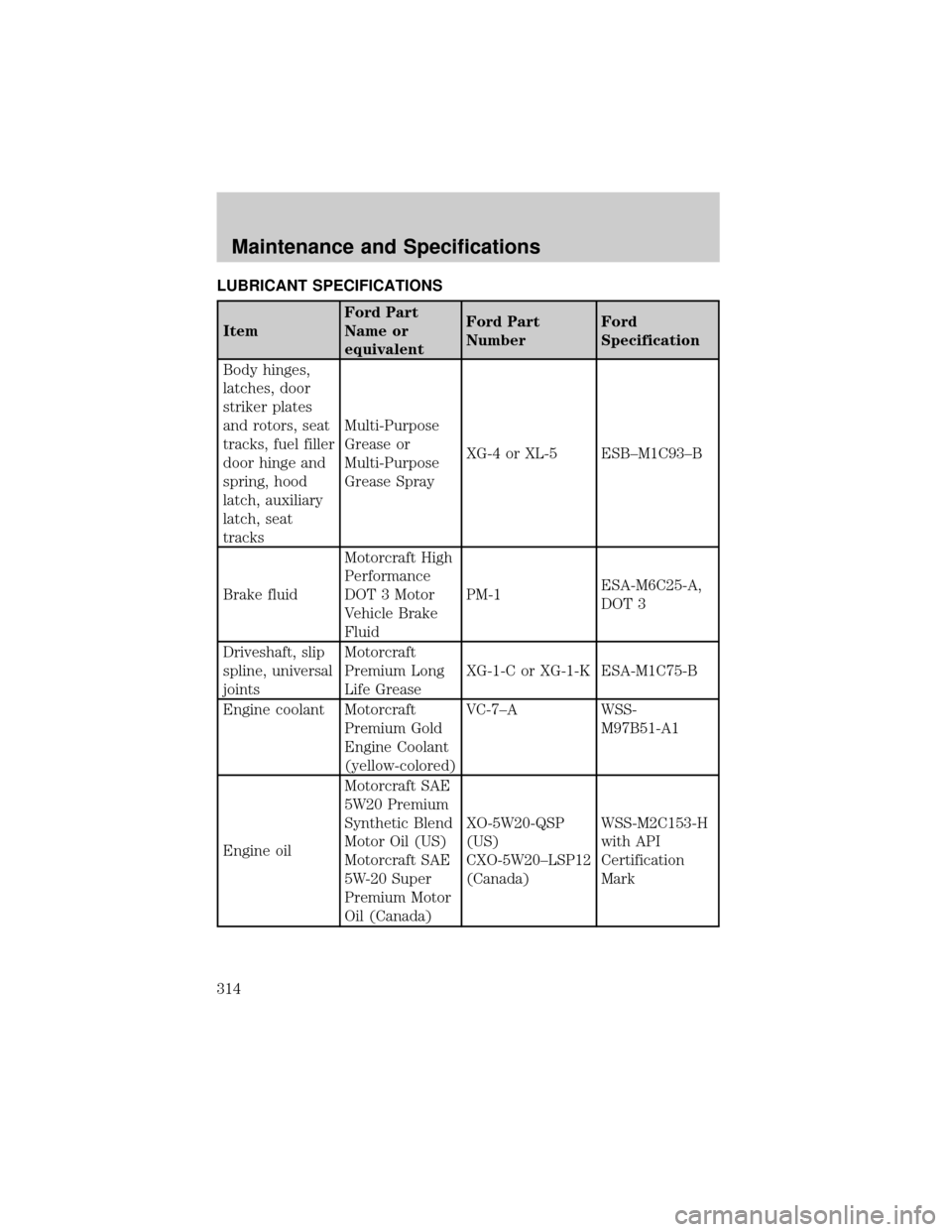
LUBRICANT SPECIFICATIONS
ItemFord Part
Name or
equivalentFord Part
NumberFord
Specification
Body hinges,
latches, door
striker plates
and rotors, seat
tracks, fuel filler
door hinge and
spring, hood
latch, auxiliary
latch, seat
tracksMulti-Purpose
Grease or
Multi-Purpose
Grease SprayXG-4 or XL-5 ESB±M1C93±B
Brake fluidMotorcraft High
Performance
DOT 3 Motor
Vehicle Brake
FluidPM-1ESA-M6C25-A,
DOT 3
Driveshaft, slip
spline, universal
jointsMotorcraft
Premium Long
Life GreaseXG-1-C or XG-1-K ESA-M1C75-B
Engine coolant Motorcraft
Premium Gold
Engine Coolant
(yellow-colored)VC-7±A WSS-
M97B51-A1
Engine oilMotorcraft SAE
5W20 Premium
Synthetic Blend
Motor Oil (US)
Motorcraft SAE
5W-20 Super
Premium Motor
Oil (Canada)XO-5W20-QSP
(US)
CXO-5W20±LSP12
(Canada)WSS-M2C153-H
with API
Certification
Mark
Maintenance and Specifications
314
Page 315 of 336
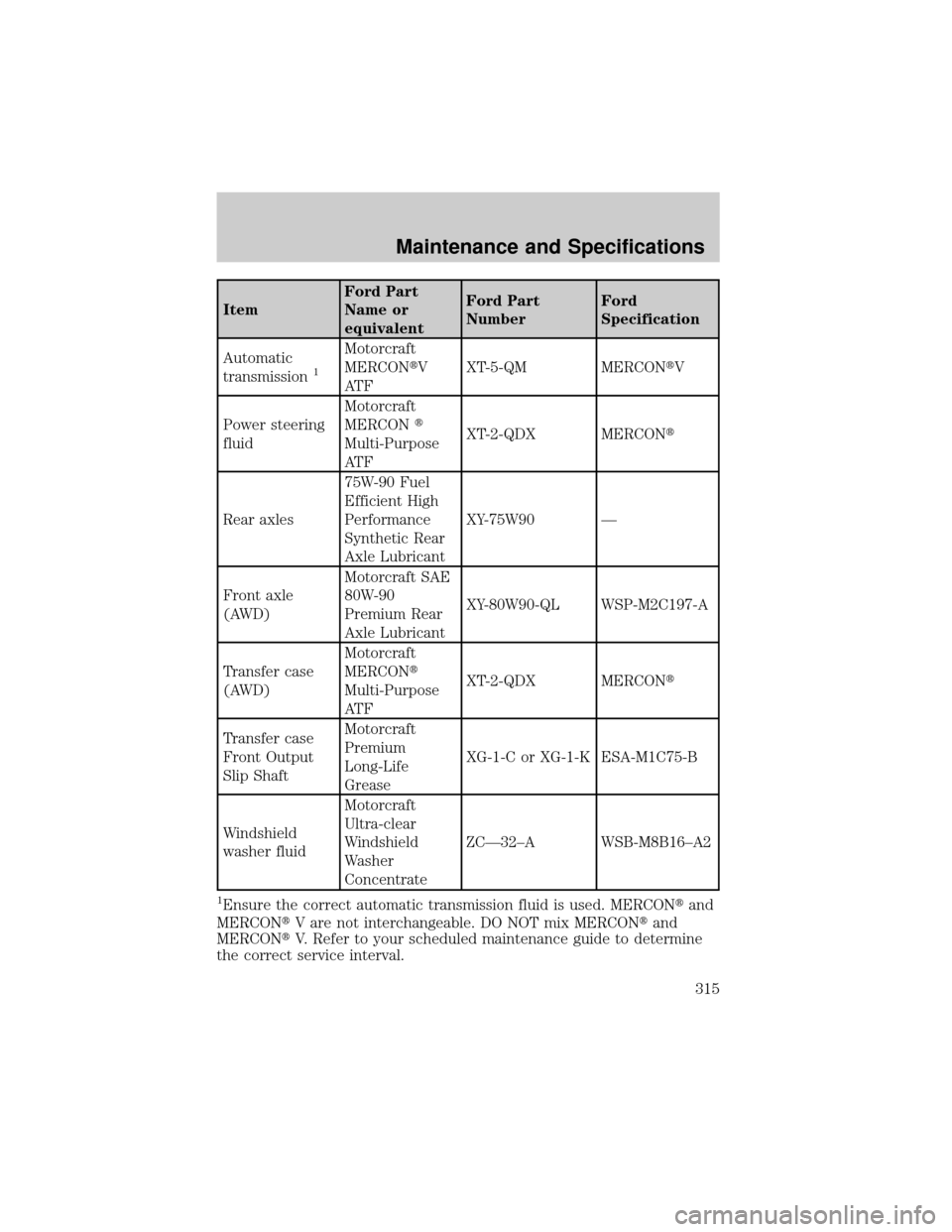
ItemFord Part
Name or
equivalentFord Part
NumberFord
Specification
Automatic
transmission
1
Motorcraft
MERCONtV
AT FXT-5-QM MERCONtV
Power steering
fluidMotorcraft
MERCONt
Multi-Purpose
AT FXT-2-QDX MERCONt
Rear axles75W-90 Fuel
Efficient High
Performance
Synthetic Rear
Axle LubricantXY-75W90 Ð
Front axle
(AWD)Motorcraft SAE
80W-90
Premium Rear
Axle LubricantXY-80W90-QL WSP-M2C197-A
Transfer case
(AWD)Motorcraft
MERCONt
Multi-Purpose
AT FXT-2-QDX MERCONt
Transfer case
Front Output
Slip ShaftMotorcraft
Premium
Long-Life
GreaseXG-1-C or XG-1-K ESA-M1C75-B
Windshield
washer fluidMotorcraft
Ultra-clear
Windshield
Washer
ConcentrateZCÐ32±A WSB-M8B16±A2
1Ensure the correct automatic transmission fluid is used. MERCONtand
MERCONtV are not interchangeable. DO NOT mix MERCONtand
MERCONtV. Refer to your scheduled maintenance guide to determine
the correct service interval.
Maintenance and Specifications
315
Page 316 of 336
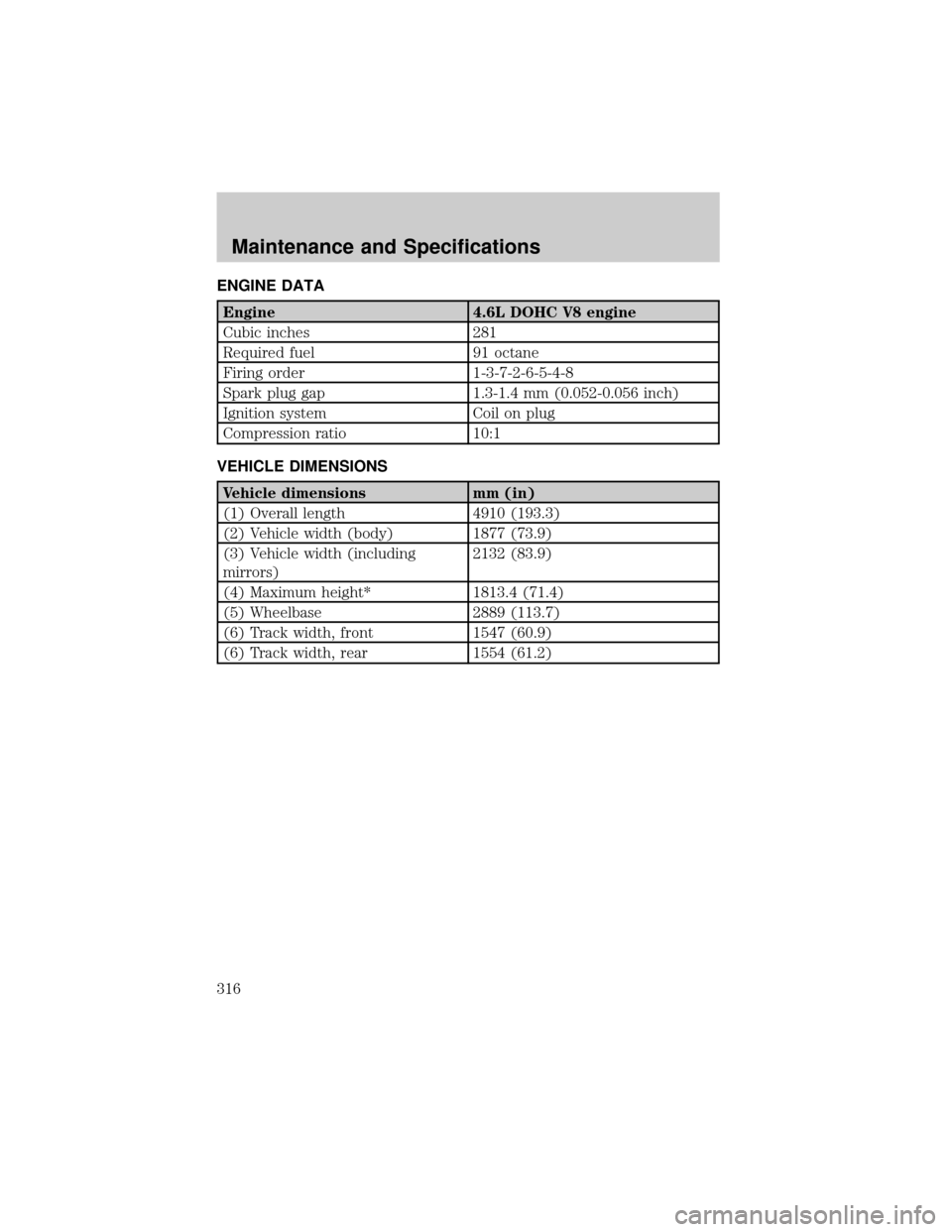
ENGINE DATA
Engine 4.6L DOHC V8 engine
Cubic inches 281
Required fuel 91 octane
Firing order 1-3-7-2-6-5-4-8
Spark plug gap 1.3-1.4 mm (0.052-0.056 inch)
Ignition system Coil on plug
Compression ratio 10:1
VEHICLE DIMENSIONS
Vehicle dimensions mm (in)
(1) Overall length 4910 (193.3)
(2) Vehicle width (body) 1877 (73.9)
(3) Vehicle width (including
mirrors)2132 (83.9)
(4) Maximum height* 1813.4 (71.4)
(5) Wheelbase 2889 (113.7)
(6) Track width, front 1547 (60.9)
(6) Track width, rear 1554 (61.2)
Maintenance and Specifications
316
Page 326 of 336

change oil soon warning,
message center .......................276
checking and adding ..............276
dipstick ....................................276
filter, specifications ........278, 311
recommendations ...................278
refill capacities ........................312
specifications ..................314, 316
Exhaust fumes ..........................196
F
Fail safe cooling ........................284
Floor mats .................................133
Fluid capacities .........................312
Foglamps .....................................82
Four-Wheel Drive vehicles
driving off road .......................213
preparing to drive your
vehicle .....................................203
Fuel ............................................285
calculating fuel
economy ..........................121, 289
cap ...........................................287
capacity ...................................312
choosing the right fuel ...........288
comparisons with EPA fuel
economy estimates .................292
detergent in fuel .....................289
filling your vehicle with
fuel ...........................285, 287, 289
filter, specifications ........289, 311
fuel pump shut-off switch .....232
improving fuel economy ........289
octane rating ...................288, 316
quality ......................................288
running out of fuel .................289
safety information relating to
automotive fuels .....................285
Fuses ..................................233±234G
Garage Door Opener (see
Homelink wireless control
system) ......................................114
Gas cap (see Fuel cap) ............287
Gas mileage
(see Fuel economy) .................289
Gauges .........................................14
GAWR (Gross Axle Weight
Rating)
calculating ...............................224
GVWR
(Gross Vehicle Weight Rating)
calculating ...............................224
H
Hazard flashers .........................232
Head restraints .........................153
Headlamps ...................................82
aiming ........................................85
autolamp system .......................82
bulb specifications ....................88
daytime running lights .............84
flash to pass ..............................85
high beam .................................84
replacing bulbs .........................90
turning on and off ....................82
HomeLink universal
transceiver
(see Garage door opener) .......118
Homelink wireless control
system ........................................114
I
Ignition ...............................193, 316
Index
326