service LINCOLN AVIATOR 2004 Repair Manual
[x] Cancel search | Manufacturer: LINCOLN, Model Year: 2004, Model line: AVIATOR, Model: LINCOLN AVIATOR 2004Pages: 336, PDF Size: 3.69 MB
Page 300 of 336
This device complies with part 15 of the FCC rules and with RS-210 of
Industry Canada. Operation is subject to the following two conditions:
(1) This device may not cause harmful interference, and (2) This device
must accept any interference received, including interference that may
cause undesired operation.
The tire pressure monitoring system is NOT a substitute for
manually checking tire pressure. The tire pressure should be
checked periodically (at least monthly) using a tire gauge, see
Checking the tire pressurein this chapter. Failure to properly
maintain your tire pressure could increase the risk of tire failure, loss
of control, vehicle rollover and personal injury.
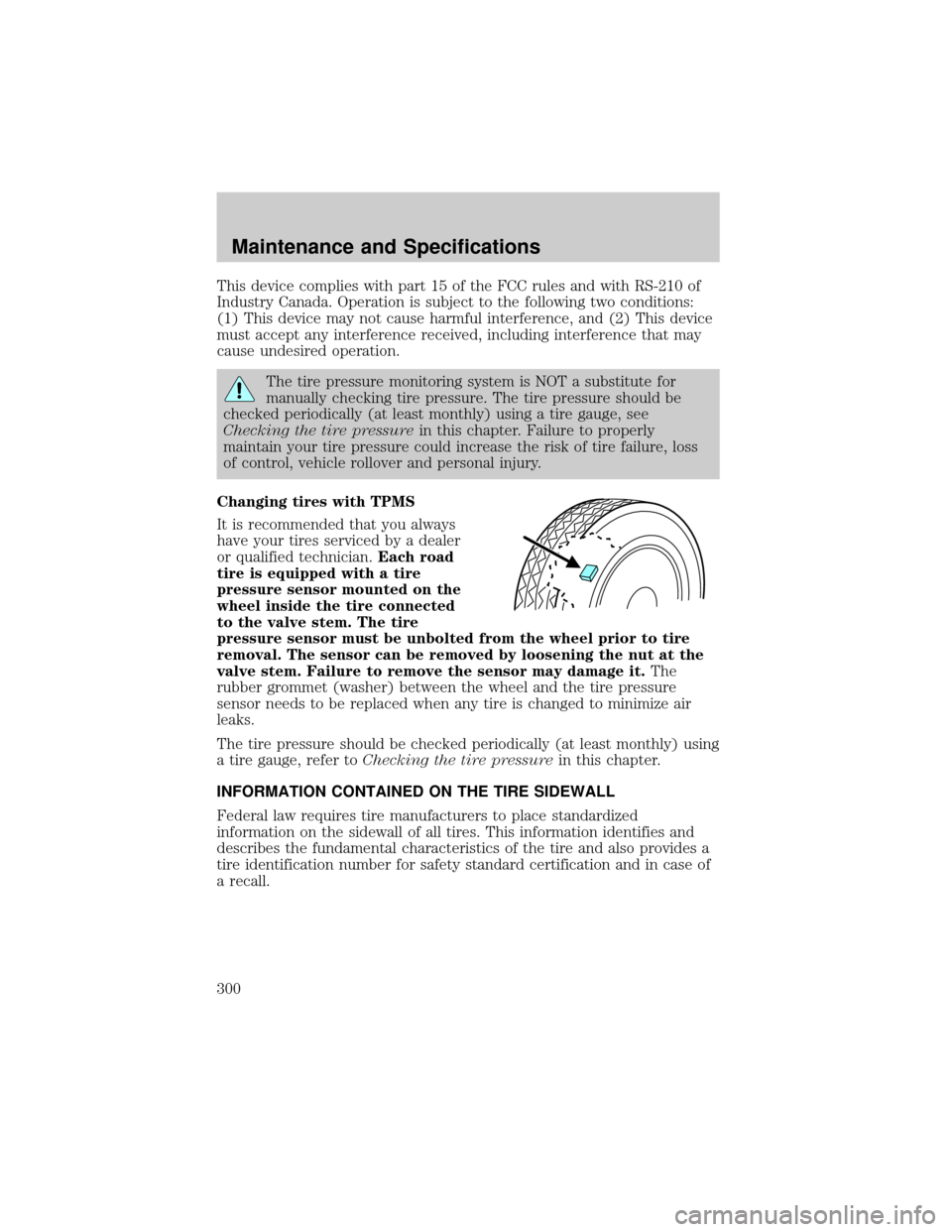
Changing tires with TPMS
It is recommended that you always
have your tires serviced by a dealer
or qualified technician.Each road
tire is equipped with a tire
pressure sensor mounted on the
wheel inside the tire connected
to the valve stem. The tire
pressure sensor must be unbolted from the wheel prior to tire
removal. The sensor can be removed by loosening the nut at the
valve stem. Failure to remove the sensor may damage it.The
rubber grommet (washer) between the wheel and the tire pressure
sensor needs to be replaced when any tire is changed to minimize air
leaks.
The tire pressure should be checked periodically (at least monthly) using
a tire gauge, refer toChecking the tire pressurein this chapter.
INFORMATION CONTAINED ON THE TIRE SIDEWALL
Federal law requires tire manufacturers to place standardized
information on the sidewall of all tires. This information identifies and
describes the fundamental characteristics of the tire and also provides a
tire identification number for safety standard certification and in case of
a recall.
Maintenance and Specifications
300
Page 301 of 336
Information on ªPº type tires
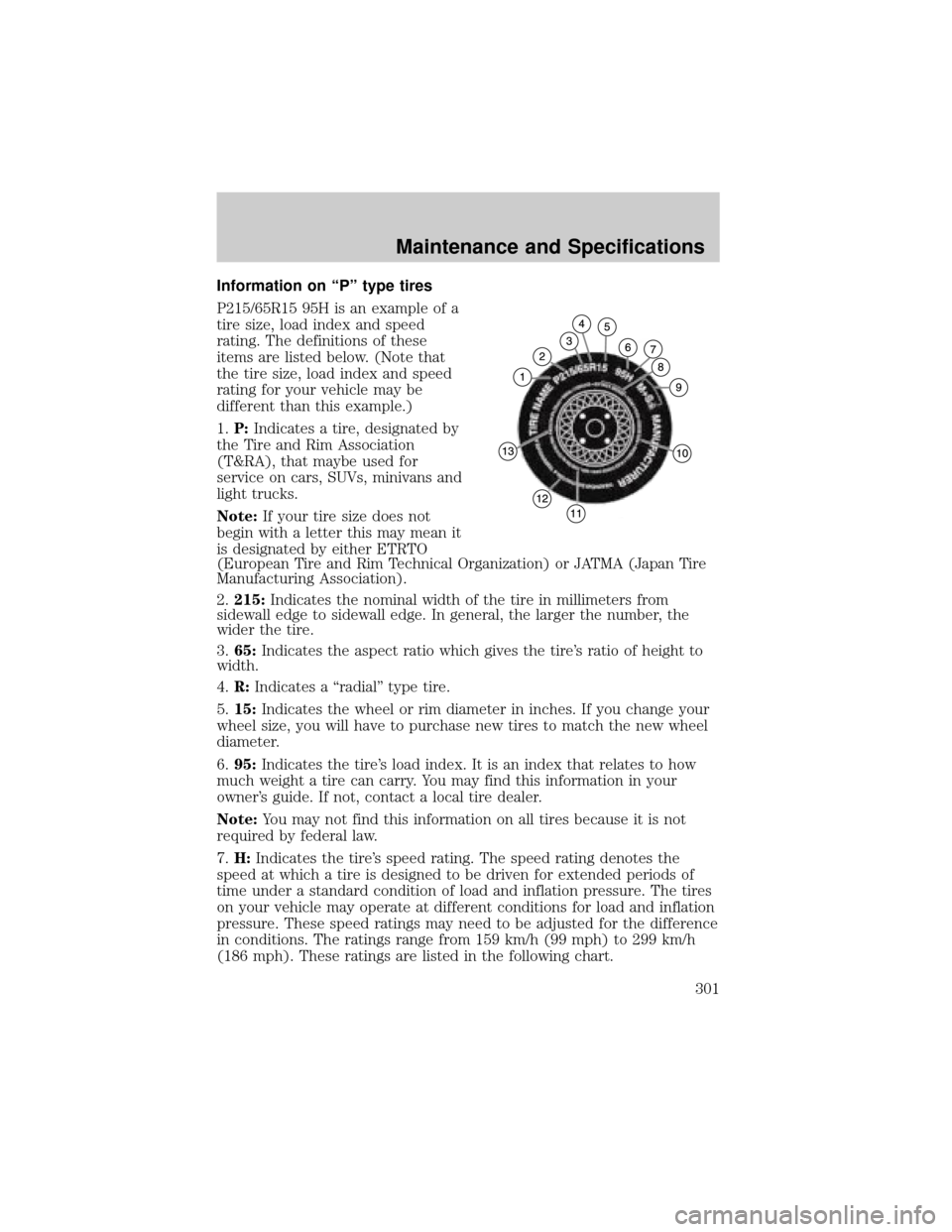
P215/65R15 95H is an example of a
tire size, load index and speed
rating. The definitions of these
items are listed below. (Note that
the tire size, load index and speed
rating for your vehicle may be
different than this example.)
1.P:Indicates a tire, designated by
the Tire and Rim Association
(T&RA), that maybe used for
service on cars, SUVs, minivans and
light trucks.
Note:If your tire size does not
begin with a letter this may mean it
is designated by either ETRTO
(European Tire and Rim Technical Organization) or JATMA (Japan Tire
Manufacturing Association).
2.215:Indicates the nominal width of the tire in millimeters from
sidewall edge to sidewall edge. In general, the larger the number, the
wider the tire.
3.65:Indicates the aspect ratio which gives the tire's ratio of height to
width.
4.R:Indicates a ªradialº type tire.
5.15:Indicates the wheel or rim diameter in inches. If you change your
wheel size, you will have to purchase new tires to match the new wheel
diameter.
6.95:Indicates the tire's load index. It is an index that relates to how
much weight a tire can carry. You may find this information in your
owner's guide. If not, contact a local tire dealer.
Note:You may not find this information on all tires because it is not
required by federal law.
7.H:Indicates the tire's speed rating. The speed rating denotes the
speed at which a tire is designed to be driven for extended periods of
time under a standard condition of load and inflation pressure. The tires
on your vehicle may operate at different conditions for load and inflation
pressure. These speed ratings may need to be adjusted for the difference
in conditions. The ratings range from 159 km/h (99 mph) to 299 km/h
(186 mph). These ratings are listed in the following chart.
Maintenance and Specifications
301
Page 304 of 336
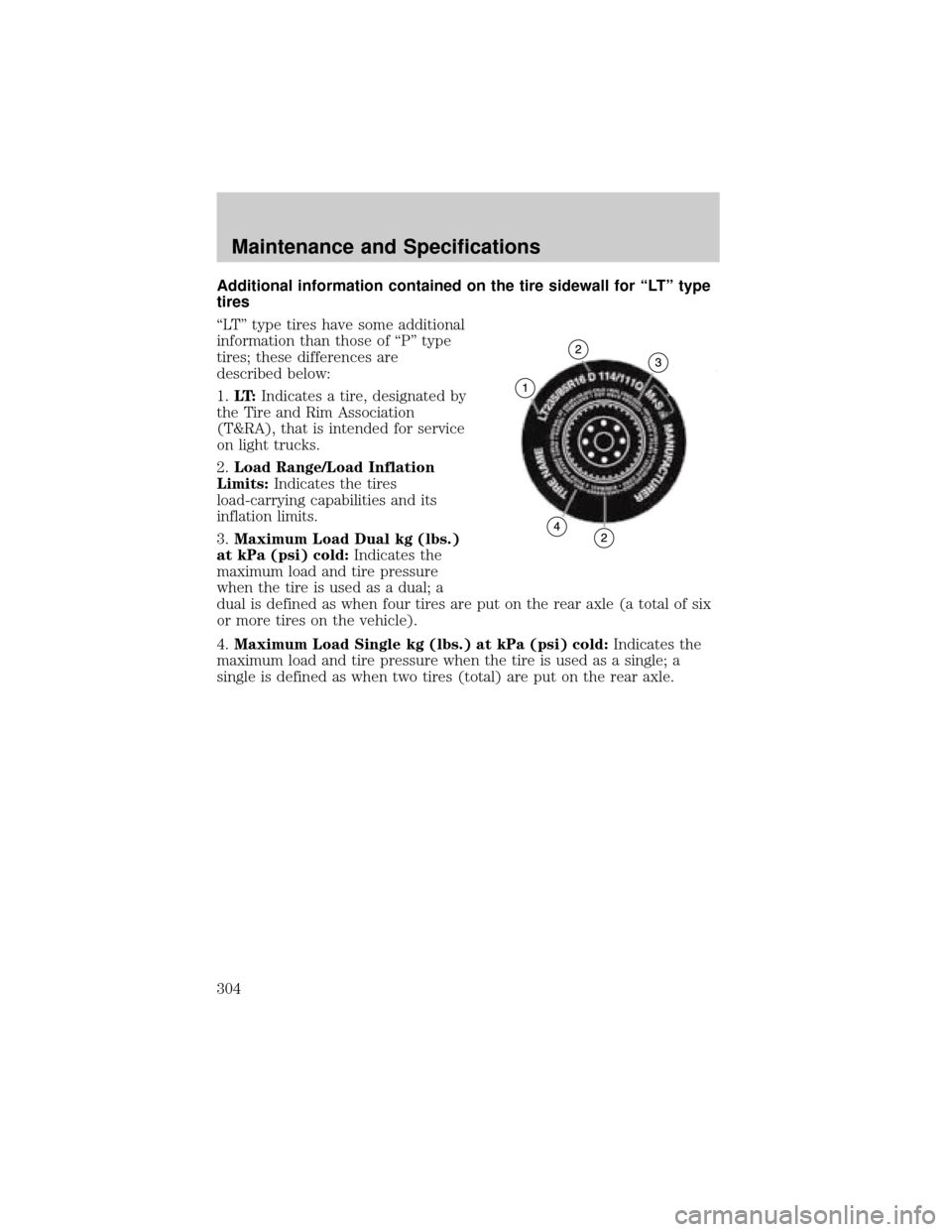
Additional information contained on the tire sidewall for ªLTº type
tires
ªLTº type tires have some additional
information than those of ªPº type
tires; these differences are
described below:
1.LT:Indicates a tire, designated by
the Tire and Rim Association
(T&RA), that is intended for service
on light trucks.
2.Load Range/Load Inflation
Limits:Indicates the tires
load-carrying capabilities and its
inflation limits.
3.Maximum Load Dual kg (lbs.)
at kPa (psi) cold:Indicates the
maximum load and tire pressure
when the tire is used as a dual; a
dual is defined as when four tires are put on the rear axle (a total of six
or more tires on the vehicle).
4.Maximum Load Single kg (lbs.) at kPa (psi) cold:Indicates the
maximum load and tire pressure when the tire is used as a single; a
single is defined as when two tires (total) are put on the rear axle.
Maintenance and Specifications
304
Page 305 of 336
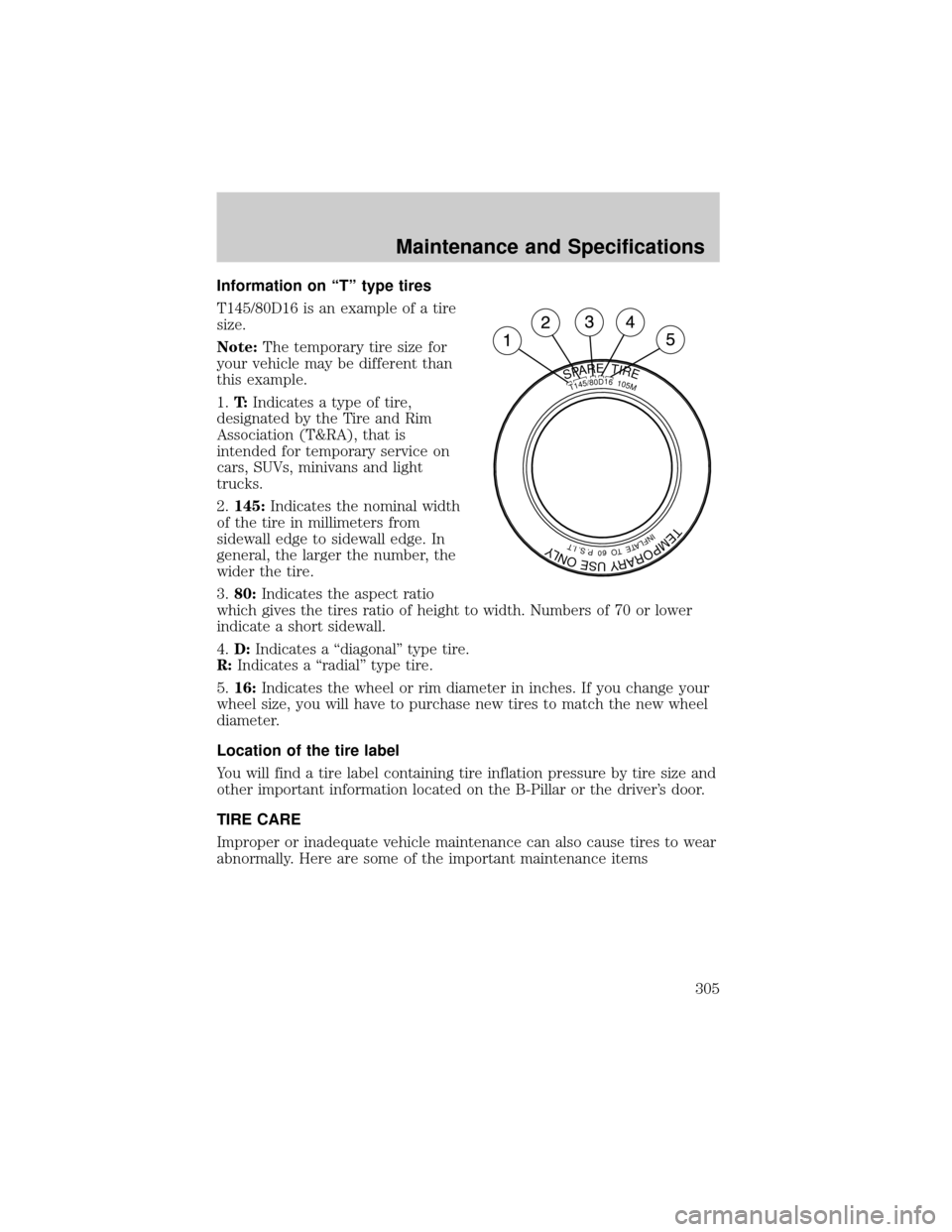
Information on ªTº type tires
T145/80D16 is an example of a tire
size.
Note:The temporary tire size for
your vehicle may be different than
this example.
1.T:Indicates a type of tire,
designated by the Tire and Rim
Association (T&RA), that is
intended for temporary service on
cars, SUVs, minivans and light
trucks.
2.145:Indicates the nominal width
of the tire in millimeters from
sidewall edge to sidewall edge. In
general, the larger the number, the
wider the tire.
3.80:Indicates the aspect ratio
which gives the tires ratio of height to width. Numbers of 70 or lower
indicate a short sidewall.
4.D:Indicates a ªdiagonalº type tire.
R:Indicates a ªradialº type tire.
5.16:Indicates the wheel or rim diameter in inches. If you change your
wheel size, you will have to purchase new tires to match the new wheel
diameter.
Location of the tire label
You will find a tire label containing tire inflation pressure by tire size and
other important information located on the B-Pillar or the driver's door.
TIRE CARE
Improper or inadequate vehicle maintenance can also cause tires to wear
abnormally. Here are some of the important maintenance items
SPARETIRE
TEMPORARYUSEONLY
INFLATETO60P.S.I.T
T145/80D16105M
Maintenance and Specifications
305
Page 306 of 336
Tire inflation pressure
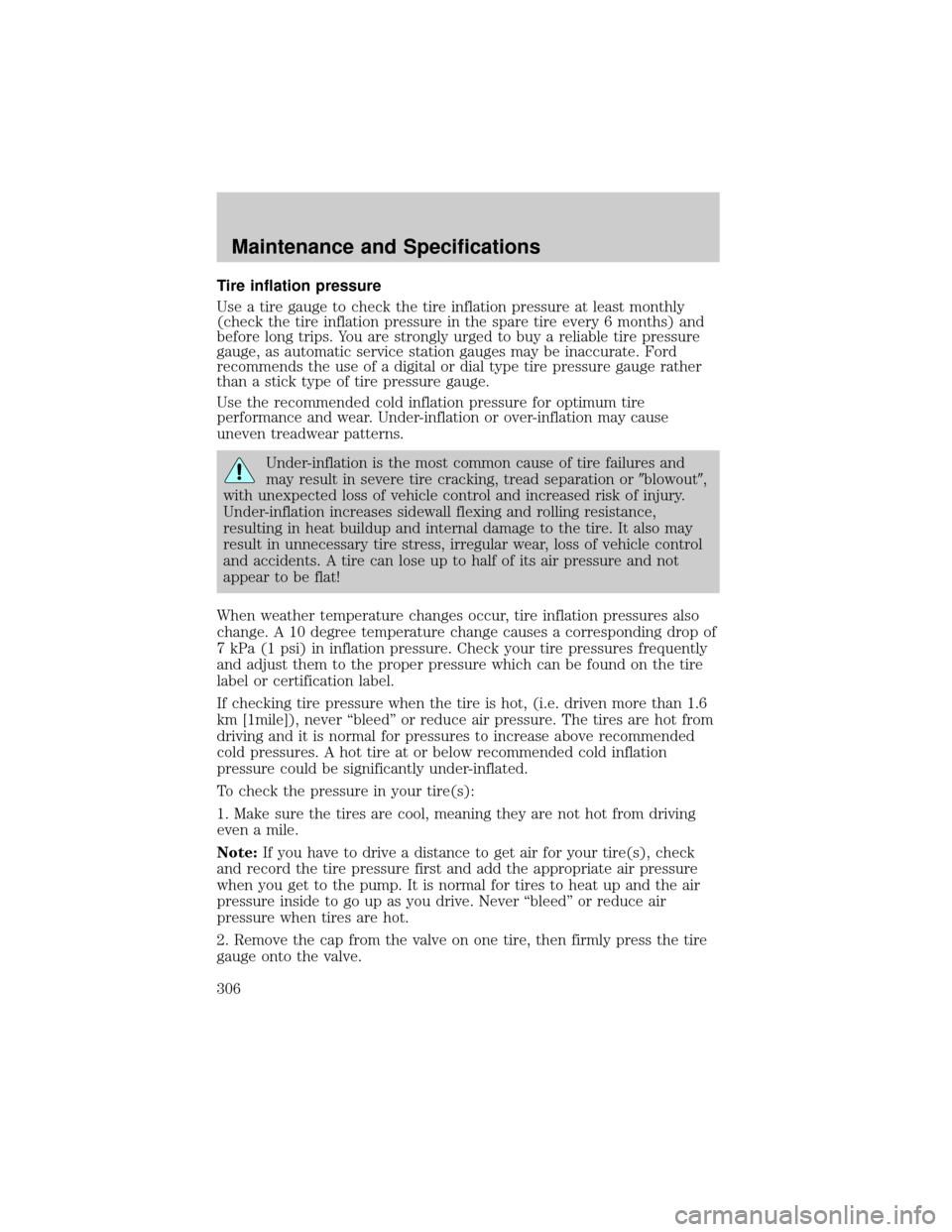
Use a tire gauge to check the tire inflation pressure at least monthly
(check the tire inflation pressure in the spare tire every 6 months) and
before long trips. You are strongly urged to buy a reliable tire pressure
gauge, as automatic service station gauges may be inaccurate. Ford
recommends the use of a digital or dial type tire pressure gauge rather
than a stick type of tire pressure gauge.
Use the recommended cold inflation pressure for optimum tire
performance and wear. Under-inflation or over-inflation may cause
uneven treadwear patterns.
Under-inflation is the most common cause of tire failures and
may result in severe tire cracking, tread separation or9blowout9,
with unexpected loss of vehicle control and increased risk of injury.
Under-inflation increases sidewall flexing and rolling resistance,
resulting in heat buildup and internal damage to the tire. It also may
result in unnecessary tire stress, irregular wear, loss of vehicle control
and accidents. A tire can lose up to half of its air pressure and not
appear to be flat!
When weather temperature changes occur, tire inflation pressures also
change. A 10 degree temperature change causes a corresponding drop of
7 kPa (1 psi) in inflation pressure. Check your tire pressures frequently
and adjust them to the proper pressure which can be found on the tire
label or certification label.
If checking tire pressure when the tire is hot, (i.e. driven more than 1.6
km [1mile]), never ªbleedº or reduce air pressure. The tires are hot from
driving and it is normal for pressures to increase above recommended
cold pressures. A hot tire at or below recommended cold inflation
pressure could be significantly under-inflated.
To check the pressure in your tire(s):
1. Make sure the tires are cool, meaning they are not hot from driving
even a mile.
Note:If you have to drive a distance to get air for your tire(s), check
and record the tire pressure first and add the appropriate air pressure
when you get to the pump. It is normal for tires to heat up and the air
pressure inside to go up as you drive. Never ªbleedº or reduce air
pressure when tires are hot.
2. Remove the cap from the valve on one tire, then firmly press the tire
gauge onto the valve.
Maintenance and Specifications
306
Page 307 of 336

3. Add air to reach the recommended air pressure
Note:If you overfill the tire, release air by pushing on the metal stem in
the center of the valve. Then recheck the pressure with your tire gauge.
4. Replace the valve cap.
5. Repeat this procedure for each tire, including the spare.
Note:Some spare tires require higher inflation pressure than the other
tires.
6. Visually inspect the tires to make sure there are no nails or other
objects embedded that could poke a hole in the tire and cause an air
leak.
7. Check the sidewalls to make sure there are no gouges, cuts, bulges or
other irregularities.
Tire and wheel alignment
A bad jolt from hitting a curb or pothole can cause the front end of your
vehicle to become misaligned or damage to your tires. If your vehicle
seems to pull to one side, vibrate or shake when you're driving, the
wheels may be out of alignment. Have a qualified technician at a
reputable repair facility check the wheel alignment periodically.
Wheel misalignment in the front or the rear can cause uneven and rapid
treadwear of your tires and should be corrected by a qualified technician
at a reputable repair facility. Front wheel drive (FWD) vehicles, and
those with independent front suspension require alignment of all four
wheels.
The tires should also be balanced periodically. An unbalanced tire and
wheel assembly may result in irregular tire wear.
Tire rotation
Rotating your tires at the recommended interval (as indicated in the
Service Maintenance Guide that comes with your vehicle) will help your
tires wear more evenly providing better tire performance and longer tire
life. Unless otherwise specified, rotate the tires approximately every
8,000 km (5,000 miles).
Maintenance and Specifications
307
Page 313 of 336
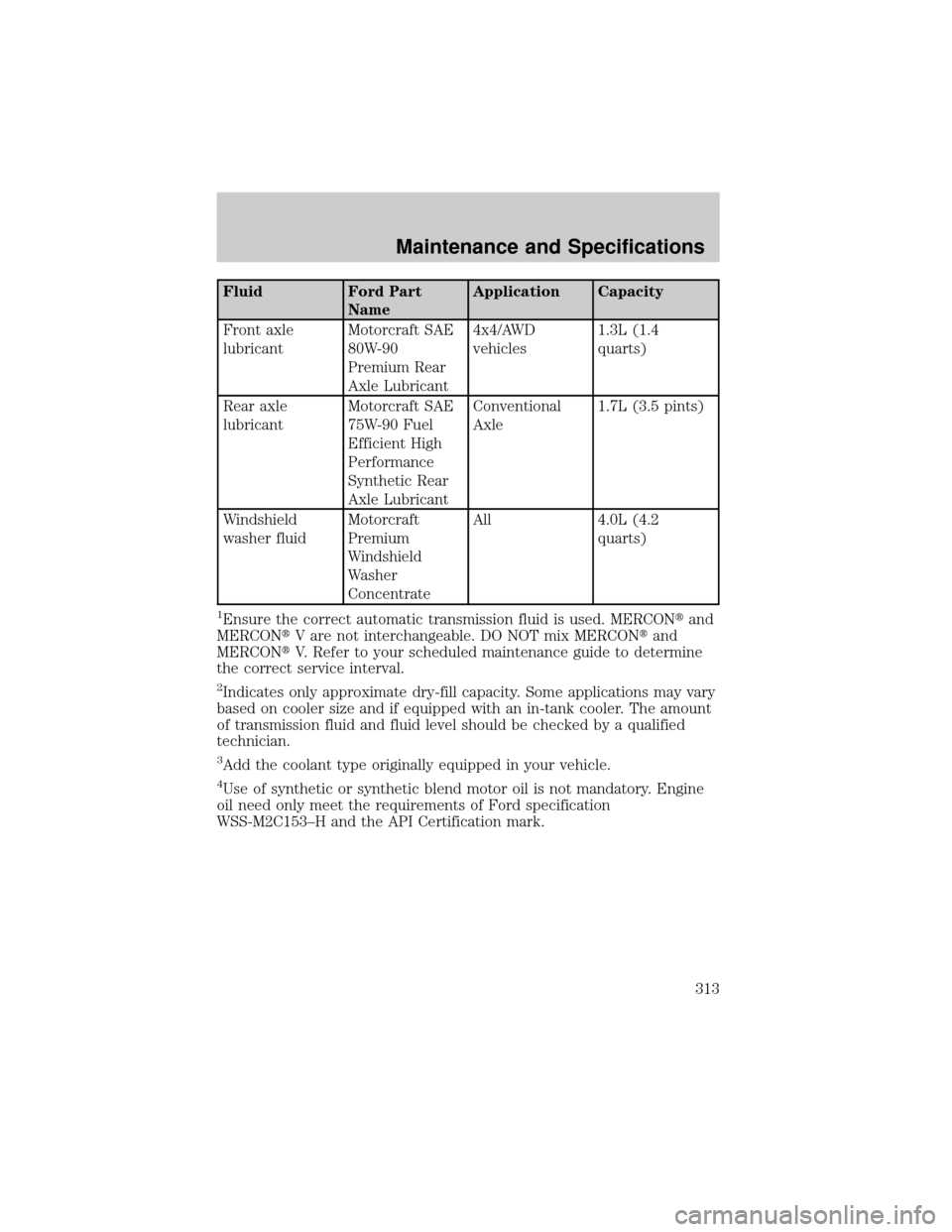
Fluid Ford Part
NameApplication Capacity
Front axle
lubricantMotorcraft SAE
80W-90
Premium Rear
Axle Lubricant4x4/AWD
vehicles1.3L (1.4
quarts)
Rear axle
lubricantMotorcraft SAE
75W-90 Fuel
Efficient High
Performance
Synthetic Rear
Axle LubricantConventional
Axle1.7L (3.5 pints)
Windshield
washer fluidMotorcraft
Premium
Windshield
Washer
ConcentrateAll 4.0L (4.2
quarts)
1Ensure the correct automatic transmission fluid is used. MERCONtand
MERCONtV are not interchangeable. DO NOT mix MERCONtand
MERCONtV. Refer to your scheduled maintenance guide to determine
the correct service interval.
2Indicates only approximate dry-fill capacity. Some applications may vary
based on cooler size and if equipped with an in-tank cooler. The amount
of transmission fluid and fluid level should be checked by a qualified
technician.
3Add the coolant type originally equipped in your vehicle.
4Use of synthetic or synthetic blend motor oil is not mandatory. Engine
oil need only meet the requirements of Ford specification
WSS-M2C153±H and the API Certification mark.
Maintenance and Specifications
313
Page 315 of 336
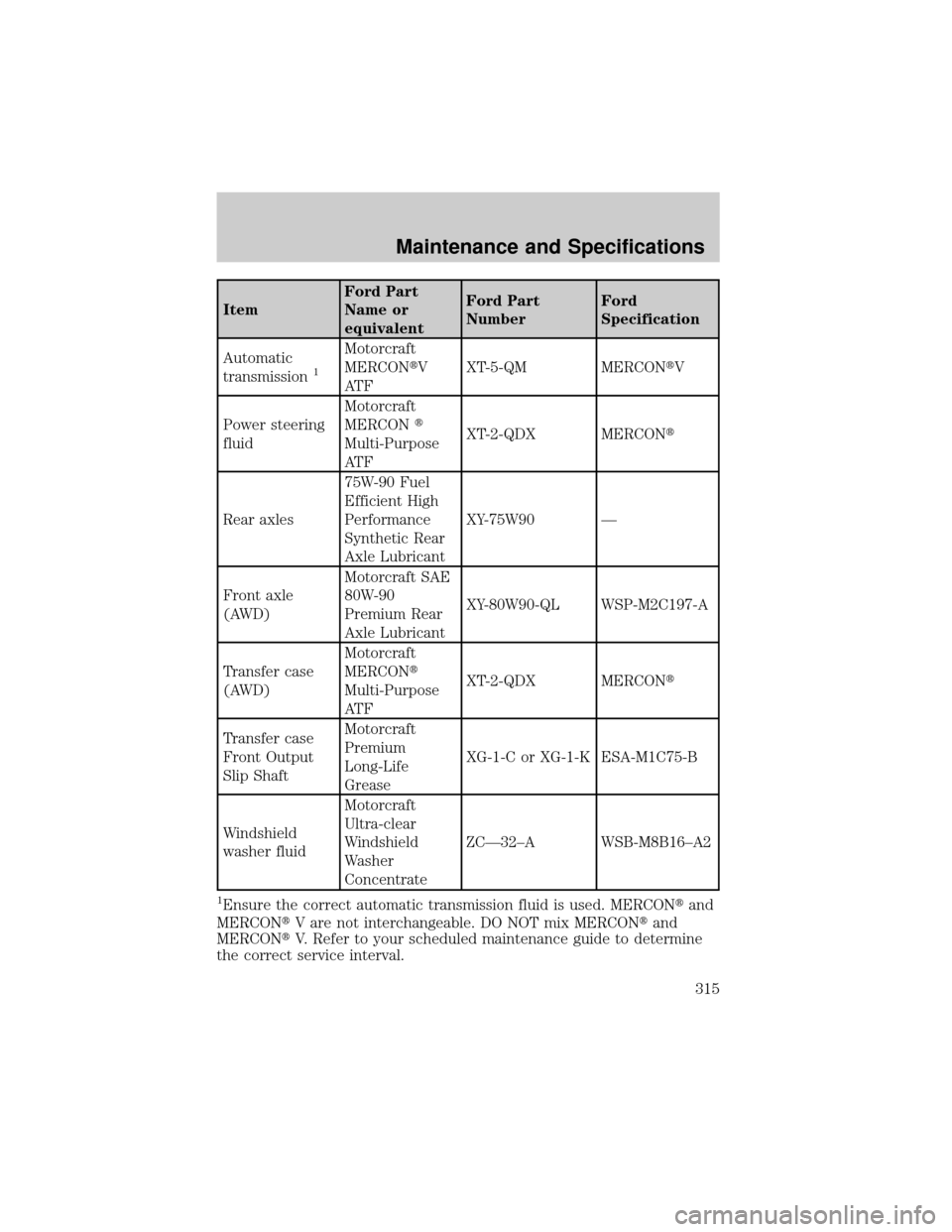
ItemFord Part
Name or
equivalentFord Part
NumberFord
Specification
Automatic
transmission
1
Motorcraft
MERCONtV
AT FXT-5-QM MERCONtV
Power steering
fluidMotorcraft
MERCONt
Multi-Purpose
AT FXT-2-QDX MERCONt
Rear axles75W-90 Fuel
Efficient High
Performance
Synthetic Rear
Axle LubricantXY-75W90 Ð
Front axle
(AWD)Motorcraft SAE
80W-90
Premium Rear
Axle LubricantXY-80W90-QL WSP-M2C197-A
Transfer case
(AWD)Motorcraft
MERCONt
Multi-Purpose
AT FXT-2-QDX MERCONt
Transfer case
Front Output
Slip ShaftMotorcraft
Premium
Long-Life
GreaseXG-1-C or XG-1-K ESA-M1C75-B
Windshield
washer fluidMotorcraft
Ultra-clear
Windshield
Washer
ConcentrateZCÐ32±A WSB-M8B16±A2
1Ensure the correct automatic transmission fluid is used. MERCONtand
MERCONtV are not interchangeable. DO NOT mix MERCONtand
MERCONtV. Refer to your scheduled maintenance guide to determine
the correct service interval.
Maintenance and Specifications
315
Page 323 of 336

For maximum vehicle performance, keep the following information in
mind when adding accessories or equipment to your vehicle:
²When adding accessories, equipment, passengers and luggage to your
vehicle, do not exceed the total weight capacity of the vehicle or of
the front or rear axle (GVWR or GAWR as indicated on the Safety
Compliance Certification label). Consult your dealer for specific weight
information.
²The Federal Communications Commission (FCC) and Canadian Radio
Telecommunications Commission (CRTC) regulate the use of mobile
communications systems Ð such as two-way radios, telephones and
theft alarms - that are equipped with radio transmitters. Any such
equipment installed in your vehicle should comply with FCC or CRTC
regulations and should be installed only by a qualified service
technician.
²Mobile communications systems may harm the operation of your
vehicle, particularly if they are not properly designed for automotive
use.
Accessories
323
Page 325 of 336

Cleaning your vehicle
engine compartment ..............267
instrument panel ....................269
interior .............................269±270
interior trim ............................270
plastic parts ............................268
washing ....................................266
waxing .....................................266
wheels ......................................267
wiper blades ............................268
Clock ..........................................101
Compass, electronic
set zone adjustment ...............120
Console ......................................132
overhead ....................................99
rear ..........................................132
Controls
power seat ...............................154
steering column ......................111
Coolant
checking and adding ..............281
refill capacities ................283, 312
specifications ..................314, 316
Cruise control
(see Speed control) ..................109
Customer Assistance ................231
Ford accessories for your
vehicle .....................................271
Ford Extended Service
Plan ..........................................259
Getting assistance outside the
U.S. and Canada .....................263
Getting roadside assistance ...231
Getting the service you
need .........................................257
Ordering additional owner's
literature .................................264
The Dispute Settlement
Board .......................................259Utilizing the
Mediation/Arbitration
Program ...................................262
D
Daytime running lamps
(see Lamps) ................................84
Defrost
rear window ..............................81
Dipstick
automatic transmission
fluid ..........................................296
engine oil .................................276
Doors
lubricant specifications ..........314
Driving under special
conditions ..........................214, 217
sand .........................................216
snow and ice ...........................218
through water .................216, 221
E
Electronic message center .......118
Emergencies, roadside
jump-starting ..........................251
Emission control system ..........292
Engine ........................................316
cleaning ...................................267
coolant .....................................281
fail-safe coolant ......................284
idle speed control ...................279
lubrication
specifications ..................314, 316
refill capacities ........................312
service points ..........................274
starting after a collision .........232
Engine block heater .................196
Engine oil ..................................276
Index
325