check oil LINCOLN AVIATOR 2021 User Guide
[x] Cancel search | Manufacturer: LINCOLN, Model Year: 2021, Model line: AVIATOR, Model: LINCOLN AVIATOR 2021Pages: 667, PDF Size: 7.01 MB
Page 391 of 667
Note:
If the oil level is between the
maximum and minimum marks, the oil level
is acceptable. Do not add oil.
Note: The oil consumption of new engines
reaches its normal level after approximately
3,000 mi (5,000 km).
Adding Engine Oil WARNING:
Do not remove the filler
cap when the engine is running.
Do not use supplemental engine oil additives
because they are unnecessary and could
lead to engine damage that may not be
covered by the vehicle Warranty. Only use oils certified for gasoline engines
by the American Petroleum Institute (API).
An oil with this trademark symbol conforms
to the current engine and emission system
protection standards and fuel economy
requirements of the International Lubricants
Specification Advisory Committee (ILSAC).
To top up the engine oil level do the
following:
1. Clean the area surrounding the engine
oil filler cap before you remove it.
2. Remove the engine oil filler cap.
See
Under Hood Overview (page 386). Turn
it counterclockwise and remove it. 3. Add engine oil that meets our
specifications.
See Capacities and
Specifications (page 450). You may have
to use a funnel to pour the engine oil into
the opening.
4. Recheck the oil level.
5. If the oil level is correct, replace the dipstick and make sure it is fully seated.
6. Replace the engine oil filler cap. Turn it clockwise until you feel a strong
resistance.
Note: Do not add oil further than the
maximum mark. Oil levels above the
maximum mark may cause engine damage.
Note: Make sure you install the oil filler cap
correctly.
Note: Soak up any spillage with an
absorbent cloth immediately.
OIL CHANGE INDICATOR RESET
Use the information display controls on the
steering wheel to reset the oil change
indicator.
388
Aviator (CTV) Canada/United States of America, enUSA, Edition date: 202007, Second-Printing MaintenanceE142732
Page 414 of 667
Body
•
Wash your vehicle thoroughly to remove
dirt, grease, oil, tar or mud from exterior
surfaces, rear-wheel housing and the
underside of front fenders.
• Periodically wash your vehicle if it is
stored in exposed locations.
• Touch-up exposed or primed metal to
prevent rust.
• Cover chrome and stainless steel parts
with a thick coat of auto wax to prevent
discoloration. Re-wax as necessary when
you wash your vehicle.
• Lubricate all hood, door and luggage
compartment hinges and latches with a
light grade oil.
• Cover interior trim to prevent fading.
• Keep all rubber parts free from oil and
solvents. Engine
•
Change the engine oil and filter prior to
storage because used engine oil contains
contaminates which may cause engine
damage.
• Start the engine every 15 days for a
minimum of 15 minutes. Run at fast idle
with the climate controls set to defrost
until the engine reaches normal
operating temperature.
• With your foot on the brake, shift through
all the gears while the engine is running.
• We recommend that you change the
engine oil before you use your vehicle
again.
Fuel system
• Fill the fuel tank with high-quality fuel
until the first automatic shutoff of the fuel
pump nozzle. Cooling system
•
Protect against freezing temperatures.
• When removing your vehicle from
storage, check coolant fluid level.
Confirm that there are no cooling system
leaks and that fluid is at the
recommended level.
Disconnecting Your 12 Volt Battery
• Check and recharge as necessary. Keep
connections clean.
• If storing your vehicle for more than 30
days without recharging the battery, we
recommend that you disconnect the
battery cables to maintain battery charge
for quick starting.
Note: It is necessary to reset memory
features if you disconnect the battery cables.
411
Aviator (CTV) Canada/United States of America, enUSA, Edition date: 202007, Second-Printing Vehicle Care
Page 415 of 667
Plugging in Your HYBRID
We recommend the following options for
your plug-in vehicle (PHEV) :
•
Leave your vehicle plugged in. The 12
volt battery maintains power if left
plugged in. However, this periodically
uses electricity from the household
outlet.
• Connect a battery charger to your 12 volt
battery and leave it on a continuous, slow
charge.
• Disconnect the 12 volt battery. If your 12
volt battery is located in the luggage
compartment, do not fully shut the
luggage compartment after
disconnecting the 12 volt battery. Only
leave the luggage compartment open if
your vehicle is stored in a locked
location.
Brakes
• Make sure the brakes and parking brake
release fully. Tires
•
Maintain recommended air pressure.
Miscellaneous
• Make sure all linkages, cables, levers and
pins under your vehicle are covered with
grease to prevent rust.
• Move vehicles at least 25 ft (7.5 m) every
15 days to lubricate working parts and
prevent corrosion.
Removing Vehicle From Storage
When your vehicle is ready to come out of
storage, do the following:
• Wash your vehicle to remove any dirt or
grease film build-up on window surfaces.
• Check windshield wipers for any
deterioration.
• Check under the hood for any foreign
material that may have collected during
storage such as mice or squirrel nests.
• Check the exhaust for any foreign
material that may have collected during
storage. •
Check tire pressures and set tire inflation
per the Tire Label.
• Check brake pedal operation. Drive your
vehicle 15 ft (4.5 m) back and forth to
remove rust build-up.
• Check fluid levels (including coolant, oil
and gas) to make sure there are no leaks,
and fluids are at recommended levels.
• If you remove the battery, clean the
battery cable ends and check for
damage.
Contact an authorized dealer if you have any
concerns or issues.
BODY STYLING KITS
(IF EQUIPPED)
The distance between the underside of your
vehicle and the ground is less than that of
other models. Drive with extreme care to
avoid damage to your vehicle.
412
Aviator (CTV) Canada/United States of America, enUSA, Edition date: 202007, Second-Printing Vehicle Care
Page 453 of 667
VEHICLE IDENTIFICATION
NUMBER
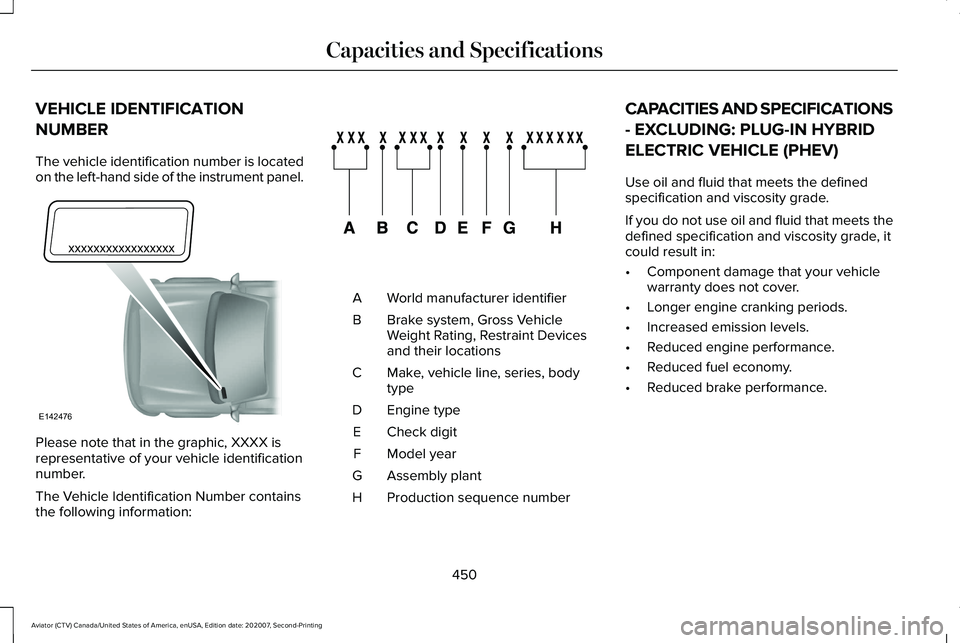
The vehicle identification number is located
on the left-hand side of the instrument panel.
Please note that in the graphic, XXXX is
representative of your vehicle identification
number.
The Vehicle Identification Number contains
the following information: World manufacturer identifier
A
Brake system, Gross Vehicle
Weight Rating, Restraint Devices
and their locations
B
Make, vehicle line, series, body
type
C
Engine type
D
Check digit
E
Model year
F
Assembly plant
G
Production sequence number
H CAPACITIES AND SPECIFICATIONS
- EXCLUDING: PLUG-IN HYBRID
ELECTRIC VEHICLE (PHEV)
Use oil and fluid that meets the defined
specification and viscosity grade.
If you do not use oil and fluid that meets the
defined specification and viscosity grade, it
could result in:
•
Component damage that your vehicle
warranty does not cover.
• Longer engine cranking periods.
• Increased emission levels.
• Reduced engine performance.
• Reduced fuel economy.
• Reduced brake performance.
450
Aviator (CTV) Canada/United States of America, enUSA, Edition date: 202007, Second-Printing Capacities and SpecificationsE142476 E142477
Page 568 of 667
When the oil change message appears in
the information display, it is time for an oil
change. Make sure you perform the oil
change within two weeks or 500 mi (800 km)
of the message appearing. Make sure you
reset the Intelligent Oil-Life Monitor after
each oil change. See Oil Change Indicator
Reset (page 388).
If your information display resets prematurely
or becomes inoperative, you should perform
the oil change interval at six months or
5,000 mi (8,000 km)
from your last oil
change. Never exceed one year or 10,000 mi
(16,000 km)
between oil change intervals,
Your vehicle is very sophisticated and built
with multiple, complex performance systems.
Every manufacturer develops these systems
using different specifications and
performance features. That is why it is
important to rely upon your dealership to
properly diagnose and repair your vehicle. We have recommended maintenance
intervals for various parts and component
systems based upon engineering testing.
We rely upon this testing to determine the
most appropriate mileage for replacement
of oils and fluids to protect your vehicle at
the lowest overall cost to you and
recommends against maintenance schedules
that deviate from the scheduled maintenance
information.
We strongly recommend the use of only our
genuine manufactured or our authorized
re-manufactured replacement parts
engineered for your vehicle.
Additives and Chemicals
This owner's manual and our Workshop
Manual list the recommended additives and
chemicals for your vehicle. We do not
recommend using chemicals or additives not
approved by us as part of your vehicle
’s
normal maintenance. Please consult your
warranty information. Oils, Fluids and Flushing
In many cases, fluid discoloration is a normal
operating characteristic and, by itself, does
not necessarily indicate a concern or that the
fluid needs to be changed. However, a
qualified expert, such as the factory-trained
technicians at your dealership, should
inspect discolored fluids that also show signs
of overheating or foreign material
contamination immediately.
Make sure to change your vehicle
’s oils and
fluids at the specified intervals or in
conjunction with a repair. Flushing is a viable
way to change fluid for many vehicle
sub-systems during scheduled maintenance.
It is critical that systems are flushed only with
new fluid that is the same as that required
to fill and operate the system or using our
approved flushing chemical.
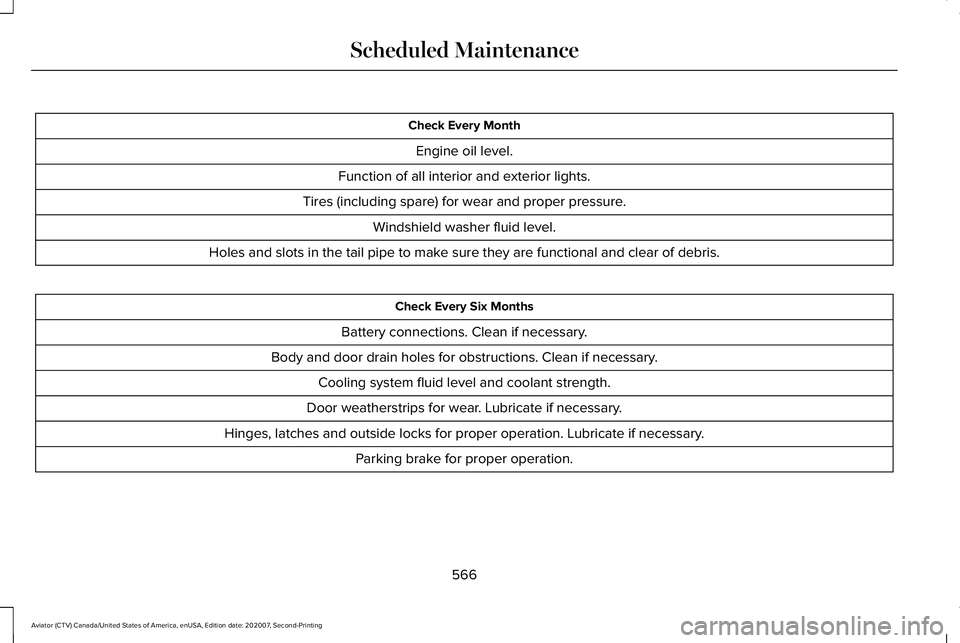
Owner Checks and Services
Make sure you perform the following basic
maintenance checks and inspections every
month or at six-month intervals.
565
Aviator (CTV) Canada/United States of America, enUSA, Edition date: 202007, Second-Printing Scheduled Maintenance
Page 569 of 667
Check Every Month
Engine oil level.
Function of all interior and exterior lights.
Tires (including spare) for wear and proper pressure. Windshield washer fluid level.
Holes and slots in the tail pipe to make sure they are functional and clear of debris. Check Every Six Months
Battery connections. Clean if necessary.
Body and door drain holes for obstructions. Clean if necessary. Cooling system fluid level and coolant strength.
Door weatherstrips for wear. Lubricate if necessary.
Hinges, latches and outside locks for proper operation. Lubricate if necessary. Parking brake for proper operation.
566
Aviator (CTV) Canada/United States of America, enUSA, Edition date: 202007, Second-Printing Scheduled Maintenance
Page 571 of 667
Multi-Point Inspection
Steering and linkage
Exterior lamps operation
Tires (including spare) for wear and proper pressure2
Fluid levels 1
; fill if necessary
Windshield for cracks, chips or pits
For oil and fluid leaks
Washer spray and wiper operation
Half-shaft dust boots
1 Brake, coolant recovery reservoir, automatic transmission and window washer
2 If your vehicle is equipped with a temporary mobility kit, check the tir\
e sealant expiration Use By date on the canister. Replace as needed.
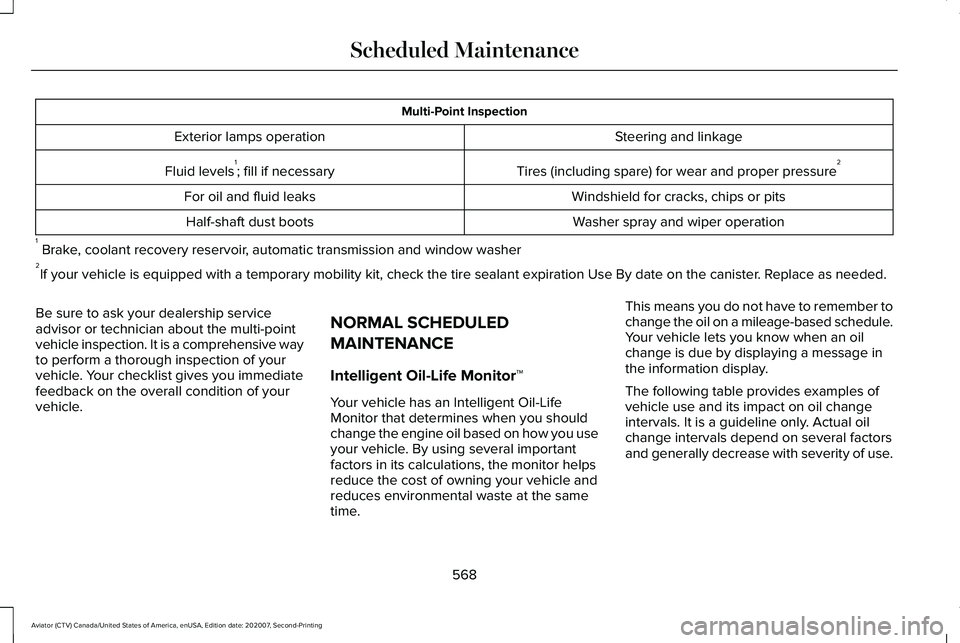
Be sure to ask your dealership service
advisor or technician about the multi-point
vehicle inspection. It is a comprehensive way
to perform a thorough inspection of your
vehicle. Your checklist gives you immediate
feedback on the overall condition of your
vehicle. NORMAL SCHEDULED
MAINTENANCE
Intelligent Oil-Life Monitor™
Your vehicle has an Intelligent Oil-Life
Monitor that determines when you should
change the engine oil based on how you use
your vehicle. By using several important
factors in its calculations, the monitor helps
reduce the cost of owning your vehicle and
reduces environmental waste at the same
time.This means you do not have to remember to
change the oil on a mileage-based schedule.
Your vehicle lets you know when an oil
change is due by displaying a message in
the information display.
The following table provides examples of
vehicle use and its impact on oil change
intervals. It is a guideline only. Actual oil
change intervals depend on several factors
and generally decrease with severity of use.
568
Aviator (CTV) Canada/United States of America, enUSA, Edition date: 202007, Second-Printing Scheduled Maintenance
Page 573 of 667
Normal Maintenance Intervals
At Every Oil Change Interval as Indicated by the Information Display
1
Change the engine oil and filter. 2
Rotate the tires.
Perform a multi-point inspection, recommended.
Inspect the brake pads, rotors, hoses and parking brake.
Inspect the engine cooling system strength and hoses.
Inspect the exhaust system and heat shields.
Inspect the front axle.
Inspect the rear axle and U-joints.
Inspect the half-shaft boots.
Inspect the steering linkage, ball joints, suspension and the tire-rod ends.
Inspect the tires, tire wear and measure the tread depth.
Inspect the wheels and related components for abnormal noise, wear, looseness or drag.
1 Do not exceed one year or 12,500 mi (20,000 km) between service intervals.
2 Reset the Intelligent Oil-Life Monitor after engine oil and filter change\
s.
See Engine Oil Check (page 387).
570
Aviator (CTV) Canada/United States of America, enUSA, Edition date: 202007, Second-Printing Scheduled Maintenance
Page 652 of 667
Manual Park Release ........................................248
SelectShift Automatic ™ Transmission............247
Stay in Neutral Mode.........................................246
Understanding Your Transmission Selector Positions...........................................................245
Automatic Transmission Fluid Check...........................................................395
Auto-Start-Stop - Excluding: Plug-In Hybrid Electric Vehicle (PHEV).............................218
Disabling Auto-Start-Stop..................................219
Enabling Auto-Start-Stop...................................218
Autowipers......................................................106 Autowipers Settings............................................107
Low Temperature Wipe Inhibit.........................
107
Auxiliary Power Points
................................203
110 Volt AC Power Point...................................203
12 Volt DC Power Point.....................................203
USB Port and Power Point Locations............
203
AWD See: All-Wheel Drive.........................................250
B
Battery See: Changing the 12V Battery.......................397
Blind Spot Information System..................312 Blind Spot Information System with Trailer
Tow.....................................................................313 Switching the System On and Off...................316
System Errors.......................................................315
Using the Blind Spot Information
System...............................................................312
BLIS See: Blind Spot Information System...............
312
Body Styling Kits............................................412
Bonnet Lock See: Opening and Closing the Hood............384
Booster Seats..................................................38 Types of Booster Seats.......................................38
Brake Fluid Check
........................................395
Brake Fluid Service Interval.............................396
Brakes
.............................................................257
General Information...........................................257
Breaking-In.....................................................348
Bulb Specification Chart.............................473
C
Canceling the Set Speed...........................290
Capacities and Specifications
...................444
Capacities and Specifications - Excluding: Plug-In Hybrid Electric Vehicle
(PHEV)..........................................................450
Air Conditioning System....................................
451
Alternative Engine Oil for Extremely Cold Climates...........................................................455 Automatic Transmission...................................452
Engine Coolant...................................................453
Engine Oil.............................................................454
Front Axle.............................................................459
Fuel Tank..............................................................456
Grease...................................................................456
Hydraulic Brake System....................................457
Locks.....................................................................458
Rear Axle..............................................................460
Transfer Case......................................................458
Washer Reservoir................................................461
Capacities and Specifications - Plug-In Hybrid Electric Vehicle (PHEV)...............462
Air Conditioning System...................................462
Alternative Engine Oil for Extremely Cold Climates...........................................................466
Automatic Transmission....................................463
Engine Coolant...................................................464
Engine Oil.............................................................465
Front Axle.............................................................470
Fuel Tank..............................................................468
Grease...................................................................468
Hydraulic Brake System...................................468
Locks.....................................................................469
Rear Axle................................................................471
Transfer Case.......................................................470
Washer Reservoir................................................472
649
Aviator (CTV) Canada/United States of America, enUSA, Edition date: 202007, Second-Printing Index
Page 655 of 667
Digital Radio...................................................484
HD Radio Reception and Station
Troubleshooting.............................................485
Direction Indicators
........................................114
Indicating a Lane Change..................................114
Doors and Locks..............................................81
Drive Mode Control.....................................329 Drive Modes........................................................329
Drive Modes
..................................................329
Conserve..............................................................329
Deep Conditions................................................329
Deep Sand...........................................................330
Excite.....................................................................330
Normal...................................................................330
Preserve EV.........................................................330
Pure EV.................................................................330
Slippery..................................................................331
Driver Alert.....................................................305 PRINCIPLE OF OPERATION............................305
USING DRIVER ALERT......................................306
Driver and Passenger Airbags....................54 Children and Airbags...........................................55
Proper Driver and Front Passenger Seating
Adjustment.........................................................55
Driver and Passenger Knee Airbags.........59
Driving Aids
...................................................305
Driving Hints..................................................347
Driving Through Water................................348 DRL
See: Daytime Running Lamps - Vehicles With:
Configurable Daytime Running Lamps.......111
See: Daytime Running Lamps - Vehicles With: Daytime Running Lamps (DRL)......................111
E
Economical Driving......................................347
Electric Parking Brake.................................258 Applying the Electric Parking Brake..............258
Automatically Releasing the Electric Parking
Brake.................................................................259
Manually Releasing the Electric Parking Brake.................................................................259
Releasing the Electric Parking Brake if the Vehicle Battery is Running Out of
Charge..............................................................259
Electric Vehicle Information
........................531
Charge Preferences..........................................535
Charge Settings..................................................532
Charge Time Settings.......................................536
Departure Time Settings..................................537
Engine On Due To...............................................531
Power Flow...........................................................531
Vehicle Operational States...............................531
Electromagnetic Compatibility.................609
Emergency Call Limitations.........................65 Emergency Call Requirements....................64
Emergency Call System Data......................20
Emergency Door Release............................89
Emission Law
.................................................234
Noise Emissions Warranty, Prohibited
Tampering Acts and Maintenance............
235
Tampering With a Noise Control System..............................................................234
End User License Agreement....................614 VEHICLE SOFTWARE END USER LICENSE
AGREEMENT (EULA) .....................................614
Engine Block Heater....................................216 Using the Engine Block Heater.......................217
Engine Coolant Check................................390 Adding Coolant....................................................391
Coolant Change..................................................393
Engine Coolant Temperature
Management...................................................394
Fail-Safe Cooling................................................393
Recycled Coolant...............................................392
Severe Climates..................................................393
Engine Emission Control
............................234
Engine Immobilizer See: Passive Anti-Theft System........................97
Engine Oil Check..........................................387 Adding Engine Oil..............................................388
Engine Oil Dipstick.......................................387
652
Aviator (CTV) Canada/United States of America, enUSA, Edition date: 202007, Second-Printing Index