warning LINCOLN AVIATOR 2023 Owners Manual
[x] Cancel search | Manufacturer: LINCOLN, Model Year: 2023, Model line: AVIATOR, Model: LINCOLN AVIATOR 2023Pages: 681, PDF Size: 9.33 MB
Page 239 of 681
The scheduled maintenance items listed in
scheduled maintenance information are
essential to the life and performance of your
vehicle and to its emissions system.
If you use anything other than Ford,
Motorcraft or Ford-authorized parts for
maintenance replacements or for service of
components affecting emission control, such
non-Ford parts should be equivalent to
genuine Ford Motor Company parts in
performance and durability.
Illumination of the service engine soon
indicator, charging system warning light or
the temperature warning light, fluid leaks,
strange odors, smoke or loss of engine
power could indicate that the emission
control system is not working properly.
An improperly operating or damaged exhaust
system may allow exhaust to enter the
vehicle. Have a damaged or improperly
operating exhaust system inspected and
repaired immediately.Do not make any unauthorized changes to
your vehicle or engine. By law, vehicle
owners and anyone who manufactures,
repairs, services, sells, leases, trades
vehicles, or supervises a fleet of vehicles are
not permitted to intentionally remove an
emission control device or prevent it from
working. Information about your vehicle’s
emission system is on the Vehicle Emission
Control Information Decal located on or near
the engine. This decal also lists engine
displacement.
Please consult your warranty information for
complete details.
On-Board Diagnostics (OBD-II)
Your vehicle has a computer known as the
on-board diagnostics system (OBD-II) that
monitors the engine’s emission control
system. The system protects the environment
by making sure that your vehicle continues
to meet government emission standards. The
OBD-II system also assists a service
technician in properly servicing your vehicle.
When the service engine soon
indicator illuminates, the OBD-II
system has detected a malfunction.
Temporary malfunctions may cause the
service engine soon indicator to illuminate.
Examples are:
1. Your vehicle has run out of fuel—the
engine may misfire or run poorly.
2. Poor fuel quality or water in the fuel—the
engine may misfire or run poorly.
3. The fuel fill inlet may not have closed
properly. See Refueling (page 229).
4. Driving through deep water—the
electrical system may be wet.
You can correct these temporary
malfunctions by filling the fuel tank with good
quality fuel, properly closing the fuel fill inlet
or letting the electrical system dry out. After
three driving cycles without these or any
other temporary malfunctions present, the
service engine soon indicator should stay off
the next time you start the engine. A driving
cycle consists of a cold engine startup
followed by mixed city and highway driving.
No additional vehicle service is required.
236
Engine Emission Control
Page 241 of 681
GENERAL INFORMATION
WARNING: This battery pack should
only be serviced by an authorized electric
vehicle technician. Improper handling can
result in personal injury or death.
WARNING: Apply the parking brake,
shift into park (P), switch the ignition off
and remove the key before you open the
hood or have any service or repair work
completed. If you do not switch the ignition
off, the engine could restart at any time.
Failure to follow this instruction could result
in personal injury or death.
WARNING: Do not touch the
electronic ignition system parts after you
have switched the ignition on or when the
engine is running. The system operates at
high voltage. Failure to follow this
instruction could result in serious personal
injury or death.
WARNING: Keep your hands and
clothing clear of the engine cooling fan.Your vehicle consists of various high-voltage
components and wiring. All of the
high-voltage power flows through specific
wiring assemblies labeled as such or covered
with a solid orange convolute, or orange
striped tape, or both. Do not come in contact
with these components.
The high-voltage battery system is a
high-voltage, lithium-ion battery system. The
pack is located underneath the vehicle. The
high voltage battery system uses an
advanced active liquid heating and cooling
system to regulate high voltage battery
temperature and help maximize the life of
the high voltage battery.
Note:The high-voltage battery does not
require regular service maintenance.
CHARGING THE HIGH VOLTAGE
BATTERY - PLUG-IN HYBRID
ELECTRIC VEHICLE (PHEV)
There are two different style chargers that
could be used for charging your vehicle.
Refer to the illustrations below to identify the
charger, and the instructions for use with the
specific type charger.
Charging Solution One (If Equipped)
IMPORTANT SAFETY INSTRUCTIONS
WARNING: Do not use the
dual-voltage charging cord in commercial
garages.
WARNING: This equipment has
arcing or sparking parts. Do not expose to
flammable vapors. Position this equipment
at least 18 in (450 mm) above the floor.
238
High Voltage Battery - Plug-In Hybrid Electric Vehicle (PHEV)
Page 242 of 681
RISK OF FIRE or ELECTRIC SHOCK
WARNING: The AC wall plug must
fit firmly into the AC outlet. If the
connection feels loose, worn or the AC
outlet is damaged, please have a qualified
electrician replace the AC outlet. Using a
dual-voltage charging cord with a worn
outlet may cause burns, property damage
and increase the risk of electric shock or
fire.
WARNING: Do not use the
dual-voltage charging cord with an
extension cord, two-prong adapter, surge
protector, timer or other adapter. Failure
to follow this instruction could result in
electric shock or fire.
WARNING: Do not allow charging
equipment to be immersed in water or
liquids. Failure to follow this warning could
result in fire, electric shock, or serious
personal injury or death.
WARNING: Do not attempt to open
the charging equipment. Failure to follow
this instruction could result in personal
injury, fire, electric shock, death or property
damage.
WARNING: Do not use the charging
equipment if it is faulty or has been
damaged. Failure to follow this instruction
could result in personal injury, fire, electric
shock, death or property damage.
WARNING: You risk death, fire, or
serious injury to yourself and others if you
do not follow the instruction highlighted
by the warning symbol.
WARNING: Install charging
equipment in compliance with local
regulations. Failure to follow this warning
could result in fire, electric shock, serious
personal injury or death.
WARNING: Do not use an
ungrounded wall outlet. The wall outlet
must be in good condition and meet
up-to-date local codes. Have a qualified
electrician check the wall outlet, if you
suspect that it is not properly grounded.
Failure to follow this instruction could result
in electric shock, personal injury, or death.
WARNING: Do not modify the
dual-voltage charging cord plug. If the
dual-voltage charging cord plug does not
properly fit into the wall outlet, have a
qualified electrician install the correct wall
outlet. Failure to follow this instruction
could result in personal injury, fire, electric
shock, or death.
OPERATION INSTRUCTIONS
• Read all the instructions before using this
product.
• Supervise this device when in use around
children.
• Do not put fingers into the electric vehicle
connector.
239
High Voltage Battery - Plug-In Hybrid Electric Vehicle (PHEV)
Page 248 of 681
4. Press the center right edge of the charge
port door to close.
Note:Do not pull the wall plug from the wall
when your vehicle is charging. Doing so
could damage the outlet and the cord.
MOVING AND STORAGE
INSTRUCTIONS
Make sure that you completely wrap the
dual-voltage charging cord after charging.
When complete, replace the dual-voltage
charging cord in the luggage compartment.
Note:Do not hold the dual-voltage charging
cord by the flexible power cable.
Note:Store the dual-voltage charging cord
in a clean, dry place between the
temperature of -40–158°F (-40–70°C).
Charging Solution Two (If Equipped)
There are two different style chargers that
could be used for charging your vehicle.
Refer to the illustration below to identify the
charger and the instructions for use with the
specific type charger.
WARNING: Do not allow charging
equipment to be immersed in water or
liquids. Failure to follow this warning could
result in fire, electric shock, or serious
personal injury or death.
WARNING: Do not attempt to open
the charging equipment. Failure to follow
this instruction could result in personal
injury, fire, electric shock, death or property
damage.
WARNING: Do not use the charging
equipment if it is faulty or has been
damaged. Failure to follow this instruction
could result in personal injury, fire, electric
shock, death or property damage.
WARNING: Install charging
equipment in compliance with local
regulations. Failure to follow this warning
could result in fire, electric shock, serious
personal injury or death.
WARNING: Do not use an
ungrounded wall outlet. The wall outlet
must be in good condition and meet
up-to-date local codes. Have a qualified
electrician check the wall outlet, if you
suspect that it is not properly grounded.
Failure to follow this instruction could result
in electric shock, personal injury, or death.
WARNING: It is recommended that
electrical outlets for use with your charging
equipment be installed by a licensed,
qualified electrician. Installations must
comply with the provisions of all local
codes. Failure to follow this warning could
result in personal injury or death.
WARNING: Do NOT DROP the
control box or coupler.
WARNING: Do NOT use if stored
outside temperature range specified.
WARNING: Do not attempt to repair
the charging equipment. Contact your local
dealer for assistance.
245
High Voltage Battery - Plug-In Hybrid Electric Vehicle (PHEV)
Page 249 of 681
WARNING: Read all warnings on the
charging equipment before using for the
first time.
WARNING: Read all instructions in
this publication before using the charging
equipment.
WARNING: To reduce the risk of fire,
connect only to a circuit provided with 40
amps maximum branch circuit overcurrent
protection installed in accordance with
NEC and local electrical code.
WARNING: Do not use the charging
equipment with an extension cord, surge
protector, timer or other adapter. Failure
to follow this instruction could result in
electric shock or fire.
WARNING: The wall plug must fit
firmly into the outlet. If the connection feels
loose, worn or the outlet is damaged, have
a qualified electrician replace the outlet.
Using charging equipment with a worn
outlet may cause burns, property damage
and increase the risk of electric shock.
WARNING: Fully insert the plug into
the wall outlet. Failure to follow this
instruction could result in electric shock.
WARNING: Children should be
supervised when in the vicinity of the
charging equipment while plugged in.
WARNING: Do not put fingers into
the electric charge coupler. Failure to
follow this instruction could result in
electric shock.
WARNING: This equipment has
arcing or sparking parts. Do not expose to
flammable vapors. Position this equipment
at least 18 in (450 mm) above the floor.
WARNING: Do not connect or
disconnect any pluggable components of
the charging equipment when in use or
charging. Failure to follow this instruct can
cause damage to the charging equipment.
WARNING: Do not use the charging
equipment in temperatures outside of the
operation range of -22°F (-30°C) to 122°F
(50°C).
WARNING: Store the charging
equipment in a clean dry place between
the temperatures of -22°F (-30°C) to 185°F
(85°C).
WARNING: Do not plug the charging
equipment into an electrical outlet that is
submerged in water or covered in snow.
WARNING: Do not use charging
equipment in severe rain, snow or
electrical storm.
246
High Voltage Battery - Plug-In Hybrid Electric Vehicle (PHEV)
Page 250 of 681
WARNING: Do not allow charging
equipment to be immersed in water or
liquids. Failure to follow this warning could
result in fire, electric shock, or serious
personal injury or death.
WARNING: When using the charging
equipment avoid moisture, water, snow
and foreign objects at all times.
WARNING: Do not replace the plug
on the connector. There are critical safety
devices in the plug, and the charging
equipment will not operate, if the plug is
replaced. Failure to follow this instruction
could result in electric shock, personal
injury, death, or fire.
WARNING: Charging equipment
contains no user modifiable or repairable
parts. If the charging equipment plug does
not properly fit into the wall outlet, have a
qualified electrician install the correct wall
outlet. Failure to follow this instruction
could result in personal injury or death.
WARNING: High voltage is present
in your electric meter housing and power
distribution service panel. Contact with
high voltage can cause death or serious
personal injury.
WARNING: Visually inspect the
charging equipment before each use. Do
not use the charging equipment if it is
damaged.
WARNING: Keep charging equipment
inside when not in use. Stow the control
box on the hanger or all the charging
equipment in the bag after use to prevent
damage to the charging equipment and
personal injury.
WARNING: Use the charger only to
supply power to electric vehicles equipped
with an SAE J1772 or IEC 62196-2
compliant vehicle receptacle.Your vehicle comes with a mobile power
cord that has a low power connector to use
with a 120V plug NEMA 5-15 and a high
power connector to use with a 240V plug
NEMA 14-50.
Specification Value Specification Type
SAE Charger Model
120-240 VAC Voltage
32 amps max
continuous Maximum Current
60Hz Frequency
< 2 Watts Power draw when
idle
< 4 Watts Power draw when
charging
Approximately 20 ft
(6.1 m) Cable length
8.6 lb (3.9 kg) Weight
-22°F (-30°C) to 122°F
(50°C) Operating temper-
ature
247
High Voltage Battery - Plug-In Hybrid Electric Vehicle (PHEV)
Page 262 of 681
AUTOMATIC TRANSMISSION
WARNING: Apply the parking brake
and make sure your vehicle is in park (P).
Power the vehicle off and remove the keys
or remote control whenever you leave your
vehicle. Failure to follow this instruction
could result in personal injury or death.
WARNING: Do not apply the brake
pedal and accelerator pedal
simultaneously. Applying both pedals
simultaneously for more than a few
seconds will limit engine performance,
which may result in difficulty maintaining
speed in traffic and could lead to serious
injury.
Note:You cannot shift out of park (P) unless
the intelligent access key is inside your
vehicle.
Understanding Your Transmission
Selector Positions
Your vehicle has an electronic transmission
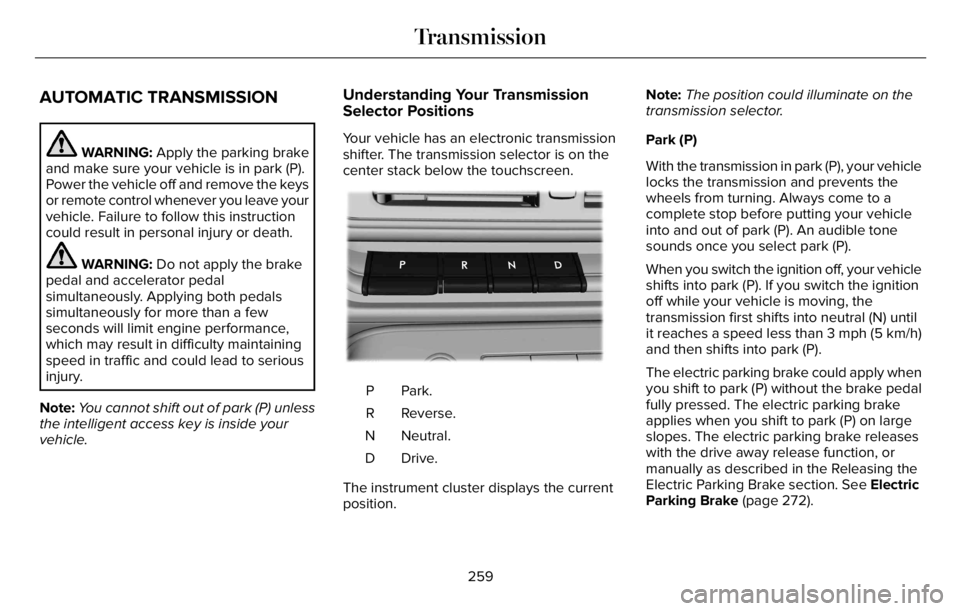
shifter. The transmission selector is on the
center stack below the touchscreen.
E247220E247E247E24E247E247E247E24E24E22E2E22E2E2E2424E247E247E247E24447247247E2472E247E247E247E24E2247E247E247E247E22222222202202220220220222202022220220220
Park. P
Reverse. R
Neutral. N
Drive. D
The instrument cluster displays the current
position.Note:The position could illuminate on the
transmission selector.
Park (P)
With the transmission in park (P), your vehicle
locks the transmission and prevents the
wheels from turning. Always come to a
complete stop before putting your vehicle
into and out of park (P). An audible tone
sounds once you select park (P).
When you switch the ignition off, your vehicle
shifts into park (P). If you switch the ignition
off while your vehicle is moving, the
transmission first shifts into neutral (N) until
it reaches a speed less than 3 mph (5 km/h)
and then shifts into park (P).
The electric parking brake could apply when
you shift to park (P) without the brake pedal
fully pressed. The electric parking brake
applies when you shift to park (P) on large
slopes. The electric parking brake releases
with the drive away release function, or
manually as described in the Releasing the
Electric Parking Brake section. See Electric
Parking Brake (page 272).
259
Transmission
Page 263 of 681
Note:A warning tone sounds if you open the
driver door and you have not shifted the
transmission selector to park (P).
Reverse (R)
With the transmission selector in reverse (R),
your vehicle moves backward. Always come
to a complete stop before shifting into and
out of reverse (R).
Neutral (N)
With the transmission selector in neutral (N),
you can start your vehicle and it is free to
roll. Hold the brake pedal down when in this
position.
Drive (D)
Drive (D) is the normal driving position for
the best fuel economy and smoothness. Shift
the transmission selector to drive (D) to allow
your vehicle to move forward and shift
through the forward gears.
The transmission shifts to the appropriate
gear for optimum performance based on
ambient temperature, road slope, vehicle
load and your input.Automatic Return to Park
Your vehicle shifts into park (P) when your
vehicle is stationary and any of the following
occur:
• You switch the vehicle off.
• You open the driver door with your
seatbelt unlatched.
• You unlatch the driver seatbelt when the
driver door is open.
Note:Do not use automatic return to park
(P) when your vehicle is moving, except in
an emergency.
Automatic return to park (P) may not work if
the door ajar switch is malfunctioning.See an authorized dealer if any of the
following occur:
• Door ajar indicator does not illuminate
with the driver door open.
• Door ajar indicator illuminates with the
driver door closed.
• Transmission not in park message
appears with the driver door closed, after
you shift out of park (P). You unlatch the
driver seatbelt when the driver door is
open.
Stay in Neutral Mode
This mode keeps your vehicle in neutral (N)
when you switch your vehicle off. Use this
mode at an automatic car wash if you exit
your vehicle, or switch your vehicle off.
Note:Automatic return to park (P) is delayed
when your vehicle is in this mode.
Your vehicle could shift to park (P) after 30
minutes, or when the vehicle battery charge
level is low. Prolonged use of this mode can
cause the vehicle battery to run out of
charge.
260
Transmission
Page 264 of 681
Do not tow your vehicle in this mode. Failure
to follow these instructions could result in
vehicle damage not covered by the vehicle
warranty.
Entering Temporary Neutral Mode
1. Power your vehicle on.
2. Bring your vehicle to a complete stop.
3. Press and hold the brake pedal.
4. Shift into neutral (N).
Note:An instructional message appears.
5. Press the neutral (N) button.
Note:A confirmation message appears
when your vehicle enters the mode.
6. Release the brake pedal.
Note:Your vehicle is free to roll.
7. Switch your vehicle off.
Note:Do not tow your vehicle in this mode.
Note:The neutral (N) indicator on the
transmission selector may flash in this mode.
Exiting Temporary Neutral Mode
1. Press the brake pedal.2. Shift into park (P), or power your vehicle
on and shift into drive (D) or reverse (R).
Manually Shifting Gears
The instrument cluster displays the current
gear. The current gear flashes when your
vehicle cannot shift into the requested gear.
Your vehicle will not shift if the requested
gear raises or lowers the engine speed
beyond the limit.
Your vehicle could shift when you fully press
the accelerator or brake pedal.
Note:Prolonged driving with high engine
speed could cause vehicle damage not
covered by vehicle warranty.
Note:Drive modes could affect when the
vehicle shifts into the requested gear.
E144821
Manually Shifting Gears in Drive (D)
Use this feature to temporarily change gear.
Note:We recommend using this feature for
engine braking or driving on hilly or
mountainous roads.
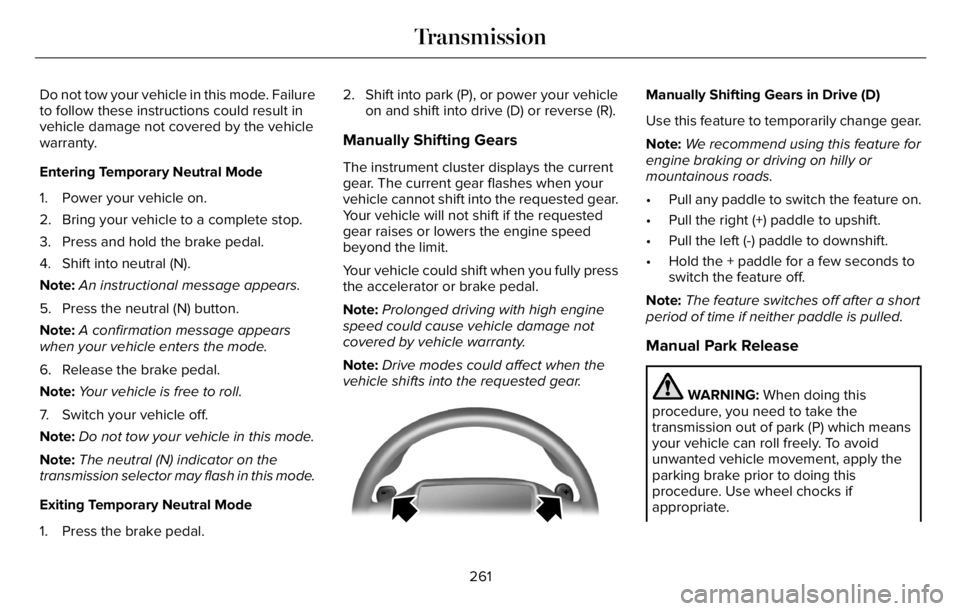
• Pull any paddle to switch the feature on.
• Pull the right (+) paddle to upshift.
• Pull the left (-) paddle to downshift.
• Hold the + paddle for a few seconds to
switch the feature off.
Note:The feature switches off after a short
period of time if neither paddle is pulled.
Manual Park Release
WARNING: When doing this
procedure, you need to take the
transmission out of park (P) which means
your vehicle can roll freely. To avoid
unwanted vehicle movement, apply the
parking brake prior to doing this
procedure. Use wheel chocks if
appropriate.
261
Transmission
Page 265 of 681
WARNING: If the parking brake is
fully released, but the brake warning lamp
remains illuminated, the brakes may not
be working properly. Have your vehicle
checked as soon as possible.
WARNING: Do not drive your vehicle
until you verify that the stoplamps are
working.
Use the manual park release to move your
transmission from the park (P) position in the
event of an electrical malfunction or
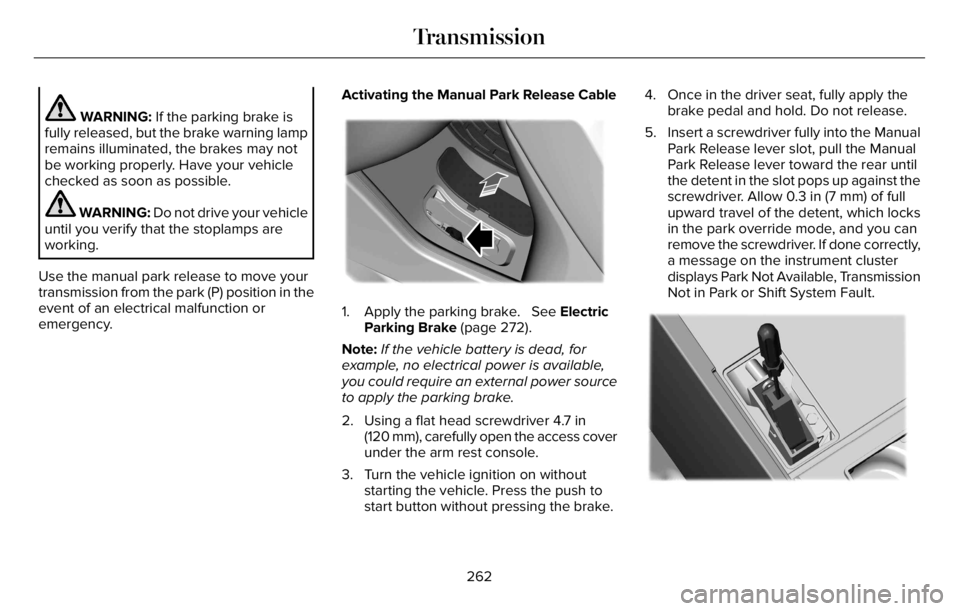
emergency.Activating the Manual Park Release CableE294326
1. Apply the parking brake. See Electric
Parking Brake (page 272).
Note:If the vehicle battery is dead, for
example, no electrical power is available,
you could require an external power source
to apply the parking brake.
2. Using a flat head screwdriver 4.7 in
(120 mm), carefully open the access cover
under the arm rest console.
3. Turn the vehicle ignition on without
starting the vehicle. Press the push to
start button without pressing the brake.4. Once in the driver seat, fully apply the
brake pedal and hold. Do not release.
5. Insert a screwdriver fully into the Manual
Park Release lever slot, pull the Manual
Park Release lever toward the rear until
the detent in the slot pops up against the
screwdriver. Allow 0.3 in (7 mm) of full
upward travel of the detent, which locks
in the park override mode, and you can
remove the screwdriver. If done correctly,
a message on the instrument cluster
displays Park Not Available, Transmission
Not in Park or Shift System Fault.
E297270E297E297E297E297E2972972972979797797777E297E297E292977297E297972972222222272727022702702702270272702702270270270
262
Transmission