warning LINCOLN CONTINENTAL 1996 Customer Assistance Guide
[x] Cancel search | Manufacturer: LINCOLN, Model Year: 1996, Model line: CONTINENTAL, Model: LINCOLN CONTINENTAL 1996Pages: 320, PDF Size: 1.8 MB
Page 25 of 320
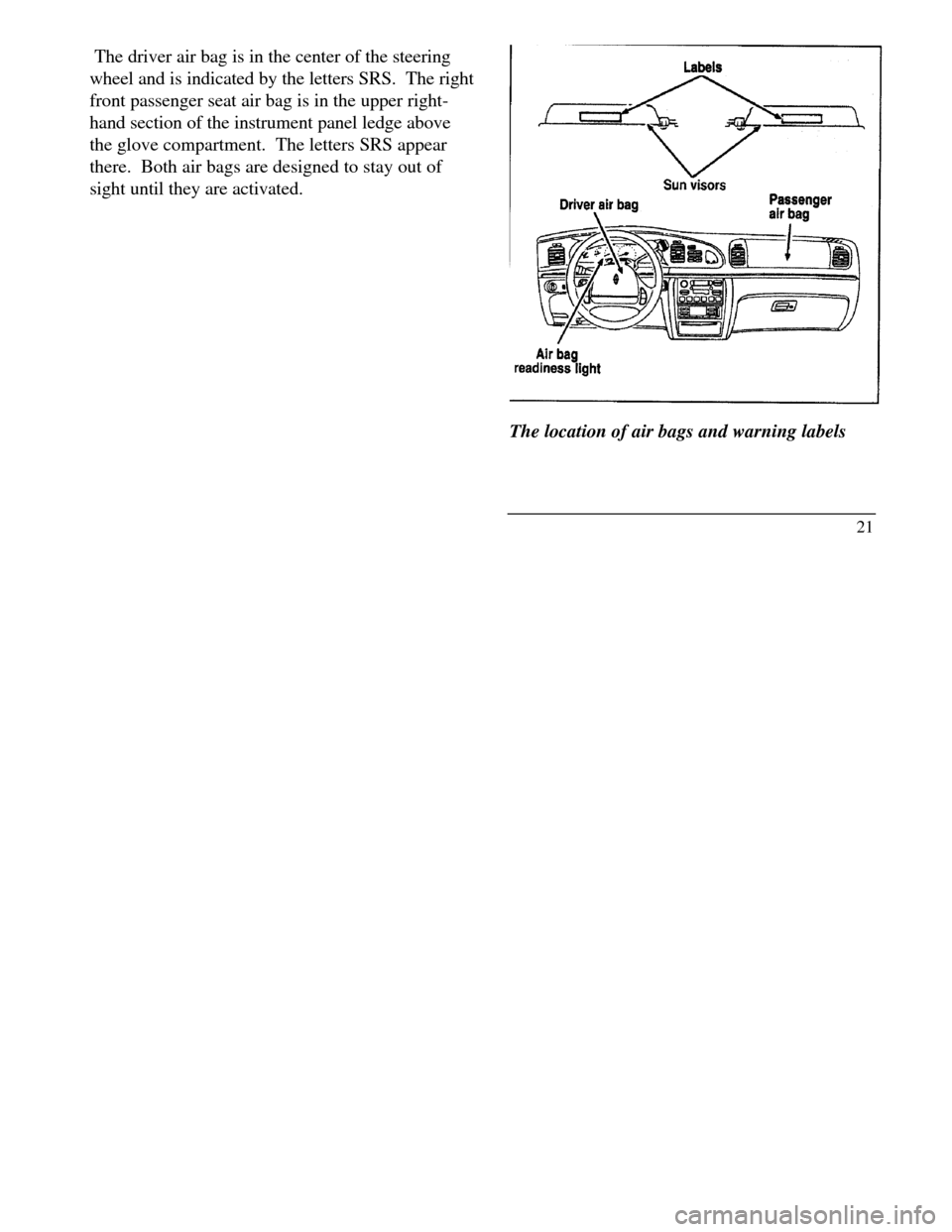
The driver air bag is in the center of the steering
wheel and is indicated by the letters SRS. The right
front passenger seat air bag is in the upper right-
hand section of the instrument panel ledge above
the glove compartment. The letters SRS appear
there. Both air bags are designed to stay out of
sight until they are activated.The location of air bags and warning labels
21
Page 26 of 320
If a collision occurs, the sensors sense the
severity of the impact and activates the air bags
if necessary. The air bag system is designed to
deploy in frontal and front-angled collisions
more severe than hitting a parked vehicle (of
similar size and weight) head-on at about 28
mph (45 km/h). Because the system senses the
crash severity rather than vehicle speed, some
frontal collisions at speeds above 28 mph (45
km/h) will not inflate the air bag.
22When the sensors activate the system, the air bags
inflate rapidly, filling with non-toxic nitrogen gas in
a fraction of a second. Immediately after inflation,
the air bags deflate by releasing the nitrogen gas
through vent holes. The whole process takes place
in a matter of seconds./!\ WARNINGAir bag system components get hot afterinflation. Do not touch them after inflation.
Page 28 of 320
/! WARNINGIf the air bag is inflated, THE AIR BAGWILL NOT FUNCTION AGAIN ANDMUST BE REPLACED IMMEDIATELY.If the air bag is not replaced, theunrepaired area will increase the risk ofinjury in a collision.To ensure that the air bag system will operate as
intended in a crash, the system is equipped with a
diagnostic module, which controls a readiness lamp
and a warning tone. The diagnostic module
monitors its own circuits, the air bag electrical
system, the air bag readiness light, the air bag
power, and the air bag inflators.
The air bag system uses a readiness light on the
instrument cluster and a tone to indicate the
condition of the system. When you turn the ignition
key to the ON position, this light will illuminate for
approximately six (6) seconds and then turn off.
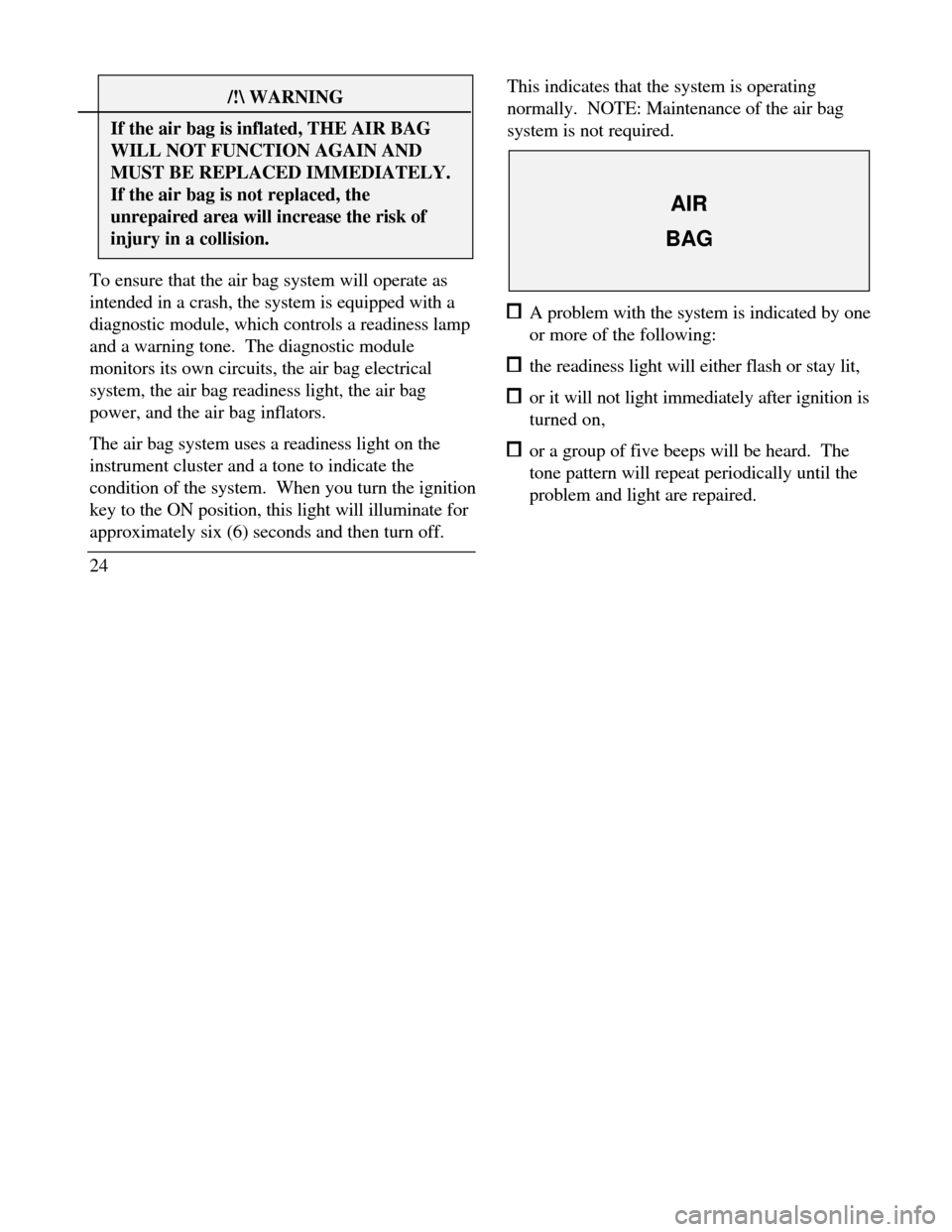
24This indicates that the system is operating
normally. NOTE: Maintenance of the air bag
system is not required.AIRBAG A problem with the system is indicated by one
or more of the following: the readiness light will either flash or stay lit, or it will not light immediately after ignition is
turned on, or a group of five beeps will be heard. The
tone pattern will repeat periodically until the
problem and light are repaired.
Page 29 of 320
If any of these things happen, have the air bag
system serviced at your Ford or Lincoln-
Mercury dealer immediately. Unless serviced,
the air bag supplemental restraint system may
not function properly in the event of a collision./!\ WARNINGDo not attempt to service, repair, or modifythe Air Bag Supplemental Restraint Systemor its fuses. See your Ford or Lincoln-Mercury dealer.Disposal of air bags or air bag equipped
vehicles
For disposal of air bags or air bag equipped
vehicles, see your local Ford or Lincoln-Mercury
dealer. Air bags MUST be disposed of by qualified
personnel.Safety Restraints for Children
In the U.S. and Canada, you are required by
law to use safety restraints for children. If
small children ride in your vehicle - this
generally includes children who are four years
old or younger and who weigh 40 pounds (18
kg) or less - you must put them in safety seats
that are made specially for children. Safety
belts alone do not provide maximum protection
for these children. Check your local and state
laws for specific requirements./!\ WARNINGNever let a passenger hold a child on his orher lap while the vehicle is moving. Thepassenger cannot protect the child frominjury in a collision.25
Page 30 of 320
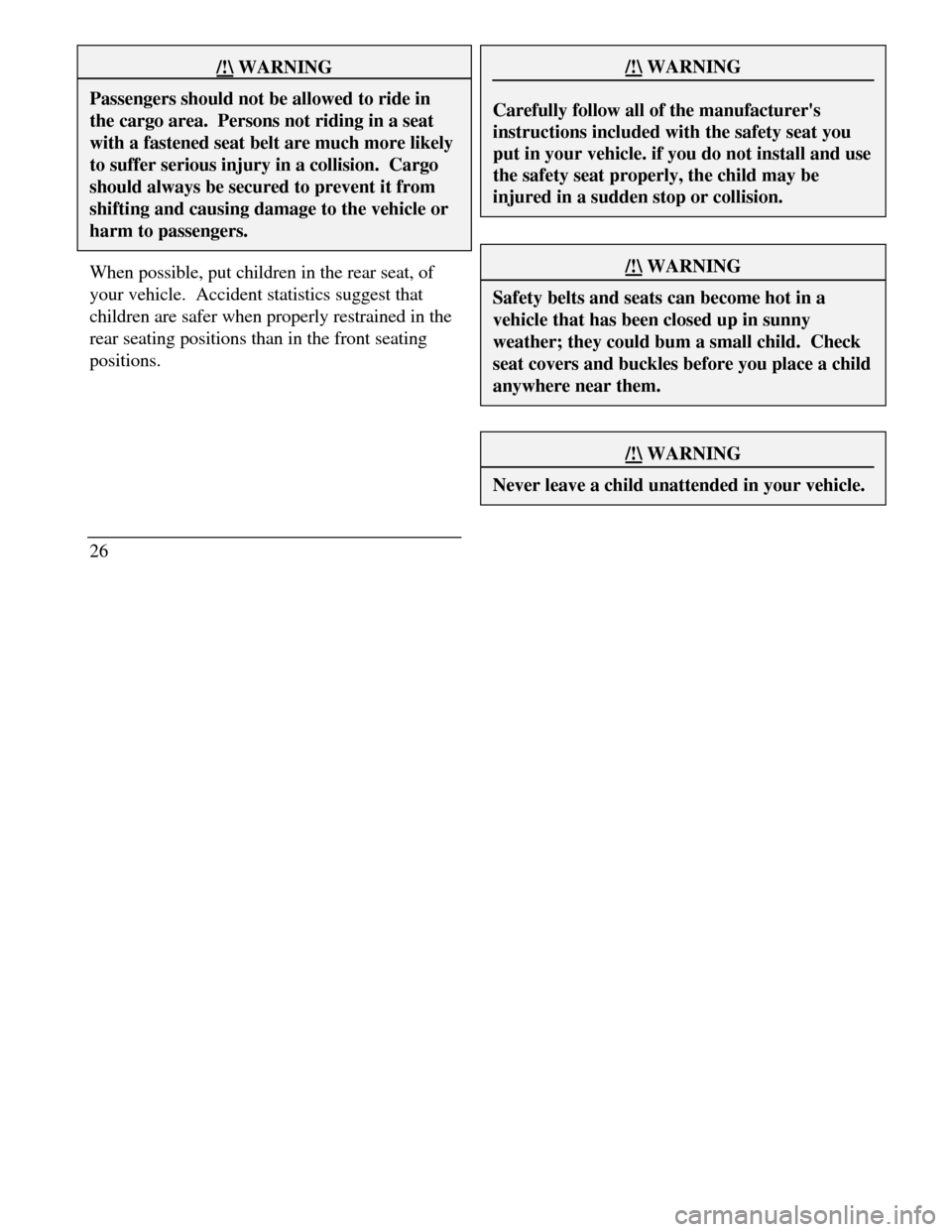
/!\ WARNINGPassengers should not be allowed to ride inthe cargo area. Persons not riding in a seatwith a fastened seat belt are much more likelyto suffer serious injury in a collision. Cargoshould always be secured to prevent it fromshifting and causing damage to the vehicle orharm to passengers.When possible, put children in the rear seat, of
your vehicle. Accident statistics suggest that
children are safer when properly restrained in the
rear seating positions than in the front seating
positions.
26/!\ WARNINGCarefully follow all of the manufacturer'sinstructions included with the safety seat youput in your vehicle. if you do not install and usethe safety seat properly, the child may beinjured in a sudden stop or collision./!\ WARNINGSafety belts and seats can become hot in avehicle that has been closed up in sunnyweather; they could bum a small child. Checkseat covers and buckles before you place a childanywhere near them./!\ WARNINGNever leave a child unattended in your vehicle.
Page 31 of 320
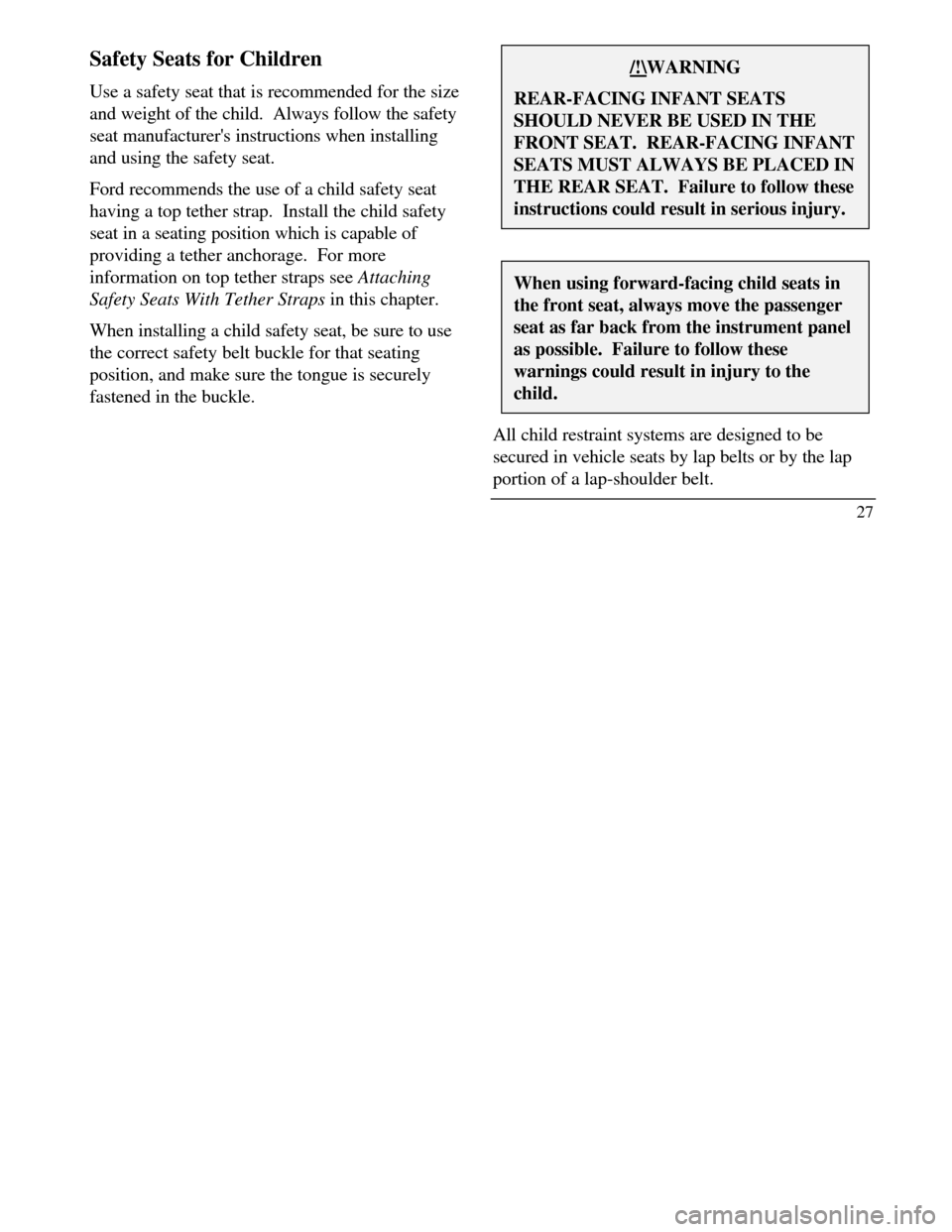
Safety Seats for Children
Use a safety seat that is recommended for the size
and weight of the child. Always follow the safety
seat manufacturer's instructions when installing
and using the safety seat.
Ford recommends the use of a child safety seat
having a top tether strap. Install the child safety
seat in a seating position which is capable of
providing a tether anchorage. For more
information on top tether straps see Attaching
Safety Seats With Tether Straps in this chapter.
When installing a child safety seat, be sure to use
the correct safety belt buckle for that seating
position, and make sure the tongue is securely
fastened in the buckle./!\WARNINGREAR-FACING INFANT SEATSSHOULD NEVER BE USED IN THEFRONT SEAT. REAR-FACING INFANTSEATS MUST ALWAYS BE PLACED INTHE REAR SEAT. Failure to follow theseinstructions could result in serious injury.When using forward-facing child seats inthe front seat, always move the passengerseat as far back from the instrument panelas possible. Failure to follow thesewarnings could result in injury to thechild.All child restraint systems are designed to be
secured in vehicle seats by lap belts or by the lap
portion of a lap-shoulder belt.
27
Page 32 of 320
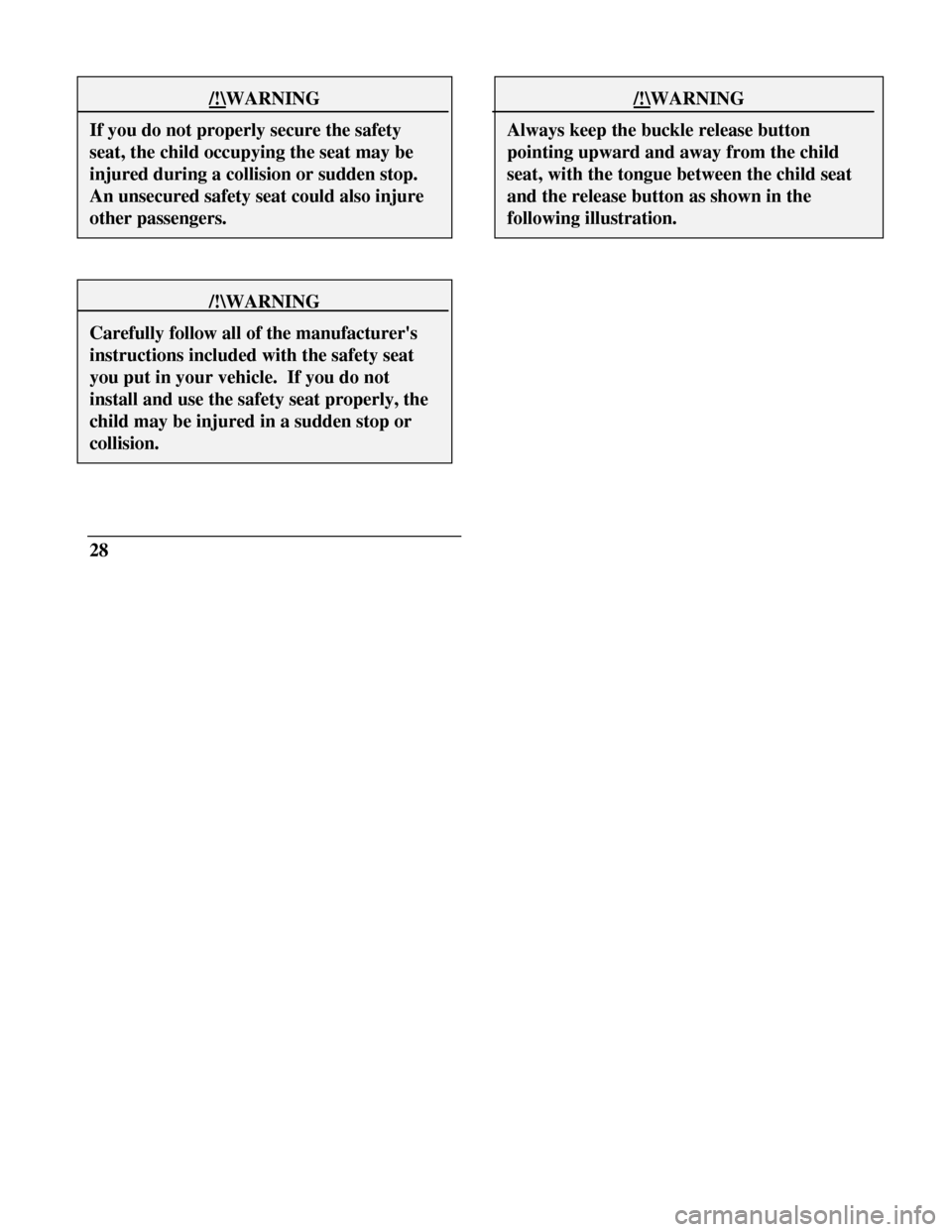
/!\WARNINGIf you do not properly secure the safetyseat, the child occupying the seat may beinjured during a collision or sudden stop.An unsecured safety seat could also injureother passengers./!\WARNINGCarefully follow all of the manufacturer'sinstructions included with the safety seatyou put in your vehicle. If you do notinstall and use the safety seat properly, thechild may be injured in a sudden stop orcollision.28/!\WARNINGAlways keep the buckle release buttonpointing upward and away from the childseat, with the tongue between the child seatand the release button as shown in thefollowing illustration.
Page 42 of 320
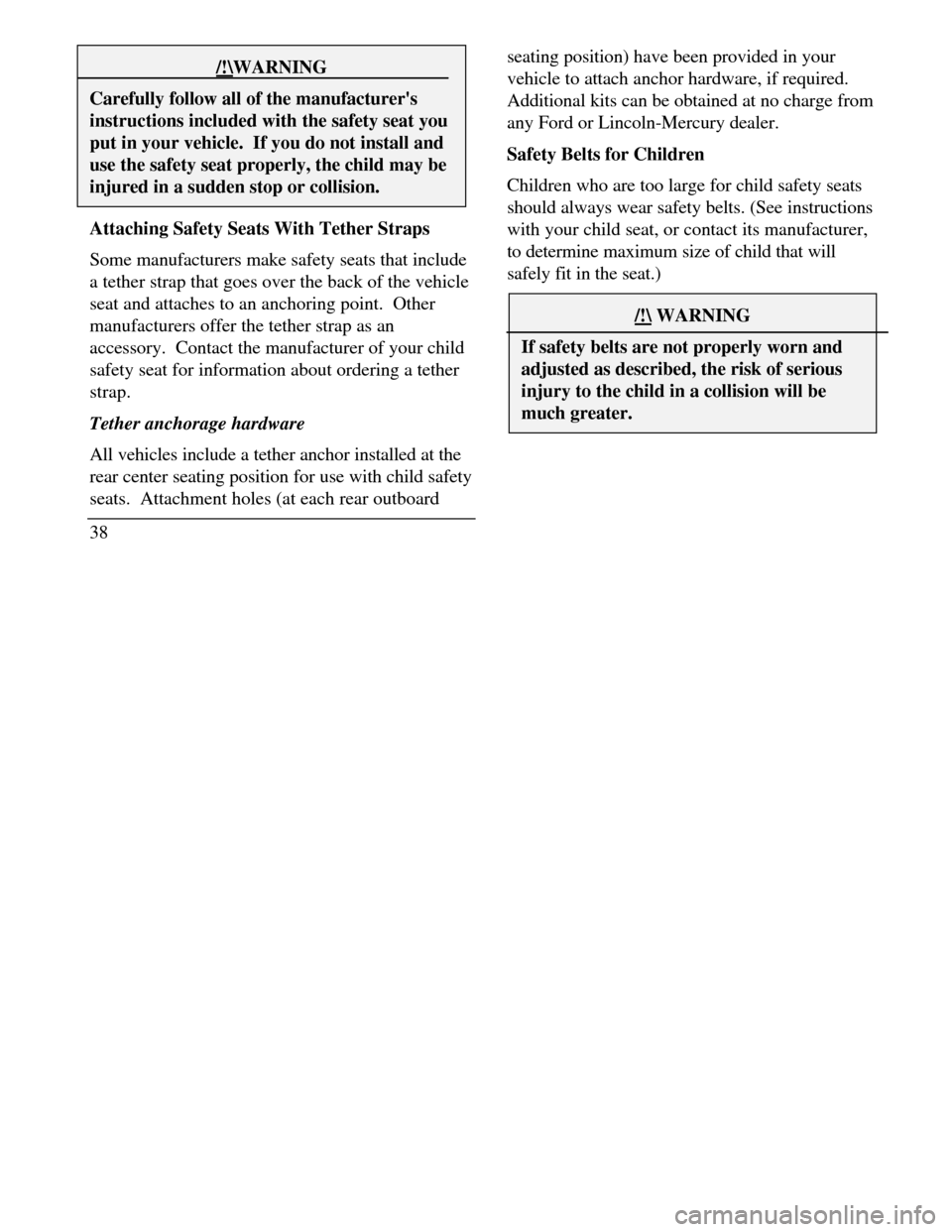
/!\WARNINGCarefully follow all of the manufacturer'sinstructions included with the safety seat youput in your vehicle. If you do not install anduse the safety seat properly, the child may beinjured in a sudden stop or collision.Attaching Safety Seats With Tether Straps
Some manufacturers make safety seats that include
a tether strap that goes over the back of the vehicle
seat and attaches to an anchoring point. Other
manufacturers offer the tether strap as an
accessory. Contact the manufacturer of your child
safety seat for information about ordering a tether
strap.
Tether anchorage hardware
All vehicles include a tether anchor installed at the
rear center seating position for use with child safety
seats. Attachment holes (at each rear outboard
38seating position) have been provided in your
vehicle to attach anchor hardware, if required.
Additional kits can be obtained at no charge from
any Ford or Lincoln-Mercury dealer.
Safety Belts for Children
Children who are too large for child safety seats
should always wear safety belts. (See instructions
with your child seat, or contact its manufacturer,
to determine maximum size of child that will
safely fit in the seat.)/!\ WARNINGIf safety belts are not properly worn andadjusted as described, the risk of seriousinjury to the child in a collision will bemuch greater.
Page 43 of 320
If the shoulder belt portion of the lap/shoulder belt
can be positioned so that it does not cross or rest in
front of the child's face or neck, the child should
wear the lap/shoulder belt. Moving the child closer
to the seat belt buckle may help provide a good
shoulder belt fit.
To improve the fit of lap and shoulder belts on
children who have outgrown child safety seats,
Ford recommends use of a belt-positioning booster
seat that is labelled as conforming to all Federal
motor vehicle safety standards. Belt-positioning
booster seats raise the child and provide a shorter,
firmer seating cushion that encourages safer seating
posture and better fit of lap and shoulder belts on
the child. A belt-positioning booster should be
used if the shoulder belt rests in front of the child's
face or neck, or if the lap belt does not fit snugly on
both thighs, or if the thighs are too short to let the
child sit all the way back on the seat cushion when
the lower legs hang over the edge of the seat
cushion. You may wish to discuss the specific
needs of your child with your pediatrician./!\ WARNINGDo not use a belt-positioning booster witha lap-only belt.Lap belts and the lap belt portion of lap and
shoulder belts should always be worn snugly and
below the hips, touching the child's thighs./!\ WARNINGTo reduce the risk of serious injury incollision, children should always ride withthe seatback upright.39
Page 45 of 320
OFF allows you to shut off the engine and all
accessories without locking the steering wheel, or the
gearshift lever.
ON allows You to test your vehicle's warning lights
(except the brake system warning light) to make sure
they work before you start the engine. The key returns
to the ON position once the engine is started and
remains in this position while the
engine runs.
START cranks the engine. Release the key once the
engine starts so that you do not damage the starter. The
key should return to ON when You release it. The
START position also allows You to test the Brake
Warning Light.
42Removing the Key From the Ignition
1.Put the gearshift in P (Park)-
2.Set the parking brake fully.
3.Turn the ignition key to LOCK.
4.Remove the key.
If the key is stuck in the LOCK position, move the
steering wheel left or right until the key turns freely.
If the driver's door is open while the key is still in the
ignition, a warning chime sounds./! WARNINGAlways set the parking brake fully andmake sure that the gearshift is securelylatched in P (Park).