warning LINCOLN CONTINENTAL 1996 Customer Assistance Guide
[x] Cancel search | Manufacturer: LINCOLN, Model Year: 1996, Model line: CONTINENTAL, Model: LINCOLN CONTINENTAL 1996Pages: 320, PDF Size: 1.8 MB
Page 46 of 320
/! WARNINGDo not leave children, unreliable adults,or pets alone in your vehicle. They couldaccidentally injure themselves or othersthrough inadvertent operation of thevehicle. Further, on hot, sunny days,temperatures in a closed vehicle couldquickly become high enough to causesevere and possibly fatal injuries to peopleas well as animals.Fuel-Injected Engines
When starting a fuel-injected engine, the most
important thing to remember is to avoid pressing
down on the accelerator before or during starting.
Only use the accelerator when you have problems
getting your vehicle started. See Starting Your Engine
in this chapter for details about when to use the
accelerator while you start your vehicle.Staring Your Vehicle
Preparing to Start Your Vehicle/!\WARNINGDo not start your vehicle in a closed garage orother enclosed area. Never sit in a stoppedvehicle for more than a short period of timewith the engine running. Exhaust fumes aretoxic. See Guarding Against Exhaust Fumesin this chapter for more instructions.Before you start your vehicle, do the following:
1. Make sure you and all your passengers buckle
your safety belts. See Safety Restraints in the
Index for more details.
2. Make sure the headlamps and other accessories
are turned off when starting.
43
Page 47 of 320

3.Make sure that the gearshift is in P (Park) and the
parking brake is set before you turn the key.
Before you start your vehicle, you should test the
warning lights on the instrument panel to make sure that
they work. Refer to the Warning Lights and Gauges
chapter.
Starting Your Engine
To start your engine:
1.Follow the steps under Preparing to Start Your
Vehicle at the beginning of this section.
2.Turn the ignition key to the ON position.
3. DO NOT depress the accelerator pedal when
starting your engine. DO NOT use the accelerator
while the vehicle is parked.
444. Turn the key to the START position (cranking)
until the engine starts. Allow the key to return to
the ON position after the engine has started.
If you have difficulty in turning the key, rotate the
steering wheel slightly because it may be binding.
For a cold engine: At temperatures 10° °F (-12° °C) and below: If the
engine does not start in fifteen (15) seconds on the
first try, turn the key to OFF, wait approximately
ten (10) seconds so you do not flood the engine,
then try again. At temperatures above 10° °F (-12° °C): If the
engine does not start in five (5) seconds on the
first try, turn the key to OFF, wait approximately
ten (10) seconds so you do not flood the engine,
then try again.
Page 49 of 320
A computer system controls the engine's idle speed.
When you start your vehicle, the engine's idle speed
normally runs higher than when it is warmed up. These
faster engine speeds will make your vehicle move
slightly faster than its normal idle speed. It should,
however, slow down after a short time. If it does not,
have the idle speed checked.
If the engine idle speed does not slow down
automatically, do not allow your vehicle to idle for more
than 10 minutes. Have the vehicle checked./! WARNINGExtended idling at high engine speeds can producevery high temperatures in the engine and exhaustsystem, creating the risk of fire or other damage.46/! WARNINGDo not park, idle, or drive your vehicle in drygrass or other dry ground cover. Theemission system heats up the enginecompartment and exhaust system, which canstart a fire.Engine Block Heater (If equipped)
Engine block heaters are strongly recommended if
you live in a region where temperatures reach -10° °F
(-23° °C) or below. An engine block heater warms
the engine coolant, which improves starting, warms
up the engine faster, and allows the heater-defrost
system to respond quickly.
To turn the heater on, simply plug it into a
grounded 110-volt outlet. Ford recommends that
you use a 110-volt circuit that is protected by a
ground fault circuit interrupter.
Page 50 of 320

/! WARNINGTo prevent electrical shock, do not use yourheater with ungrounded electrical systemsor two-pronged (cheater) adapters.For best results, plug the heater in at least three
hours before you start your vehicle. Using the
heater for longer than three hours will not damage
the engine, so you can plug it in at night to start
your vehicle the following morning.If the Engine Cranks but Does
Not Start After a Collision
Fuel Pump Shut-off Switch
If the engine cranks but does not start or does
not start after a collision, the fuel pump shut-off
switch may have been triggered. The shut-off
switch is a device intended to stop the fuel pump
when your vehicle has been involved in a
substantial jolt.
Once the shut-off switch is triggered, you must
reset the switch by hand before you can start
your vehicle. The switch is on the left side of the
trunk.
47
Page 51 of 320
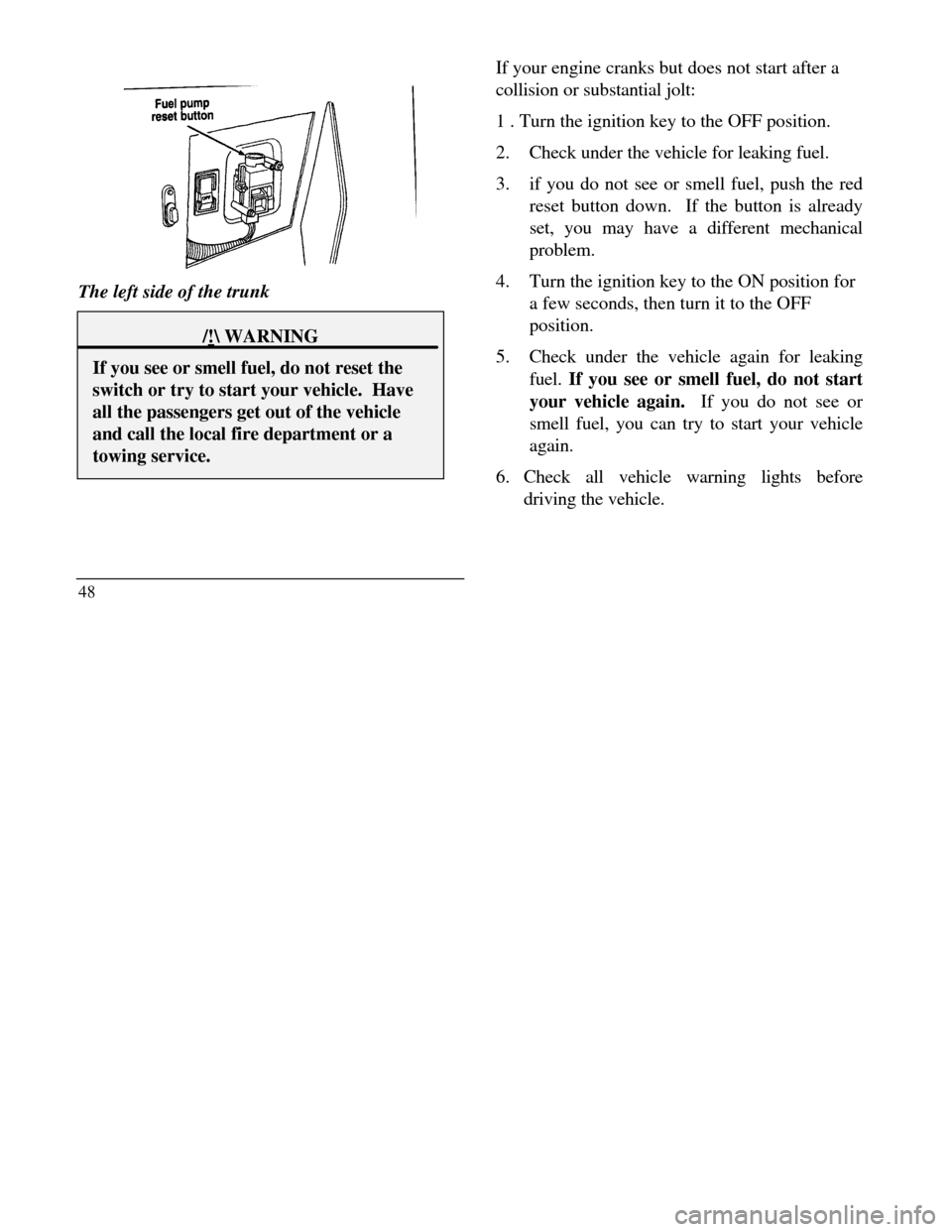
The left side of the trunk/! WARNINGIf you see or smell fuel, do not reset theswitch or try to start your vehicle. Haveall the passengers get out of the vehicleand call the local fire department or atowing service.48If your engine cranks but does not start after a
collision or substantial jolt:
1 . Turn the ignition key to the OFF position.
2.Check under the vehicle for leaking fuel.
3.if you do not see or smell fuel, push the red
reset button down. If the button is already
set, you may have a different mechanical
problem.
4.Turn the ignition key to the ON position for
a few seconds, then turn it to the OFF
position.
5.Check under the vehicle again for leaking
fuel. If you see or smell fuel, do not start
your vehicle again. If you do not see or
smell fuel, you can try to start your vehicle
again.
6. Check all vehicle warning lights before
driving the vehicle.
Page 52 of 320
Pushing
Vehicles with automatic transaxles cannot be
started by pushing. Follow the directions under If
Your Vehicle Needs a Jump-Start in the Roadside
Emergencies Chapter.
Guarding Against Exhaust Fumes
Carbon monoxide, although colorless and odorless,
is present in exhaust fumes. Take precautions to
avoid its dangerous effects./!\WARNINGDo not start your vehicle in a closed garageor other enclosed area. Never sit in astopped vehicle for more than a shortperiod of time with the engine running.Exhaust fumes are toxic. See GuardingAgainst Exhaust Fumes in this chapter formore instructions./!\WARNINGIf you smell exhaust fumes inside yourvehicle, have your dealer inspect yourvehicle immediately. Do not drive if yousmell exhaust fumes.49
Page 54 of 320
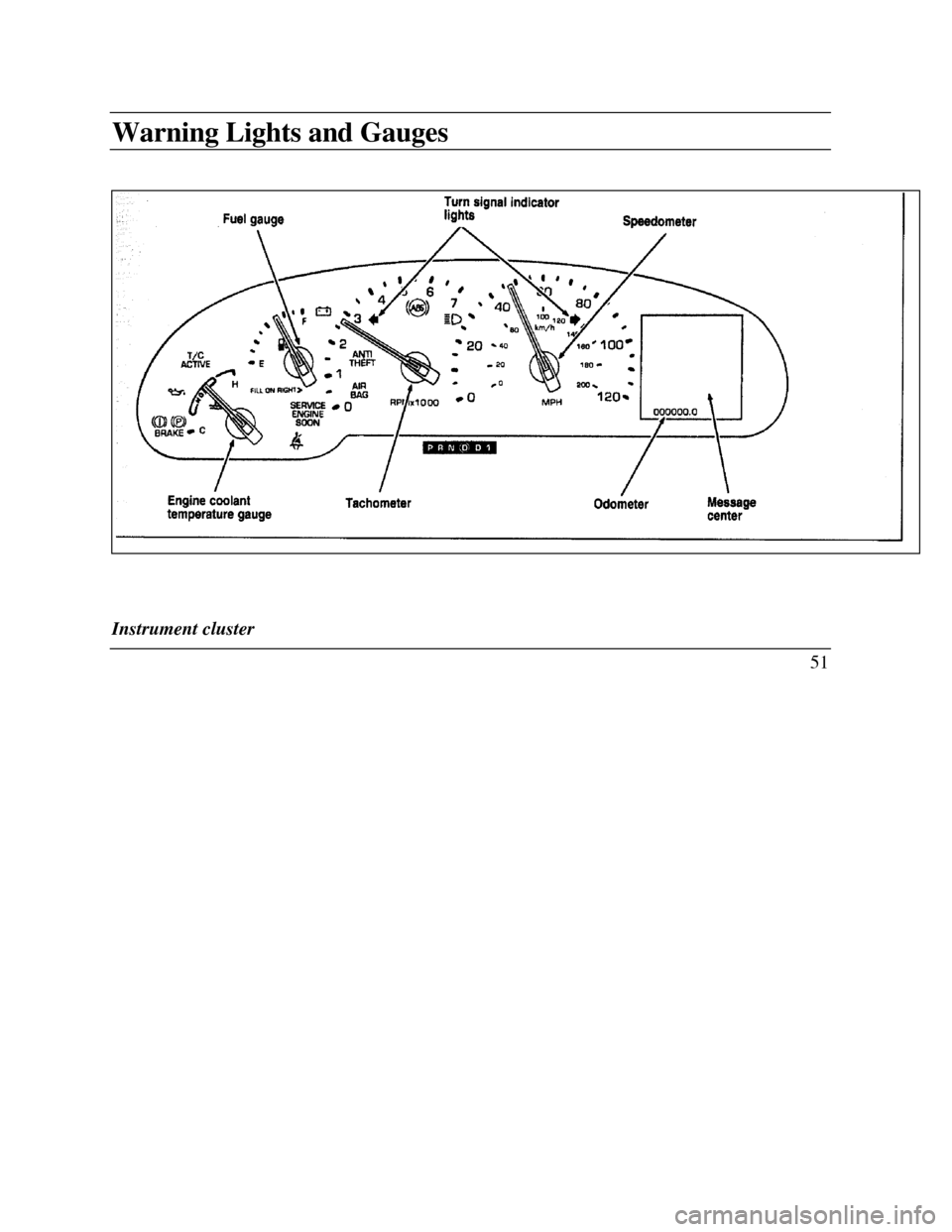
Warning Lights and GaugesInstrument cluster
51
Page 55 of 320
The following warning lights and gauges are on
the instrument cluster. AD of the warning
lights and gauges alert you to possible
problems with your vehicle.
Indicator Lights and Chimes
Safety Belt Warning Light and Chime
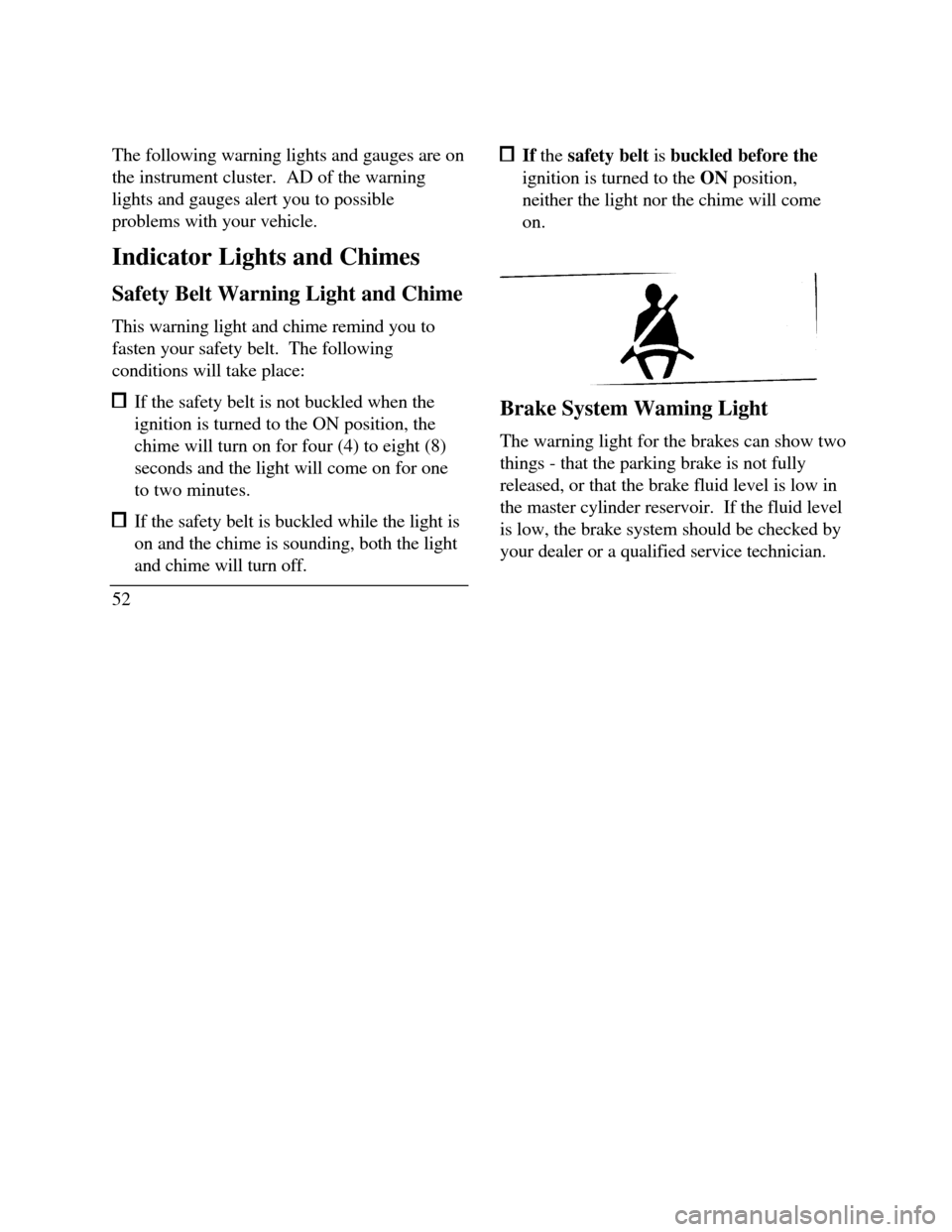
This warning light and chime remind you to
fasten your safety belt. The following
conditions will take place: If the safety belt is not buckled when the
ignition is turned to the ON position, the
chime will turn on for four (4) to eight (8)
seconds and the light will come on for one
to two minutes. If the safety belt is buckled while the light is
on and the chime is sounding, both the light
and chime will turn off.
52 If the safety belt is buckled before the
ignition is turned to the ON position,
neither the light nor the chime will come
on.Brake System Waming Light
The warning light for the brakes can show two
things - that the parking brake is not fully
released, or that the brake fluid level is low in
the master cylinder reservoir. If the fluid level
is low, the brake system should be checked by
your dealer or a qualified service technician.
Page 56 of 320
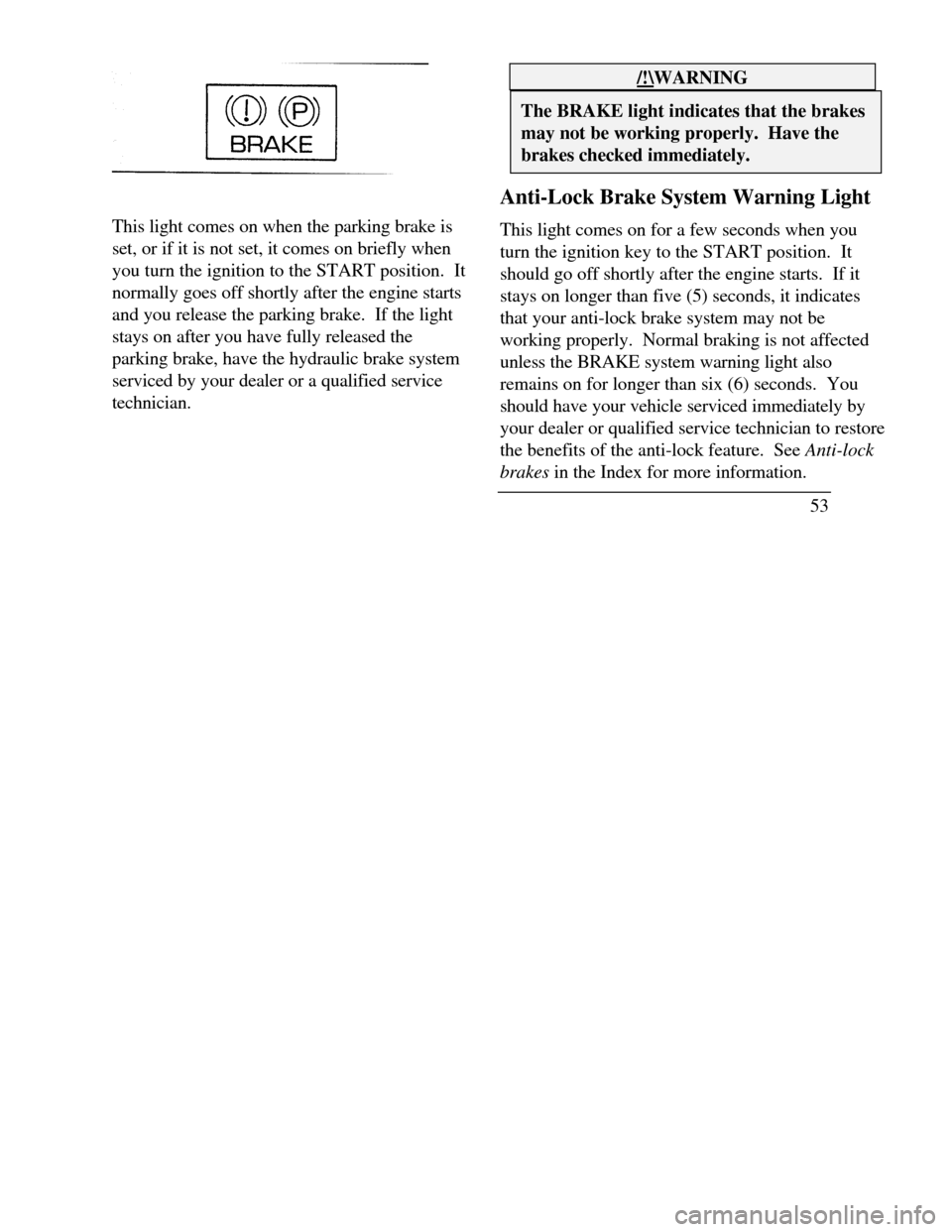
This light comes on when the parking brake is
set, or if it is not set, it comes on briefly when
you turn the ignition to the START position. It
normally goes off shortly after the engine starts
and you release the parking brake. If the light
stays on after you have fully released the
parking brake, have the hydraulic brake system
serviced by your dealer or a qualified service
technician./!\WARNINGThe BRAKE light indicates that the brakesmay not be working properly. Have thebrakes checked immediately.Anti-Lock Brake System Warning Light
This light comes on for a few seconds when you
turn the ignition key to the START position. It
should go off shortly after the engine starts. If it
stays on longer than five (5) seconds, it indicates
that your anti-lock brake system may not be
working properly. Normal braking is not affected
unless the BRAKE system warning light also
remains on for longer than six (6) seconds. You
should have your vehicle serviced immediately by
your dealer or qualified service technician to restore
the benefits of the anti-lock feature. See Anti-lock
brakes in the Index for more information.
53
Page 57 of 320

Engine Oil Pressure Warning Light
This light indicates the engine's oil pressure, not
the oil level. However, if your engine's oil level
is low, it could affect the oil pressure. The
light will come on briefly when you turn your
key to the START and ON position. The light
should stay off when the engine is running with
normal oil pressure. If the light comes on while
the engine is running, you have lost oil pressure
and continued operation will cause severe
engine damage.
54If you lose engine oil pressure:
1. Pull off the road as soon as safely possible.
2. Shut off the engine immediately or severe engine
damage could result.
3. Check the engine's oil level, following the
instructions on checking and adding engine oil,
see the Engine Oil in the Index. If you do not
follow these instructions, you or others could be
injured. To assure an accurate reading, your car
should be on level ground.
4. If the level is low, add only as much oil as
necessary before you start the engine again. Do
not overfill. Do not operate the engine if the light
is on, regardless of the oil level. Contact your
nearest dealer for further service actions.
For more information about adding oil, see Adding
engine oil in the Servicing Your Vehicle chapter.