tow LINCOLN CONTINENTAL 1996 Customer Assistance Guide
[x] Cancel search | Manufacturer: LINCOLN, Model Year: 1996, Model line: CONTINENTAL, Model: LINCOLN CONTINENTAL 1996Pages: 320, PDF Size: 1.8 MB
Page 199 of 320

Towing ClassLight-dutyMaximum gross trailer
weight1,000/2,000 lbs. (454/907
kg)*Maximum tongue load100/200 lbs. (45/91 kg)Engine4.OLHitch designLoad carrying typeTraffer-tow package
optionNot requiredVehicle speed should not exceed 45 mph (72 km/h) when
towing on grades. Limit maximum gross trailer weight to
1,000 lbs. (454 kg) and maximum tongue load to 100 lbs. (45
kg): (1) when you are towing a trailer on steep hills or on
moderate hills for a long distance (five miles (8 kms) or more)
(2) on very hot days (when the temperature is 1OO°F (38°C)
or more).
You should also limit your trailer's load when you
tow in high altitudes.
196Preparing to Tow
For your safety and for the good of your
vehicle, use the right equipment for the type of
trailer you tow. Also, make sure that all
towing equipment is properly attached to your
vehicle. If you are not certain that you are
using the right equipment in the proper manner,
see your Ford or Lincoln-Mercury dealer.
Do not use hitches that clamp onto your
vehicle's bumper. The bumper is not designed
to bear the load.
Always check the pressure in all your vehicle's
tires when preparing to tow (see inflation
recommendation on the tire label).
Connecting the safety chains
Always attach the trailer's safety chains to your
vehicle. They help protect your trailer if the
hitch breaks.
Page 201 of 320

Driving While You Tow
Be especially careful when driving while you tow a
trailer. Never drive faster than 45 mph (70 km/h)
when you tow in hilly country on hot days. Also,
anticipate stops so that you can brake gradually.
Towing a trailer increases the load on the engine and
transaxle, particularly in hilly country and with
heavier trailers. Under these conditions you may
experience an excessive amount of shifting between
Overdrive and Third gears. Moving the shift selector
to D (Overdrive Lockout) will keep this from
happening and will provide better engine braking.
When driving in less hilly country or with a lighter
trailer load. you may move the gearshift selector
lever to (Overdrive) without experiencing
excessive shifting.
198When driving down steep hills, you should put
the gearshift selector lever in the I (First)
position to shift the transaxle into second gear.
This will provide additional engine braking.
The automatic transaxle will automatically
downshift to the proper gear for driving up a
grade.
If you use the speed control while you are
towing on very long, steep grades, the speed
control may shut off.
Servicing your vehicle if you tow
If you tow a trailer for a long distance, your
vehicle will need to be serviced more frequently
than usual. See the Maintenance Schedule and
Record booklet.
Page 207 of 320

Changing a Tire
if you get a flat tire while you are driving, do not
apply the brake heavily. Instead, gradually decrease
the speed. Hold the steering wheel firmly and
slowly move to a safe place on the side of the road.
Park on a level spot, turn off the ignition, set the
parking brake, and turn on the hazard flashers.
The Temporary Spare Tire
You may have a high pressure temporary spare tire.
This spare tire is smaller than a regular tire and is
designed for emergency use only. Use it only when
you get a flat tire and replace it as soon as you can.
This spare tire is marked with the words
"TEMPORARY USE ONLY" so that you can easily
identify it.
204/! WARNINGIf you use the temporary spare tirecontinuously or do not follow theseprecautions, the tire could fail, causing you tolose control of the vehicle, possibly injuringyourself or others.When you drive with the temporary spare tire,
DO NOT: exceed 50 mph (80 km/h) under any
circumstances. load your vehicle so that it is heavier than the
maximum vehicle load rating listed on the tire
decal. tow a trailer. try to repair the temporary spare tire or remove it
from its wheel. use the wheel for any other type of vehicle.
Page 209 of 320
To remove the spare tire:
1.Remove the spare tire cover.
2.Unscrew the wing-nut holding down the spare
tire.
3. Lift out the spare tire and jack kit.
Preparing to Change the Tire
1.Make sure that your vehicle will not move or
roll. Put the gearshift in P (Park). Set the
parking brake and block the wheel that is
diagonally opposite the tire that you are
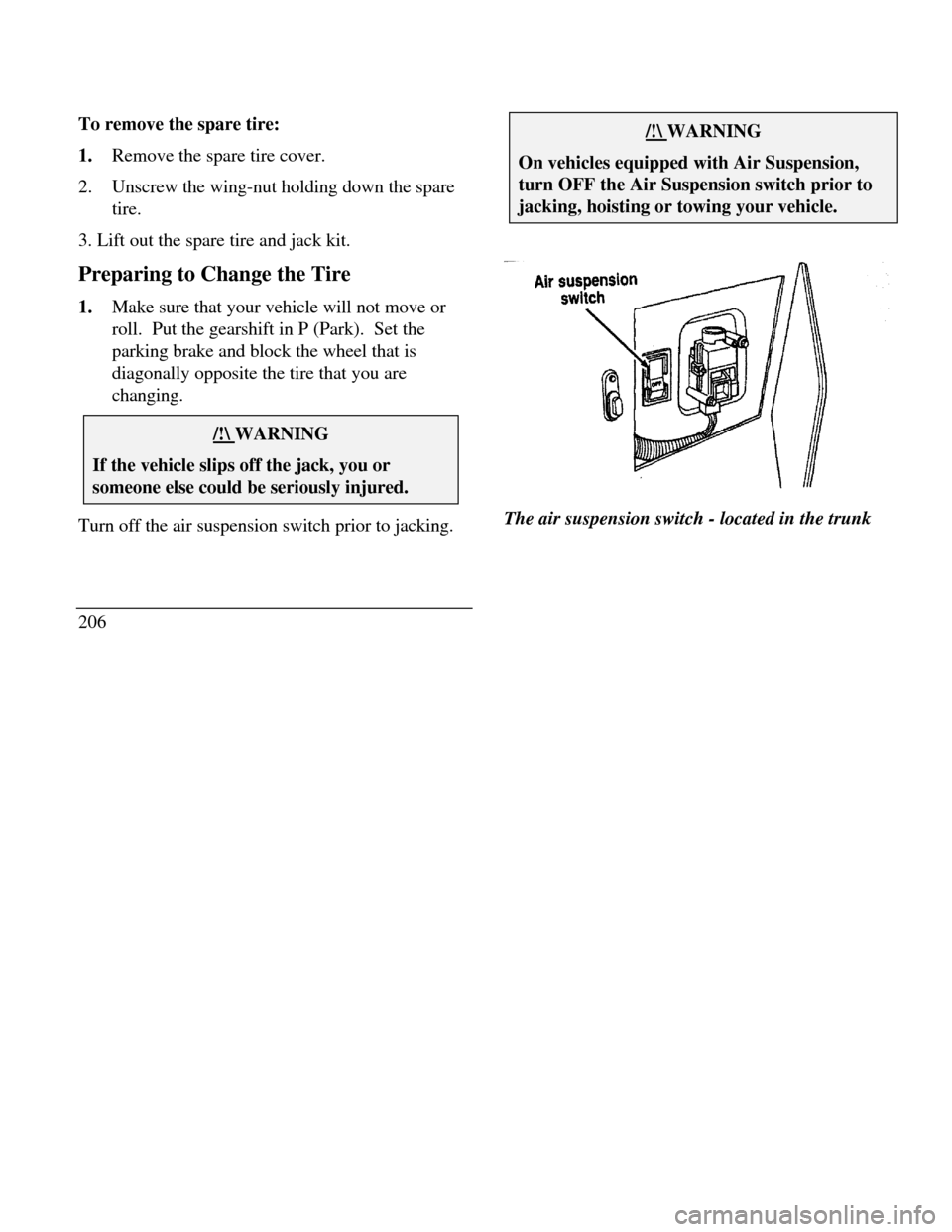
changing./! WARNINGIf the vehicle slips off the jack, you orsomeone else could be seriously injured.Turn off the air suspension switch prior to jacking.
206/! WARNINGOn vehicles equipped with Air Suspension,turn OFF the Air Suspension switch prior tojacking, hoisting or towing your vehicle.Air suspension switchThe air suspension switch - located in the trunk
Page 214 of 320
Towing Your Vehicle
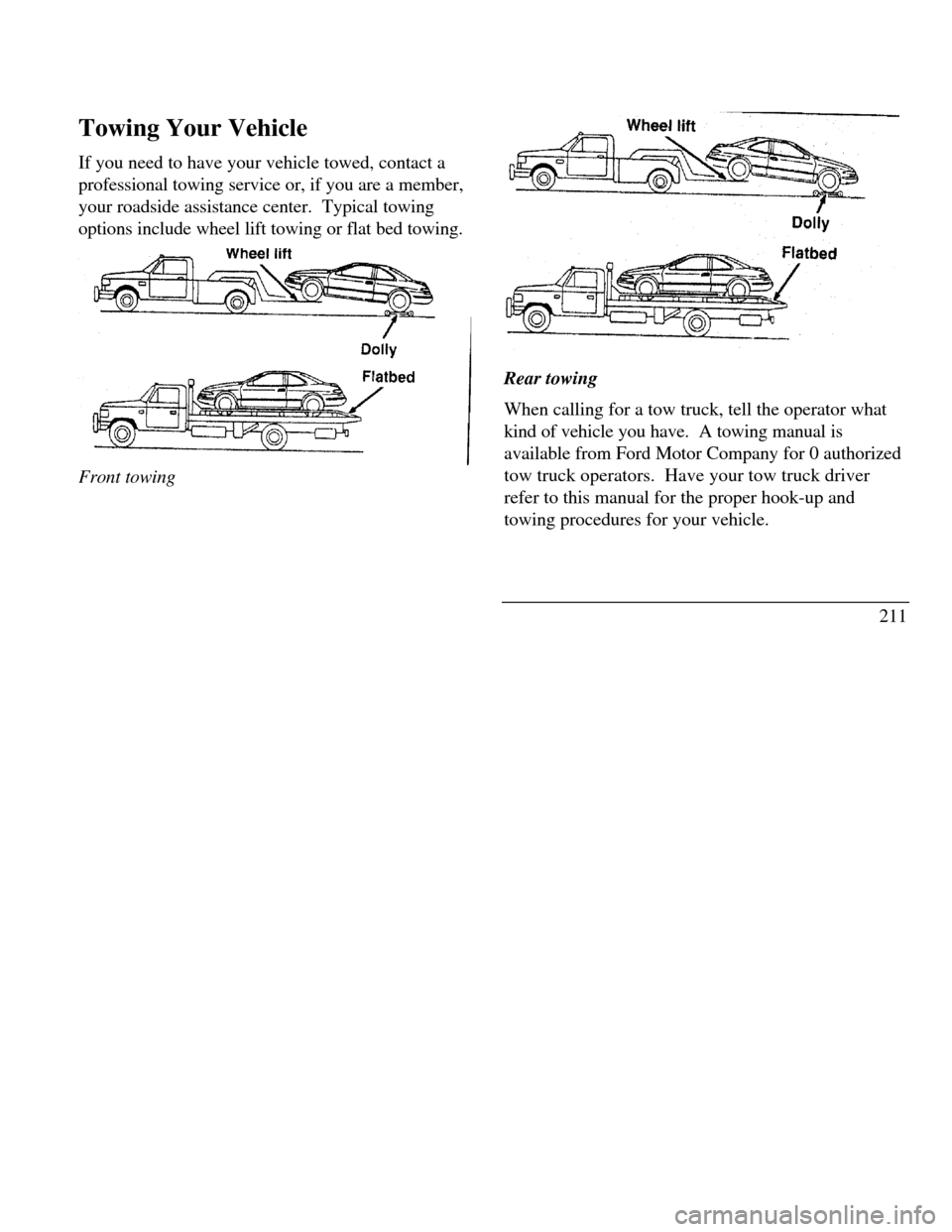
If you need to have your vehicle towed, contact a
professional towing service or, if you are a member,
your roadside assistance center. Typical towing
options include wheel lift towing or flat bed towing.Front towingRear towing
When calling for a tow truck, tell the operator what
kind of vehicle you have. A towing manual is
available from Ford Motor Company for 0 authorized
tow truck operators. Have your tow truck driver
refer to this manual for the proper hook-up and
towing procedures for your vehicle.
211
Page 215 of 320

Lincoln RESCU System
(If equipped)
The Lincoln RESCU buttons, located in the
overhead console, should be used in the event that
you require roadside assistance (out of gas, need a
tow, etc.) or emergency assistance (involved in an
accident, report a crime or fire, require medical
attention, etc.).
212See Lincoln RESCU System in the Features chapter
for more information.
Page 236 of 320
3.Block the wheels. This will prevent your
vehicle from moving unexpectedly.
Working with the engine on:
1. Set the parking brake fully and make sure that
the gearshift is securely latched in P (Park).
2.Block the wheels. This will prevent your
vehicle from moving unexpectedly./! WARNINGDo not start your engine with the aircleaner removed and do not remove it whilethe engine is running./! WARNINGThe cooling fan is automatic and may comeon at any time. Always disconnect thenegative terminal of the battery beforeworking near the fan.234If the battery is disconnected' the computer must
releam its idle control. See Battery in the Index.
NOTE: The engine compartment light may be
switched on or off at the light assembly. The light
assembly is located on the hood on the driver's side.
To turn the light on, pull the switch toward you; to
turn it off, push it away from you. The switch may
remain in the on position at all times, as the light will
turn off when the hood is closed.
Opening the Hood
1. Inside the vehicle, pull the hood release handle
located under the bottom left comer of the
instrument panel.
Page 281 of 320

1.Make sure that the headlamp switch is in the
OFF position.
2.Lift the hood and remove the plastic sight
shield covering the back of the headlamps by
lifting up on the rear corners to release the
velcro attachments. Lift the shield and pull
towards the windshield.
3.At the back of the headlamp, pull up on the
two right angle brackets to release the
headlamp assembly from the vehicle.
4.Carefully pull the headlamp assembly away
from the vehicle to expose the back of the
bulb and wiring connector.
5.Remove the electrical connector from the bulb
by grasping the wire with a quick pull
rearward.6.Remove the retaining ring by turning it 1/8 of
a turn to free it from the socket. Then slide
the ring off the plastic base of the bad bulb.
Keep the ring. You must use it again to hold
the new bulb in place.
7.Carefully remove the bulb assembly from its
socket by gently pulling it rearward without
turning.
Installing the headlamp bulb
1.With the flat side of the bulb's plastic base
facing upward, insert the glass end of the bulb
into the socket. You may need to turn the
bulb left or right to line up the grooves in the
plastic base with the tabs in the socket. When
the grooves are aligned, push the bulb into the
socket until the plastic base contacts the rear
of the socket.
279
Page 309 of 320

Driving under special conditionsEmission control system
bad weather191catalytic converter................................284
heavy load192emissions warranty...............................284
high water192Engine
slippery roads191does not start....................................45
towing a trailer194fuel injected engine, starting..............43
fuel pump shut-off switch..................47
Epreparing to start..............................43
Electrical systemrefill capacities..................................287
fuses275service points....................................237
operating when the engine is off41starting.............................................44
Electronic sound systemstarting after a collision.....................47
accessory delay165storing your vehicle...........................291
antenna165Engine block heater..................................46
radio reception176Engine coolant
tuning the radio.......................................161checking and adding................247
warranty and service information.............178disposal232, 250, 262
Emergencies, roadside.........................................................drain and flush.........................251
battery acid spills...................................199preparing for storage...............291
jump-starting199................refill capacities.........................287
towing211................refill procedure........................251
Emergency brake (parking brake).................188specifications...........................289
311
Page 313 of 320

Keys.............................................................charging system...............................55
key in ignition chime............................42engine oil pressure...........................54
positions of the ignition........................41high beam........................................58
removing from the ignition...................42oil pressure......................................54
stuck in lock position...........................42safety belt........................................52
L.................................service engine soon..........................56
Lamps..........................................................turn signal indicator.........................56
autolamp delay system.........................83Load limits
checking............................................277GAWR............................................192
................................................................GVVVR..........................................192
daytime running light system................81trailer towing...................................194
flashing the lamps................................90Lubricant specifications........................289
hazard flashers.....................................92Luggage compartment..........................135
headlamps............................................82Lug nuts, anti-theft...............................209
high beams...........................................90
replacing bulbs...................................277..........................M
trailer.................................................197Maintenance (see Servicing).................231
Lane change indicator (see Turn signal)....89Map pockets.........................................134
Lights, warning and indicator.......................Methanol in fuel...................................241
air bag.................................................59Mileage, calculating fuel economy........243
anti-theft..............................................59Mirrors
brake...................................................52automatic dimming rearview mirror..125
315