wheel LINCOLN CONTINENTAL 1996 Customer Assistance Guide
[x] Cancel search | Manufacturer: LINCOLN, Model Year: 1996, Model line: CONTINENTAL, Model: LINCOLN CONTINENTAL 1996Pages: 320, PDF Size: 1.8 MB
Page 147 of 320
Servicing Your Securitires/!\ WARNINGDo not use aerosol tire inflator/sealer withSecuritires. Doing so may damage the tire'spressure sensor.If you cannot service your Securitire immediately,
replace it with your mini-spare as soon as it is safe
to do so.
Your mini-spare tire can be used until your
Securitire has been repaired. See Tires in the
Servicing chapter of this guide for more information
on using the spare.
It is recommended that you always have your
Securitires serviced by an authorized Michelin tire
dealer. Each Securitire is equipped with a
pressure sensor around the wheel rim. This
sensor could be damaged when removing and
installing the tire. Servicing a Securitire at
144locations other than your Michelin tire dealer
lmay adversely affect your warranty.
If you have questions concerning your
Securitires or servicing, please call the Michelin
Tire Information Line at 1-800-847-3435 or
contact your local Michelin tire dealer.
Lincoln RESCU System
(If equipped) /!\ WARNINGIt is important that you understand thelimitations of your Lincoln RESCUSystem prior to initiating an activation.See Lincoln RESCU System Limitationslater in this chapter for details.
Page 182 of 320
Driving Your ContinentalYour vehicle has an automatic overdrive
transaxle. You may be familiar with the term
"transmission." We use transaxle because it is a
more accurate term for vehicles that have front-
wheel drive.
Driving with an Automatic
Overdrive Transaxle
Your automatic overdrive transaxle provides
fully automatic operation in either (Overdrive) or D (Drive). Driving with the shift
selector in (Overdrive) gives the best fuel
economy for normal driving conditions. For
manual control, start in 1 (First) and then shift
manually.
Your vehicle is equipped with an Electronic
Powertrain Control Module that limits engine
and/or vehicle speeds with a cut-out mode to
promote durability.Putting Your Vehicle in Gear
Your vehicle's gearshift can be on the column
or on the console./! WARNINGHold the brake pedal down while youmove the gearshift lever from position toposition. If you do not hold the brakepedal down, your vehicle may moveunexpectedly and injure someone.179
Page 186 of 320

Driving
When to use (Overdrive) (Overdrive) is the usual driving position for an
automatic overdrive transaxle. It works the same
way D (Drive) works, automatically upshifting or
downshifting as the vehicle speeds or slows.
However, (Overdrive) also shifts into a fourth gear
- an overdrive gear - when your vehicle cruises at a
consistent speed for any length of time. This fourth
gear will increase your fuel economy when you travel
at cruising speeds.(Overdrive) may not be appropriate for certain
terrain. If the transaxle shifts back and forth between
third and fourth gears while you are driving on hilly
roads or if your vehicle requires additional power for
climbing hills, shift to D (Drive).When to use D (Drive)
D (Drive) eliminates the excessive shifting
between third and fourth gears that your
vehicle sometimes does when you are traveling
through hilly terrain in Overdrive. It also
gives more engine braking to ml slow your
vehicle on downgrades than Overdrive.
When to use 1 (First)
Use I (First) when added engine braking is
desired when descending steep hills.
The automatic transaxle will shift to the proper
gear to ascend any grade without any need to
shift to I (First).
P (Park)
Always come to a complete stop before you
shift into P (Park). Make sure that the
gearshift is securely latched in P (Park). This
locks the transaxle and prevents the front
wheels from rotating.
183
Page 187 of 320

/!\ WARNINGAlways set the parking brake fully and makesure that the gearshift is securely latched in P(Park). Never leave your vehicle unattendedwhile it is running.You can tell a column-mounted gearshift is securely
latched in P (Park) if the lever is adjacent to the P
(Park) and you cannot move it without pulling it
toward you and rotating it downward.
You can tell a console-mounted gearshift is securely
latched in P (Park) if the lever is adjacent to the P
(Park) and you cannot move it without pushing in the
thumb button.
The gearshift will lock when you turn the key to the
LOCK position. When the gearshift is in any
position except P (Park), the ignition key cannot be
turned to the LOCK position or removed from the
steering column. To remove the key, the gearshift
lever must be in P (Park).
184Traction ControlÔ Ô (If equipped)
Your vehicle may be equipped with the
optional Traction ControlÔ, system. This
system helps prevent wheel spin in order to
improve tire traction and is an especially useful
feature when you drive in hilly areas or on
slippery, icy or snowy roads.
When the Traction Control system is
controlling wheelspin, an electric motor sound
may be heard from the engine compartment and
engine acceleration may seem slower. This is
normal.
Traction ControlÔ works automatically by
rapidly applying and releasing the brakes and
reducing engine torque to prevent one or both
of the front drive wheels from spinning during
acceleration.
During the Traction ControlÔ function, which
most often occurs during low speed
acceleration on slippery surfaces, a noise may
be heard coming from the engine compartment.
This is normal and may last for a few seconds
during the acceleration of the vehicle.
Page 188 of 320

In general, this system improves your vehicle's
stability and acceleration performance when road
conditions warrant. Traction ControlÔ is fully
effective at all vehicle speeds.
If the Traction ControlÔ system is cycled
excessively, the brake portion of the system will shut
down to prevent the front brakes from overheating.
A limited Traction ControlÔ function using engine
torque will still control wheels from spinning. A
cooling down period is required to prevent damage
to the brakes. This time period varies and depends
on brake usage during the cooling down period.
Anti-Lock braking is not affected and will function
normally during the cool down period.
After the cool down period, the full Traction
ControlÔ' function is restored.Steering Your Vehicle
Your vehicle comes with power steering.
Power steering uses energy from the engine to
help steer your vehicle.
If the amount of effort needed to steer your
vehicle changes, check your steering effort
selection in the Message Center. If this is not
the problem, have the power steering system
checked. If the power steering system breaks
down (or if the engine is turned off), you can
steer the vehicle manually but it takes more
effort.
The steering system in your vehicle is speed
sensitive. This means that the steering effort is
light for parking and heavier for highway
driving. However, if you have to swerve
around an object or another vehicle, your
steering will have full power assist.
185
Page 189 of 320
Never hold the steering wheel to the extreme right or
left for more than five seconds if the engine is running.
This can damage the power steering pump.
Air Suspension Adaptive Ride
Control System
Your vehicle has an air suspension system with
automatic load leveling and automatic ride control.
This system keeps your vehicle at a constant level by
adding air or releasing air from the springs. Ride and
handling is enhanced by firming shock absorber
performance during certain road conditions, steering
maneuvers, braking, and accelerations and is
returned to the driver selected ride calibration when
driver or road surface induced motion changes are
completed.
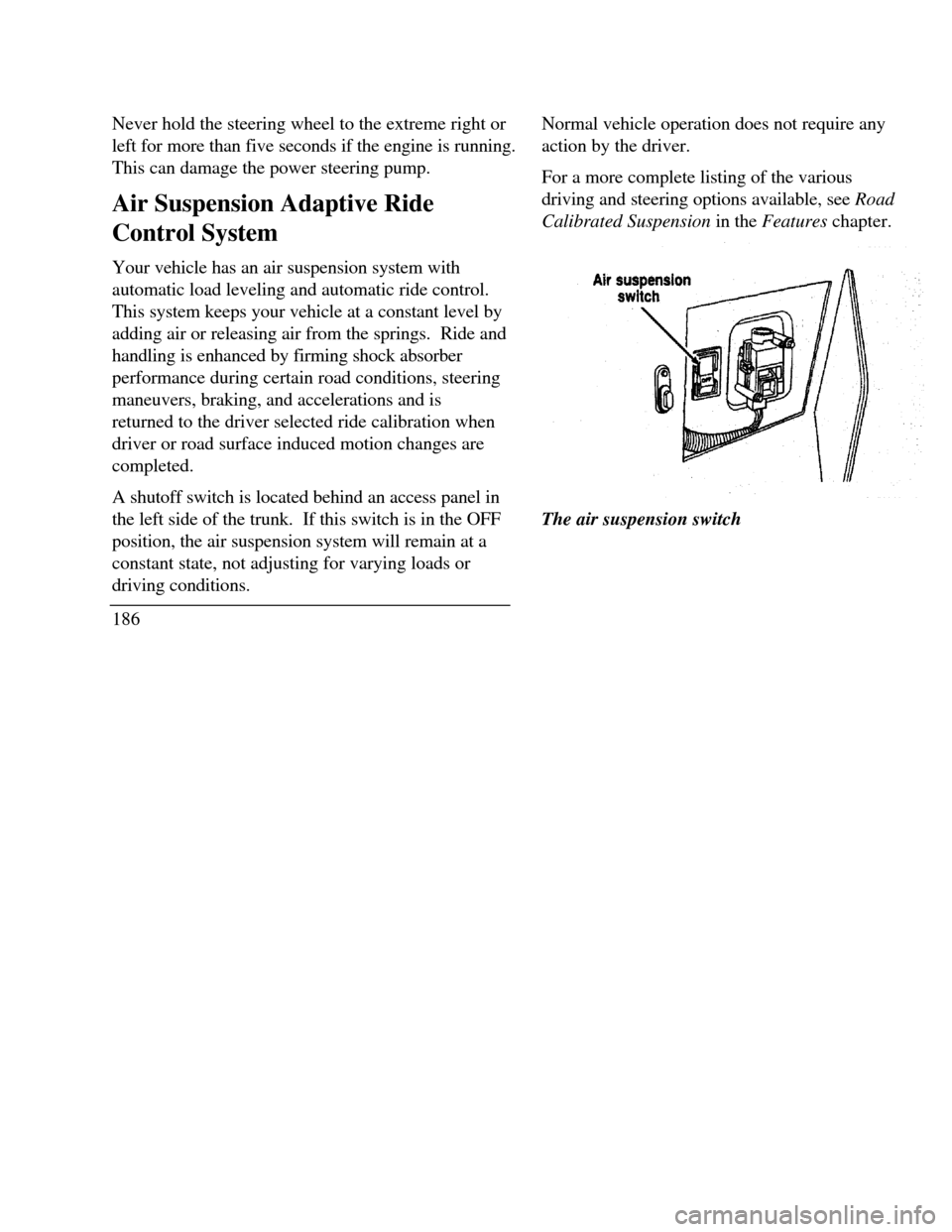
A shutoff switch is located behind an access panel in
the left side of the trunk. If this switch is in the OFF
position, the air suspension system will remain at a
constant state, not adjusting for varying loads or
driving conditions.
186Normal vehicle operation does not require any
action by the driver.
For a more complete listing of the various
driving and steering options available, see Road
Calibrated Suspension in the Features chapter.Air suspension switchThe air suspension switch
Page 190 of 320

Brakes
Applying the Brakes
Your vehicle has anti-lock disc brakes on all four
wheels. They adjust automatically as the brake pads
wear down.
When you press down hard on the brake pedal, the
wheels will not lock and slide. The Anti-lock Brake
System (ABS) automatically starts releasing and
reapplying the front brakes independently and the
rear brakes together whenever your wheels start to
lock. When this happens, you will feel the brake
pedal pulsate. This is an indication that the ABS
system is working correctly and is normal.
Each time you turn the ignition key to the ON
position, the anti-lock brake system will function
through one test cycle. When this happens, the ANTI-
LOCK light will come on for up to five seconds and a
clunk may be felt in the pedal. If the light stays on
longer than five seconds, shut off theengine and restart. If it remains on, it means the
anti-lock brake system is disabled and should be
serviced immediately to restore the benefits of
the anti-lock feature. Normal braking is not
affected unless the brake warning light is also lit.
The And-lock Brake System has self-check
capabilities. As described above, the system
turns on the ANTI-LOCK light each time you
start your engine. After the engine is started
and the ANTI-LOCK light turns off, the system
performs another test the first time the vehicle
reaches 14 m.p.h. (22 km/h). The system turns
on the ABS pump motor for approximately 1/2
second. At this time, a mechanical noise may
be heard. This is a normal part of the self-
check feature. If a malfunction is found during
this check the ANTI-LOCK light will come on.
Do not drive with your foot resting on the
brake pedal; you will wear out the linings and
increase your vehicle's stopping distance.
Brake rotor damage may also eventually occur.
187
Page 194 of 320
Driving in Bad Weather
Slippery roads
On some slippery road surfaces, front-wheel drive
may provide better acceleration than rear-wheel
drive. However, this does not mean that your
vehicle can stop any faster or any better than a
vehicle with rear-wheel drive. Exercise the same
caution while driving on slippery roads with your
front-wheel drive vehicle as you would with a rear-
wheel drive vehicle. Do not quickly move the steering wheel unless
necessary. Drive slower than you normally would. Give your vehicle more distance to stop./!\ WARNINGTo avoid skidding and losing control onslippery roads, do not downshift into First(1) when you are moving faster than 20mph (32 km/h)./!\ WARNINGIf your vehicle has speed control, do notuse it on slippery roads. You could losecontrol of your vehicle and could injuresomeone.If your vehicle gets stuck (for example, in mud
or snow), you may try to "rock" it out of the
spot. Shift, in a steady rhythm, between
forward and reverse gears. While in each gear,
press lightly on the accelerator and release.
191
Page 195 of 320

/!\ WARNINGDo not spin the wheels at over 35 mph (55km/h). The tires may fail and injure apassenger or bystander.By moving the vehicle backward and forward, you
may gain enough momentum to move out of the
spot. Do not rock the vehicle for more than a few
minutes. This may overheat the engine, damage the
transaxle, or damage the tires. If you are still stuck
after a minute or two of rocking, call for a tow truck.
High water
Do not drive through flooded areas unless you are
sure that the water is below the bottom of the wheel
rims.
If you must drive through high water, drive slowly.
You may have limited traction or wet brakes, so
allow extra stopping distance because your vehicle
will not stop as quickly as usual.
192After you drive through the standing water,
apply your brakes gently several times as your
vehicle moves slowly. This helps to dry the
brakes.
Driving With a Heavy Load
There are limits to the amount of weight your
vehicle can carry or tow. The total weight of
your vehicle, plus the weight of the passengers
and cargo, should never be more than the
Gross Vehicle Weight Rating (GVWR). Also,
the weight that your vehicle carries over the
front axle and rear axle should never be more
than the Gross Axle Weight Rating (GAWR)
for the respective axle.
You can find your vehicle's GVWR and
GAWR on the Safety Compliance Certification
Label on the left front door lock facing or on
the door latch post pillar.
Page 207 of 320

Changing a Tire
if you get a flat tire while you are driving, do not
apply the brake heavily. Instead, gradually decrease
the speed. Hold the steering wheel firmly and
slowly move to a safe place on the side of the road.
Park on a level spot, turn off the ignition, set the
parking brake, and turn on the hazard flashers.
The Temporary Spare Tire
You may have a high pressure temporary spare tire.
This spare tire is smaller than a regular tire and is
designed for emergency use only. Use it only when
you get a flat tire and replace it as soon as you can.
This spare tire is marked with the words
"TEMPORARY USE ONLY" so that you can easily
identify it.
204/! WARNINGIf you use the temporary spare tirecontinuously or do not follow theseprecautions, the tire could fail, causing you tolose control of the vehicle, possibly injuringyourself or others.When you drive with the temporary spare tire,
DO NOT: exceed 50 mph (80 km/h) under any
circumstances. load your vehicle so that it is heavier than the
maximum vehicle load rating listed on the tire
decal. tow a trailer. try to repair the temporary spare tire or remove it
from its wheel. use the wheel for any other type of vehicle.