warning LINCOLN CONTINENTAL 1996 Customer Assistance Guide
[x] Cancel search | Manufacturer: LINCOLN, Model Year: 1996, Model line: CONTINENTAL, Model: LINCOLN CONTINENTAL 1996Pages: 320, PDF Size: 1.8 MB
Page 242 of 320
/!\ WARNINGIf you do not use the proper fuel cap, thepressure in the fuel tank can damage the fuelsystem or cause it to work improperly in acollision.NOTE: If you replace your fuel cap with an
aftermarket fuel filler cap, the customer warranty
may be void for any damage to the fuel tank and/or
fuel system.
Choosing the Right Fuel
Use only PREMIUM UNLEADED FUEL in your
vehicle. Using leaded fuel is prohibited by federal
law. Your warranty may not apply if your vehicle is
damaged because you used the wrong fuel.
Octane recommendations
The 4.6L engine is designed to operate on
premium fuel with an octane rating of 91 or
higher. Regular fuel with an octane rating of 87
240may be used if necessary. For optimum
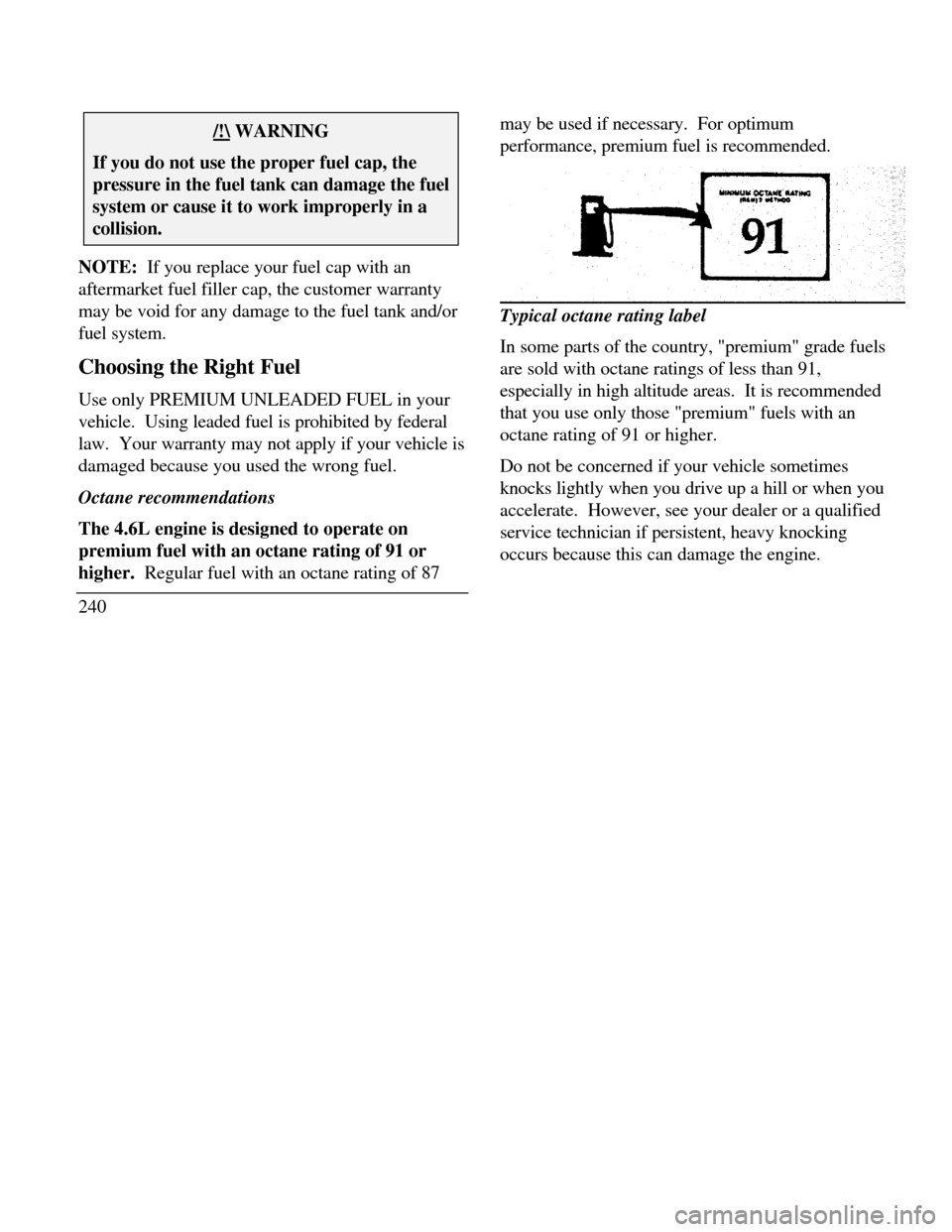
performance, premium fuel is recommended.Typical octane rating label
In some parts of the country, "premium" grade fuels
are sold with octane ratings of less than 91,
especially in high altitude areas. It is recommended
that you use only those "premium" fuels with an
octane rating of 91 or higher.
Do not be concerned if your vehicle sometimes
knocks lightly when you drive up a hill or when you
accelerate. However, see your dealer or a qualified
service technician if persistent, heavy knocking
occurs because this can damage the engine.
Page 243 of 320
If you are experiencing starting, rough idle or
hesitation problems when the engine is cold, it may
be caused by fuel with low volatility. Try a different
brand of fuel. If the condition persists, see your
dealer or a qualified service technician.
Gasolines for clean air
Fuels in certain areas of the country are required to
contain oxygenates to improve air quality.
Common oxygenates are ethanol or grain alcohol
(blended at no more than 10%), methanol or wood
alcohol (blended at no more than 5% with
cosolvents and additives), and MTBE or methyl
tertiary butyl ether (blended at no more than 15%).
Generally, you should not experience difficulties
operating your vehicle on fuels containing
oxygenates. We encourage you to use these fuels.Safety Information Relating to Automotive
Fuels/!\ WARNINGAutomotive fuels can cause serious injury ordeath if misused or mishandled. Turn vehicle off when refueling. Do not smoke when refueling. Fuels are
extremely flammable. Do not siphon any fuel by mouth./!\ WARNINGGasoline or gasoline blended with methanolcan cause blindness and possible death whenswallowed. If any fuel is swallowed, callphysician or poison control centerimmediately.241
Page 244 of 320
Avoid breathing vapors while refueling. If fuel is splashed on the skin, wash with soap
and water. If fuel is splashed in the eyes, remove contact
lenses (if worn), flush with water for 15 minutes,
and seek medical attention.
Gasoline and gasoline blends may contain small
amounts of carcinogens, such as benzene. Long-
term exposure to unleaded gasoline vapors has
caused cancer in laboratory animals.
if you are taking the medication "Antabuse" or
other forms of disulfiram for the treatment of
alcoholism, vapor or skin contact with a gasoline-
methanol blend, may cause the same kind of adverse
reaction as drinking an alcoholic beverage. In
sensitive individuals, serious personal injury or
sickness could result. Consult a physician promptly
if you experience an adverse reaction.
242Running Out of Fuel
NOTE: Avoid running out of fuel because this
situation may have an adverse effect on modern
powertrain components.
You may need to crank the engine several times
before the fuel system starts to pump fuel from the
tank to the engine.
If the engine does not start, check the fuel pump
shut-off switch and reset as required. See Fuel pump
shut-off switch in the Index./!\ WARNINGNever pour fuel in the throttle body orattempt to start the engine with the aircleaner removed. Doing so could result infire and personal injury.
Page 249 of 320
Changing the Engine Oil and the Oil
Filter
Refer to the Maintenance Schedule and Record
booklet for recommended intervals./!\ WARNINGContinuous contact with USED motor oilhas caused cancer in laboratory mice.Protect your skin by washing with soap and water.
Engine Coolant
Checking the Engine Coolant
NOTE: Be sure to read and understand
Precautions Men Servicing Your Vehicle at the
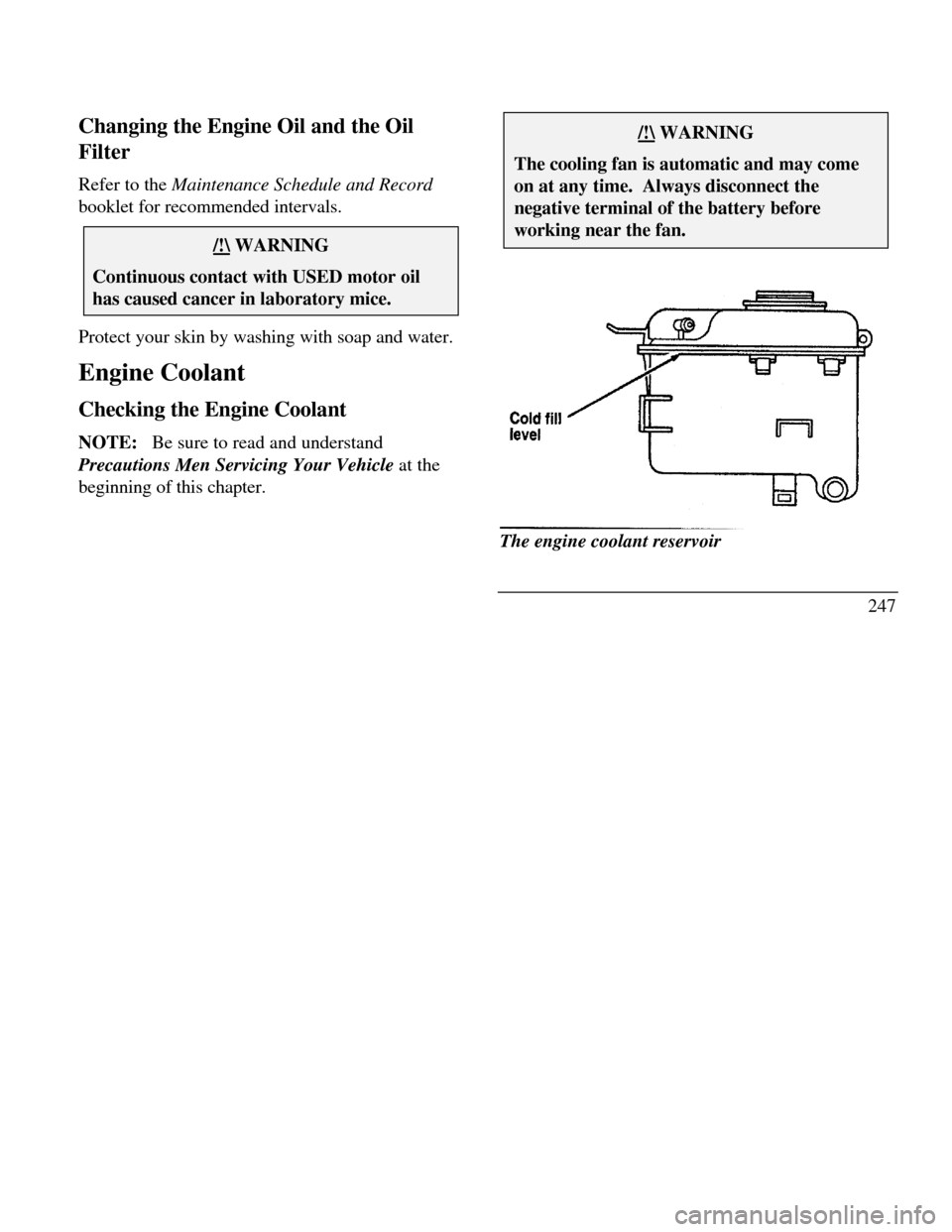
beginning of this chapter./!\ WARNINGThe cooling fan is automatic and may comeon at any time. Always disconnect thenegative terminal of the battery beforeworking near the fan.Cold fill levelThe engine coolant reservoir
247
Page 250 of 320
Your vehicle's coolant protects your engine from
overheating in the summer and from freezing in the
winter. Check the level of the coolant at least once
a month. Simply look at the engine coolant
reservoir located in the engine compartment. To
locate the reservoir, see the diagram of your
vehicle's engine under Engine Type, in this chapter.
Check the engine coolant level in the engine coolant
reservoir at least once a month using the following
guidelines.
When your vehicle's engine is cool, the coolant level
in the engine coolant reservoir should be at the top
of the clear portion of the reservoir. If the level is
below the cold fill level, coolant may need to be
added.
The coolant additives also protect the entire cooling
system from internal passageway corrosion and
these additives lubricate the water pump. The
coolant should be serviced as noted in the
Maintenance Schedule and Record booklet.
248Adding engine coolant/!\ WARNINGDo not put engine coolant in the containerfor the windshield washer fluid.If sprayed to clean the glass, engine coolant or
antifreeze could make it difficult to see through the
windshield./!\ WARNINGNever remove the pressure cap while theengine is running or hot. Follow these stepsto avoid personal injury that can be causedby escaping steam or engine coolant.1. Before you remove the cap, turn the engine off
and let it cool. Even when the engine is cool, be
careful when you remove the pressure cap.
Page 251 of 320
2.When the engine is cool, wrap a thick cloth
around the cap and turn it slowly counter-
clockwise to relieve pressure.
3.Step back while the pressure releases.
4.When you are sure that all the pressure has
been released, use the cloth to turn and remove
cap.
5. Stand away from the reservoir opening. Hot
steam may blow out or hot engine coolant may
even splash out./!\ WARNINGFailure to follow these instructions couldresult in serious personal injury from hotengine coolant or steam blowout and/ordamage to the engine cooling system orengine.To find out how much engine coolant mixture your
vehicle's coolant system can hold, see Refill
capacities for fluids in the Index.
Add engine coolant only to the coolant reservoir.
If the coolant level is low, add to the reservoir a
50/50 or appropriate mixture of water and the type
of engine coolant that Ford specifies. You may add
water by itself only in an emergency, but you should
replace it with a 50/50 mixture as soon as possible.
Check the engine coolant again the next few times
you drive your vehicle.
Have your dealer check the engine cooling system
for leaks if you have to add more than a quart (liter)
of engine coolant more than once a month.
Ford Premium Cooling System Fluid is an optimized
formula that will protect all metals and rubber
elastomers used in Ford engines for four years or
50,000 miles (80,000 km). It is not necessary and
not recommended to use supplemental coolant
additives in your vehicle. These additives may harm
249
Page 256 of 320
If you do not let the engine relearn its idle, the idle
quality of your vehicle may be adversely affected
until the idle is relearned. Your vehicle will
eventually relearn its idle while you drive it, but it
takes much longer than if you use the previous
procedure.
Windshield Washer Fluid and
Wipers
Washer Fluid
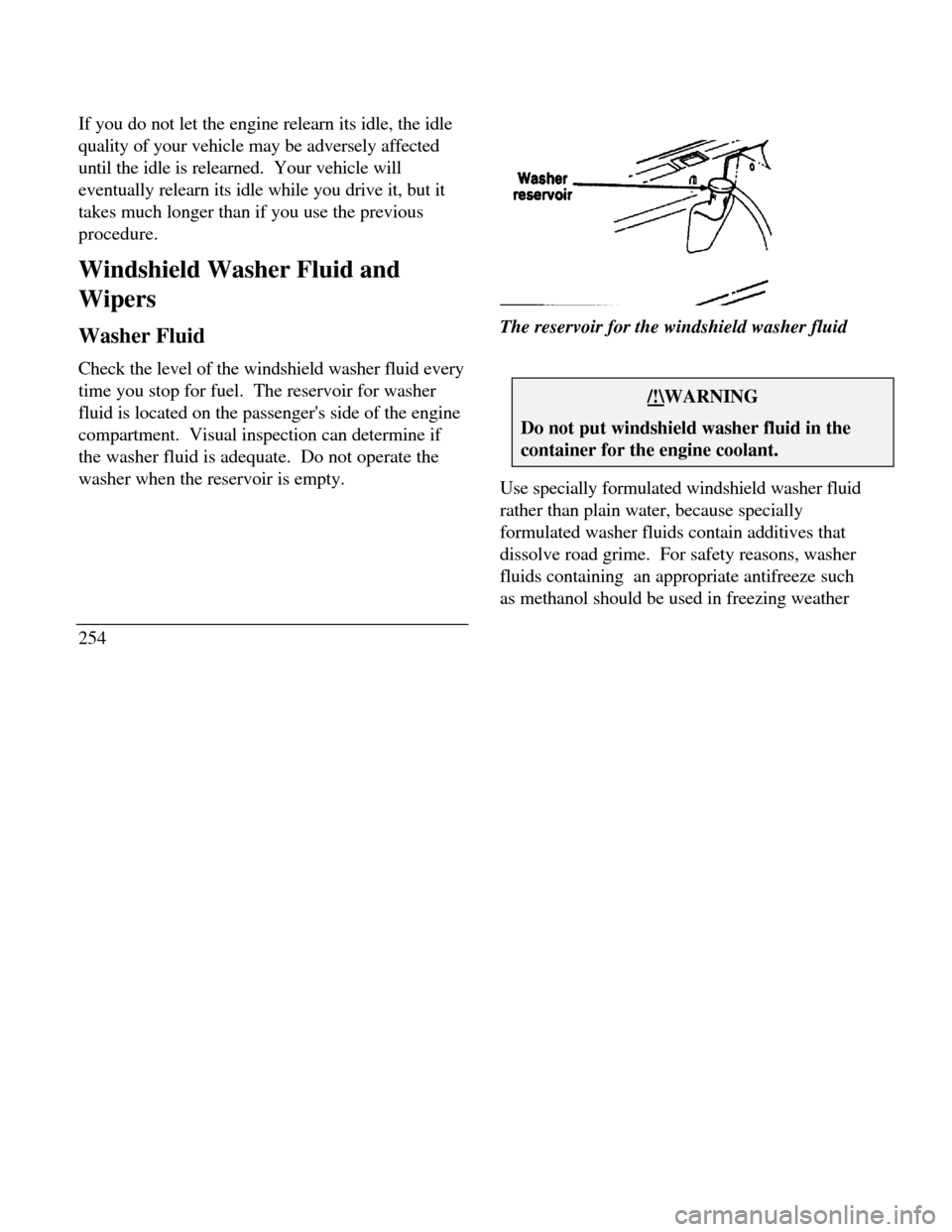
Check the level of the windshield washer fluid every
time you stop for fuel. The reservoir for washer
fluid is located on the passenger's side of the engine
compartment. Visual inspection can determine if
the washer fluid is adequate. Do not operate the
washer when the reservoir is empty.
254Washer reservoirThe reservoir for the windshield washer fluid/!\WARNINGDo not put windshield washer fluid in thecontainer for the engine coolant.Use specially formulated windshield washer fluid
rather than plain water, because specially
formulated washer fluids contain additives that
dissolve road grime. For safety reasons, washer
fluids containing an appropriate antifreeze such
as methanol should be used in freezing weather
Page 258 of 320
Keep your tires inflated to the recommended
pressures. Stay within the recommended load limits (see
Load limits in the Index). Make sure the weight of your load is evenly
distributed.
If you do not take these precautions, your tires may
fail or go flat.
Ford Motor Company recommends obeying posted
speed limits./!\ WARNINGDriving too fast for conditions creates thepossibility of loss of vehicle control. Drivingat very high speeds for extended periods oftime may result in damage to vehiclecomponents.256At least once a month, check the pressure in all your
vehicle's tires, including the spare. Use an accurate
tire pressure gauge. Check the tire pressure when
tires are cold, after the vehicle has been parked for at
least one hour or has been driven less than 3 miles (5
km). You can find proper cold pressure and load
limits of recommended size tires on the Safety
Compliance Certification Label./!\ WARNINGImproperly inflated tires can affect vehiclehandling and can fail suddenly, possiblyresulting in loss of vehicle control.Tire Rotation
Because your vehicle's front and rear tires perform
different jobs, they often wear differently. To make
sure your tires wear evenly and last longer, rotate
them as indicated in the following diagram.
Page 260 of 320

/!\ WARNINGWhen replacing full size tires, never mixradial, bias-belted, or bias-type tires. Use onlythe tire sizes that are listed on the tirepressure decal. Make sure that all tires arethe same size, speed rating, and load-carryingcapacity. Use only the tire combinationsrecommended on the decal. If you do notfollow these precautions, your vehicle may notdrive properly and safely.Tires that are larger or smaller than your vehicle's
original tires may also affect the accuracy of your
speedometer.
258Information About Tire Quality Grades
New vehicles are fitted with tires that have their Tire
Quality Grade (described below) molded into the
tire's sidewall. These Tire Quality Grades are
determined by standards that the United States
Department of Transportation has set.
Tire Quality Grades apply to new pneumatic tires for
use on passenger cars. They do not apply to deep
tread, winter-type snow tires, space-saver or
temporary use spare tires, tires with nominal rim
diameters of 10 to 12 inches or limited production
tires as defined in Title 49 Code of Federal
Regulations Part 575.104(c)(2).
U.S. Department of Transportation - Tire quality
grades: The U.S. Department of Transportation
requires Ford to give you the following information
about tire grades exactly as the government has
written it.
Page 261 of 320

Treadwear
The treadwear grade is a comparative rating based
on the wear rate of the tire when tested under
controlled conditions on a specified government test
course. For example, a tire graded 150 would wear
one and one-half (1 1/2) times as well on the
government course as a tire graded 100. The
relative performance of tires depends upon the
actual conditions of their use, however, and may
depart significantly from the norm due to variations
in driving habits, service practices and differences in
road characteristics and climate.
Traction A B C
The traction grades, from highest to lowest, are A, B,
and C, and they represent the tire's ability to stop on
wet pavement as measured under controlled
conditions on specified government test surfaces of
asphalt and concrete. A tire marked C may have
poor traction performance. Warning: The traction
grade assigned to this tire is based on braking(straightahead) traction tests and does not include
cornering (turning) traction.
Temperature A B C
The temperature grades are A (the highest), B, and
C, representing the tire's resistance to the generation
of heat and its ability to dissipate heat when tested
under controlled conditions on a specified indoor
laboratory test wheel. Sustained high temperature
can cause the material of the tire to degenerate and
reduce tire life, and excessive temperature can lead
to sudden tire failure. The grade C corresponds to a
level of performance which all passenger car tires
must meet under the Federal Motor Vehicle Safety
Standard No. 109. Grades B and A represent higher
levels of performance on the laboratory test wheel
than the minimum required by law. Warning: The
temperature grade for this tire is established for a tire
that is properly inflated and not overloaded.
Excessive speed, underinflation, or excessive
259