warning LINCOLN CONTINENTAL 1996 Customer Assistance Guide
[x] Cancel search | Manufacturer: LINCOLN, Model Year: 1996, Model line: CONTINENTAL, Model: LINCOLN CONTINENTAL 1996Pages: 320, PDF Size: 1.8 MB
Page 187 of 320

/!\ WARNINGAlways set the parking brake fully and makesure that the gearshift is securely latched in P(Park). Never leave your vehicle unattendedwhile it is running.You can tell a column-mounted gearshift is securely
latched in P (Park) if the lever is adjacent to the P
(Park) and you cannot move it without pulling it
toward you and rotating it downward.
You can tell a console-mounted gearshift is securely
latched in P (Park) if the lever is adjacent to the P
(Park) and you cannot move it without pushing in the
thumb button.
The gearshift will lock when you turn the key to the
LOCK position. When the gearshift is in any
position except P (Park), the ignition key cannot be
turned to the LOCK position or removed from the
steering column. To remove the key, the gearshift
lever must be in P (Park).
184Traction ControlÔ Ô (If equipped)
Your vehicle may be equipped with the
optional Traction ControlÔ, system. This
system helps prevent wheel spin in order to
improve tire traction and is an especially useful
feature when you drive in hilly areas or on
slippery, icy or snowy roads.
When the Traction Control system is
controlling wheelspin, an electric motor sound
may be heard from the engine compartment and
engine acceleration may seem slower. This is
normal.
Traction ControlÔ works automatically by
rapidly applying and releasing the brakes and
reducing engine torque to prevent one or both
of the front drive wheels from spinning during
acceleration.
During the Traction ControlÔ function, which
most often occurs during low speed
acceleration on slippery surfaces, a noise may
be heard coming from the engine compartment.
This is normal and may last for a few seconds
during the acceleration of the vehicle.
Page 190 of 320

Brakes
Applying the Brakes
Your vehicle has anti-lock disc brakes on all four
wheels. They adjust automatically as the brake pads
wear down.
When you press down hard on the brake pedal, the
wheels will not lock and slide. The Anti-lock Brake
System (ABS) automatically starts releasing and
reapplying the front brakes independently and the
rear brakes together whenever your wheels start to
lock. When this happens, you will feel the brake
pedal pulsate. This is an indication that the ABS
system is working correctly and is normal.
Each time you turn the ignition key to the ON
position, the anti-lock brake system will function
through one test cycle. When this happens, the ANTI-
LOCK light will come on for up to five seconds and a
clunk may be felt in the pedal. If the light stays on
longer than five seconds, shut off theengine and restart. If it remains on, it means the
anti-lock brake system is disabled and should be
serviced immediately to restore the benefits of
the anti-lock feature. Normal braking is not
affected unless the brake warning light is also lit.
The And-lock Brake System has self-check
capabilities. As described above, the system
turns on the ANTI-LOCK light each time you
start your engine. After the engine is started
and the ANTI-LOCK light turns off, the system
performs another test the first time the vehicle
reaches 14 m.p.h. (22 km/h). The system turns
on the ABS pump motor for approximately 1/2
second. At this time, a mechanical noise may
be heard. This is a normal part of the self-
check feature. If a malfunction is found during
this check the ANTI-LOCK light will come on.
Do not drive with your foot resting on the
brake pedal; you will wear out the linings and
increase your vehicle's stopping distance.
Brake rotor damage may also eventually occur.
187
Page 192 of 320
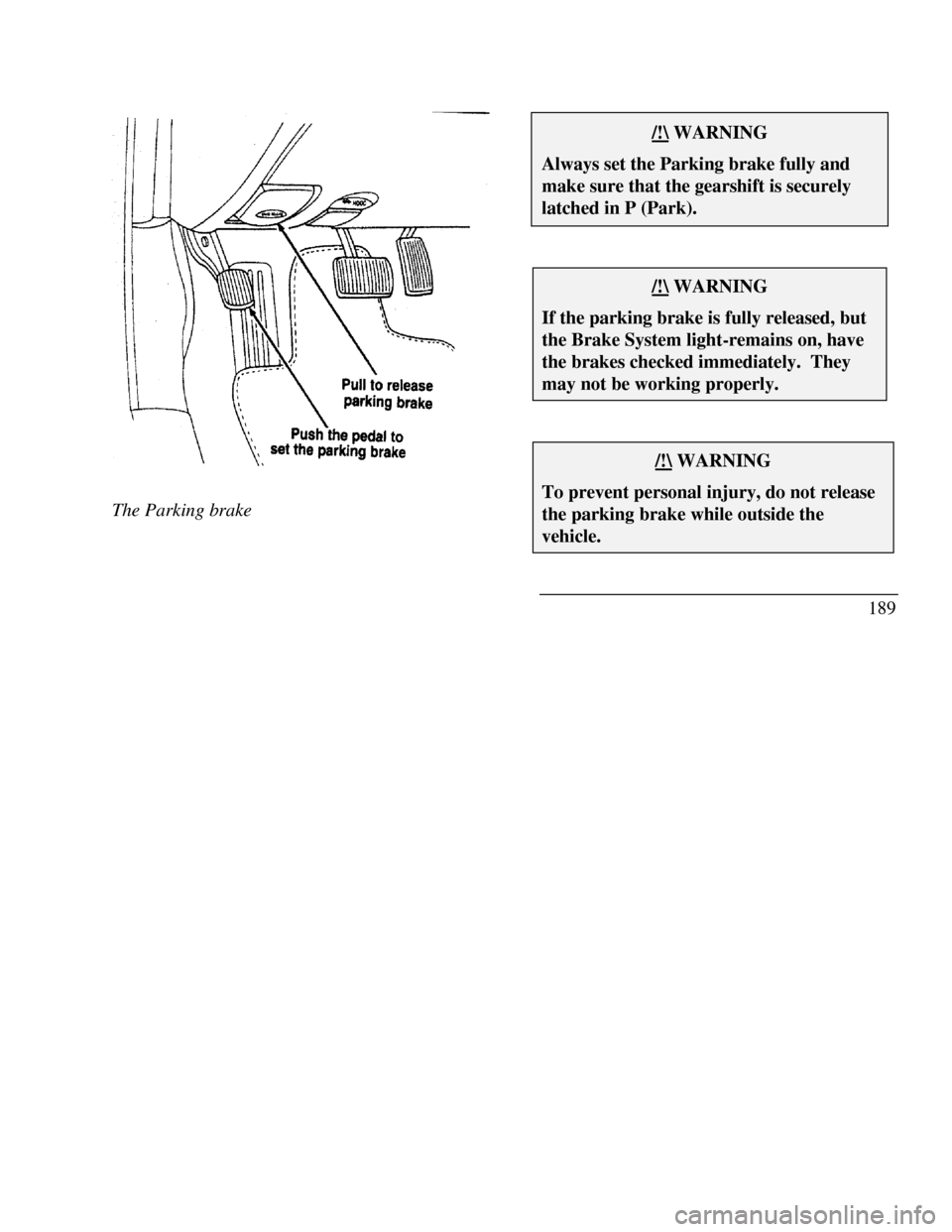
The Parking brake/!\ WARNINGAlways set the Parking brake fully andmake sure that the gearshift is securelylatched in P (Park)./!\ WARNINGIf the parking brake is fully released, butthe Brake System light-remains on, havethe brakes checked immediately. Theymay not be working properly./!\ WARNINGTo prevent personal injury, do not releasethe parking brake while outside thevehicle.189
Page 193 of 320

You have an automatic release for the parking brake.
The parking brake should automatically unlock when
you move the gearshift to any forward gear while the
engine is running. However, the automatic release
does not work when the gearshift is in reverse,
neutral or park.
To manually release the parking brake, pull the
BRAKE RELEASE handle located on the lower left
comer of the instrument panel. The Brake Warning
Light will illuminate if the parking brake is not fully
released when the engine is running.
The parking brake is not designed to stop a moving
vehicle, but you can use the parking brake to stop
your vehicle in an emergency if the normal brakes
fail. However, since the parking brake applies only
the rear brakes, the stopping distance will increase
greatly and the handling of your vehicle will be
adversely affected.
190Always check the Brake Warning light each
time you start your engine. Driving with the
parking brake on will cause the brakes to wear
out quickly and will reduce the fuel economy.
Driving Under Special Conditions
Tips for Safe Driving
As with any new vehicle, yours may drive and
handle differently from your previous vehicle.
Use care until you become accustomed to its
various features and driving characteristics.
Operate your vehicle within reasonable limits.
Sudden acceleration, deceleration, turning, or
combinations of these maneuvers can cause a
vehicle to behave differently than anticipated.
Page 194 of 320
Driving in Bad Weather
Slippery roads
On some slippery road surfaces, front-wheel drive
may provide better acceleration than rear-wheel
drive. However, this does not mean that your
vehicle can stop any faster or any better than a
vehicle with rear-wheel drive. Exercise the same
caution while driving on slippery roads with your
front-wheel drive vehicle as you would with a rear-
wheel drive vehicle. Do not quickly move the steering wheel unless
necessary. Drive slower than you normally would. Give your vehicle more distance to stop./!\ WARNINGTo avoid skidding and losing control onslippery roads, do not downshift into First(1) when you are moving faster than 20mph (32 km/h)./!\ WARNINGIf your vehicle has speed control, do notuse it on slippery roads. You could losecontrol of your vehicle and could injuresomeone.If your vehicle gets stuck (for example, in mud
or snow), you may try to "rock" it out of the
spot. Shift, in a steady rhythm, between
forward and reverse gears. While in each gear,
press lightly on the accelerator and release.
191
Page 195 of 320

/!\ WARNINGDo not spin the wheels at over 35 mph (55km/h). The tires may fail and injure apassenger or bystander.By moving the vehicle backward and forward, you
may gain enough momentum to move out of the
spot. Do not rock the vehicle for more than a few
minutes. This may overheat the engine, damage the
transaxle, or damage the tires. If you are still stuck
after a minute or two of rocking, call for a tow truck.
High water
Do not drive through flooded areas unless you are
sure that the water is below the bottom of the wheel
rims.
If you must drive through high water, drive slowly.
You may have limited traction or wet brakes, so
allow extra stopping distance because your vehicle
will not stop as quickly as usual.
192After you drive through the standing water,
apply your brakes gently several times as your
vehicle moves slowly. This helps to dry the
brakes.
Driving With a Heavy Load
There are limits to the amount of weight your
vehicle can carry or tow. The total weight of
your vehicle, plus the weight of the passengers
and cargo, should never be more than the
Gross Vehicle Weight Rating (GVWR). Also,
the weight that your vehicle carries over the
front axle and rear axle should never be more
than the Gross Axle Weight Rating (GAWR)
for the respective axle.
You can find your vehicle's GVWR and
GAWR on the Safety Compliance Certification
Label on the left front door lock facing or on
the door latch post pillar.
Page 196 of 320
The weight limits of your vehicles tires affect the
GVWR or GAWR limitations. Usage of replacement
tires with higher weight limit than originals does not
increase GVWR or GAWR. Usage of lower
capacity replacement tires may lower GVWR and
GAWR limitations./!\ WARNINGIf the GVWR or the GAWR specified on theSafety Compliance Certification Label isexceeded, your vehicle may be damaged oryou may lose control and injure someone.Limiting Your Vehicle's Load
The load that you add to Your vehicle must not
exceed the maximum load stated on the Safety
Compliance Certification Decal attached to the left
front door pillar.To figure the weight of your vehicle's load, add
the weights of. the driver and passengers luggage and any other items that you put in
your vehicle the tongue load of the loaded trailer the Weight of any equipment that has been
added to your vehicle since it was delivered
to your dealer
If you do not know the actual weights of these
items, use the following procedure to figure the
weight of a load:
1. Weigh your vehicle without the driver,
passengers and luggage. You might take
your vehicle to a shipping company or an
inspection station for trucks.
2. Then weigh Your vehicle with the driver
passengers and luggage.
193
Page 197 of 320
3. Subtract the first reading from the second to
figure the total weight of the load.
After determining this load, you must also make sure
that the total weight of your vehicle, plus the load it
carries, is less than its GVWR. Also, make sure that
the weight your vehicle carries over each axle is less
than the GAWR for the respective axle.
If your vehicle exceeds the GVWR, remove cargo
from your vehicle accordingly. If your vehicle
exceeds the GAWR for either axle, shift the load or
remove cargo accordingly./!\ WARNINGImproper distribution of your vehicle's loador carrying weight in excess of the amountshown on the tire decal can cause rapid tirewear or loss of vehicle control.194Trailer Towing
Your vehicle is capable of towing a trailer of up
to a maximum of 2,000 lbs. (907 kg) gross
trailer weight with a maximum tongue load of
200 lbs. (91 kg).
Because towing a trailer puts extra strain on
your vehicle, you must follow certain
precautions for your safety and the good of
your vehicle: Stay within the load limits for towing your
vehicle. (See Trailer towing specifications
in this chapter.) Carefully and thoroughly prepare your
vehicle for towing, making sure to use the
right equipment and to attach it properly.
(See Preparing to Tow in this chapter.) Use extra caution when driving your vehicle
while you tow. (See Driving while you tow
in this chapter.)
Page 198 of 320
Service your vehicle more frequently if you tow a
trailer. (See Servicing your vehicle if you tow in
this chapter.)
Ten to 15% of the loaded trailer's weight should be
on the tongue. However, the tongue load should
never exceed 10% of the maximum weight that your
vehicle can safely tow.
New vehicles should be driven 2,000 miles (3,200
km) before towing a trailer./!\ WARNINGTowing trailers beyond the maximumrecommended gross trailer weight exceeds thelimit of the vehicle and could result in enginedamage, transaxle damage, structuraldamage, loss of control, and personal injury./!\ WARNINGDo not tow a trailer when thetemporary spare tire is being used.See the following chart for the amount of
weight your vehicle can tow.
195
Page 200 of 320

To connect the trailer's safety chains:
1. Cross the chains under the trailer tongue and
attach them to your vehicle's frame or hook
retainers. Never attach the safety chains to your
vehicle's bumper. The bumper is not designed to
bear the weight of a trailer.
2. Make sure that you leave enough slack in the
chains to allow you to turn corners.
If you use a rental trailer, follow the instructions that
the rental agency gives you.
Connecting the trailer's brakes
Electric brakes and manual, automatic, or surge-type
hydraulic brakes are safe if you install them properly
and adjust them according to the manufacturer's
instructions. Be sure that your trailer's brakes meet
local and federal regulations.
Separate trailer brakes of adequate size should be
used for trailers weighing over 1.000 lbs. (454 kg)
loaded weight./!\ WARNINGDo not connect a trailer's hydraulicbrake system directly to your vehicle'sbrake system. Your vehicle may nothave enough braking power and yourchances of having a collision greatlyincrease.Connecting the trailer's lights
Do not connect a trailer's fighting system
wiring directly to your vehicle's fighting
system wiring. To get the proper equipment
for hooking up your trailer's lights, see your
local trailer dealer and your Ford dealer. Be
sure to follow their instructions carefully.
If you do not install trailer lights correctly, you
may cause damage to the vehicle's hghting
system.
197