brake LINCOLN CONTINENTAL 1997 User Guide
[x] Cancel search | Manufacturer: LINCOLN, Model Year: 1997, Model line: CONTINENTAL, Model: LINCOLN CONTINENTAL 1997Pages: 321, PDF Size: 2.37 MB
Page 183 of 321

181
The console-mounted gearshift thumb button and
brake pedal must be depressed to move the
gearshift lever out of P (Park). The thumb button
pops out automatically when the gearshift latches
into position. Once the gearshift is secure, gradually
release the brake pedal and use the accelerator as
necessary.Gear Selection (Column- and
Console-Mounted Control)R (Reverse)With the gearshift in the R (Reverse) position, the
vehicle will move backward. You should always
come to a complete stop before shifting into or out
of R (Reverse).N (Neutral)With the gearshift in the N (Neutral) position, the
vehicle can be started and is free to roll. Hold the
brake pedal down while in this position.
DrivingWhen to usej(Overdrive)j(Overdrive) is the usual driving position for an
automatic overdrive transaxle. It works the same
way D (Drive) works, automatically upshifting or
downshifting as the vehicle speeds or slows.
However,j(Overdrive) also shifts into a fourth
gear Ð an overdrive gear Ð when your vehicle
cruises at a consistent speed for any length of time.
This fourth gear will increase your fuel economy
when you travel at cruising speeds.
j(Overdrive) may not be appropriate for certain
terrain. If the transaxle shifts back and forth
between third and fourth gears while you are
driving on hilly roads or if your vehicle requires
additional power for climbing hills, shift to D
(Drive).
File:09fngfc.ex
Update:Fri Sep 6 08:48:49 1996
Page 184 of 321

182When to use D (Drive)D (Drive) eliminates the excessive shifting between
third and fourth gears that your vehicle sometimes
does when you are traveling through hilly terrain in
jOverdrive. It also gives more engine braking to
slow your vehicle on downgrades thanj
Overdrive.When to use 1 (First)Use 1 (First) when added engine braking is desired
when descending steep hills.
The automatic transaxle will shift to the proper gear
to ascend any grade without any need to shift to 1
(First).
P (Park)Always come to a complete stop before you shift
into P (Park). Make sure that the gearshift is
securely latched in P (Park). This locks the transaxle
and prevents the front wheels from rotating.
Always set the parking brake fully and make sure
the gearshift is latched in P (Park). Turn off the
ignition whenever you leave your vehicle.
You can tell a column-mounted gearshift is securely
latched in P (Park) if the lever is adjacent to the P
(Park) and you cannot move it without pulling it
toward you and rotating it downward.
You can tell a console-mounted gearshift is securely
latched in P (Park) if the lever is adjacent to the P
(Park) and you cannot move it without pushing in
the thumb button.
File:09fngfc.ex
Update:Fri Sep 6 08:48:49 1996
Page 190 of 321

188
Connectingth e trailer' sbrakesWARNING
D o no tconnec ta trailer' shydraulic
Page 191 of 321

189
Driving While You TowBe especially careful when driving while you tow a
trailer. Never drive faster than 45 mph (70 km/h)
when you tow in hilly country on hot days. Also,
anticipate stops so that you can brake gradually.
Towing a trailer increases the load on the engine
and transaxle, particularly in hilly country and with
heavier trailers. Under these conditions you may
experience an excessive amount of shifting between
Overdrive and Third gears. Moving the shift selector
to D (Overdrive Lockout) will keep this from
happening and will provide better engine braking.
When driving in less hilly country or with a lighter
trailer load, you may move the gearshift selector
lever toj(Overdrive) without experiencing
excessive shifting.When driving down steep hills, you should put the
gearshift selector lever in the 1 (First) position to
shift the transaxle into second gear. This will
provide additional engine braking.
The automatic transaxle will automatically
downshift to the proper gear for driving up a grade.
If you use the speed control while you are towing
on very long, steep grades, the speed control may
shut off.
Servicing Your Vehicle If You TowIf you tow a trailer for a long distance, your vehicle
will need to be serviced more frequently than usual.
Refer to theMaintenance Schedulebooklet for
additional information.
File:09fngfc.ex
Update:Fri Sep 6 08:48:49 1996
Page 214 of 321

213
Preparing Your Vehicle1. Your vehicle has a 12-volt starting system, so
you need to use a 12-volt jumper system. You
will damage your starting motor, ignition
system, and other electrical parts if you connect
them to a 24-volt power supply (either two
12-volt batteries in series or a 24-volt generator
set).
2. Do not disconnect the battery of the disabled
vehicle. You could damage the vehicle's
electrical system.3. Park the booster vehicle close to the hood of
the disabled vehicle.Make sure the vehicles
do not touch each other.Set the parking
brake on both vehicles and stay clear of the
engine cooling fan and other moving parts.
4. Check all battery terminals and remove any
excessive corrosion before you attach the
jumper cables.
5. Turn on the heater fan in both vehicles. Press
the DEFROST button. Turning on the fan helps
protect the electrical system from voltage
surges. Turn off all other switches and gauges.
File:10fnerc.ex
Update:Fri Sep 6 08:49:57 1996
Page 228 of 321
227
Checking and Adding Engine OilSince the proper amount of engine oil is important
for safe engine operation, check the oil using the
dipstick each time you put fuel in your vehicle.
Remember the engine must be off, the oil must be
warm and the vehicle must be parked on level
ground.
Checking the engine oil level:
1. Turn the engine off after it has warmed up and
allow a few minutes for the engine oil to drain
back into the oil pan.
2. Set the parking brake, making sure the gearshift
is securely latched in P (Park).
3. Open the hood. Protect yourself from engine
heat.
4. Locate the engine oil dipstick (highlighted in
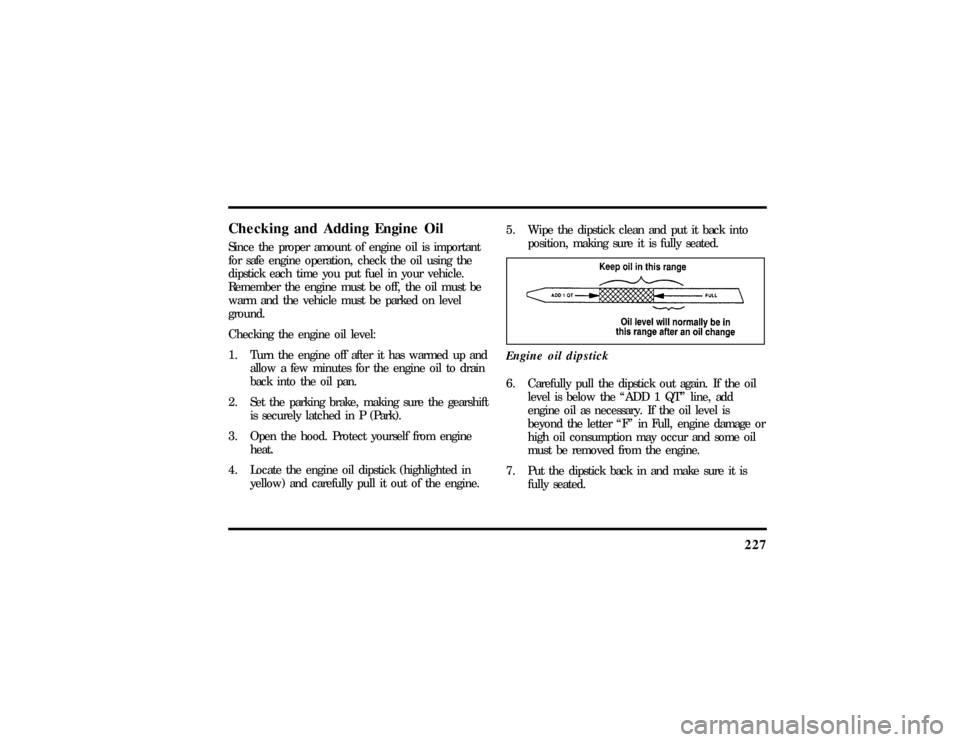
yellow) and carefully pull it out of the engine.5. Wipe the dipstick clean and put it back into
position, making sure it is fully seated.
Engine oil dipstick
6. Carefully pull the dipstick out again. If the oil
level is below the ªADD 1 QTº line, add
engine oil as necessary. If the oil level is
beyond the letter ªFº in Full, engine damage or
high oil consumption may occur and some oil
must be removed from the engine.
7. Put the dipstick back in and make sure it is
fully seated.
File:11fnmcc.ex
Update:Fri Sep 6 08:51:16 1996
Page 240 of 321

239
Checking the Automatic Transaxle
FluidWith the vehicle on a level surface and the brake
fully applied, start the engine and move the gear
shift selector through all of the gears allowing
sufficient time for each position to engage. Securely
latch the gear shift selector in the P (Park) position.
Fully set the parking brake and leave the engine
running.
Wipe off the dipstick cap and pull the dipstick out.
Wipe the indicator end clean. Put the dipstick back
into the filler tube and make sure it is fully seated.
Pull the dipstick out and read the fluid level.
NOTE:Your vehicle should not be driven until
some fluid has been added if the fluid level is
below the bottom dimple on the dipstick and the
outside temperature is above50ÊF(10ÊC). Addonly
enough fluid to bring the level above the bottom
hole.If the vehicle has not been driven and the fluid
level is above the bottom dimple on the dipstick, do
not add fluid. Recheck the fluid level after your
vehicle has reached normal operating temperature.
Normal operating temperature is reached after
driving approximately 20 miles (30 km). The fluid
level should be within the crosshatched area on the
dipstick.
NOTE:If the vehicle has been operated for an
extended period at high speeds, driven in city traffic
during hot weather, or has been pulling a trailer,
the vehicle should be turned off for about 30
minutes to allow the fluid to cool before checking.
File:11fnmcc.ex
Update:Fri Sep 6 08:51:16 1996
Page 258 of 321

257
q
English: MPG = (total miles)/(gallons used).
q
Metric: L/100K = (liters used) x 100/(total
kilometers)
Comparisons With Environmental
Protection Agency (EPA) and Transport
Canada (TC) Fuel Economy EstimatesEPA fuel economy figures are obtained from
laboratory tests under simulated road conditions and
may not reflect the actual conditions you experience
or your style of driving. The EPA fuel economy
estimate is not a guarantee that you will achieve
the fuel economy shown.
The following decrease fuel economy:q
Lack of regular, scheduled maintenance
q
Rapid acceleration and excessive speed
q
Driving with your foot on the brake
q
Sudden stops
q
Extended engine idling
q
Using speed control in hilly terrain
q
Extended use of the A/C, defroster, rear
window defroster and other accessories
q
Underinflated tires
q
Heavy loads
q
Aftermarket add-ons such as bike, ski or luggage
racks, bug deflectors, etc.
Self-Service PointersIf you choose to do your own fueling, you should
also perform a few simple maintenance routines.
This extra effort will save you additional money and
contribute to the driving efficiency of your vehicle.
File:11fnmcc.ex
Update:Fri Sep 6 08:51:16 1996
Page 262 of 321

261
The driving modes required to reach the ready
condition consist of a minimum of 30 minutes of
city and highway driving as described below:q
At least twenty minutes driving in stop and go,
city type traffic with at least four idle periods.
q
At least ten minutes of driving on an
expressway or highway.
Before completing the above driving modes, the
engine must be warmed up and at operating
temperature. Once started, the vehicle must not be
turned off during these driving modes.
Lights and Bulb ReplacementIt is a good idea to check the operation of the
following lights frequently:q
headlamps
q
high-mount brakelamp
q
tail lamps
q
brakelamps
q
hazard flasher
q
turn signals
q
side markers
q
license plate lamps
The alignment of your headlamps should be
checked if:
q
oncoming motorists frequently signal you to turn
off your vehicle's high beams when you do not
have the high beams on
q
the headlamps do not seem to give you enough
light to see clearly at night
q
the headlamp beams are pointed substantially
away from a position slightly down and to the
right
File:11fnmcc.ex
Update:Fri Sep 6 08:51:16 1996
Page 276 of 321

275
Engineq
Start engine every 15 days. Run at fast idle
until it reaches normal operating temperature.
q
With your foot on the brake, shift through all
the gears while the engine is running.
Fuel systemq
Fill fuel tank with high-quality, premium
unleaded fuel until the first automatic shutoff of
the fuel pump nozzle.
NOTE:During extended periods of vehicle storage
(60 days or more), fuel may deteriorate due to
oxidation. This can damage rubber and other
polymers in the fuel system and may also clog small
orifices.Ford Gas Stabilizer should be added whenever
actual or expected storage periods exceed 60 days.
Follow the instructions on the label. The vehicle
should then be operated at idle speed to circulate
the additive throughout the fuel system.
A volatile corrosion inhibitor added to the fuel
system will protect the fuel system's inner surfaces
from corrosion. Follow the instructions packaged
with the product.
Cooling systemq
Protect against freezing temperatures.
File:12fncsc.ex
Update:Mon Sep 9 10:15:52 1996