lights LINCOLN CONTINENTAL 1997 User Guide
[x] Cancel search | Manufacturer: LINCOLN, Model Year: 1997, Model line: CONTINENTAL, Model: LINCOLN CONTINENTAL 1997Pages: 321, PDF Size: 2.37 MB
Page 69 of 321

65
Turn SignalsMove the lever up to signal a right turn. Move it
down to signal a left turn. The corresponding
indicator light in the instrument cluster will flash.
If the turn signal stays on after you turn, move the
lever back to the center (off) position. A warning
chime will sound after approximately one-half mile
(one kilometer) of driving if you do not return the
lever to off.
For lane changes, move the lever far enough to
signal but not to latch. The lever will return to the
off position when you release it.
NOTE:The flash rate of the turn signal will speed
up considerably if the Lighting Control Module
detects a left or right turn lamp bulb (front or rear)
is burned out.
High BeamsTo turn on the high beams, turn the headlamp
control switch to the headlamp ON position (or
activate the autolamp feature) and push the turn
signal lever away from you until it latches. When
the high beams are ON, the high beam indicator
light on the instrument cluster comes on.
To turn off the high beams, pull the lever toward
you until it latches. The high beam indicator light
turns off.Flashing the LightsTo flash the headlamps, pull the lever toward you
for a moment and then release it. The headlamps
will flash whether the headlamp knob is in the on
or off position.
File:05fncfc.ex
Update:Fri Sep 6 14:53:57 1996
Page 94 of 321
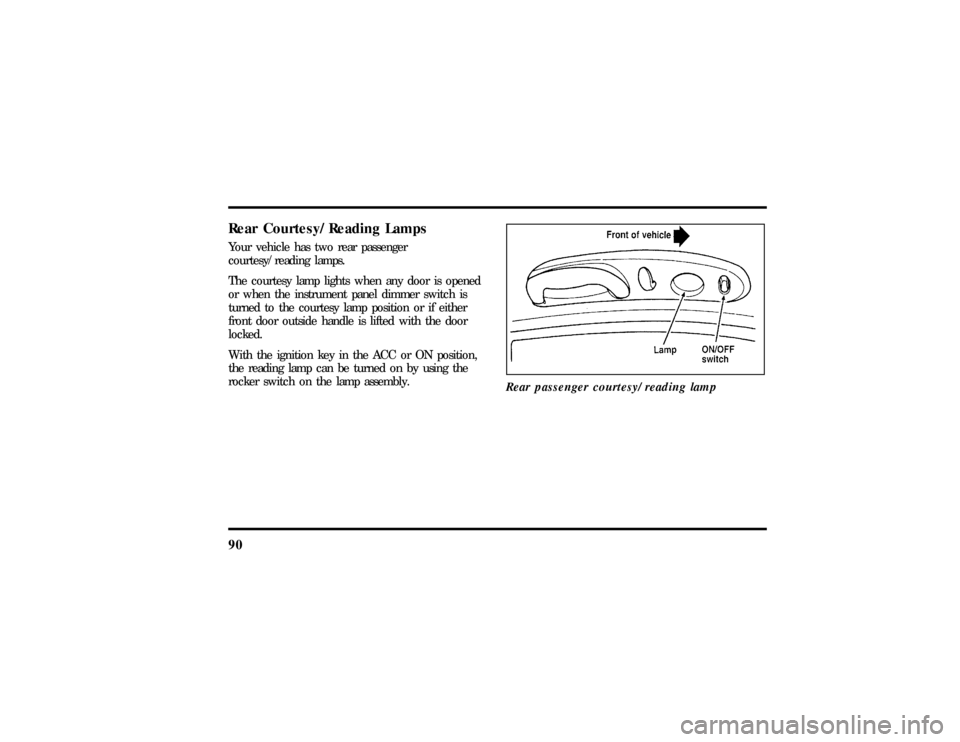
90Rear Courtesy/Reading LampsYour vehicle has two rear passenger
courtesy/reading lamps.
The courtesy lamp lights when any door is opened
or when the instrument panel dimmer switch is
turned to the courtesy lamp position or if either
front door outside handle is lifted with the door
locked.
With the ignition key in the ACC or ON position,
the reading lamp can be turned on by using the
rocker switch on the lamp assembly.
Rear passenger courtesy/reading lamp
File:05fncfc.ex
Update:Fri Sep 6 14:53:57 1996
Page 123 of 321
119
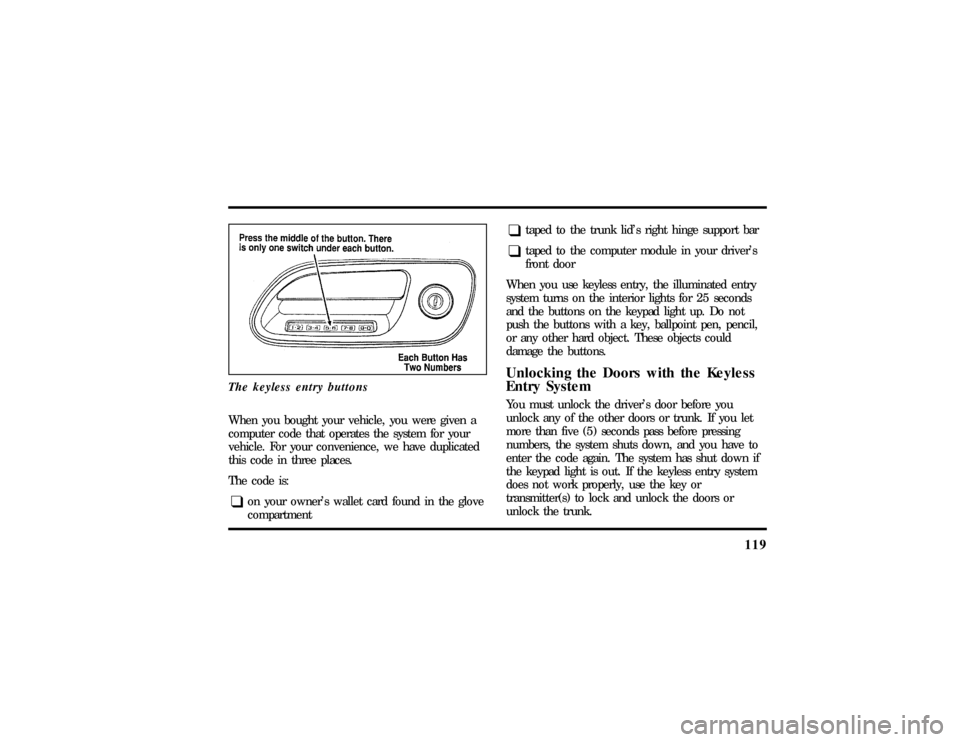
The keyless entry buttonsWhen you bought your vehicle, you were given a
computer code that operates the system for your
vehicle. For your convenience, we have duplicated
this code in three places.
The code is:q
on your owner's wallet card found in the glove
compartment
q
taped to the trunk lid's right hinge support bar
q
taped to the computer module in your driver's
front door
When you use keyless entry, the illuminated entry
system turns on the interior lights for 25 seconds
and the buttons on the keypad light up. Do not
push the buttons with a key, ballpoint pen, pencil,
or any other hard object. These objects could
damage the buttons.
Unlocking the Doors with the Keyless
Entry SystemYou must unlock the driver's door before you
unlock any of the other doors or trunk. If you let
more than five (5) seconds pass before pressing
numbers, the system shuts down, and you have to
enter the code again. The system has shut down if
the keypad light is out. If the keyless entry system
does not work properly, use the key or
transmitter(s) to lock and unlock the doors or
unlock the trunk.
File:05fncfc.ex
Update:Fri Sep 6 14:53:57 1996
Page 130 of 321

126NOTE:All transmitters to be used on your vehicle
must be programmed/reprogrammed at the same
time.Battery SaverWhen the ignition is turned off, the vehicle will
turn off battery voltage to the interior lights after 45
minutes.
This will prevent draining of the battery if those
lights have been left on inadvertently or if a door is
not completely closed. Battery voltage to these
lamps will be restored when the keyless entry
keypad is used, the remote entry transmitter is
used, any door is opened, the trunk is opened, or
the ignition key is turned to the ON position.
Anti-theft SystemWhen armed, this system helps protect your vehicle
against break-ins or theft by monitoring all doors,
the hood, and the trunk lock cylinder.
When an unauthorized entry occurs, the system
triggers and will:q
flash the headlamps, parking lamps, interior
lamps, and alarm indicator light
q
honk the horn
q
prevent the engine from starting
NOTE:The factory installed Remote Entry System
has a PANIC feature that also chirps the vehicle
horn and flashes the interior/exterior lamps when
the PANIC button on the remote entry transmitter
is pushed.The PANIC alarm and the Anti-Theft
alarm are two separate features.Both the
anti-theft alarm and the PANIC feature can be
active at the same time.
File:05fncfc.ex
Update:Fri Sep 6 14:53:57 1996
Page 133 of 321

129
Triggering the Alarm SystemThe armed system will be triggered if:q
any door is opened without disarming the
system (see previous paragraphs), or
q
the trunk lock cylinder is removed
NOTE:You can open the trunk with your key
without setting off the alarm.
q
the hood is opened.
Disarming a Triggered SystemThe alarm can be disarmed by:q
unlocking a front door with the key
q
using the keyless entry unlock code
q
using the UNLOCK control on the remote entry
transmitterNOTE:The flashing lights and honking horn will
shut off automatically approximately three minutes
after the system is triggered. It will trigger again if
another intrusion occurs. However, the engine will
not be allowed to start until the system is disarmed.
File:05fncfc.ex
Update:Fri Sep 6 14:53:57 1996
Page 168 of 321

1663. Make sure that the gearshift is in P (Park) and
the parking brake is set before you turn the
key.
Before you start your vehicle, you should test the
warning lights on the instrument panel to make
sure that they work. Refer to theInstrumentation
chapter.Starting Your EngineTo start your engine:
1. Follow the steps underPreparing to Start Your
Vehicleat the beginning of this section.
2. Turn the ignition key to the ON position.
3. DO NOT depress the accelerator pedal when
starting your engine. DO NOT use the
accelerator while the vehicle is parked.4. Turn the key to the START position (cranking)
until the engine starts. Allow the key to return
to the ON position after the engine has started.
If you have difficulty in turning the key, rotate
the steering wheel slightly because it may be
binding.
For a cold engine:
q
At temperatures10ÊF(-12ÊC) andbelow:If
the engine does not start infifteen (15)
secondson the first try, turn the key to OFF,
wait approximately ten (10) seconds so you do
not flood the engine, then try again.
q
At temperaturesabove10ÊF(-12ÊC):If the
engine does not start infive (5) secondson
the first try, turn the key to OFF, wait
approximately ten (10) seconds so you do not
flood the engine, then try again.
File:08fntoc.ex
Update:Mon Jun 17 14:19:30 1996
Page 174 of 321

172Do not drive with your foot resting on the brake
pedal; you will wear out the linings and increase
your vehicle's stopping distance. Brake rotor damage
may also eventually occur.
NOTE:If you are driving down a long or steep hill,
shift to a lower gear and do not apply your brakes
continuously. If you apply your brakes continuously,
they may overheat and become less effective.
Occasional brake squeal during light to moderate
stops does not affect the function of the brake
system and is normal. However, if the squeal
becomes louder or more frequent, have your brakes
inspected by your dealer or a qualified service
technician.
Ford Motor Company has not found any
detrimental effects of popular mobile radio
transmitting equipment installed on vehicles with
the anti-lock brake system, if the equipment is
installed according to the manufacturer's
instructions. However, if mobile radio transmittingequipment is installed in your vehicle and, if either
the anti-lock brake system cycles or the ANTI-LOCK
light comes on at any time other than right after
you turn the key to the ON position or during a
sudden stop, have your mobile radio dealer inspect
the installation.
Parking BrakeThe parking brake should be used whenever
you park your vehicle.
The parking brake is suspended just below the
lower left corner of the instrument panel.
To set the parking brake:
1. Move the gearshifter to P (Park).
2. Push the parking brake pedal down firmly and
fully with your left foot.
The Brake System Light in the warning lights will
glow once the parking brake is set.
File:09fngfc.ex
Update:Fri Sep 6 08:48:49 1996
Page 262 of 321

261
The driving modes required to reach the ready
condition consist of a minimum of 30 minutes of
city and highway driving as described below:q
At least twenty minutes driving in stop and go,
city type traffic with at least four idle periods.
q
At least ten minutes of driving on an
expressway or highway.
Before completing the above driving modes, the
engine must be warmed up and at operating
temperature. Once started, the vehicle must not be
turned off during these driving modes.
Lights and Bulb ReplacementIt is a good idea to check the operation of the
following lights frequently:q
headlamps
q
high-mount brakelamp
q
tail lamps
q
brakelamps
q
hazard flasher
q
turn signals
q
side markers
q
license plate lamps
The alignment of your headlamps should be
checked if:
q
oncoming motorists frequently signal you to turn
off your vehicle's high beams when you do not
have the high beams on
q
the headlamps do not seem to give you enough
light to see clearly at night
q
the headlamp beams are pointed substantially
away from a position slightly down and to the
right
File:11fnmcc.ex
Update:Fri Sep 6 08:51:16 1996
Page 310 of 321

312
checking and adding......... 227
check oil warning light........ 12
dipstick............... 227
disposal............220, 240
engine oil pressure warning light.... 12
filter, specifications.......... 271
low oil warning light......... 12
refill capacities............ 272
specifications.........226, 273
synthetic oil............. 226
viscosity.............. 226
F
Fan.................. 221
engine fan, avoiding injury...... 221
Flashers, hazard............ 68
Flashing the lights........... 65
Flat tire................ 205
Fluid refill capacities.......... 272
Ford Dispute Settlement Board...... 280
Ford Motor Company of Canada..... 284
Ford of Canada CustomerAssistance Centre........... 284
Foreign registration........... 286
French owner guides, how to obtain.... 3
Fuel................. 251
calculating fuel economy....... 256
capacity............... 272
choosing the right fuel........ 253
comparisons with EPA fuel
economy estimates......... 257
filling your vehicle with fuel...... 251
filter, specifications.......... 271
fuel filler door release lever...... 251
fuel gauge.............. 18
octane rating............ 253
quality............... 253
running out of fuel.......... 256
safety information relating to
automotive fuels.......... 255
storing your vehicle......... 275
treating emergencies......... 255
Fuel cap................ 251
removing.............. 251
File:fnixc.ex
Update:Tue Sep 17 08:28:54 1996
Page 312 of 321

314
calculating............. 184
definition.............. 183
driving with a heavy load....... 183
location............... 183
H
Hazard flashers............. 68
Headlamps
aiming............... 264
autolamp system........... 57
checking alignment.......... 261
cleaning.............. 261
daytime running lights........ 56
flashing............... 65
high beam............. 65
replacing bulbs........... 261
turning on and off.......... 57
warning chime............ 15
Head restraints............. 131
Heated mirrors............. 112
Heating
electronic automatic temperature control
system.............. 45High beams
indicator light............ 15
operation............ 56,65
Hood................. 223
latch location............ 223
lubrication specifications....... 273
release lever............. 223
working under the hood....... 221
Horn................. 69
I
Idle, relearning..........216, 221
Ignition
chime............... 63
positions of the ignition........ 62
removing the key.......... 63
Indicator lights and chimes (see Lights) . . . 7
Infant seats (see Safety seats)....148, 149
Instrument panel............. 7
cleaning............... 269
Interval wipers............. 66
File:fnixc.ex
Update:Tue Sep 17 08:28:54 1996