light LINCOLN CONTINENTAL 1997 Service Manual
[x] Cancel search | Manufacturer: LINCOLN, Model Year: 1997, Model line: CONTINENTAL, Model: LINCOLN CONTINENTAL 1997Pages: 321, PDF Size: 2.37 MB
Page 176 of 321

174You have an automatic release for the parking
brake. The parking brake should automatically
unlock when you move the gearshift to any forward
gear while the engine is running. However, the
automatic release does not work when the gearshift
is in reverse, neutral or park.
To manually release the parking brake, pull the
BRAKE RELEASE handle located on the lower left
corner of the instrument panel. The Brake Warning
Light will illuminate if the parking brake is not fully
released when the engine is running.
The parking brake is not designed to stop a moving
vehicle, but you can use the parking brake to stop
your vehicle in an emergency if the normal brakes
fail. However, since the parking brake applies only
the rear brakes, the stopping distance will increase
greatly and the handling of your vehicle will be
adversely affected.Always check the Brake Warning Light each time
you start your engine. Driving with the parking
brake on will cause the brakes to wear out quickly
and will reduce the fuel economy.
Traction Control
TM
Your vehicle is be equipped with the Traction
Control
TM
system. This system helps prevent wheel
spin in order to improve tire traction and is an
especially useful feature when you drive in hilly
areas or on slippery, icy or snowy roads.
When the Traction Control system is controlling
wheelspin, an electric motor sound may be heard
from the engine compartment and engine
acceleration may seem slower. This is normal.
Traction Control
TM
works automatically by rapidly
applying and releasing the brakes and reducing
engine torque to prevent one or both of the front
drive wheels from spinning during acceleration.
File:09fngfc.ex
Update:Fri Sep 6 08:48:49 1996
Page 179 of 321

177
Steering Your VehicleYour vehicle comes with power steering. Power
steering uses energy from the engine to help steer
your vehicle.
If the amount of effort needed to steer your vehicle
changes, check your steering effort selection in the
Message Center. If this is not the problem, have the
power steering system checked. If the power
steering system breaks down (or if the engine is
turned off), you can steer the vehicle manually but
it takes more effort.
The steering system in your vehicle is speed
sensitive. This means that the steering effort is light
for parking and heavier for highway driving.
However, if you have to swerve around an object
or another vehicle, your steering will have full
power assist.
Never hold the steering wheel to the extreme right
or left for more than five seconds if the engine is
running. This can damage the power steering pump.
Driving with an Automatic
Overdrive TransaxleYour automatic overdrive transaxle provides fully
automatic operation in eitherj(Overdrive) or D
(Drive). Driving with the shift selector inj
(Overdrive) gives the best fuel economy for normal
driving conditions. For manual control, start in 1
(First) and then shift manually.
Your vehicle is equipped with an Electronic
Powertrain Control Module that limits engine
and/or vehicle speeds with a cut-out mode to
promote durability.
File:09fngfc.ex
Update:Fri Sep 6 08:48:49 1996
Page 191 of 321

189
Driving While You TowBe especially careful when driving while you tow a
trailer. Never drive faster than 45 mph (70 km/h)
when you tow in hilly country on hot days. Also,
anticipate stops so that you can brake gradually.
Towing a trailer increases the load on the engine
and transaxle, particularly in hilly country and with
heavier trailers. Under these conditions you may
experience an excessive amount of shifting between
Overdrive and Third gears. Moving the shift selector
to D (Overdrive Lockout) will keep this from
happening and will provide better engine braking.
When driving in less hilly country or with a lighter
trailer load, you may move the gearshift selector
lever toj(Overdrive) without experiencing
excessive shifting.When driving down steep hills, you should put the
gearshift selector lever in the 1 (First) position to
shift the transaxle into second gear. This will
provide additional engine braking.
The automatic transaxle will automatically
downshift to the proper gear for driving up a grade.
If you use the speed control while you are towing
on very long, steep grades, the speed control may
shut off.
Servicing Your Vehicle If You TowIf you tow a trailer for a long distance, your vehicle
will need to be serviced more frequently than usual.
Refer to theMaintenance Schedulebooklet for
additional information.
File:09fngfc.ex
Update:Fri Sep 6 08:48:49 1996
Page 217 of 321

216Jump-Starting1. Make sure that the jumper cables are not in
the way of moving engine parts, then start the
booster vehicle. Run the engine at a moderate
speed.
2. Let the discharged battery charge for a few
minutes and then start the disabled vehicle. It
may take a couple of tries before the vehicle
starts. If the vehicle does not start after several
attempts, there may be a different problem.
3. When both vehicles are running, let them idle
for a few minutes to charge the discharged
battery.Removing jumper cables1.Always remove the jumper cables in the
reverse order.Remove the negative (s) end
of the jumper cable from the metallic surface
on the engine or frame of the disabled vehicle.2. Remove the negative (s) cable from the
booster battery.
3. Remove the positive (+) cable from the booster
battery.
4. Remove the other end of the positive (+) cable
from the discharged battery.
After the vehicle is started, let it idle for a while to
let the engine ªrelearnº its idle conditions. Drive it
around for a while with all electrical accessories
turned off to let the battery recharge. Driveability
may be deteriorated slightly until all drive modes
are ªrelearned.ºYou may need to use a battery
charger to fully recharge the battery.
If you need to replace your battery, seeBatteryin
theMaintenance and Carechapter.
File:10fnerc.ex
Update:Fri Sep 6 08:49:57 1996
Page 220 of 321

219
Maintenance and CareService Made EasyFord has two goals for servicing your vehicle.
1. When we can, we design parts that do not
need to be serviced.
2. We want to make servicing your vehicle as
easy as possible. To help you:q
We highlight do-it-yourself items in yellow in
the engine compartment so that you can find
them easily.
q
When possible, we design parts that can be
replaced without tools.
q
We give you a Maintenance Schedule that
makes tracking routine service for your vehicle
easy. The maintenance schedule is located in
theMaintenance Schedulebooklet.This chapter tells you about the basic parts that you
need to check and service regularly.
If your vehicle needs professional servicing, your
dealership can provide the parts and service
required. Check yourWarranty Information Booklet
to find out which parts and services are covered.
Also see theCustomer Assistancechapter of this
Owner Guide.
Ford Motor Company recommends that the Owner
Maintenance Checks listed in theMaintenance
Schedulebooklet be performed for the proper
operation of your vehicle. In addition to the
conditions listed in theOwner Maintenance
Checklist, be alert for any unusual noise, vibration,
or other indication that your vehicle may need
service. If you do notice something unusual, see
that your vehicle is serviced promptly.
File:11fnmcc.ex
Update:Fri Sep 6 08:51:16 1996
Page 228 of 321
227
Checking and Adding Engine OilSince the proper amount of engine oil is important
for safe engine operation, check the oil using the
dipstick each time you put fuel in your vehicle.
Remember the engine must be off, the oil must be
warm and the vehicle must be parked on level
ground.
Checking the engine oil level:
1. Turn the engine off after it has warmed up and
allow a few minutes for the engine oil to drain
back into the oil pan.
2. Set the parking brake, making sure the gearshift
is securely latched in P (Park).
3. Open the hood. Protect yourself from engine
heat.
4. Locate the engine oil dipstick (highlighted in
yellow) and carefully pull it out of the engine.5. Wipe the dipstick clean and put it back into
position, making sure it is fully seated.
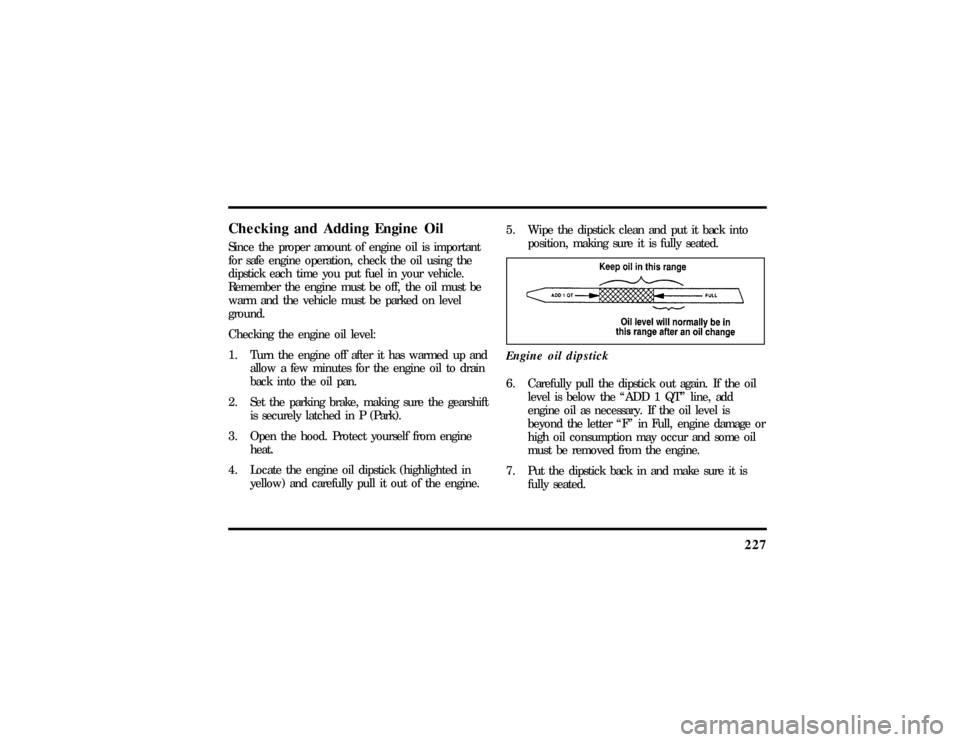
Engine oil dipstick
6. Carefully pull the dipstick out again. If the oil
level is below the ªADD 1 QTº line, add
engine oil as necessary. If the oil level is
beyond the letter ªFº in Full, engine damage or
high oil consumption may occur and some oil
must be removed from the engine.
7. Put the dipstick back in and make sure it is
fully seated.
File:11fnmcc.ex
Update:Fri Sep 6 08:51:16 1996
Page 229 of 321
228It may be necessary to add some oil between oil
changes. Make sure you use a CERTIFIED engine
oil of the preferred viscosity. Your vehicle's
warranty coverage may not apply if engine damage
is caused by the use of improper engine oil.
Add engine oil through the oil filler cap highlighted
in yellow. To add oil, remove the filler cap and use
a funnel to pour oil into the opening. Be careful not
to overfill the engine. Recheck the oil level after 30
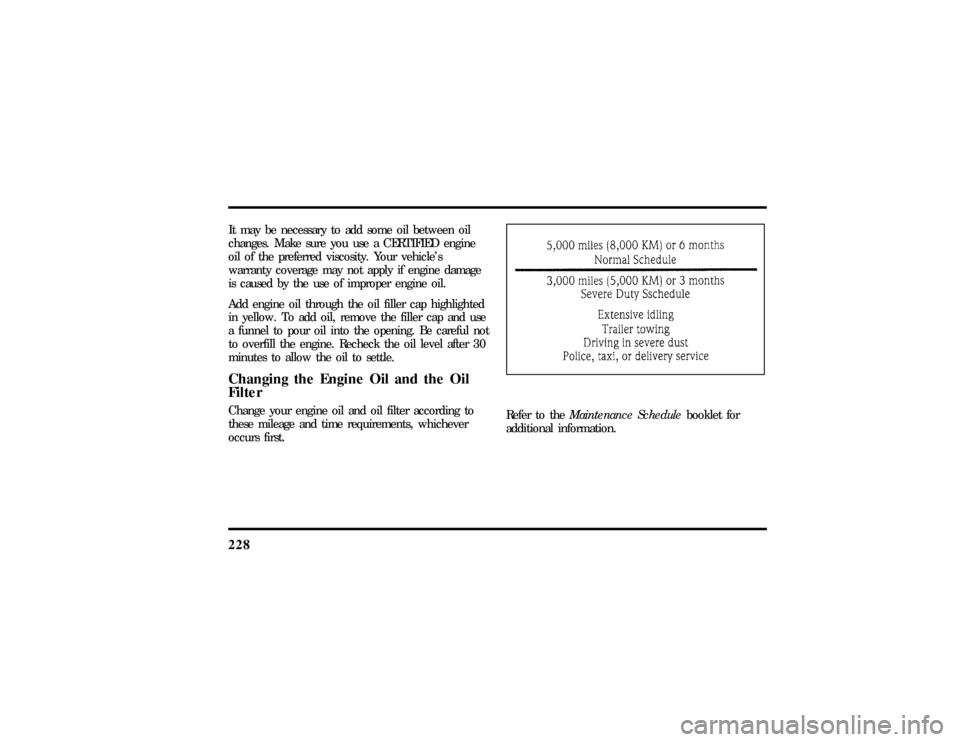
minutes to allow the oil to settle.Changing the Engine Oil and the Oil
FilterChange your engine oil and oil filter according to
these mileage and time requirements, whichever
occurs first.
Refer to theMaintenance Schedulebooklet for
additional information.
File:11fnmcc.ex
Update:Fri Sep 6 08:51:16 1996
Page 245 of 321
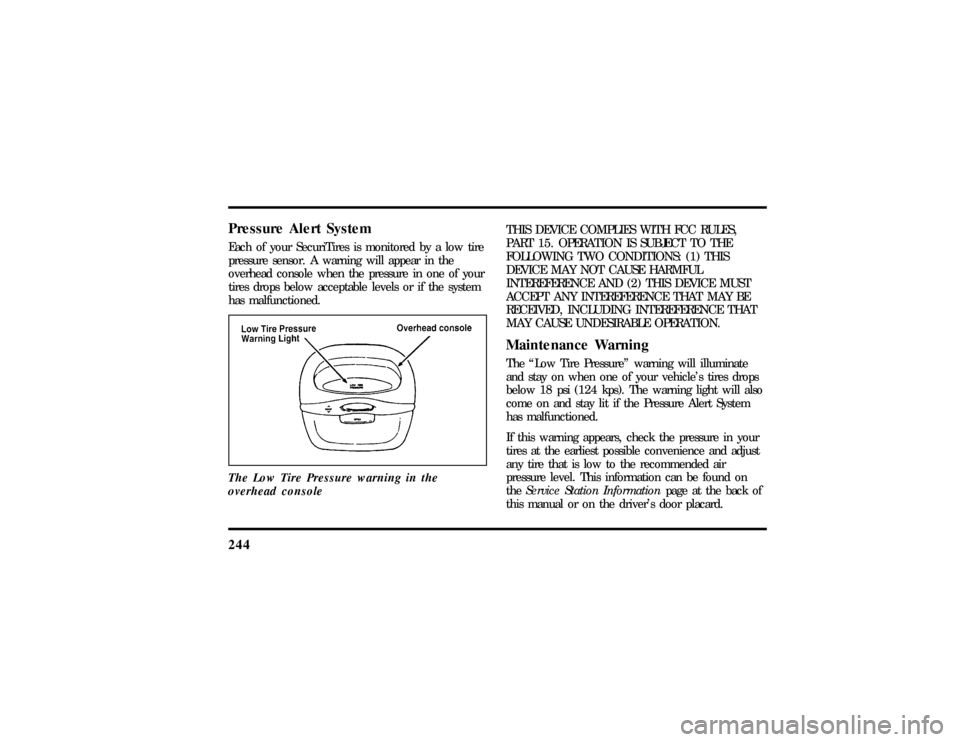
244Pressure Alert SystemEach of your SecuriTires is monitored by a low tire
pressure sensor. A warning will appear in the
overhead console when the pressure in one of your
tires drops below acceptable levels or if the system
has malfunctioned.
The Low Tire Pressure warning in the
overhead console
THIS DEVICE COMPLIES WITH FCC RULES,
PART 15. OPERATION IS SUBJECT TO THE
FOLLOWING TWO CONDITIONS: (1) THIS
DEVICE MAY NOT CAUSE HARMFUL
INTEREFERENCE AND (2) THIS DEVICE MUST
ACCEPT ANY INTEREFERENCE THAT MAY BE
RECEIVED, INCLUDING INTEREFERENCE THAT
MAY CAUSE UNDESIRABLE OPERATION.Maintenance WarningThe ªLow Tire Pressureº warning will illuminate
and stay on when one of your vehicle's tires drops
below 18 psi (124 kps). The warning light will also
come on and stay lit if the Pressure Alert System
has malfunctioned.
If this warning appears, check the pressure in your
tires at the earliest possible convenience and adjust
any tire that is low to the recommended air
pressure level. This information can be found on
theService Station Informationpage at the back of
this manual or on the driver's door placard.
File:11fnmcc.ex
Update:Fri Sep 6 08:51:16 1996
Page 255 of 321
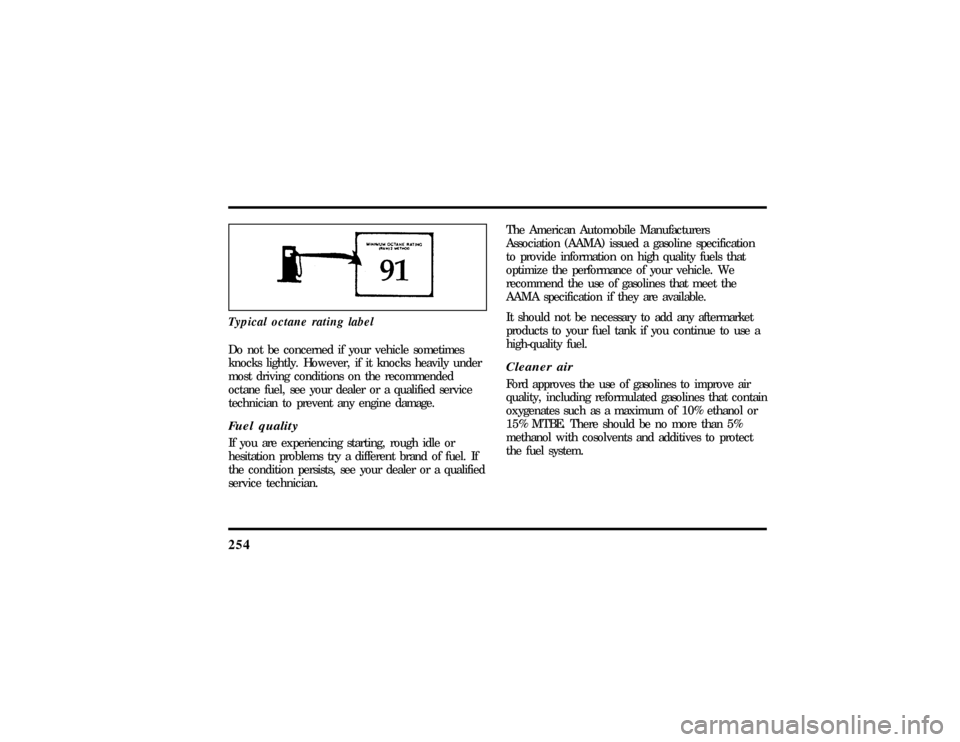
254Typical octane rating labelDo not be concerned if your vehicle sometimes
knocks lightly. However, if it knocks heavily under
most driving conditions on the recommended
octane fuel, see your dealer or a qualified service
technician to prevent any engine damage.Fuel qualityIf you are experiencing starting, rough idle or
hesitation problems try a different brand of fuel. If
the condition persists, see your dealer or a qualified
service technician.The American Automobile Manufacturers
Association (AAMA) issued a gasoline specification
to provide information on high quality fuels that
optimize the performance of your vehicle. We
recommend the use of gasolines that meet the
AAMA specification if they are available.
It should not be necessary to add any aftermarket
products to your fuel tank if you continue to use a
high-quality fuel.
Cleaner airFord approves the use of gasolines to improve air
quality, including reformulated gasolines that contain
oxygenates such as a maximum of 10% ethanol or
15% MTBE. There should be no more than 5%
methanol with cosolvents and additives to protect
the fuel system.
File:11fnmcc.ex
Update:Fri Sep 6 08:51:16 1996
Page 262 of 321

261
The driving modes required to reach the ready
condition consist of a minimum of 30 minutes of
city and highway driving as described below:q
At least twenty minutes driving in stop and go,
city type traffic with at least four idle periods.
q
At least ten minutes of driving on an
expressway or highway.
Before completing the above driving modes, the
engine must be warmed up and at operating
temperature. Once started, the vehicle must not be
turned off during these driving modes.
Lights and Bulb ReplacementIt is a good idea to check the operation of the
following lights frequently:q
headlamps
q
high-mount brakelamp
q
tail lamps
q
brakelamps
q
hazard flasher
q
turn signals
q
side markers
q
license plate lamps
The alignment of your headlamps should be
checked if:
q
oncoming motorists frequently signal you to turn
off your vehicle's high beams when you do not
have the high beams on
q
the headlamps do not seem to give you enough
light to see clearly at night
q
the headlamp beams are pointed substantially
away from a position slightly down and to the
right
File:11fnmcc.ex
Update:Fri Sep 6 08:51:16 1996