fuel LINCOLN CONTINENTAL 1998 Owner's Manual
[x] Cancel search | Manufacturer: LINCOLN, Model Year: 1998, Model line: CONTINENTAL, Model: LINCOLN CONTINENTAL 1998Pages: 176, PDF Size: 1.32 MB
Page 146 of 176
WHAT YOU SHOULD KNOW ABOUT AUTOMOTIVE FUELS
Important safety precautions
Do not overfill the fuel tank. The pressure in an overfilled tank
may cause leakage and lead to fuel spray and fire.
If you do not use the proper fuel cap, the pressure in the fuel
tank can damage the fuel system or cause it to work improperly
in a collision.
The fuel system may be under pressure. If the fuel cap is venting
vapor or if you hear a hissing sound, wait until it stops before
completely removing the cap.
Automotive fuels can cause serious injury or death if misused or
mishandled.
Observe the following guidelines when handling automotive fuel:
²Extinguish all smoking materials
and any open flames before
fueling your vehicle.
²Always turn off the vehicle before
fueling.
²Automotive fuels can be harmful
or fatal if swallowed. If fuel is
swallowed, call a physician
immediately, even if no symptoms
are immediately apparent. The
toxic effects of fuel may not be visible for hours.
²Fuels can also be harmful if absorbed through the skin. If fuel is
splashed on the skin, promptly remove contaminated clothing and
wash skin thoroughly with soap and water.
²If fuel is splashed in the eyes, remove contact lenses, flush with water
for 15 minutes and seek medical attention.
Maintenance and care
146
Page 147 of 176
²Be particularly careful if you are taking ªAntabuseº or other forms of
disulfiram for the treatment of alcoholism. Breathing gasoline vapors
or skin contact could cause an adverse reaction. Consult a physician
immediately.
Choosing the right fuel
Use only UNLEADED FUEL. The use of leaded fuel is prohibited by law
and could damage your vehicle.
Your vehicle was not designed to use fuel or fuel additives with metallic
compounds, including manganese-based compounds containing MMT.
Vehicles certified to California emission standards (indicated on the
underhood Vehicle Emissions Control Information label) are designed to
operate on California reformulated gasolines. If California reformulated
gasoline is not available when you refuel, your vehicle can be operated
on non-California fuels. However, even though your engine will perform
adequately on other gasolines, the performance of the emission control
devices and systems may be adversely affected.
Repair of damage caused by using a fuel that your vehicle was not
designed for may not be covered by your warranty.
Octane recommendations
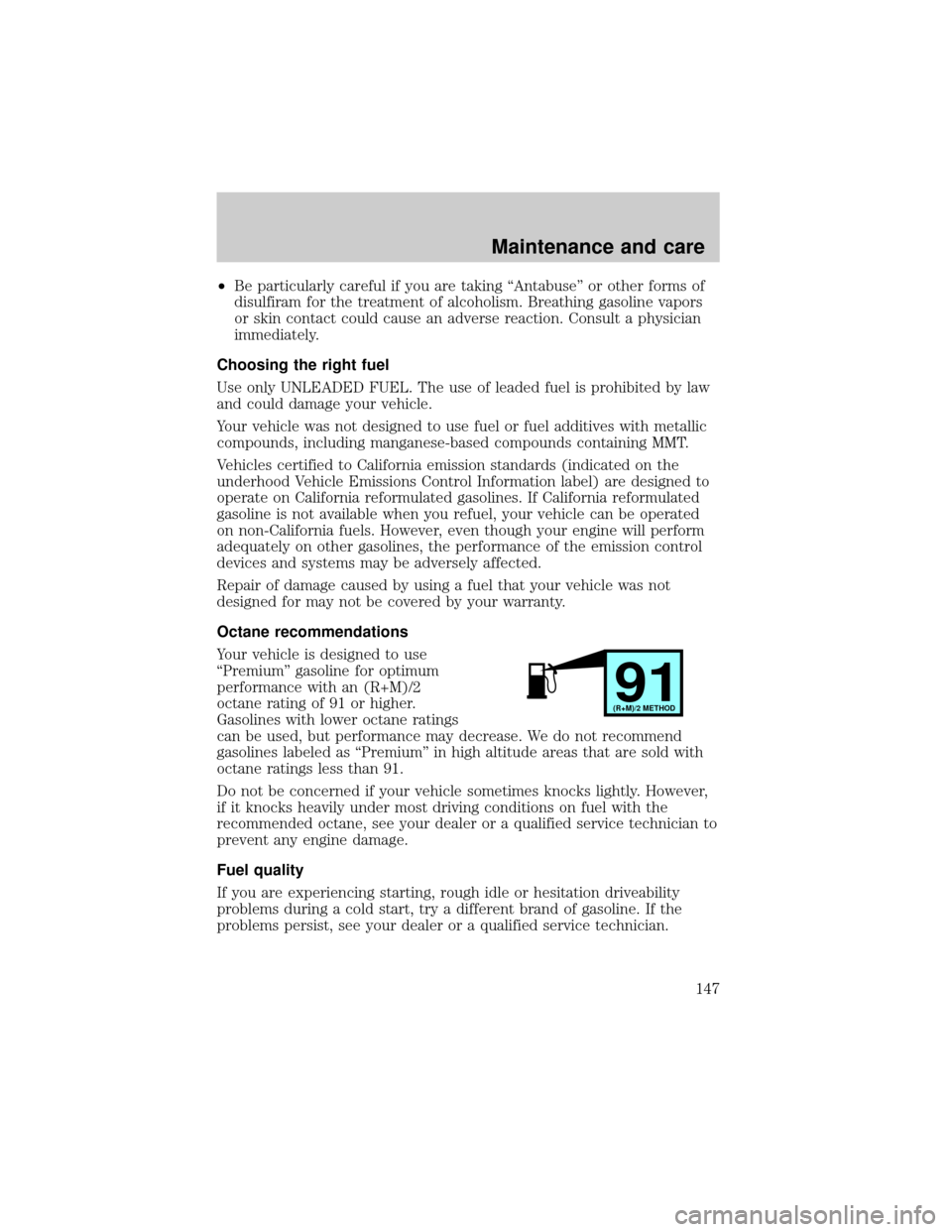
Your vehicle is designed to use
ªPremiumº gasoline for optimum
performance with an (R+M)/2
octane rating of 91 or higher.
Gasolines with lower octane ratings
can be used, but performance may decrease. We do not recommend
gasolines labeled as ªPremiumº in high altitude areas that are sold with
octane ratings less than 91.
Do not be concerned if your vehicle sometimes knocks lightly. However,
if it knocks heavily under most driving conditions on fuel with the
recommended octane, see your dealer or a qualified service technician to
prevent any engine damage.
Fuel quality
If you are experiencing starting, rough idle or hesitation driveability
problems during a cold start, try a different brand of gasoline. If the
problems persist, see your dealer or a qualified service technician.
91(R+M)/2 METHOD
Maintenance and care
147
Page 148 of 176
The American Automobile Manufacturers Association (AAMA) issued a
gasoline specification to provide information on high quality fuels that
optimize the performance of your vehicle. We recommend the use of
gasolines that meet the AAMA specification if they are available.
It should not be necessary to add any aftermarket products to your fuel
tank if you continue to use a high-quality fuel.
Cleaner air
Ford approves the use of gasolines to improve air quality, including
reformulated gasolines that contain oxygenates up to 10% ethanol or
15% MTBE.
Do not use gasolines containing methanol, which can damage critical fuel
system components. Damage resulting from the use of methanol may not
be covered by your warranty.
Running out of fuel
Avoid running out fuel because this situation may have an adverse affect
on modern powertrain components.
You may need to crank the engine several times before the system starts
to pump fuel from the tank to the engine. If you run out of fuel, your
Service Engine Soon light may come on. For more information on the
Service Engine Soon light, refer to theInstrumentationchapter.
Calculating fuel economy
To accurately calculate your vehicle's fuel economy:
1. Fill the tank completely and record the initial odometer reading.
2. Each time you fill the tank, record the amount of fuel added
(in liters or gallons).
3. After at least three to five fuel tank fill-ups, fill the fuel tank and
record the current mileage reading.
4. Use one of the following equations to calculate fuel economy.
Liters used x 1004Total kilometers traveled
Total miles traveled4Total gallons used
Keep a record for at least one month. This will provide an accurate
estimate of the vehicle's fuel economy.
Maintenance and care
148
Page 149 of 176
EMISSION CONTROL SYSTEM
Your vehicle is equipped with various emission control components and a
catalytic converter which will enable your vehicle to comply with
applicable exhaust emission standards. To make sure that the catalytic
converter and other emission control components continue to work
properly:
²Use only unleaded fuel.
²Avoid running out of fuel.
²Do not turn off the ignition while your vehicle is moving, especially at
high speeds.
²Have the services listed in your ªService Guideº performed according
to the specified schedule.
The Scheduled Maintenance Services listed in the ªService Guideº are
required because they are considered essential to the life and
performance of your vehicle and to its emissions system.
If other than Ford, Motorcraft or Ford authorized parts are used for
maintenance replacements or for service of components affecting
emission control such non-Ford parts should be equivalent to genuine
Ford Motor Company parts in performance and durability.
Do not park, idle, or drive your vehicle in dry grass or other dry
ground cover. The emission system heats up the engine
compartment and exhaust system, which can start a fire.
Watch for fluid leaks, strange odors, smoke, loss of oil pressure, the
charging system warning light, the ªService Engine Soonº light or the
temperature warning light. These events could indicate that the emission
control system is not working properly.
If you smell exhaust fumes of any kind inside your vehicle, have
the dealer inspect and fix your vehicle immediately. Do not drive
if you smell exhaust fumes. These fumes are harmful and could kill
you.
Do not make any unauthorized changes to your vehicle or engine. By
law, vehicle owners and anyone who manufactures, repairs, services,
sells, leases, trades vehicles, or supervises a fleet of vehicles are not
permitted to intentionally remove an emission control device or prevent
it from working. Information about your vehicle's emission system is on
Maintenance and care
149
Page 156 of 176
Repairing paint chips
Minor scratches or paint damage from road debris may be repaired with
touch-up paint, repair foil or aerosol paint spray from the Ford accessory
line. Observe the application instructions on the products.
Remove particles such as bird droppings, tree sap, insect remains, tar
spots, road salt and industrial fallout immediately.
Cleaning the wheels
Wash with the same detergent as the body of your vehicle. Do not use
acid-based wheel cleaners, steel wool, fuel or strong detergents. Never
use abrasives that will damage the finish of special wheel surfaces. Use a
tar remover to remove grease and tar.
Cleaning the engine
Engines are more efficient when they are clean because grease and dirt
buildup keep the engine warmer than normal. When washing:
²Take care when using a power washer to clean the engine. The high
pressure fluid could penetrate the sealed parts and cause damage.
²Do not spray with cold water to avoid cracking the engine block or
other engine components.
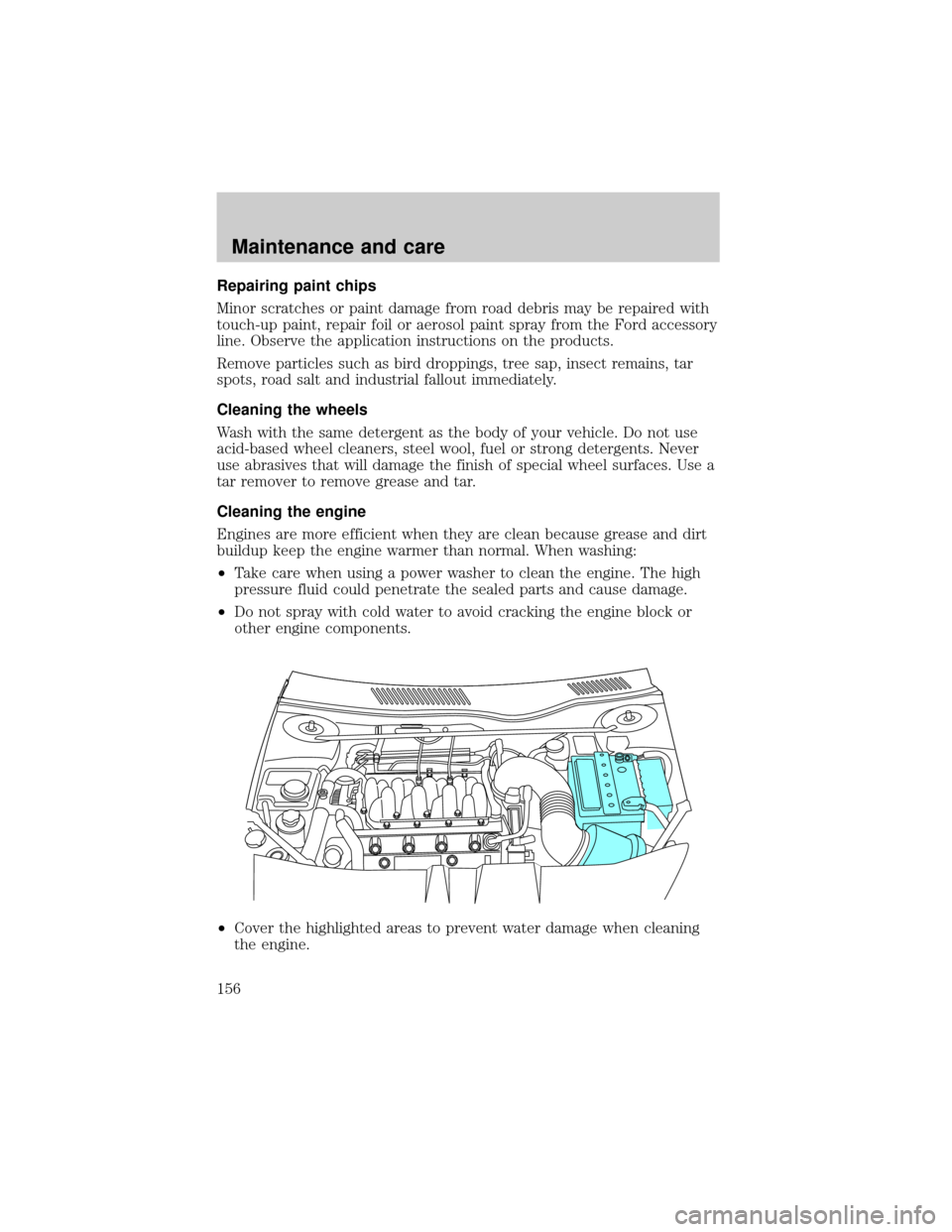
²Cover the highlighted areas to prevent water damage when cleaning
the engine.
Maintenance and care
156
Page 157 of 176
²Never wash or rinse the engine while it is running; water in the
running engine may cause internal damage.
Cleaning plastic exterior parts
Use vinyl cleaner for routine cleaning. Clean with a tar remover if
necessary. Do not clean plastic parts with thinners, solvents or
petroleum-based cleaners.
Cleaning the exterior lamps
Wash with the same detergent as the exterior of your vehicle. Use glass
cleaner or tar remover if necessary.
To avoid scratching the lamps, do not use a dry paper towel, chemical
solvents or abrasive cleaners.
Cleaning the wiper blades
If the wiper blades do not wipe properly, clean the windshield and wiper
blades with undiluted windshield wiper solution or a mild detergent.
Rinse thoroughly with clean water. To avoid damaging the blades, do not
use fuel, kerosene, paint thinner or other solvents.
Cleaning the instrument panel
Clean with a damp cloth, then dry with a dry cloth.
Avoid cleaner or polish that increases the gloss of the upper portion of
the instrument panel. The dull finish in this area helps protect the driver
from undesirable windshield reflection.
Cleaning and maintaining the safety belts
Clean the safety belts with a mild soap solution recommended for
cleaning upholstery or carpets. Do not bleach or dye the belts, because
these actions may weaken the belt webbing.
Check the safety belt system periodically to make sure there are no
nicks, wear or cuts. If your vehicle has been involved in an accident,
refer to theSafety belt maintenancesection in theSeating and safety
restraintschapter.
Underbody
Flush the complete underside of vehicle frequently. Keep body drain
holes unplugged. Inspect for road damage.
Maintenance and care
157
Page 160 of 176
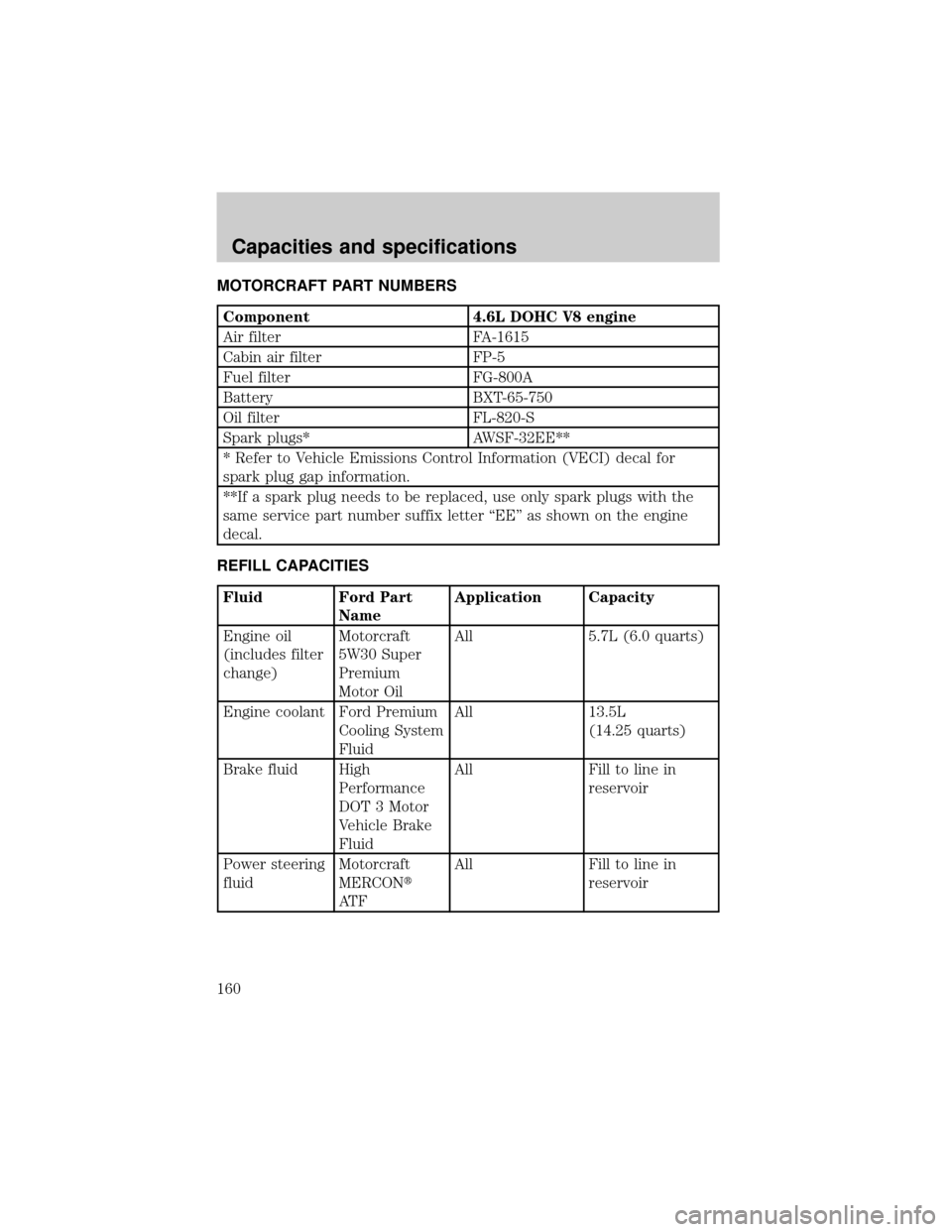
MOTORCRAFT PART NUMBERS
Component 4.6L DOHC V8 engine
Air filter FA-1615
Cabin air filter FP-5
Fuel filter FG-800A
Battery BXT-65-750
Oil filter FL-820-S
Spark plugs* AWSF-32EE**
* Refer to Vehicle Emissions Control Information (VECI) decal for
spark plug gap information.
**If a spark plug needs to be replaced, use only spark plugs with the
same service part number suffix letter ªEEº as shown on the engine
decal.
REFILL CAPACITIES
Fluid Ford Part
NameApplication Capacity
Engine oil
(includes filter
change)Motorcraft
5W30 Super
Premium
Motor OilAll 5.7L (6.0 quarts)
Engine coolant Ford Premium
Cooling System
FluidAll 13.5L
(14.25 quarts)
Brake fluid High
Performance
DOT 3 Motor
Vehicle Brake
FluidAll Fill to line in
reservoir
Power steering
fluidMotorcraft
MERCONt
AT FAll Fill to line in
reservoir
Capacities and specifications
160
Page 161 of 176
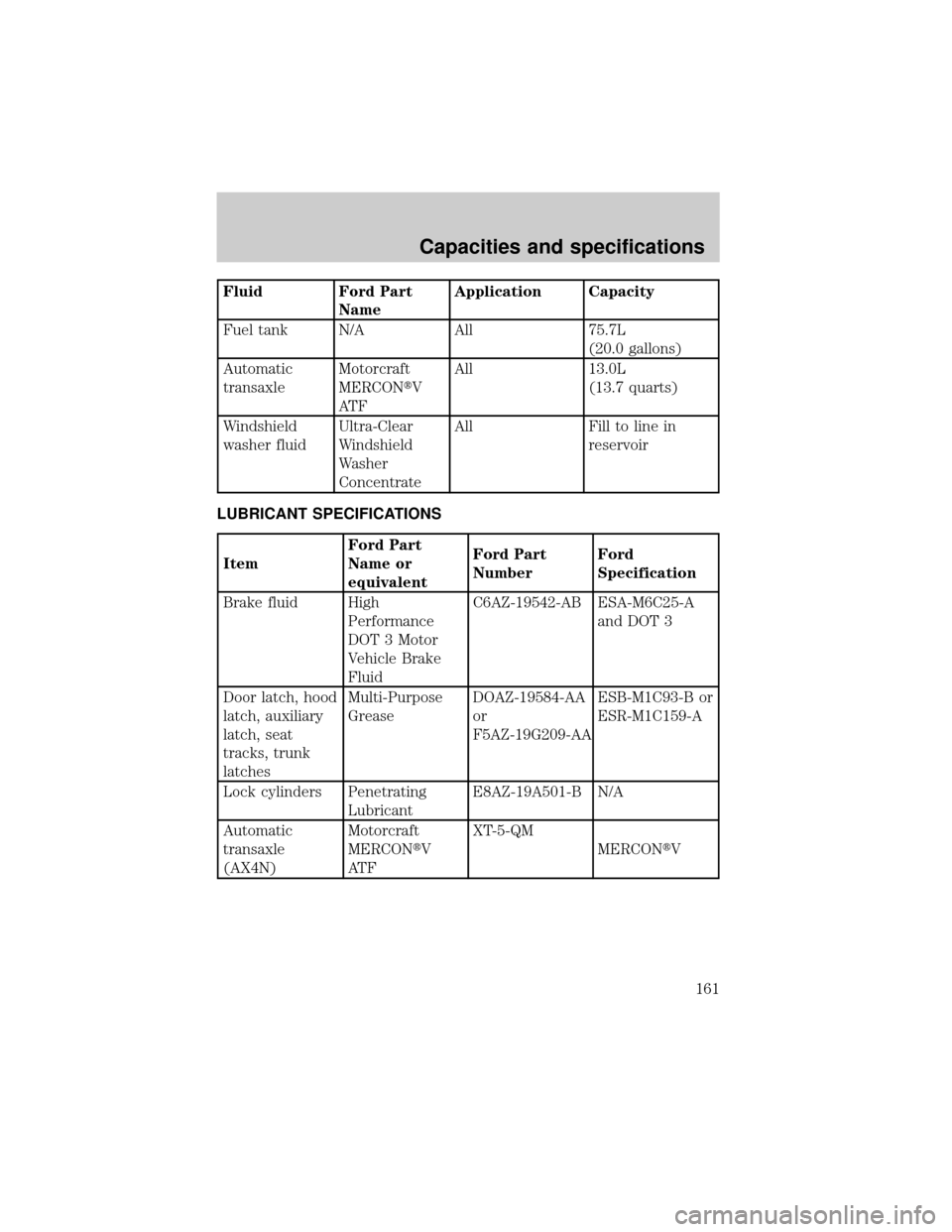
Fluid Ford Part
NameApplication Capacity
Fuel tank N/A All 75.7L
(20.0 gallons)
Automatic
transaxleMotorcraft
MERCONtV
AT FAll 13.0L
(13.7 quarts)
Windshield
washer fluidUltra-Clear
Windshield
Washer
ConcentrateAll Fill to line in
reservoir
LUBRICANT SPECIFICATIONS
ItemFord Part
Name or
equivalentFord Part
NumberFord
Specification
Brake fluid High
Performance
DOT 3 Motor
Vehicle Brake
FluidC6AZ-19542-AB ESA-M6C25-A
and DOT 3
Door latch, hood
latch, auxiliary
latch, seat
tracks, trunk
latchesMulti-Purpose
GreaseDOAZ-19584-AA
or
F5AZ-19G209-AAESB-M1C93-B or
ESR-M1C159-A
Lock cylinders Penetrating
LubricantE8AZ-19A501-B N/A
Automatic
transaxle
(AX4N)Motorcraft
MERCONtV
AT FXT-5-QM
MERCONtV
Capacities and specifications
161
Page 162 of 176
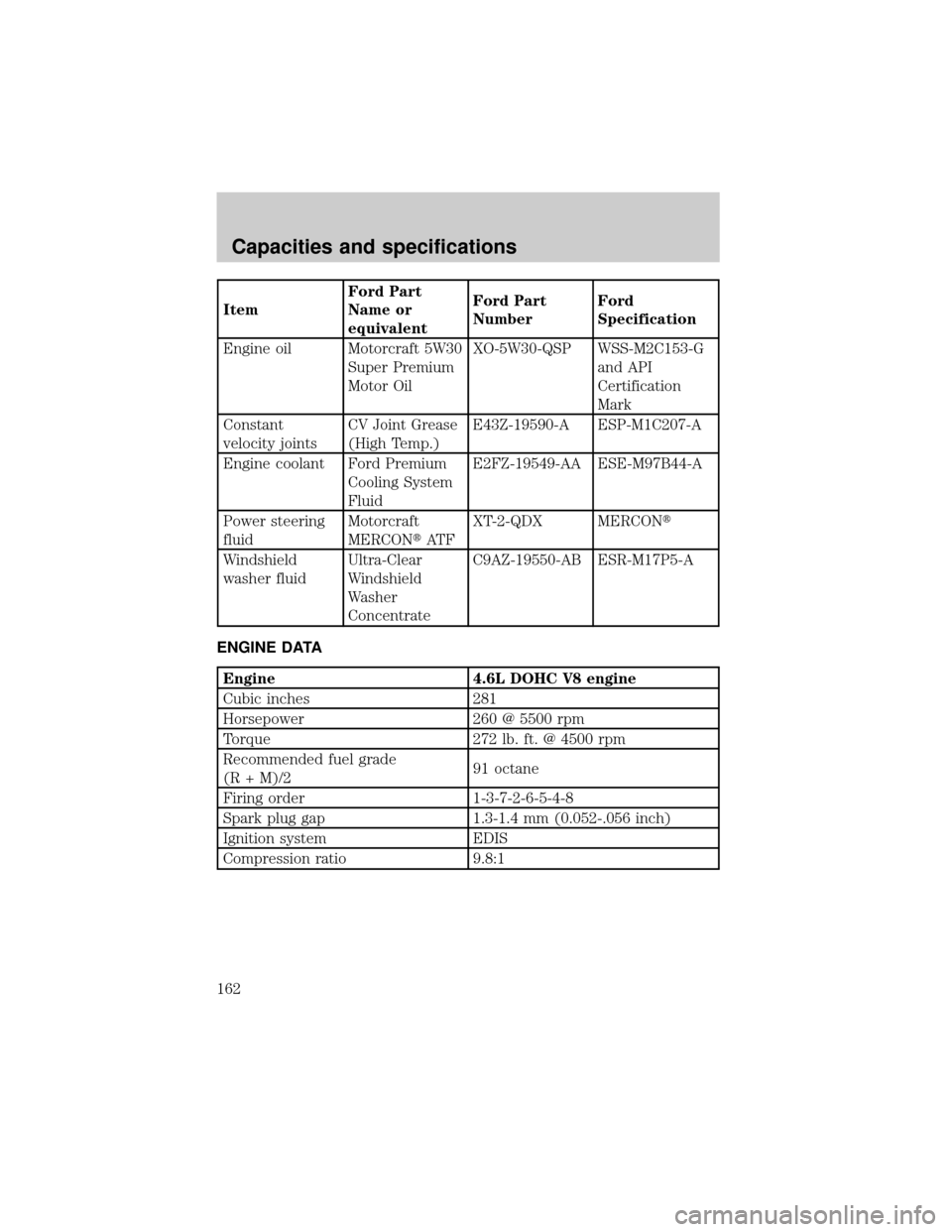
ItemFord Part
Name or
equivalentFord Part
NumberFord
Specification
Engine oil Motorcraft 5W30
Super Premium
Motor OilXO-5W30-QSP WSS-M2C153-G
and API
Certification
Mark
Constant
velocity jointsCV Joint Grease
(High Temp.)E43Z-19590-A ESP-M1C207-A
Engine coolant Ford Premium
Cooling System
FluidE2FZ-19549-AA ESE-M97B44-A
Power steering
fluidMotorcraft
MERCONtAT FXT-2-QDX MERCONt
Windshield
washer fluidUltra-Clear
Windshield
Washer
ConcentrateC9AZ-19550-AB ESR-M17P5-A
ENGINE DATA
Engine 4.6L DOHC V8 engine
Cubic inches 281
Horsepower 260 @ 5500 rpm
Torque 272 lb. ft. @ 4500 rpm
Recommended fuel grade
(R + M)/291 octane
Firing order 1-3-7-2-6-5-4-8
Spark plug gap 1.3-1.4 mm (0.052-.056 inch)
Ignition system EDIS
Compression ratio 9.8:1
Capacities and specifications
162
Page 167 of 176

Air bag supplemental restraint
system ..........................................80
and child safety seats ..............81
description ................................80
disposal ......................................83
indicator light ...........................82
passenger air bag .....................81
Air suspension
description ................................98
Anti-lock brake system
(ABS)#$description
Anti-theft system ........................63
Battery .......................................136
Brakes ..........................................95
anti-lock .....................................95
anti-lock brake system (ABS)
warning light .............................95
fluid, checking and adding ....130
traction control .........................97
Brake-shift interlock ...................99
Break-in period .............................2
Bulbs, replacing ........................150
headlamps ...............................150
specifications ..........................154
Changing a tire .........................119
Child safety seats ........................84
Childproof locks ..........................61
Chime
headlamps on ..............................9
Cleaning your vehicle ...............155
engine compartment ..............156
instrument panel ....................157
plastic parts ............................157
safety belts ..............................157
tail lamps .................................157
washing ....................................155
waxing .....................................155
wheels ......................................156
windows ..................................159
woodtone trim ........................158Climate control system
automatic temperature
control ..............27,28,29,30,31,32
Clock ............................................33
Compass, electronic ....................55
calibration .................................57
set zone adjustment .................56
Controls .......................................62
Electronic sound system ............62
Emission control system ..........149
Engine ........................................162
service points ..........................127
Engine block heater ...................93
Engine coolant
checking and adding .......131,132
disposal ....................................133
refill capacities ........................133
Engine oil ...........................128,129
changing oil and oil filter .......130
checking and adding .......128,129
Exhaust fumes ............................93
Floor mats ...................................63
Fuel
calculating fuel economy .......148
improving fuel economy ........108
octane rating ...........................147
quality ......................................147
running out of fuel .................148
safety information relating to
automotive fuels .....................146
Fuel gauge ...................................10
Fuel pump shut-off switch .......109
Fuse panels
instrument panel ....................110
power distribution box ...........117
Fuses ...................................109,110
Gauges, Mechanical ....................10
engine coolant temperature
gauge .........................................11
Headlamps
autolamp system .......................27
flashing ......................................26
Index
167