wheel LINCOLN CONTINENTAL 1998 Owner's Manual
[x] Cancel search | Manufacturer: LINCOLN, Model Year: 1998, Model line: CONTINENTAL, Model: LINCOLN CONTINENTAL 1998Pages: 176, PDF Size: 1.32 MB
Page 126 of 176

SERVICE RECOMMENDATIONS
To help you service your vehicle:
²We highlight do-it-yourself items in the engine compartment for easy
location.
²We provide a ªService Guideº which makes tracking routine service
easy.
If your vehicle requires professional service, your dealership can provide
necessary parts and service. Check your ªWarranty Guideº to find out
which parts and services are covered.
Use only recommended fuels, lubricants, fluids and service parts
conforming to specifications. Motorcraft parts are designed and built to
provide the best performance in your vehicle.
PRECAUTIONS WHEN SERVICING YOUR VEHICLE
Be especially careful when inspecting or servicing your vehicle.
²Do not work on a hot engine.
²When the engine is running, avoid wearing loose clothing, jewelry or
long hair that could get caught up in moving parts.
²Do not work on a vehicle with the engine running in an enclosed
space, unless you are sure you have enough ventilation.
²Keep all lit cigarettes, open flames and other lit material away from
the battery and all fuel related parts.
If you disconnect the battery, the engine must ªrelearnº its idle
conditions before your vehicle will drive properly, as explained in
theBatterysection in this chapter.
Working with the engine off
1. Set the parking brake, and ensure the gearshift is securely latched in
park.
2. Turn off the engine and remove the key.
3. Block the wheels to prevent the vehicle from moving unexpectedly.
Working with the engine on
1. Set the parking brake and
ensure the gearshift is securely latched in P (Park).
2. Block the wheels to prevent the vehicle from moving unexpectedly.
Maintenance and care
126
Page 134 of 176
coolant concentration above 60%. Leave a 50/50 mixture of engine
coolant and water in your vehicle year-round in non-extreme climates.
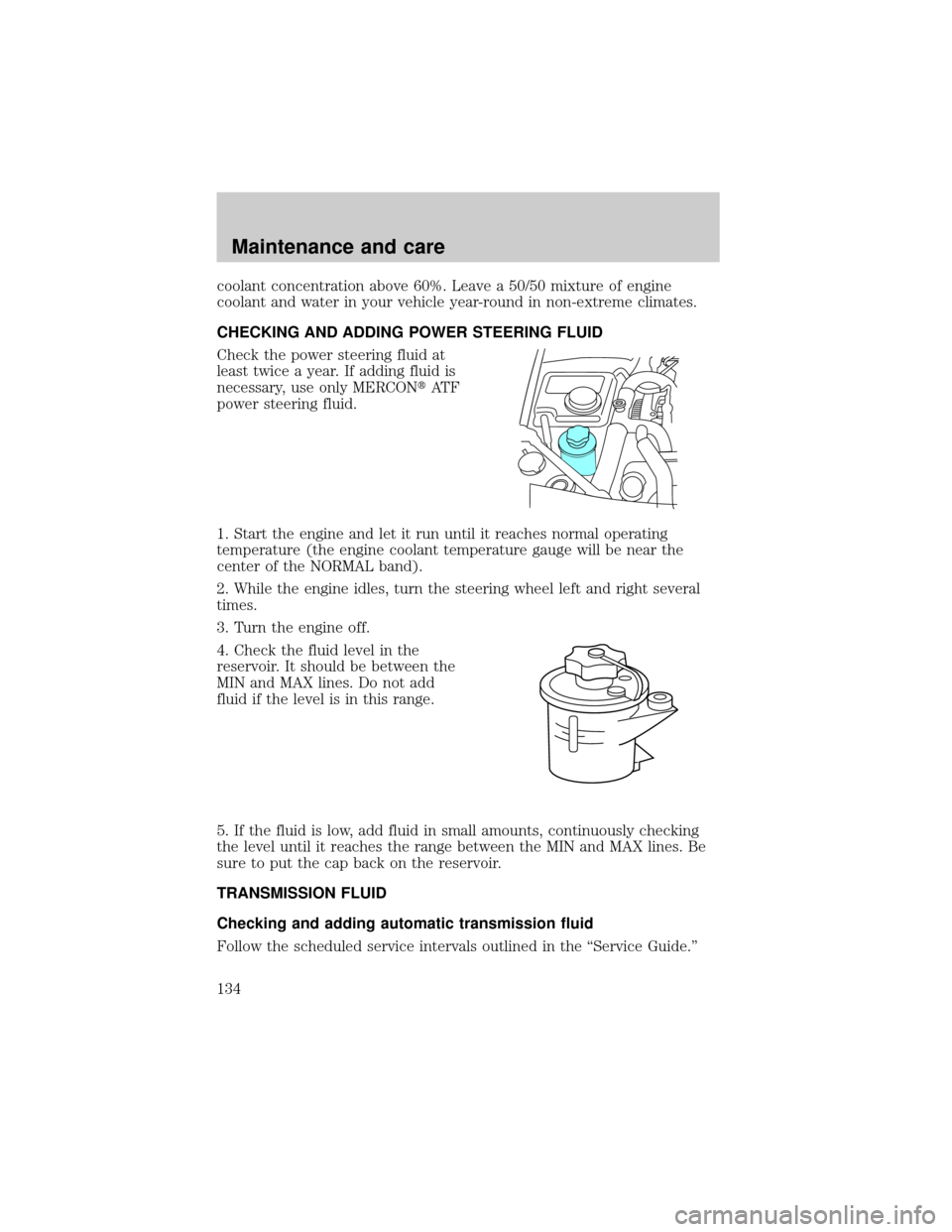
CHECKING AND ADDING POWER STEERING FLUID
Check the power steering fluid at
least twice a year. If adding fluid is
necessary, use only MERCONtAT F
power steering fluid.
1. Start the engine and let it run until it reaches normal operating
temperature (the engine coolant temperature gauge will be near the
center of the NORMAL band).
2. While the engine idles, turn the steering wheel left and right several
times.
3. Turn the engine off.
4. Check the fluid level in the
reservoir. It should be between the
MIN and MAX lines. Do not add
fluid if the level is in this range.
5. If the fluid is low, add fluid in small amounts, continuously checking
the level until it reaches the range between the MIN and MAX lines. Be
sure to put the cap back on the reservoir.
TRANSMISSION FLUID
Checking and adding automatic transmission fluid
Follow the scheduled service intervals outlined in the ªService Guide.º
Maintenance and care
134
Page 142 of 176

your SecuriTire requires service as soon as possible. Refer toServicing
your SecuriTires.
The Pressure Alert System will activate only when the vehicle is moving
faster than 15 km/h (10 mph).
Servicing your SecuriTires
If you cannot service your SecuriTire immediately, replace it with your
temporary spare as soon as safely possible.
Your temporary spare tire can be used until your SecuriTire has been
repaired.
It is recommended that you always have your SecuriTires serviced by an
authorized Michelin tire dealer.Each SecuriTire is equipped with a
pressure sensor around the wheel rim. This sensor could be
damaged when removing and installing the tire.Servicing a
SecuriTire at locations other than your Michelin tire dealer may
adversely affect your warranty.
If you have questions concerning your SecuriTires or servicing, pleas call
the Michelin Tire Information Line at 1-800-847-3435 or contact your
local Michelin tire dealer.
INFORMATION ABOUT TIRE QUALITY GRADES
New vehicles are fitted with tires
that have their Tire Quality Grade
(described below) molded into the
tire's sidewall. These Tire Quality
Grades are determined by standards
that the United States Department
of Transportation has set.
Tire Quality Grades apply to new
pneumatic tires for use on
passenger cars. They do not apply
to deep tread, winter-type snow
tires, space-saver or temporary use spare tires, tires with nominal rim
diameters of 10 to 12 inches or limited production tires as defined in
Title 49 Code of Federal Regulations Part 575.104(c)(2).
U.S. Department of Transportation-Tire quality grades:The U.S.
Department of Transportation requires Ford to give you the following
information about tire grades exactly as the government has written it.
Maintenance and care
142
Page 143 of 176
Treadwear
The treadwear grade is a comparative rating based on the wear rate of
the tire when tested under controlled conditions on a specified
government test course. For example, a tire grade 150 would wear one
and one-half (1 1/2) times as well on the government course as a tire
grade 100. The relative performance of tires depends upon the actual
conditions of their use, however, and may depart significantly from the
norm due to variations in driving habits, service practices, and
differences in road characteristics and climate.
Traction A B C
The traction grades, from highest to lowest are A, B, and C, and they
represent the tire's ability to stop on wet pavement as measured under
test surfaces of asphalt and concrete. A tire marked C may have poor
traction performance.
The traction grade assigned to this tire is based on braking
(straight ahead) traction tests and does not include cornering
(turning) traction.
Temperature A B C
The temperature grades are A (the highest), B, and C, representing the
tire's resistance to the generation of heat and its ability to dissipate heat
when tested under controlled conditions on a specified indoor laboratory
test wheel. Sustained high temperature can cause the material of the tire
to degenerate and reduce tire life, and excessive temperature can lead to
sudden tire failure. The grade C corresponds to a level of performance
which all passenger car tires must meet under the Federal Motor Vehicle
Safety Standard No. 109. Grades B and A represent higher levels of
performance on the laboratory test wheel than the minimum required by
law.
The temperature grade for this tire is established for a tire that
is properly inflated and not overloaded. Excessive speed,
underinflation, or excessive loading, either separately or in
combination, can cause heat buildup and possible tire failure.
Maintenance and care
143
Page 156 of 176
Repairing paint chips
Minor scratches or paint damage from road debris may be repaired with
touch-up paint, repair foil or aerosol paint spray from the Ford accessory
line. Observe the application instructions on the products.
Remove particles such as bird droppings, tree sap, insect remains, tar
spots, road salt and industrial fallout immediately.
Cleaning the wheels
Wash with the same detergent as the body of your vehicle. Do not use
acid-based wheel cleaners, steel wool, fuel or strong detergents. Never
use abrasives that will damage the finish of special wheel surfaces. Use a
tar remover to remove grease and tar.
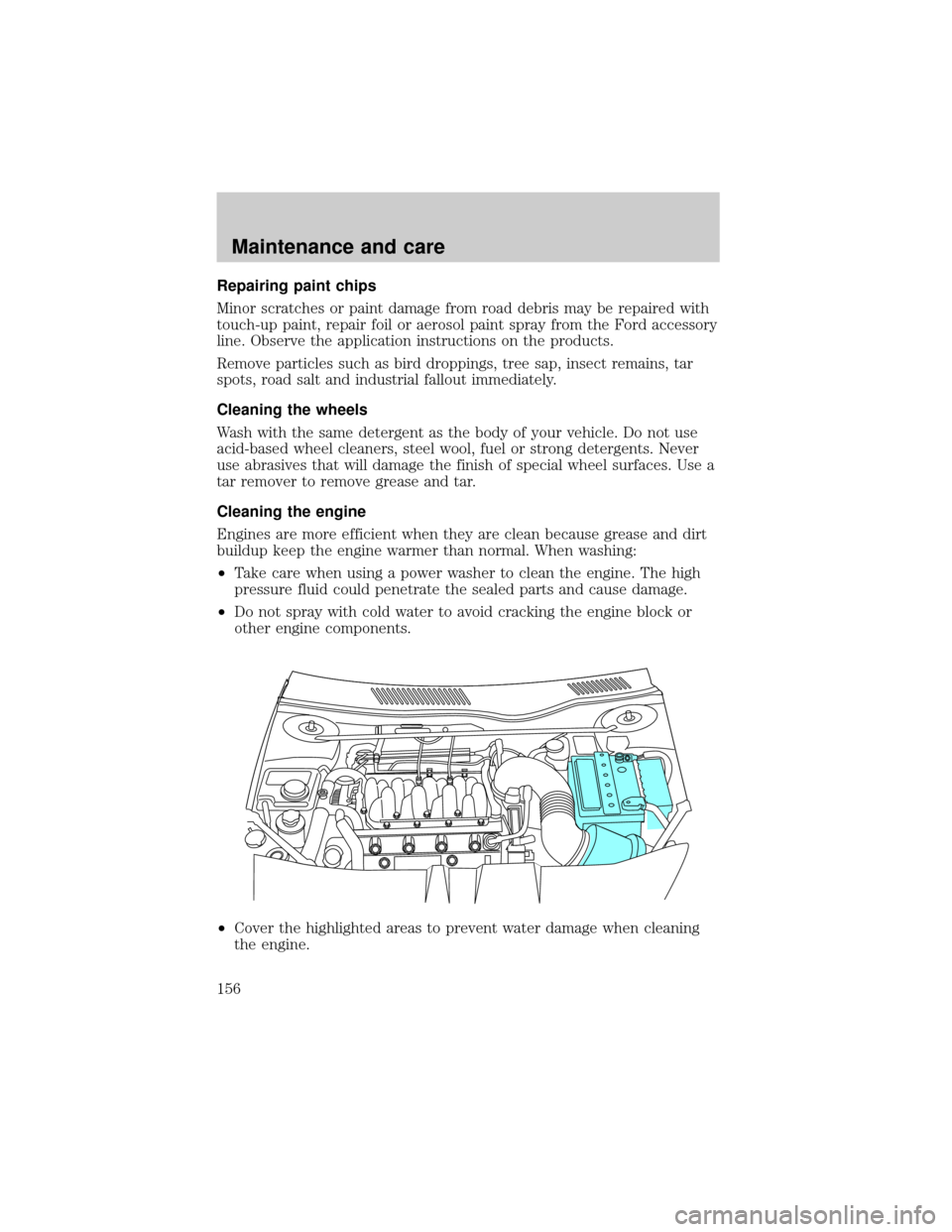
Cleaning the engine
Engines are more efficient when they are clean because grease and dirt
buildup keep the engine warmer than normal. When washing:
²Take care when using a power washer to clean the engine. The high
pressure fluid could penetrate the sealed parts and cause damage.
²Do not spray with cold water to avoid cracking the engine block or
other engine components.
²Cover the highlighted areas to prevent water damage when cleaning
the engine.
Maintenance and care
156
Page 163 of 176

VEHICLE DIMENSIONS
Vehicle dimensions mm (in)
(1) Overall length 5 294.7 (208.4)
(2) Overall width 1 870.3 (76.3)
(3) Overall height 1 421.9 (55.9)
(4) Wheelbase 2 769.8 (109.0)
(5) Track - Front 1 600.2 (63.0)
(5) Track - Rear 1 562.1 (61.5)
1
4
Capacities and specifications
163
Page 167 of 176

Air bag supplemental restraint
system ..........................................80
and child safety seats ..............81
description ................................80
disposal ......................................83
indicator light ...........................82
passenger air bag .....................81
Air suspension
description ................................98
Anti-lock brake system
(ABS)#$description
Anti-theft system ........................63
Battery .......................................136
Brakes ..........................................95
anti-lock .....................................95
anti-lock brake system (ABS)
warning light .............................95
fluid, checking and adding ....130
traction control .........................97
Brake-shift interlock ...................99
Break-in period .............................2
Bulbs, replacing ........................150
headlamps ...............................150
specifications ..........................154
Changing a tire .........................119
Child safety seats ........................84
Childproof locks ..........................61
Chime
headlamps on ..............................9
Cleaning your vehicle ...............155
engine compartment ..............156
instrument panel ....................157
plastic parts ............................157
safety belts ..............................157
tail lamps .................................157
washing ....................................155
waxing .....................................155
wheels ......................................156
windows ..................................159
woodtone trim ........................158Climate control system
automatic temperature
control ..............27,28,29,30,31,32
Clock ............................................33
Compass, electronic ....................55
calibration .................................57
set zone adjustment .................56
Controls .......................................62
Electronic sound system ............62
Emission control system ..........149
Engine ........................................162
service points ..........................127
Engine block heater ...................93
Engine coolant
checking and adding .......131,132
disposal ....................................133
refill capacities ........................133
Engine oil ...........................128,129
changing oil and oil filter .......130
checking and adding .......128,129
Exhaust fumes ............................93
Floor mats ...................................63
Fuel
calculating fuel economy .......148
improving fuel economy ........108
octane rating ...........................147
quality ......................................147
running out of fuel .................148
safety information relating to
automotive fuels .....................146
Fuel gauge ...................................10
Fuel pump shut-off switch .......109
Fuse panels
instrument panel ....................110
power distribution box ...........117
Fuses ...................................109,110
Gauges, Mechanical ....................10
engine coolant temperature
gauge .........................................11
Headlamps
autolamp system .......................27
flashing ......................................26
Index
167
Page 169 of 176

Speed control ..............................36
canceling a set speed ...............39
resuming a set speed ...............39
tap up/tap down .......................38
turning off .................................37
Speedometer ...............................10
Starting your vehicle .............90,92
Sunvisor .......................................52
Tachometer
mechanical cluster ...................11
Tilt steering wheel ......................40
Tires ....................................142,144
changing ..................................119
checking the pressure ............144
replacing ..................................145
rotating ....................................144
snow tires and chains ............145
treadwear ................................143
Traction control
off light ........................................9
Trailer towing ............................105
tips ...........................................107
Transaxle .....................................99
automatic operation .......100,101,
102,103
Transmission .............................134
fluid, checking and adding
(automatic) .............................134
Trunk
using the remote entry
system to open .........................66
Turn signal
lever ...........................................35
Universal transmitter ..................52
erasing channels .......................55
operating ...................................54
programming .............................53
Vehicle dimensions ...................163
Vehicle headlamp aiming
device (VHAD) .........................152
Vehicle Identification Number
(VIN) ..........................................165Vehicle loading ..........................104
Ventilating your vehicle .............94
Warning chimes .............................6
Wheels
anti-theft lug nuts ..................121
Windows
accessory delay .........................60
power windows, operating .......59
Windshield washer fluid and
wipers
checking and adding fluid .....131
checking and replacing wiper
blades ......................................139
operation ...................................34
Wrecker towing .........................124
Index
169