check engine LINCOLN CONTINENTAL 2001 Owner's Manual
[x] Cancel search | Manufacturer: LINCOLN, Model Year: 2001, Model line: CONTINENTAL, Model: LINCOLN CONTINENTAL 2001Pages: 224, PDF Size: 1.82 MB
Page 162 of 224
Vehicles driven year-round in non-extreme climates should use a 50/50
mixture of engine coolant and distilled water for optimum cooling system
and engine protection.
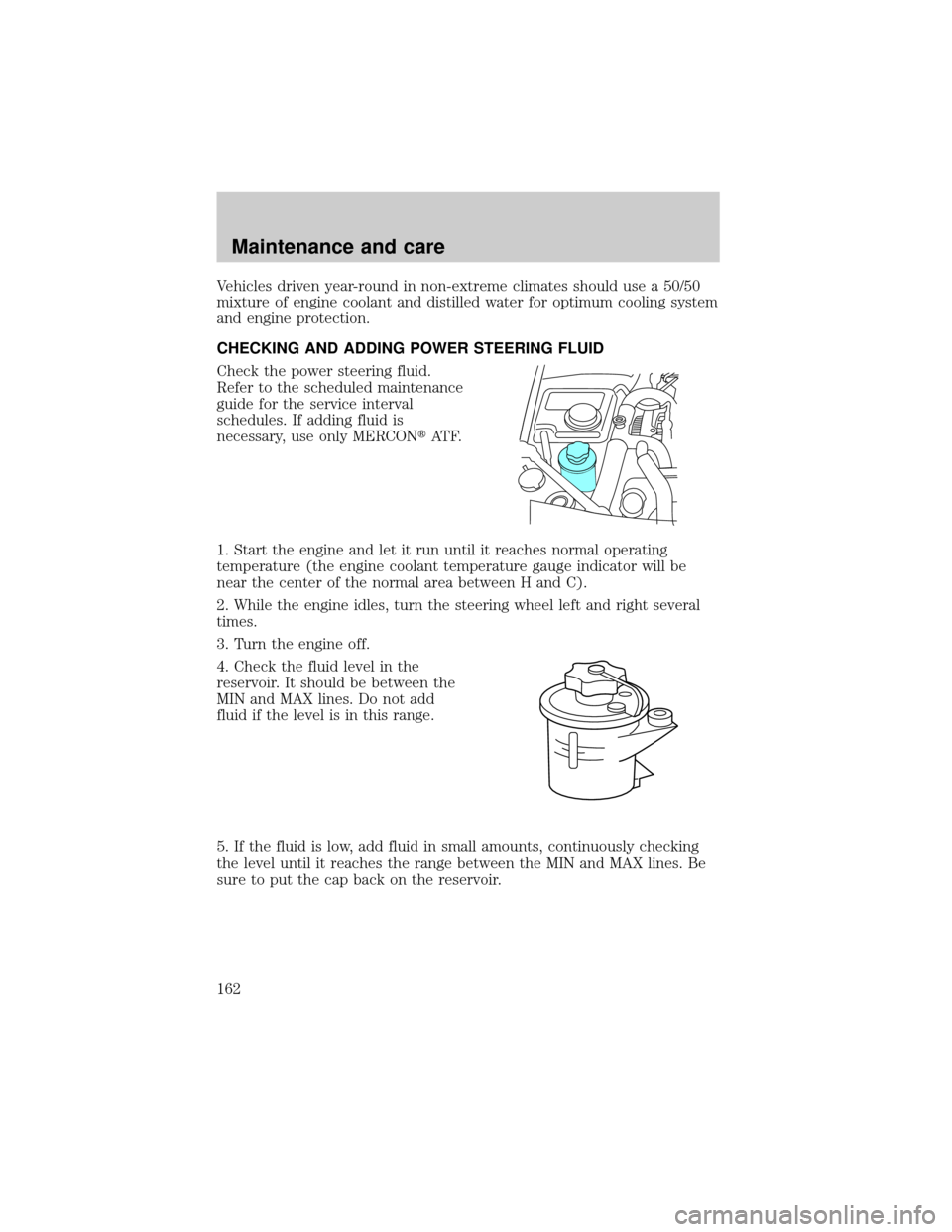
CHECKING AND ADDING POWER STEERING FLUID
Check the power steering fluid.
Refer to the scheduled maintenance
guide for the service interval
schedules. If adding fluid is
necessary, use only MERCONtAT F.
1. Start the engine and let it run until it reaches normal operating
temperature (the engine coolant temperature gauge indicator will be
near the center of the normal area between H and C).
2. While the engine idles, turn the steering wheel left and right several
times.
3. Turn the engine off.
4. Check the fluid level in the
reservoir. It should be between the
MIN and MAX lines. Do not add
fluid if the level is in this range.
5. If the fluid is low, add fluid in small amounts, continuously checking
the level until it reaches the range between the MIN and MAX lines. Be
sure to put the cap back on the reservoir.
Maintenance and care
162
Page 163 of 224
TRANSMISSION FLUID
Checking automatic transmission fluid
Refer to your scheduled maintenance guide for scheduled intervals for
fluid checks and changes. Your transaxle does not consume fluid.
However, the fluid level should be checked if the transaxle is not working
properly, i.e., if the transaxle slips or shifts slowly or if you notice some
sign of fluid leakage.
Automatic transmission fluid expands when warmed. To obtain an
accurate fluid check, drive the vehicle until it is warmed up
(approximately 30 km [20 miles]). If your vehicle has been
operated for an extended period at high speeds, in city traffic
during hot weather or pulling a trailer, the vehicle should be
turned off for about 30 minutes to allow fluid to cool before
checking.
1. Drive the vehicle 30 km (20 miles) or until it reaches normal operating
temperature.
2. Park the vehicle on a level surface and engage the parking brake.
3. With the parking brake engaged and your foot on the brake pedal,
start the engine and move the gearshift lever through all of the gear
ranges. Allow sufficient time for each gear to engage.
4. Latch the gearshift lever in P (Park) and leave the engine running.
5. Remove the dipstick, wiping it clean with a clean, dry lint free rag. If
necessary, refer toIdentifying components in the engine compartment
in this chapter for the location of the dipstick.
6. Install the dipstick making sure it is fully seated in the filler tube.
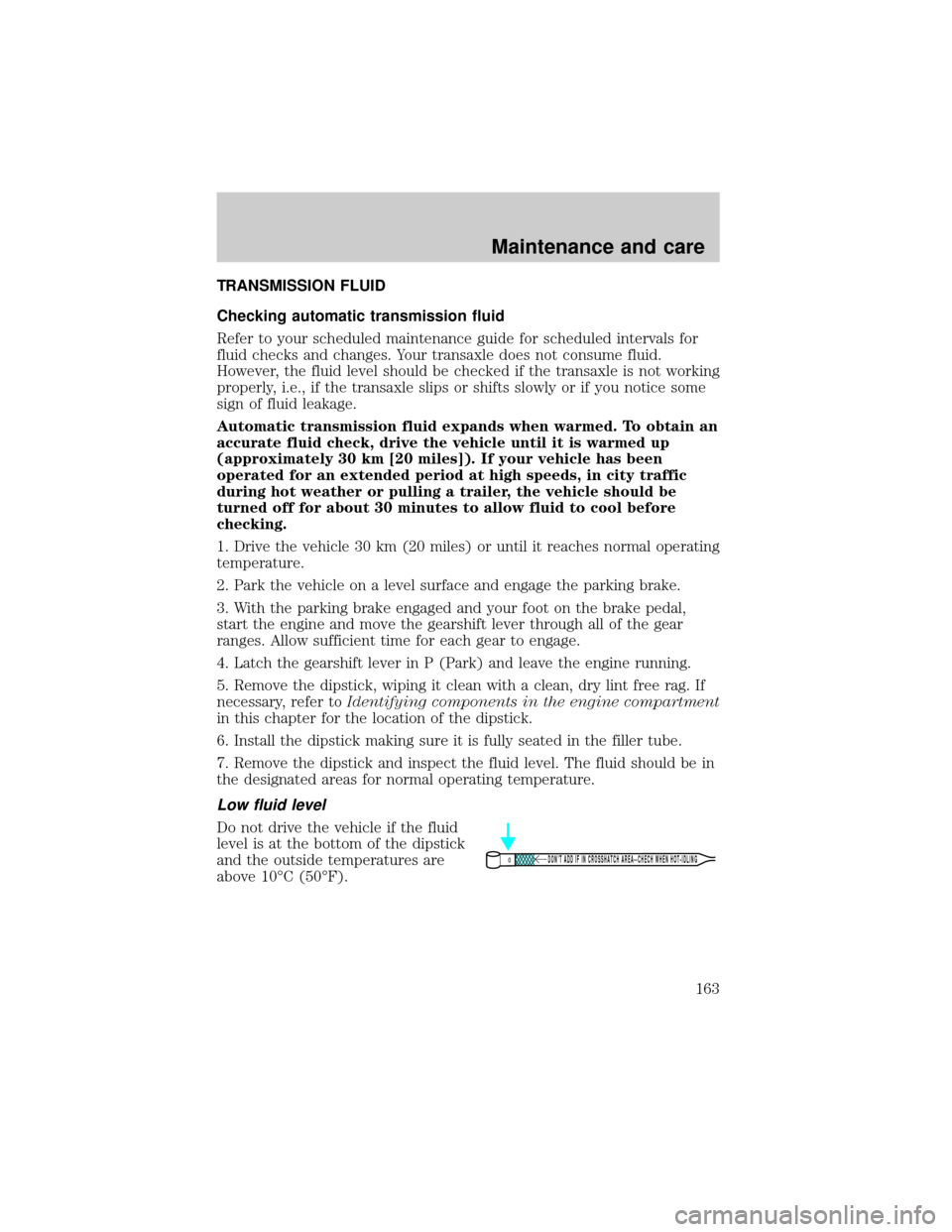
7. Remove the dipstick and inspect the fluid level. The fluid should be in
the designated areas for normal operating temperature.
Low fluid level
Do not drive the vehicle if the fluid
level is at the bottom of the dipstick
and the outside temperatures are
above 10ÉC (50ÉF).
DON’T ADD IF IN CROSSHATCH AREA--CHECH WHEN HOT-IDLING
Maintenance and care
163
Page 178 of 224
The flow of fuel through a fuel pump nozzle can produce static
electricity, which can cause a fire if fuel is pumped into an
ungrounded fuel container.
Use the following guidelines to avoid static build-up when filling an
ungrounded fuel container:
²Place approved fuel container on the ground.
²DO NOT fill a fuel container while it is in the vehicle.
²Keep the fuel pump nozzle in contact with the fuel container while
filling.
²DO NOT use a device that would hold the fuel pump handle in the fill
position.
Fuel Filler Cap
Your fuel tank filler cap has an indexed design with a 1/8 turn on/off
feature.
When fueling your vehicle:
1. Turn the engine off.
2. Carefully turn the filler cap counterclockwise 1/8 of a turn until it
stops.
3. Pull to remove the cap from the fuel filler pipe.
4. To install the cap, align the tabs on the cap with the notches on the
filler pipe.
5. Turn the filler cap clockwise 1/8 of a turn until it stops.
The ªCheck Fuel Capº (if equipped) light illuminates when the ignition is
turned to the ON position. It will also illuminate when the fuel filler cap
is not properly installed. Proper fuel filler cap installation is checked
automatically as the vehicle is driven, but not until after some fuel is
used (fuel guage drops below full). Once the fuel filler cap is properly
secured, the ªCheck Fuel Capº light will turn off after a short period of
driving. Refer toFuel Filler Capin theMaintenance and Carechapter.
If you must replace the fuel filler cap, replace it with a fuel filler
cap that is designed for your vehicle. The customer warranty may
be void for any damage to the fuel tank or fuel system if the
correct genuine Ford or Motorcraft fuel filler cap is not used.
Maintenance and care
178
Page 183 of 224
![LINCOLN CONTINENTAL 2001 Owners Manual ²Sudden or hard accelerations may reduce fuel economy.
²Slow down gradually.
²Driving at reasonable speeds (traveling at 88 km/h [55 mph] uses 15%
less fuel than traveling at 105 km/h [65 mph]).
²](/img/15/6879/w960_6879-182.png "LINCOLN CONTINENTAL 2001 Owners Manual ²Sudden or hard accelerations may reduce fuel economy.
²Slow down gradually.
²Driving at reasonable speeds (traveling at 88 km/h [55 mph] uses 15%
less fuel than traveling at 105 km/h [65 mph]).
²")
²Sudden or hard accelerations may reduce fuel economy.
²Slow down gradually.
²Driving at reasonable speeds (traveling at 88 km/h [55 mph] uses 15%
less fuel than traveling at 105 km/h [65 mph]).
²Revving the engine before turning it off may reduce fuel economy.
²Using the air conditioner or defroster may reduce fuel economy.
²You may want to turn off the speed control in hilly terrain if
unnecessary shifting between third and fourth gear occurs.
Unnecessary shifting of this type could result in reduced fuel
economy.
²Warming up a vehicle on cold mornings is not required and may
reduce fuel economy.
²Resting your foot on the brake pedal while driving may reduce fuel
economy.
²Combine errands and minimize stop-and-go driving.
Maintenance
²Keep tires properly inflated and use only recommended size.
²Operating a vehicle with the wheels out of alignment will reduce fuel
economy.
²Use recommended engine oil. Refer toLubricant Specifications.
²Perform all regularly scheduled maintenance items. Follow the
recommended maintenance schedule and owner maintenance checks
found in your vehicle scheduled maintenance guide.
Conditions
²Heavily loading a vehicle or towing a trailer may reduce fuel economy
at any speed.
²Carrying unnecessary weight may reduce fuel economy (approximately
0.4 km/L [1 mpg] is lost for every 180 kg [400 lb] of weight carried).
²Adding certain accessories to your vehicle (for example bug
deflectors, rollbars/light bars, running boards, ski/luggage racks) may
reduce fuel economy.
²Using fuel blended with alcohol may lower fuel economy.
²Fuel economy may decrease with lower temperatures during the first
12±16 km (8±10 miles) of driving.
Maintenance and care
183
Page 185 of 224
Do not park, idle, or drive your vehicle in dry grass or other dry
ground cover. The emission system heats up the engine
compartment and exhaust system, which can start a fire.
Illumination of the ªService Engine Soonº light, charging system warning
light or the temperature warning light, fluid leaks, strange odors, smoke
or loss of engine power, could indicate that the emission control system
is not working properly.
Exhaust leaks may result in entry of harmful and potentially
lethal fumes into the passenger compartment.
Do not make any unauthorized changes to your vehicle or engine. By
law, vehicle owners and anyone who manufactures, repairs, services,
sells, leases, trades vehicles, or supervises a fleet of vehicles are not
permitted to intentionally remove an emission control device or prevent
it from working. Information about your vehicle's emission system is on
the Vehicle Emission Control Information Decal located on or near the
engine. This decal identifies engine displacement and gives some tune up
specifications.
Please consult your ªWarranty Guideº for complete emission warranty
information.
Readiness for Inspection/Maintenance (I/M) testing
In some localities, it may be a legal requirement to pass an I/M test of
the on-board diagnostics system. If your ªCheck Engine/Service Engine
Soonº light is on, refer to the description in theWarning Lights and
Chimessection of theInstrumentationchapter. Your vehicle may not
pass the I/M test with the ªCheck Engine/Service Engine Soonº light on.
If the vehicle's powertrain system or its battery has just been serviced,
the on-board diagnostics system is reset to a ªnot ready for I/M testº
condition. To ready the on-board diagnostics system for I/M testing, a
minimum of 30 minutes of city and highway driving is necessary as
described below:
²First, at least 10 minutes of driving on an expressway or highway.
²Next, at least 20 minutes driving in stop-and-go, city-type traffic with
at least four idle periods.
Allow the vehicle to sit for at least eight hours without starting the
engine. Then, start the engine and complete the above driving cycle. The
Maintenance and care
185
Page 186 of 224
engine must warm up to its normal operating temperature. Once started,
do not turn off the engine until the above driving cycle is complete.
REPLACING EXTERIOR BULBS
Check the operation of the following lamps frequently:
²Headlamps
²Tail lamps
²Brakelamps
²High-mount brakelamp
²Turn signals
²Backup lamps
²License plate lamp
Do not remove lamp bulbs unless they will be replaced immediately. If a
bulb is removed for an extended period of time, contaminants may enter
the lamp housings and affect performance.
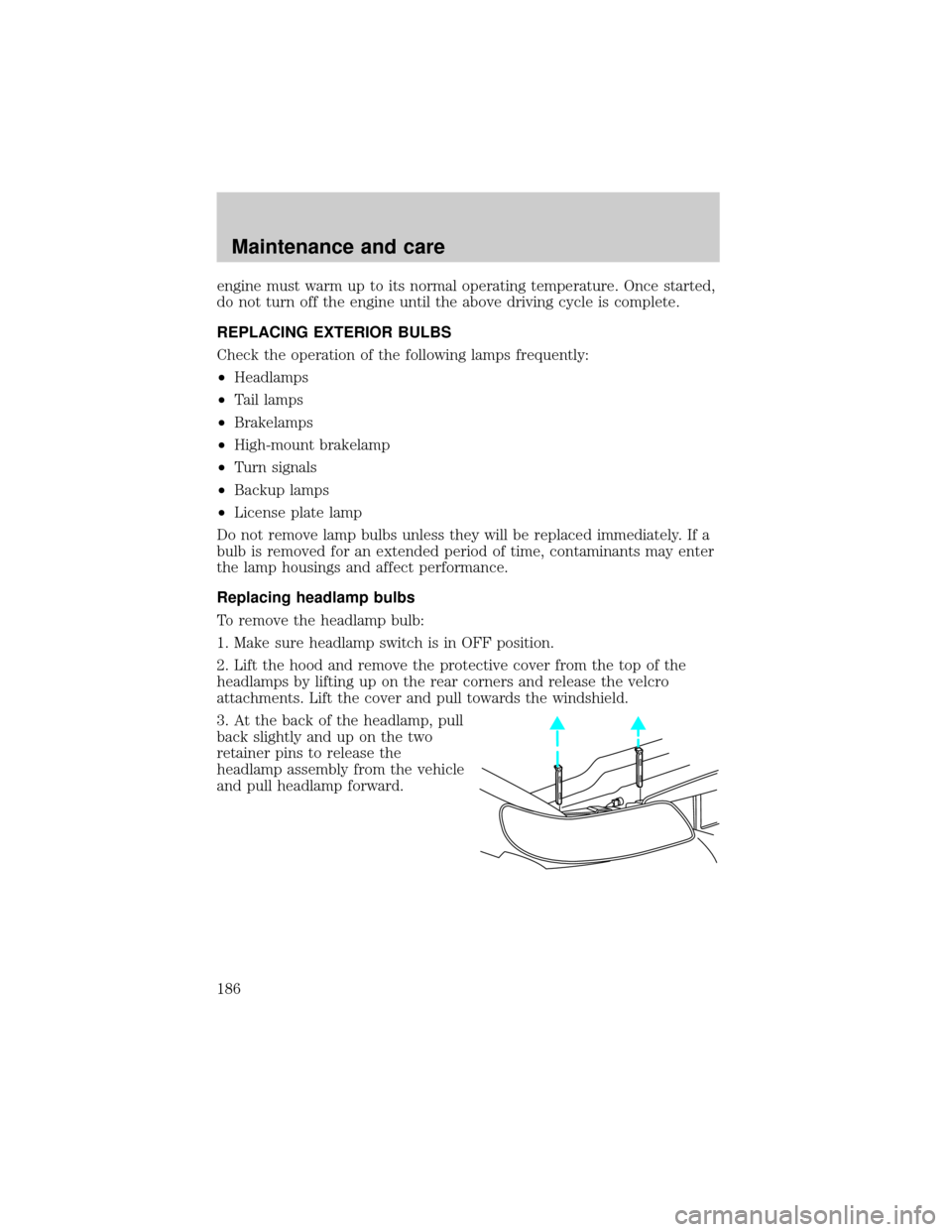
Replacing headlamp bulbs
To remove the headlamp bulb:
1. Make sure headlamp switch is in OFF position.
2. Lift the hood and remove the protective cover from the top of the
headlamps by lifting up on the rear corners and release the velcro
attachments. Lift the cover and pull towards the windshield.
3. At the back of the headlamp, pull
back slightly and up on the two
retainer pins to release the
headlamp assembly from the vehicle
and pull headlamp forward.
Maintenance and care
186
Page 215 of 224

²Mobile communications systems may harm the operation of your
vehicle, particularly if they are not properly designed for automotive
use or are not properly installed. When operated, such systems may
cause the engine to stumble or stall or cause the transmission to be
damaged or operate improperly. In addition, such systems may be
damaged or their performance may be affected by operating your
vehicle. (Citizens band [CB] transceivers, garage door openers and
other transmitters with outputs of five watts or less will not ordinarily
affect your vehicle's operation.)
²Ford cannot assume responsibility for any adverse effects or damage
that may result from the use of such equipment.
ORDERING ADDITIONAL OWNER'S LITERATURE
To order the publications in this portfolio:
Make checks payable to:
HELM, INCORPORATED
P.O. Box 07150
Detroit, Michigan 48207
For a free publication catalog, order toll free: 1-800-782-4356
Monday-Friday 8:00 a.m. - 6:00 p.m. EST,
for credit card holders only
Obtaining a French owner's guide
French Owner's Guides can be obtained from your dealer or by writing to
Ford Motor Company of Canada, Limited, Service Publications, P.O. Box
1580, Station B, Mississauga, Ontario L4Y 4G3.
Customer assistance
215
Page 218 of 224

A
Accessory delay ..........................66
Air bag supplemental
restraint system ..................97, 101
and child safety seats ..............99
description ........................97, 101
disposal ....................................104
driver air bag ....................99, 102
indicator light .............9, 101, 103
operation ...........................99, 102
passenger air bag .............99, 102
side air bag ..............................101
Air cleaner filter .......................200
Air conditioning ..........................27
automatic temperature
control system ..........................27
Air filter, cabin ..........................167
Air suspension ...........................120
description ..............................120
Antifreeze
(see Engine coolant) ................157
Anti-lock brake system
(see Brakes) ......................116±117
Anti-theft system ........................69
arming the system ....................70
disarming a triggered system ..71
Audio system (see Radio) .........34
Automatic transaxle .................121
driving with .............................123
fluid, adding ............................163
fluid, checking ........................163
fluid, refill capacities ..............200
fluid, specification ..................202
Axle
lubricant specifications ..........201B
Battery .......................................165
acid, treating emergencies .....165
charging system
warning light .............................11
jumping a disabled battery ....144
maintenance-free ....................165
replacement, specifications ...200
servicing ..................................165
Belt minder .................................93
Brakes ........................................116
anti-lock ...........................116±117
anti-lock brake system
(ABS) warning light .........10, 117
brake warning light ..................10
fluid, checking and adding ....156
fluid, refill capacities ..............200
fluid, specifications .........201±202
lubricant specifications ..201±202
shift interlock ..........................121
Break-in period .............................3
C
Capacities for refilling fluids ....200
CD changer .................................44
Certification Label ....................203
Child safety restraints ..............104
child safety belts ....................104
Child safety seats ......................105
attaching with tether straps ..109
in front seat ............................107
in rear seat ..............................107
Cleaning your vehicle ...............194
engine compartment ..............197
exterior ............................195±196
exterior lamps .........................196
instrument cluster lens ..........198
Index
218
Page 219 of 224

instrument panel ....................198
interior .....................................199
mirrors .....................................196
plastic parts ............................196
safety belts ..............................199
washing ....................................195
waxing .....................................195
wheels ......................................196
windows ..................................199
wiper blades ............................197
woodtone trim ........................198
Climate control (see Air
conditioning or Heating) ............27
Clock ............................................33
Compass, electronic ....................61
calibration .................................62
set zone adjustment .................61
Console ..................................68±69
Controls
power seat .................................84
steering column ........................51
Coolant
checking and adding ..............157
refill capacities ................161, 200
specifications ..................201±202
Cruise control
(see Speed control) ....................51
Customer Assistance ................132
Ford accessories
for your vehicle ......................212
Ford Extended
Service Plan ............................205
Getting assistance outside
the U.S. and Canada ..............211
Getting roadside assistance ...132
Getting the
service you need ....................205
Ordering additional
owner's literature ...................215The Dispute
Settlement Board ...................208
Utilizing the Mediation/
Arbitration Program ...............211
D
Daytime running lamps
(see Lamps) ................................25
Defrost
rear window ..............................33
Dipstick
automatic
transmission fluid ...................163
engine oil .................................153
Doors
lubricant specifications ..........201
Driving under special
conditions
through water .........................126
E
Electronic message center .........14
Emergencies, roadside
jump-starting ..........................144
Emission control system ..........184
Engine ........................................202
check engine/
service engine soon light ...........8
cleaning ...................................197
coolant .....................................157
idle speed control ...................165
lubrication
specifications ..................201±202
refill capacities ........................200
service points ..........................152
starting after a collision .........133
Engine block heater .................114
Index
219
Page 220 of 224

Engine oil ..................................153
change oil soon warning,
message center .......................153
checking and adding ..............153
dipstick ....................................153
filter, specifications ........155, 200
recommendations ...................155
refill capacities ........................200
specifications ..................201±202
Exhaust fumes ..........................115
F
Floor mats ...................................69
Fluid capacities .........................200
Fuel ............................................176
calculating
fuel economy ....................23, 181
cap ...........................................178
capacity ...................................200
choosing the right fuel ...........179
comparisons with EPA fuel
economy estimates .................184
detergent in fuel .....................180
filling your vehicle
with fuel ..................176, 178, 181
filter, specifications ........180, 200
fuel filler door override ............68
fuel filler door release ..............68
fuel pump shut-off switch .....133
gauge .........................................12
improving fuel economy ........181
octane rating ...................179, 202
quality ......................................179
running out of fuel .................180
safety information relating
to automotive fuels ................176
Fuses ..................................134±135G
Garage door opener ....................57
Gas cap (see Fuel cap) ............178
Gas mileage
(see Fuel economy) .................181
Gauges .........................................12
engine coolant
temperature gauge ...................13
fuel gauge ..................................12
odometer ...................................13
speedometer .............................13
tachometer ................................13
GAWR
(Gross Axle Weight Rating) .....126
definition .................................126
driving with a heavy load ......126
location ....................................126
GVWR (Gross
Vehicle Weight Rating) .............126
calculating ...............................126
definition .................................126
driving with a heavy load ......126
location ....................................126
H
Hazard flashers .........................133
Head restraints ...........................84
Headlamps ...................................25
aiming ..............................192±194
autolamp system .......................26
bulb specifications ..................191
daytime running lights .............25
flash to pass ..............................26
high beam ...........................10, 26
replacing bulbs .......................186
turning on and off ..............10, 25
warning chime ..........................12
Index
220