child restraint LINCOLN CONTINENTAL 2018 User Guide
[x] Cancel search | Manufacturer: LINCOLN, Model Year: 2018, Model line: CONTINENTAL, Model: LINCOLN CONTINENTAL 2018Pages: 615, PDF Size: 5.31 MB
Page 30 of 615
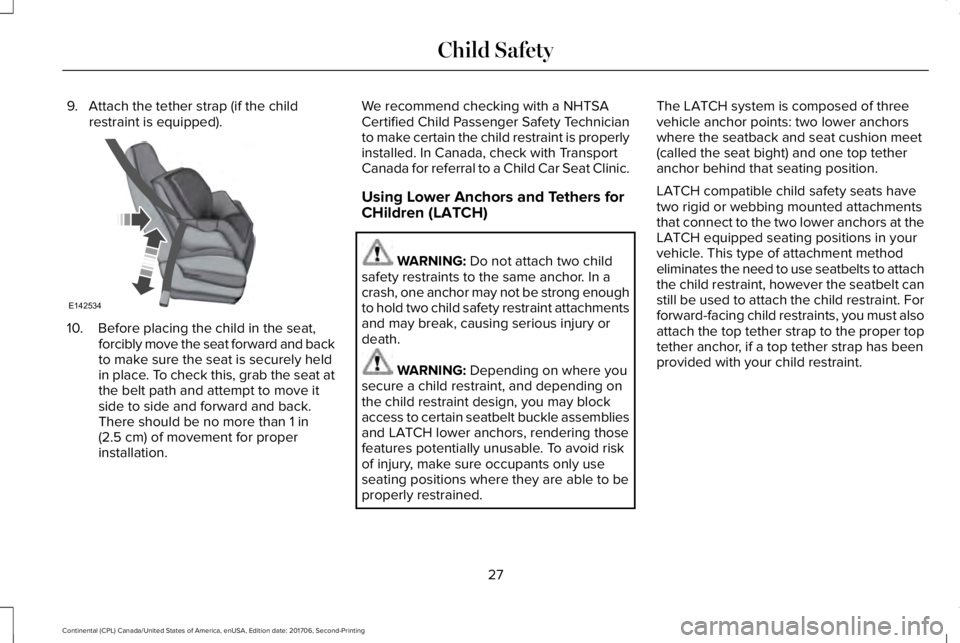
9. Attach the tether strap (if the childrestraint is equipped).
10. Before placing the child in the seat,forcibly move the seat forward and backto make sure the seat is securely heldin place. To check this, grab the seat atthe belt path and attempt to move itside to side and forward and back.There should be no more than 1 in(2.5 cm) of movement for properinstallation.
We recommend checking with a NHTSACertified Child Passenger Safety Technicianto make certain the child restraint is properlyinstalled. In Canada, check with TransportCanada for referral to a Child Car Seat Clinic.
Using Lower Anchors and Tethers for
CHildren (LATCH)
WARNING: Do not attach two childsafety restraints to the same anchor. In acrash, one anchor may not be strong enoughto hold two child safety restraint attachmentsand may break, causing serious injury ordeath.
WARNING: Depending on where yousecure a child restraint, and depending onthe child restraint design, you may blockaccess to certain seatbelt buckle assembliesand LATCH lower anchors, rendering thosefeatures potentially unusable. To avoid riskof injury, make sure occupants only useseating positions where they are able to beproperly restrained.
The LATCH system is composed of threevehicle anchor points: two lower anchorswhere the seatback and seat cushion meet(called the seat bight) and one top tetheranchor behind that seating position.
LATCH compatible child safety seats havetwo rigid or webbing mounted attachmentsthat connect to the two lower anchors at theLATCH equipped seating positions in yourvehicle. This type of attachment methodeliminates the need to use seatbelts to attachthe child restraint, however the seatbelt canstill be used to attach the child restraint. Forforward-facing child restraints, you must alsoattach the top tether strap to the proper toptether anchor, if a top tether strap has beenprovided with your child restraint.
27
Continental (CPL) Canada/United States of America, enUSA, Edition date: 201706, Second-Printing
Child SafetyE142534
Page 31 of 615
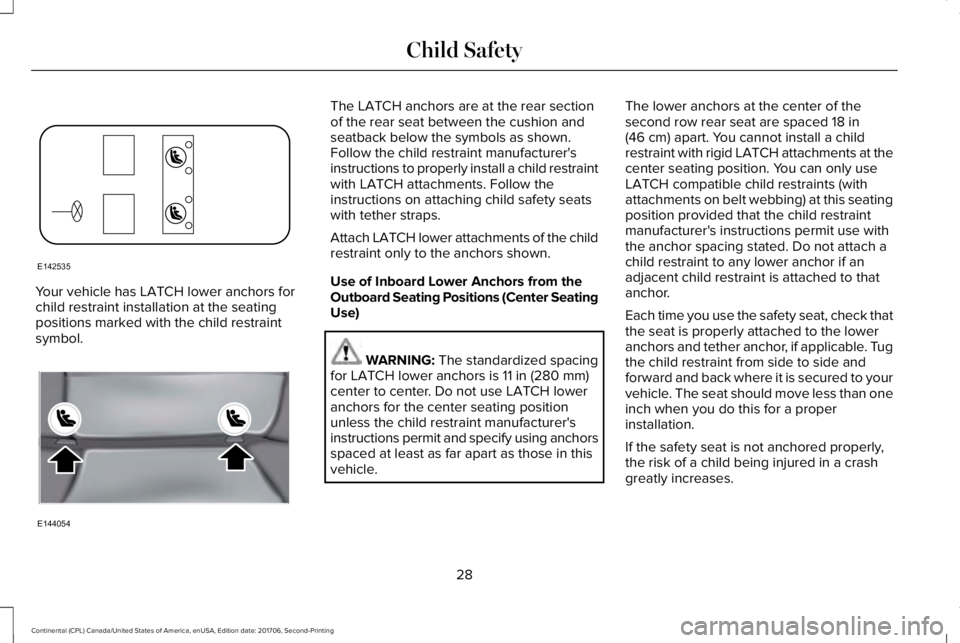
Your vehicle has LATCH lower anchors forchild restraint installation at the seatingpositions marked with the child restraintsymbol.
The LATCH anchors are at the rear sectionof the rear seat between the cushion andseatback below the symbols as shown.Follow the child restraint manufacturer'sinstructions to properly install a child restraintwith LATCH attachments. Follow theinstructions on attaching child safety seatswith tether straps.
Attach LATCH lower attachments of the childrestraint only to the anchors shown.
Use of Inboard Lower Anchors from theOutboard Seating Positions (Center SeatingUse)
WARNING: The standardized spacingfor LATCH lower anchors is 11 in (280 mm)center to center. Do not use LATCH loweranchors for the center seating positionunless the child restraint manufacturer'sinstructions permit and specify using anchorsspaced at least as far apart as those in thisvehicle.
The lower anchors at the center of thesecond row rear seat are spaced 18 in(46 cm) apart. You cannot install a childrestraint with rigid LATCH attachments at thecenter seating position. You can only useLATCH compatible child restraints (withattachments on belt webbing) at this seatingposition provided that the child restraintmanufacturer's instructions permit use withthe anchor spacing stated. Do not attach achild restraint to any lower anchor if anadjacent child restraint is attached to thatanchor.
Each time you use the safety seat, check thatthe seat is properly attached to the loweranchors and tether anchor, if applicable. Tugthe child restraint from side to side andforward and back where it is secured to yourvehicle. The seat should move less than oneinch when you do this for a properinstallation.
If the safety seat is not anchored properly,the risk of a child being injured in a crashgreatly increases.
28
Continental (CPL) Canada/United States of America, enUSA, Edition date: 201706, Second-Printing
Child SafetyE142535 E144054
Page 32 of 615
Combining Seatbelt and LATCH LowerAnchors for Attaching Child Safety Seats
When used in combination, either theseatbelt or the LATCH lower anchors maybe attached first, provided a properinstallation is achieved. Attach the tetherstrap afterward, if included with the childrestraint.
Using Tether Straps
Many forward-facing child safety seatsinclude a tether strap which extends fromthe back of the child safety seat and hooksto an anchoring point called the top tetheranchor. Tether straps are available as anaccessory for many older safety seats.
Contact the manufacturer of your childrestraint for information about ordering atether strap, or to obtain a longer tether strapif the tether strap on your safety seat doesnot reach the appropriate top tether anchorin your vehicle.
Once the child safety seat has been installedusing either the seatbelt, the lower anchorsof the LATCH system, or both, you can attachthe top tether strap.
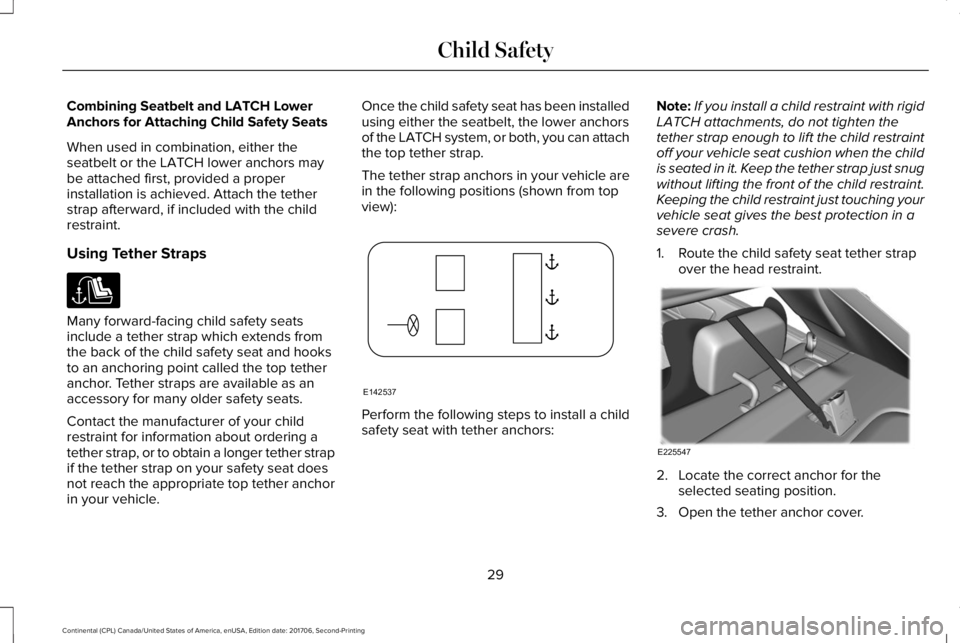
The tether strap anchors in your vehicle arein the following positions (shown from topview):
Perform the following steps to install a childsafety seat with tether anchors:
Note:If you install a child restraint with rigidLATCH attachments, do not tighten thetether strap enough to lift the child restraintoff your vehicle seat cushion when the childis seated in it. Keep the tether strap just snugwithout lifting the front of the child restraint.Keeping the child restraint just touching yourvehicle seat gives the best protection in asevere crash.
1. Route the child safety seat tether strapover the head restraint.
2. Locate the correct anchor for theselected seating position.
3. Open the tether anchor cover.
29
Continental (CPL) Canada/United States of America, enUSA, Edition date: 201706, Second-Printing
Child Safety E142537 E225547
Page 33 of 615
4. Clip the tether strap to the anchor.
5.Tighten the child safety seat tether strapaccording to the manufacturer'sinstructions.
If your child restraint system has a tetherstrap, and the child restraint manufacturerrecommends its use, we also recommend itsuse.
BOOSTER SEATS
WARNING: Do not put the shouldersection of the seatbelt or allow the child toput the shoulder section of the seatbeltunder their arm or behind their back. Failureto follow this instruction could reduce theeffectiveness of the seatbelt and increasethe risk of injury or death in a crash.
Note:Some booster seat seatbelt guidesmay not accommodate the shoulder portionof the inflatable seatbelt.
Use a belt-positioning booster seat forchildren who have outgrown or no longerproperly fit in a child safety seat (generallychildren who are less than 57 in (1.45 m) tall,are greater than age four (4) and less thanage twelve (12), and between 40 lb (18 kg)and 80 lb (36 kg) and upward to 100 lb(45 kg) if recommended by your childrestraint manufacturer). Many state andprovincial laws require that children useapproved booster seats until they reach ageeight, a height of 57 in (1.45 m) tall, or 80 lb(36 kg).
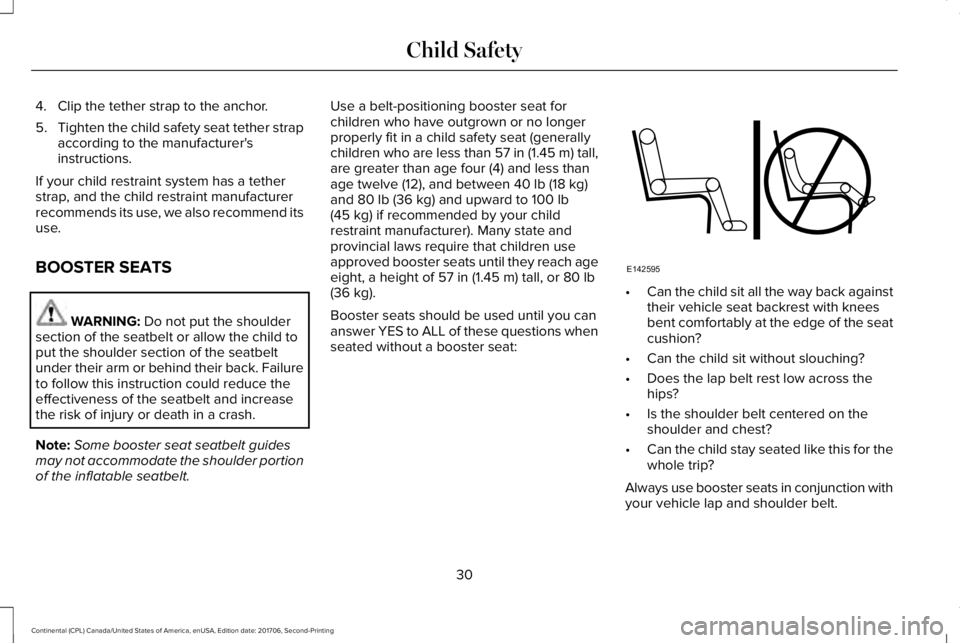
Booster seats should be used until you cananswer YES to ALL of these questions whenseated without a booster seat:
•Can the child sit all the way back againsttheir vehicle seat backrest with kneesbent comfortably at the edge of the seatcushion?
•Can the child sit without slouching?
•Does the lap belt rest low across thehips?
•Is the shoulder belt centered on theshoulder and chest?
•Can the child stay seated like this for thewhole trip?
Always use booster seats in conjunction withyour vehicle lap and shoulder belt.
30
Continental (CPL) Canada/United States of America, enUSA, Edition date: 201706, Second-Printing
Child SafetyE142595
Page 34 of 615
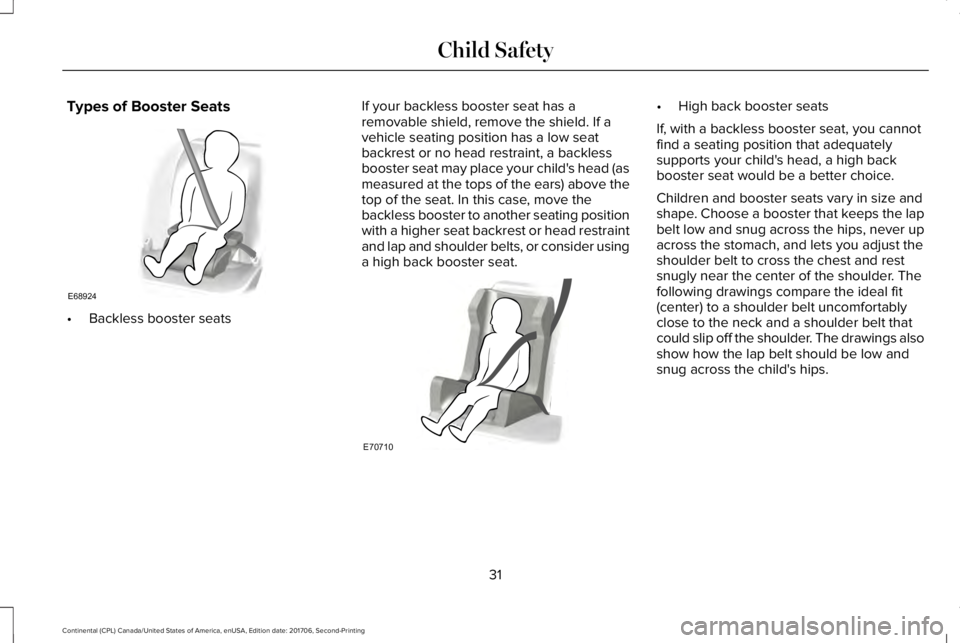
Types of Booster Seats
•Backless booster seats
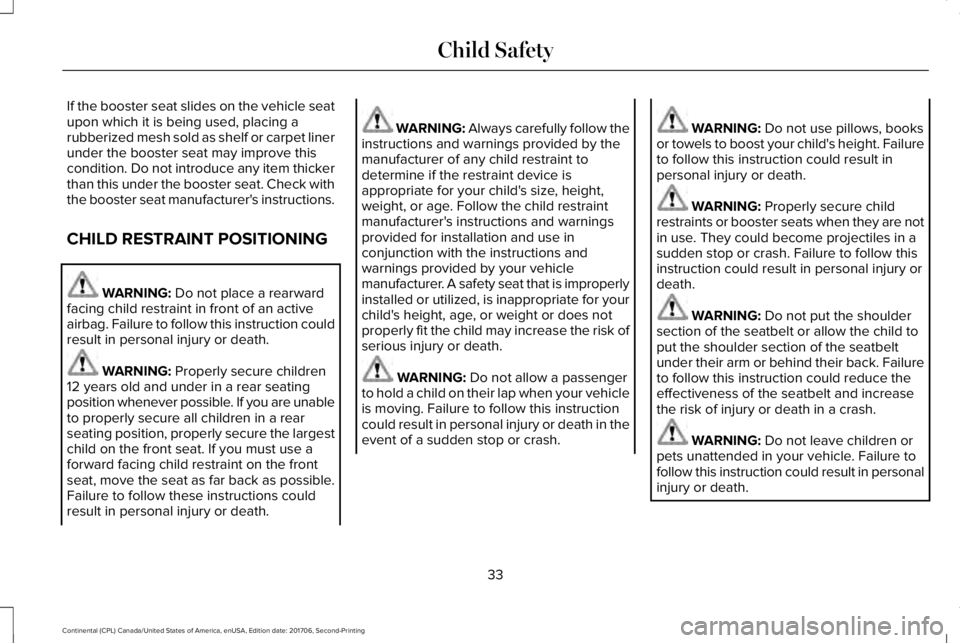
If your backless booster seat has aremovable shield, remove the shield. If avehicle seating position has a low seatbackrest or no head restraint, a backlessbooster seat may place your child's head (asmeasured at the tops of the ears) above thetop of the seat. In this case, move thebackless booster to another seating positionwith a higher seat backrest or head restraintand lap and shoulder belts, or consider usinga high back booster seat.
•High back booster seats
If, with a backless booster seat, you cannotfind a seating position that adequatelysupports your child's head, a high backbooster seat would be a better choice.
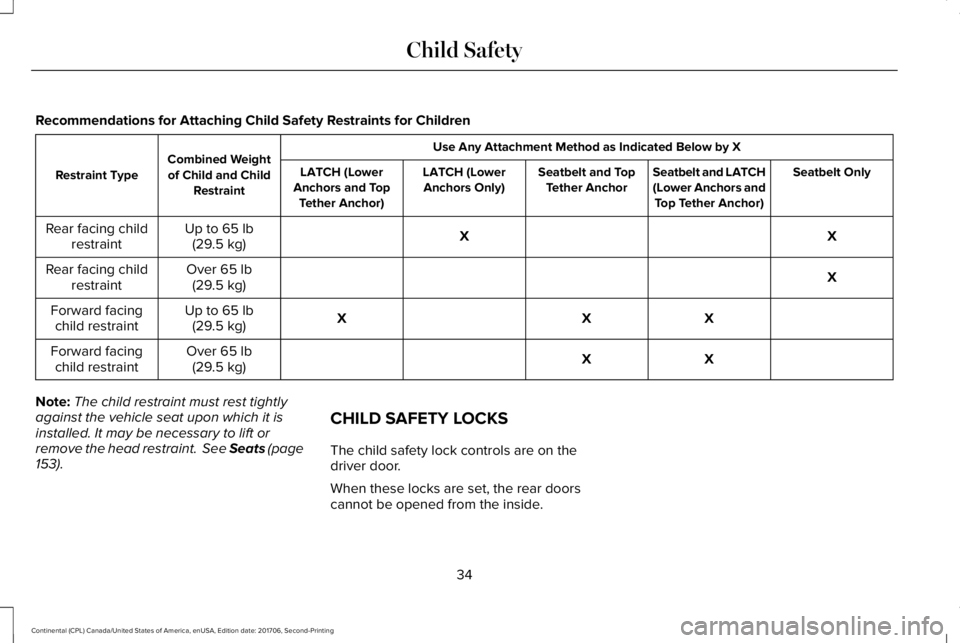
Children and booster seats vary in size andshape. Choose a booster that keeps the lapbelt low and snug across the hips, never upacross the stomach, and lets you adjust theshoulder belt to cross the chest and restsnugly near the center of the shoulder. Thefollowing drawings compare the ideal fit(center) to a shoulder belt uncomfortablyclose to the neck and a shoulder belt thatcould slip off the shoulder. The drawings alsoshow how the lap belt should be low andsnug across the child's hips.
31
Continental (CPL) Canada/United States of America, enUSA, Edition date: 201706, Second-Printing
Child SafetyE68924 E70710
Page 36 of 615
If the booster seat slides on the vehicle seatupon which it is being used, placing arubberized mesh sold as shelf or carpet linerunder the booster seat may improve thiscondition. Do not introduce any item thickerthan this under the booster seat. Check withthe booster seat manufacturer's instructions.
CHILD RESTRAINT POSITIONING
WARNING: Do not place a rearwardfacing child restraint in front of an activeairbag. Failure to follow this instruction couldresult in personal injury or death.
WARNING: Properly secure children12 years old and under in a rear seatingposition whenever possible. If you are unableto properly secure all children in a rearseating position, properly secure the largestchild on the front seat. If you must use aforward facing child restraint on the frontseat, move the seat as far back as possible.Failure to follow these instructions couldresult in personal injury or death.
WARNING: Always carefully follow theinstructions and warnings provided by themanufacturer of any child restraint todetermine if the restraint device isappropriate for your child's size, height,weight, or age. Follow the child restraintmanufacturer's instructions and warningsprovided for installation and use inconjunction with the instructions andwarnings provided by your vehiclemanufacturer. A safety seat that is improperlyinstalled or utilized, is inappropriate for yourchild's height, age, or weight or does notproperly fit the child may increase the risk ofserious injury or death.
WARNING: Do not allow a passengerto hold a child on their lap when your vehicleis moving. Failure to follow this instructioncould result in personal injury or death in theevent of a sudden stop or crash.
WARNING: Do not use pillows, booksor towels to boost your child's height. Failureto follow this instruction could result inpersonal injury or death.
WARNING: Properly secure childrestraints or booster seats when they are notin use. They could become projectiles in asudden stop or crash. Failure to follow thisinstruction could result in personal injury ordeath.
WARNING: Do not put the shouldersection of the seatbelt or allow the child toput the shoulder section of the seatbeltunder their arm or behind their back. Failureto follow this instruction could reduce theeffectiveness of the seatbelt and increasethe risk of injury or death in a crash.
WARNING: Do not leave children orpets unattended in your vehicle. Failure tofollow this instruction could result in personalinjury or death.
33
Continental (CPL) Canada/United States of America, enUSA, Edition date: 201706, Second-Printing
Child Safety
Page 37 of 615
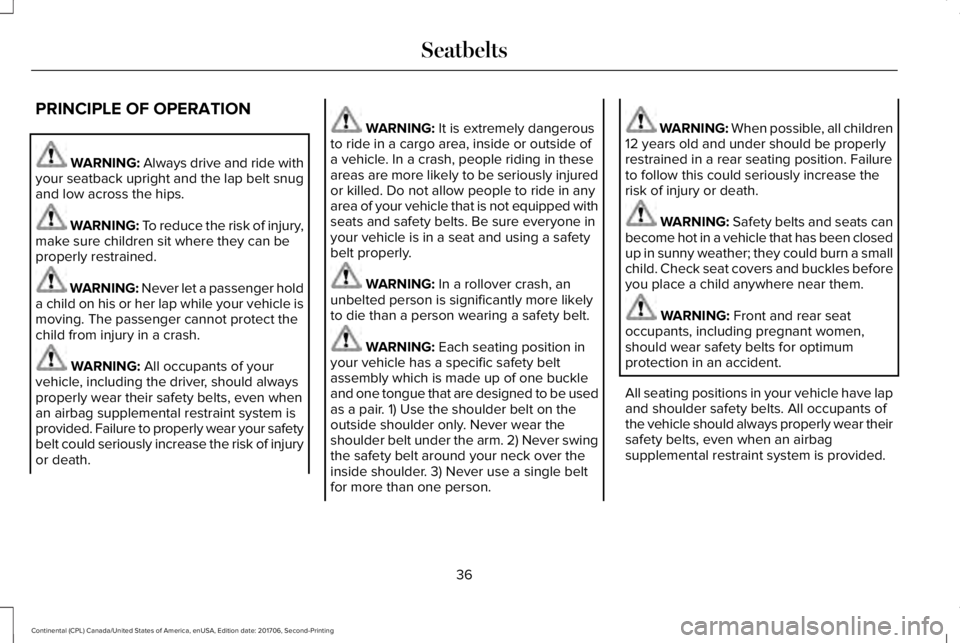
Recommendations for Attaching Child Safety Restraints for Children
Use Any Attachment Method as Indicated Below by XCombined Weightof Child and ChildRestraintRestraint TypeSeatbelt OnlySeatbelt and LATCH(Lower Anchors andTop Tether Anchor)
Seatbelt and TopTether AnchorLATCH (LowerAnchors Only)LATCH (LowerAnchors and TopTether Anchor)
XXUp to 65 lb(29.5 kg)Rear facing childrestraint
XOver 65 lb(29.5 kg)Rear facing childrestraint
XXXUp to 65 lb(29.5 kg)Forward facingchild restraint
XXOver 65 lb(29.5 kg)Forward facingchild restraint
Note:The child restraint must rest tightlyagainst the vehicle seat upon which it isinstalled. It may be necessary to lift orremove the head restraint. See Seats (page153).
CHILD SAFETY LOCKS
The child safety lock controls are on thedriver door.
When these locks are set, the rear doorscannot be opened from the inside.
34
Continental (CPL) Canada/United States of America, enUSA, Edition date: 201706, Second-Printing
Child Safety
Page 39 of 615
PRINCIPLE OF OPERATION
WARNING: Always drive and ride withyour seatback upright and the lap belt snugand low across the hips.
WARNING: To reduce the risk of injury,make sure children sit where they can beproperly restrained.
WARNING: Never let a passenger holda child on his or her lap while your vehicle ismoving. The passenger cannot protect thechild from injury in a crash.
WARNING: All occupants of yourvehicle, including the driver, should alwaysproperly wear their safety belts, even whenan airbag supplemental restraint system isprovided. Failure to properly wear your safetybelt could seriously increase the risk of injuryor death.
WARNING: It is extremely dangerousto ride in a cargo area, inside or outside ofa vehicle. In a crash, people riding in theseareas are more likely to be seriously injuredor killed. Do not allow people to ride in anyarea of your vehicle that is not equipped withseats and safety belts. Be sure everyone inyour vehicle is in a seat and using a safetybelt properly.
WARNING: In a rollover crash, anunbelted person is significantly more likelyto die than a person wearing a safety belt.
WARNING: Each seating position inyour vehicle has a specific safety beltassembly which is made up of one buckleand one tongue that are designed to be usedas a pair. 1) Use the shoulder belt on theoutside shoulder only. Never wear theshoulder belt under the arm. 2) Never swingthe safety belt around your neck over theinside shoulder. 3) Never use a single beltfor more than one person.
WARNING: When possible, all children12 years old and under should be properlyrestrained in a rear seating position. Failureto follow this could seriously increase therisk of injury or death.
WARNING: Safety belts and seats canbecome hot in a vehicle that has been closedup in sunny weather; they could burn a smallchild. Check seat covers and buckles beforeyou place a child anywhere near them.
WARNING: Front and rear seatoccupants, including pregnant women,should wear safety belts for optimumprotection in an accident.
All seating positions in your vehicle have lapand shoulder safety belts. All occupants ofthe vehicle should always properly wear theirsafety belts, even when an airbagsupplemental restraint system is provided.
36
Continental (CPL) Canada/United States of America, enUSA, Edition date: 201706, Second-Printing
Seatbelts
Page 41 of 615
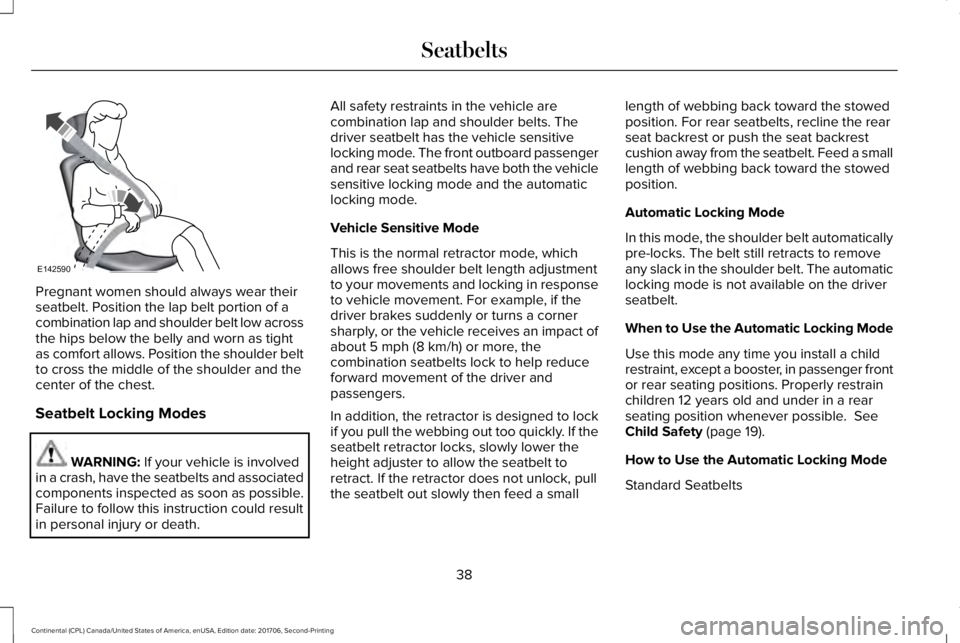
Pregnant women should always wear theirseatbelt. Position the lap belt portion of acombination lap and shoulder belt low acrossthe hips below the belly and worn as tightas comfort allows. Position the shoulder beltto cross the middle of the shoulder and thecenter of the chest.
Seatbelt Locking Modes
WARNING: If your vehicle is involvedin a crash, have the seatbelts and associatedcomponents inspected as soon as possible.Failure to follow this instruction could resultin personal injury or death.
All safety restraints in the vehicle arecombination lap and shoulder belts. Thedriver seatbelt has the vehicle sensitivelocking mode. The front outboard passengerand rear seat seatbelts have both the vehiclesensitive locking mode and the automaticlocking mode.
Vehicle Sensitive Mode
This is the normal retractor mode, whichallows free shoulder belt length adjustmentto your movements and locking in responseto vehicle movement. For example, if thedriver brakes suddenly or turns a cornersharply, or the vehicle receives an impact ofabout 5 mph (8 km/h) or more, thecombination seatbelts lock to help reduceforward movement of the driver andpassengers.
In addition, the retractor is designed to lockif you pull the webbing out too quickly. If theseatbelt retractor locks, slowly lower theheight adjuster to allow the seatbelt toretract. If the retractor does not unlock, pullthe seatbelt out slowly then feed a small
length of webbing back toward the stowedposition. For rear seatbelts, recline the rearseat backrest or push the seat backrestcushion away from the seatbelt. Feed a smalllength of webbing back toward the stowedposition.
Automatic Locking Mode
In this mode, the shoulder belt automaticallypre-locks. The belt still retracts to removeany slack in the shoulder belt. The automaticlocking mode is not available on the driverseatbelt.
When to Use the Automatic Locking Mode
Use this mode any time you install a childrestraint, except a booster, in passenger frontor rear seating positions. Properly restrainchildren 12 years old and under in a rearseating position whenever possible. SeeChild Safety (page 19).
How to Use the Automatic Locking Mode
Standard Seatbelts
38
Continental (CPL) Canada/United States of America, enUSA, Edition date: 201706, Second-Printing
SeatbeltsE142590
Page 43 of 615
Note:The rear inflatable seatbelts arecompatible with most infant and child safetycar seats and belt positioning booster seatswhen properly installed. This is because theyare designed to fill with a cooled gas at alower pressure and at a slower rate thantraditional airbags. After inflation, theshoulder portion of the seatbelt remains coolto the touch.
The rear inflatable seatbelt consists of thefollowing:
•An inflatable bag in the shoulder seatbeltwebbing.
•Lap seatbelt webbing with automaticlocking mode.
•The same warning light, electroniccontrol and diagnostic unit as used forthe front seatbelts.
•Impact sensors in various parts of thevehicle.
How does the rear inflatable seatbeltsystem work?
WARNING: If a supplementary restraintsystem component has deployed, it will notfunction again. Have the system andassociated components inspected as soonas possible. Failure to follow this instructioncould result in personal injury or death.
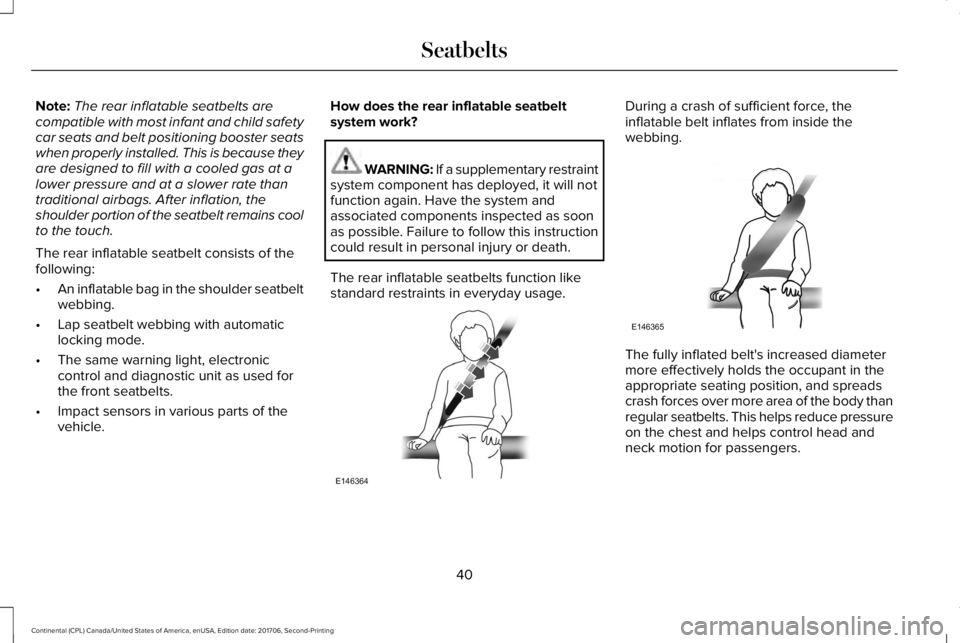
The rear inflatable seatbelts function likestandard restraints in everyday usage.
During a crash of sufficient force, theinflatable belt inflates from inside thewebbing.
The fully inflated belt's increased diametermore effectively holds the occupant in theappropriate seating position, and spreadscrash forces over more area of the body thanregular seatbelts. This helps reduce pressureon the chest and helps control head andneck motion for passengers.
40
Continental (CPL) Canada/United States of America, enUSA, Edition date: 201706, Second-Printing
SeatbeltsE146364 E146365