traction control LINCOLN LS 2002 User Guide
[x] Cancel search | Manufacturer: LINCOLN, Model Year: 2002, Model line: LS, Model: LINCOLN LS 2002Pages: 288, PDF Size: 2.44 MB
Page 165 of 288

AdvanceTracYStability Enhancement System (if equipped)
The AdvanceTracysystem helps the driver maintain the stability and
steerability of the vehicle. The system integrates anti-lock braking system
(ABS), Traction Controlyand a more advanced function to further
enhance the stability of the vehicle. The system shares many of the
electronic and mechanical elements already present in the Traction
Controlyand ABS systems.
The AdvanceTracyconstantly monitors the vehicle motion relative to
the driver's intended course. This is done by using added sensors that
compare the steering inputs from the driver with the actual motion of
the vehicle. When there is a discrepancy between the driver's inputs and
the vehicle motion, AdvanceTracychanges the force at each tire to help
control the vehicle. If the vehicle begins to rotate excessively left or
right, spin out, or slide sideways, the system will attempt to correct the
excessive motion. If the vehicle does not respond to steering inputs, the
system will attempt to increase the turning response of the vehicle.
The AdvanceTracyenhances stability during maneuvers that require all
available tire traction to control the vehicle. The benefits of the
AdvanceTracysystem are most noticeable when driving in wet/snowy/icy
road conditions and/or when performing emergency maneuvers. In an
emergency lane-change, the driver will experience better overall vehicle
traction, and have better control of the vehicle.
Driving conditions which may activate AdvanceTracyinclude:
²Taking a turn too fast
²Evasively maneuvering to avoid an accident, pedestrian or obstacle
²Hitting a patch of ice
²Changing lanes on a snow-rutted road
²Entering a snow-free road from a snow-covered side street
²Entering a paved road from a gravel road
²Hitting a curb while turning
²Driving on slick surfaces
The AdvanceTracysystem defaults to ON when the engine is started.
The system does not work when the vehicle is traveling backwards. In
reverse, ABS and Traction Controlywill continue to function. The
system uses ABS and Traction Controly(including control of the
engine) as well as its more advanced controls to enhance vehicle
stability.
Driving
165
Page 166 of 288
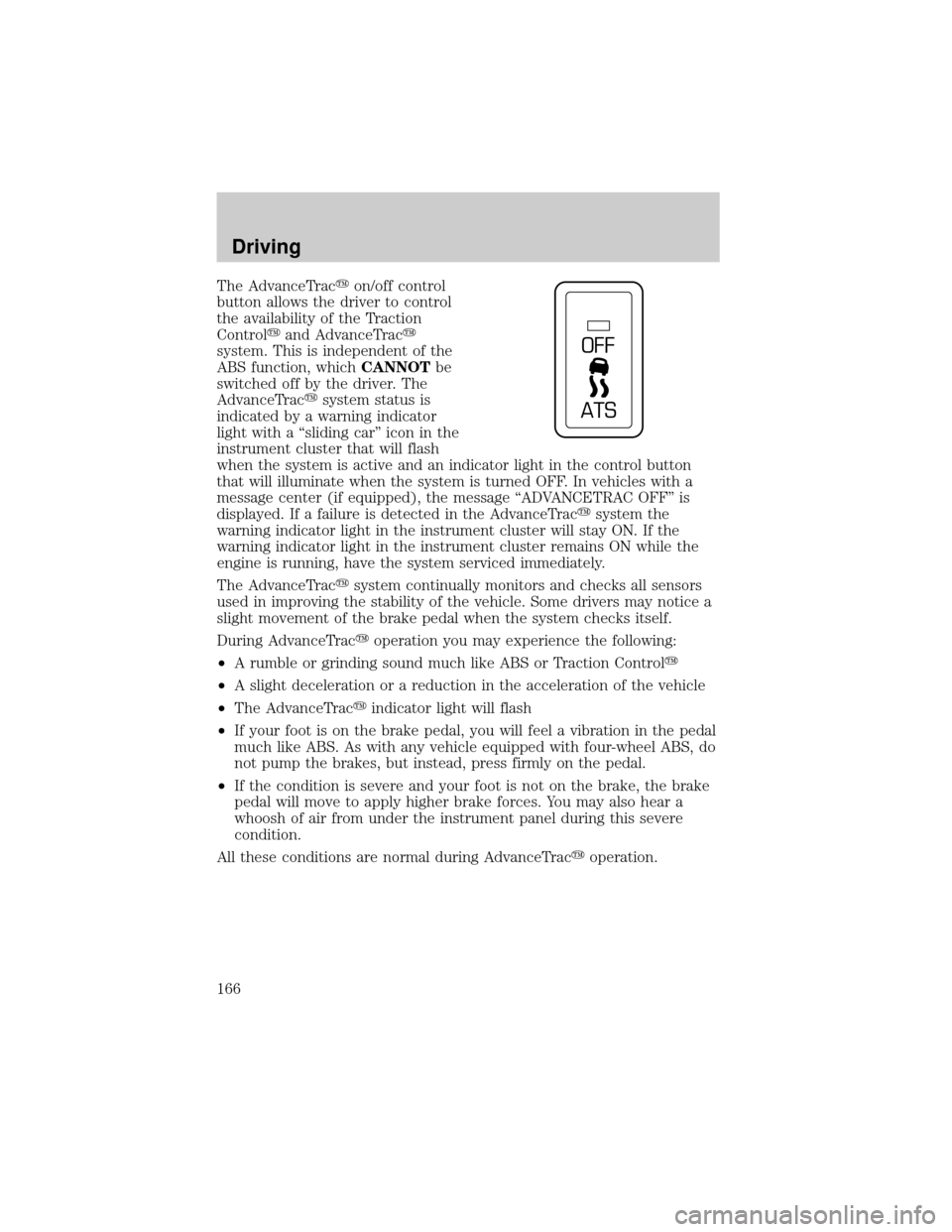
The AdvanceTracyon/off control
button allows the driver to control
the availability of the Traction
Controlyand AdvanceTracy
system. This is independent of the
ABS function, whichCANNOTbe
switched off by the driver. The
AdvanceTracysystem status is
indicated by a warning indicator
light with a ªsliding carº icon in the
instrument cluster that will flash
when the system is active and an indicator light in the control button
that will illuminate when the system is turned OFF. In vehicles with a
message center (if equipped), the message ªADVANCETRAC OFFº is
displayed. If a failure is detected in the AdvanceTracysystem the
warning indicator light in the instrument cluster will stay ON. If the
warning indicator light in the instrument cluster remains ON while the
engine is running, have the system serviced immediately.
The AdvanceTracysystem continually monitors and checks all sensors
used in improving the stability of the vehicle. Some drivers may notice a
slight movement of the brake pedal when the system checks itself.
During AdvanceTracyoperation you may experience the following:
²A rumble or grinding sound much like ABS or Traction Controly
²A slight deceleration or a reduction in the acceleration of the vehicle
²The AdvanceTracyindicator light will flash
²If your foot is on the brake pedal, you will feel a vibration in the pedal
much like ABS. As with any vehicle equipped with four-wheel ABS, do
not pump the brakes, but instead, press firmly on the pedal.
²If the condition is severe and your foot is not on the brake, the brake
pedal will move to apply higher brake forces. You may also hear a
whoosh of air from under the instrument panel during this severe
condition.
All these conditions are normal during AdvanceTracyoperation.
OFF
ATS
Driving
166
Page 256 of 288
U.S. Department of Transportation-Tire quality grades:The U.S.
Department of Transportation requires Ford to give you the following
information about tire grades exactly as the government has written it.
Treadwear
The treadwear grade is a comparative rating based on the wear rate of
the tire when tested under controlled conditions on a specified
government test course. For example, a tire graded 150 would wear one
and one-half (1 1/2) times as well on the government course as a tire
graded 100. The relative performance of tires depends upon the actual
conditions of their use, however, and may depart significantly from the
norm due to variations in driving habits, service practices, and
differences in road characteristics and climate.
Traction AA A B C
The traction grades, from highest to lowest are AA, A, B, and C. The
grades represent the tire's ability to stop on wet pavement as measured
under controlled conditions on specified government test surfaces of
asphalt and concrete. A tire marked C may have poor traction
performance.
The traction grade assigned to this tire is based on
straight-ahead braking traction tests, and does not include
acceleration, cornering, hydroplaning or peak traction characteristics.
Temperature A B C
The temperature grades are A (the highest), B, and C, representing the
tire's resistance to the generation of heat and its ability to dissipate heat
when tested under controlled conditions on a specified indoor laboratory
test wheel. Sustained high temperature can cause the material of the tire
to degenerate and reduce tire life, and excessive temperature can lead to
sudden tire failure. The grade C corresponds to a level of performance
which all passenger car tires must meet under the Federal Motor Vehicle
Safety Standard No. 109. Grades B and A represent higher levels of
performance on the laboratory test wheel than the minimum required by
law.
Maintenance and Specifications
256
Page 260 of 288
Failure to follow these precautions may adversely affect the
handling of the vehicle and make it easier for the driver to lose
control and roll over.
Tires that are larger or smaller than your vehicle's original tires may also
affect the accuracy of your speedometer.
SNOW TIRES AND CHAINS
Snow tires must be the same size and grade as the tires you
currently have on your vehicle.
The tires on your vehicle have all weather treads to provide traction in
rain and snow. However, in some climates, you may need to use snow
tires or chains.
Follow these guidelines when using snow tires and chains:
²Use only SAE Class S chains with P215/60R16 tires.
²Do not use tire chains with size P235/50R17 tires. Use of SAE Class S
chains or other chain types may damage your vehicle.
²Install chains securely, verifying that the chains do not touch any
wiring, brake lines or fuel lines.
²Drive cautiously. If you hear the chains rub or bang against your
vehicle, stop and re-tighten the chains. If this does not work, remove
the chains to prevent damage to your vehicle.
²If possible, avoid fully loading your vehicle.
²Remove the tire chains when they are no longer needed. Do not use
tire chains on dry roads.
²The suspension insulation and bumpers will help prevent vehicle
damage. Do not remove these components from your vehicle when
using snow tires or chains.
Maintenance and Specifications
260
Page 280 of 288

low fuel ......................................14
low washer fluid .......................14
oil pressure ...............................12
safety belt .................................12
speed control ............................83
steering column lock ................14
traction control active ..............13
transmission PRNDL
indicator ....................................13
turn signal indicator .................14
Load limits .................................181
GAWR ......................................181
GVWR ......................................181
trailer towing ..........................181
Locks
autolock ...................................115
childproof ................................109
doors ........................................108
Lubricant
specifications .....................263±264
Lug nuts, anti-theft ...................201
Lumbar support, seats .............122
M
Manual transmission .................177
fluid capacities ........................261
lubricant specifications ..........264
reverse .....................................180
Message center .....................94±95
select button .............................94
warning messages .....................98
Mirrors .........................................73
automatic dimming rearview
mirror ........................................74
heated ........................................78
programmable memory ..........116
side view mirrors (power) .......77Moon roof ....................................86
Motorcraft parts ................250, 261
O
Octane rating ............................248
Odometer .....................................17
Oil (see Engine oil) ..................232
P
Panic alarm feature, remote
entry system ..............................113
Parking brake ............................162
Parts (see Motorcraft parts) ....261
Power distribution box
(see Fuses) .......................193, 196
Power door locks ..............108, 115
Power steering ..........................163
fluid, checking and adding ....250
fluid, refill capacity ................261
fluid, specifications .........263±264
R
Rear window defroster ...............59
Relays ........................................190
Remote entry system .......111, 113
illuminated entry ....................115
locking/unlocking
doors ................................112±113
opening the trunk ...................114
panic alarm .............................113
replacement/additional
transmitters .............................115
replacing the batteries ...........114
Roof rack ...................................107
Index
280
Page 281 of 288

S
Safety belts (see Safety
restraints) ....15, 126, 128±131, 133
Safety defects, reporting ..........219
Safety restraints ........126, 128±133
belt minder .............................134
cleaning the safety
belts .................................138, 226
extension assembly ................137
for adults .........................128±131
for children .....................146±147
warning light
and chime ............12, 15, 133±134
Safety seats for children ..........148
Seat belts
(see Safety restraints) .............126
Seats ..........................................121
child safety seats ....................148
cleaning ...................................225
easy access/easyout
feature .....................................124
memory seat ...................116, 125
SecuriLock passive
anti-theft system ...............117, 119
Select Shift Transmission
(SST) shifter .............................173
Servicing your vehicle ..............228
Spark plugs,
specifications .............261, 264±265
Specification chart,
lubricants ...........................263±264
Speed control ..............................78
Speedometer ...............................17
Starting your vehicle ........156±158
jump starting ..........................202Steering
speed sensitive .......................163
Steering column lock ................106
Steering wheel
controls ..........................72, 78, 84
tilting ...................................14, 72
T
Tachometer .................................18
Tires ...........................198, 255±257
changing ..........................198±199
checking the pressure ............257
replacing ..................................259
rotating ....................................257
snow tires and chains ............260
tire grades ...............................256
treadwear ................................256
Towing .......................................183
recreational towing .................186
trailer towing ..........................183
wrecker ....................................209
Traction control ........................164
active light ................................13
Transmission ...............................13
automatic operation ...............167
fluid, checking and adding
(automatic) .............................252
fluid, checking and adding
(manual) .................................252
fluid, refill capacities ..............261
lubricant specifications ..263±264
manual operation ..............13, 177
Trip odometer .............................17
Trunk .........................................109
remote release ................104, 114
Turn signal ......................14±15, 64
Index
281