wiper blades LINCOLN LS 2002 Owners Manual
[x] Cancel search | Manufacturer: LINCOLN, Model Year: 2002, Model line: LS, Model: LINCOLN LS 2002Pages: 288, PDF Size: 2.44 MB
Page 55 of 288

(panel/floor) Ð Distributes air through the instrument panel and
center console registers, and the front and rear seat floor ducts. For
added customer comfort, the air distributed through the floor ducts may
be slightly warmer than the air sent to the instrument panel registers.
(floor) Ð Distributes air through the front and rear seat floor ducts.
The system will allow some airflow out the defroster ducts, the demister
outlets and outer instrument panel registers.
(floor/defrost) Ð Distributes air through the windshield defroster
ducts, the demister outlets and the front and rear seat floor ducts. The
system will allow some airflow out the outer instrument panel registers.
When floor/defrost is selected, if the outside temperature is about 2É C
(35É F) or higher, the air conditioner will automatically dehumidify the
air to reduce window fogging. For added customer comfort, the air
distributed through the floor ducts may be slightly warmer than the air
sent to the windshield defroster ducts. When floor/defrost is selected,
the system will automatically provide outside air to reduce window
fogging. Recirculation and A/C override controls can be selected.
(defrost) Ð Distributes outside air through the windshield
defroster ducts and the demister outlets. It can be used to clear ice or
fog from the windshield. The system will allow some airflow out the
outer instrument panel registers. If the outside temperature is about 2É C
(35É F) or higher, the air conditioner will automatically dehumidify the
air to reduce window fogging. (Note that the A/C indicator does not
illuminate when this mode is selected.) Recirculation and A/C override
controls cannot be selected.
²Turn DATC off
OFF-Outside air is shut out. The fan, heating and air conditioning will
not operate. The outside temperature will still display when selected
with the ignition in the RUN position.
Heated wiper rest
(heated wiper rest) Ð Located at the base of the windshield, this
feature heats the front glass area below the area heated by the front
defroster where the windshield wipers sit in their parked position. When
activated, the feature keeps the wiper blades warm and reduces the
chance of ice build up on the blades. The indicator will light when the
feature is in operation.
Climate Controls
55
Page 70 of 288
WINDSHIELD WIPER BLADES
Check the wiper blades at least twice a year or when they seem less
effective. Substances such as tree sap and some hot wax treatments used
by commercial car washes reduce the effectiveness of wiper blades.
In cold weather conditions, the wiper blades need to be thawed before
operating in order to prevent premature wear to the wiper blades. Before
operating the wiper blades in cold weather, refer to theElectric window
heatersin this chapter.
Checking the wiper blades
If the wiper blades do not wipe properly, clean both the windshield and
wiper blades using undiluted windshield wiper solution or a mild
detergent. Rinse thoroughly with clean water. To avoid damaging the
blades, do not use fuel, kerosene, paint thinner or other solvents.
Changing the wiper blades
To replace the wiper blades:
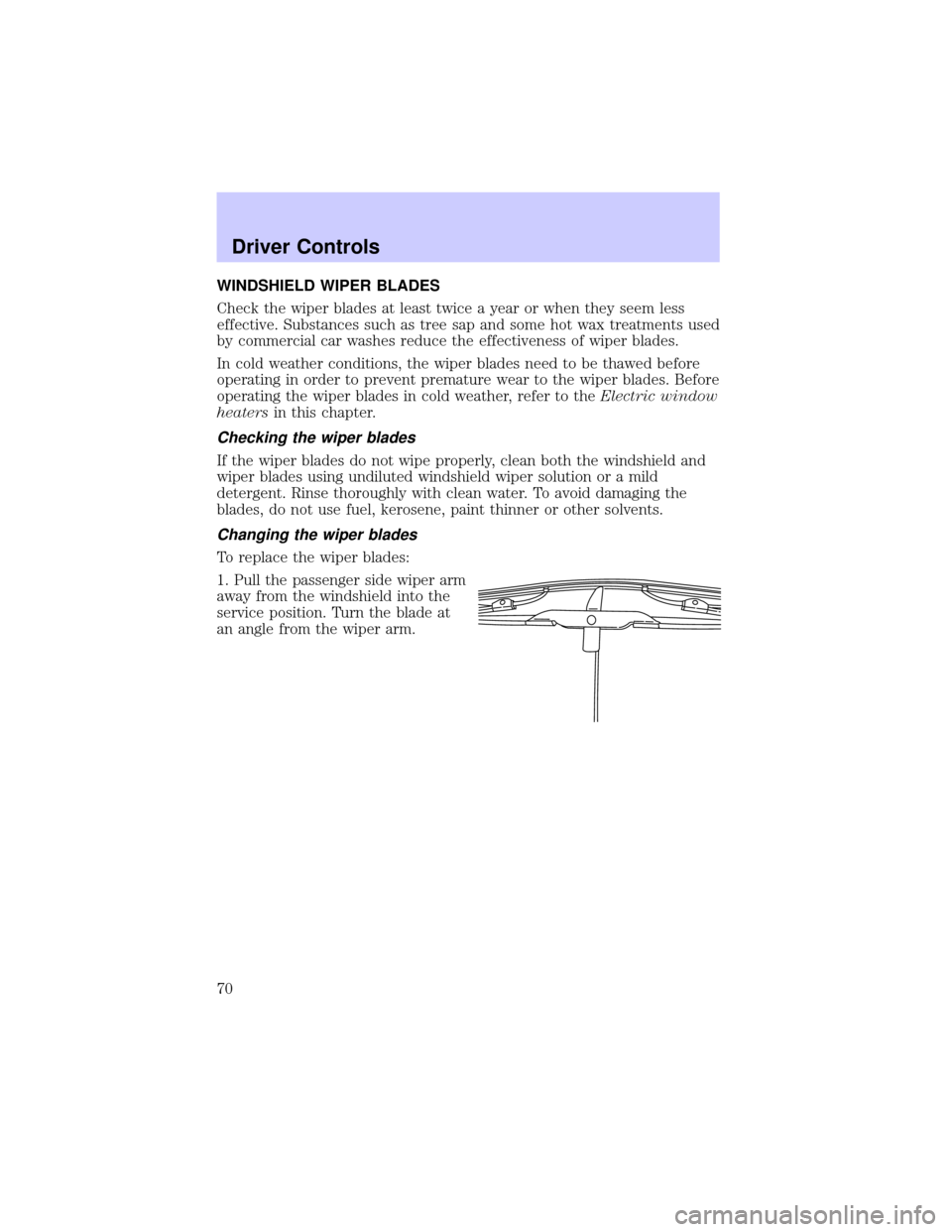
1. Pull the passenger side wiper arm
away from the windshield into the
service position. Turn the blade at
an angle from the wiper arm.
Driver Controls
70
Page 224 of 288

WASHING THE EXTERIOR LAMPS
In order to avoid scratching the plastic lamps, do not use dry
paper towels, non-approved chemical solvents or abrasive
cleaners.
Use a soft cloth and a solution of Triple Clean (EOAZ-19526±AA), mixed
properly with water, in order to remove bug residue. If tar or grease
spots are present, clean with Extra Strength Tar and Road Oil Removal
(B7A-19520±AA).
CLEANING THE WINDSHIELD, WIPER BLADES AND REAR
WINDOW
If the wiper does not wipe properly, substances on the windshield, rear
window or the wiper blades may be the cause. These may include hot
wax treatments used by commercial car washes, tree sap, or other
organic contamination.
Do not clean the windshield or rear window glass with abrasives,
as they may cause scratches.
Do not use fuel, kerosene, or paint thinner to clean the
windshield, rear window or the wiper blades as damage may
occur.
Clean the outside of the windshield or rear window with a non-abrasive
cleaner such as Ultra Clear Spray Glass Cleaner (E4AZ-19C507±AA),
available from your authorized Ford, Lincoln or Mercury dealer. If after
cleaning the glass surface, the water sheets from the glass (e.g., does not
bead), then the window is clean.
The windshield, rear window and wiper blades should be cleaned
regularly. Wiper blades can be cleaned with isopropyl (rubbing) alcohol
or windshield washer solution. Be sure to replace wiper blades when
they appear worn or do not function properly.
CLEANING THE INSTRUMENT PANEL
Clean the instrument panel with a damp cloth, then dry with a dry cloth.
Avoid cleaners or polish that increase the gloss of the upper portion of
the instrument panel. The dull finish in this area helps protect the driver
from undesirable windshield reflection.
Cleaning
224
Page 232 of 288
WASHER FLUID
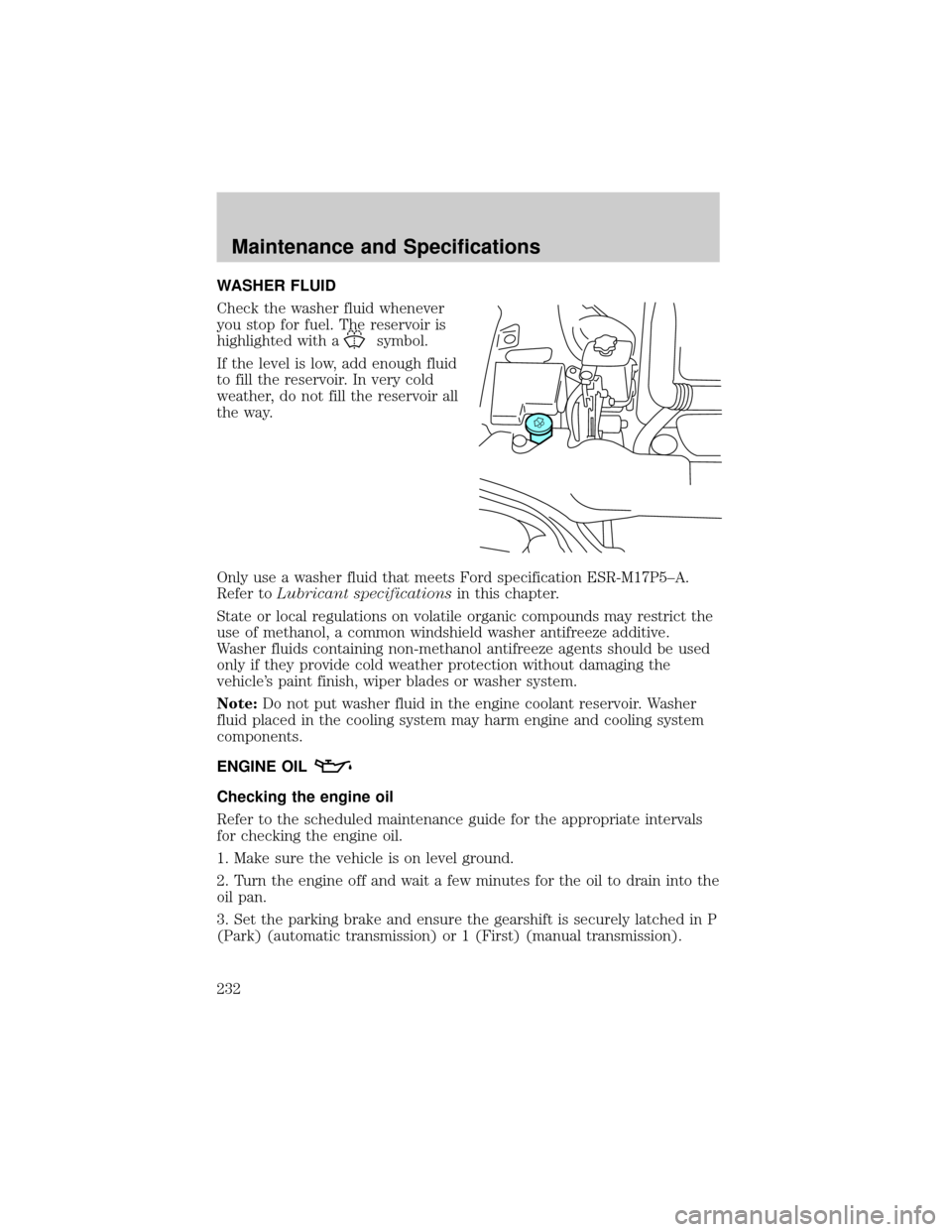
Check the washer fluid whenever
you stop for fuel. The reservoir is
highlighted with a
symbol.
If the level is low, add enough fluid
to fill the reservoir. In very cold
weather, do not fill the reservoir all
the way.
Only use a washer fluid that meets Ford specification ESR-M17P5±A.
Refer toLubricant specificationsin this chapter.
State or local regulations on volatile organic compounds may restrict the
use of methanol, a common windshield washer antifreeze additive.
Washer fluids containing non-methanol antifreeze agents should be used
only if they provide cold weather protection without damaging the
vehicle's paint finish, wiper blades or washer system.
Note:Do not put washer fluid in the engine coolant reservoir. Washer
fluid placed in the cooling system may harm engine and cooling system
components.
ENGINE OIL
Checking the engine oil
Refer to the scheduled maintenance guide for the appropriate intervals
for checking the engine oil.
1. Make sure the vehicle is on level ground.
2. Turn the engine off and wait a few minutes for the oil to drain into the
oil pan.
3. Set the parking brake and ensure the gearshift is securely latched in P
(Park) (automatic transmission) or 1 (First) (manual transmission).
Maintenance and Specifications
232
Page 277 of 288

in front seat ............................149
in rear seat ..............................149
Cleaning your vehicle
engine compartment ..............222
exterior ....................................226
instrument cluster lens ..........225
instrument panel ....................224
interior .....................................225
plastic parts ....................223±224
safety belts ..............................226
washing ....................................220
waxing .....................................220
wheels ......................................221
windows ..................................226
wiper blades ............................224
Clock ......................................24, 36
Clutch
fluid ..........................................253
operation while driving ..........177
recommended shift speeds ....178
Compass, electronic ..............74±75
calibration .................................77
set zone adjustment .................76
Console ......................................106
Controls
power seat ...............................123
steering column ........................84
Coolant
checking and adding ..............237
coolant temperature light ........13
refill capacities ................241, 261
specifications ..................263±264
Cruise control
(see Speed control) ....................78
Customer Assistance ................187
Ford accessories for your
vehicle .....................................227Ford Extended
Service Plan ............................212
Getting assistance outside
the U.S. and Canada ..............216
Getting roadside assistance ...187
Getting the service
you need .................................210
Ordering additional
owner's literature ...................217
The Dispute Settlement
Board .......................................213
Utilizing the Mediation/
Arbitration Program ...............216
D
Daytime running lamps
(see Lamps) ................................61
Defrost
rear window ..............................59
Dipstick
automatic transmission
fluid ..........................................252
engine oil .................................232
Doors
central unlocking ....................109
door ajar warning .....................15
lubricant specifications ..........263
Driving under special
conditions
through water .........................181
Dual automatic temperature
control (DATC) ...........................48
E
Emergencies, roadside
jump-starting ..........................202
Emission control system ..........265
Index
277
Page 282 of 288

V
Valet Switch ..............................108
Vehicle Communication System 90
Vehicle dimensions ...................270
Vehicle Identification Number
(VIN) ..........................................272
Vehicle loading ..........................181
Ventilating your vehicle ...........160W
Warning chimes ...........................15
Warning lights (see Lights) .......10
Water, Driving through .............181
Windows
power .........................................73
Windshield washer fluid and
wipers
checking and cleaning ..............70
operation ...................................69
replacing wiper blades .............70
Wrecker towing .........................209
Index
282