trunk LINCOLN MARK VIII 1997 User Guide
[x] Cancel search | Manufacturer: LINCOLN, Model Year: 1997, Model line: MARK VIII, Model: LINCOLN MARK VIII 1997Pages: 315, PDF Size: 2.18 MB
Page 129 of 315

124When you use the remote entry UNLOCK, TRUNK
or PANIC buttons, the illuminated entry system
turns on the interior lights for 25 seconds. You can
turn these lights off with the LOCK button or by
turning the ignition to the RUN position.Memory Seat/Mirrors/Steering Column
FeatureYour vehicle allows the remote keyless entry system
to control the Memory Seat/Mirrors/Steering
Column feature. With this feature, each of the first
two transmitters programmed will recall a different
seat position.
Pressing the transmitter UNLOCK button once will
unlock the driver's door and move the seat to its
corresponding memory seat/mirrors position, just as
if you had pressed the memory button in the
vehicle.When your dealer programs new transmitters, the
order of programming controls seat recall as follows:
q
First Transmitter Programmed Ð Recall
Seat/Mirrors/Steering Column Position #1
q
Second Transmitter Programmed Ð Recall
Seat/Mirrors/Steering Column Position #2
q
Third Transmitter Programmed Ð NO
Recall/Memory Seat/Mirrors/Steering Column
(allows only three positions)
You may change seat/mirrors positions at any time.
Once programmed, Transmitter #1 will always
move the seat/mirrors/steering column to position
#1.
The feature is turned on at the factory for your
convenience. You can deactivate the system by
using the OFF button or switching the key fob
switch to OFF.
File:05fncf8.ex
Update:Thu Jun 27 10:02:20 1996
Page 131 of 315

126Battery SaverWhen the ignition is turned off, the vehicle will
turn off battery voltage to the courtesy lamps after
10 minutes and the demand lamps after 30
minutes.
This will prevent draining of the battery if those
lights have been left on inadvertently or if a door is
not completely closed. Battery voltage to these
lamps will be restored when the keyless entry
keypad is used, the remote entry transmitter is
used, any door is opened, the trunk is opened, or
the ignition key is turned to the ON position.Perimeter Anti-Theft SystemWhen armed, this system helps to protect your
vehicle against break-ins or theft.
When an unauthorized entry occurs, the system
triggers and will:q
flash the headlamps, parking lamps, and alarm
indicator light
q
honk the horn
q
prevent the engine from starting
NOTE: The factory installed Remote Entry System
has a PANIC feature that also honks the vehicle
horn and flashes the interior/exterior lamps when
the PANIC button on the remote entry transmitter
is pushed.The PANIC alarm and the Anti-Theft
alarm are two separate features.Both the
anti-theft alarm and the PANIC feature can be
active at the same time.
To tell the difference between a PANIC alarm and
a triggered Anti-Theft alarm:
q
only the Anti-Theft alarm will cause the alarm
indicator light (located in the center of the
instrument cluster) to flash on and off.
q
only the Anti-Theft alarm will prevent the
engine from starting.
For more information on the PANIC alarm, see
Remote Entry Systemin the Index.
File:05fncf8.ex
Update:Thu Jun 27 10:02:20 1996
Page 180 of 315

175
NOTE:Engine torque reduction isNOTactive
when engine coolant temperature is below-10ÊF
(-23ÊC).
During the Traction Control
TM
function, which most
often occurs during low speed acceleration on
slippery surfaces, a noise may be heard coming from
the engine compartment. This is normal and may
last for a few seconds during the acceleration of the
vehicle.
In general, this system improves your vehicle's
stability and acceleration performance when road
conditions warrant. Traction Control
TM
is fully
effective at all vehicle speeds.
If the Traction Control
TM
system is cycled
excessively, the brake portion of the system will
shut down to prevent the rear brakes from
overheating. A limited Traction Control
TM
function
using engine torque will still control wheels from
spinning. A cooling down period is required to
prevent damage to the brakes. This time periodvaries and depends on brake usage during the
cooling down period. Anti-Lock braking is not
affected and will function normally during the cool
down period.
After the cool down period, the full Traction
Control
TM
function is restored.
Air Suspension SystemYour vehicle is equipped with an automatic load
leveling air suspension system. This system
maintains the vehicle height at a constant level by
automatically adding air or releasing air from the air
springs to offset changes in vehicle loads.
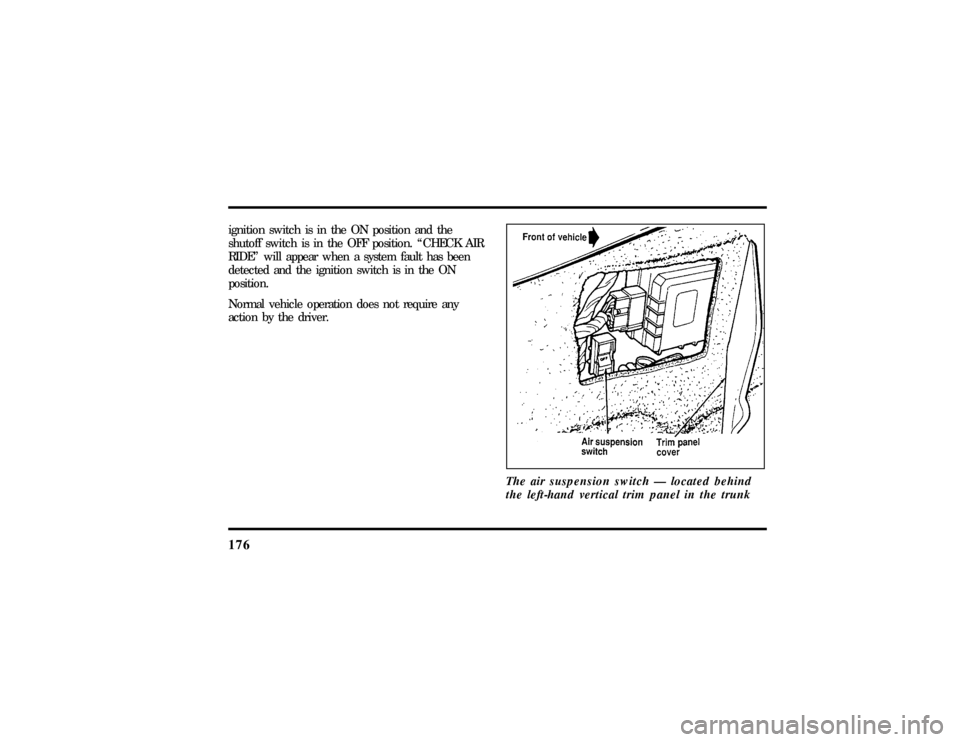
A shutoff switch is located in the trunk behind the
left hand vertical trim panel. If this switch is in the
OFF position, the automatic leveling system will not
operate. The switch should be OFF whenever
jacking up the vehicle. ªAIR RIDE SWITCH OFFº
will appear in the Message Center when the
File:09fngf8.ex
Update:Wed Jun 19 10:45:23 1996
Page 181 of 315
176ignition switch is in the ON position and the
shutoff switch is in the OFF position. ªCHECK AIR
RIDEº will appear when a system fault has been
detected and the ignition switch is in the ON
position.
Normal vehicle operation does not require any
action by the driver.
The air suspension switch Ð located behind
the left-hand vertical trim panel in the trunk
File:09fngf8.ex
Update:Wed Jun 19 10:45:23 1996
Page 194 of 315

189
Roadside EmergenciesHazard FlashersThe flashers work whether your vehicle is running
or not. The flashers work for up to two hours
when the battery is fully charged and in good
condition without draining the battery excessively. If
the flashers run for longer than two hours or if the
battery is not fully charged, the battery can be
drained.
If the Engine Cranks but Does
Not Start or Does Not Start After
a CollisionFuel Pump Shut-off SwitchIf the engine cranks but does not start even after a
small collision, the fuel pump shut-off switch may
have been actuated. The shut-off switch is a device
intended to stop the fuel pump when your vehicle
has been involved in a substantial jolt.
Once the shut-off switch is actuated, you must reset
the switch by hand before you can start your
vehicle. The switch is on the left side of the trunk.
File:10fner8.ex
Update:Thu Jun 20 14:27:22 1996
Page 207 of 315

202When you drive with the temporary spare tire,
DO NOT:q
exceed 50 mph (80 km/h) under any
circumstances.
q
load your vehicle so that it is heavier than the
maximum vehicle load rating listed on the tire
decal.
q
tow a trailer.
q
use tire chains on this tire.
q
try to repair the temporary spare tire or remove
it from its wheel.
q
use the wheel for any other type of vehicle.
q
drive through an automatic car wash with this
tire. Because the temporary spare tire is smaller
than a conventional tire, it reduces the ground
clearance. Your vehicle may get caught in the
rails and it could be damaged.
Spare Tire LocationThe spare tire is stored under the carpet on the
floor of the trunk.
You will find additional instructions for the spare
tire on the warning label located on the wheel and
the jacking instructions located on the spare tire
cover.
File:10fner8.ex
Update:Thu Jun 20 14:27:22 1996
Page 213 of 315
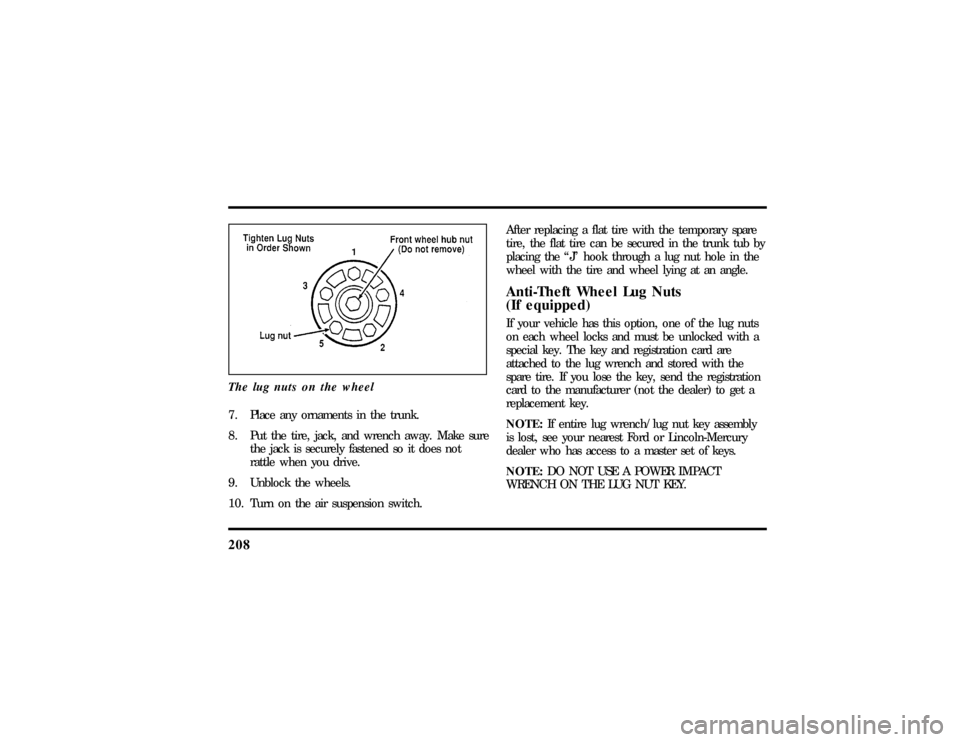
208The lug nuts on the wheel7. Place any ornaments in the trunk.
8. Put the tire, jack, and wrench away. Make sure
the jack is securely fastened so it does not
rattle when you drive.
9. Unblock the wheels.
10. Turn on the air suspension switch.After replacing a flat tire with the temporary spare
tire, the flat tire can be secured in the trunk tub by
placing the ªJº hook through a lug nut hole in the
wheel with the tire and wheel lying at an angle.
Anti-Theft Wheel Lug Nuts
(If equipped)If your vehicle has this option, one of the lug nuts
on each wheel locks and must be unlocked with a
special key. The key and registration card are
attached to the lug wrench and stored with the
spare tire. If you lose the key, send the registration
card to the manufacturer (not the dealer) to get a
replacement key.
NOTE:If entire lug wrench/lug nut key assembly
is lost, see your nearest Ford or Lincoln-Mercury
dealer who has access to a master set of keys.
NOTE:DO NOT USE A POWER IMPACT
WRENCH ON THE LUG NUT KEY.
File:10fner8.ex
Update:Thu Jun 20 14:27:22 1996
Page 271 of 315

266NOTE:Rear axle lube quantities must be replaced
every 100,000 miles (160,000 km) or if the axle
has been submerged in water. Otherwise, the lube
should not be checked or changed unless a leak is
suspected or repair required.Vehicle StorageMaintenance TipsIf you plan on storing your vehicle for an extended
period of time (60 days or more), refer to the
following maintenance recommendations to ensure
your vehicle stays in good operating condition.Generalq
Store all vehicles in a dry, ventilated place.
q
Protect from sunlight, if possible.
q
If vehicles are stored outside, they require
regular maintenance to protect against rust and
damage.
Bodyq
Wash vehicle thoroughly to remove dirt, grease,
oil, tar or mud from exterior surfaces, rear
wheel housing and underside of front fenders.
q
Periodically wash vehicles stored in exposed
locations.
q
Touch-up raw or primed metal to prevent rust.
q
Cover chrome and stainless steel parts with a
thick coat of auto wax to prevent discoloration.
Re-wax as necessary when the vehicle is
washed.
q
Lubricate all hood, door and trunk lid hinges
and latches with a light grade oil.
q
Cover interior soft trim to prevent fading.
q
Keep all rubber parts free from oil and solvents.
File:12fncs8.ex
Update:Thu Jun 20 14:28:48 1996
Page 309 of 315

308Remote entry system
arming and disarming the
anti-theft system.......... 123
locking/unlocking doors........ 123
opening the trunk.......... 123
panic alarm............. 123
replacement/additional transmitters . . . 125
replacing the batteries........ 125
Reporting safety defects......... 269
Restraints, safety (see Safety restraints)
adult................ 138
child................ 150
head................ 131
infant............... 150
Reverse................ 180
Roadside emergencies.......... 189
Rotating the tires............ 239
S
Safety belts (see Safety restraints)..... 138
Safety chains, when towing a trailer.... 186
Safety Compliance Certification Label . . . 182
Safety defects, reporting......... 269
Safety information relating to
automotive fuels........... 247
Safety restraints
adjusting the safety belts....... 140
automatic locking mode........ 143
center rear lap belt.......... 143
cleaning the safety belts........ 261
extension assembly.......... 144
for adults.............. 138
for children............. 150
File:fnix8.ex
Update:Thu Jun 27 10:02:38 1996
Page 312 of 315

311
Tires................. 238
changing.............. 201
checking the pressure......... 238
cleaning.............. 262
inspection and maintenance...... 238
replacing.............. 240
rotating............... 239
snow tires and chains........ 242
spare tire.............. 202
storing your vehicle......... 268
tire grades............. 241
treadwear.............. 241
wear bands............. 240
Towing a trailer (see Trailer towing) . . . 184
Towing your vehicle.......... 213
using wheel dollies.......... 213
with a tow truck........... 213
Traction Control active light....... 12Trailer towing............. 184
calculating maximum trailer weight . . . 184
safety chains............. 186
tips................ 187
trailer brakes............ 187
trailer lamps............. 187
Transmission
automatic operation.......... 177
fluid, checking and adding....... 235
fluid, refill capacities......... 264
lubricant specifications........ 265
Transmission control switch....... 180
Trunk, using the remote entry system
to open............... 123
Trunk, power release.......... 118
Tune-up specifications (VECI)....... 252
Turn signal.............. 85
indicator lights............ 14
lever................ 85
File:fnix8.ex
Update:Thu Jun 27 10:02:38 1996