Washer LINCOLN MKC 2016 User Guide
[x] Cancel search | Manufacturer: LINCOLN, Model Year: 2016, Model line: MKC, Model: LINCOLN MKC 2016Pages: 432, PDF Size: 4.89 MB
Page 271 of 432
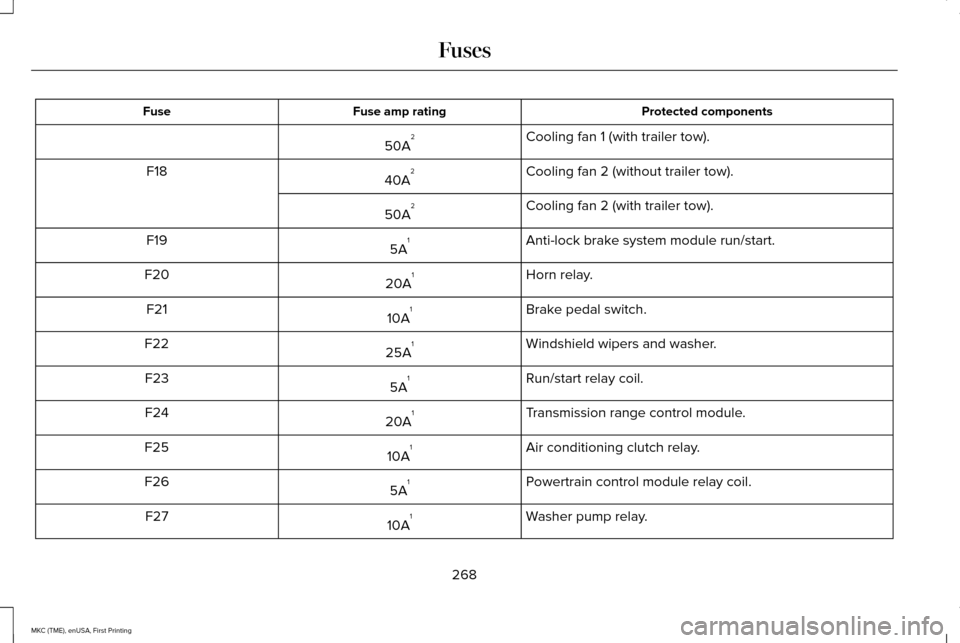
Protected components
Fuse amp rating
Fuse
Cooling fan 1 (with trailer tow).
50A 2
Cooling fan 2 (without trailer tow).
40A 2
F18
Cooling fan 2 (with trailer tow).
50A 2
Anti-lock brake system module run/start.
5A 1
F19
Horn relay.
20A 1
F20
Brake pedal switch.
10A 1
F21
Windshield wipers and washer.
25A 1
F22
Run/start relay coil.
5A 1
F23
Transmission range control module.
20A 1
F24
Air conditioning clutch relay.
10A 1
F25
Powertrain control module relay coil.
5A 1
F26
Washer pump relay.
10A 1
F27
268
MKC (TME), enUSA, First Printing Fuses
Page 272 of 432
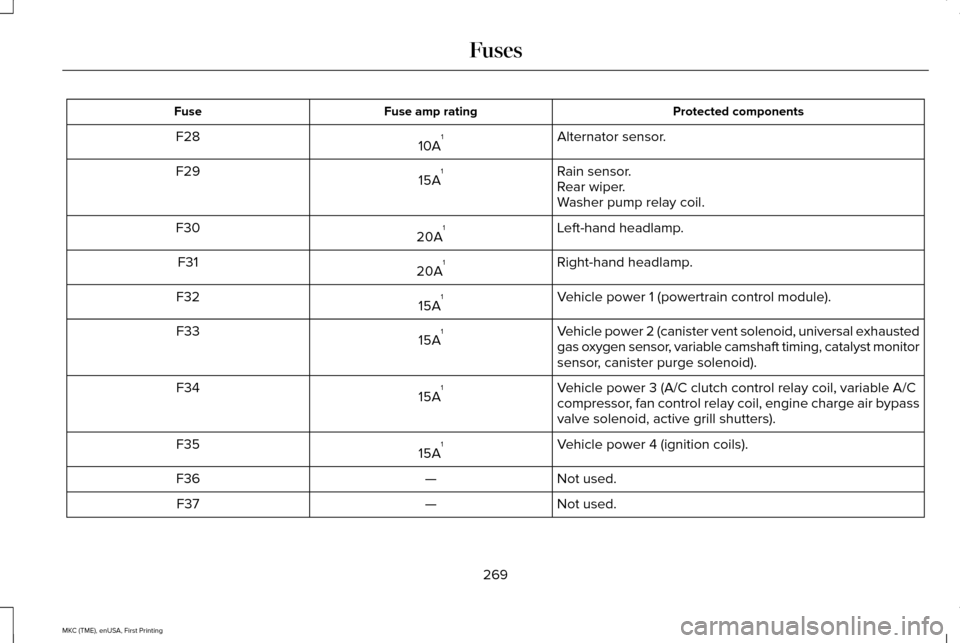
Protected components
Fuse amp rating
Fuse
Alternator sensor.
10A 1
F28
Rain sensor.
15A 1
F29
Rear wiper.
Washer pump relay coil.
Left-hand headlamp.
20A 1
F30
Right-hand headlamp.
20A 1
F31
Vehicle power 1 (powertrain control module).
15A 1
F32
Vehicle power 2 (canister vent solenoid, universal exhausted
gas oxygen sensor, variable camshaft timing, catalyst monitor
sensor, canister purge solenoid).
15A
1
F33
Vehicle power 3 (A/C clutch control relay coil, variable A/C
compressor, fan control relay coil, engine charge air bypass
valve solenoid, active grill shutters).
15A
1
F34
Vehicle power 4 (ignition coils).
15A 1
F35
Not used.
—
F36
Not used.
—
F37
269
MKC (TME), enUSA, First Printing Fuses
Page 274 of 432
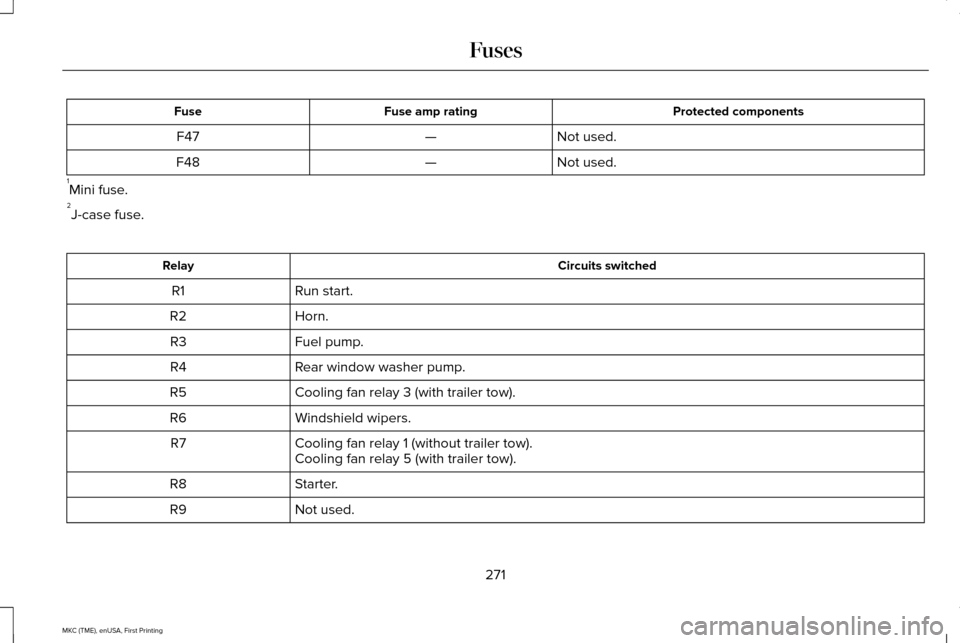
Protected components
Fuse amp rating
Fuse
Not used.
—
F47
Not used.
—
F48
1 Mini fuse.
2 J-case fuse. Circuits switched
Relay
Run start.
R1
Horn.
R2
Fuel pump.
R3
Rear window washer pump.
R4
Cooling fan relay 3 (with trailer tow).
R5
Windshield wipers.
R6
Cooling fan relay 1 (without trailer tow).
R7
Cooling fan relay 5 (with trailer tow).
Starter.
R8
Not used.
R9
271
MKC (TME), enUSA, First Printing Fuses
Page 288 of 432
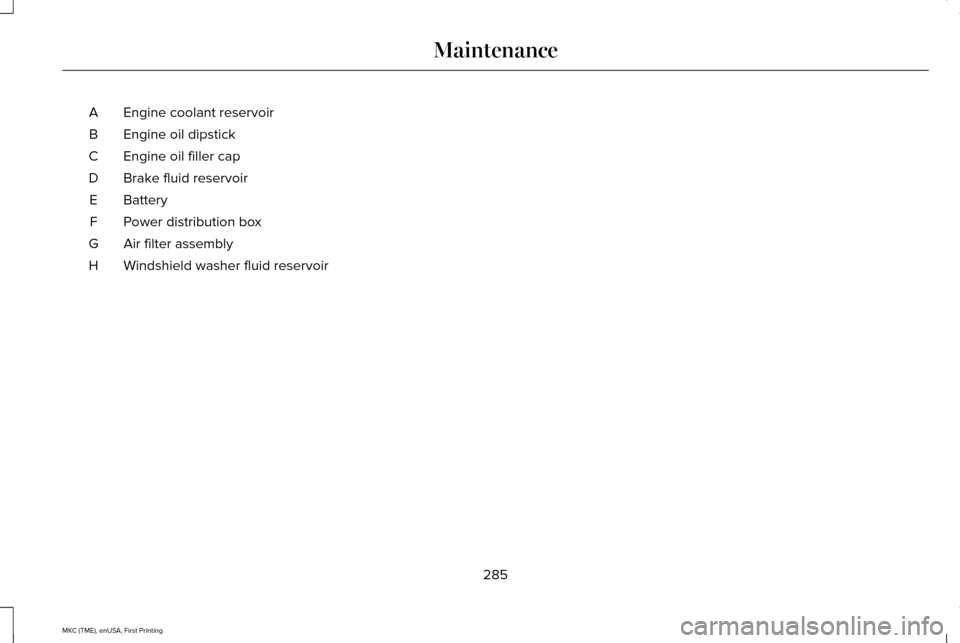
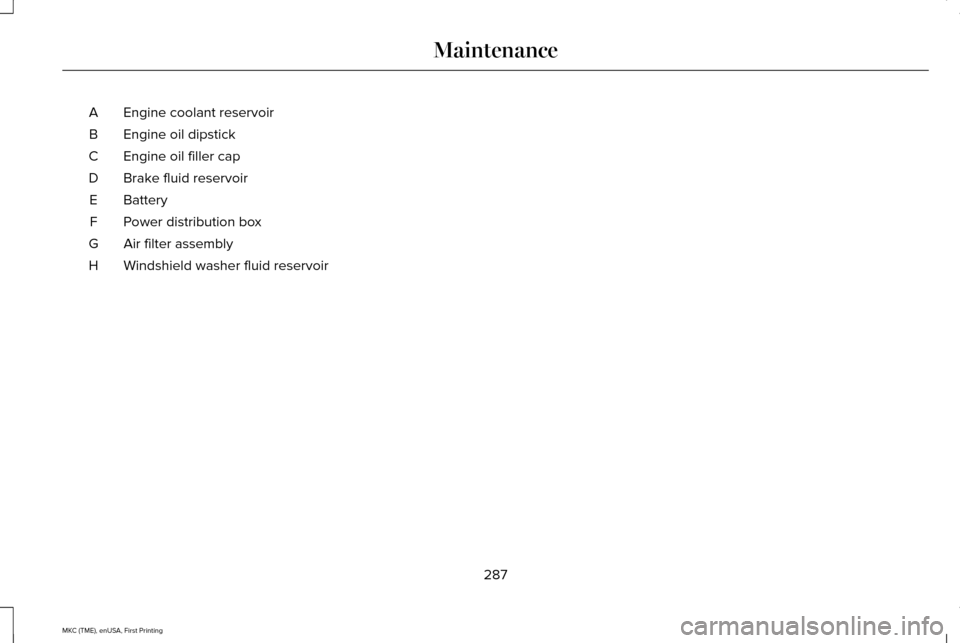
Engine coolant reservoir
A
Engine oil dipstick
B
Engine oil filler cap
C
Brake fluid reservoir
D
Battery
E
Power distribution box
F
Air filter assembly
G
Windshield washer fluid reservoir
H
285
MKC (TME), enUSA, First Printing Maintenance
Page 290 of 432
Engine coolant reservoir
A
Engine oil dipstick
B
Engine oil filler cap
C
Brake fluid reservoir
D
Battery
E
Power distribution box
F
Air filter assembly
G
Windshield washer fluid reservoir
H
287
MKC (TME), enUSA, First Printing Maintenance
Page 292 of 432
WARNINGS
Do not remove the filler cap when the
engine is running.
1. Remove the engine oil filler cap.
2. Add engine oil that meets Ford
specifications. See Capacities and
Specifications (page 342).
3. Wipe off any spilled oil.
4. Replace the engine oil filler cap. Turn it clockwise until you feel a strong
resistance.
Note: Do not add oil further than the
maximum mark. Oil levels above the
maximum mark may cause engine damage.
Note: Soak up any spillage with an
absorbent cloth immediately.
OIL CHANGE INDICATOR RESET
Use the information display controls on the
steering wheel to reset the oil change
indicator. From the main menu scroll to: Action and description
Message
Press the right arrow button,
then from this menu scroll to
the following message.
Settings
Press the right arrow button,
then from this menu scroll to
the following message.
Vehicle
Press the right arrow button,
then from this menu scroll to
the following message.
Oil Life
Press and hold the OK button
until the instrument cluster
displays the following
message.
Hold OK to
Reset
Reset Successful
When the oil change indicator
resets the instrument cluster
displays 100%.
Remaining Life
{00}% Action and description
Message
If the instrument cluster
displays one of the following
messages, repeat the
process.
Not Reset
Reset Cancelled
ENGINE COOLANT CHECK
Checking the Engine Coolant WARNINGS
Do not add engine coolant when the
engine is hot. Steam and scalding
liquids released from a hot cooling system
can burn you badly. Also, you can be burned
if you spill coolant on hot engine parts. Do not put engine coolant in the
windshield washer fluid container. If
sprayed on the windshield, engine coolant
could make it difficult to see through the
windshield.
289
MKC (TME), enUSA, First Printing Maintenance
Page 293 of 432
WARNINGS
To reduce the risk of personal injury,
make sure the engine is cool before
unscrewing the coolant pressure relief cap.
The cooling system is under pressure; steam
and hot liquid can come out forcefully when
the cap is loosened slightly. Do not add coolant further than the
MAX mark.
Note:
Automotive fluids are not
interchangeable. Do not use engine coolant
or antifreeze or windshield washer fluid
outside of its specified function and vehicle
location.
Note: Do not use stop leak pellets, cooling
system sealants, or additives as they can
cause damage to the engine cooling or
heating systems. This damage would not be
covered under your vehicle ’s warranty. Note:
During normal vehicle operation, the
engine coolant may change color from
orange to pink or light red. As long as the
engine coolant is clear and uncontaminated,
this color change does not indicate the
engine coolant has degraded nor does it
require the engine coolant to be drained,
the system to be flushed, or the engine
coolant to be replaced.
When the engine is cold, check the
concentration and level of the engine coolant
at the intervals listed in the scheduled
maintenance information. See Scheduled
Maintenance (page 367).
Note: Make sure that the level is between
the MIN and MAX marks on the coolant
reservoir.
Note: Coolant expands when it is hot. The
level may extend beyond the MAX mark.
Note: If the level is at the MIN mark, below
the MIN mark, or empty, add coolant
immediately. See
Adding Engine Coolant
in this chapter. The coolant concentration should be
maintained within 48% to 50%, which
equates to a freeze point between -30°F
(-34°C) and -34°F (-37°C).
Note:
For best results, coolant concentration
should be tested with a refractometer such
as Robinair® Coolant and Battery
Refractometer 75240. We do not
recommend the use of hydrometers or
coolant test strips for measuring coolant
concentrations.
290
MKC (TME), enUSA, First Printing Maintenance
Page 296 of 432
You have limited engine power when in the
fail-safe mode, so drive your vehicle with
caution. Your vehicle will not be able to
maintain high-speed operation and the
engine will run rough. Remember that the
engine is capable of completely shutting
down automatically to prevent engine
damage, therefore:
1. Pull off the road as soon as safely
possible and switch the engine off.
2. Arrange for your vehicle to be taken to an authorized dealer.
3. If this is not possible, wait a short period
for the engine to cool.
4. Check the coolant level and replenish if low.
5. Re-start the engine and take your vehicle
to an authorized dealer.
Note: Driving your vehicle without repairing
the engine problem increases the chance of
engine damage. Take your vehicle to an
authorized dealer as soon as possible. AUTOMATIC TRANSMISSION
FLUID CHECK
The automatic transmission does not have
a transmission fluid dipstick.
The automatic transmission does not
consume fluid. However, the fluid level
should be checked if the transmission is not
working properly, for example if the
transmission slips or shifts slowly or if you
notice some sign of fluid leakage.
Note:
Transmission fluid should be checked
by an authorized dealer. If required, fluid
should be added by an authorized dealer.
Do not use supplemental transmission fluid
additives, treatments or cleaning agents. The
use of these materials may affect
transmission operation and result in damage
to internal transmission components. BRAKE FLUID CHECK
Fluid levels between the MIN and MAX lines
are within the normal operating range; there
is no need to add fluid. If the fluid levels are
outside of the normal operating range, the
performance of the system could be
compromised; seek service from your
authorized dealer immediately.
WASHER FLUID CHECK
WARNING
If you operate your vehicle in
temperatures below 40°F (5°C), use
washer fluid with antifreeze protection.
Failure to use washer fluid with antifreeze
protection in cold weather could result in
impaired windshield vision and increase the
risk of injury or accident. Note:
The front and rear washer systems
are supplied from the same reservoir.
293
MKC (TME), enUSA, First Printing Maintenance
Page 297 of 432
Add fluid to fill the reservoir if the level is low.
Only use a washer fluid that meets Ford
specifications. See Capacities and
Specifications (page 342).
State or local regulations on volatile organic
compounds may restrict the use of methanol,
a common windshield washer antifreeze
additive. Washer fluids containing
non-methanol antifreeze agents should be
used only if they provide cold weather
protection without damaging the vehicle ’s
paint finish, wiper blades or washer system.
FUEL FILTER
Your vehicle is equipped with a lifetime fuel
filter that is integrated with the fuel tank.
Regular maintenance or replacement is not
needed. CHANGING THE 12V BATTERY WARNINGS
Batteries normally produce explosive
gases which can cause personal injury.
Therefore, do not allow flames, sparks or
lighted substances to come near the battery.
When working near the battery, always shield
your face and protect your eyes. Always
provide proper ventilation. When lifting a plastic-cased battery,
excessive pressure on the end walls
could cause acid to flow through the vent
caps, resulting in personal injury and damage
to the vehicle or battery. Lift the battery with
a battery carrier or with your hands on
opposite corners. WARNINGS
Keep batteries out of reach of children.
Batteries contain sulfuric acid. Avoid
contact with skin, eyes or clothing. Shield
your eyes when working near the battery to
protect against possible splashing of acid
solution. In case of acid contact with skin or
eyes, flush immediately with water for a
minimum of 15 minutes and get prompt
medical attention. If acid is swallowed, call a
physician immediately. Your vehicle is equipped with a Motorcraft®
maintenance-free battery which normally
does not require additional water during its
life of service.
Note:
If your battery has a cover or shield,
make sure it is reinstalled after the battery
has been cleaned or replaced.
Note: See an authorized dealer for low
voltage battery access, testing, or
replacement.
294
MKC (TME), enUSA, First Printing Maintenance
Page 299 of 432
7. While the engine is running, step on the
brake pedal and shift the transmission to
N.
8. Allow the engine to run for at least one minute by pressing on the accelerator
pedal.
9. Drive your vehicle at least 10 miles (16 kilometers) to completely relearn the idle
and fuel trim strategy.
Note: Certain features may not operate if
the Battery Monitor System is not reset with
a scan tool following a jump start or battery
replacement. Normal electrical accessory
operation should resume after your vehicle
is left undisturbed for 8 hours.
Note: If you do not allow the engine to
relearn the idle and fuel trim strategy, the
idle quality of your vehicle may be adversely
affected until the engine computer
eventually relearns the idle trim and fuel trim
strategy. Note:
Always dispose of automotive
batteries in a responsible manner. Follow
your local authorized standards for disposal.
Call your local authorized recycling center
to find out more about recycling automotive
batteries.
Note: It is recommended that the negative
battery cable terminal be disconnected from
the battery if you plan to store your vehicle
for an extended period of time.
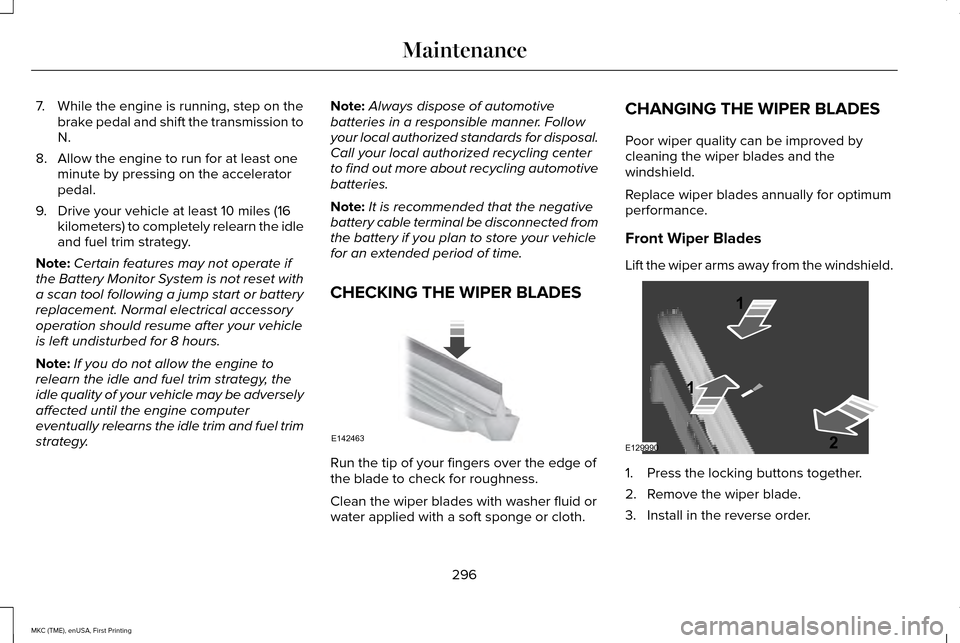
CHECKING THE WIPER BLADES Run the tip of your fingers over the edge of
the blade to check for roughness.
Clean the wiper blades with washer fluid or
water applied with a soft sponge or cloth.CHANGING THE WIPER BLADES
Poor wiper quality can be improved by
cleaning the wiper blades and the
windshield.
Replace wiper blades annually for optimum
performance.
Front Wiper Blades
Lift the wiper arms away from the windshield.
1. Press the locking buttons together.
2. Remove the wiper blade.
3. Install in the reverse order.
296
MKC (TME), enUSA, First Printing MaintenanceE142463 E129990
1
1 2