air conditioning LINCOLN MKC 2016 Owners Manual
[x] Cancel search | Manufacturer: LINCOLN, Model Year: 2016, Model line: MKC, Model: LINCOLN MKC 2016Pages: 432, PDF Size: 4.89 MB
Page 11 of 432
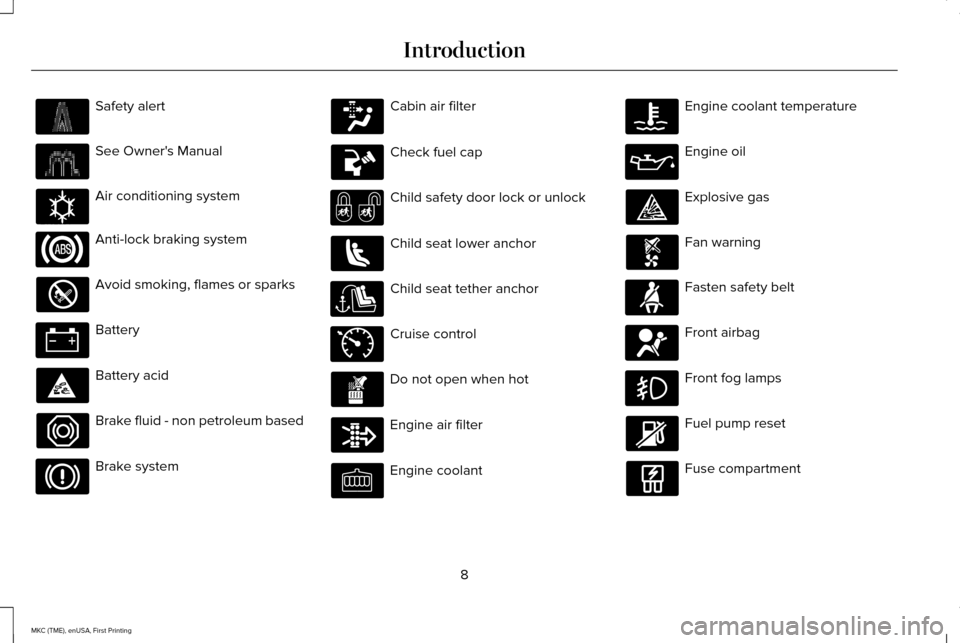
Safety alert
See Owner's Manual
Air conditioning system
Anti-lock braking system
Avoid smoking, flames or sparks
Battery
Battery acid
Brake fluid - non petroleum based
Brake system Cabin air filter
Check fuel cap
Child safety door lock or unlock
Child seat lower anchor
Child seat tether anchor
Cruise control
Do not open when hot
Engine air filter
Engine coolant Engine coolant temperature
Engine oil
Explosive gas
Fan warning
Fasten safety belt
Front airbag
Front fog lamps
Fuel pump reset
Fuse compartment
8
MKC (TME), enUSA, First Printing Introduction E162384 E71340
Page 137 of 432
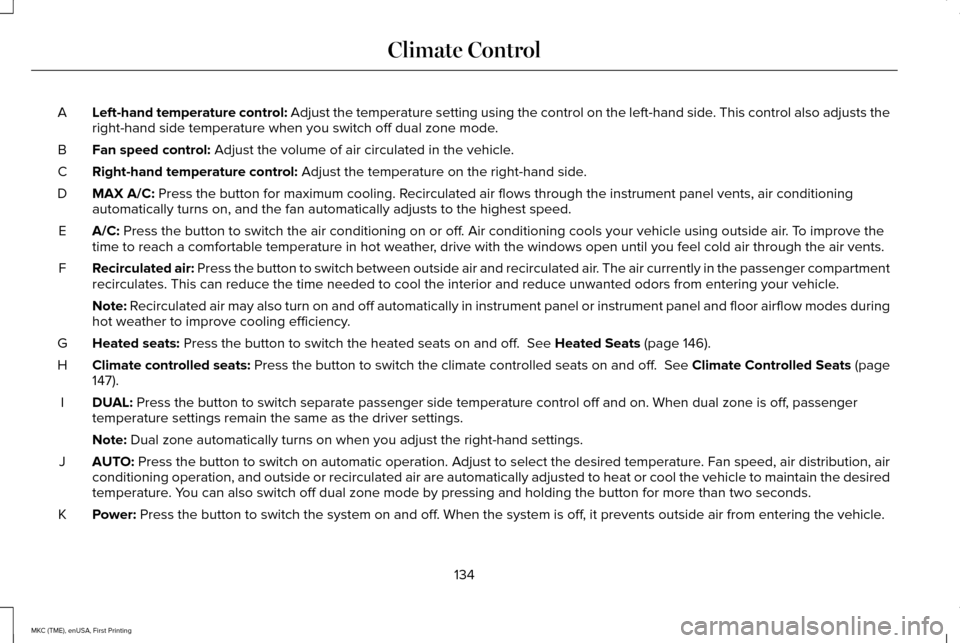
Left-hand temperature control: Adjust the temperature setting using the control on the left-hand side. This control also adjusts the
right-hand side temperature when you switch off dual zone mode.
A
Fan speed control: Adjust the volume of air circulated in the vehicle.
B
Right-hand temperature control:
Adjust the temperature on the right-hand side.
C
MAX A/C:
Press the button for maximum cooling. Recirculated air flows through the instrument panel vents, air conditioni\
ng
automatically turns on, and the fan automatically adjusts to the highest\
speed.
D
A/C:
Press the button to switch the air conditioning on or off. Air conditioning cools your vehicle using outside air. To improve the
time to reach a comfortable temperature in hot weather, drive with the windows open until you feel cold air through the air ve\
nts.
E
Recirculated air: Press the button to switch between outside air and recirculated air. The air currently in the passenger compartment
recirculates. This can reduce the time needed to cool the interior and r\
educe unwanted odors from entering your vehicle.
F
Note:
Recirculated air may also turn on and off automatically in instrument pan\
el or instrument panel and floor airflow modes during
hot weather to improve cooling efficiency.
Heated seats:
Press the button to switch the heated seats on and off. See Heated Seats (page 146).
G
Climate controlled seats:
Press the button to switch the climate controlled seats on and off. See Climate Controlled Seats (page
147).
H
DUAL:
Press the button to switch separate passenger side temperature control \
off and on. When dual zone is off, passenger
temperature settings remain the same as the driver settings.
I
Note:
Dual zone automatically turns on when you adjust the right-hand setting\
s.
AUTO:
Press the button to switch on automatic operation. Adjust to select the\
desired temperature. Fan speed, air distribution, air
conditioning operation, and outside or recirculated air are automaticall\
y adjusted to heat or cool the vehicle to maintain the desired
temperature. You can also switch off dual zone mode by pressing and holding the button\
for more than two seconds.
J
Power:
Press the button to switch the system on and off. When the system is off, it prevents outside air from entering the vehicle.
K
134
MKC (TME), enUSA, First Printing Climate Control
Page 182 of 432
When driving at slow speeds off road under
high load conditions, use a low gear when
possible. Low gear operation will maximize
the engine and transmission cooling
capability.
Under severe operating conditions, the air
conditioning may cycle on and off to prevent
the engine from overheating.
Basic Operating Principles
•
Drive slower in strong crosswinds that
can affect the normal steering
characteristics of your vehicle.
• When driving your vehicle on surfaces
made slippery by loose sand, water,
gravel, snow or ice proceed with care.
If Your Vehicle leaves the Road
If your vehicle leaves the road, reduce your
vehicle speed and avoid severe braking.
Once you have reduced your vehicle speed,
ease your vehicle back onto the road. Do
not turn the steering wheel sharply while
returning your vehicle to the road. It may be safer to stay on the shoulder of the
road and slow down gradually before
returning to the road. You may lose control
if you do not slow down or if you turn the
steering wheel too sharply or abruptly.
It may be less risky to strike small objects,
such as freeway reflectors, with minor
damage to your vehicle rather than attempt
an abrupt dangerous direction change.
Remember, your primary concern should be
your safety and the safety of others.
Emergency Maneuvers
If you must make a sudden emergency
direction change, avoid over-driving your
vehicle. Turn the steering wheel only as
rapidly and as far as you need to avoid the
emergency. Apply smooth pressure to the
accelerator pedal or brake pedal as needed.
Avoid abrupt steering, acceleration and
braking changes. Abrupt changes could
increase the risk of vehicle roll over, loss of
vehicle control and personal injury. Use all
available road surface to bring your vehicle
to under control.In the event of an emergency stop, avoid
skidding and do not attempt any sharp
steering wheel movements.
Your vehicle responds differently to steering,
accelerating and braking on different road
surfaces when changing from one type of
surface to another.
Sand
When driving over sand, avoid driving at
excessive speeds. This will cause your
vehicle momentum to work against you. Your
vehicle could become stuck that may require
assistance from another vehicle. Remember,
if you proceed with caution you may be able
to back out the way you came.
Do not drive in deep sand for an extended
period. This will cause the all-wheel drive
system to overheat. You will see a warning
message in the information display. See
Information Messages (page 115).
179
MKC (TME), enUSA, First Printing All-Wheel Drive
(If Equipped)
Page 271 of 432
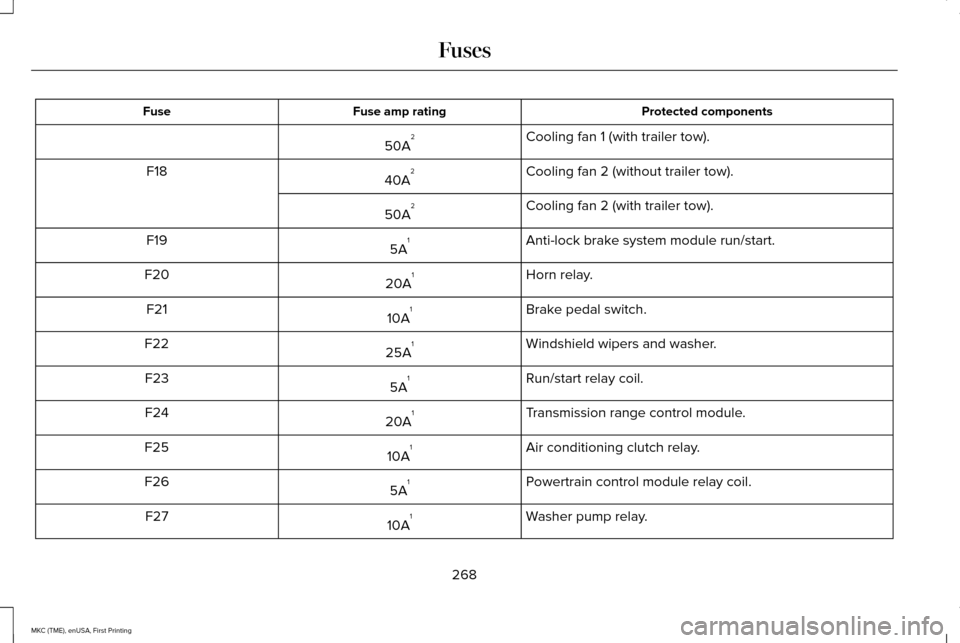
Protected components
Fuse amp rating
Fuse
Cooling fan 1 (with trailer tow).
50A 2
Cooling fan 2 (without trailer tow).
40A 2
F18
Cooling fan 2 (with trailer tow).
50A 2
Anti-lock brake system module run/start.
5A 1
F19
Horn relay.
20A 1
F20
Brake pedal switch.
10A 1
F21
Windshield wipers and washer.
25A 1
F22
Run/start relay coil.
5A 1
F23
Transmission range control module.
20A 1
F24
Air conditioning clutch relay.
10A 1
F25
Powertrain control module relay coil.
5A 1
F26
Washer pump relay.
10A 1
F27
268
MKC (TME), enUSA, First Printing Fuses
Page 275 of 432
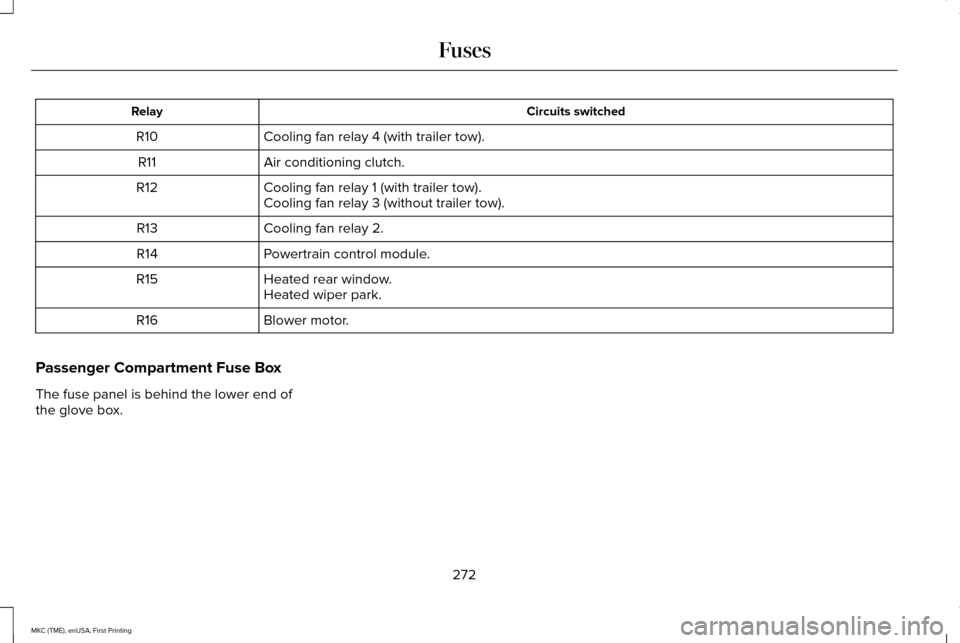
Circuits switched
Relay
Cooling fan relay 4 (with trailer tow).
R10
Air conditioning clutch.
R11
Cooling fan relay 1 (with trailer tow).
R12
Cooling fan relay 3 (without trailer tow).
Cooling fan relay 2.
R13
Powertrain control module.
R14
Heated rear window.
R15
Heated wiper park.
Blower motor.
R16
Passenger Compartment Fuse Box
The fuse panel is behind the lower end of
the glove box.
272
MKC (TME), enUSA, First Printing Fuses
Page 295 of 432
If you drive in extremely hot climates:
•
It may be necessary to have a Ford
authorized dealer decrease the coolant
concentration to 40%.
• A coolant concentration of 40% will
provide improved overheat protection.
Engine coolant concentrations below
40% will decrease the freeze and
corrosion protection characteristics of
the engine coolant and may cause
engine damage.
Vehicles driven year-round in non-extreme
climates should use prediluted engine
coolant for optimum cooling system and
engine protection.
What You Should Know About Fail-Safe
Cooling
If the engine coolant supply is depleted, this
feature allows the vehicle to be driven
temporarily before incremental component
damage is incurred. The “fail-safe ” distance
depends on ambient temperatures, vehicle
load and terrain. How Fail-Safe Cooling Works
If the engine begins to overheat, the engine
coolant temperature gauge will move to the
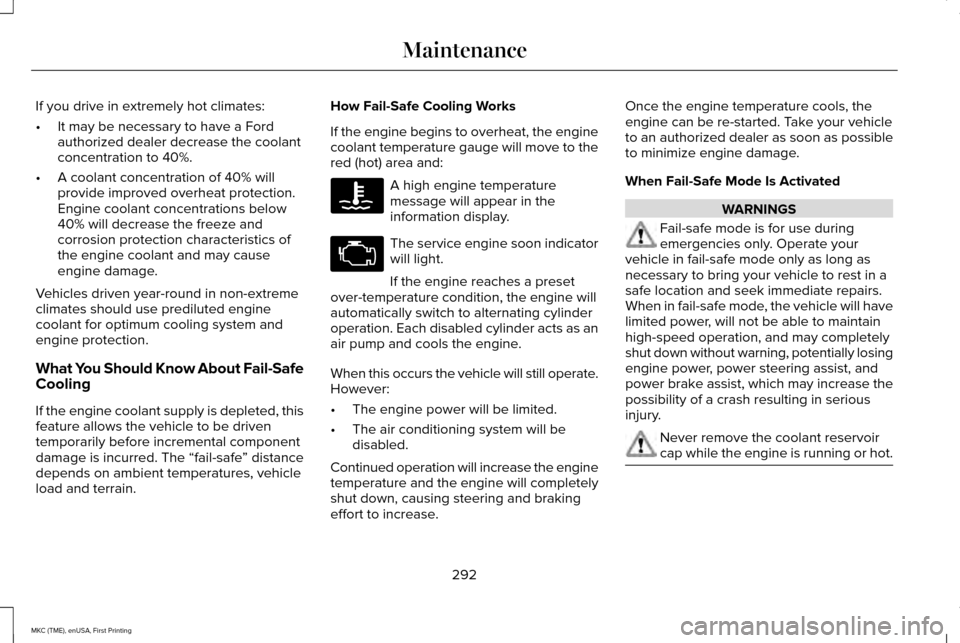
red (hot) area and: A high engine temperature
message will appear in the
information display.
The service engine soon indicator
will light.
If the engine reaches a preset
over-temperature condition, the engine will
automatically switch to alternating cylinder
operation. Each disabled cylinder acts as an
air pump and cools the engine.
When this occurs the vehicle will still operate.
However:
• The engine power will be limited.
• The air conditioning system will be
disabled.
Continued operation will increase the engine
temperature and the engine will completely
shut down, causing steering and braking
effort to increase. Once the engine temperature cools, the
engine can be re-started. Take your vehicle
to an authorized dealer as soon as possible
to minimize engine damage.
When Fail-Safe Mode Is Activated
WARNINGS
Fail-safe mode is for use during
emergencies only. Operate your
vehicle in fail-safe mode only as long as
necessary to bring your vehicle to rest in a
safe location and seek immediate repairs.
When in fail-safe mode, the vehicle will have
limited power, will not be able to maintain
high-speed operation, and may completely
shut down without warning, potentially losing
engine power, power steering assist, and
power brake assist, which may increase the
possibility of a crash resulting in serious
injury. Never remove the coolant reservoir
cap while the engine is running or hot.
292
MKC (TME), enUSA, First Printing Maintenance
Page 349 of 432

CAPACITIES AND SPECIFICATIONS - 2.0L ECOBOOST™
Capacities
WARNING
The air conditioning refrigerant system contains refrigerant R-134a unde\
r high pressure. Only qualified personnel should service the air
conditioning refrigerant system. Opening the air conditioning refrigeran\
t system can cause personal injury.
Capacity
Item
5.7 qt (5.4 L)
Engine oil
9.7 qt (9.2 L)
Engine coolant
Between MIN/MAX on brake fluid reservoir
Brake fluid
2.4 pt (1.15L)
Rear differential (All Wheel Drive) fluid
17.9 fl oz (0.53 L)
Power Transfer Unit (PTU) fluid (All Wheel Drive)
9.0 qt (8.5 L)*
Automatic transmission fluid
Fill as required
Windshield washer fluid
15.5 gal (58.5 L)
Fuel tank
24 oz (0.68 kg)
A/C refrigerant
4.6 fl oz (136 ml)
A/C refrigerant compressor oil
* Approximate dry fill capacity. Actual amount may vary during fluid changes.
346
MKC (TME), enUSA, First Printing Capacities and Specifications
Page 354 of 432
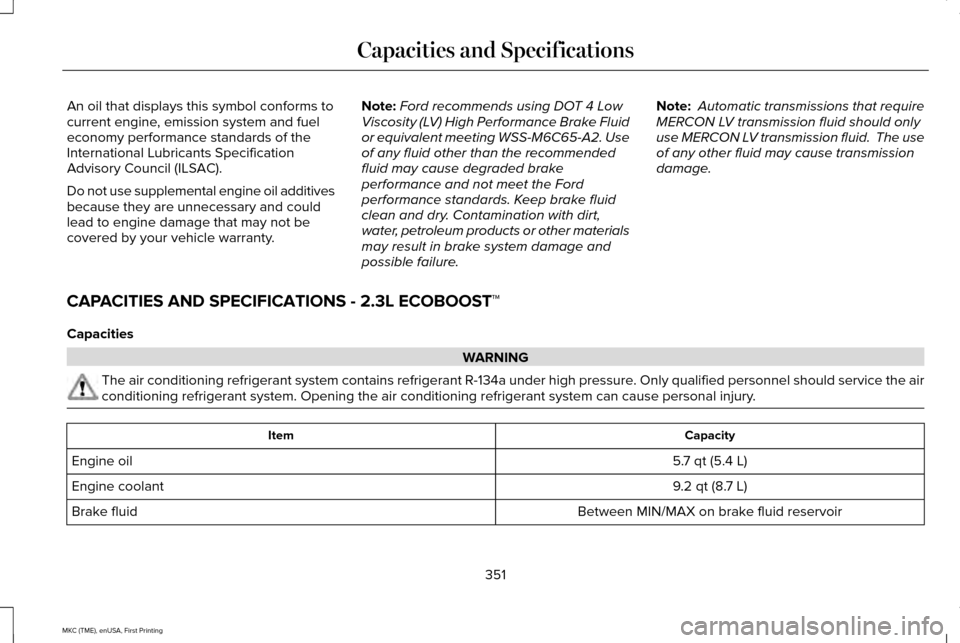
An oil that displays this symbol conforms to
current engine, emission system and fuel
economy performance standards of the
International Lubricants Specification
Advisory Council (ILSAC).
Do not use supplemental engine oil additives
because they are unnecessary and could
lead to engine damage that may not be
covered by your vehicle warranty.
Note:
Ford recommends using DOT 4 Low
Viscosity (LV) High Performance Brake Fluid
or equivalent meeting WSS-M6C65-A2. Use
of any fluid other than the recommended
fluid may cause degraded brake
performance and not meet the Ford
performance standards. Keep brake fluid
clean and dry. Contamination with dirt,
water, petroleum products or other materials
may result in brake system damage and
possible failure. Note:
Automatic transmissions that require
MERCON LV transmission fluid should only
use MERCON LV transmission fluid. The use
of any other fluid may cause transmission
damage.
CAPACITIES AND SPECIFICATIONS - 2.3L ECOBOOST™
Capacities WARNING
The air conditioning refrigerant system contains refrigerant R-134a unde\
r high pressure. Only qualified personnel should service the air
conditioning refrigerant system. Opening the air conditioning refrigeran\
t system can cause personal injury.
Capacity
Item
5.7 qt (5.4 L)
Engine oil
9.2 qt (8.7 L)
Engine coolant
Between MIN/MAX on brake fluid reservoir
Brake fluid
351
MKC (TME), enUSA, First Printing Capacities and Specifications
Page 373 of 432
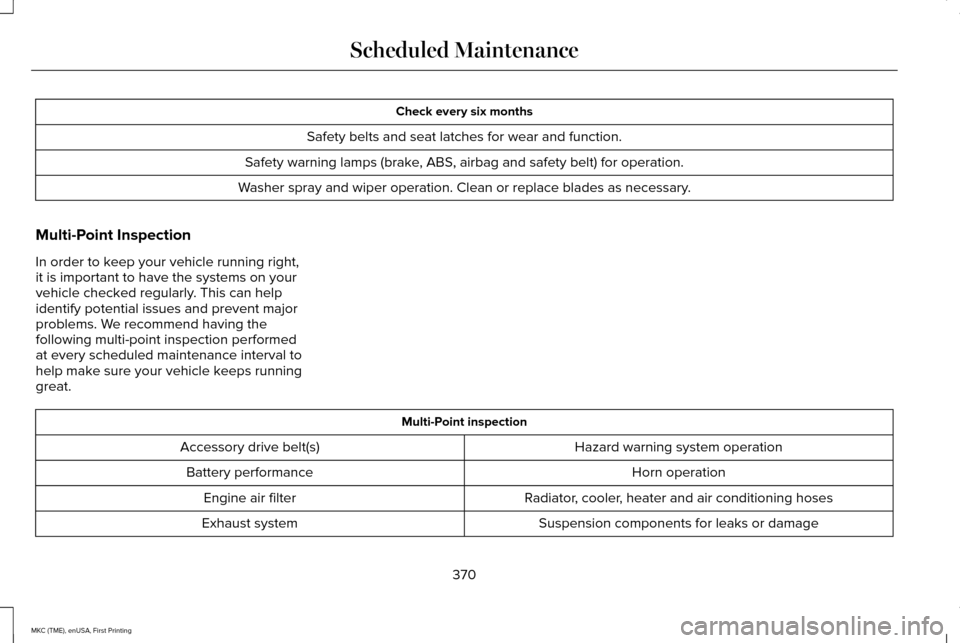
Check every six months
Safety belts and seat latches for wear and function.
Safety warning lamps (brake, ABS, airbag and safety belt) for operation.
Washer spray and wiper operation. Clean or replace blades as necessary.
Multi-Point Inspection
In order to keep your vehicle running right,
it is important to have the systems on your
vehicle checked regularly. This can help
identify potential issues and prevent major
problems. We recommend having the
following multi-point inspection performed
at every scheduled maintenance interval to
help make sure your vehicle keeps running
great. Multi-Point inspection
Hazard warning system operation
Accessory drive belt(s)
Horn operation
Battery performance
Radiator, cooler, heater and air conditioning hoses
Engine air filter
Suspension components for leaks or damage
Exhaust system
370
MKC (TME), enUSA, First Printing Scheduled Maintenance
Page 422 of 432
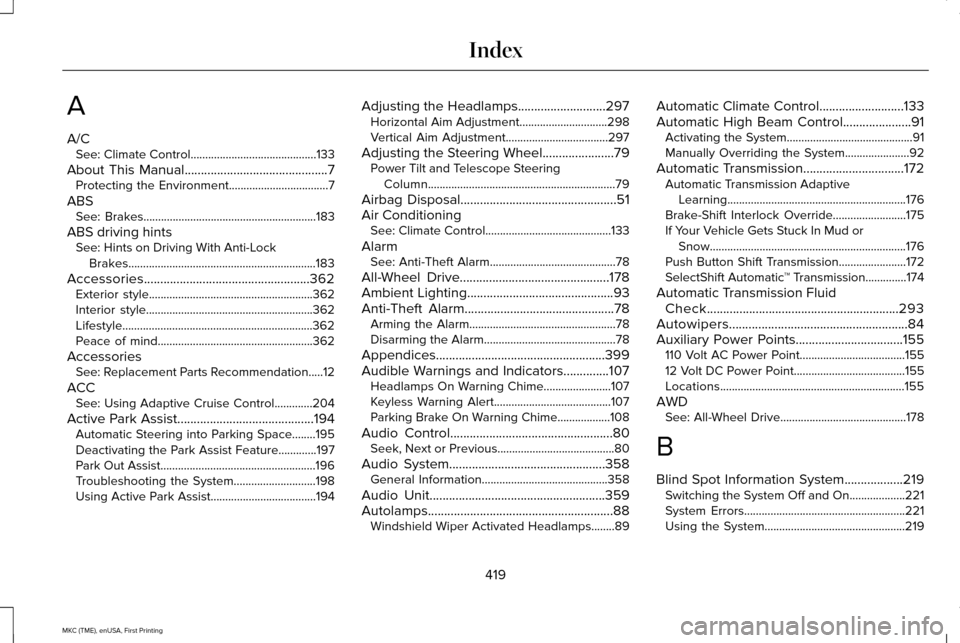
A
A/C
See: Climate Control...........................................133
About This Manual............................................7
Protecting the Environment..................................7
ABS See: Brakes...........................................................183
ABS driving hints See: Hints on Driving With Anti-Lock
Brakes................................................................183
Accessories...................................................362 Exterior style........................................................362
Interior style.........................................................362
Lifestyle.................................................................362
Peace of mind.....................................................362
Accessories See: Replacement Parts Recommendation.....12
ACC See: Using Adaptive Cruise Control.............204
Active Park Assist..........................................194 Automatic Steering into Parking Space........195
Deactivating the Park Assist Feature.............197
Park Out Assist.....................................................196
Troubleshooting the System............................198
Using Active Park Assist....................................194 Adjusting the Headlamps...........................297
Horizontal Aim Adjustment..............................
298
Vertical Aim Adjustment...................................297
Adjusting the Steering Wheel......................79 Power Tilt and Telescope Steering
Column................................................................79
Airbag Disposal
................................................51
Air Conditioning See: Climate Control...........................................133
Alarm See: Anti-Theft Alarm...........................................78
All-Wheel Drive
..............................................178
Ambient Lighting.............................................93
Anti-Theft Alarm..............................................78 Arming the Alarm..................................................78
Disarming the Alarm.............................................78
Appendices....................................................399
Audible Warnings and Indicators..............107 Headlamps On Warning Chime.......................
107
Keyless Warning Alert........................................107
Parking Brake On Warning Chime..................108
Audio Control
..................................................80
Seek, Next or Previous........................................80
Audio System................................................358 General Information...........................................358
Audio Unit......................................................359
Autolamps.........................................................88 Windshield Wiper Activated Headlamps........89 Automatic Climate Control..........................133
Automatic High Beam Control.....................91
Activating the System...........................................91
Manually Overriding the System......................92
Automatic Transmission
...............................172
Automatic Transmission Adaptive
Learning.............................................................176
Brake-Shift Interlock Override.........................175
If Your Vehicle Gets Stuck In Mud or Snow...................................................................176
Push Button Shift Transmission.......................172
SelectShift Automatic ™ Transmission..............174
Automatic Transmission Fluid Check...........................................................293
Autowipers.......................................................84
Auxiliary Power Points.................................155 110 Volt AC Power Point....................................155
12 Volt DC Power Point......................................155
Locations...............................................................155
AWD See: All-Wheel Drive...........................................178
B
Blind Spot Information System..................219 Switching the System Off and On...................221
System Errors.......................................................221
Using the System................................................219
419
MKC (TME), enUSA, First Printing Index