child restraint LINCOLN MKC 2019 User Guide
[x] Cancel search | Manufacturer: LINCOLN, Model Year: 2019, Model line: MKC, Model: LINCOLN MKC 2019Pages: 581, PDF Size: 5.41 MB
Page 31 of 581
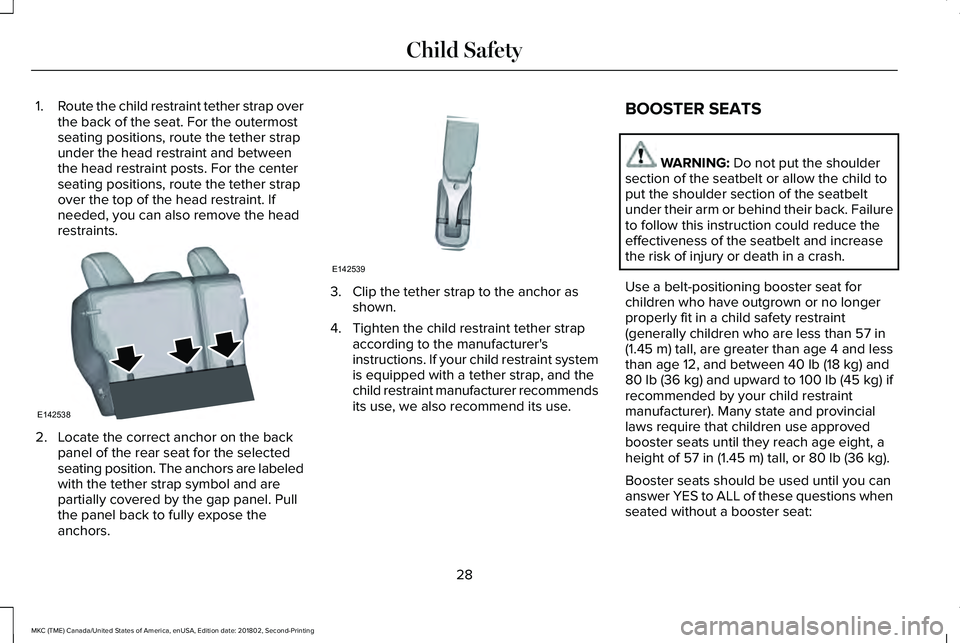
1.Route the child restraint tether strap overthe back of the seat. For the outermostseating positions, route the tether strapunder the head restraint and betweenthe head restraint posts. For the centerseating positions, route the tether strapover the top of the head restraint. Ifneeded, you can also remove the headrestraints.
2. Locate the correct anchor on the backpanel of the rear seat for the selectedseating position. The anchors are labeledwith the tether strap symbol and arepartially covered by the gap panel. Pullthe panel back to fully expose theanchors.
3. Clip the tether strap to the anchor asshown.
4. Tighten the child restraint tether strapaccording to the manufacturer'sinstructions. If your child restraint systemis equipped with a tether strap, and thechild restraint manufacturer recommendsits use, we also recommend its use.
BOOSTER SEATS
WARNING: Do not put the shouldersection of the seatbelt or allow the child toput the shoulder section of the seatbeltunder their arm or behind their back. Failureto follow this instruction could reduce theeffectiveness of the seatbelt and increasethe risk of injury or death in a crash.
Use a belt-positioning booster seat forchildren who have outgrown or no longerproperly fit in a child safety restraint(generally children who are less than 57 in(1.45 m) tall, are greater than age 4 and lessthan age 12, and between 40 lb (18 kg) and80 lb (36 kg) and upward to 100 lb (45 kg) ifrecommended by your child restraintmanufacturer). Many state and provinciallaws require that children use approvedbooster seats until they reach age eight, aheight of 57 in (1.45 m) tall, or 80 lb (36 kg).
Booster seats should be used until you cananswer YES to ALL of these questions whenseated without a booster seat:
28
MKC (TME) Canada/United States of America, enUSA, Edition date: 201802, Second-Printing
Child SafetyE142538 E142539
Page 32 of 581
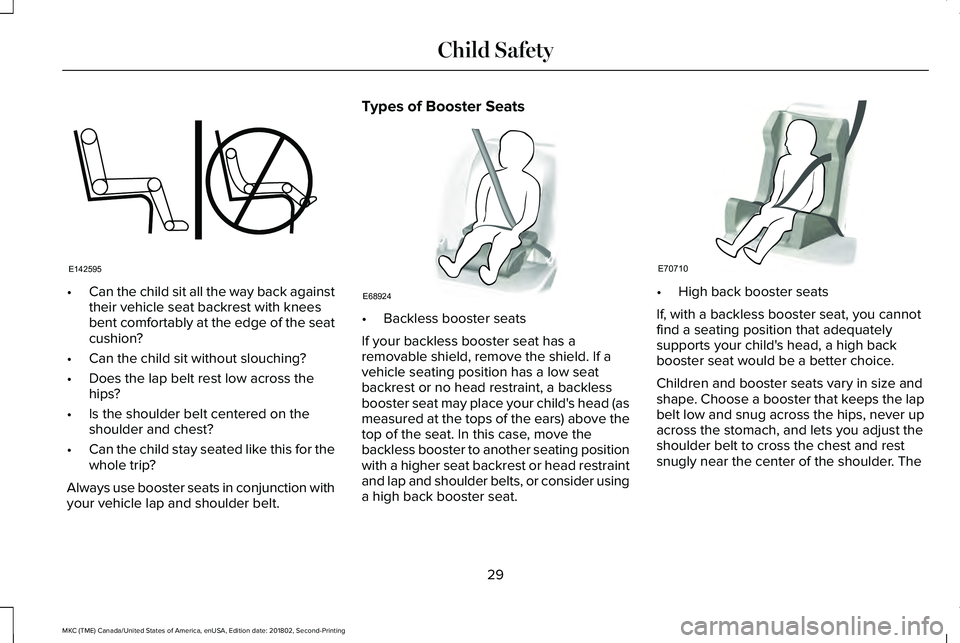
•Can the child sit all the way back againsttheir vehicle seat backrest with kneesbent comfortably at the edge of the seatcushion?
•Can the child sit without slouching?
•Does the lap belt rest low across thehips?
•Is the shoulder belt centered on theshoulder and chest?
•Can the child stay seated like this for thewhole trip?
Always use booster seats in conjunction withyour vehicle lap and shoulder belt.
Types of Booster Seats
•Backless booster seats
If your backless booster seat has aremovable shield, remove the shield. If avehicle seating position has a low seatbackrest or no head restraint, a backlessbooster seat may place your child's head (asmeasured at the tops of the ears) above thetop of the seat. In this case, move thebackless booster to another seating positionwith a higher seat backrest or head restraintand lap and shoulder belts, or consider usinga high back booster seat.
•High back booster seats
If, with a backless booster seat, you cannotfind a seating position that adequatelysupports your child's head, a high backbooster seat would be a better choice.
Children and booster seats vary in size andshape. Choose a booster that keeps the lapbelt low and snug across the hips, never upacross the stomach, and lets you adjust theshoulder belt to cross the chest and restsnugly near the center of the shoulder. The
29
MKC (TME) Canada/United States of America, enUSA, Edition date: 201802, Second-Printing
Child SafetyE142595 E68924 E70710
Page 34 of 581
If the booster seat slides on the vehicle seatupon which it is being used, placing arubberized mesh sold as shelf or carpet linerunder the booster seat may improve thiscondition. Do not introduce any item thickerthan this under the booster seat. Check withthe booster seat manufacturer's instructions.
CHILD RESTRAINT POSITIONING
WARNING: Do not place a rearwardfacing child restraint in front of an activeairbag. Failure to follow this instruction couldresult in personal injury or death.
WARNING: Properly secure children12 years old and under in a rear seatingposition whenever possible. If you are unableto properly secure all children in a rearseating position, properly secure the largestchild on the front seat. If you must use aforward facing child restraint on the frontseat, move the seat as far back as possible.Failure to follow these instructions couldresult in personal injury or death.
WARNING: Always carefully follow theinstructions and warnings provided by themanufacturer of any child restraint todetermine if the restraint device isappropriate for your child's size, height,weight, or age. Follow the child restraintmanufacturer's instructions and warningsprovided for installation and use inconjunction with the instructions andwarnings provided by your vehiclemanufacturer. A safety seat that is improperlyinstalled or utilized, is inappropriate for yourchild's height, age, or weight or does notproperly fit the child may increase the risk ofserious injury or death.
WARNING: Do not allow a passengerto hold a child on their lap when your vehicleis moving. Failure to follow this instructioncould result in personal injury or death in theevent of a sudden stop or crash.
WARNING: Do not use pillows, booksor towels to boost your child's height. Failureto follow this instruction could result inpersonal injury or death.
WARNING: Properly secure childrestraints or booster seats when they are notin use. They could become projectiles in asudden stop or crash. Failure to follow thisinstruction could result in personal injury ordeath.
WARNING: Do not put the shouldersection of the seatbelt or allow the child toput the shoulder section of the seatbeltunder their arm or behind their back. Failureto follow this instruction could reduce theeffectiveness of the seatbelt and increasethe risk of injury or death in a crash.
WARNING: Do not leave children orpets unattended in your vehicle. Failure tofollow this instruction could result in personalinjury or death.
31
MKC (TME) Canada/United States of America, enUSA, Edition date: 201802, Second-Printing
Child Safety
Page 35 of 581
Recommendations for Attaching Child Safety Restraints for Children
Use Any Attachment Method as Indicated Below by XCombined Weightof Child and ChildRestraintRestraint TypeSeatbelt OnlySeatbelt and LATCH(Lower Anchors andTop Tether Anchor)
Seatbelt and TopTether AnchorLATCH (LowerAnchors Only)LATCH (LowerAnchors and TopTether Anchor)
XXUp to 65 lb(29.5 kg)Rear facing childrestraint
XOver 65 lb(29.5 kg)Rear facing childrestraint
XXXUp to 65 lb(29.5 kg)Forward facingchild restraint
XXOver 65 lb(29.5 kg)Forward facingchild restraint
Note:The child restraint must rest tightlyagainst the vehicle seat upon which it isinstalled. It may be necessary to lift orremove the head restraint. See Seats (page137).
CHILD SAFETY LOCKS
When these locks are set, the rear doorscannot be opened from the inside.
32
MKC (TME) Canada/United States of America, enUSA, Edition date: 201802, Second-Printing
Child Safety
Page 37 of 581
PRINCIPLE OF OPERATION
WARNING: Always drive and ride withyour seatback upright and the lap belt snugand low across the hips.
WARNING: To reduce the risk of injury,make sure children sit where they can beproperly restrained.
WARNING: Never let a passenger holda child on his or her lap while your vehicle ismoving. The passenger cannot protect thechild from injury in a crash.
WARNING: All occupants of yourvehicle, including the driver, should alwaysproperly wear their safety belts, even whenan airbag supplemental restraint system isprovided.
WARNING: It is extremely dangerousto ride in a cargo area, inside or outside ofa vehicle. In a crash, people riding in theseareas are more likely to be seriously injuredor killed. Do not allow people to ride in anyarea of your vehicle that is not equipped withseats and safety belts. Be sure everyone inyour vehicle is in a seat and using a safetybelt properly.
WARNING: In a rollover crash, anunbelted person is significantly more likelyto die than a person wearing a safety belt.
WARNING: Each seating position inyour vehicle has a specific safety beltassembly which is made up of one buckleand one tongue that are designed to be usedas a pair. 1) Use the shoulder belt on theoutside shoulder only. Never wear theshoulder belt under the arm. 2) Never swingthe safety belt around your neck over theinside shoulder. 3) Never use a single beltfor more than one person.
WARNING: When possible, all children12 years old and under should be properlyrestrained in a rear seating position.
WARNING: Safety belts and seats canbecome hot in a vehicle that has been closedup in sunny weather; they could burn a smallchild. Check seat covers and buckles beforeyou place a child anywhere near them.
WARNING: Front and rear seatoccupants, including pregnant women,should wear safety belts for optimumprotection in an accident.
All seating positions in this vehicle have lapand shoulder safety belts. All occupants ofthe vehicle should always properly wear theirsafety belts, even when an airbagsupplemental restraint system is provided.
The safety belt system consists of:
•lap and shoulder safety belts
•shoulder safety belt with automaticlocking mode, (except driver safety belt)
34
MKC (TME) Canada/United States of America, enUSA, Edition date: 201802, Second-Printing
Seatbelts
Page 39 of 581
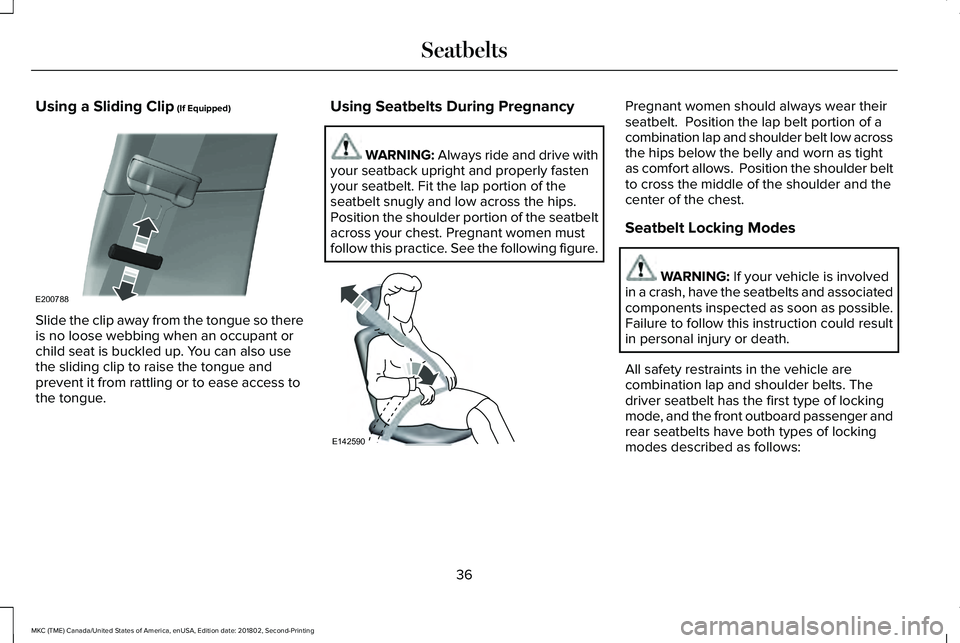
Using a Sliding Clip (If Equipped)
Slide the clip away from the tongue so thereis no loose webbing when an occupant orchild seat is buckled up. You can also usethe sliding clip to raise the tongue andprevent it from rattling or to ease access tothe tongue.
Using Seatbelts During Pregnancy
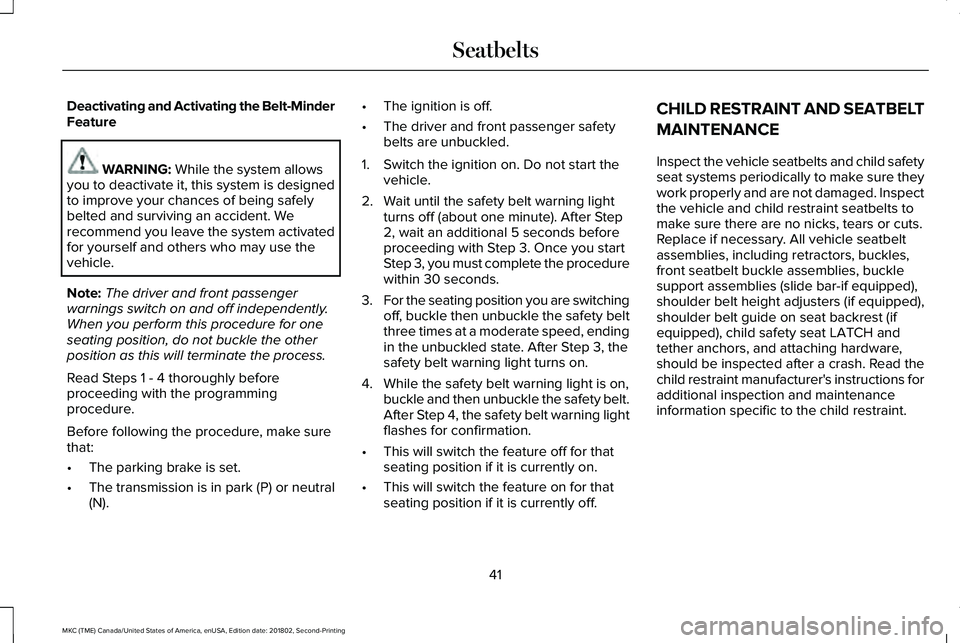
WARNING: Always ride and drive withyour seatback upright and properly fastenyour seatbelt. Fit the lap portion of theseatbelt snugly and low across the hips.Position the shoulder portion of the seatbeltacross your chest. Pregnant women mustfollow this practice. See the following figure.
Pregnant women should always wear theirseatbelt. Position the lap belt portion of acombination lap and shoulder belt low acrossthe hips below the belly and worn as tightas comfort allows. Position the shoulder beltto cross the middle of the shoulder and thecenter of the chest.
Seatbelt Locking Modes
WARNING: If your vehicle is involvedin a crash, have the seatbelts and associatedcomponents inspected as soon as possible.Failure to follow this instruction could resultin personal injury or death.
All safety restraints in the vehicle arecombination lap and shoulder belts. Thedriver seatbelt has the first type of lockingmode, and the front outboard passenger andrear seatbelts have both types of lockingmodes described as follows:
36
MKC (TME) Canada/United States of America, enUSA, Edition date: 201802, Second-Printing
SeatbeltsE200788 E142590
Page 44 of 581
Deactivating and Activating the Belt-MinderFeature
WARNING: While the system allowsyou to deactivate it, this system is designedto improve your chances of being safelybelted and surviving an accident. Werecommend you leave the system activatedfor yourself and others who may use thevehicle.
Note:The driver and front passengerwarnings switch on and off independently.When you perform this procedure for oneseating position, do not buckle the otherposition as this will terminate the process.
Read Steps 1 - 4 thoroughly beforeproceeding with the programmingprocedure.
Before following the procedure, make surethat:
•The parking brake is set.
•The transmission is in park (P) or neutral(N).
•The ignition is off.
•The driver and front passenger safetybelts are unbuckled.
1. Switch the ignition on. Do not start thevehicle.
2. Wait until the safety belt warning lightturns off (about one minute). After Step2, wait an additional 5 seconds beforeproceeding with Step 3. Once you startStep 3, you must complete the procedurewithin 30 seconds.
3.For the seating position you are switchingoff, buckle then unbuckle the safety beltthree times at a moderate speed, endingin the unbuckled state. After Step 3, thesafety belt warning light turns on.
4. While the safety belt warning light is on,buckle and then unbuckle the safety belt.After Step 4, the safety belt warning lightflashes for confirmation.
•This will switch the feature off for thatseating position if it is currently on.
•This will switch the feature on for thatseating position if it is currently off.
CHILD RESTRAINT AND SEATBELT
MAINTENANCE
Inspect the vehicle seatbelts and child safetyseat systems periodically to make sure theywork properly and are not damaged. Inspectthe vehicle and child restraint seatbelts tomake sure there are no nicks, tears or cuts.Replace if necessary. All vehicle seatbeltassemblies, including retractors, buckles,front seatbelt buckle assemblies, bucklesupport assemblies (slide bar-if equipped),shoulder belt height adjusters (if equipped),shoulder belt guide on seat backrest (ifequipped), child safety seat LATCH andtether anchors, and attaching hardware,should be inspected after a crash. Read thechild restraint manufacturer's instructions foradditional inspection and maintenanceinformation specific to the child restraint.
41
MKC (TME) Canada/United States of America, enUSA, Edition date: 201802, Second-Printing
Seatbelts
Page 45 of 581
We recommend that all seatbelt assembliesin use in vehicles involved in a crash bereplaced. However, if the crash was minorand an authorized dealer finds that the beltsdo not show damage and continue tooperate properly, they do not need to bereplaced. Seatbelt assemblies not in useduring a crash should also be inspected andreplaced if either damage or improperoperation is noted.
Properly care for seatbelts. See VehicleCare (page 305).
SEATBELT EXTENSION
WARNING: Persons who fit into thevehicle's seatbelt should not use anextension. Unnecessary use could result inserious personal injury in the event of acrash.
WARNING: Only use extensionsprovided free of charge by Lincoln MotorCompany dealers. The dealer will providean extension designed specifically for thisvehicle, model year and seating position. Theuse of an extension intended for anothervehicle, model year or seating position maynot offer you the full protection of yourvehicle’s seatbelt restraint system.
WARNING: Never use seatbeltextensions to install child restraints.
WARNING: Do not use a seatbeltextension with an inflatable seatbelt.
WARNING: Do not use extensions tochange the fit of the belt across the torso,over the lap or to make the seatbelt buckleeasier to reach.
If, because of body size or driving position,it is not possible to properly fasten theseatbelt over your lap and shoulder, anextension that is compatible with theseatbelts is available free of charge fromLincoln Motor Company dealers. Only Lincolnseatbelt extensions made by the samecompany which made the original equipmentseatbelts, should be used with Lincolnseatbelts. Ask your authorized dealer if yourextension is compatible with your Lincolnvehicle restraint system.
42
MKC (TME) Canada/United States of America, enUSA, Edition date: 201802, Second-Printing
Seatbelts
Page 47 of 581
PRINCIPLE OF OPERATION
WARNING: Airbags do not inflateslowly or gently, and the risk of injury from adeploying airbag is the greatest close to thetrim covering the airbag module.
WARNING: All occupants of yourvehicle, including the driver, should alwaysproperly wear their seatbelts, even when anairbag supplemental restraint system isprovided. Failure to properly wear yourseatbelt could seriously increase the risk ofinjury or death.
WARNING: Even with advancedrestraints systems, properly restrain children12 and under in a rear seating position.Failure to follow this could seriously increasethe risk of injury or death.
WARNING: Do not place your arms onthe airbag cover or through the steeringwheel. Failure to follow this instruction couldresult in personal injury.
WARNING: Keep the areas in front ofthe airbags free from obstruction. Do not affixanything to or over the airbag covers.Objects could become projectiles duringairbag deployment or in a sudden stop.Failure to follow this instruction could resultin personal injury or death.
WARNING: Airbags can kill or injure achild in a child restraint. Never place arear-facing child restraint in front of an activeairbag. If you must use a forward-facing childrestraint in the front seat, move the seat uponwhich the child restraint is installed all theway back.
WARNING: Do not attempt to service,repair, or modify the supplementary restraintsystem or associated components. Failureto follow this instruction could result inpersonal injury or death.
WARNING: Several airbag systemcomponents get hot after inflation. To reducethe risk of injury, do not touch them afterinflation.
WARNING: If a supplementary restraintsystem component has deployed, it will notfunction again. Have the system andassociated components inspected as soonas possible. Failure to follow this instructioncould result in personal injury or death.
The airbags are a supplemental restraintsystem and are designed to work with theseatbelts to help protect the driver and rightfront passenger from certain upper bodyinjuries. Airbags do not inflate slowly; thereis a risk of injury from a deploying airbag.
Note:You will hear a loud bang and see acloud of harmless powdery residue if anairbag deploys. This is normal.
44
MKC (TME) Canada/United States of America, enUSA, Edition date: 201802, Second-Printing
Supplementary Restraints System
Page 48 of 581
The airbags inflate and deflate rapidly uponactivation. After airbag deployment, it isnormal to notice a smoke-like, powderyresidue or smell the burnt propellant. Thismay consist of cornstarch, talcum powder (tolubricate the bag) or sodium compounds (forexample, baking soda) that result from thecombustion process that inflates the airbag. Small amounts of sodium hydroxide may bepresent which may irritate the skin and eyes,but none of the residue is toxic.
While the system is designed to help reduceserious injuries, contact with a deployingairbag may also cause abrasions or swelling.Temporary hearing loss is also a possibilityas a result of the noise associated with adeploying airbag. Because airbags mustinflate rapidly and with considerable force,there is the risk of death or serious injuriessuch as fractures, facial and eye injuries orinternal injuries, particularly to occupantswho are not properly restrained or areotherwise out of position at the time of airbagdeployment. Thus, it is extremely importantthat occupants be properly restrained as faraway from the airbag module as possiblewhile maintaining vehicle control.
Routine maintenance of the airbags is notrequired.
DRIVER AND PASSENGER
AIRBAGS
WARNING: Do not place your arms onthe airbag cover or through the steeringwheel. Failure to follow this instruction couldresult in personal injury.
WARNING: Keep the areas in front ofthe airbags free from obstruction. Do not affixanything to or over the airbag covers.Objects could become projectiles duringairbag deployment or in a sudden stop.Failure to follow this instruction could resultin personal injury or death.
WARNING: Airbags can kill or injure achild in a child restraint. Never place arear-facing child restraint in front of an activeairbag. If you must use a forward-facing childrestraint in the front seat, move the seat uponwhich the child restraint is installed all theway back.
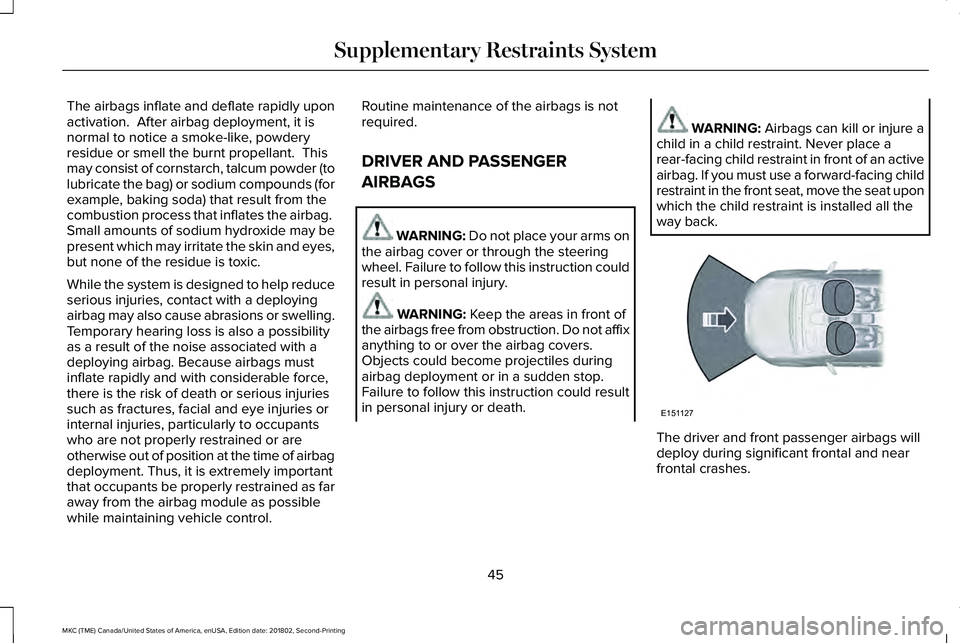
The driver and front passenger airbags willdeploy during significant frontal and nearfrontal crashes.
45
MKC (TME) Canada/United States of America, enUSA, Edition date: 201802, Second-Printing
Supplementary Restraints SystemE151127