child restraint LINCOLN MKC 2019 Owners Manual
[x] Cancel search | Manufacturer: LINCOLN, Model Year: 2019, Model line: MKC, Model: LINCOLN MKC 2019Pages: 581, PDF Size: 5.41 MB
Page 4 of 581
Introduction
About This Manual...........................................7
Symbols Glossary.............................................7
Data Recording...............................................10
Perchlorate.......................................................13
Lincoln Automotive Financial Services..........................................................................14
Replacement Parts Recommendation..........................................................................14
Special Notices...............................................15
Mobile Communications Equipment.........16
Export Unique Options..................................16
Environment
Protecting the Environment.........................17
At a Glance
Instrument Panel Overview..........................18
Child Safety
General Information......................................20
Installing Child Restraints............................22
Booster Seats.................................................28
Child Restraint Positioning...........................31
Child Safety Locks.........................................32
Seatbelts
Principle of Operation..................................34
Fastening the Seatbelts...............................35
Seatbelt Height Adjustment.......................38
Seatbelt Warning Lamp and IndicatorChime...........................................................38
Seatbelt Reminder.........................................39
Child Restraint and Seatbelt Maintenance..........................................................................41
Seatbelt Extension........................................42
Personal Safety System™
Personal Safety System™.............................43
Supplementary Restraints System
Principle of Operation..................................44
Driver and Passenger Airbags...................45
Front Passenger Sensing System..............47
Side Airbags...................................................50
Driver Knee Airbag.........................................51
Safety Canopy™...............................................51
Crash Sensors and Airbag Indicator.........53
Airbag Disposal..............................................54
Keys and Remote Controls
General Information on Radio Frequencies........................................................................55
Remote Control..............................................56
Replacing a Lost Key or Remote Control........................................................................59
MyKey™
Principle of Operation..................................60
Creating a MyKey...........................................61
Clearing All MyKeys......................................62
Checking MyKey System Status................62
Using MyKey With Remote Start Systems.........................................................................63
MyKey Troubleshooting...............................63
Doors and Locks
Locking and Unlocking................................65
Keyless Entry...................................................70
1
MKC (TME) Canada/United States of America, enUSA, Edition date: 201802, Second-Printing
Table of Contents
Page 18 of 581
SPECIAL NOTICES
New Vehicle Limited Warranty
For a detailed description of what is coveredand what is not covered by your vehicle’sNew Vehicle Limited Warranty, see theWarranty Manual that is provided to youalong with your Owner’s Manual.
Special Instructions
For your added safety, your vehicle is fittedwith sophisticated electronic controls.
WARNING: You risk death or seriousinjury to yourself and others if you do notfollow the instruction highlighted by thewarning symbol. Failure to follow the specificwarnings and instructions could result inpersonal injury.
WARNING: NEVER use a rearwardfacing child restraint on a seat protected byan ACTIVE AIRBAG in front of it, DEATH orSERIOUS INJURY to the CHILD can occur.
On Board Diagnostics Data LinkConnector
WARNING: Do not connect wirelessplug-in devices to the data link connector.Unauthorized third parties could gain accessto vehicle data and impair the performanceof safety related systems. Only allow repairfacilities that follow our service and repairinstructions to connect their equipment tothe data link connector.
Your vehicle has an OBD Data LinkConnector (DLC) that is used in conjunctionwith a diagnostic scan tool for vehiclediagnostics, repairs and reprogrammingservices. Installing an aftermarket device thatuses the DLC during normal driving forpurposes such as remote insurance companymonitoring, transmission of vehicle data toother devices or entities, or altering theperformance of the vehicle, may cause
interference with or even damage to vehiclesystems. We do not recommend or endorsethe use of aftermarket plug-in devices unlessapproved by Ford. The vehicle Warranty willnot cover damage caused by an aftermarketplug-in device.
Notice to Owners of Pickup Trucks andUtility Type Vehicles
WARNING: Utility vehicles have asignificantly higher rollover rate than othertypes of vehicles.
Before you drive your vehicle, please readthis Owner’s Guide carefully. Your vehicle isnot a passenger car. As with other vehiclesof this type, failure to operate this vehiclecorrectly may result in loss of vehicle control,vehicle rollover, personal injury or death.
Using Your Vehicle With a Snowplow
Do not use this vehicle for snowplowing.
Your vehicle does not have a snowplowingpackage.
15
MKC (TME) Canada/United States of America, enUSA, Edition date: 201802, Second-Printing
Introduction
Page 23 of 581
GENERAL INFORMATION
See the following sections for directions onhow to properly use safety restraints forchildren.
WARNING: Always make sure yourchild is secured properly in a device that isappropriate for their height, age and weight.Child safety restraints must be boughtseparately from your vehicle. Failure to followthese instructions and guidelines may resultin an increased risk of serious injury or deathto your child.
WARNING: All children are shapeddifferently. The National Highway TrafficSafety Administration and other safetyorganizations, base their recommendationsfor child restraints on probable child height,age and weight thresholds, or on theminimum requirements of the law. Werecommend that you check with a NHTSACertified Child Passenger Safety Technician(CPST) to make sure that you properly installthe child restraint in your vehicle and thatyou consult your pediatrician to make sureyou have a child restraint appropriate foryour child. To locate a child restraint fittingstation and CPST, contact NHTSA toll freeat 1-888-327-4236 or go to
www.nhtsa.dot.gov. In Canada, contactTransport Canada toll free at 1-800-333-0371or go to www.tc.gc.ca to find a Child Car SeatClinic in your area. Failure to properly restrainchildren in child restraints made especiallyfor their height, age and weight, may resultin an increased risk of serious injury or deathto your child.
WARNING: On hot days, thetemperature inside the vehicle can rise veryquickly. Exposure of people or animals tothese high temperatures for even a shorttime can cause death or serious heat relatedinjuries, including brain damage. Smallchildren are particularly at risk.
20
MKC (TME) Canada/United States of America, enUSA, Edition date: 201802, Second-Printing
Child Safety
Page 24 of 581
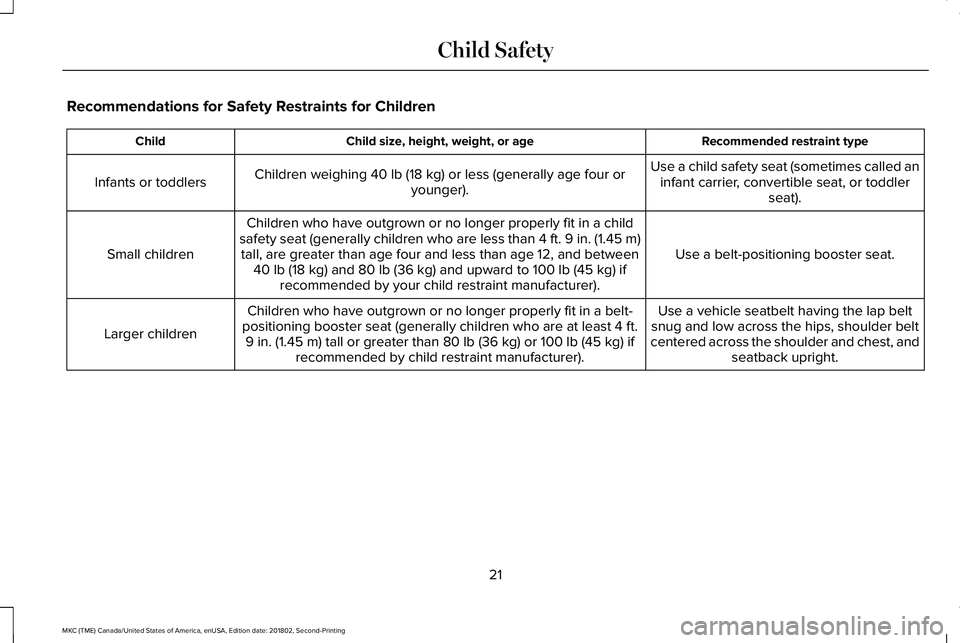
Recommendations for Safety Restraints for Children
Recommended restraint typeChild size, height, weight, or ageChild
Use a child safety seat (sometimes called aninfant carrier, convertible seat, or toddlerseat).
Children weighing 40 lb (18 kg) or less (generally age four oryounger).Infants or toddlers
Use a belt-positioning booster seat.
Children who have outgrown or no longer properly fit in a childsafety seat (generally children who are less than 4 ft. 9 in. (1.45 m)tall, are greater than age four and less than age 12, and between40 lb (18 kg) and 80 lb (36 kg) and upward to 100 lb (45 kg) ifrecommended by your child restraint manufacturer).
Small children
Use a vehicle seatbelt having the lap beltsnug and low across the hips, shoulder beltcentered across the shoulder and chest, andseatback upright.
Children who have outgrown or no longer properly fit in a belt-positioning booster seat (generally children who are at least 4 ft.9 in. (1.45 m) tall or greater than 80 lb (36 kg) or 100 lb (45 kg) ifrecommended by child restraint manufacturer).
Larger children
21
MKC (TME) Canada/United States of America, enUSA, Edition date: 201802, Second-Printing
Child Safety
Page 25 of 581
•You are required by law to properly usesafety seats for infants and toddlers inthe United States and Canada.
•Many states and provinces require thatsmall children use approved boosterseats until they reach age eight, a heightof 4 feet 9 inches (1.45 meters) tall, or80 lb (36 kg). Check your local and stateor provincial laws for specificrequirements about the safety of childrenin your vehicle.
•When possible, always properly restrainchildren 12 years of age and under in arear seating position of your vehicle.Accident statistics suggest that childrenare safer when properly restrained in therear seating positions than in a frontseating position. See Front PassengerSensing System (page 47).
INSTALLING CHILD RESTRAINTS
Child Restraints
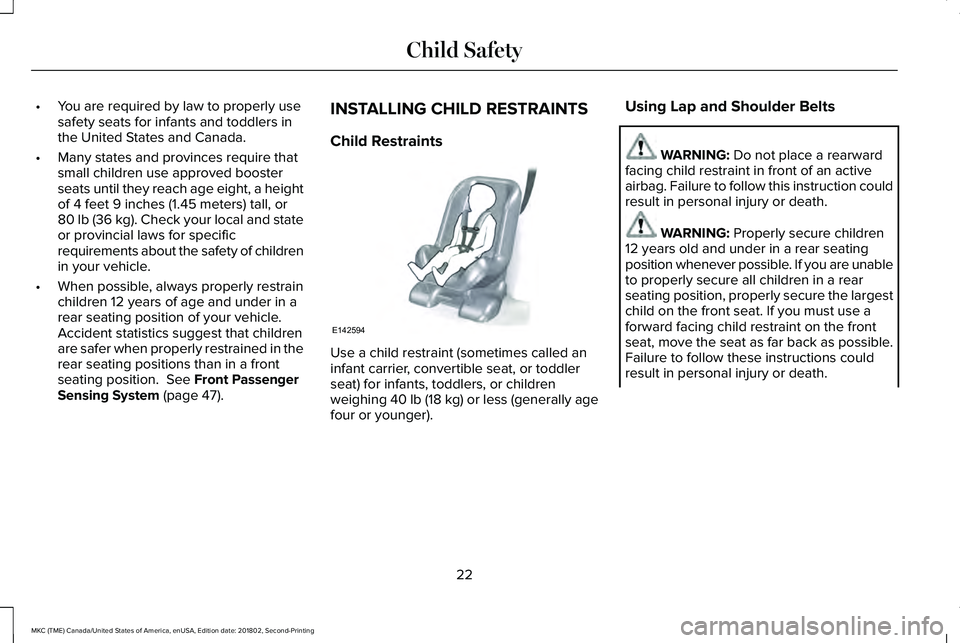
Use a child restraint (sometimes called aninfant carrier, convertible seat, or toddlerseat) for infants, toddlers, or childrenweighing 40 lb (18 kg) or less (generally agefour or younger).
Using Lap and Shoulder Belts
WARNING: Do not place a rearwardfacing child restraint in front of an activeairbag. Failure to follow this instruction couldresult in personal injury or death.
WARNING: Properly secure children12 years old and under in a rear seatingposition whenever possible. If you are unableto properly secure all children in a rearseating position, properly secure the largestchild on the front seat. If you must use aforward facing child restraint on the frontseat, move the seat as far back as possible.Failure to follow these instructions couldresult in personal injury or death.
22
MKC (TME) Canada/United States of America, enUSA, Edition date: 201802, Second-Printing
Child SafetyE142594
Page 26 of 581
WARNING: Depending on where yousecure a child restraint, and depending onthe child restraint design, you may blockaccess to certain seatbelt buckle assembliesand LATCH lower anchors, rendering thosefeatures potentially unusable. To avoid riskof injury, make sure occupants only useseating positions where they are able to beproperly restrained.
When installing a child restraint withcombination lap and shoulder belts:
•Use the correct seatbelt buckle for thatseating position.
•Insert the belt tongue into the properbuckle until you hear a snap and feel itlatch. Make sure the tongue is securelyfastened in the buckle.
•Keep the buckle release button pointingup and away from the child restraint, withthe tongue between the child restraintand the release button, to preventaccidental unbuckling.
•Place the vehicle seat upon which thechild restraint will be installed in theupright position.
•Put the seatbelt in the automatic lockingmode. See Step 5. This vehicle does notrequire the use of a locking clip.
Perform the following steps when installingthe child restraint with combination lap andshoulder belts:
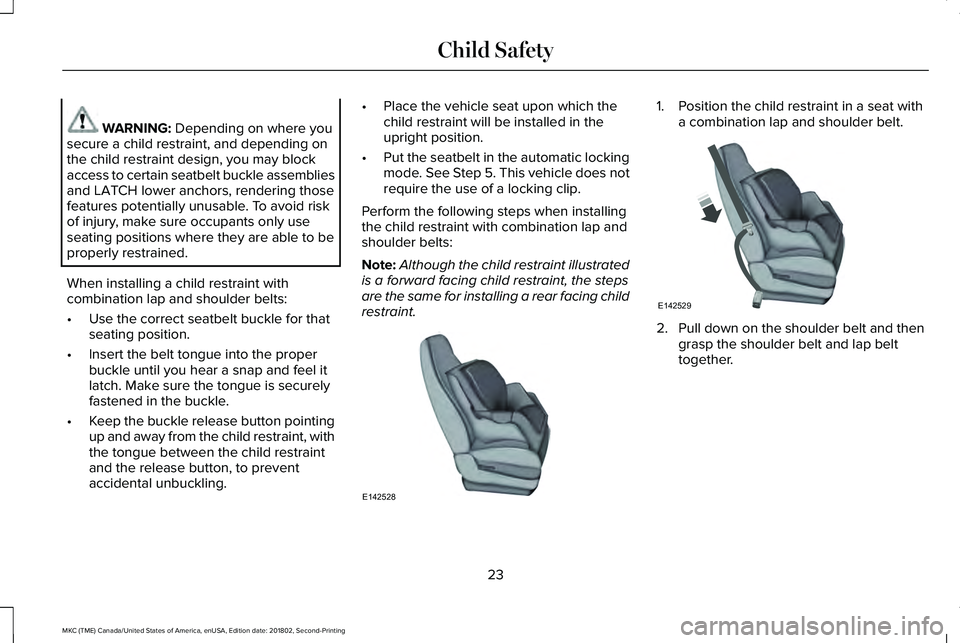
Note:Although the child restraint illustratedis a forward facing child restraint, the stepsare the same for installing a rear facing childrestraint.
1. Position the child restraint in a seat witha combination lap and shoulder belt.
2.Pull down on the shoulder belt and thengrasp the shoulder belt and lap belttogether.
23
MKC (TME) Canada/United States of America, enUSA, Edition date: 201802, Second-Printing
Child SafetyE142528 E142529
Page 27 of 581
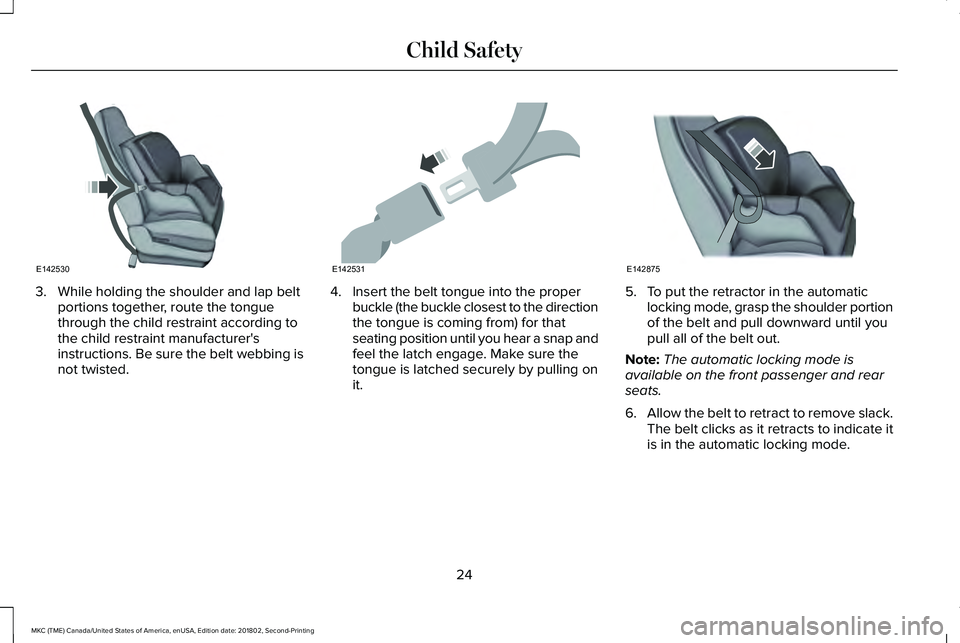
3. While holding the shoulder and lap beltportions together, route the tonguethrough the child restraint according tothe child restraint manufacturer'sinstructions. Be sure the belt webbing isnot twisted.
4. Insert the belt tongue into the properbuckle (the buckle closest to the directionthe tongue is coming from) for thatseating position until you hear a snap andfeel the latch engage. Make sure thetongue is latched securely by pulling onit.
5. To put the retractor in the automaticlocking mode, grasp the shoulder portionof the belt and pull downward until youpull all of the belt out.
Note:The automatic locking mode isavailable on the front passenger and rearseats.
6.Allow the belt to retract to remove slack.The belt clicks as it retracts to indicate itis in the automatic locking mode.
24
MKC (TME) Canada/United States of America, enUSA, Edition date: 201802, Second-Printing
Child SafetyE142530 E142531 E142875
Page 28 of 581
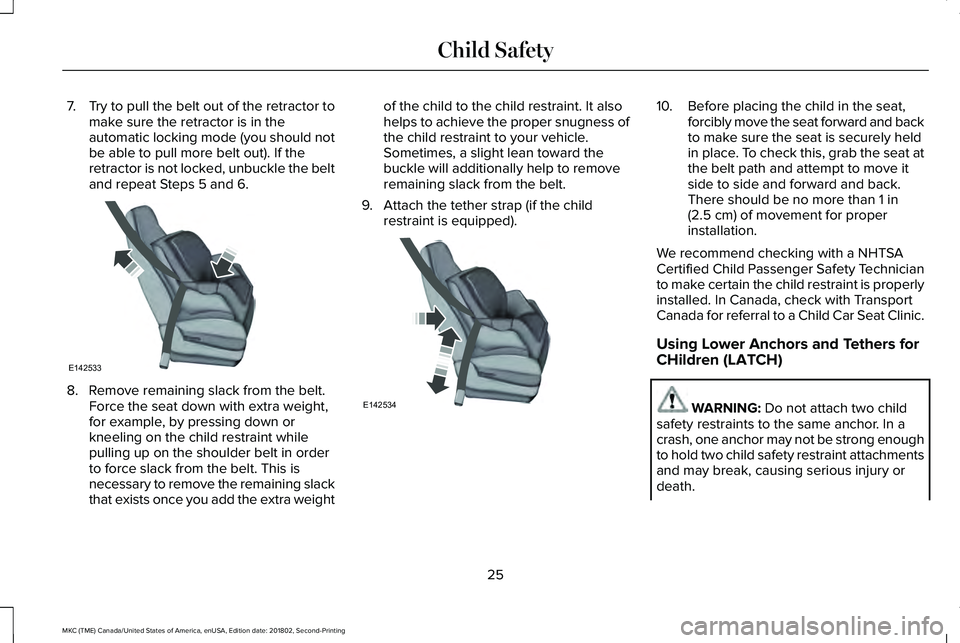
7.Try to pull the belt out of the retractor tomake sure the retractor is in theautomatic locking mode (you should notbe able to pull more belt out). If theretractor is not locked, unbuckle the beltand repeat Steps 5 and 6.
8. Remove remaining slack from the belt.Force the seat down with extra weight,for example, by pressing down orkneeling on the child restraint whilepulling up on the shoulder belt in orderto force slack from the belt. This isnecessary to remove the remaining slackthat exists once you add the extra weight
of the child to the child restraint. It alsohelps to achieve the proper snugness ofthe child restraint to your vehicle.Sometimes, a slight lean toward thebuckle will additionally help to removeremaining slack from the belt.
9. Attach the tether strap (if the childrestraint is equipped).
10. Before placing the child in the seat,forcibly move the seat forward and backto make sure the seat is securely heldin place. To check this, grab the seat atthe belt path and attempt to move itside to side and forward and back.There should be no more than 1 in(2.5 cm) of movement for properinstallation.
We recommend checking with a NHTSACertified Child Passenger Safety Technicianto make certain the child restraint is properlyinstalled. In Canada, check with TransportCanada for referral to a Child Car Seat Clinic.
Using Lower Anchors and Tethers forCHildren (LATCH)
WARNING: Do not attach two childsafety restraints to the same anchor. In acrash, one anchor may not be strong enoughto hold two child safety restraint attachmentsand may break, causing serious injury ordeath.
25
MKC (TME) Canada/United States of America, enUSA, Edition date: 201802, Second-Printing
Child SafetyE142533 E142534
Page 29 of 581
WARNING: Depending on where yousecure a child restraint, and depending onthe child restraint design, you may blockaccess to certain seatbelt buckle assembliesand LATCH lower anchors, rendering thosefeatures potentially unusable. To avoid riskof injury, make sure occupants only useseating positions where they are able to beproperly restrained.
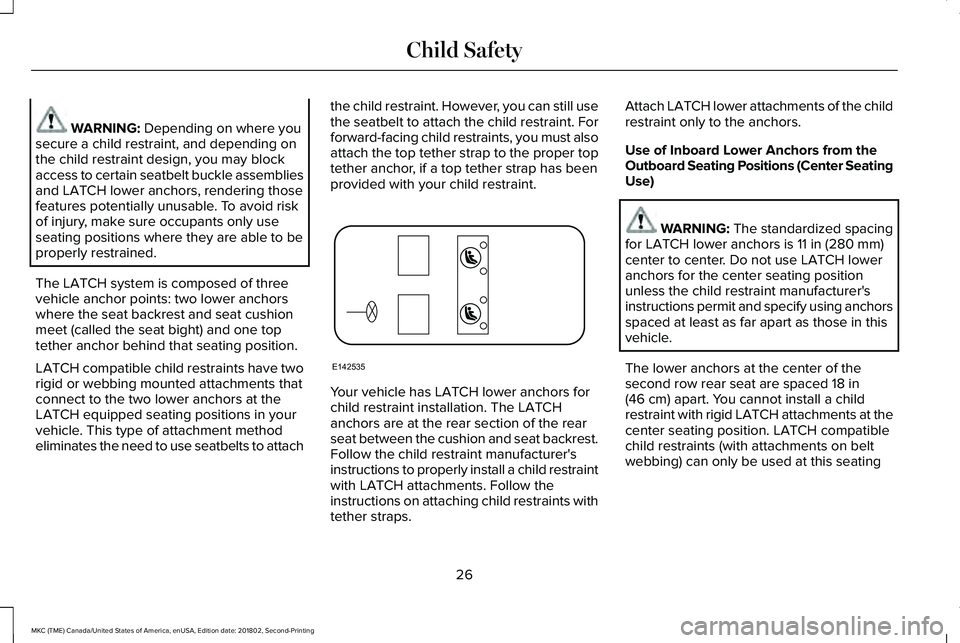
The LATCH system is composed of threevehicle anchor points: two lower anchorswhere the seat backrest and seat cushionmeet (called the seat bight) and one toptether anchor behind that seating position.
LATCH compatible child restraints have tworigid or webbing mounted attachments thatconnect to the two lower anchors at theLATCH equipped seating positions in yourvehicle. This type of attachment methodeliminates the need to use seatbelts to attach
the child restraint. However, you can still usethe seatbelt to attach the child restraint. Forforward-facing child restraints, you must alsoattach the top tether strap to the proper toptether anchor, if a top tether strap has beenprovided with your child restraint.
Your vehicle has LATCH lower anchors forchild restraint installation. The LATCHanchors are at the rear section of the rearseat between the cushion and seat backrest.Follow the child restraint manufacturer'sinstructions to properly install a child restraintwith LATCH attachments. Follow theinstructions on attaching child restraints withtether straps.
Attach LATCH lower attachments of the childrestraint only to the anchors.
Use of Inboard Lower Anchors from theOutboard Seating Positions (Center SeatingUse)
WARNING: The standardized spacingfor LATCH lower anchors is 11 in (280 mm)center to center. Do not use LATCH loweranchors for the center seating positionunless the child restraint manufacturer'sinstructions permit and specify using anchorsspaced at least as far apart as those in thisvehicle.
The lower anchors at the center of thesecond row rear seat are spaced 18 in(46 cm) apart. You cannot install a childrestraint with rigid LATCH attachments at thecenter seating position. LATCH compatiblechild restraints (with attachments on beltwebbing) can only be used at this seating
26
MKC (TME) Canada/United States of America, enUSA, Edition date: 201802, Second-Printing
Child SafetyE142535
Page 30 of 581
position provided that the child restraintmanufacturer's instructions permit use withthe anchor spacing stated. Do not attach achild restraint to any lower anchor if anadjacent child restraint is attached to thatanchor.
Each time you use the child restraint, checkthat the seat is properly attached to the loweranchors and tether anchor, if applicable. Tugthe child restraint from side to side andforward and back where it is secured to yourvehicle. The seat should move less than 1 in(2.5 cm) when you do this for a properinstallation.
If the child restraint is not anchored properly,the risk of a child being injured in a crashgreatly increases.
Combining Seatbelt and LATCH LowerAnchors for Attaching Child Restraints
When used in combination, either theseatbelt or the LATCH lower anchors maybe attached first, provided a properinstallation is achieved. Attach the tetherstrap afterward, if included with the childrestraint.
Using Tether Straps
Many forward-facing childrestraints include a tether strapwhich extends from the back of thechild restraints and hooks to an anchoringpoint called the top tether anchor. Tetherstraps are available as an accessory for manyolder child restraints.
Contact the manufacturer of your childrestraint for information about ordering atether strap, or to obtain a longer tether strapif the tether strap on your child restraint doesnot reach the appropriate top tether anchorin your vehicle.
Once you install the child restraint usingeither the seatbelt, the lower anchors of theLATCH system, or both, you can attach thetop tether strap.
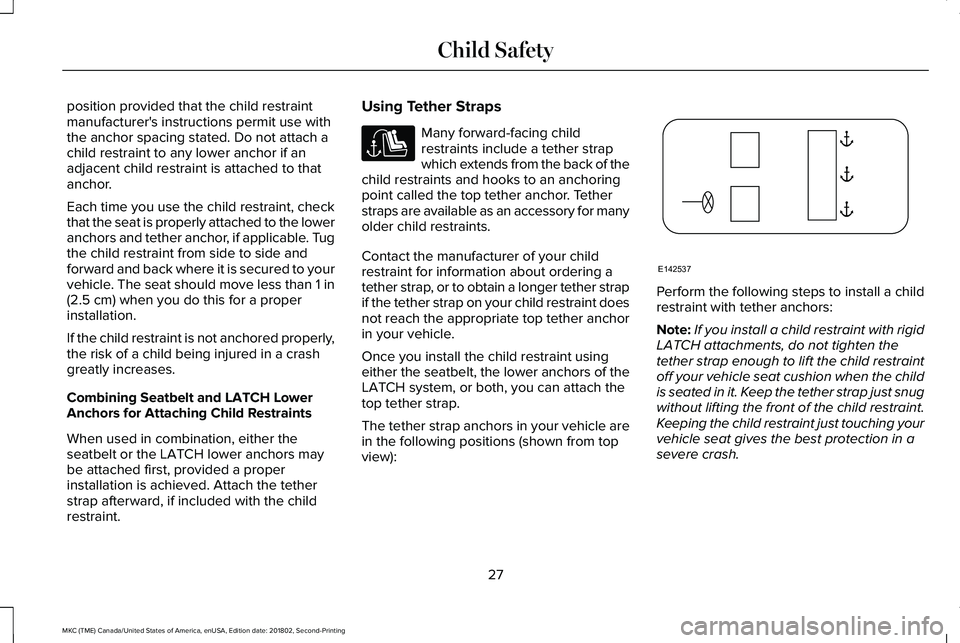
The tether strap anchors in your vehicle arein the following positions (shown from topview):
Perform the following steps to install a childrestraint with tether anchors:
Note:If you install a child restraint with rigidLATCH attachments, do not tighten thetether strap enough to lift the child restraintoff your vehicle seat cushion when the childis seated in it. Keep the tether strap just snugwithout lifting the front of the child restraint.Keeping the child restraint just touching yourvehicle seat gives the best protection in asevere crash.
27
MKC (TME) Canada/United States of America, enUSA, Edition date: 201802, Second-Printing
Child Safety E142537