steering wheel LINCOLN MKS 2009 Owner's Manual
[x] Cancel search | Manufacturer: LINCOLN, Model Year: 2009, Model line: MKS, Model: LINCOLN MKS 2009Pages: 323, PDF Size: 2.58 MB
Page 237 of 323
Driving on snow and ice
Note:Excessive tire slippage can cause transmission damage.
AWD vehicles have advantages over 2WD vehicles in snow and ice but
can skid like any other vehicle.
Should you start to slide while driving on snowy or icy roads, turn the
steering wheel in the direction of the slide until you regain control.
Avoid sudden applications of power and quick changes of direction on
snow and ice. Apply the accelerator slowly and steadily when starting
from a full stop.
Avoid sudden braking as well. Although an AWD vehicle may accelerate
better than a two-wheel drive vehicle in snow and ice, it won’t stop any
faster, because as in other vehicles, braking occurs at all four wheels. Do
not become overconfident as to road conditions.
Make sure you allow sufficient distance between you and other vehicles
for stopping. Drive slower than usual and consider using one of the lower
gears. In emergency stopping situations, apply the brake steadily. Since
your vehicle is equipped with a four wheel anti-lock brake system (ABS),
do not “pump” the brakes. Refer to theBrakessection of this chapter
for additional information on the operation of the anti-lock brake system.
Maintenance and Modifications
The suspension and steering systems on your vehicle have been designed
and tested to provide predictable performance whether loaded or empty
and durable load carrying capability. For this reason, Ford Motor
Company strongly recommends that you do not make modifications such
as adding or removing parts (such as lift kits or stabilizer bars) or by
using replacement parts not equivalent to the original factory equipment.
Any modifications to a vehicle that raise the center of gravity can make
it more likely the vehicle will rollover as a result of a loss of control.
Ford Motor Company recommends that caution be used with any vehicle
equipped with a high load or device (such as ladder or luggage racks).
Failure to maintain your vehicle properly may void the warranty, increase
your repair cost, reduce vehicle performance and operational capabilities
and adversely affect driver and passenger safety. Frequent inspection of
vehicle chassis components is recommended if the vehicle is subjected to
heavy off-highway usage.
2009 MKS(mks)
Owners Guide (post-2002-fmt)
USA(fus)
Driving
237
Page 243 of 323
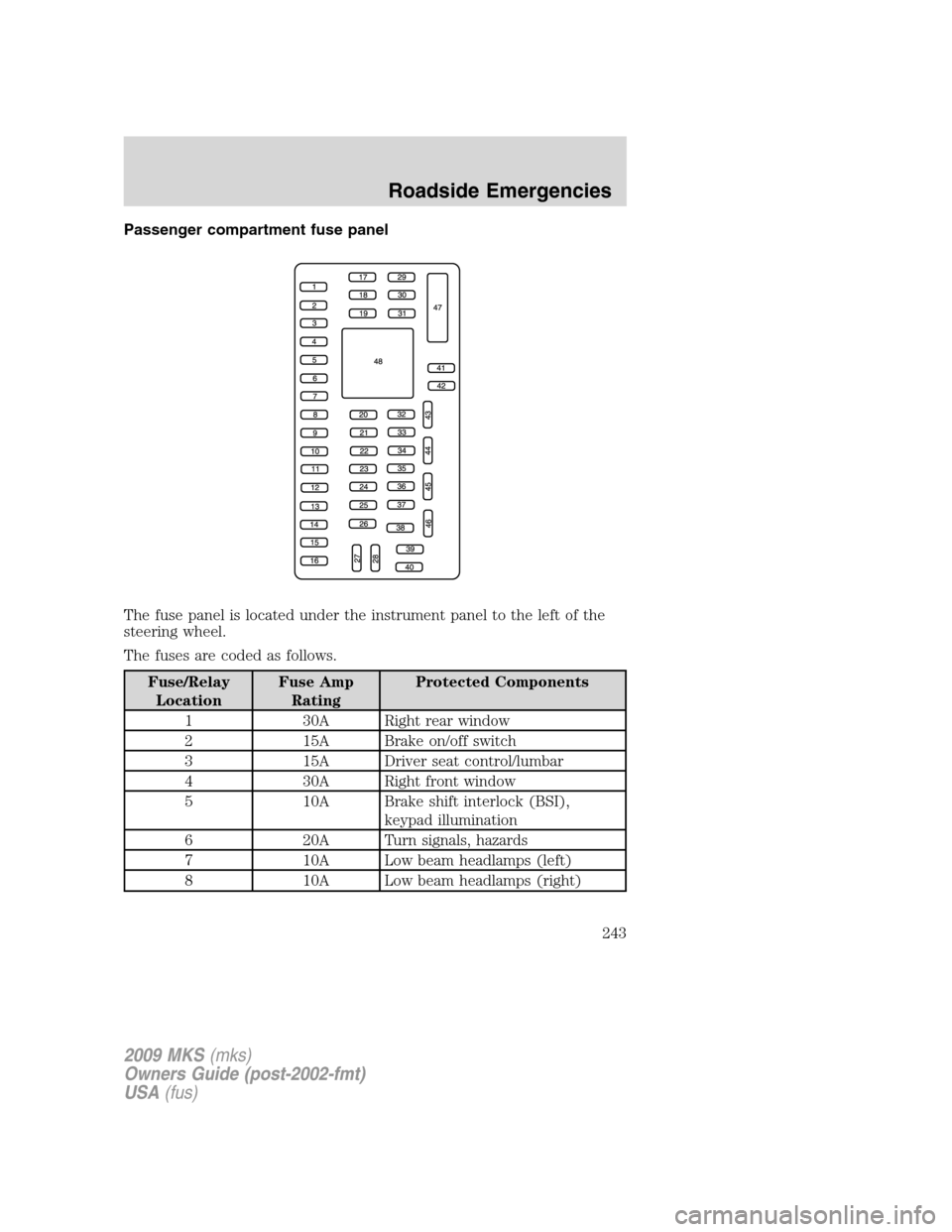
Passenger compartment fuse panel
The fuse panel is located under the instrument panel to the left of the
steering wheel.
The fuses are coded as follows.
Fuse/Relay
LocationFuse Amp
RatingProtected Components
1 30A Right rear window
2 15A Brake on/off switch
3 15A Driver seat control/lumbar
4 30A Right front window
5 10A Brake shift interlock (BSI),
keypad illumination
6 20A Turn signals, hazards
7 10A Low beam headlamps (left)
8 10A Low beam headlamps (right)
2009 MKS(mks)
Owners Guide (post-2002-fmt)
USA(fus)
Roadside Emergencies
243
Page 244 of 323
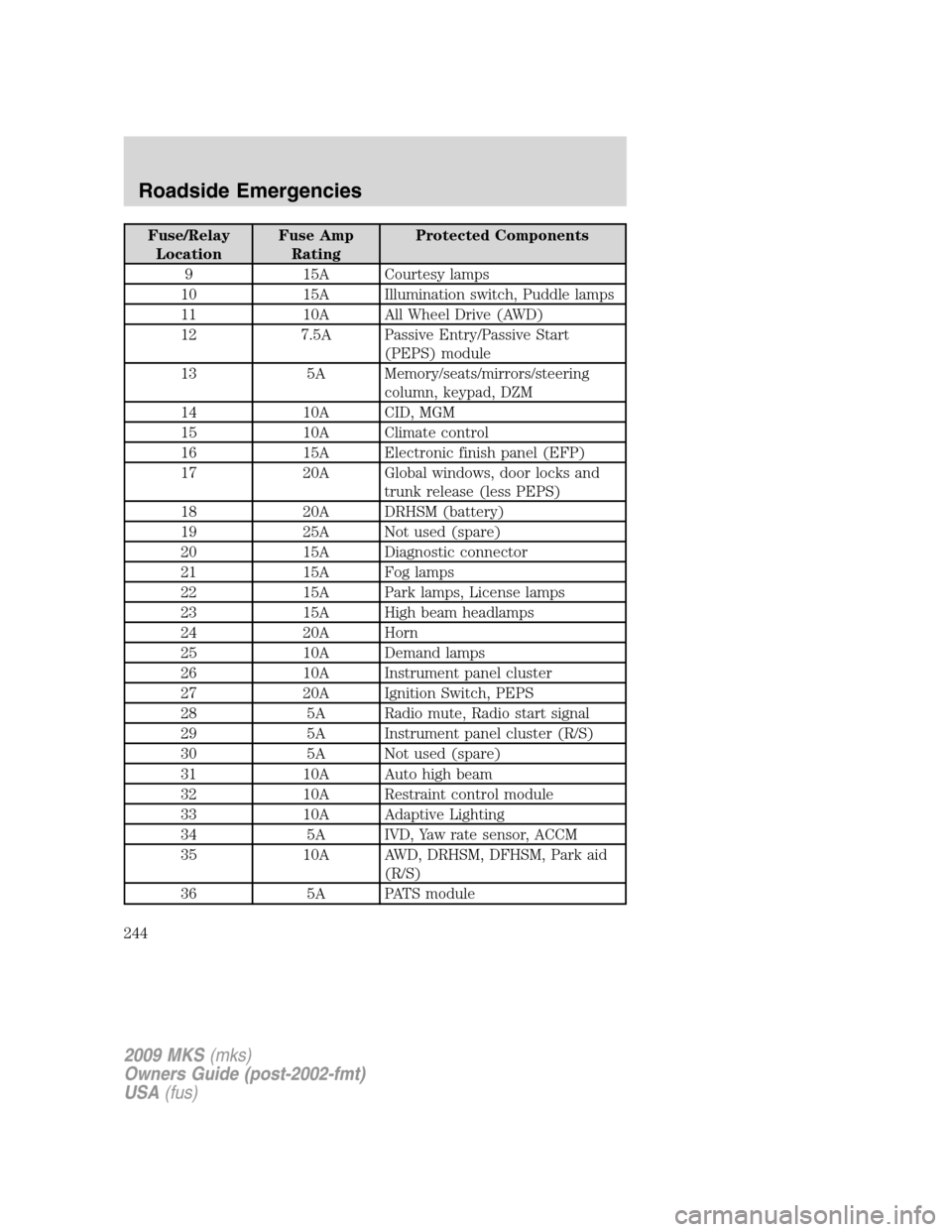
Fuse/Relay
LocationFuse Amp
RatingProtected Components
9 15A Courtesy lamps
10 15A Illumination switch, Puddle lamps
11 10A All Wheel Drive (AWD)
12 7.5A Passive Entry/Passive Start
(PEPS) module
13 5A Memory/seats/mirrors/steering
column, keypad, DZM
14 10A CID, MGM
15 10A Climate control
16 15A Electronic finish panel (EFP)
17 20A Global windows, door locks and
trunk release (less PEPS)
18 20A DRHSM (battery)
19 25A Not used (spare)
20 15A Diagnostic connector
21 15A Fog lamps
22 15A Park lamps, License lamps
23 15A High beam headlamps
24 20A Horn
25 10A Demand lamps
26 10A Instrument panel cluster
27 20A Ignition Switch, PEPS
28 5A Radio mute, Radio start signal
29 5A Instrument panel cluster (R/S)
30 5A Not used (spare)
31 10A Auto high beam
32 10A Restraint control module
33 10A Adaptive Lighting
34 5A IVD, Yaw rate sensor, ACCM
35 10A AWD, DRHSM, DFHSM, Park aid
(R/S)
36 5A PATS module
2009 MKS(mks)
Owners Guide (post-2002-fmt)
USA(fus)
Roadside Emergencies
244
Page 248 of 323
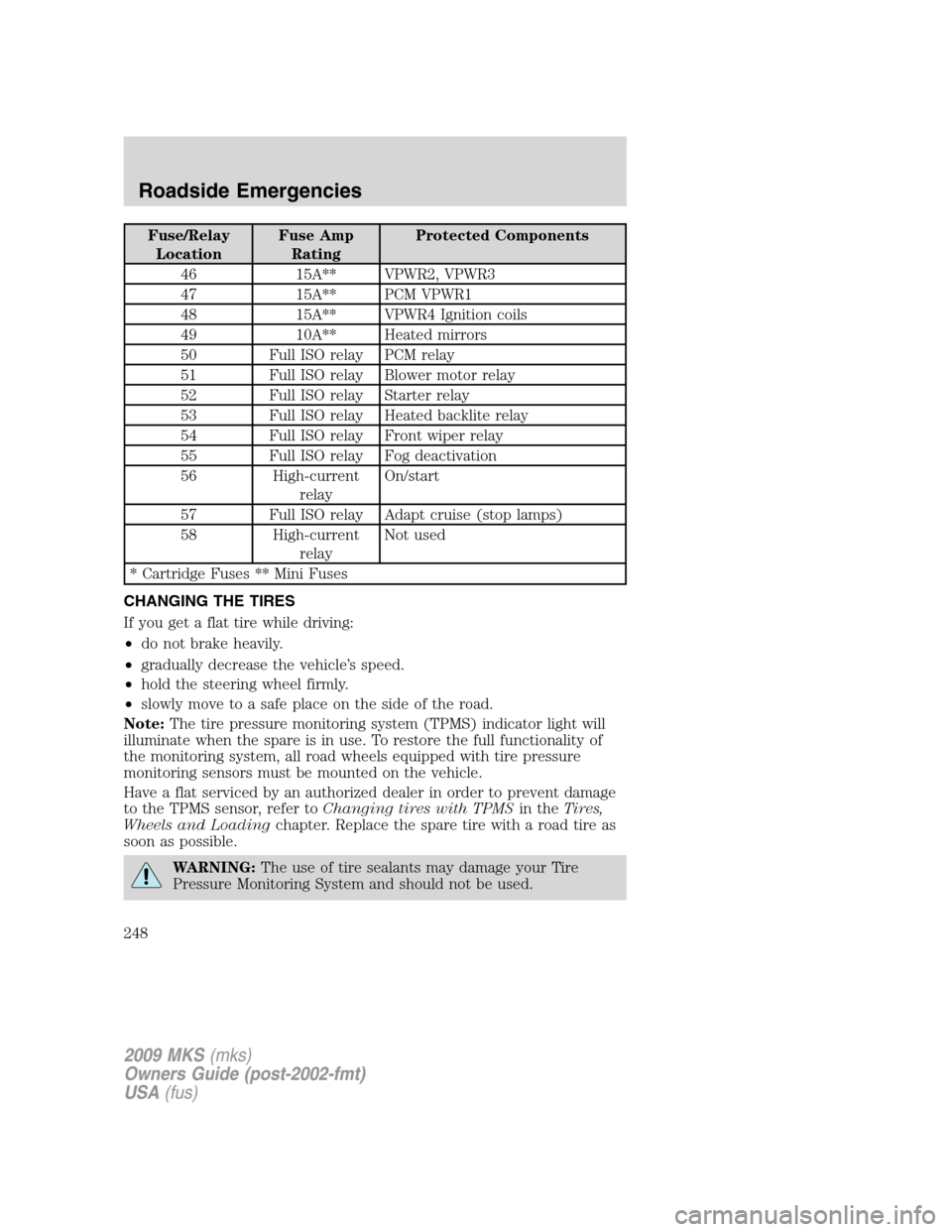
Fuse/Relay
LocationFuse Amp
RatingProtected Components
46 15A** VPWR2, VPWR3
47 15A** PCM VPWR1
48 15A** VPWR4 Ignition coils
49 10A** Heated mirrors
50 Full ISO relay PCM relay
51 Full ISO relay Blower motor relay
52 Full ISO relay Starter relay
53 Full ISO relay Heated backlite relay
54 Full ISO relay Front wiper relay
55 Full ISO relay Fog deactivation
56 High-current
relayOn/start
57 Full ISO relay Adapt cruise (stop lamps)
58 High-current
relayNot used
* Cartridge Fuses ** Mini Fuses
CHANGING THE TIRES
If you get a flat tire while driving:
•do not brake heavily.
•gradually decrease the vehicle’s speed.
•hold the steering wheel firmly.
•slowly move to a safe place on the side of the road.
Note:The tire pressure monitoring system (TPMS) indicator light will
illuminate when the spare is in use. To restore the full functionality of
the monitoring system, all road wheels equipped with tire pressure
monitoring sensors must be mounted on the vehicle.
Have a flat serviced by an authorized dealer in order to prevent damage
to the TPMS sensor, refer toChanging tires with TPMSin theTires,
Wheels and Loadingchapter. Replace the spare tire with a road tire as
soon as possible.
WARNING:The use of tire sealants may damage your Tire
Pressure Monitoring System and should not be used.
2009 MKS(mks)
Owners Guide (post-2002-fmt)
USA(fus)
Roadside Emergencies
248
Page 276 of 323
•Be certain to wash or wipe your hands clean if you have been in
contact with certain products such as insect repellent and suntan
lotion in order to avoid possible damage to the interior painted
surfaces.
•Do not use household or glass cleaners as these may damage the
finish of the instrument panel, interior trim and cluster lens.
WARNING:Do not use chemical solvents or strong detergents
when cleaning the steering wheel or instrument panel to avoid
contamination of the airbag system.
If a staining liquid like coffee/juice has been spilled on the instrument
panel or on interior trim surfaces, clean as follows:
1. Wipe up spilled liquid using a clean, white, cotton cloth.
2. Apply Motorcraft Deluxe Leather and Vinyl Cleaner (ZC-11-A) [In
Canada use Motorcraft Multi-Purpose Cleaner (CXC-101)] to the wiped
area and spread around evenly.
3. Apply more Motorcraft cleaner to a clean, white, cotton cloth and
press the cloth onto the soiled area–allow this to set at room
temperature for 30 minutes.
4. Remove the soaked cloth, and if it is not soiled badly, use this cloth to
clean the area by using a rubbing motion for 60 seconds.
5. Following this, wipe area dry with a clean, white, cotton cloth.
INTERIOR
For fabric, carpets, cloth seats, safety belts and seats equipped with side
airbags:
•Remove dust and loose dirt with a vacuum cleaner.
•Remove light stains and soil with Motorcraft Professional Strength
Carpet & Upholstery Cleaner (ZC-54).
•If grease or tar is present on the material, spot-clean the area first
with Motorcraft Spot and Stain Remover (ZC-14). In Canada, use
Motorcraft Multi-Purpose Cleaner (CXC-101).
•If a ring forms on the fabric after spot cleaning, clean the entire area
immediately (but do not oversaturate) or the ring will set.
•Do not use household cleaning products or glass cleaners, which can
stain and discolor the fabric and affect the flame retardant abilities of
the seat materials.
2009 MKS(mks)
Owners Guide (post-2002-fmt)
USA(fus)
Cleaning
276
Page 306 of 323
for 15 seconds without cranking the engine. If theService engine
soon
indicator blinks eight times, it means that the vehicle is not
ready for I/M testing; if theService engine soon
indicator stays on
solid, it means that the vehicle is ready for I/M testing.
The OBD-II system is designed to check the emission control system
during normal driving. A complete check may take several days. If the
vehicle is not ready for I/M testing, the following driving cycle consisting
of mixed city and highway driving may be performed:
15 minutes of steady driving on an expressway/highway followed by
20 minutes of stop-and-go driving with at least four 30-second idle
periods.
Allow the vehicle to sit for at least eight hours without starting the
engine. Then, start the engine and complete the above driving cycle. The
engine must warm up to its normal operating temperature. Once started,
do not turn off the engine until the above driving cycle is complete. If
the vehicle is still not ready for I/M testing, the above driving cycle will
have to be repeated.
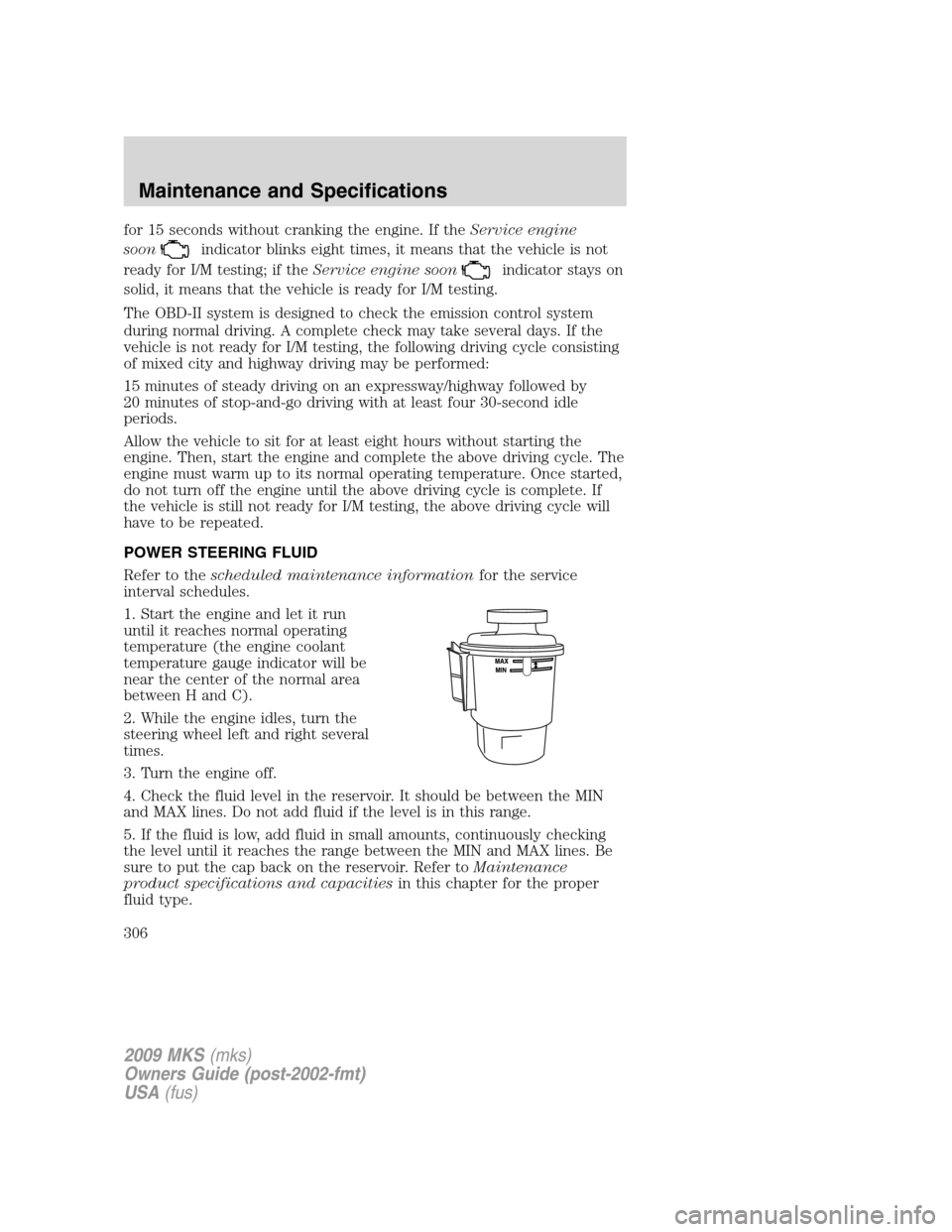
POWER STEERING FLUID
Refer to thescheduled maintenance informationfor the service
interval schedules.
1. Start the engine and let it run
until it reaches normal operating
temperature (the engine coolant
temperature gauge indicator will be
near the center of the normal area
between H and C).
2. While the engine idles, turn the
steering wheel left and right several
times.
3. Turn the engine off.
4. Check the fluid level in the reservoir. It should be between the MIN
and MAX lines. Do not add fluid if the level is in this range.
5. If the fluid is low, add fluid in small amounts, continuously checking
the level until it reaches the range between the MIN and MAX lines. Be
sure to put the cap back on the reservoir. Refer toMaintenance
product specifications and capacitiesin this chapter for the proper
fluid type.
2009 MKS(mks)
Owners Guide (post-2002-fmt)
USA(fus)
Maintenance and Specifications
306
Page 319 of 323
recommendations ...................162
Child safety seats - booster
seats ...........................................172
Cleaning your vehicle
engine compartment ..............274
instrument panel ....................275
interior .....................................276
plastic parts ............................274
washing ....................................272
waxing .....................................273
wheels ......................................273
wiper blades ............................275
Climate control (see Air
conditioning or Heating) ......32, 35
Clock ............................................16
Clock adjust
AM/FM/CD/MP3 ........................16
Console
overhead ....................................54
Controls
power seat ...............................123
steering column ........................72
Coolant
checking and adding ..............288
refill capacities ................292, 311
specifications ..........................311
Cooled Seats ..............................125
Cruise control
(see Speed control) ....................60
Cupholder(s) .............................129
Customer Assistance ................239
Ford Extended Service
Plan ..........................................268
Getting assistance outside
the U.S. and Canada ..............269
Getting roadside assistance ...239
Getting the service you
need .........................................264Ordering additional owner’s
literature .................................269
Utilizing the
Mediation/Arbitration
Program ...................................267
D
Daytime running lamps
(see Lamps) ................................45
Defrost
rear window ..............................32
rear window and rearview
mirrors .......................................35
windshield ...........................32, 35
Dipstick
automatic transmission
fluid ..........................................307
engine oil .................................283
Doors
central unlocking ......................96
Driving under special
conditions ..........................233, 236
sand .........................................234
snow and ice ...........................237
through water .................235, 238
E
Electronic message center .........78
Emergencies, roadside
jump-starting ..........................256
running out of fuel .........256, 298
Emission control system ..........303
Engine ........................................313
cleaning ...................................274
coolant .....................................288
fail-safe cooling .......................293
idle speed control ...................286
lubrication specifications .......311
2009 MKS(mks)
Owners Guide (post-2002-fmt)
USA(fus)
Index
319
Page 323 of 323
Starting your vehicle ........208–210
jump starting ..........................256
push button start system .......211
Steering wheel
controls ......................................72
tilting .........................................53
Stereo
6-CD in dash .............................16
CD-MP3 .....................................16
SYNC ............................................31
T
Tilt steering wheel ......................53
Tire Pressure Monitoring
System (TPMS)
Roadside Emergencies ...........248
Tires, Wheels and Loading ....192
Tires ...........................176–177, 248
alignment ................................184
care ..........................................180
changing ..........................248, 251
checking the pressure ............180
inflating ...................................178
label .........................................191
replacing ..................................182
rotating ....................................184
safety practices .......................183
sidewall information ...............186
snow tires and chains ............197
spare tire .................................249
terminology .............................177
tire grades ...............................177
treadwear ........................176, 181
Towing .......................................204
recreational towing .................207
trailer towing ..........................204wrecker ....................................262
Transaxle
fluid, refill capacities ..............311
lubricant specifications ..........311
Transmission .............................222
brake-shift interlock (BSI) ....222
fluid, checking and adding
(automatic) .............................307
Trunk .........................................100
remote release ..................90, 105
Turn signal ..................................47
U
USB port ......................................25
V
Vehicle Identification Number
(VIN) ..........................................314
Vehicle loading ..........................198
Ventilating your vehicle ...........213
W
Warning lights (see Lights) .......10
Washer fluid ..............................282
Water, Driving through .............238
Windows
power .........................................56
Windshield washer fluid and
wipers ..........................................52
checking and adding fluid .....282
replacing wiper blades ...........283
Wrecker towing .........................262
2009 MKS(mks)
Owners Guide (post-2002-fmt)
USA(fus)
Index
323