transmission LINCOLN MKS 2015 Owner's Guide
[x] Cancel search | Manufacturer: LINCOLN, Model Year: 2015, Model line: MKS, Model: LINCOLN MKS 2015Pages: 424, PDF Size: 3.96 MB
Page 160 of 424
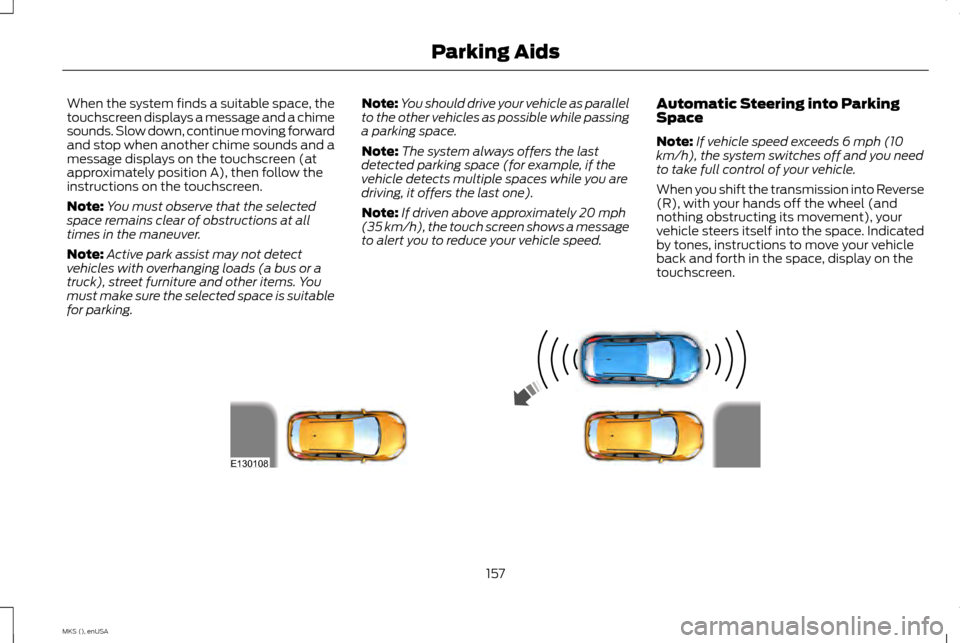
When the system finds a suitable space, the
touchscreen displays a message and a chime
sounds. Slow down, continue moving forward
and stop when another chime sounds and a
message displays on the touchscreen (at
approximately position A), then follow the
instructions on the touchscreen.
Note:
You must observe that the selected
space remains clear of obstructions at all
times in the maneuver.
Note: Active park assist may not detect
vehicles with overhanging loads (a bus or a
truck), street furniture and other items. You
must make sure the selected space is suitable
for parking. Note:
You should drive your vehicle as parallel
to the other vehicles as possible while passing
a parking space.
Note: The system always offers the last
detected parking space (for example, if the
vehicle detects multiple spaces while you are
driving, it offers the last one).
Note: If driven above approximately 20 mph
(35 km/h), the touch screen shows a message
to alert you to reduce your vehicle speed. Automatic Steering into Parking
Space
Note:
If vehicle speed exceeds 6 mph (10
km/h), the system switches off and you need
to take full control of your vehicle.
When you shift the transmission into Reverse
(R), with your hands off the wheel (and
nothing obstructing its movement), your
vehicle steers itself into the space. Indicated
by tones, instructions to move your vehicle
back and forth in the space, display on the
touchscreen. 157
MKS (), enUSA Parking AidsE130108
Page 161 of 424
When you think your vehicle has enough
space in front and behind it, or you hear a
solid tone from the parking aid (accompanied
by a touchscreen display message and a
chime), bring your vehicle to a complete stop.
When automatic steering is finished, the
touch screen displays a message and a chime
sounds, indicating that the active park assist
process is done. The driver is responsible for
checking the parking job and making any
necessary corrections before putting the
transmission in Park (P).
Deactivating the Park Assist Feature
Manually deactivate the system by:
•
Pressing the active park assist button.
• Grabbing the steering wheel.
• Driving above approximately 20 mph (35
km/h) for 30 seconds during an active
park search.
• Driving above 6 mph (10 km/h) during
automatic steering.
• Turning off the traction control system. Certain vehicle conditions can also deactivate
the system, such as:
•
Traction control has activated on a
slippery or loose surface.
• There is an anti-lock brake system
activation or failure.
• Something touches the steering wheel.
If a problem occurs with the system, a
warning message is displayed, followed by
a chime. Occasional system messages may
occur in normal operation. For recurring or
frequent system faults, contact an authorized
dealer to have your vehicle serviced.
Troubleshooting the System The system does not look for a space
The traction control system may be off
The transmission is in Reverse (R); your vehicle must be moving forward to detect a parking space The system does not offer a particular space
Something may be contacting the front bumper or side sensors
There is not enough room on both sides of your vehicle in order to park
There is not enough space for the parking maneuver on the opposite side of the parking space
158
MKS (), enUSA Parking Aids
Page 162 of 424
The system does not offer a particular space
Your vehicle is farther than 6.5 ft (2.0 m) from the parking space
Your vehicle is closer than 16 in. (40 cm) from neighboring parked vehicles
The transmission is in Reverse (R); your vehicle must be moving forward to detect a parking space
Your vehicle is going faster than 20 mph (35 km/h) The system does not position the vehicle where I want in the space
Your vehicle is rolling in the opposite direction of the transmission (rolling forward when Reverse [R] is selected)
An irregular curb along the parking space prevents the system from aligning your vehicle properly
Vehicles or objects bordering the space may not be positioned correctly
Your vehicle was pulled too far past the parking space. The system performs best when you drive the same distance past the parking space
The tires may not be installed or maintained correctly (not inflated correctly, improper size, or of different sizes)
A repair or alteration has changed detection capabilities
A parked vehicle has a high attachment (salt sprayer, snowplow, moving truck bed, etc.)
The parking space length or position of parked objects changed after your vehicle passed
The temperature around your vehicle changes quickly (driving from a heated garage into the cold, or after leaving a car wash)
159
MKS (), enUSA Parking Aids
Page 163 of 424
REAR VIEW CAMERA (If Equipped)
WARNINGS
The rear view camera system is a
reverse aid supplement device that still
requires the driver to use it in
conjunction with the interior and exterior
mirrors for maximum coverage. Objects that are close to either corner
of the bumper or under the bumper,
might not be seen on the screen due to
the limited coverage of the camera system. Back up as slow as possible since
higher speeds might limit your reaction
time to stop the vehicle.
Use caution when using the rear video
camera and the trunk is ajar. If the trunk
is ajar, the camera will be out of
position and the video image may be
incorrect. All guidelines (if enabled) have
been removed when the trunk is ajar. Use caution when turning camera
features on or off while in R (Reverse).
Make sure the vehicle is not moving. The rear view camera system provides a
video image of the area behind your vehicle.
The image will display in either the rear view
mirror or the display in the center of the
instrument panel.
During operation, lines will appear in the
display that represent your vehicle
’s path and
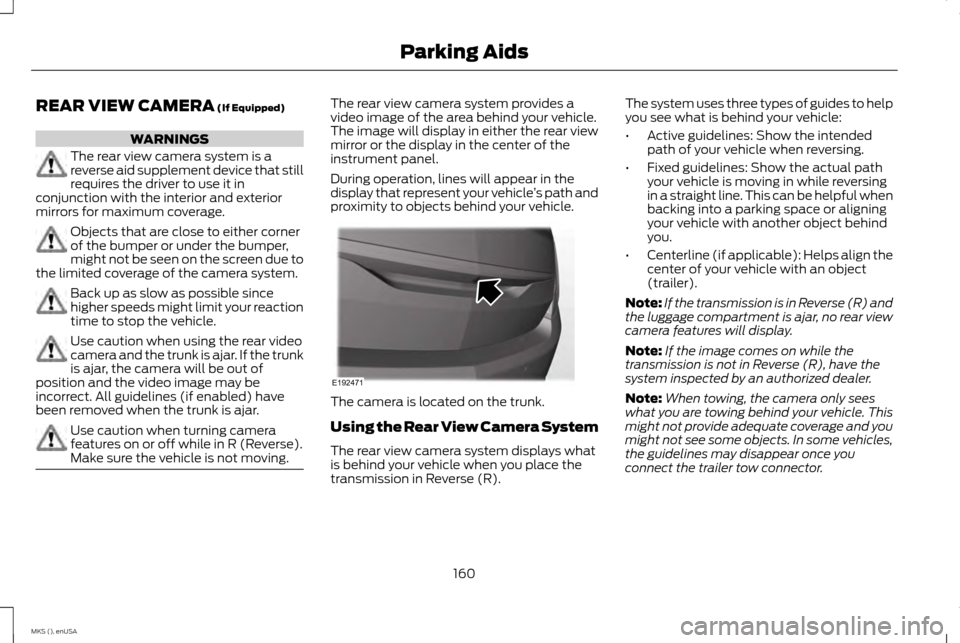
proximity to objects behind your vehicle. The camera is located on the trunk.
Using the Rear View Camera System
The rear view camera system displays what
is behind your vehicle when you place the
transmission in Reverse (R).The system uses three types of guides to help
you see what is behind your vehicle:
•
Active guidelines: Show the intended
path of your vehicle when reversing.
• Fixed guidelines: Show the actual path
your vehicle is moving in while reversing
in a straight line. This can be helpful when
backing into a parking space or aligning
your vehicle with another object behind
you.
• Centerline (if applicable): Helps align the
center of your vehicle with an object
(trailer).
Note: If the transmission is in Reverse (R) and
the luggage compartment is ajar, no rear view
camera features will display.
Note: If the image comes on while the
transmission is not in Reverse (R), have the
system inspected by an authorized dealer.
Note: When towing, the camera only sees
what you are towing behind your vehicle. This
might not provide adequate coverage and you
might not see some objects. In some vehicles,
the guidelines may disappear once you
connect the trailer tow connector.
160
MKS (), enUSA Parking AidsE192471
Page 164 of 424
The camera may not operate correctly under
the following conditions:
•
Nighttime or dark areas if the reverse
lamps are not operating.
• Mud, water or debris obstructs the
camera's view. Clean the lens with a soft,
lint-free cloth and non-abrasive cleaner.
• The camera is misaligned due to damage
to the rear of your vehicle.
To access any of the rear view camera
system settings, make the following
selections in the touch screen when the
transmission is not in Reverse (R):
• Menu > Vehicle > Rear View Camera
After changing a system setting, the touch
screen shows a preview of the selected
features.
Guidelines and the Centerline
Note: Active guidelines and fixed guidelines
are only available when the transmission is in
Reverse (R).
Note: The centerline is only available if Active
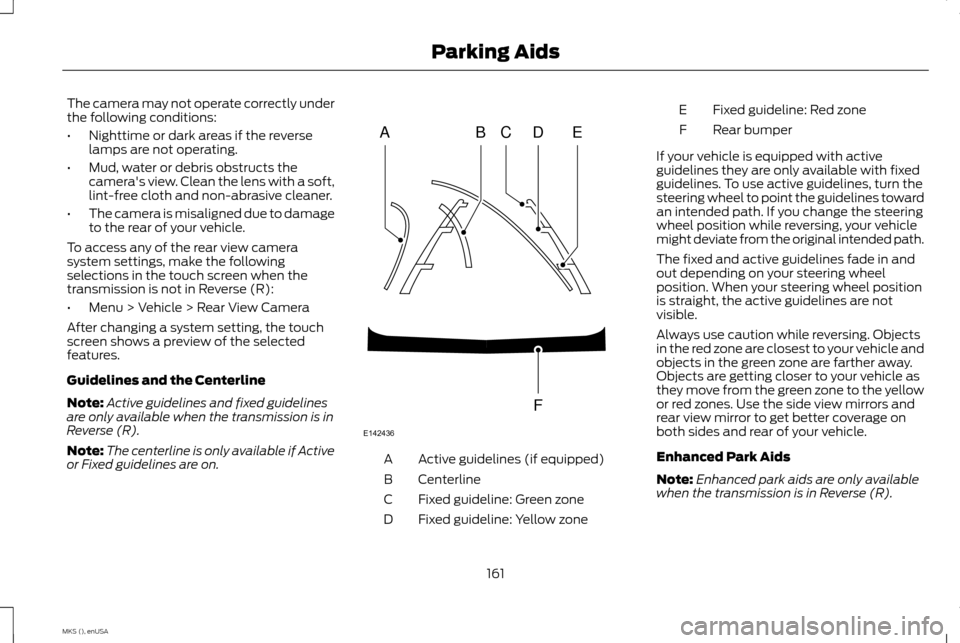
or Fixed guidelines are on. Active guidelines (if equipped)
A
Centerline
B
Fixed guideline: Green zone
C
Fixed guideline: Yellow zone
D Fixed guideline: Red zone
E
Rear bumper
F
If your vehicle is equipped with active
guidelines they are only available with fixed
guidelines. To use active guidelines, turn the
steering wheel to point the guidelines toward
an intended path. If you change the steering
wheel position while reversing, your vehicle
might deviate from the original intended path.
The fixed and active guidelines fade in and
out depending on your steering wheel
position. When your steering wheel position
is straight, the active guidelines are not
visible.
Always use caution while reversing. Objects
in the red zone are closest to your vehicle and
objects in the green zone are farther away.
Objects are getting closer to your vehicle as
they move from the green zone to the yellow
or red zones. Use the side view mirrors and
rear view mirror to get better coverage on
both sides and rear of your vehicle.
Enhanced Park Aids
Note: Enhanced park aids are only available
when the transmission is in Reverse (R).
161
MKS (), enUSA Parking AidsABCD
F
E
E142436
Page 165 of 424
Note:
The reverse sensing system is not
effective at speeds above 3 mph (5 km/h) and
may not detect certain angular or moving
objects.
The system uses red, yellow and green
highlights that appear on top of the video
image when the reverse sensing system
detects an object. The alert highlights the
closest object detected. You can disable the
reverse sensing alert if you have visual park
aid alert enabled, you will still see the
displayed highlighted areas.
Selectable settings for this feature are ON
and OFF.
Manual Zoom WARNING
When manual zoom is on, the full area
behind your vehicle is not shown. Be
aware of your surroundings when using
the manual zoom feature. Note:
Manual zoom is only available when
the transmission is in Reverse (R).
Note: Only the centerline shows when you
enable manual zoom. This allows you to get a closer view of an
object behind your vehicle. The zoomed
image keeps the bumper in the image to
provide a reference. The zoom is only active
while the transmission is in Reverse (R).
When you shift the transmission out of
Reverse (R), the feature automatically turns
off and you must enable it to use it used
again.
Selectable settings for this feature are ON
and OFF.
Rear Camera Delay
When shifting the transmission out of
Reverse (R) and into any gear other than Park
(P), the camera image remains in the display
until your vehicle speed reaches 6 mph (10
km/h or until you select a radio button.
Selectable settings for this feature are ON
and OFF. The default setting for the rear
camera delay is OFF.
162
MKS (), enUSA Parking Aids
Page 179 of 424
Why does the vehicle not come back into the middle of the lane always, as expected, in the Aid or Aid + Alert mode?
High cross winds
Large road crown
Rough roads, grooves, shoulder drop-offs
Heavy uneven loading of the vehicle or improper tire inflation pressure
If the tires have been exchanged (including snow tires), or the suspension has been modified
Vehicle accessories such as snow plows or trailers
BLIND SPOT INFORMATION
SYSTEM
Blind Spot Information System
(BLIS ™) with Cross Traffic Alert (If
Equipped) WARNING
To help avoid injuries, NEVER use the
Blind Spot Information System as a
replacement for using the interior and
exterior mirrors or looking over your shoulder
before changing lanes. The Blind Spot
Information System is not a replacement for
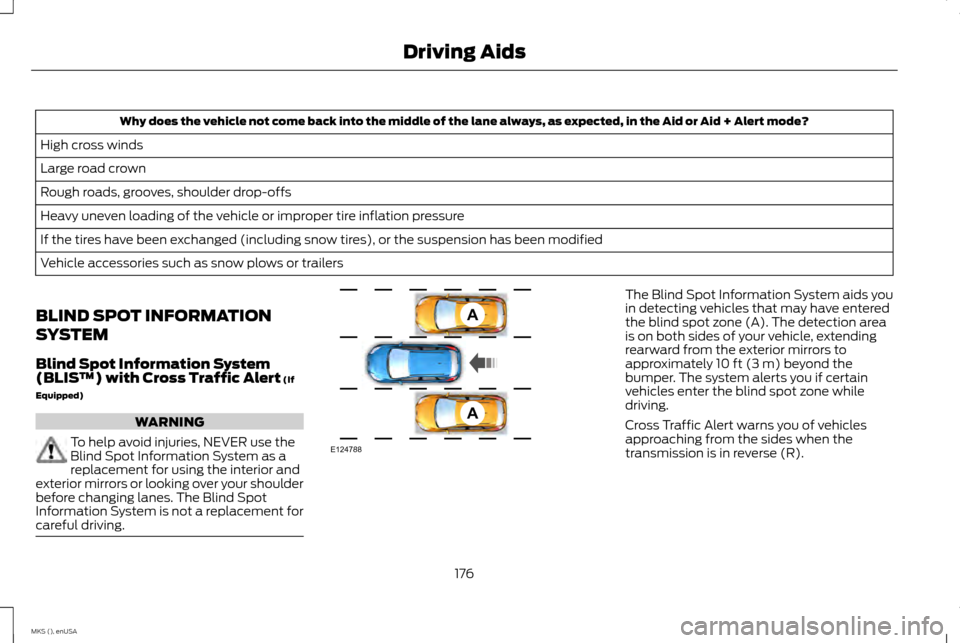
careful driving. The Blind Spot Information System aids you
in detecting vehicles that may have entered
the blind spot zone (A). The detection area
is on both sides of your vehicle, extending
rearward from the exterior mirrors to
approximately 10 ft (3 m) beyond the
bumper. The system alerts you if certain
vehicles enter the blind spot zone while
driving.
Cross Traffic Alert warns you of vehicles
approaching from the sides when the
transmission is in reverse (R).
176
MKS (), enUSA Driving AidsA
A
E124788
Page 180 of 424
Note:
The Blind Spot Information System
does not prevent contact with other vehicles
or objects; nor detect parked vehicles, people,
animals or infrastructure (fences, guardrails,
trees). It only alerts you to vehicles in the blind
zones.
Note: When a vehicle passes quickly through
the blind zone, typically fewer than two
seconds, the system does not trigger. Using the Systems
The Blind Spot Information System turns on
when you start the engine and you drive your
vehicle forward above 2 mph (3 km/h); it
remains on while the transmission is in drive
(D) and neutral (N). If shifted out of drive (D)
or neutral (N), the system enters cross traffic
alert mode. Once shifted back into drive (D),
the Blind Spot Information System turns back
on when you drive your vehicle above
2 mph
(3 km/h). Note:
The Blind Spot Information System
does not function in reverse (R) or park (P) or
provide any additional warning when a
direction indicator is on.
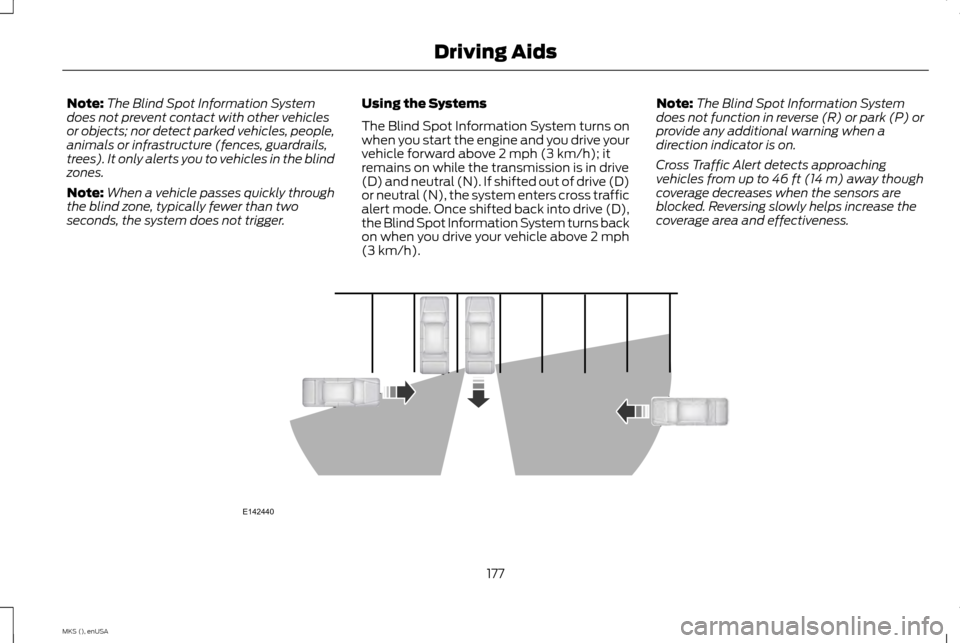
Cross Traffic Alert detects approaching
vehicles from up to
46 ft (14 m) away though
coverage decreases when the sensors are
blocked. Reversing slowly helps increase the
coverage area and effectiveness. 177
MKS (), enUSA Driving AidsE142440
Page 196 of 424
WARNING
Exceeding the Safety
Compliance Certification Label
vehicle weight rating limits could
result in substandard vehicle
handling or performance, engine,
transmission and/or structural
damage, serious damage to the
vehicle, loss of control and personal
injury. 193
MKS (), enUSA Load CarryingE142524
Page 201 of 424
TOWING A TRAILER
WARNINGS
Do not exceed the GVWR or the
GAWR specified on the
certification label. Towing trailers beyond the
maximum recommended gross
trailer weight exceeds the limit of
your vehicle and could result in
engine damage, transmission
damage, structural damage, loss of
vehicle control, vehicle rollover and
personal injury. Note:
There may be electrical items
such as fuses or relays that can affect
trailer towing operation. See Fuses
(page 218).
The load capacity of your vehicle is
designated by weight not volume.
You may not necessarily be able to
use all available space when loading
your vehicle or trailer. Towing a trailer places extra load
on the engine, transmission, axle,
brakes, tires, and suspension.
Inspect these components before,
during and after towing.
Load Placement
To help minimize how trailer
movement affects the vehicle when
driving:
•
Load the heaviest items closest
to the trailer floor.
• Load the heaviest items in the
center of the left and right side
trailer tires. •
Load the heaviest items above
the trailer axles or just slightly
forward toward the trailer
tongue. Do not allow the final
trailer tongue weight to go above
or below 10-15% of the loaded
trailer weight.
• Select a tow bar with the correct
rise or drop. When both the
loaded vehicle and trailer are
connected, the trailer frame
should be level, or slightly angled
down toward the vehicle, when
viewed from the side.
When driving with a trailer or
payload, a slight takeoff vibration or
shudder may be present due to the
increased payload weight.
Additional information regarding
proper trailer loading and setting
your vehicle up for towing is located
in the Load Carrying chapter. See
Load Limit (page 187). You can also
find the information in the
RV &
Trailer Towing Guide, available at
an authorized dealer.
198
MKS (), enUSA Towing