fuel LINCOLN MKS 2015 Service Manual
[x] Cancel search | Manufacturer: LINCOLN, Model Year: 2015, Model line: MKS, Model: LINCOLN MKS 2015Pages: 424, PDF Size: 3.96 MB
Page 251 of 424
WASHER FLUID CHECK
WARNING
If you operate your vehicle in
temperatures below 40°F (5°C), use
washer fluid with antifreeze protection.
Failure to use washer fluid with antifreeze
protection in cold weather could result in
impaired windshield vision and increase the
risk of injury or accident. Add fluid to fill the reservoir if the level is low.
Only use a washer fluid that meets Ford
specifications. See Capacities and
Specifications (page 290).
State or local regulations on volatile organic
compounds may restrict the use of methanol,
a common windshield washer antifreeze
additive. Washer fluids containing
non-methanol antifreeze agents should be
used only if they provide cold weather
protection without damaging the vehicle ’s
paint finish, wiper blades or washer system. FUEL FILTER
Your vehicle is equipped with a lifetime fuel
filter that is integrated with the fuel tank.
Regular maintenance or replacement is not
needed.
CHANGING THE 12V BATTERY WARNINGS
Batteries normally produce explosive
gases that can cause personal injury.
Therefore, do not allow flames, sparks
or lighted substances to come near the
battery. When working near the battery,
always shield your face and protect your
eyes. Always provide proper ventilation. This vehicle may be equipped with
more than one battery, removal of
cable from only one battery does not
disconnect your vehicle electrical system. Be
sure to disconnect cables from all batteries
when disconnecting power. Failure to do so
may cause serious personal injury or property
damage. WARNINGS
When lifting a plastic-cased battery,
excessive pressure on the end walls
could cause acid to flow through the
vent caps, resulting in personal injury and
damage to the vehicle or battery. Lift the
battery with a battery carrier or with your
hands on opposite corners. Keep batteries out of reach of children.
Batteries contain sulfuric acid. Avoid
contact with skin, eyes or clothing.
Shield your eyes when working near the
battery to protect against possible splashing
of acid solution. In case of acid contact with
skin or eyes, flush immediately with water for
a minimum of 15 minutes and get prompt
medical attention. If acid is swallowed, call
a physician immediately. Note:
If your battery has a cover/shield, make
sure it is reinstalled after the battery has been
cleaned or replaced.
Note: Battery posts, terminals and related
accessories contain lead and lead compounds.
Wash hands after handling.
Note: Electrical or electronic accessories or
components added to your vehicle by the
dealer or the owner may adversely affect
battery performance and durability.
248
MKS (), enUSA Maintenance
Page 252 of 424
Your vehicle is equipped with a Motorcraft
maintenance-free battery which normally
does not require additional water during its
life of service.
For longer, trouble-free operation, keep the
top of the battery clean and dry. Also, make
certain the battery cables are always tightly
fastened to the battery terminals.
If you see any corrosion on the battery or
terminals, remove the cables from the
terminals and clean with a wire brush. You
can neutralize the acid with a solution of
baking soda and water.
It is recommended that the negative battery
cable terminal be disconnected from the
battery if you plan to store your vehicle for
an extended period of time.
Because your vehicle
’s engine is electronically
controlled by a computer, some control
conditions are maintained by power from the
battery. When the battery is disconnected or
a new battery is installed, the engine must
relearn its idle and fuel trim strategy for
optimum driveability and performance.
Flexible fuel vehicles (FFV) must also relearn
the ethanol content of the fuel for optimum
driveability and performance. To begin this
process: 1.
With your vehicle at a complete stop, set
the parking brake.
2. Put the gearshift in P(Park), turn off all
accessories.
3. Start the engine. Run the engine until it reaches normal operating temperature.
4. Allow the engine to idle for at least one minute.
5. Turn the air conditioning on and allow the
engine to idle for at least one minute. 6.
Release the parking brake. With your foot
on the brake pedal and with the air
conditioning on, put your vehicle in D
(Drive) and allow the engine to idle for at
least one minute.
• If you do not allow the engine to
relearn its idle trim, the idle quality of
your vehicle may be adversely
affected until the idle trim is
eventually relearned.
7. Drive your vehicle to complete the relearning process
•Your vehicle may need to be driven 10
miles (16 kilometers) or more to
relearn the idle and fuel trim strategy
along with the ethanol content for
flexible fuel vehicles.
• For flexible fuel vehicles, if you are
operating on E85, you may experience
poor starts or an inability to start the
engine and driveability problems until
the fuel trim and ethanol content
have been relearned.
If the battery has been disconnected or a new
battery has been installed, the clock and
radio settings must be reset once the battery
is reconnected.
249
MKS (), enUSA Maintenance
Page 260 of 424
GENERAL INFORMATION
Your Ford or Lincoln authorized dealer has
many quality products available to clean your
vehicle and protect its finishes.
CLEANING PRODUCTS
For best results, use the following products
or products of equivalent quality:
•
Motorcraft Bug and Tar Remover (ZC-42)
• Motorcraft Custom Bright Metal Cleaner
(ZC-15)
• Motorcraft Detail Wash (ZC-3-A)
• Motorcraft Dusting Cloth (ZC-24)
• Motorcraft Engine Shampoo and
Degreaser (U.S. only) (ZC-20)
• Motorcraft Engine Shampoo (Canada
only) (CXC-66-A)
• Motorcraft Multi-Purpose Cleaner
(Canada only) (CXC-101)
• Motorcraft Premium Glass Cleaner
(Canada only) (CXC-100)
• Motorcraft Premium Quality Windshield
Washer Fluid (Canada only) [CXC-37-(A,
B, D or F)] •
Motorcraft Premium Windshield Wash
Concentrate with Bitterant (U.S. only)
(ZC-32-B2)
• Motorcraft Professional Strength Carpet
& Upholstery Cleaner (ZC-54)
• Motorcraft Premium Leather and Vinyl
Cleaner (ZC-56)
• Motorcraft Spot and Stain Remover (U.S.
only) (ZC-14)
• Motorcraft Ultra-Clear Spray Glass
Cleaner (ZC-23)
• Motorcraft Wheel and Tire Cleaner
(ZC-37-A)
CLEANING THE EXTERIOR
Wash your vehicle regularly with cool or
lukewarm water and a neutral pH shampoo,
we recommend Motorcraft Detail Wash.
• Never use strong household detergents
or soap, for example dish washing or
laundry liquid. These products can
discolor and spot painted surfaces.
• Never wash your vehicle when is hot to
the touch, or during strong or direct
sunlight. •
Dry your vehicle with a chamois or soft
terry cloth towel to eliminate water
spotting.
• Immediately remove fuel spillages, bird
droppings, insect deposits and road tar.
These may cause damage to your
vehicle ’s paintwork or trim over time. We
recommend Motorcraft Bug and Tar
Remover.
• Remove any exterior accessories, for
example antennas, before entering a car
wash.
Note: Suntan lotions and insect repellents
can damage painted surfaces. If these
substances come in contact with your vehicle,
wash the affected area as soon as possible.
257
MKS (), enUSA Vehicle Care
Page 264 of 424
For cleaning and removing spots and stains
such as dye transfer, use Motorcraft Premium
Leather and Vinyl Cleaner or a commercially
available leather cleaning product for
automotive interiors.
Note:
Test any cleaner or stain remover on an
inconspicuous area.
You should:
• Remove dust and loose dirt with a
vacuum cleaner.
• Clean and treat spills and stains as soon
as possible.
Do not use the following products as these
may damage the leather:
• Oil and petroleum or silicone-based
leather conditioners.
• Household cleaners.
• Alcohol solutions.
• Solvents or cleaners intended specifically
for rubber, vinyl and plastics. Note:
Do not use Motorcraft Premium Leather
and Vinyl Cleaner ZC-56 on Lincoln Black
Label, Presidential or Reserve Leathers
because it can damage those and other
semi-aniline leather seating fabrics. It can also
damage surround microfiber accent surfaces.
To clean Lincoln Black Label, Presidential or
Reserve Leathers, first vacuum the seats to
remove loose dirt. Then wipe the leather with
a clean soft cloth dampened with lukewarm
water and a mild soap. Wiper the leather again
with a slightly damp cloth to remove soap
residue, and dry with a soft cloth. To maintain
the leather's resiliency, it should be cleaned
whenever soiled.
REPAIRING MINOR PAINT
DAMAGE
Authorized dealers have touch-up paint to
match your vehicle ’s color. Your vehicle color
code is printed on a sticker on the front,
left-hand side door jamb. Take your color
code to your authorized dealer to make sure
you get the correct color.
Before repairing minor paint damage, use a
cleaner such as Motorcraft Bug and Tar
Remover to remove particles such as bird
droppings, tree sap, insect deposits, tar spots,
road salt and industrial fallout. Always read the instructions before using
cleaning products.
CLEANING THE ALLOY WHEELS
Note:
Do not apply a cleaning chemical to
warm or hot wheel rims and covers.
Note: Some automatic car washes may cause
damage to the finish on your wheel rims and
covers.
Note: Industrial-strength or heavy-duty
cleaners in combination with brush agitation
to remove brake dust and dirt, could wear
away the clear coat finish over a period time.
Note: Do not use hydrofluoric acid-based or
high caustic-based wheel cleaners, steel wool,
fuels or strong household detergents.
Note: If you intend parking your vehicle for an
extended period after cleaning the wheels with
a wheel cleaner, drive your vehicle for a few
minutes before doing so. This will reduce the
risk of increased corrosion of the brake discs.
Alloy wheels and wheel covers are coated
with a clear coat paint finish. To maintain
their condition we recommend that you:
261
MKS (), enUSA Vehicle Care
Page 265 of 424
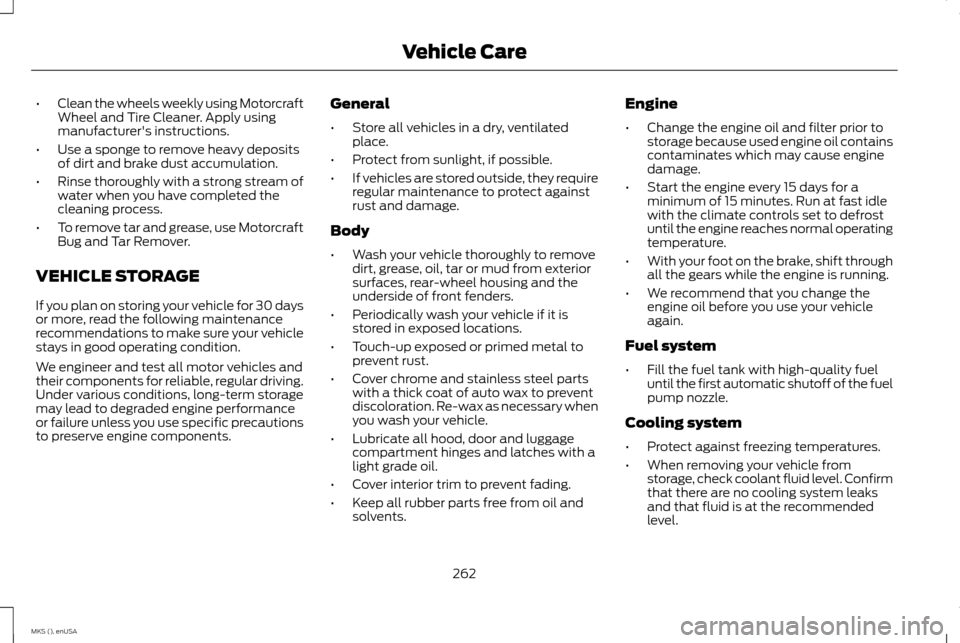
•
Clean the wheels weekly using Motorcraft
Wheel and Tire Cleaner. Apply using
manufacturer's instructions.
• Use a sponge to remove heavy deposits
of dirt and brake dust accumulation.
• Rinse thoroughly with a strong stream of
water when you have completed the
cleaning process.
• To remove tar and grease, use Motorcraft
Bug and Tar Remover.
VEHICLE STORAGE
If you plan on storing your vehicle for 30 days
or more, read the following maintenance
recommendations to make sure your vehicle
stays in good operating condition.
We engineer and test all motor vehicles and
their components for reliable, regular driving.
Under various conditions, long-term storage
may lead to degraded engine performance
or failure unless you use specific precautions
to preserve engine components. General
•
Store all vehicles in a dry, ventilated
place.
• Protect from sunlight, if possible.
• If vehicles are stored outside, they require
regular maintenance to protect against
rust and damage.
Body
• Wash your vehicle thoroughly to remove
dirt, grease, oil, tar or mud from exterior
surfaces, rear-wheel housing and the
underside of front fenders.
• Periodically wash your vehicle if it is
stored in exposed locations.
• Touch-up exposed or primed metal to
prevent rust.
• Cover chrome and stainless steel parts
with a thick coat of auto wax to prevent
discoloration. Re-wax as necessary when
you wash your vehicle.
• Lubricate all hood, door and luggage
compartment hinges and latches with a
light grade oil.
• Cover interior trim to prevent fading.
• Keep all rubber parts free from oil and
solvents. Engine
•
Change the engine oil and filter prior to
storage because used engine oil contains
contaminates which may cause engine
damage.
• Start the engine every 15 days for a
minimum of 15 minutes. Run at fast idle
with the climate controls set to defrost
until the engine reaches normal operating
temperature.
• With your foot on the brake, shift through
all the gears while the engine is running.
• We recommend that you change the
engine oil before you use your vehicle
again.
Fuel system
• Fill the fuel tank with high-quality fuel
until the first automatic shutoff of the fuel
pump nozzle.
Cooling system
• Protect against freezing temperatures.
• When removing your vehicle from
storage, check coolant fluid level. Confirm
that there are no cooling system leaks
and that fluid is at the recommended
level.
262
MKS (), enUSA Vehicle Care
Page 283 of 424
Each tire, including the spare (if
provided), should be checked
monthly when cold and inflated to
the inflation pressure
recommended by the vehicle manufacturer
on the vehicle placard or tire inflation
pressure label. (If your vehicle has tires of a
different size than the size indicated on the
vehicle placard or tire inflation pressure label,
you should determine the proper tire inflation
pressure for those tires.)
As an added safety feature, your vehicle has
been equipped with a Tire Pressure
Monitoring System (TPMS) that illuminates
a low tire pressure telltale when one or more
of your tires is significantly under-inflated.
Accordingly, when the low tire pressure
telltale illuminates, you should stop and
check your tires as soon as possible, and
inflate them to the proper pressure. Driving
on a significantly under-inflated tire causes
the tire to overheat and can lead to tire
failure. Under-inflation also reduces fuel
efficiency and tire tread life, and may affect
the vehicle ’s handling and stopping ability. Please note that the TPMS is not a substitute
for proper tire maintenance, and it is the
driver
’s responsibility to maintain correct tire
pressure, even if under-inflation has not
reached the level to trigger illumination of
the TPMS low tire pressure telltale.
Your vehicle has also been equipped with a
TPMS malfunction indicator to indicate when
the system is not operating properly. The
TPMS malfunction indicator is combined with
the low tire pressure telltale. When the
system detects a malfunction, the telltale
will flash for approximately one minute and
then remain continuously illuminated. This
sequence will continue upon subsequent
vehicle start-ups as long as the malfunction
exists.
When the malfunction indicator is
illuminated, the system may not be able to
detect or signal low tire pressure as intended.
TPMS malfunctions may occur for a variety
of reasons, including the installation of
replacement or alternate tires or wheels on
the vehicle that prevent the TPMS from
functioning properly. Always check the TPMS
malfunction telltale after replacing one or
more tires or wheels on your vehicle to ensure
that the replacement or alternate tires and
wheels allow the TPMS to continue to
function properly. The tire pressure monitoring system complies
with part 15 of the FCC rules and with
RSS-210 of Industry Canada. Operation is
subject to the following two conditions: (1)
This device may not cause harmful
interference, and (2) This device must accept
any interference received, including
interference that may cause undesired
operation.
Changing Tires With a Tire Pressure
Monitoring System
280
MKS (), enUSA Wheels and Tires E142549
Page 293 of 424
ENGINE SPECIFICATIONS
3.7 V6
3.5L V6 Ecoboost
Engine
226
214
Cubic inches
Minimum 87 octane
Minimum 87 octane
Required fuel
1-4-2-5-3-6
1-4-2-5-3-6
Firing order
Coil on plug
Coil on plug
Ignition system
.049-.053 in. (1.25-1.35 mm)
.030-.033 in. (.75-.85 mm)
Spark plug gap
10.5:1
10.0:1
Compression ratio
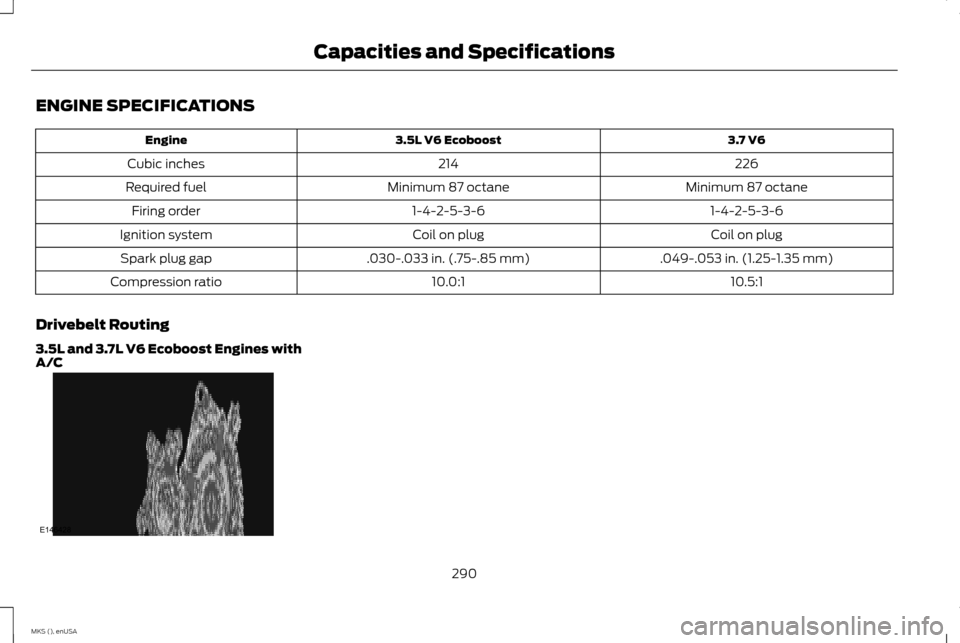
Drivebelt Routing
3.5L and 3.7L V6 Ecoboost Engines with
A/C 290
MKS (), enUSA Capacities and SpecificationsE146428
Page 297 of 424
TECHNICAL SPECIFICATIONS
WARNING
The air conditioning refrigerant system contains refrigerant R-134a under high pressure. Opening the air conditioning refrigerant system
can cause personal injury. Have the air conditioning refrigerant system serviced only by qualified personnel.
Ford part number / Ford specification
Recommended fluids and
lubricants
Capacity
Item
XL-1 (U.S.) / --
Motorcraft Penetrating and
Lock Lubricant (U.S.)
—
Lock cylinders
CXC-51-A (Canada) / --
Motorcraft Penetrating Fluid
(Canada)
XL-5
Motorcraft Multi-Purpose
Grease Spray
—
Hinges, latches, striker plates,
fuel filler door hinge and seat tracks
PM-20 / WSS-M6C65-A2
Motorcraft DOT 4 LV High
Performance Motor Vehicle Brake Fluid
Between MIN/MAX on brake fluid
reservoir
Brake fluid 1
XO-5W30-QSP or XO-5W30-QFS (U.S.)/ WSS-M2C946-A
Motorcraft SAE 5W-30
Premium Synthetic Blend Motor Oil or Motorcraft SAE 5W-30 Full Synthetic Motor Oil
6.0 qt (5.7 L)
3.5L EcoBoost engine oil
CXO-5W30-LSP12 or CXO-5W30-LFS12
(Canada) / WSS-M2C946-A
294
MKS (), enUSA Capacities and Specifications
Page 299 of 424
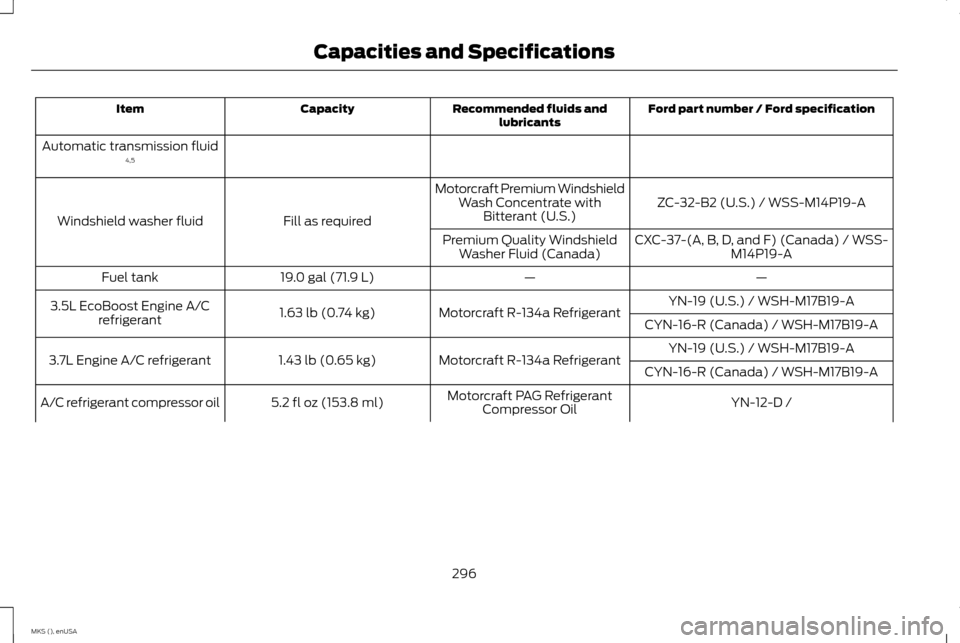
Ford part number / Ford specification
Recommended fluids and
lubricants
Capacity
Item
Automatic transmission fluid 4,5
ZC-32-B2 (U.S.) / WSS-M14P19-A
Motorcraft Premium Windshield
Wash Concentrate with Bitterant (U.S.)
Fill as required
Windshield washer fluid
CXC-37-(A, B, D, and F) (Canada) / WSS-M14P19-A
Premium Quality Windshield
Washer Fluid (Canada)
—
—
19.0 gal (71.9 L)
Fuel tank
YN-19 (U.S.) / WSH-M17B19-A
Motorcraft R-134a Refrigerant
1.63 lb (0.74 kg)
3.5L EcoBoost Engine A/C
refrigerant CYN-16-R (Canada) / WSH-M17B19-A
YN-19 (U.S.) / WSH-M17B19-A
Motorcraft R-134a Refrigerant
1.43 lb (0.65 kg)
3.7L Engine A/C refrigerant
CYN-16-R (Canada) / WSH-M17B19-A
YN-12-D /
Motorcraft PAG Refrigerant
Compressor Oil
5.2 fl oz (153.8 ml)
A/C refrigerant compressor oil
296
MKS (), enUSA Capacities and Specifications
Page 300 of 424
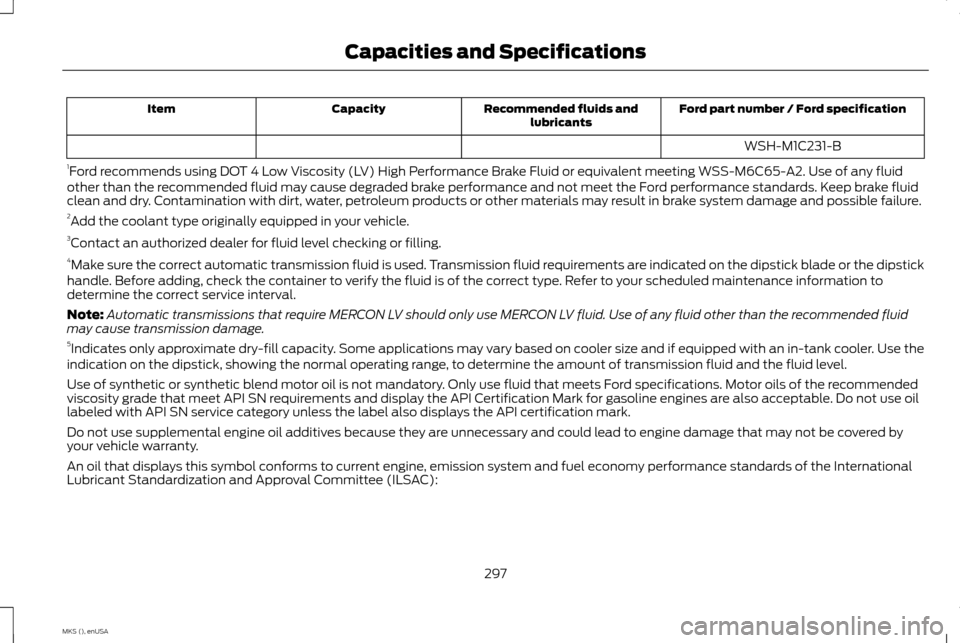
Ford part number / Ford specification
Recommended fluids and
lubricants
Capacity
Item
WSH-M1C231-B
1 Ford recommends using DOT 4 Low Viscosity (LV) High Performance Brake Fluid or equivalent meeting WSS-M6C65-A2. Use of any fluid
other than the recommended fluid may cause degraded brake performance and not meet the Ford performance standards. Keep brake fluid
clean and dry. Contamination with dirt, water, petroleum products or other materials may result in brake system damage and possible failure.
2 Add the coolant type originally equipped in your vehicle.
3 Contact an authorized dealer for fluid level checking or filling.
4 Make sure the correct automatic transmission fluid is used. Transmission fluid requirements are indicated on the dipstick blade or the dipstick
handle. Before adding, check the container to verify the fluid is of the correct type. Refer to your scheduled maintenance information to
determine the correct service interval.
Note: Automatic transmissions that require MERCON LV should only use MERCON LV fluid. Use of any fluid other than the recommended fluid
may cause transmission damage.
5 Indicates only approximate dry-fill capacity. Some applications may vary based on cooler size and if equipped with an in-tank cooler. Use the
indication on the dipstick, showing the normal operating range, to determine the amount of transmission fluid and the fluid level.
Use of synthetic or synthetic blend motor oil is not mandatory. Only use fluid that meets Ford specifications. Motor oils of the recommended
viscosity grade that meet API SN requirements and display the API Certification Mark for gasoline engines are also acceptable. Do not use oil
labeled with API SN service category unless the label also displays the API certification mark.
Do not use supplemental engine oil additives because they are unnecessary and could lead to engine damage that may not be covered by
your vehicle warranty.
An oil that displays this symbol conforms to current engine, emission system and fuel economy performance standards of the International
Lubricant Standardization and Approval Committee (ILSAC):
297
MKS (), enUSA Capacities and Specifications