oil change LINCOLN MKS 2015 Owners Manual
[x] Cancel search | Manufacturer: LINCOLN, Model Year: 2015, Model line: MKS, Model: LINCOLN MKS 2015Pages: 424, PDF Size: 3.96 MB
Page 7 of 424
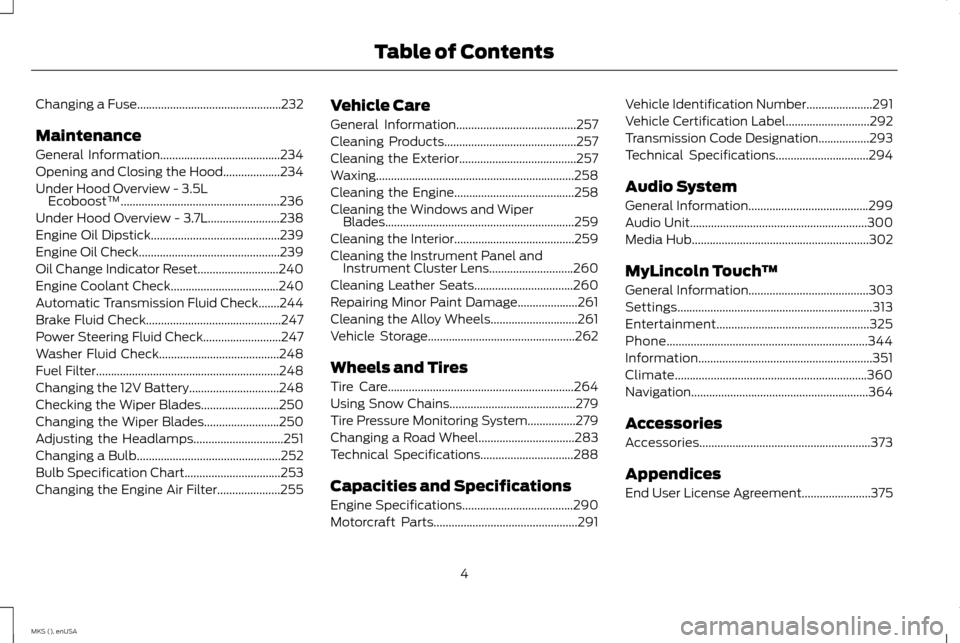
Changing a Fuse................................................232
Maintenance
General Information........................................234
Opening and Closing the Hood...................234
Under Hood Overview -
3.5L
Ecoboost™.....................................................236
Under Hood Overview - 3.7L........................238
Engine Oil Dipstick...........................................239
Engine Oil Check...............................................239
Oil Change Indicator Reset...........................240
Engine Coolant Check....................................240
Automatic Transmission Fluid Check.......244
Brake Fluid Check.............................................247
Power Steering Fluid Check..........................247
Washer Fluid Check
........................................248
Fuel Filter
.............................................................248
Changing the 12V Battery..............................248
Checking the Wiper Blades..........................250
Changing the Wiper Blades.........................250
Adjusting the Headlamps..............................251
Changing a Bulb
................................................252
Bulb Specification Chart................................253
Changing the Engine Air Filter
.....................255 Vehicle Care
General Information
........................................257
Cleaning Products
............................................257
Cleaning the Exterior.......................................257
Waxing ..................................................................
258
Cleaning the Engine
........................................258
Cleaning the Windows and Wiper Blades
...............................................................259
Cleaning the Interior
........................................259
Cleaning the Instrument Panel and Instrument Cluster Lens
............................260
Cleaning Leather Seats
.................................260
Repairing Minor Paint Damage
....................261
Cleaning the Alloy Wheels.............................261
Vehicle Storage
.................................................262
Wheels and Tires
Tire Care..............................................................264
Using Snow Chains..........................................279
Tire Pressure Monitoring System................279
Changing a Road Wheel
................................283
Technical Specifications
...............................288
Capacities and Specifications
Engine Specifications
.....................................290
Motorcraft Parts................................................291 Vehicle Identification Number
......................291
Vehicle Certification Label
............................292
Transmission Code Designation.................293
Technical Specifications...............................294
Audio System
General Information
........................................299
Audio Unit
...........................................................300
Media Hub
...........................................................302
MyLincoln Touch ™
General Information
........................................303
Settings.................................................................313
Entertainment...................................................325
Phone
...................................................................344
Information..........................................................351
Climate................................................................360
Navigation...........................................................364
Accessories
Accessories.........................................................373
Appendices
End User License Agreement.......................375
4
MKS (), enUSA Table of Contents
Page 104 of 424
Maintenance
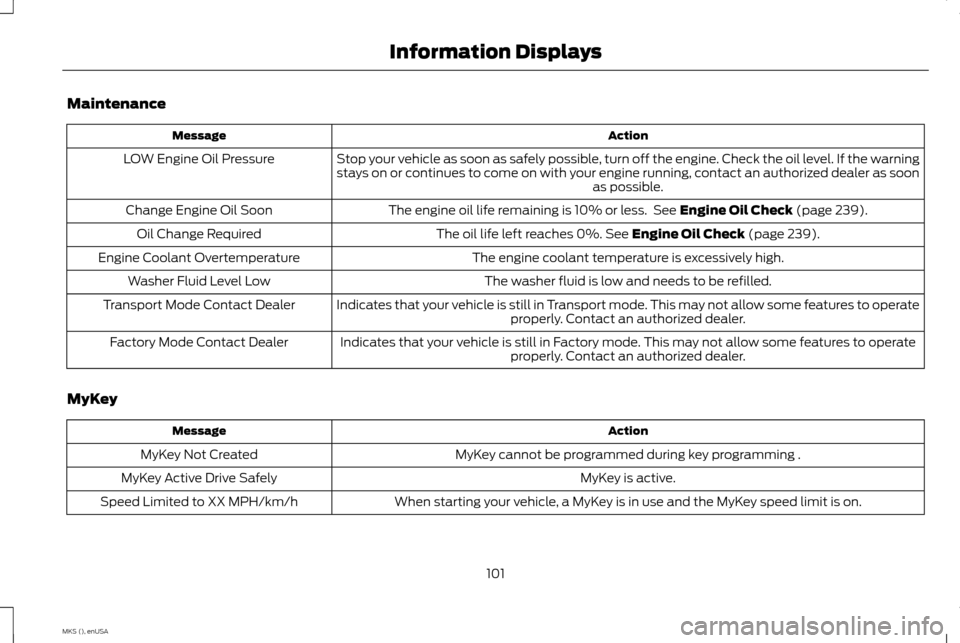
Action
Message
Stop your vehicle as soon as safely possible, turn off the engine. Check the oil level. If the warning
stays on or continues to come on with your engine running, contact an authorized dealer as soon as possible.
LOW Engine Oil Pressure
The engine oil life remaining is 10% or less. See Engine Oil Check (page 239).
Change Engine Oil Soon
The oil life left reaches 0%.
See Engine Oil Check (page 239).
Oil Change Required
The engine coolant temperature is excessively high.
Engine Coolant Overtemperature
The washer fluid is low and needs to be refilled.
Washer Fluid Level Low
Indicates that your vehicle is still in Transport mode. This may not allow some features to operateproperly. Contact an authorized dealer.
Transport Mode Contact Dealer
Indicates that your vehicle is still in Factory mode. This may not allow some features to operateproperly. Contact an authorized dealer.
Factory Mode Contact Dealer
MyKey Action
Message
MyKey cannot be programmed during key programming .
MyKey Not Created
MyKey is active.
MyKey Active Drive Safely
When starting your vehicle, a MyKey is in use and the MyKey speed limit is on.
Speed Limited to XX MPH/km/h
101
MKS (), enUSA Information Displays
Page 207 of 424
BREAKING-IN
You need to break in new tires for
approximately 300 miles (480 kilometers).
During this time, your vehicle may exhibit
some unusual driving characteristics.
Avoid driving too fast during the first 1000
miles (1600 kilometers). Vary your speed
frequently and change up through the gears
early. Do not labor the engine.
Do not tow during the first 1000 miles (1600
kilometers).
ECONOMICAL DRIVING
Fuel economy is affected by several things
such as how you drive, the conditions you
drive under and how you maintain your
vehicle.
There are some things to keep in mind that
may improve your fuel economy:
•
Accelerate and slow down in a smooth,
moderate fashion.
• Drive at steady speeds.
• Anticipate stops; slowing down may
eliminate the need to stop. •
Combine errands and minimize
stop-and-go driving.
•When running errands, go to the
furthest destination first and then
work your way back home.
• Close the windows for high-speed driving.
• Drive at reasonable speeds. (Traveling at
65 mph/105 kph uses about 15% less fuel
than traveling at 75 mph/121 kph).
• Keep the tires properly inflated and use
only the recommended size.
• Use the recommended engine oil.
• Perform all regularly scheduled
maintenance.
There are also some things you may want to
avoid doing because they reduce your fuel
economy:
• Avoid sudden or hard accelerations.
• Avoid revving the engine before turning
off the car.
• Avoid long idle periods.
• Do not warm up your vehicle on cold
mornings.
• Reduce the use of air conditioning and
heat.
• Avoid using speed control in hilly terrain. •
Do not rest your foot on the brake pedal
while driving.
• Avoid carrying unnecessary weight
(approximately 1 mpg [0.4
kilometers/liter] is lost for every 400 lbs
[180 kilograms] of weight carried).
• Avoid adding particular accessories to
your vehicle (e.g. bug deflectors,
rollbars/light bars, running boards, ski
racks).
• Avoid driving with the wheels out of
alignment.
DRIVING THROUGH WATER WARNING
Do not drive through flowing or deep
water as you may lose control of your
vehicle.
Note:
Driving through standing water can
cause vehicle damage.
Note: Engine damage can occur if water
enters the air filter.
Before driving through standing water, check
the depth. Never drive through water that is
higher than the bottom of the front rocker
area of your vehicle.
204
MKS (), enUSA Driving Hints
Page 242 of 424
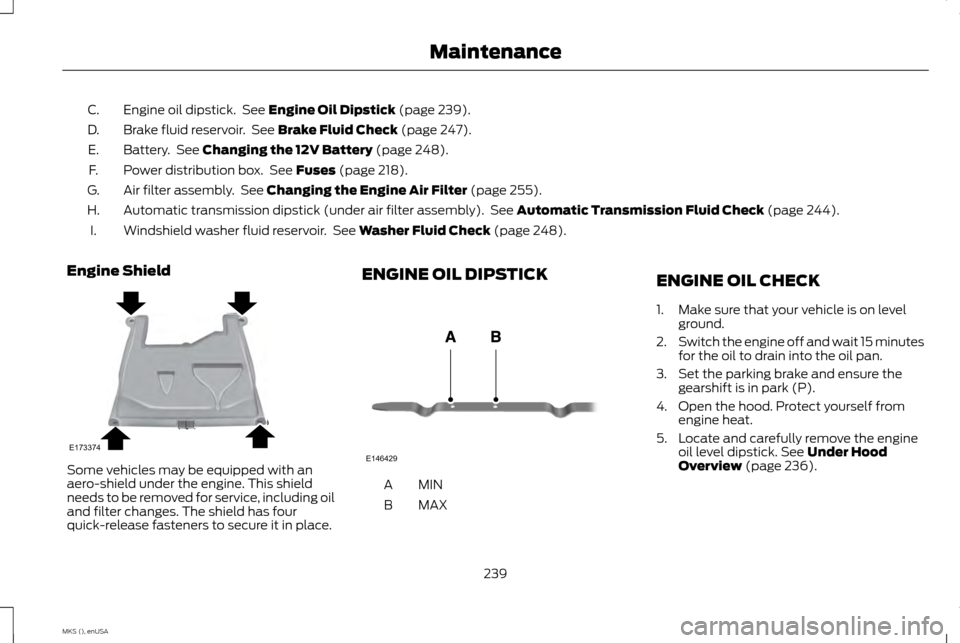
Engine oil dipstick. See Engine Oil Dipstick (page 239).
C.
Brake fluid reservoir. See
Brake Fluid Check (page 247).
D.
Battery. See
Changing the 12V Battery (page 248).
E.
Power distribution box. See
Fuses (page 218).
F.
Air filter assembly. See
Changing the Engine Air Filter (page 255).
G.
Automatic transmission dipstick (under air filter assembly). See
Automatic Transmission Fluid Check (page 244).
H.
Windshield washer fluid reservoir. See
Washer Fluid Check (page 248).
I.
Engine Shield Some vehicles may be equipped with an
aero-shield under the engine. This shield
needs to be removed for service, including oil
and filter changes. The shield has four
quick-release fasteners to secure it in place. ENGINE OIL DIPSTICK
MINA
MAX
B ENGINE OIL CHECK
1. Make sure that your vehicle is on level
ground.
2. Switch the engine off and wait 15 minutes
for the oil to drain into the oil pan.
3. Set the parking brake and ensure the gearshift is in park (P).
4. Open the hood. Protect yourself from engine heat.
5. Locate and carefully remove the engine oil level dipstick.
See Under Hood
Overview (page 236).
239
MKS (), enUSA MaintenanceE173374 E146429
Page 243 of 424
6.
Wipe the dipstick clean. Insert the dipstick
fully, then remove it again.
•If the oil level is between the lower
and upper holes, the oil level is
acceptable. DO NOT ADD OIL.
• If the oil level is below the lower hole,
add enough oil to raise the level within
the lower and upper holes.
• Oil levels above the upper hole may
cause engine damage. Some oil must
be removed from the engine by an
authorized dealer.
7. Put the oil level dipstick back into the oil dipstick tube and ensure it is fully seated.
Adding Engine Oil
Note: Do not remove the filler cap when the
engine is running.
Note: Do not remove the engine oil level
dipstick when the engine is running.
Note: Do not add oil further than the MAX
mark. Oil levels above the MAX mark may
cause engine damage. Only use oils certified for gasoline engines by
the American Petroleum Institute (API). An
oil with this trademark symbol conforms to
the current engine and emission system
protection standards and fuel economy
requirements of the International Lubricants
Specification Advisory Council (ILSAC),
comprised of U.S. and Japanese automobile
manufacturers.
1. Check the engine oil level.
2. If the engine oil level is not within the
normal range, add engine oil that meets
Ford specifications. See Capacities and
Specifications (page 290).
3. Remove the engine oil filler cap and use a funnel to pour the engine oil into the
opening. 4. Recheck the engine oil level. Make sure
the oil level is not above the normal
operating range on the engine oil level
dipstick.
5. Install the engine oil level dipstick and ensure it is fully seated.
6. Fully install the engine oil filler cap by turning the filler cap clockwise until three
clicks are heard or until the cap is fully
seated.
OIL CHANGE INDICATOR RESET
To reset the oil monitoring system after an
oil change, See General Information (page
88
).
ENGINE COOLANT CHECK WARNINGS
Do not add engine coolant when the
engine is hot. Steam and scalding
liquids released from a hot cooling
system can burn you badly. Also, spilling
coolant on hot engine parts can burn you.
240
MKS (), enUSA MaintenanceE142732
Page 265 of 424
•
Clean the wheels weekly using Motorcraft
Wheel and Tire Cleaner. Apply using
manufacturer's instructions.
• Use a sponge to remove heavy deposits
of dirt and brake dust accumulation.
• Rinse thoroughly with a strong stream of
water when you have completed the
cleaning process.
• To remove tar and grease, use Motorcraft
Bug and Tar Remover.
VEHICLE STORAGE
If you plan on storing your vehicle for 30 days
or more, read the following maintenance
recommendations to make sure your vehicle
stays in good operating condition.
We engineer and test all motor vehicles and
their components for reliable, regular driving.
Under various conditions, long-term storage
may lead to degraded engine performance
or failure unless you use specific precautions
to preserve engine components. General
•
Store all vehicles in a dry, ventilated
place.
• Protect from sunlight, if possible.
• If vehicles are stored outside, they require
regular maintenance to protect against
rust and damage.
Body
• Wash your vehicle thoroughly to remove
dirt, grease, oil, tar or mud from exterior
surfaces, rear-wheel housing and the
underside of front fenders.
• Periodically wash your vehicle if it is
stored in exposed locations.
• Touch-up exposed or primed metal to
prevent rust.
• Cover chrome and stainless steel parts
with a thick coat of auto wax to prevent
discoloration. Re-wax as necessary when
you wash your vehicle.
• Lubricate all hood, door and luggage
compartment hinges and latches with a
light grade oil.
• Cover interior trim to prevent fading.
• Keep all rubber parts free from oil and
solvents. Engine
•
Change the engine oil and filter prior to
storage because used engine oil contains
contaminates which may cause engine
damage.
• Start the engine every 15 days for a
minimum of 15 minutes. Run at fast idle
with the climate controls set to defrost
until the engine reaches normal operating
temperature.
• With your foot on the brake, shift through
all the gears while the engine is running.
• We recommend that you change the
engine oil before you use your vehicle
again.
Fuel system
• Fill the fuel tank with high-quality fuel
until the first automatic shutoff of the fuel
pump nozzle.
Cooling system
• Protect against freezing temperatures.
• When removing your vehicle from
storage, check coolant fluid level. Confirm
that there are no cooling system leaks
and that fluid is at the recommended
level.
262
MKS (), enUSA Vehicle Care
Page 395 of 424
GENERAL MAINTENANCE
INFORMATION
Why Maintain Your Vehicle?
Carefully following the maintenance
schedule helps protect against major repair
expenses resulting from neglect or
inadequate maintenance and may help to
increase the value of your vehicle when you
sell or trade it. Keep all receipts for
completed maintenance with your vehicle.
We have established regular maintenance
intervals for your vehicle based upon rigorous
testing. It is important that you have your
vehicle serviced at the proper times. These
intervals serve two purposes; one is to
maintain the reliability of your vehicle and
the second is to keep your cost of owning
your vehicle down.
It is your responsibility to have all scheduled
maintenance performed and to make sure
that the materials used meet the
specifications identified in this owner's
manual. See Capacities and
Specifications (page 290).
Failure to perform scheduled maintenance
invalidates warranty coverage on parts
affected by the lack of maintenance. Why Maintain Your Vehicle at Your
Dealership?
Factory-Trained Technicians
Service technicians participate in extensive
factory-sponsored certification training to
help them become experts on the operation
of your vehicle. Ask your dealership about the
training and certification their technicians
have received.
Genuine Ford and Motorcraft®
Replacement Parts
Dealerships stock Ford, Motorcraft and
Ford-authorized branded re-manufactured
replacement parts. These parts meet or
exceed our specifications. Parts installed at
your dealership carry a nationwide 24-month
or unlimited mile (kilometer) parts and labor
limited warranty.
If you do not use Ford authorized parts they
may not meet our specifications and
depending on the part, it could affect
emissions compliance.
Convenience
Many dealerships have extended evening and
Saturday hours to make your service visit
more convenient and they offer one stop
shopping. They can perform any services that
are required on your vehicle, from general
maintenance to collision repairs.
Note:
Not all dealers have extended hours or
body shops. Please contact your dealer for
details.
Protecting Your Investment
Maintenance is an investment that pays
dividends in the form of improved reliability,
durability and resale value. To maintain the
proper performance of your vehicle and its
emission control systems, make sure you
have scheduled maintenance performed at
the designated intervals.
Your vehicle is equipped with the Intelligent
Oil-Life Monitor system, which displays a
message in the information display at the
proper oil change interval. This interval may
be up to one year or 10000 miles (16000
kilometers).
392
MKS (), enUSA Scheduled Maintenance
Page 396 of 424
When the oil change message appears in the
information display, it is time for an oil
change. Make sure you perform the oil change
within two weeks or 500 miles (800
kilometers) of the message appearing. Make
sure you reset the Intelligent Oil-Life Monitor
after each oil change. See General
Information (page 88).
If your information display resets prematurely
or becomes inoperative, you should perform
the oil change interval at six months or 5000
miles (8000 kilometers) from your last oil
change. Never exceed one year or 10000
miles (16000 kilometers) between oil change
intervals.
Your vehicle is very sophisticated and built
with multiple, complex, performance
systems. Every manufacturer develops these
systems using different specifications and
performance features. That is why it is
important to rely upon your dealership to
properly diagnose and repair your vehicle. Ford Motor Company has recommended
maintenance intervals for various parts and
component systems based upon engineering
testing. Ford Motor Company relies upon this
testing to determine the most appropriate
mileage for replacement of oils and fluids to
protect your vehicle at the lowest overall cost
to you and recommends against
maintenance schedules that deviate from
the scheduled maintenance information.
We strongly recommend the use of only
genuine Ford, Motorcraft or Ford-authorized
re-manufactured replacement parts
engineered for your vehicle.
Additives and Chemicals
This owner's manual and the Ford Workshop
Manual list the recommended additives and
chemicals for your vehicle. We do not
recommend using chemicals or additives not
approved by us as part of your vehicle
’s
normal maintenance. Please consult your
warranty information. Oils, Fluids and Flushing
In many cases, fluid discoloration is a normal
operating characteristic and, by itself, does
not necessarily indicate a concern or that the
fluid needs to be changed. However, a
qualified expert, such as the factory-trained
technicians at your dealership, should inspect
discolored fluids that also show signs of
overheating or foreign material
contamination immediately.
Make sure to change your vehicle
’s oils and
fluids at the specified intervals or in
conjunction with a repair. Flushing is a viable
way to change fluid for many vehicle
sub-systems during scheduled maintenance.
It is critical that systems are flushed only with
new fluid that is the same as that required to
fill and operate the system or using a
Ford-approved flushing chemical.
Owner Checks and Services
Make sure you perform the following basic
maintenance checks and inspections every
month or at six-month intervals.
393
MKS (), enUSA Scheduled Maintenance
Page 399 of 424
Be sure to ask your dealership service advisor
or technician about the multi-point vehicle
inspection. It is a comprehensive way to
perform a thorough inspection of your vehicle.
Your checklist gives you immediate feedback
on the overall condition of your vehicle.
NORMAL SCHEDULED
MAINTENANCE
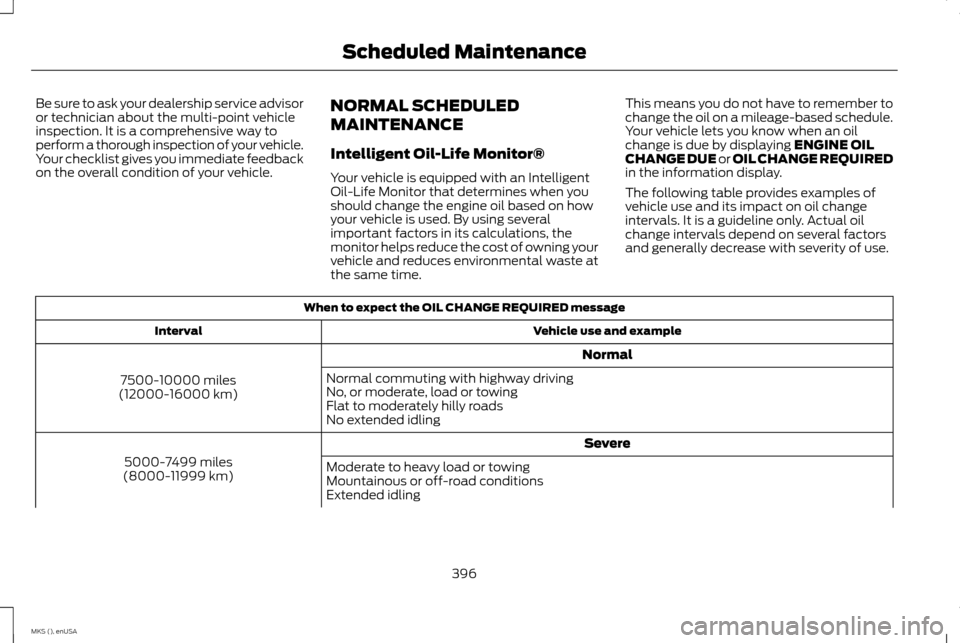
Intelligent Oil-Life Monitor®
Your vehicle is equipped with an Intelligent
Oil-Life Monitor that determines when you
should change the engine oil based on how
your vehicle is used. By using several
important factors in its calculations, the
monitor helps reduce the cost of owning your
vehicle and reduces environmental waste at
the same time.This means you do not have to remember to
change the oil on a mileage-based schedule.
Your vehicle lets you know when an oil
change is due by displaying ENGINE OIL
CHANGE DUE or OIL CHANGE REQUIRED
in the information display.
The following table provides examples of
vehicle use and its impact on oil change
intervals. It is a guideline only. Actual oil
change intervals depend on several factors
and generally decrease with severity of use. When to expect the OIL CHANGE REQUIRED message
Vehicle use and example
Interval
Normal
7500-10000 miles
(12000-16000 km) Normal commuting with highway driving
No, or moderate, load or towing
Flat to moderately hilly roads
No extended idling
Severe
5000-7499 miles
(8000-11999 km) Moderate to heavy load or towing
Mountainous or off-road conditions
Extended idling
396
MKS (), enUSA Scheduled Maintenance
Page 400 of 424
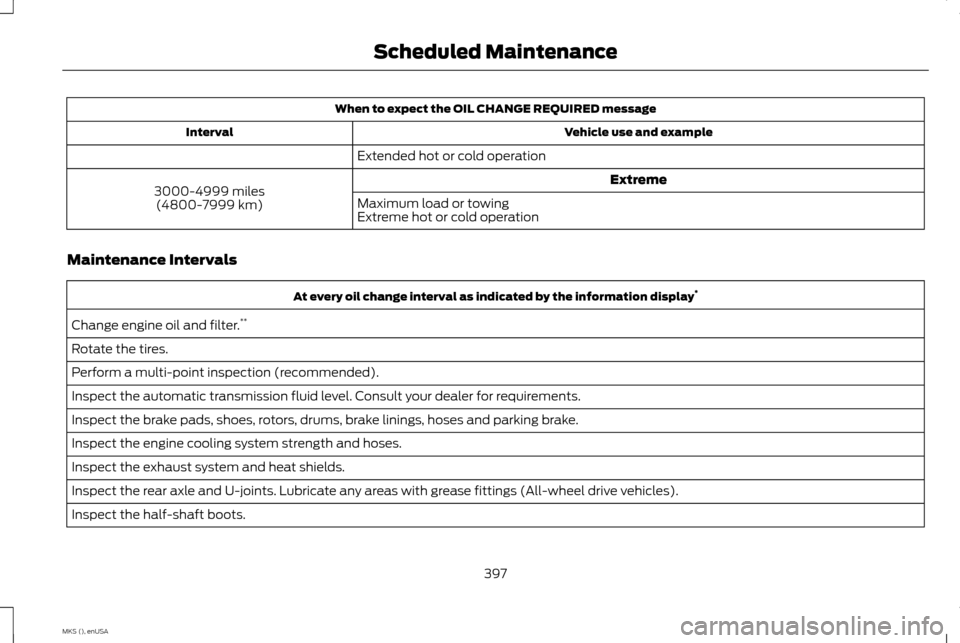
When to expect the OIL CHANGE REQUIRED message
Vehicle use and example
Interval
Extended hot or cold operation Extreme
3000-4999 miles
(4800-7999 km) Maximum load or towing
Extreme hot or cold operation
Maintenance Intervals At every oil change interval as indicated by the information display
*
Change engine oil and filter. **
Rotate the tires.
Perform a multi-point inspection (recommended).
Inspect the automatic transmission fluid level. Consult your dealer for requirements.
Inspect the brake pads, shoes, rotors, drums, brake linings, hoses and parking brake.
Inspect the engine cooling system strength and hoses.
Inspect the exhaust system and heat shields.
Inspect the rear axle and U-joints. Lubricate any areas with grease fittings (All-wheel drive vehicles).
Inspect the half-shaft boots.
397
MKS (), enUSA Scheduled Maintenance